
Absolutely! You can most certainly scuba dive with manta rays, and if you ask any diver who’s done it, they’ll tell you it’s an experience that will stick with you forever. This isn't just another notch on your dive belt; it's a genuine, soul-stirring encounter with one of the ocean's most intelligent and graceful giants.
Your Guide to Diving with Manta Rays
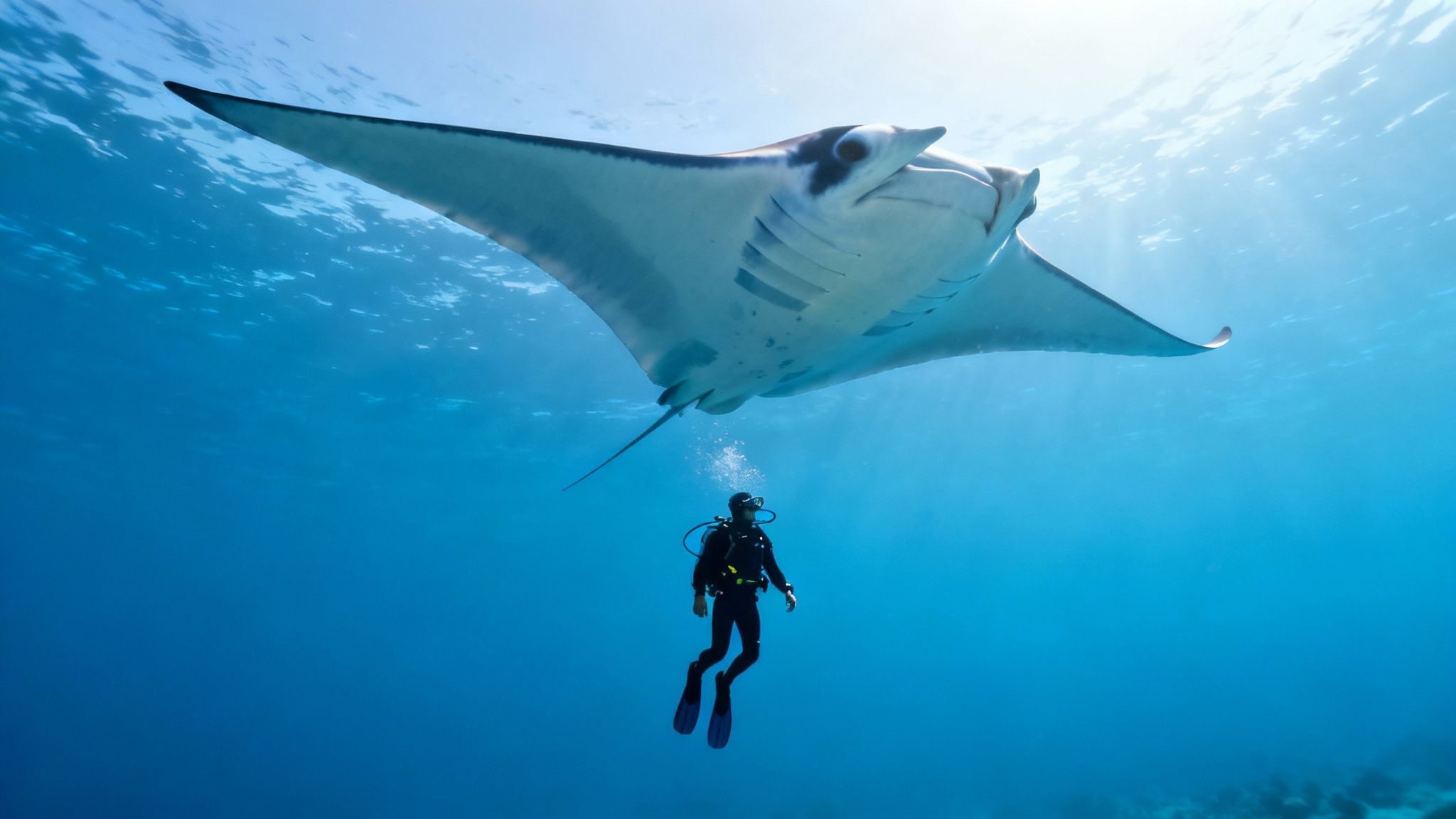
Picture a creature with a wingspan wider than a car, soaring through the water just inches above your head. That's what's waiting for you. This guide is here to take you beyond a simple "yes" and show you exactly how to turn that incredible image into a real memory. We'll dive into the best spots on the planet for reliable sightings, talk about the gentle nature of these animals, and go over the simple "rules of the road" for a safe and respectful encounter.
Diving with mantas is not only possible but incredibly popular in some of the world's most beautiful dive destinations. Certain spots have become legendary for their consistent manta action, giving divers a front-row seat to an incredible underwater ballet. Take Hanifaru Bay in the Maldives, for example, which is famous for its massive feeding frenzies where hundreds of mantas gather in a plankton-rich soup. You can explore more of the world's top manta ray diving spots on PADI.com to see just how many options there are.
Key Considerations For Your Dive
Perhaps the most famous manta experience of all is the Kona Manta Ray Night Dive on the Big Island of Hawaii. This dive is truly one-of-a-kind. It's an underwater spectacle that feels almost staged because the encounters are so close and consistent, happening almost every single night of the year.
To get your planning started, here’s a quick look at the essentials for any manta ray dive.
Manta Ray Diving At A Glance
This table gives you a quick summary of the key things to think about when you're getting ready for this incredible adventure.
| Consideration | Key Information |
|---|---|
| Best Time to Go | Varies by location, but Kona, Hawaii, offers year-round sightings. |
| Certification Level | Open Water certification is usually sufficient for most sites. |
| Essential Skills | Excellent buoyancy control is the most critical skill to have. |
| Safety | Manta rays are harmless, with no teeth, stingers, or barbs. |
| Ethical Rules | The primary rule is passive observation—never touch the mantas. |
Thinking through these points will help ensure your trip is smooth, safe, and utterly unforgettable.
Our goal here isn’t just to help you see a manta ray. It’s to prepare you to have a meaningful, responsible, and truly awesome experience with these magnificent animals.
Meet the Gentle Giants of the Ocean
Before you jump in the water to scuba dive with manta rays, it really helps to get to know them a little better. Forget what you think you know about "rays." These aren't just big fish; they're more like the intelligent, curious birds of the sea, gliding effortlessly through the water. Their size can be a bit breathtaking at first, but you’ll quickly see they’re incredibly gentle.
You're likely to cross paths with one of two different species on your dives, and knowing which is which makes the encounter even more thrilling.
Types of Manta Rays
- Oceanic Manta Rays (Mobula birostris): These are the true titans of the manta world. We're talking about incredible wingspans of up to 23 feet (7 meters). They’re true globetrotters, migrating across vast stretches of open ocean, which makes any sighting a truly rare and unforgettable moment.
- Reef Manta Rays (Mobula alfredi): While a bit smaller, reef mantas are still seriously impressive, with wingspans reaching up to 18 feet (5.5 meters). They prefer to stick closer to coastal areas and are the stars of the show at famous spots like the Kona Manta Ray Night Dive.
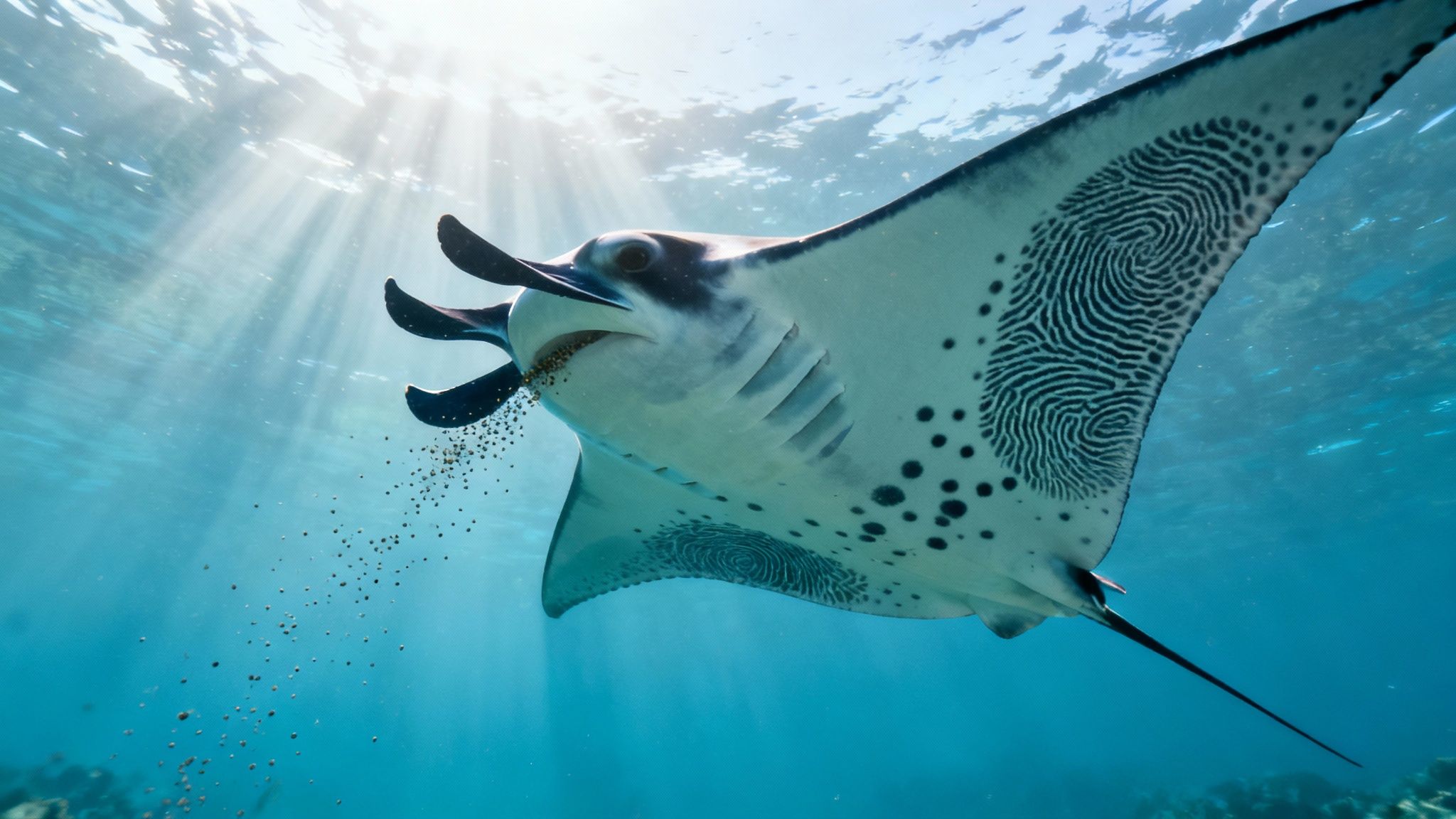
Don't let their massive size fool you—both species are completely harmless. They're filter feeders, dining on microscopic zooplankton. To eat, they unfurl two special fins on either side of their head, called cephalic fins, which act like funnels to guide plankton-filled water into their mouths. They have no teeth, no stinger, no barb. Just pure grace.
One of the coolest things about manta rays? Every single one has a unique pattern of spots on its belly. It's just like a human fingerprint. This allows scientists and even sharp-eyed divers to identify individuals, track their travels, and help protect their populations.
Deep Divers and Navigators
Oceanic mantas aren’t just big; they're also master navigators. It turns out they’re capable of some seriously deep dives, plunging to depths of over 1,200 meters (that's nearly 4,000 feet!). A decade-long study tracking their movements found that these deep dives weren't about finding food. Instead, it’s believed they use them to navigate across hundreds of miles of open ocean. You can read more about these fascinating oceanic manta ray navigation findings on Discover Wildlife.
Unfortunately, manta rays are listed as vulnerable, facing threats from overfishing and getting tangled in fishing gear. This reality makes every encounter we have with them even more precious. When you choose responsible tour operators, you're doing more than just going for a dive; you're supporting an industry that gives local communities a powerful reason to protect these magnificent animals. Knowing a bit about their world transforms your dive from a cool adventure into a real connection with one of the ocean's most majestic creatures.
Discover the World’s Best Manta Ray Dives
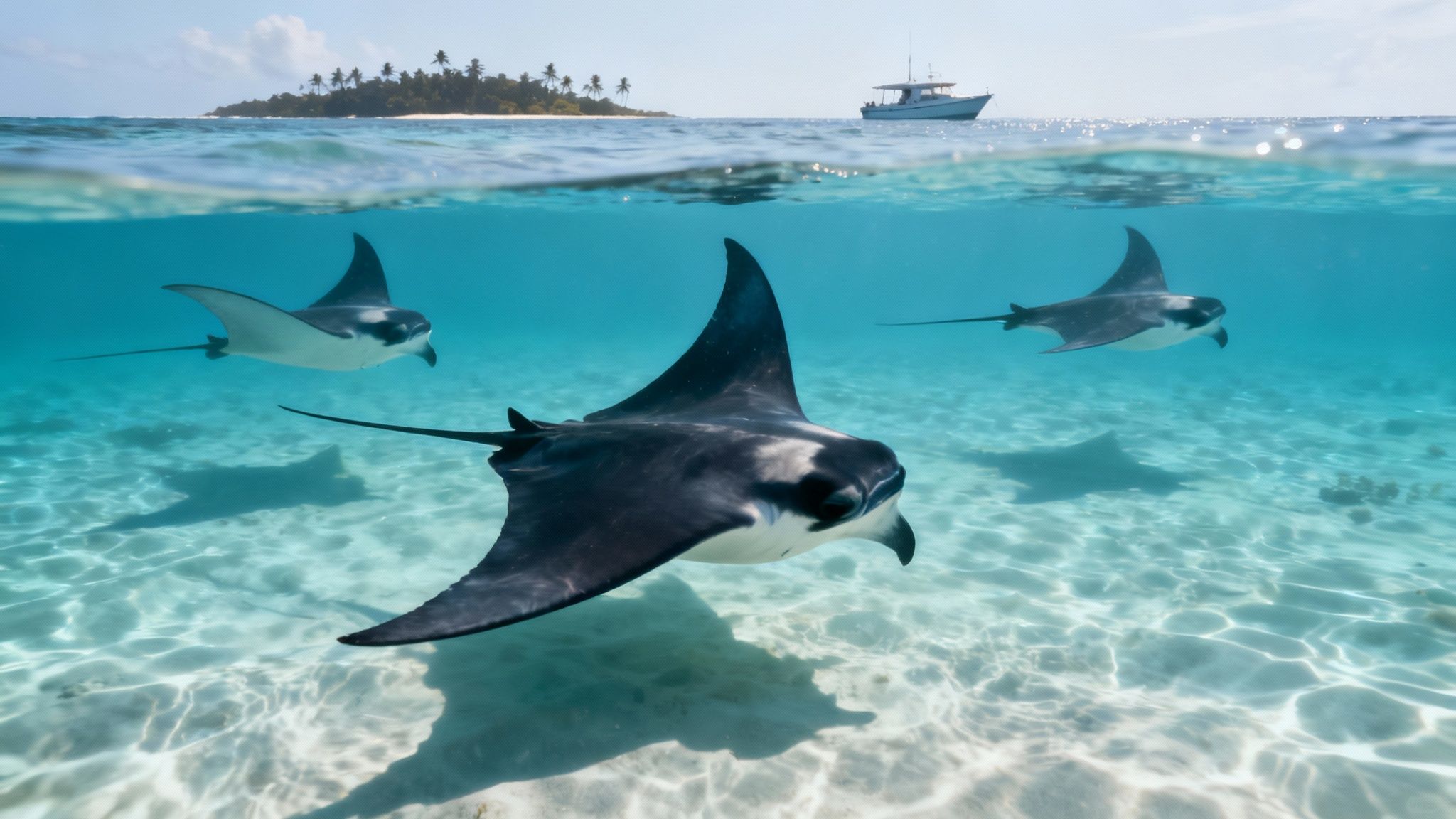
Alright, now that you know a bit more about these incredible animals, let's get to the fun part: planning your own manta ray adventure. When divers ask me, "can you really scuba dive with manta rays?" their eyes light up when I tell them just how many reliable hotspots there are across the globe.
From the warm, clear waters of the Pacific to the teeming reefs of the Indian Ocean, each destination offers a totally unique and unforgettable underwater show.
Let's kick things off with the absolute crown jewel of manta encounters: Kona, Hawaii. The Big Island is world-famous for its legendary Manta Ray Night Dive, and for good reason. It’s a surreal experience that feels more like an underwater ballet than a dive.
The setup is brilliant in its simplicity. Dive operators place powerful lights on the ocean floor, which attract huge clouds of plankton. This, in turn, acts like a dinner bell for Kona's resident reef mantas, drawing them in for a spectacular feeding frenzy right over your head.
To experience this iconic dive, you'll want to go with a top-notch operator. Companies like Kona Honu Divers have built a stellar reputation for running safe, educational, and genuinely awe-inspiring trips, giving you a front-row seat to one of nature's greatest performances.
A Global Tour of Manta Hotspots
While Kona is a bucket-list dive for many, the world is dotted with other amazing places to see mantas. Each spot offers a different kind of encounter, perfect for different skill levels and travel styles.
- The Maldives: Hanifaru Bay, a UNESCO Biosphere Reserve, is the stuff of legends. During the monsoon season (usually May to November), you can witness massive feeding aggregations where hundreds of mantas create a swirling vortex. It’s mind-blowing.
- Socorro Island, Mexico: If you're looking for giants, this is your place. Part of the remote Revillagigedo Archipelago, Socorro is a magnet for massive oceanic mantas. These are deep, blue-water dives best for experienced divers, but the payoff is an encounter you'll never forget.
- Indonesia: The vibrant waters of Indonesia, from Komodo National Park to Raja Ampat, are home to countless manta cleaning and feeding stations. Manta Point in Komodo is a classic, where you can reliably watch mantas getting a full-service grooming from smaller reef fish.
- Australia: On the Great Barrier Reef, Lady Elliot Island is known as the "Home of the Manta Ray." You can find them here year-round, but the action really picks up during the Australian winter.
The Largest Manta Population on Earth
Just when we thought we had the manta map figured out, a groundbreaking discovery changed everything. Researchers have identified the world's largest known population of oceanic manta rays right off the coast of Ecuador.
Scientists have cataloged over 2,800 individual rays in this area, with estimates suggesting the total population could be a staggering 22,000. This incredible gathering is all thanks to nutrient-rich upwellings that create an all-you-can-eat plankton buffet. You can dive into the science behind this on the Manta Trust's website.
Ultimately, picking the right spot comes down to what you're looking for. Do you want the guaranteed spectacle of a night dive, a remote blue-water adventure, or a bustling reef ecosystem?
For those set on Hawaii, our guide on where to see manta rays in Hawaii breaks down all the best locations. Still, the Kona Manta Ray Dive stands out as one of the most accessible and consistently amazing wildlife encounters on the planet.
Preparing for Your Manta Ray Encounter
A good dive starts long before you hit the water. It begins with preparation. And when it comes to diving with manta rays, there's one skill that matters more than anything else.
The great news is you don’t need a logbook filled with hundreds of dives. Most manta encounters, including the world-famous Kona Manta Ray Night Dive, are open to anyone with a standard Open Water certification. This incredible spectacle is surprisingly accessible.
But there’s a catch. You absolutely must have excellent buoyancy control. That's the non-negotiable part. Your goal is to be a silent, floating observer in their world, not a clumsy intruder.
Mastering Your Position in the Water
Picture this: you're settled on the ocean floor, or hovering mid-water, and these gentle giants are gliding inches above your head. You'll need to stay completely still, sometimes in a bit of current, without kicking up a sandstorm or bumping into the reef. More importantly, you can never, ever touch a manta ray.
Good buoyancy allows you to hold your spot, relax, and just let the show unfold. The mantas get curious and come to you, which is exactly the kind of magic you're there for.
If it's been a while since you were last in the water, or you know your buoyancy is a little shaky, do yourself a favor and book a refresher course. It's a small step that makes a world of difference in your confidence and how much you'll enjoy the main event.
Ready to take it to the next level? An advanced certification is your key to unlocking more adventurous sites, whether it's on the Big Island or in far-flung destinations like Socorro Island. An advanced dive tour opens up deeper dives and more challenging conditions, which is where some truly epic encounters happen.
Gear and Photography Pointers
Besides your usual scuba kit, a couple of extra items will make your manta dive—especially a night dive—even better.
- A Solid Dive Light: On a night dive, this is more than just a light; it's the beacon that attracts the plankton the mantas feed on. Make sure it's fully charged, and maybe even bring a backup.
- Camera Smarts: Of course, you’ll want to capture the moment. Just be smart about it. Big, clunky camera rigs can be a hazard, and you don't want to accidentally bump a manta. Let them approach you. And never chase an animal for a better shot or use a powerful strobe that could startle them.
In the end, the best preparation is a calm, respectful attitude. Dial in your buoyancy, bring the right gear, and get ready for an underwater experience that will stick with you for a lifetime.
How to Interact Safely and Ethically with Manta Rays
When you dive with manta rays, you’re stepping into their world as a guest. The absolute most important rule is passive observation. We're there to witness their incredible grace, not to interfere. This is the cornerstone of a safe and ethical encounter, and it’s how we ensure these animals are protected for generations to come.
This means no touching, no chasing, and never blocking a manta’s path. Think of their skin as being covered in a delicate, protective slime coat—almost like a layer of aloe vera. Touching them can strip this layer away, leaving them vulnerable to nasty bacterial infections.
The Golden Rules of Manta Interaction
To make sure the experience is amazing for both you and the mantas, a few simple rules go a long way. Keeping your behavior calm and predictable is the secret to having these gentle giants feel comfortable enough to come close.
Here’s a quick guide to what you should and shouldn't do when you're in the water with them.
Manta Ray Interaction Do's and Don'ts
| Do | Don't |
|---|---|
| Stay on or near the seabed during night dives. | Float up into the water column where mantas are feeding. |
| Point your dive light straight up towards the surface. | Shine your light directly into a manta's eyes. |
| Keep your movements slow, calm, and predictable. | Chase after or try to "ride" a manta ray. |
| Let the mantas approach you on their terms. | Reach out and touch a manta as it passes by. |
| Remain still and enjoy the show. | Block a manta's natural swimming path. |
Following this simple etiquette isn't just about protecting the animals; it also dramatically improves your own experience. When mantas don't feel threatened, they put on their most spectacular and breathtaking show.
To dive deeper into this topic, you can explore the principles of responsible and considerate diver etiquette, which help protect all marine ecosystems. Your mindful approach is what guarantees the future of incredible wildlife encounters like this one.
The World-Famous Kona Manta Ray Night Dive
If you want to talk about unforgettable underwater experiences, let’s go straight to the top. The Kona Manta Ray Night Dive isn't just a dive; it's a world-renowned spectacle often listed as one of the top ten dives on the planet. When people ask, "Can you scuba dive with manta rays?" Kona offers the definitive answer. Here, you don't just glimpse them—you become a front-row guest at their nightly feast.
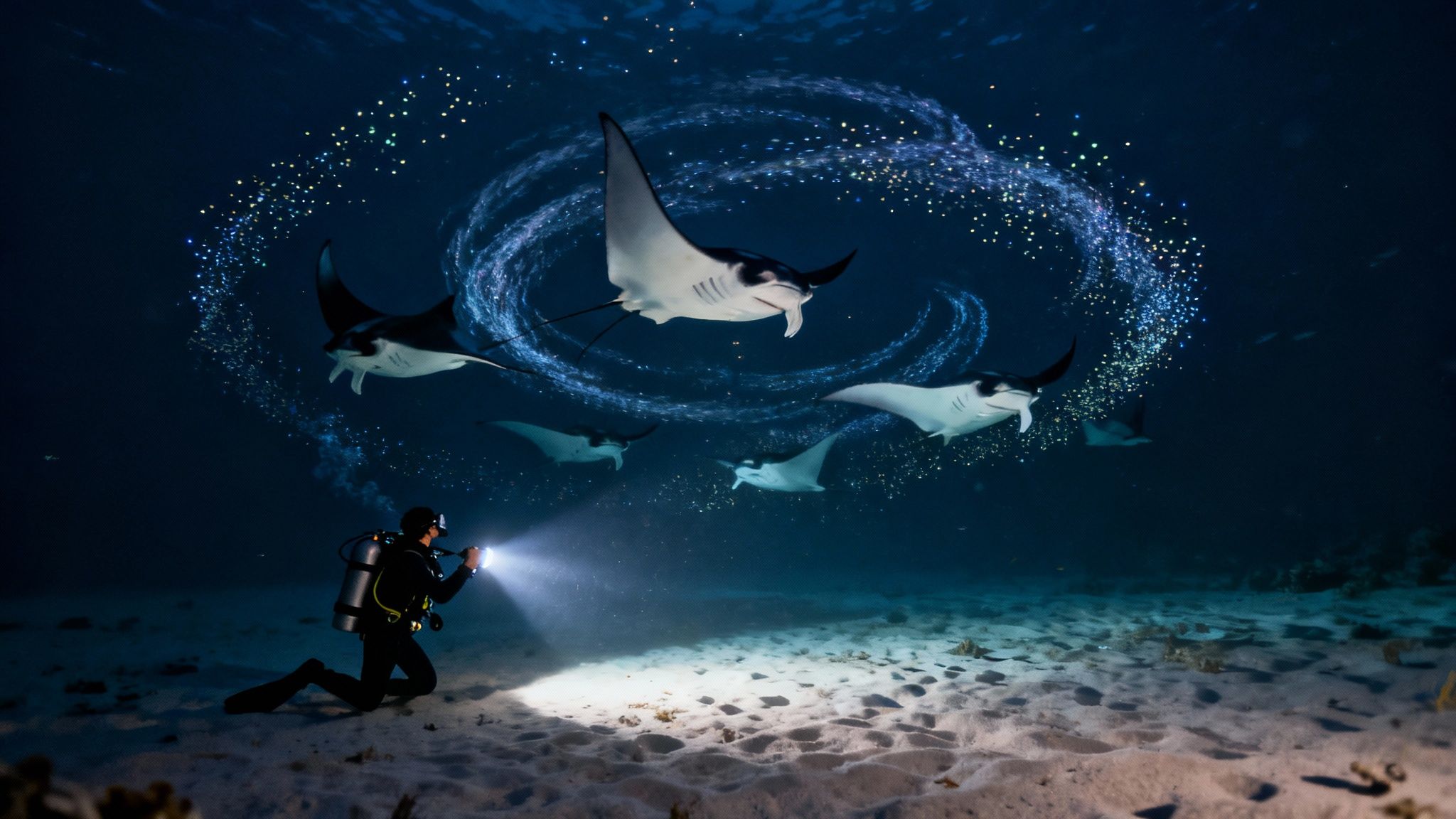
The concept behind this dive is pure genius. Dive operators set up a ring of powerful, stationary lights on the ocean floor, creating what we affectionately call the "campfire." This intense light attracts massive clouds of plankton, which is basically ringing the dinner bell for Kona's resident population of reef mantas.
As a diver, your role is simple. You descend just as the sun sets, find a spot on the sand among the other divers, point your personal dive light straight up, and wait for the show to begin.
An Underwater Ballet Unfolds
And what a show it is. Out of the dark, these gentle giants appear, some with wingspans stretching 12 feet or more. They glide into the beams of light and perform these incredible, acrobatic barrel rolls, scooping up mouthfuls of plankton. It's not uncommon for them to soar just inches above your head.
The whole experience is completely peaceful and mesmerizing. You're just watching this silent, underwater ballet unfold right in front of you, with the mantas choreographing the entire thing. This isn't some lucky, one-off encounter. It’s one of the most reliable big-animal dives in the world, with a success rate of over 90%. Operators like Kona Honu Divers have spent years perfecting this experience to ensure it’s not only breathtaking for us but also safe and respectful for the mantas.
Why Kona's Dive Is So Special
Many manta dives around the world happen at "cleaning stations," where you see mantas holding still while smaller fish clean them. That's cool, but the Kona dive is different. Here, you get to witness their natural feeding behavior up close and personal.
Seeing them so active and dynamic is what truly sets this dive apart. It's a chance to observe their intelligence and sheer grace in a way you just can't anywhere else. For a full rundown of what makes this adventure so special, check out our detailed guide to the Kona manta dive.
Of course, the mantas are just one piece of the incredible scuba diving the Big Island has to offer. The island offers everything from vibrant reef explorations to the unique thrill of open-ocean Blackwater Dives.
To get a feel for everything the island has to offer, it's worth exploring all the Kona diving tours available. But if you have to pick just one, this world-class manta dive is an accessible, awe-inspiring adventure that absolutely belongs on every diver's bucket list.
Your Manta Ray Dive Questions, Answered
Even the most seasoned diver has questions before jumping in on a new adventure. It's totally normal! Let's clear up a few of the most common things people ask before they book their trip, so you can feel completely prepared for what's sure to be an unforgettable experience.
Are Manta Rays Dangerous?
Let me put this one to rest right away: absolutely not. Manta rays are famously gentle giants. They're filter-feeders, meaning they glide through the water with their mouths open to eat tiny plankton.
They have zero teeth, no stingers, and no barbs like their stingray cousins. The only "risk" is the slim chance of an accidental bump if a manta gets a little too close, which is exactly why it's so important to listen to your guide and stay in your designated spot.
When Is the Best Time to See Manta Rays in Kona?
This is the best part—you can see them all year round! Kona is blessed with a healthy, resident manta population that shows up to the "dinner table" night after night. This consistency makes the Kona Manta Ray Dive one of the most reliable big-animal encounters on the planet.
While any month is a great month for mantas, the summer often gives us the calmest and flattest ocean conditions, which can make for a slightly more comfortable boat ride.
What Certification Do I Need for the Kona Manta Ray Dive?
You don't need to be a master diver for this one. An Open Water Diver certification from PADI (or an equivalent from another agency) is all that's required to join the fun.
The dive itself isn't particularly deep. The most important skills you'll want to have dialed in are good buoyancy control and feeling comfortable in the dark. If you can hold your position in the water without sinking or floating up, you're golden.
Here at Kona Honu Divers, we live and breathe this stuff. Our crew is obsessed with making sure you have a safe, thrilling, and truly memorable time with these incredible animals. We've got your back every step of the way.