
So, can you actually scuba dive with manta rays? The short answer is a resounding yes. But that simple “yes” doesn’t even begin to capture the experience.
This isn't just another dive. It’s a chance to witness one of the ocean's most profound and memorable encounters. Picture it: you're weightless underwater as these gentle giants, with wingspans stretching over 20 feet, glide effortlessly around you. It's less of a dive and more of a silent, underwater ballet.
Your Complete Guide to Diving with Manta Rays
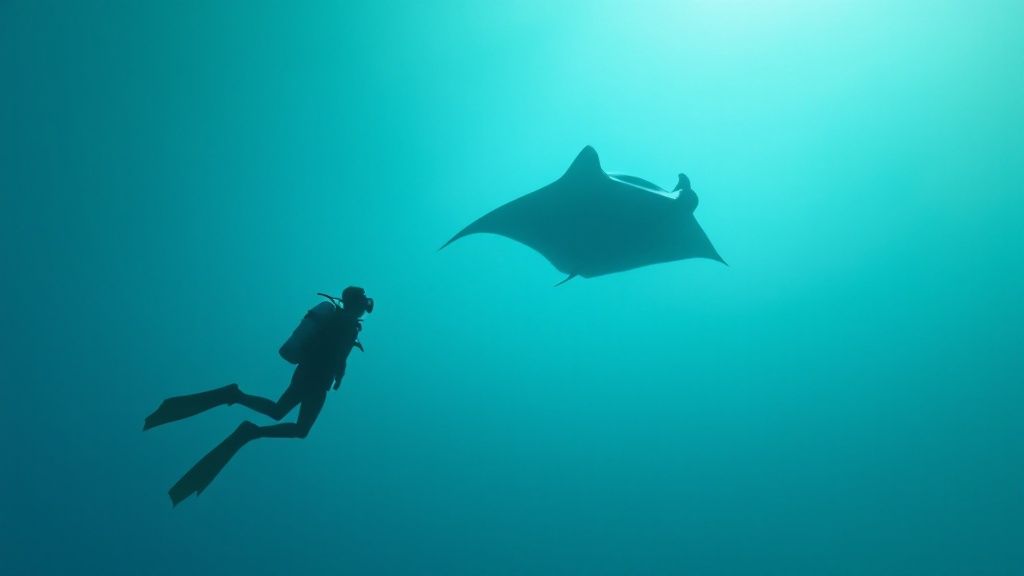
This guide is built to turn that dream into a reality. We're going to break down everything you need to know, from the basics of manta behavior to the best dive spots on the planet. You'll quickly see why this has become a bucket-list item for divers everywhere, and how places like Kona, Hawaii, offer reliable, almost magical encounters.
What makes diving with mantas so special? It's their sheer size, their effortless grace, and their surprising intelligence. Unlike a lot of big marine animals, they are completely harmless to people—they have no stinger and no teeth. In fact, their natural curiosity often brings them incredibly close to divers, creating a powerful connection that stays with you long after you surface.
Before we jump in, here's a quick overview of what you can expect on a manta dive.
| Manta Ray Dive Quick Facts | |
|---|---|
| Key Consideration | Details |
| Best For | Certified Open Water divers and above. Some night dives may require an Advanced certification. |
| Manta Size | Reef mantas can have wingspans up to 18 feet, while Giant Oceanic mantas can exceed 23 feet. |
| Temperament | Gentle, curious, and non-aggressive. They have no teeth or barbs. |
| Typical Depth | Usually shallow, between 25-45 feet, as they feed on plankton near the surface. |
| Dive Type | Often stationary dives, especially at night. Divers remain in one spot while mantas feed around them. |
| Key Rule | Look, but don't touch. Passive observation is critical for the mantas' safety. |
This table gives you the essentials, but there's so much more to know to make your experience truly incredible.
What to Expect from This Guide
To get you ready for this adventure, we’ll cover all the essentials. This way, your dive will not only be breathtaking but also safe and respectful for these amazing animals.
Here’s a look at what we’ll cover:
- Understanding Manta Behavior: We'll dive into who these gentle giants are, what they eat, and why they're so peaceful around divers.
- Top Global Dive Destinations: I’ll share my picks for the world's premier locations for manta encounters, with a special focus on the legendary Kona, Hawaii.
- Responsible Diving Practices: You'll learn the do's and don'ts of interacting with mantas to protect them and their fragile environment.
- The Kona Manta Ray Night Dive: We'll take an inside look at one of the most famous and spectacular night dives on the entire planet.
It all starts with the fundamentals. Once you understand the basics, you can fully appreciate the majesty of these creatures when you finally meet them face-to-face. For anyone feeling the pull of the Big Island, a great first step is to explore the variety of Kona, Hawaii diving tours available.
Ready? Let's dive in and get you prepped for an unforgettable experience.
Understanding the Gentle Giants of the Sea
Before you ever hit the water, it's worth getting to know the incredible animals you're hoping to meet. The most important thing to understand right off the bat is that manta rays are incredibly gentle creatures. It's a common mistake to lump them in with their stingray cousins, but that couldn't be further from the truth.
Manta rays are completely harmless to people. They don't have a stinger, a barb, or any teeth meant for more than filtering tiny organisms from the water. Think of them as the ocean's massive, graceful vacuum cleaners, gliding effortlessly while they scoop up huge amounts of plankton. We go into a lot more detail on this in our article that answers the question, "can manta rays sting you?".
More Than Just a Big Fish
What really makes manta rays special is their mind-blowing intelligence. They actually have the largest brain-to-body size ratio of any cold-blooded fish. This isn't just for show; they display complex social behaviors, impressive problem-solving skills, and even what some scientists believe is a form of self-awareness.
So, when you dive with manta rays, you’re not just passively observing wildlife. You're sharing the water with a highly intelligent and curious being.
On top of that, every single manta is unique. They can be identified by the one-of-a-kind pattern of spots on their bellies.
These spots are like a human fingerprint. The markings are permanent and let researchers identify, track, and get to know individual mantas over their entire lives, which has been a game-changer for conservation efforts.
This means your dive isn't just a generic tour. You might be meeting a well-known local with a name, a history, and a distinct personality.
Two Main Types of Manta Rays
When divers talk about manta encounters, they're usually referring to one of two distinct species. Knowing the difference can make your dive that much richer.
- Reef Manta (Mobula alfredi): This is the type you're most likely to meet, especially in famous coastal spots like Kona, Hawaii. They're a bit smaller, with an average wingspan of 11 to 15 feet, and they tend to stick to familiar home territories.
- Giant Oceanic Manta (Mobula birostris): Just like the name implies, these are the largest rays on the planet. Their wingspans can stretch over an incredible 23 feet! As open-ocean travelers, they cover huge distances and are a much rarer, truly special sight for divers.
Getting a handle on these basics will completely change your experience. You won't just see a big fish; you'll appreciate the gentle nature, the keen intelligence, and the unique identity of every ray you see. It’s this deeper understanding that turns a cool dive into a truly unforgettable connection.
Discovering Global Manta Ray Hotspots
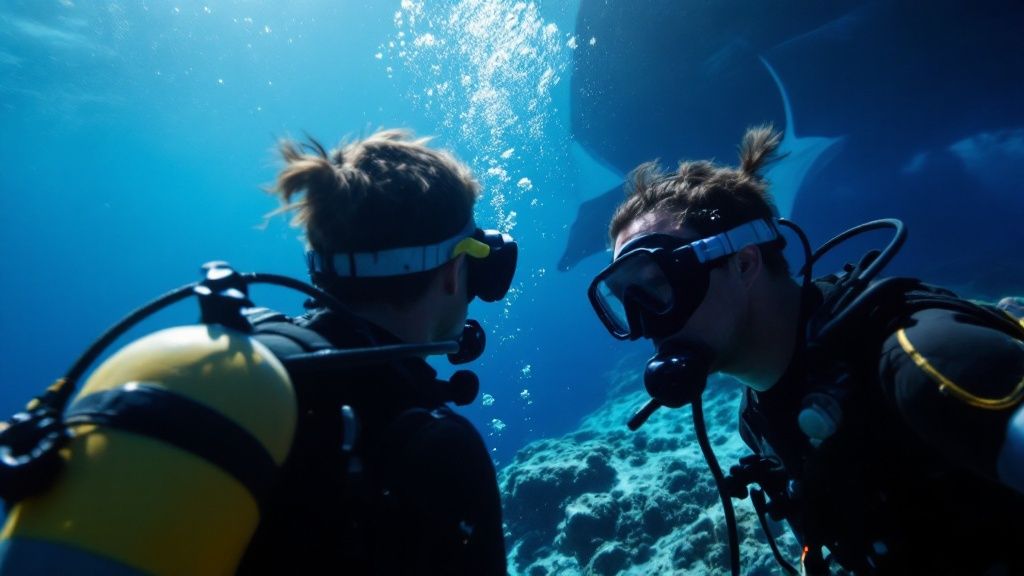
Alright, you’ve got the basics down, so let's get to the exciting part: deciding where in the world you'll go to meet these gentle giants. Diving with manta rays has exploded in popularity, and for good reason. It’s an unforgettable experience, and a handful of spots around the globe have become legendary for their reliable encounters.
The boom in manta tourism has even fueled some fascinating research. One global survey of divers tallied a minimum of 5,802 individual rays, with the vast majority spotted in just a few key locations. If you're curious about the data behind dive tourism, the National Center for Biotechnology Information website has some great information.
While you can find mantas in tropical waters worldwide, a few destinations offer something truly special.
Top Destinations for Manta Ray Dives
Ask any seasoned diver about their manta ray wishlist, and you'll likely hear the same few names pop up again and again. These are the places that offer not just a chance encounter, but a front-row seat to incredible natural behaviors.
Here are some of the most celebrated manta ray hotspots on the planet:
- Baa Atoll, Maldives: This UNESCO Biosphere Reserve is a must-see during the southwest monsoon (May to November). Plankton gets concentrated in the atoll, and hundreds of mantas show up for the feast. It's a true spectacle.
- Raja Ampat, Indonesia: Famous for its mind-blowing biodiversity, Raja Ampat is home to both reef and the larger oceanic mantas. The big attraction here are the "cleaning stations"—coral heads where mantas line up to let little fish pick off their parasites.
- Lady Elliot Island, Australia: Right on the Great Barrier Reef, this spot offers solid manta encounters all year. The action really picks up in the winter months (May to August) when large groups of rays congregate.
While these destinations are all world-class, there's one place that consistently delivers an experience so unique and reliable it's in a league of its own: Kona, Hawaii.
Kona: The Manta Ray Capital of the World
When it comes to guaranteed manta ray encounters, nowhere on Earth beats Kona on the Big Island of Hawaii. The secret is a one-of-a-kind night dive often called the "manta campfire."
Here’s how it works: Dive operators set up powerful lights on the ocean floor, which attract swarms of plankton—a manta’s favorite meal. Before you know it, the local reef mantas arrive for the all-you-can-eat buffet. They swoop and perform graceful barrel rolls right over your head to scoop up the food. It's a ballet of giants, and it happens almost every single night.
You can learn more about this incredible night dive and other local viewing spots in our guide on where to see manta rays in Hawaii.
The Kona experience is so dependable that it has become a true bucket-list dive. If you're ready to see the magic for yourself, the Kona Manta Ray Dive is something you absolutely have to do.
How to Be a Responsible Manta Ray Diver
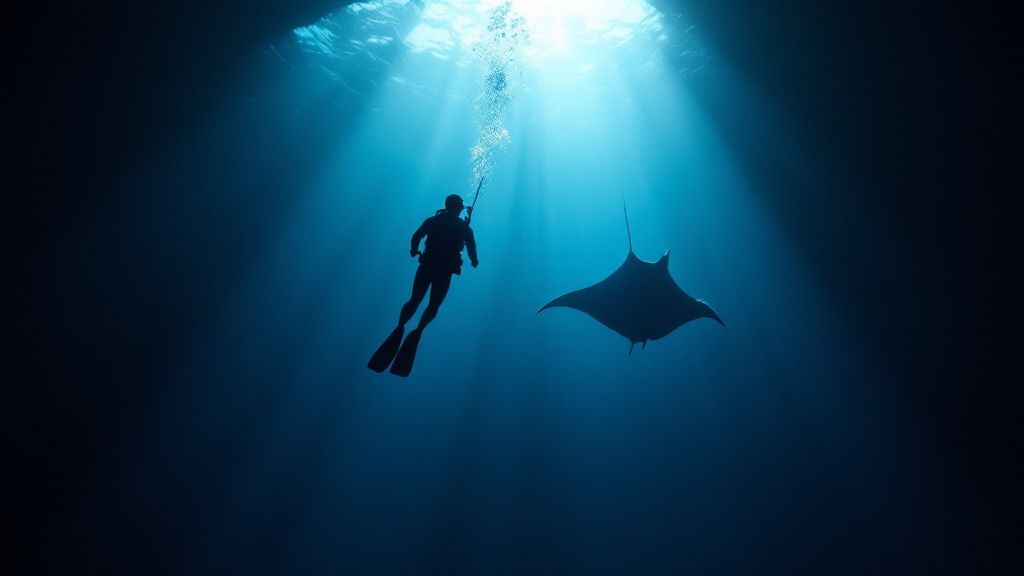
Sharing the water with wildlife as magnificent as manta rays is a profound privilege, and with that privilege comes a great responsibility. The golden rule for any manta dive is simple: passive interaction.
Think of it as being a polite guest in their underwater home. Your job is to observe, not to interfere. This simple concept means you let the mantas control the entire encounter. When you remain calm and respectful, they feel safe, which often means they’ll come closer and stick around for much longer.
The Dos and Don'ts of Manta Ray Encounters
To keep both yourself and these gentle giants safe, every diver needs to follow a clear code of conduct. These aren't just suggestions—they are absolutely essential for protecting the manta populations we are so lucky to visit.
Here are the most critical rules to follow:
- Do Maintain a Safe Distance: Give the mantas plenty of room to move freely. Never block their path or hover directly above or below them, as this can get in the way of their feeding.
- Don't Touch the Manta Rays: This is the single most important rule. Manta rays are covered in a protective mucous layer that acts like a shield against infection. Touching them can strip this layer away, leaving them vulnerable to disease.
- Do Keep Your Movements Slow and Calm: No sudden moves, frantic kicking, or splashing. Smooth, deliberate actions help you blend into the background and keep the animals from getting spooked.
- Don't Chase the Mantas: Never, ever pursue a manta ray. Chasing causes them stress and will almost certainly make them flee, ruining the experience for everyone and potentially scaring them away from the site for good.
This isn't just anecdotal advice; scientific research backs it up. A study on Caribbean manta rays found that when divers were passive, 88% of mantas that were initially evasive calmed down and began swimming in a more relaxed, directional way. In contrast, when divers were active and intrusive, 96% of mantas stayed evasive and tried to escape.
Your behavior directly impacts the manta's well-being and the quality of the dive. By being a calm observer, you contribute to a positive and sustainable interaction that allows these animals to thrive.
These interactions are a huge deal, contributing an estimated $140 million to the global economy each year from over one million divers.
Choosing a Responsible Dive Operator
Your choice of dive company is just as important as your own behavior in the water. A good operator is a champion for conservation. They will strictly enforce these guidelines, give you a thorough briefing, and always prioritize the well-being of the mantas over getting a photo.
To be a truly responsible manta diver, you have to see the bigger picture of marine protection. Supporting operators committed to sustainability is a powerful way to vote with your wallet and ensure these incredible encounters are possible for future generations. You can learn more about broader conservation efforts and see how small actions can lead to a healthier ocean. By following these practices, you go from being just a tourist to a true advocate for marine life.
The Unforgettable Kona Manta Ray Night Dive
You can find incredible spots to dive with mantas all over the world, but the legendary Kona Manta Ray Night Dive is truly in a league of its own. It’s more than just a dive—it’s an underwater ballet, a spectacle that unfolds right in front of you. For many divers, this single experience is the definitive answer to the question, "can you scuba dive with manta rays?".
Picture this: you descend into the warm, dark Pacific just as the last bit of sunlight disappears. Your group follows the divemaster down to a sandy spot on the ocean floor, usually around 35 feet deep. Once everyone is settled in, the dive team strategically places powerful lights in the center of the group, aiming the beams straight up toward the surface.
This setup creates what the locals affectionately call the "manta campfire."
The Magic of the Manta Campfire
That brilliant column of light acts like a giant magnet for microscopic plankton, drawing in a thick, swirling cloud of them. And wherever you find a plankton buffet, the manta rays are never far behind.
The show starts subtly. You might catch a fleeting shadow at the edge of your vision. Then, the real magic begins. One by one, giant manta rays emerge from the darkness, drawn to the feast. They swoop in, performing graceful, acrobatic barrel rolls just inches above your head, their huge mouths wide open to filter the plankton from the water. It’s an intimate and breathtaking performance that feels both surreal and deeply personal.
To get a full picture of what this dive is all about, you can learn more about the complete Kona Manta Ray Night Dive experience.
Safety and Expertise with Kona Honu Divers
An experience this special demands a serious commitment to safety and respect for the animals. Top-tier operators like Kona Honu Divers have perfected this dive over many years, ensuring a spectacular and responsible encounter for everyone. Their expert divemasters give thorough briefings and manage the entire dive flawlessly, so all you have to do is relax and soak in the wonder.
Their deep knowledge of the local manta population and dedication to passive interaction means the animals are never stressed or disturbed. This commitment makes for a sustainable encounter you can feel good about.
The Kona night dive is a bucket-list item for a reason. With success rates consistently above 90%, it's one of the most reliable megafauna encounters on the planet.
For those looking for another thrill after meeting the mantas, Kona has other unique adventures waiting. The Blackwater Dive takes you miles offshore to witness the bizarre and luminous creatures that rise from the deep ocean abyss each night. It's a completely different kind of nocturnal dive for adventurers ready to see something truly out of this world.
Whether you're watching the manta ballet for the first time or seeking the next deep-water challenge, Kona offers underwater experiences that will stick with you for a lifetime.
Your Top Questions About Manta Dives Answered
It’s totally normal to have a few questions buzzing around your head before you take the plunge on a manta ray dive. After all, it's a big adventure! Let's walk through some of the most common things divers ask so you can feel confident and ready for an incredible experience.
What Certification Do I Actually Need?
Good news! For most manta ray dives around the world, including the legendary Kona night dive, a standard Open Water Diver certification is all that's required. These dives are almost always in fairly shallow, protected waters, which makes them accessible for divers who are relatively new to the sport.
Of course, your dive operator will want to see that you're comfortable in the water. For some of the more challenging sites with deeper profiles or stronger currents in other parts of the world, an Advanced Open Water certification might be on the gear list. The best rule of thumb is to simply ask the dive shop when you book.
Is It Really Safe to Dive with Mantas?
Absolutely. In fact, this is one of the safest and most serene big animal encounters you can have. Manta rays are the definition of gentle giants. They're filter feeders, so they don’t have teeth for biting, and they lack the stingers or barbs you might see on their stingray cousins. They pose zero threat to people.
The real safety focus on a manta dive comes down to good diving practices. Listen carefully to the briefing from your divemaster, keep your buoyancy in check to avoid touching the seafloor (or a manta!), and just give these amazing animals the space they deserve. This respect ensures a magical, safe dive for everyone involved—mantas included.
What Kind of Gear Should I Pack?
You'll bring your standard scuba setup, but there are a few pieces of gear that are extra important for a great manta dive.
- Your Core Scuba Kit: Don't leave home without your mask, fins, BCD, and regulator set. And, of course, a dive computer is a non-negotiable piece of safety gear on any dive.
- Dive Lights: A powerful primary dive light is essential for night dives. Most operators will provide one, but it's always smart to double-check. I always recommend bringing a smaller backup light, just in case.
- Camera Gear: You are going to want to capture this! An underwater camera is a must. Just make sure you know how to disable the flash before you get in the water, as sudden bright flashes can startle the mantas.
- Post-Dive Comforts: A fluffy towel and a warm, dry set of clothes for the boat ride back will feel like pure luxury. For daytime trips, always use reef-safe sunscreen to protect your skin without harming the delicate coral ecosystem.
Am I Guaranteed to See Manta Rays?
This is the million-dollar question, isn't it? The honest answer is that with wildlife, there are never any 100% guarantees. We're visiting wild animals in their own home, and they come and go as they please.
That said, the odds are overwhelmingly in your favor. Premier spots like Kona in Hawaii have phenomenal success rates, often well over 90%. The local dive operators have been doing this for years and know exactly where and when to go. It's always a good idea to ask about their "manta guarantee" policy—many of the best companies will let you come back for free on another night if the mantas decide not to show up for your dive.
Ready to see the underwater ballet for yourself? At Kona Honu Divers, we've been guiding divers on this world-famous night dive for years. Our experienced crew is passionate about safety, conservation, and showing you the pure magic of the Kona coast.
Learn more about our Manta Ray Dive Tours and book your adventure today.