
Let's get the big question out of the way first: can manta rays sting you?
The answer is a straightforward and resounding no. Manta rays are physically incapable of stinging. They simply don't have a stinger or a venomous barb on their tail like their famous cousins, the stingrays.
This is the number one point of confusion for most people. Manta rays and stingrays look similar, but in terms of their anatomy and temperament, they are worlds apart. Manta rays are gentle giants, filter-feeding on tiny plankton, and are known for being curious and peaceful around divers.
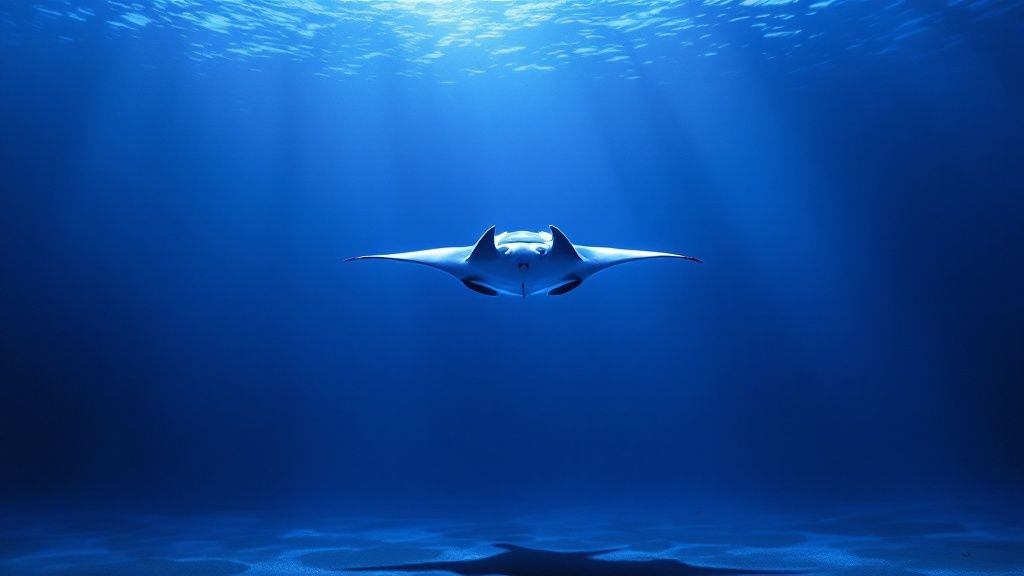
Manta Ray vs Stingray At a Glance
To quickly clear up any confusion, it helps to see the key differences side-by-side. The table below highlights why you can swim with a manta ray without worry, but you need to be cautious around a stingray.
| Feature | Manta Ray | Stingray |
|---|---|---|
| Tail | Long and whip-like, but completely smooth. No stinger. | Shorter and thicker, armed with one or more sharp, venomous barbs. |
| Defense | Their only defense is their massive size and speed. They simply swim away from threats. | Uses its venomous stinger for self-defense if it feels trapped or is stepped on. |
| Mouth Position | Large, gaping mouth located at the very front of its head for filter-feeding. | Mouth is located on its underside, perfect for eating crustaceans off the seafloor. |
| Diet | Filters massive amounts of tiny zooplankton out of the water column. | A carnivore that actively hunts for mollusks, worms, and crustaceans in the sand. |
| Habitat | Lives in the open ocean (pelagic), often near the surface or along reefs. | Stays close to the seafloor (benthic), often burying itself in sand or mud. |
As you can see, their entire biology is different. The manta ray is built for a life of graceful travel in the open water, while the stingray is a bottom-dweller equipped with a serious defensive weapon. It’s this fundamental difference that makes manta rays such incredible and safe animals to encounter in the wild. You can learn more about the unique biology of manta rays and what makes them so special.
Why Manta Rays and Stingrays Are So Different
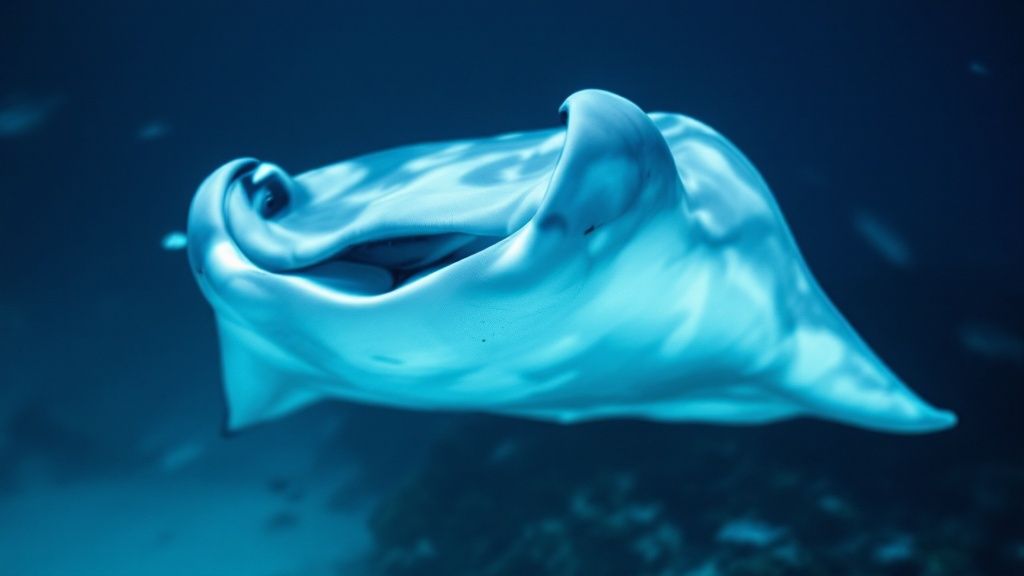
It’s easy to see why people mix them up. Both have those iconic, wing-like bodies that ripple through the water. But lumping manta rays and stingrays together is a bit like confusing a gentle whale shark with a great white—they might look vaguely related, but they live completely different lives.
The manta ray is a true open-ocean nomad, built for endless gliding through the big blue. Everything about its anatomy is fine-tuned for this pelagic lifestyle. The most important difference, and the one that puts divers at ease, is its tail. A manta’s tail is a simple, whip-like appendage that acts as a rudder for steering. That's it. No barb, no venom, no stinger.
This is the number one reason manta rays cannot sting you. They physically don't have the equipment.
Stingrays, on the other hand, are masters of the seafloor. They spend their days camouflaged in the sand, either hiding from predators from above or waiting to ambush their next meal.
Defensive Designs and Dining Habits
Living on the bottom means a stingray needs a reliable defense mechanism, and it has a powerful one: a sharp, serrated barb located at the base of its tail. This isn't for hunting; it's a last resort used only when the ray feels pinned down or threatened, like when an unsuspecting person accidentally steps on it.
Their feeding strategies also couldn't be more different, and you can see it just by looking at them.
- Manta Rays: Look at a manta's head and you'll see two paddle-like lobes called cephalic fins. When it's feeding time, these fins unfurl to help funnel massive amounts of plankton-filled water into its wide, forward-facing mouth. They're basically giant, swimming sieves.
- Stingrays: A stingray’s mouth is on its underside, perfectly placed to vacuum up crabs, clams, and worms directly from the sand and sediment.
This core split in lifestyles—the graceful, open-water filter feeder versus the well-camouflaged bottom-dweller—explains everything. One evolved for gentle gliding, the other for cautious hiding and defending its personal space.
This is exactly why an experience like diving with manta rays in Hawaii is so safe and breathtaking. You're meeting a creature whose entire existence is about peaceful, graceful flight through the water, making any encounter a moment you'll never forget.
Why Stingrays Sting (And Mantas Don’t)
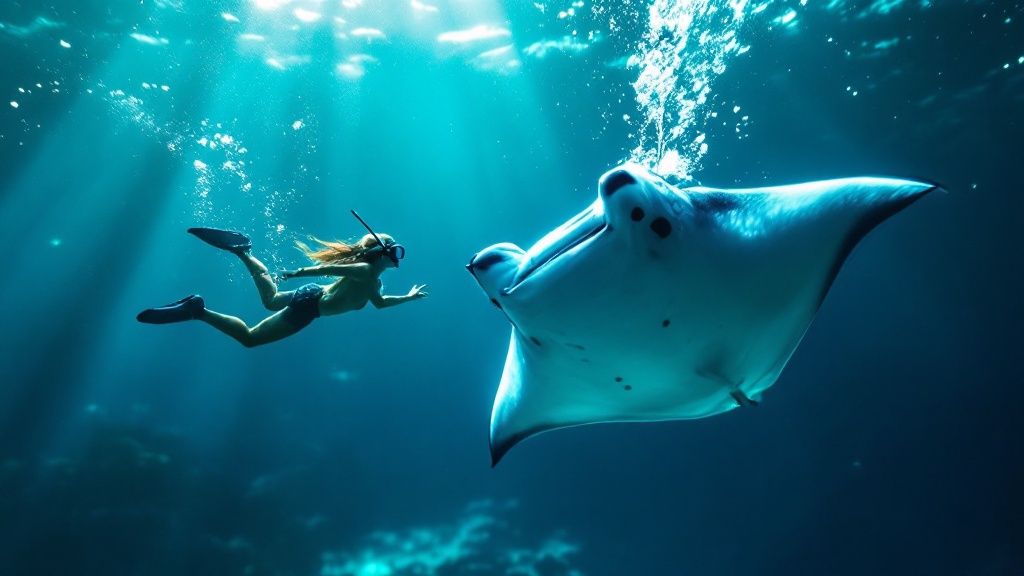
To really grasp why manta rays are so gentle, it helps to look at their cousins, the stingrays. A stingray's infamous sting isn't an attack. It's a pure, last-ditch defensive move. They never hunt with their barbs and they certainly don't go looking for trouble.
The classic sting scenario plays out when someone wading in the shallows accidentally steps on a stingray perfectly camouflaged on the seafloor. In that split second of feeling trapped, the ray’s survival instinct kicks in, causing it to whip its tail upwards in a reflex action. That’s when the sharp, serrated barb at the base of its tail can cause a painful injury.
This is where the two relatives are worlds apart. While mantas are harmless, stingrays are behind a surprising number of marine injuries. In the U.S. alone, estimates suggest there are 750 to 2,000 stingray injuries reported every year. Most of these happen in the exact warm, shallow waters where people and rays often share the same space. You can read more about these incidents in these stingray injury statistics on ncbi.nlm.nih.gov.
How to Avoid a Stingray Encounter
The good news? Avoiding a sting is surprisingly easy. Since the sting is a reaction to being pinned down, the trick is to simply announce your arrival.
The best way to do this is with the "stingray shuffle." It’s a simple technique: instead of taking normal steps in shallow water, just shuffle your feet along the sandy bottom.
This shuffle does two key things:
- It sends out a warning: The vibrations from your shuffling feet travel through the sand, alerting any buried stingrays that something big is approaching.
- It gives them a chance to flee: This early warning gives a stingray plenty of time to do what it wants to do anyway—get out of your way.
Understanding that even a stingray's defense comes from fear, not aggression, really highlights the peaceful nature of their manta ray cousins. One is a cautious bottom-dweller with a defensive tool; the other is a gentle giant of the open ocean, completely unarmed.
Experience the Kona Manta Ray Night Dive
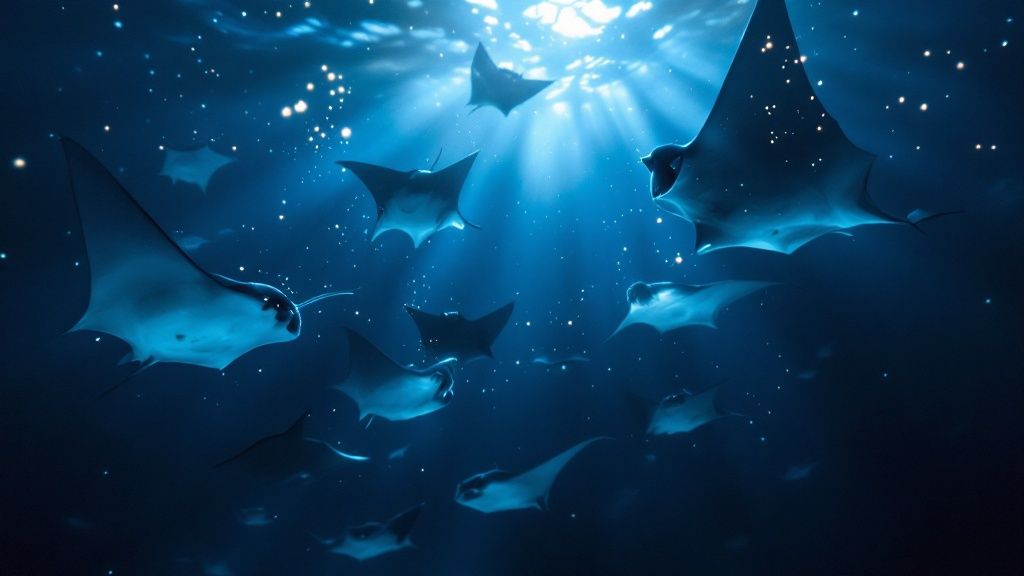
So, we've established that manta rays can't sting you. Now, let's talk about one of the most incredible ways to see their gentle nature up close: the world-famous Manta Ray Night Dive in Kona, Hawaii.
This isn't just another dive. It's an underwater ballet, a truly magical experience that has become a powerful symbol of the peaceful bond we can share with marine life.
Picture this: you descend into the warm, dark Pacific. Your guide from a top-tier operator like Kona Honu Divers flips on a set of powerful underwater lights on the seafloor. Almost instantly, these beams attract huge, swirling clouds of plankton—a manta ray's favorite meal.
It’s like ringing a giant dinner bell for every manta in the area.
An Unforgettable Underwater Ballet
What unfolds next is pure, breathtaking magic. These gentle giants, some with massive wingspans stretching over 12 feet, glide into the light. They swoop, soar, and perform mesmerizing barrel rolls just inches above your head.
With their giant mouths wide open, they elegantly filter the plankton from the water, dancing through the light beams. It’s a stunning spectacle that allows hundreds of people to have a safe, intimate encounter with wild manta rays every single night.
This is a true bucket-list adventure, and there’s no better way to understand just how docile these creatures are. You can dive deeper into what makes this experience so special in our complete guide to the Kona Manta Ray Night Dive.
To watch these huge, harmless animals perform their nightly feeding dance is to understand something profound about the ocean. It's an unforgettable reminder that the most impressive creatures are often the most peaceful.
If you’re ready to witness this incredible performance for yourself, the team at Kona Honu Divers has built a fantastic reputation for running safe, respectful, and absolutely awe-inspiring trips.
Jumping on a professionally guided manta ray dive tour is the absolute best way to do it. A great crew will handle all the logistics, ensuring both your safety and the well-being of the mantas, leaving you free to just enjoy the show.
Safety and Etiquette for Manta Ray Encounters
Knowing manta rays can't sting is one thing, but learning how to act around them is what truly makes for a magical encounter. The golden rule is simple: practice passive observation. You're a guest in their home, and the best guests are the ones who are barely noticed.
The most critical thing to remember is to never, ever touch a manta ray. Their skin is covered in a protective mucus layer, which is their first line of defense against nasty bacteria and infections. When you touch them, you strip that slime coat off, basically compromising their immune system.
Rules of Engagement
Following a few simple guidelines keeps you safe, the mantas comfortable, and honestly, it makes the whole experience better. A calm, undisturbed manta is far more likely to stick around and put on a show.
- Let Them Approach You: Resist the urge to chase after a manta. Just find a good spot, stay still, and let their curiosity bring them to you. It’s worth the wait.
- Don't Block Their Path: Always leave them an "out." Never swim above, below, or directly in front of them, as it can make them feel trapped and stressed.
- No Flash Photography: This is a big one, especially on night dives. A sudden burst of bright light can easily startle or disorient a manta while it's trying to feed.
When you follow these rules, you're not just a tourist; you're an ambassador for the ocean. Your respect allows for an incredible, up-close look at their underwater ballet without causing any harm.
Ultimately, being a good guest in their world is what ensures these incredible animals will be around for future divers to see. To learn more, take a look at our complete guide on how to be a responsible and considerate diver.
A Few More Things You Might Be Wondering About Mantas
We've covered the big question about stings, but let's dive into a few other common curiosities. Knowing a bit more about these animals really deepens your appreciation for them when you finally see them in the water.
Do Manta Rays Have Teeth?
They do, but probably not for the reason you think! Manta rays have rows of tiny, peg-like teeth on their lower jaw, but they aren't for chewing. Since mantas are filter feeders, they simply gulp down mouthfuls of tiny plankton.
So what are the teeth for? The best guess is that they play some role in mating rituals, perhaps allowing the male to get a better grip during courtship. For a diver, they're completely harmless.
Just How Big Do Manta Rays Get?
Picture this: a creature the size of a small bus gliding effortlessly through the water. That's a manta ray for you. They are, without a doubt, the largest rays in the world.
The true giants are the oceanic mantas, which can have a "wingspan" of up to a staggering 29 feet (9 meters). The reef mantas we see here on the Kona coast are a bit smaller but still absolutely massive, regularly reaching 18 feet (5.5 meters) across. Their sheer presence in the water is something you feel as much as see.
Manta rays are living proof that the most impressive animals in the ocean are often the most peaceful. Their incredible size is their defense, not a weapon.
What’s the Difference Between a Manta Ray and a Mobula Ray?
This is a great question, and one that even marine biologists have debated for years. It's gotten a little tricky recently, as genetic testing has confirmed they are so closely related that mantas are now officially in the Mobula genus.
But for telling them apart on a dive, there’s one simple trick. Just look at the mouth:
- Manta Rays: Have a wide mouth right at the very front of their head (terminal), perfect for scooping up plankton.
- Mobula Rays: Have a mouth located underneath their head (sub-terminal).
It's that small difference in placement that gives them away every time.
Ready to see these gentle giants for yourself? The world-famous Kona manta ray night dive is an experience that will stick with you forever. Here at Kona Honu Divers, we're all about running safe, respectful tours that create a real connection between you and these incredible animals.
Come join our crew for a front-row seat to the most magical ballet in the ocean. Book your unforgettable manta ray dive tour and let's get you in the water!