
Imagine floating in absolute darkness, miles from shore, with thousands of feet of inky black ocean beneath you. You’re not exploring a reef or a wreck. Instead, you're suspended in the open sea, surrounded by a universe of tiny, bizarre, and often glowing creatures that look like they belong on another planet.
That, in a nutshell, is blackwater diving. It’s an experience that feels more like a spacewalk than a scuba dive.
What Exactly Is Blackwater Diving
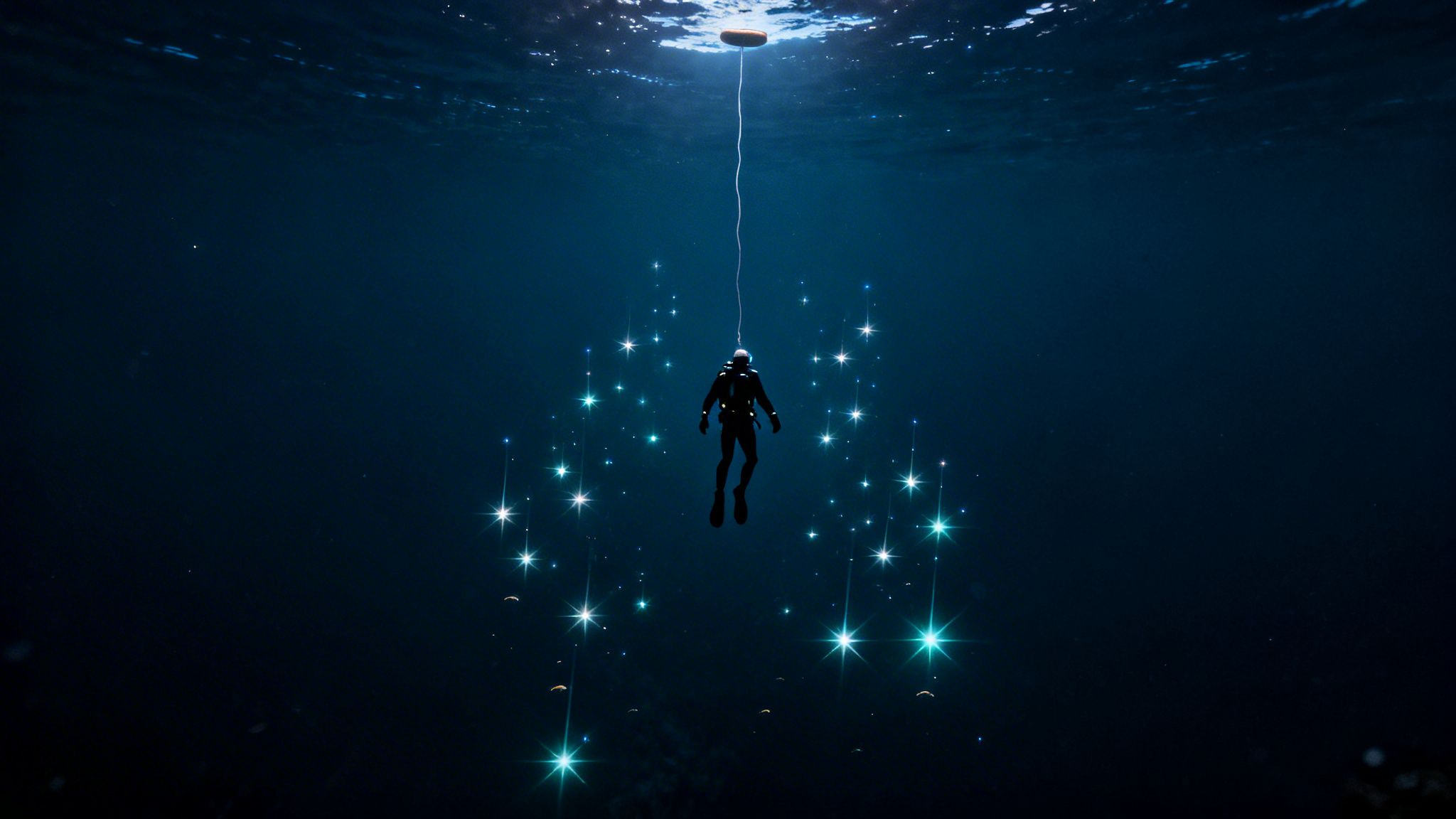
Unlike a typical night dive where you stick close to a familiar reef, blackwater diving is a completely different beast. It's a pelagic drift dive, meaning you're out in the open ocean with no bottom in sight.
The setup is simple but ingenious. Divers are connected by tethers to a line that hangs from a big, brightly lit buoy on the surface. These powerful lights are the key—they create a brilliant oasis in the dark, attracting an unbelievable procession of creatures from the abyss. It’s all about witnessing the largest migration on Earth, which happens every single night.
A Journey Into The Vertical Migration
The science behind the magic is called diel vertical migration. Every night, under the cover of darkness, trillions of tiny organisms make the journey from the deep sea toward the surface to feed. When you drop into the water, you're intersecting with this massive underwater parade.
You’re not looking for big sharks or manta rays here. This dive is about the small, the strange, and the spectacular. You’ll see:
- Larval Creatures: See the baby versions of well-known fish like eels, flounder, and even swordfish. They look absolutely nothing like their adult counterparts.
- Bizarre Cephalopods: Tiny, iridescent squid and the almost mythical paper nautilus often make an appearance.
- Gelatinous Zooplankton: You'll be mesmerized by pulsating siphonophores and delicate comb jellies that refract your light into shimmering rainbows.
This migration turns the empty, dark water into a living cosmos of light and movement. It's an incredible opportunity to see the earliest, and often weirdest, life stages of marine animals.
The Kona Connection
So, where did this crazy idea come from? You can thank the Big Island of Hawaii. Recreational blackwater diving really got its start in Kona back in the 1990s. Dive operators began taking a scientific practice—using lights to attract deep-sea life—and turned it into an adventure for certified divers.
Kona’s unique geography, with its deep offshore drop-offs, calm waters, and amazing visibility, made it the perfect proving ground. By the early 2000s, it was a nightly attraction, and today, it's a signature dive that companies like Kona Honu Divers have perfected on their blackwater excursions. You can dive deep into the origins of this incredible dive on Scuba.com.
Make no mistake, this is an advanced dive. Floating in open water with no visual references demands exceptional buoyancy control and a cool head. But for those ready for the challenge, the reward is an experience that is truly out of this world.
The Science Powering Your Dive: Diel Vertical Migration
Every single blackwater diving trip is plugged directly into the largest migration on our planet. It’s a nightly event called diel vertical migration, and it’s a spectacle of unimaginable scale involving trillions of organisms moving in sync.
As the sun dips below the horizon, an absolute hoard of marine life starts its journey up from the deep. They rise from the crushing blackness, sometimes traveling thousands of feet, to reach the food-rich surface waters where they’ll hunt all night under the cover of darkness.
This daily rhythm transforms the open ocean from an empty-looking blue void into a vibrant, living soup of alien creatures. Think of it as an underwater Serengeti that materializes out of nowhere each evening, a temporary ecosystem buzzing with predators and prey that disappears just as quickly at sunrise.
The Key Players in This Nightly Procession
The cast of characters you'll encounter on this vertical stage is mind-bogglingly diverse, and most look like they swam right out of a sci-fi movie. Many are in their larval stages, appearing as see-through, otherworldly versions of the reef fish you might recognize.
The powerful lights on your rig act like a porch light on a summer night, attracting this incredible parade of life right to you. You'll find yourself floating among:
- Larval Fish: You get to see the bizarre beginnings of many familiar species. Transparent eel larvae, called leptocephali, look like drifting glass ribbons. You might even spot a tiny larval flounder with an eye still on each side of its head, long before it flattens out for a life on the seafloor.
- Cephalopods: Small, shimmering squid and the almost mythical paper nautilus are frequent visitors. They dart in and out of the light beam, actively hunting smaller critters drawn to the glow.
- Zooplankton: This isn't just one thing; it's a catch-all for a huge range of tiny animals. You'll see delicate comb jellies that shimmer with rainbow colors and complex colonial creatures like siphonophores, which are actually made of many smaller, specialized organisms working together.
This nightly migration is more than just a cool sight; it's a vital process for the planet. It’s a massive conveyor belt, moving energy and nutrients from the surface down to the deep sea. When you do a blackwater dive, you're witnessing a fundamental engine that helps regulate our climate and supports the entire deep-sea food web.
A Window Into Early Life
One of the most profound parts of blackwater diving is the chance to see the earliest, most vulnerable life stages of marine animals. Normally, these larval creatures are lost to us, scattered across the immense open ocean and nearly impossible to find or study.
This is where your dive goes from being a thrilling adventure to a genuine scientific observation. A larval tripod fish, for example, is a fragile, transparent floater that looks nothing like the bizarre, stilt-walking adult it will one day become.
Every encounter offers a rare peek into the complex life cycles that fuel the ocean’s incredible biodiversity. For marine biologists, the photos and videos captured by divers like you are pure gold. This data provides invaluable insights into species distribution and behavior that would be otherwise out of reach. You're not just a tourist; you're an explorer on the front lines of ocean discovery.
Gearing Up For Your Journey Into The Dark
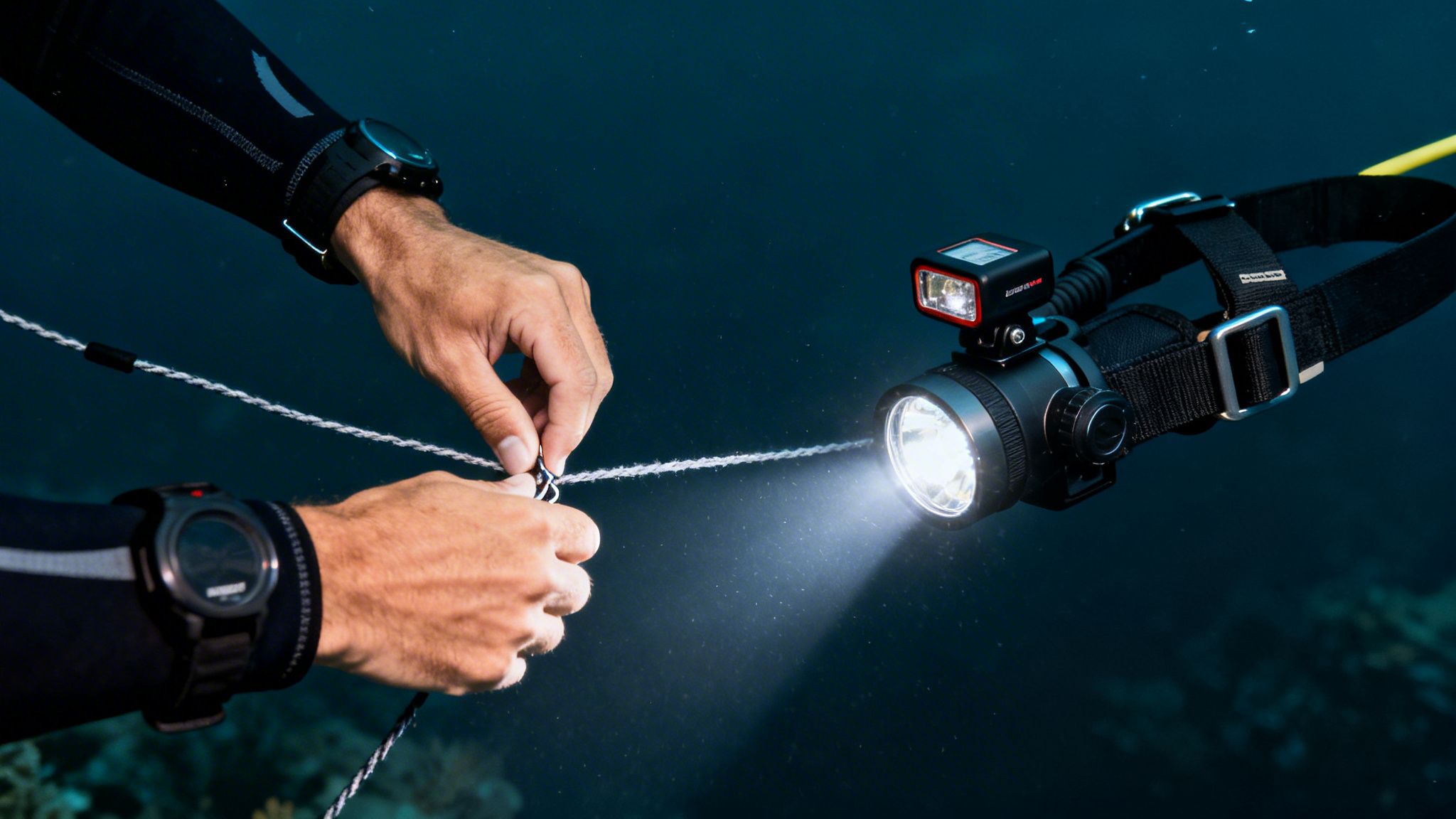
Dropping into the abyss for a blackwater dive calls for more than your standard reef-diving kit. You're in a world of total darkness, suspended in the open ocean with no bottom in sight. This unique environment demands specialized gear built for safety, orientation, and, of course, making the most of those unbelievable encounters.
While your trusty mask, fins, and BCD are still essential, a few key pieces of equipment become absolutely non-negotiable. Knowing your gear is in perfect working order is the first step toward a mind-blowing experience. This is one of the big advantages of diving with a top-tier operator like Kona Honu Divers—their professionally serviced rental gear gives you total peace of mind. You can see a full rundown of what gear you will need for a Kona diving adventure on their site.
Your Lifeline: The Tether System
On any guided blackwater dive, the tether system is the single most important piece of safety equipment. Picture a big, brightly lit buoy floating on the surface. From this buoy, a weighted line—the downline—drops straight down into the deep. This isn't just a rope; it's your only point of reference in a world that has none.
Each diver clips onto this central downline with a shorter tether, and this simple setup is a game-changer for a few reasons:
- Keeps You Grounded: It prevents you from accidentally drifting up or down in the dark, which is a very real risk when you can't see the bottom or the surface.
- Keeps The Group Together: It ensures all divers stay in a controlled area around the downline and near the boat.
- Provides An Anchor: It gives you a secure point to hold onto, letting you relax and focus on the incredible creatures floating past you.
This brilliant system turns a potentially disorienting dive into a safe, controlled, and totally immersive experience.
Essential Lighting Equipment
Out in the pitch-black open ocean, light is everything. It's how you'll attract and see the animals, but it's also a critical tool for safety and communication. For a blackwater dive, your lighting needs to be powerful and, most importantly, redundant.
A common rookie mistake is underestimating just how much light you need. Your average night-diving torch just won't cut it. You need a high-lumen primary light that can slice through the darkness and make those tiny, often translucent, subjects pop.
To put it in perspective, let's compare what you'd bring on a standard night dive versus what's needed for the deep blue.
Blackwater Diving Gear Checklist: Standard vs. Specialized
| Gear Item | Standard Night Dive | Blackwater Dive Recommendation |
|---|---|---|
| Primary Light | A reliable torch with 800-1200 lumens is usually fine. | A powerful, wide-beam video light or a high-lumen (2000+) primary dive light is highly recommended to see subjects clearly. |
| Backup Light | One small, reliable backup light is standard practice. | At least one, if not two, dependable backup lights are crucial. Redundancy is key when you're miles from shore. |
| Marker Strobe | Not always required, but a good safety addition. | Absolutely essential. A personal strobe attached to your tank valve ensures the boat and your fellow divers can see you at all times. |
| Focus Light | For photographers, a standard white focus light works. | A red focus light is strongly preferred. Red light is less likely to scare away the skittish creatures of the deep. |
Having the right lights not only makes the dive safer but dramatically increases your chances of spotting the weird and wonderful life that a weaker beam would miss entirely.
Capturing The Aliens: Photography Tips
Photographing blackwater creatures is one of the most challenging—and rewarding—pursuits in underwater photography. These critters are often tiny, see-through, and always on the move. Success comes down to having the right setup and a specific approach.
Your best bet is a macro lens, something in the 60mm or 100mm range, to capture the delicate details of these miniature aliens. Autofocus will struggle in the dark, so many pros use a bright focus light and rely on techniques like "back-button focusing" or even full manual focus to nail the shot.
Strobe positioning is also critical. Using two strobes, placed far out to the sides, helps minimize backscatter and creates the dramatic lighting you need to make these transparent animals stand out against the inky black backdrop.
Mastering Safety In The Open Ocean
Let’s be clear: safety is the absolute bedrock of every jaw-dropping blackwater dive. This isn't just a casual night swim. We're talking about a highly specialized activity that demands a deep respect for the open ocean and a solid understanding of specific protocols. When you're floating in the dark with thousands of feet of water below you, it calls for a different mindset and skillset than you'd use on a typical reef dive.
The environment itself is what makes this an advanced dive. You're in a world with no visual references—no sandy bottom, no coral wall to orient yourself. That's why your buoyancy control has to be second nature. It’s not just a nice-to-have skill; it's your single most important safety tool out there. Without it, you could sink too deep or rise too fast before you even realize it.
Professional Protocols And Procedures
Any reputable dive charter, like ours, turns this potentially intimidating environment into a tightly controlled and incredibly safe experience. This is all thanks to strict, well-rehearsed procedures that start long before you hit the water. Every single dive kicks off with a detailed pre-dive briefing that goes way beyond just pointing out cool critters.
Think of this briefing as your roadmap for the entire dive. We'll cover:
- The Tether System: You'll learn exactly how to clip on and off the downline. This line is your lifeline, your primary point of reference for depth and orientation.
- Buddy Protocols: We'll go over how to communicate with your buddy and guide in the dark using light signals and how to maintain a safe, close proximity.
- Emergency Preparedness: You'll know what to do in the unlikely event of an equipment problem, getting separated from the group, or having an unexpected encounter.
Sticking close to that downline and your guide is non-negotiable. It's your anchor in the big blue, making sure you stay at a safe depth and always remain connected to the boat on the surface.
Blackwater diving gets a reputation for being high-risk, but it's really more of a mental challenge than a physical one. With expert guides and a commitment to following the rules, the perceived risks are managed so well that the focus is on discovery, not danger.
Navigating The Darkness Confidently
One of the first things people worry about is getting disoriented. It makes sense—with no reef to follow, it's easy to imagine feeling lost in the dark. But the entire dive is structured to prevent exactly that. By being tethered to a brightly lit downline, your world shrinks to the illuminated column of water right in front of you. It becomes a completely manageable, self-contained universe within the vastness of the ocean.
Another question we get a lot is about bumping into larger pelagic animals. While anything is possible in the ocean, it's extremely rare. The powerful lights and all the activity are a magnet for tiny, curious creatures, not big predators. On the off chance a larger animal swims by, our guides are trained to handle the situation calmly and professionally.
The safety record for blackwater diving speaks for itself. It’s a testament to these rigorous protocols. Global data shows it's a controlled and thrilling activity when done right, even when you're drifting over abyssal depths that feel like outer space. Dives usually happen between 15-30 meters, with divers clipped onto lines that drift miles offshore over water thousands of meters deep. But thanks to training, lights, and guides, it’s no more hazardous than a standard night dive for a diver with excellent buoyancy. You can find a great breakdown of these diving dynamics on Divernet. Mastering these protocols, including knowing how to perform a proper scuba safety stop, is what makes it all possible.
Why Kona Hawaii Is The Ultimate Blackwater Destination
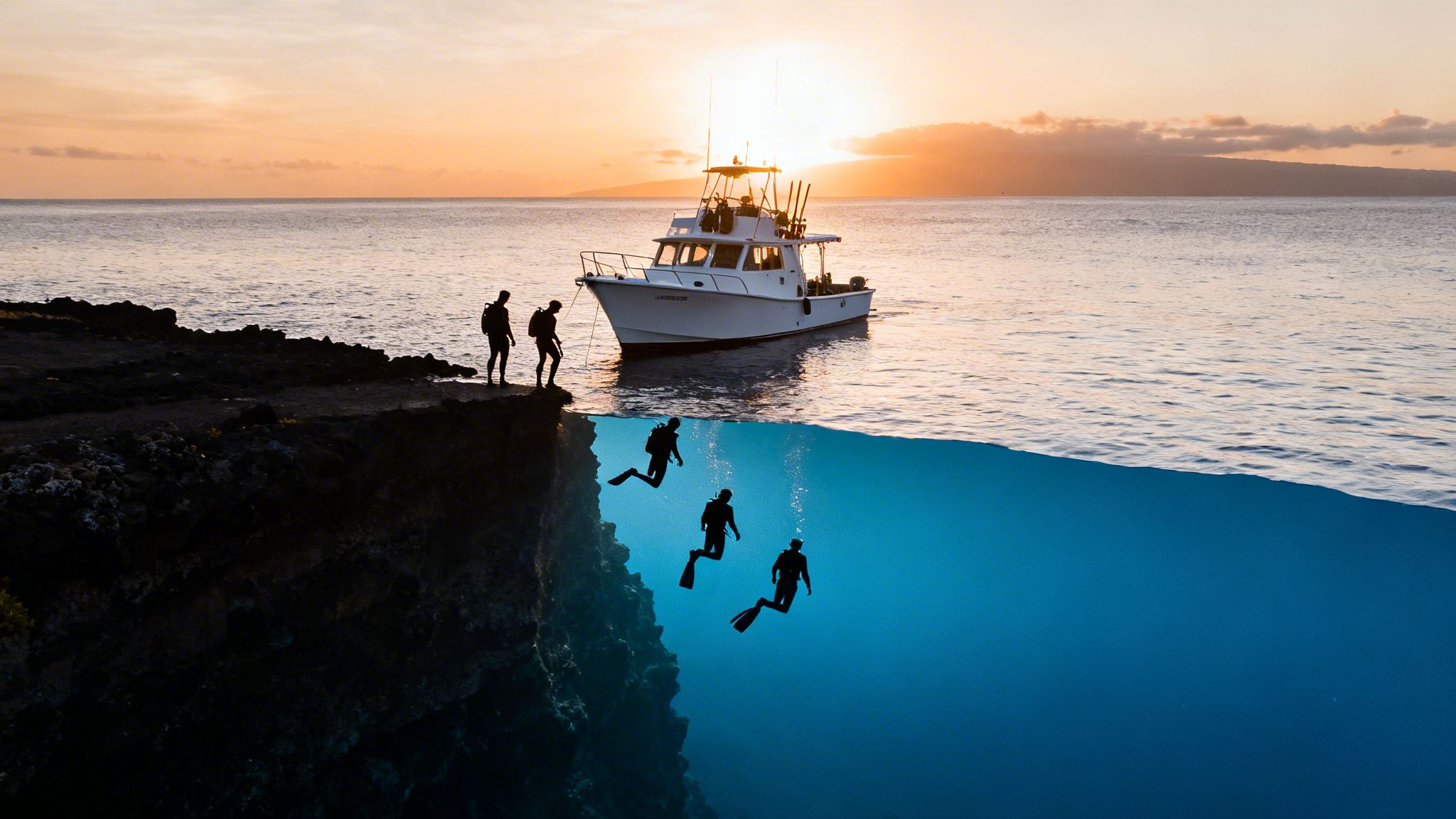
While you can technically do a blackwater dive in a handful of places worldwide, Kona isn't just another spot on the map. It's the global epicenter—the place where this unique type of diving was pioneered and perfected.
The secret is all about the island's incredible underwater geography. In most places, you’d have to travel for hours to reach truly deep water. But here, the seafloor off the Kona coast drops like a cliff, plummeting thousands of feet just a short boat ride from the harbor. This gives us almost immediate access to the deep-water world where the magic happens.
That one-of-a-kind geology means less time traveling and more time diving into the planet's largest migration. Add in the calm, protected waters on the leeward side of the island, and you have perfect, predictable conditions that make these dives possible almost any night of the year.
The Kona Honu Divers Experience
When you’re floating in the middle of the ocean at night, your guide and boat crew make all the difference. Kona Honu Divers has really set the standard for this highly specialized dive. Their expert-led Blackwater Dive tour is a masterclass in safety, professionalism, and jaw-dropping wonder.
The trip begins as the sun dips below the horizon, painting the sky with an unforgettable Hawaiian sunset. The boat ride itself is an experience, with the massive silhouettes of Hualālai and Mauna Loa watching over you. As true darkness sets in, the crew prepares a custom-built lighting rig that will serve as your beacon in the abyss.
Once you slip into the water, you’re in a different universe. Tethered securely to the downline, you float in a column of light, a tiny outpost in an endless cosmos. Guided by seasoned pros who know these waters intimately, you'll witness a living galaxy of bizarre and beautiful creatures materializing out of the dark.
A Dive That Contributes To Science
This is more than just a thrilling dive; it's a chance to visit a true scientific frontier. Many of the creatures you'll encounter are so rare or their larval stages so mysterious that every single dive holds the potential for a new discovery.
A fascinating NOAA study really brings this home. Researchers on targeted blackwater dives collected 76 tiny specimens for DNA analysis. They were able to identify 44 of them down to the species or genus level with over 99% accuracy. It’s a powerful example of how these dives are unlocking the secrets of the deep. You can read the full research about these findings to see the scientific impact for yourself.
When you dive with an experienced crew, you’re not just a tourist—you’re a citizen scientist contributing to our understanding of the ocean's most elusive life forms.
Taking Your Skills To The Next Level
There’s no getting around it: blackwater diving is an advanced skill that demands excellent buoyancy and awareness. For divers looking to build their confidence, Kona is the perfect training ground. You can learn more about why the Big Island is so good for scuba diving in our detailed guide.
Operators like Kona Honu Divers offer incredible opportunities to sharpen your abilities. If you’re looking to push your boundaries, their premium advanced dive tour is the perfect next step. These dives explore deeper sites, intricate lava tubes, and remote pinnacles, helping you master the fine-tuned control needed for the blackwater challenge.
By honing your skills in Kona's varied underwater landscapes, you’re preparing yourself for what is truly one of the most rewarding experiences in all of diving.
Common Questions About Blackwater Diving
Jumping into the deep, dark ocean at night is a serious thrill, but it’s completely normal to have a few questions before you go. Blackwater diving is a world away from your typical reef dive; it’s a unique blend of a night dive’s excitement and the vast, mysterious feel of the open ocean. Getting a handle on the safety, the critters, and the skills you’ll need is the best way to feel ready to take the plunge.
Let's tackle some of the most common things divers ask before heading out on this incredible adventure.
Is Blackwater Diving Dangerous?
This is usually the first question on everyone's mind. Diving in the pitch black with no bottom in sight sounds pretty intense, and it is! But here’s the thing: while it's definitely an advanced dive, it isn't inherently more dangerous than a standard reef night dive when it's done right.
The secret is the strict set of safety protocols that professional operators live by. A reputable charter, like ours, essentially turns a sliver of the massive open ocean into a controlled, safe environment for the dive.
Here’s how it works:
- The Tether System: This is the cornerstone of safety. Every diver is clipped to a central downline that’s lit up. It’s a simple but brilliant system that gives you a constant depth reference, keeps you from drifting off into the blue (or black!), and holds the group together.
- Expert Guides: Our guides are blackwater specialists. They live and breathe this stuff. From the detailed pre-dive briefing to watching over you in the water, they’re trained to handle the unique environment and keep everyone safe.
- Strict Skill Requirements: We don’t take just anyone. We require advanced certifications and recent night diving experience to make sure every diver on the boat has the skills to be there, especially rock-solid buoyancy control.
What Creatures Will I See?
This is the magic of a blackwater dive—you genuinely have no idea what’s going to drift by. Every single dive is a completely different show. The deep sends up a new cast of characters every night, which is what gets us so excited to go out.
You can expect to see a whole parade of tiny planktonic creatures, many of them in their baby, or larval, stages. Think transparent, alien-looking larvae of eels, flounder, and even swordfish that look absolutely nothing like their adult selves. You'll also see glowing squid, the almost mythical paper nautilus, and crazy-looking siphonophores that can stretch for meters. Then there are the comb jellies, which light up like a rainbow when your beam hits them. It's like diving through a soup of creatures from another planet.
What Diver Certification Do I Need?
This is definitely not a dive for beginners. The conditions require you to be completely comfortable and skilled in the water. Most professional outfits, including Kona Honu Divers, have a few prerequisites to make sure the dive is safe and enjoyable for the whole group.
Typically, you’ll need:
- An Advanced Open Water certification (or an equivalent from PADI, NAUI, etc.).
- A decent number of dives under your belt, usually 50 or more, to show you have plenty of in-water experience.
- Recent night diving experience. This is a must, just so we know you’re comfortable in the dark before we add the whole "no bottom" thing to the mix.
But honestly, more than any certification card, the single most critical skill is excellent buoyancy control. When you have no visual references, being able to hold your depth without even thinking about it is non-negotiable.
Can I Try This As A New Diver?
In a word, no. We would never put a new diver in this environment. We strongly encourage anyone new to diving to spend time building their confidence and mastering the fundamentals first. The best way to get ready for a blackwater dive is to just go diving! Log more reef dives and, especially, more standard night dives.
Kona has some of the best diving in the world, so there are amazing alternatives for every skill level. A perfect goal to work towards is the world-famous manta ray night dive. It’s an absolutely unforgettable experience that lets you get a taste of Kona's nightlife in a more structured setting. It’s the perfect way to build the skills and confidence you’ll need for a future trip into the black.
Ready to experience the ultimate underwater adventure for yourself? At Kona Honu Divers, our expert crew is ready to guide you on a safe and unforgettable journey into the abyss. Book your spot on our next Blackwater Dive tour and witness the planet's largest migration firsthand.