
Picture yourself floating in outer space, but instead of stars, you're surrounded by glowing, otherworldly creatures that look like they're straight out of a sci-fi movie. That’s the closest I can get to describing blackwater diving. It’s an incredible adventure that takes you miles offshore, into the deep, dark open ocean at night.
This isn't your typical night dive. You're not exploring a reef. You're suspended in the vast water column, witnessing the largest animal migration on Earth with your own eyes.
What Is Blackwater Diving
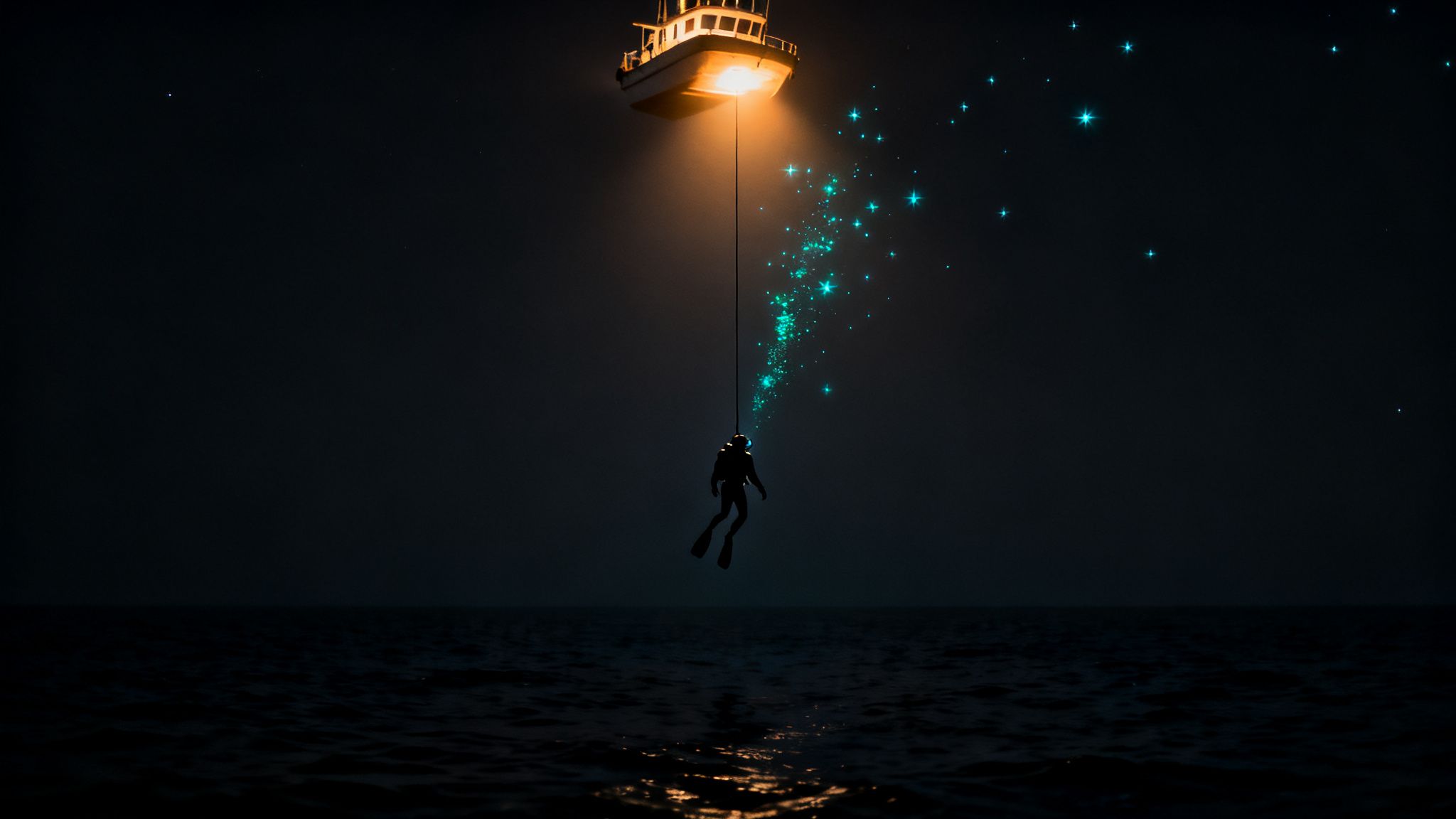
So, what does this actually look like? Blackwater diving is a very specialized type of dive where you drift in the open ocean at night, far from shore with no seafloor in sight. To keep everyone safe and together, divers are attached by tethers to a boat that simply drifts with the current.
Below the boat, a powerful light system hangs in the water, illuminating the inky blackness. Think of it like a giant underwater porch light. This light attracts a stunning variety of deep-sea organisms that are rarely, if ever, seen by humans.
You get a front-row seat to the planet's most significant daily migration, a phenomenon called diel vertical migration. Every single night, trillions of organisms—many in their strange and beautiful larval stages—rise from the crushing dark of the deep ocean toward the surface to feed. It’s not just a dive in the dark; it's a dive into a living, breathing galaxy of alien-like life.
Blackwater Diving Vs Traditional Night Diving
While both dives happen after sunset, that's where the similarities end. A standard night dive is about observing the familiar creatures of the reef as they go about their nocturnal business. A blackwater dive, on the other hand, is a journey into the completely unknown pelagic world.
Here’s a quick breakdown to see just how different they are.
| Feature | Blackwater Diving | Traditional Night Diving |
|---|---|---|
| Location | Miles offshore over deep open ocean | Near a coastline or shallow reef |
| Primary Focus | Pelagic, larval, and deep-water organisms | Reef fish, corals, and nocturnal reef critters |
| Bottom Reference | None; divers are suspended mid-water | The reef or seafloor is always visible below |
| Technique | Drifting with the current while tethered | Navigating a specific dive site and returning |
As you can see, they are two completely different experiences, each incredible in its own way.
The Birthplace of Blackwater Diving
This mind-blowing adventure has its roots right here in Kona, Hawaii. Back in the 1990s, a few curious divers started experimenting, and what they discovered eventually became the professionally guided tours offered today. Kona is truly the birthplace of recreational blackwater diving.
These pioneering efforts have turned into a must-do for adventure-seekers worldwide. People come here specifically to witness that massive migration, where billions of tiny planktonic creatures travel up from depths of 1,000 meters every single evening. Unique diving experiences like this have a significant effect, and you can read more about the economic impact of unique diving experiences on Scripps.ucsd.edu.
Discovering the Aliens of the Deep
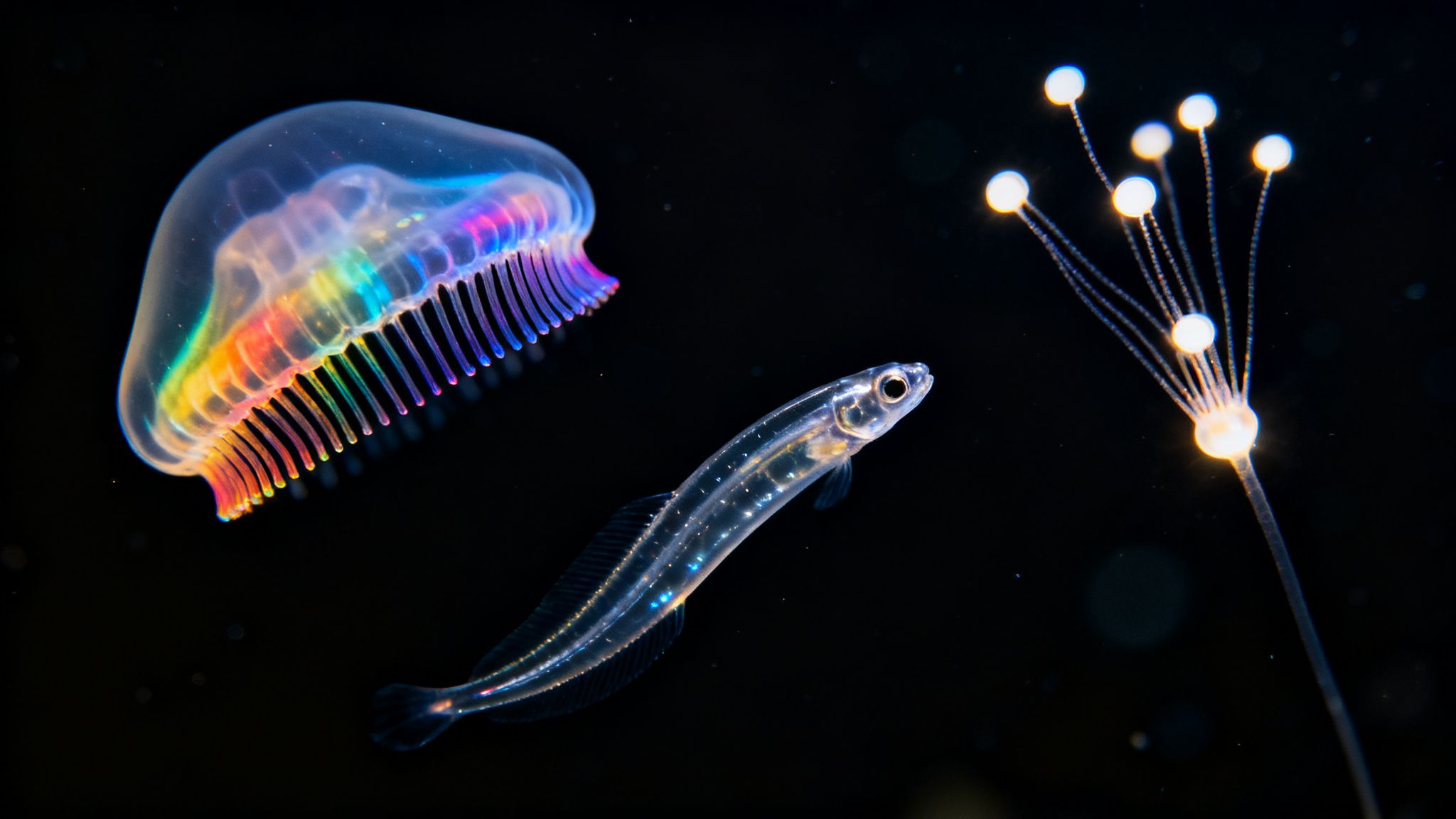
The real thrill of a blackwater dive is coming face-to-face with life that looks like it swam right out of a sci-fi movie. This isn't about seeing the usual nocturnal reef fish. It's about meeting creatures from the deep that most people will never see outside of a documentary.
Many of these animals are in their larval, or baby, stages, and they look completely different from their adult forms. It’s like floating through a living galaxy of tiny, bizarre organisms drifting right past your dive mask. One moment you might see a glass-like eel larva, the next a larval fish with impossibly long, trailing fins, followed by a pulsating siphonophore that looks like a string of alien Christmas lights.
The Cast of Deep-Sea Characters
Every single dive is its own premiere, with a brand-new cast of characters rising from the depths. That's the beauty of it—no two blackwater dives are ever the same. Each time you drop into the water, you get a genuine sense of discovery.
Some of the most incredible encounters you might have include:
- Comb Jellies (Ctenophores): These aren't your typical jellyfish. As they move, their rows of tiny hairs, or cilia, catch your dive light and shatter it into a cascade of living, pulsating rainbows. It's an absolutely mesmerizing sight.
- Blanket Octopus (Tremoctopus spp.): Finding one of these is a holy grail moment for any diver. The female has a long, flowing membrane between her arms that she can unfurl like a magnificent cape. Seeing it happen in the vast, open ocean will take your breath away.
- Venus's Girdles (Cestum veneris): This is another type of comb jelly, but one that forms a razor-thin, iridescent ribbon. It can grow over three feet long and undulates through the water with an eerie grace.
The diel vertical migration brings an estimated 70-80% of all ocean biomass towards the surface every single night. Blackwater dives offer a front-row seat to this event, and it's not uncommon for divers in Kona to spot up to 100+ species on a single outing.
A Window into Scientific Discovery
Blackwater diving is more than just a cool adventure; you're also participating in a form of citizen science. Many of the organisms you’ll see are incredibly rare or only exist in a brief larval stage, so they remain a mystery to scientists.
In fact, recreational blackwater dives have led to real scientific discoveries. One study was able to collect 76 specimens from these dives, and DNA barcoding revealed creatures that had never been seen alive before. They even helped identify eight entirely new species of hydrozoans.
From tiny larval flounders with their eyes still migrating across their heads to delicate paper nautiluses clutching their eggs, the biodiversity is just staggering. Every sweep of your light could illuminate a creature you’ve never seen, or maybe one nobody has. It makes every descent a true exploration into the unknown.
Speaking of unique creatures, you might be interested in diving the Big Island of Hawaii to look for endemic marine animals.
Your Blackwater Dive Experience in Kona
An adventure like blackwater diving is truly a world apart, and it demands genuine expertise and an unwavering focus on safety. That’s exactly how we run things at Kona Honu Divers. Your trip into the abyss doesn’t start when you get in the water; it begins on the boat with a thorough, easy-to-understand briefing from our seasoned crew.
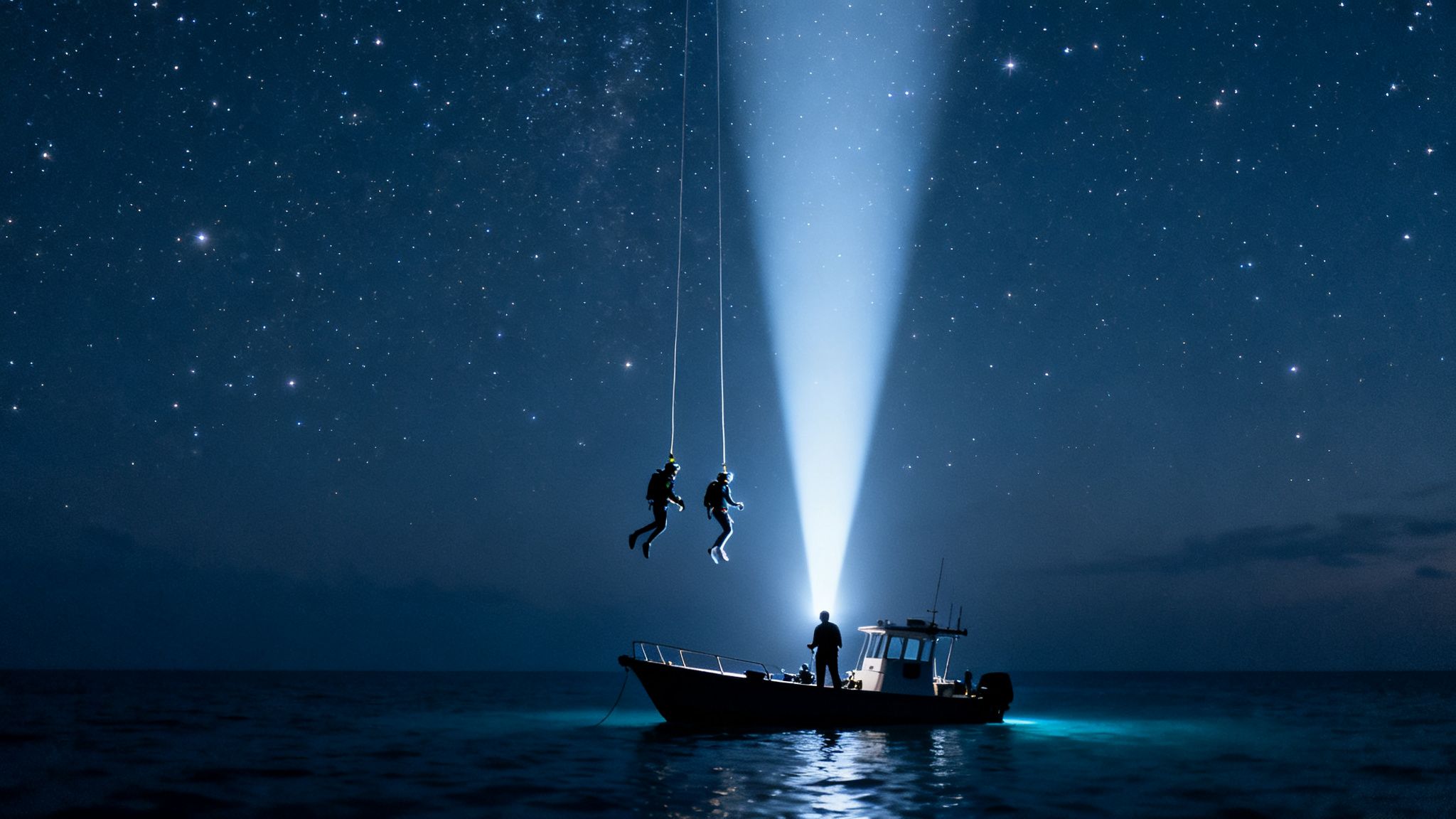
After a short ride, we'll head miles offshore until we're hovering over thousands of feet of deep, open ocean. Once we've found the perfect spot, the real show begins. We set up our custom light rig, a powerful downline that dangles deep into the water column. Think of it as an underwater campfire—its bright glow is the beacon that draws in that nightly parade of strange and wonderful creatures from the depths below.
A Safe and Guided Exploration
Your safety is, without question, our top priority. Every diver is securely attached to the main downline with their own personal tether, usually about 10 feet long. It's a brilliantly simple system that accomplishes two critical things: it keeps you from drifting off into the dark and prevents you from going too deep.
This setup gives you total freedom to explore the illuminated water around you without a single worry.
With no bottom to use as a reference point, that tether is your lifeline. It’s what allows you to completely immerse yourself in the experience, focusing on the alien-like marine life instead of worrying about your buoyancy or getting separated from the group.
Our divemasters are the real heart of the operation. They're not just there to keep you safe; they're experts at spotting the tiny, translucent, and perfectly camouflaged critters that float by. Their trained eyes will point out a larval fish that looks like a sliver of glass or a pulsating jelly that you would have completely missed otherwise.
Transforming Your Perspective
Having an expert guide by your side is what turns a dive from just floating in the dark into a true discovery. They carry underwater slates to identify what you’re looking at, transforming a mysterious encounter into a genuine "aha!" moment. It’s this professional guidance that makes all the difference and why divers come back to us for this bucket-list experience.
Time and again, our guests tell us it’s the professionalism and deep knowledge of our crew that makes this specialized dive so incredible.
This careful, thoughtful approach ensures your blackwater diving adventure is not only breathtaking but also safe, educational, and completely unforgettable. Ready to see the great vertical migration for yourself? Learn more about what to expect on our Kona Blackwater Dive tour.
Essential Gear and Safety Protocols
Heading out miles offshore into the deep, dark ocean at night sounds pretty intense, right? It can be, but a **blackwater dive** is actually a surprisingly safe and controlled adventure, as long as you stick to the plan. Safety is everything on this dive, and it all comes down to some very specific, well-thought-out systems.The most important piece of that system is the tether. This is your lifeline, literally. Every diver gets attached to a main line that runs straight down from the boat. It's a simple idea, but it's incredibly effective. This setup makes it impossible to drift away in the current or sink too deep, keeping everyone in the cone of light and close to the divemaster.
Mastering Your Place in the Big Blue
Out there in the open ocean, you've got no reef or sandy bottom to use as a reference point. This means your buoyancy control has to be absolutely dialed in. The whole goal is to hang perfectly still and neutral in the water, just floating. If you're bobbing up and down, it’s not just disorienting for you—it can mess up the experience for everyone else.
The only way to get this right is practice. Before the dive, take the time to really nail your weighting and breathing so you can achieve that perfect, weightless feeling. Once you’re stable, you can stop thinking about where you are in the water and focus all your attention on the incredible critters drifting by.
Your ability to maintain neutral buoyancy is the single most important skill for a great blackwater dive. It saves you energy, helps you spot more life, and keeps you safely at your assigned depth on the tether.
Gearing Up for the Abyss
You can use a lot of your standard scuba kit, but blackwater diving calls for a few specific pieces of gear to keep you safe, comfortable, and able to actually see the good stuff. A good mask and fins are a given, but your lights are what will make or break the dive.
Here’s a breakdown of the critical gear:
- A Powerful Primary Dive Light: This is your portal into the dark. You need a strong, focused beam to spot the tiny, often see-through animals that make blackwater diving so unique.
- A Reliable Backup Light: Just like any night dive, redundancy is non-negotiable. A trusty backup light is a must-have piece of safety gear.
- Personal Marker Light: A small strobe or tank light ensures the divemaster and other divers can easily see you at all times.
Having this gear, along with following the strict safety rules, is what gives divers the confidence to take on this incredible adventure. If you're looking for more info on equipment, check out our guide on the best scuba gear for beginners.
Photographing Pelagic Marine Life
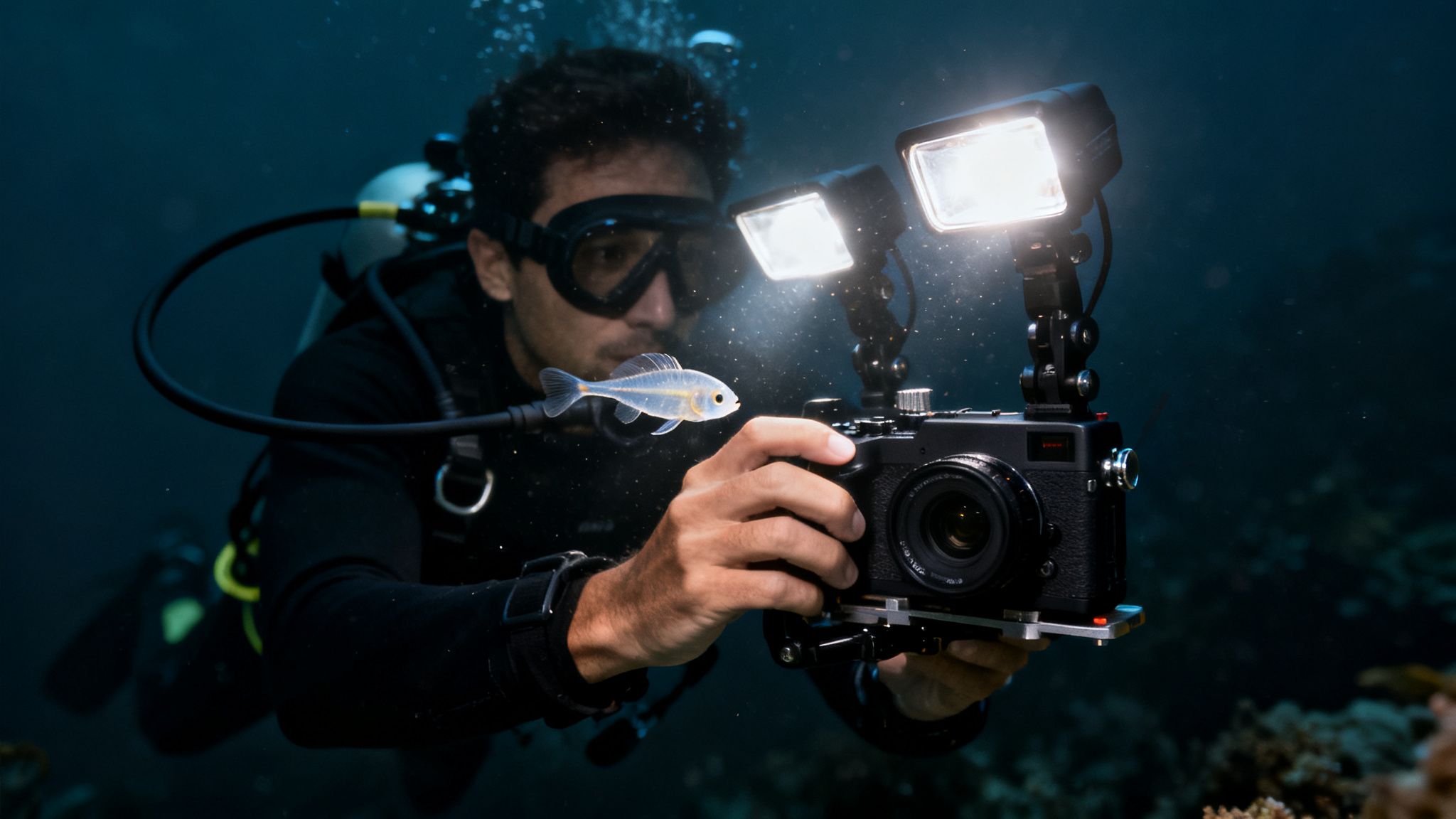
Trying to capture the ghostly beauty of blackwater critters is an art. It’s one part technical know-how, one part patience, and a healthy dose of luck. These animals are often miniscule, see-through, and can move with surprising speed, which makes getting a great shot one of the most satisfying challenges in underwater photography.
It all starts with your camera settings. To freeze these little drifters in their tracks, you’ll need a snappy shutter speed. I’d start around 1/200s or faster to avoid any motion blur and keep your images tack sharp. Of course, shooting in the pitch-black means you have to let light in wherever you can. Open up that aperture (think f/8 or wider) and don’t be shy about bumping up the ISO—starting around 400-800 is a good ballpark.
Lighting the Void
On a blackwater dive, your strobes and focus light are your absolute best friends. In fact, a powerful focus light isn’t just nice to have; it's essential. Your camera's autofocus system will be completely lost in the dark without a strong beam to guide it. A lot of experienced photographers prefer using a red light, which seems to be less disruptive to the light-sensitive creatures you're hoping to meet.
Strobe placement is where the magic really happens. Get it wrong, and you’ll end up with a photo full of backscatter—that snowy, distracting effect from your flash lighting up all the tiny particles in the water.
- Go Wide: Position your strobes way out to the sides of your housing, and even a little behind the plane of your lens. This lights up your subject from the side, not the water right in front of your camera.
- Angle Inward: Turn the strobes so their beams of light cross just in front of where you plan to shoot.
- Manual Power is Key: Set your strobes to a low power setting to start, then adjust from there. Blasting these tiny, transparent animals with too much light will completely wash out their delicate features.
Your goal is to create a "black box" with your light. You're trying to illuminate only the subject, letting the background fall away into pure, inky black. When you nail it, the creature pops from the frame with incredible detail and clarity.
Composition in the Abyss
Without a reef or a sandy bottom to frame your shot, composition is all about the subject. Your focus is singular. Try to get as close as you can to fill the frame and show off the animal’s intricate biology.
Shooting with a slight upward angle can often create a more dynamic and interesting photo. And don't be afraid to play with negative space. A tiny, glowing creature hanging in an endless black void can create a profound sense of scale and awe. It's what makes blackwater diving photography so uniquely captivating.
Common Blackwater Diving Questions
Even the most experienced divers usually have a few questions before their first blackwater dive. It’s not your typical night dive, after all. The whole idea of floating in the open ocean, miles from shore, in the dead of night, brings up some important points about safety, what to expect, and how it all works.Let's walk through some of the questions we hear all the time from divers who are ready to see Kona's incredible pelagic migration for themselves. Getting these answers sorted out is the first step toward having an amazing time out there.
What Certification Level Do I Need for a Blackwater Dive?
This isn’t a dive for brand-new divers. Because you’re floating in the middle of the water column with no bottom in sight, you need to be really comfortable with your skills. Here at Kona Honu Divers, we require an Advanced Open Water certification (or an equivalent from another agency) to join. This is one of the more experienced diving opportunities we offer.
More than just the card, though, you need rock-solid buoyancy control. The whole game is staying perfectly still at your assigned depth on the tether, watching the critters drift by without you bobbing up and down. We also strongly suggest you’ve been on a night dive recently so you're already comfortable with being underwater in the dark before we head miles offshore.
Will I Get Seasick?
It's definitely a possibility, especially if you're prone to motion sickness. We head a few miles offshore into deep, open water where the boat drifts right along with us. It’s a slow, constant motion, but for some people, that gentle rocking is all it takes.
If you know you get seasick, your best bet is to take some non-drowsy medication before you even get on the boat. Most brands recommend taking it an hour or two ahead of time for it to really kick in.
A little bit of planning here can make a world of difference. You want to be focused on the incredible alien-like creatures, not on feeling queasy.
How Deep Do You Go on a Blackwater Dive?
This is probably the biggest surprise for most people. Even though you're floating above thousands of feet of ocean, the dive itself is actually pretty shallow. We attach divers to tethers that keep them at a consistent depth, usually right around 40 to 50 feet (12-15 meters). Your depth is set by the gear, not by you.
The magic here isn't about going deep—it's about the deep coming to you. You're simply hanging out in the path of the largest migration on Earth, where creatures from over 3,000 feet down rise toward the surface to feed under the cover of darkness. You become a silent observer as a parade of unimaginable life drifts right past your dive light. It completely redefines what a night dive can be.
Ready to take the plunge into one of the most unique underwater adventures on the planet? The mysterious world of pelagic marine life is waiting.
At Kona Honu Divers, we specialize in providing safe, professional, and unforgettable blackwater diving experiences. Our expert guides and top-of-the-line equipment ensure you can explore the abyss with confidence. Book your spot today and witness the ocean's greatest migration for yourself.