
Picture this: you're floating in the middle of the deep, dark ocean, miles from shore. Below you? Thousands of feet of inky black water. This is the heart of blackwater diving—a surreal, open-ocean drift dive that puts you front and center for an incredible parade of strange and beautiful creatures rising from the abyss.
What Exactly Is Blackwater Diving?
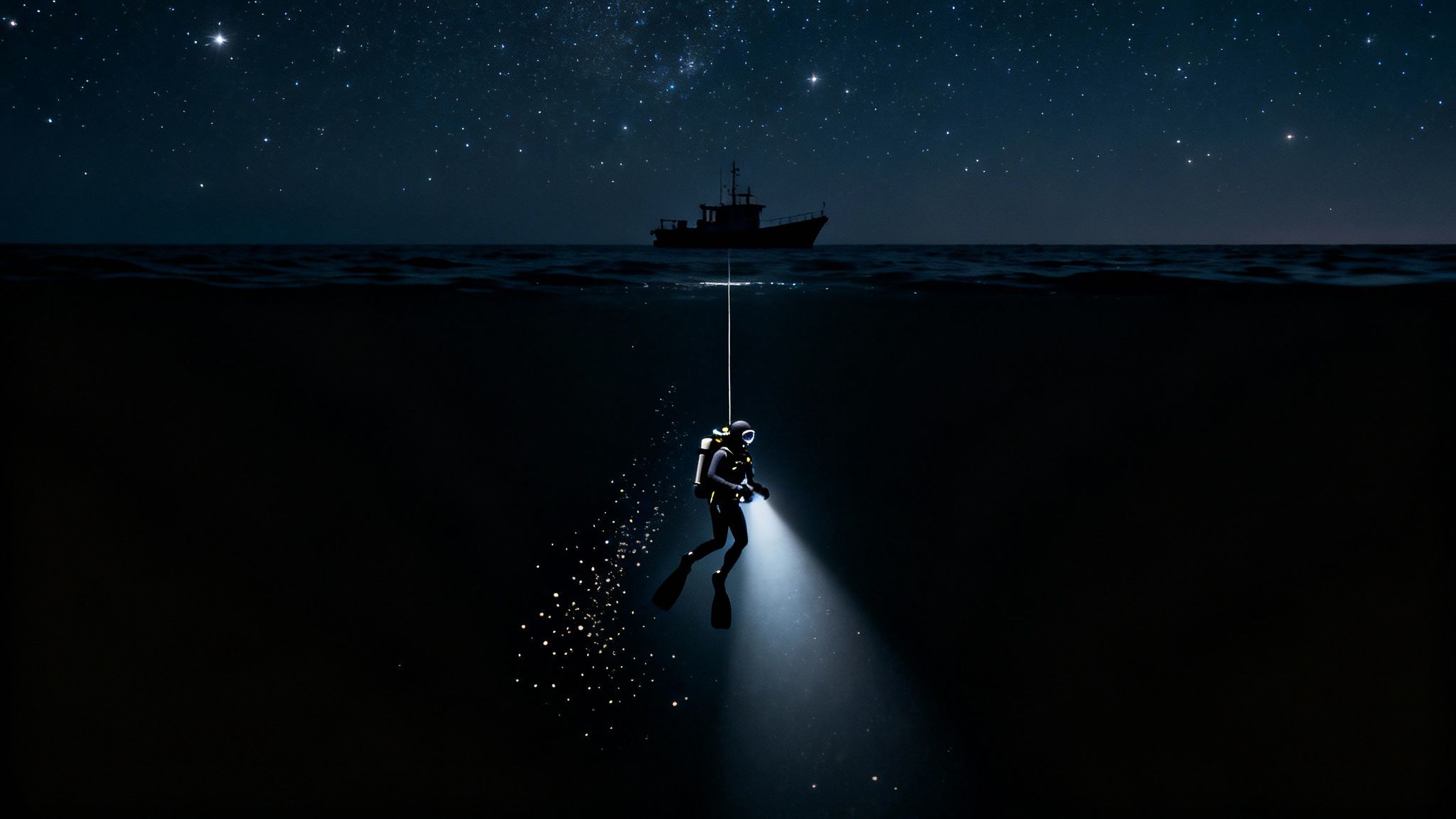
The best way to think about it is like being an astronaut exploring inner space. Your boat on the surface is your spaceship, and your mission is to witness the largest migration on Earth, a phenomenon known as diel vertical migration.
Every single night, a staggering number of deep-sea organisms—literally trillions of them—journey from the crushing pressure of the depths toward the surface to feed, all under the protective cover of darkness. This nightly commute brings up a bizarre and mesmerizing collection of life that most people will never see.
Unlike a typical night dive where you follow a familiar reef line, blackwater diving happens way out in the open ocean, often over waters that are thousands of feet deep. You aren't fighting currents or exploring a fixed spot. Instead, you're just drifting along with the ocean itself, safely tethered to the boat.
A New Frontier Born in Kona
While people have been poking around in the dark ocean for a while, the specific thrill of recreational blackwater diving has a definite birthplace: right here in Kona, Hawaii. This incredible adventure got its start in the 1990s when a few pioneers started experimenting with night drifts. By the early 2000s, it had blossomed into a full-blown tour, drawing divers from all over the world who were hungry to see larval fish and otherworldly planktonic critters.
The techniques developed in Kona have since spread across the globe to places like Florida and Indonesia, but this is where it all began. You can read more about the origins of blackwater diving on Scuba.com.
This unique dive drops you right into an ecosystem that's still largely a mystery. Many of the creatures you'll encounter are in their larval stages, looking completely alien compared to what they'll become as adults. It's an experience that’s both thrilling and profoundly peaceful, as you float weightlessly in a seemingly infinite void.
Blackwater Diving vs. Traditional Night Diving
So, what really separates a blackwater dive from the night dives you might be used to? They're completely different worlds.
Here’s a quick comparison to see what makes blackwater diving such a unique adventure compared to a standard reef night dive.
| Feature | Blackwater Diving | Traditional Night Diving |
|---|---|---|
| Location | Open ocean, miles offshore, over deep water | Coastal reef or known dive site |
| Reference | Suspended mid-water, no bottom visible | Seafloor, reef structures, and landmarks |
| Objective | Observe migrating pelagic organisms | Explore reef life and nocturnal creatures |
| Movement | Drifting with the current, tethered to boat | Navigating a specific area or route |
Essentially, one is about exploring a known environment in the dark, while the other is about drifting through the unknown and letting the ocean bring its mysteries to you.
The Unforgettable Kona Dive Experience
Your blackwater diving adventure in Kona doesn’t just start when you splash into the ocean. It begins at sunset, gathered on the boat for a thorough pre-dive briefing with an expert crew, like our team here at Kona Honu Divers. This briefing is essential; it’s where we walk through the unique procedures of an open-ocean dive, building confidence and making sure everyone is on the same page.
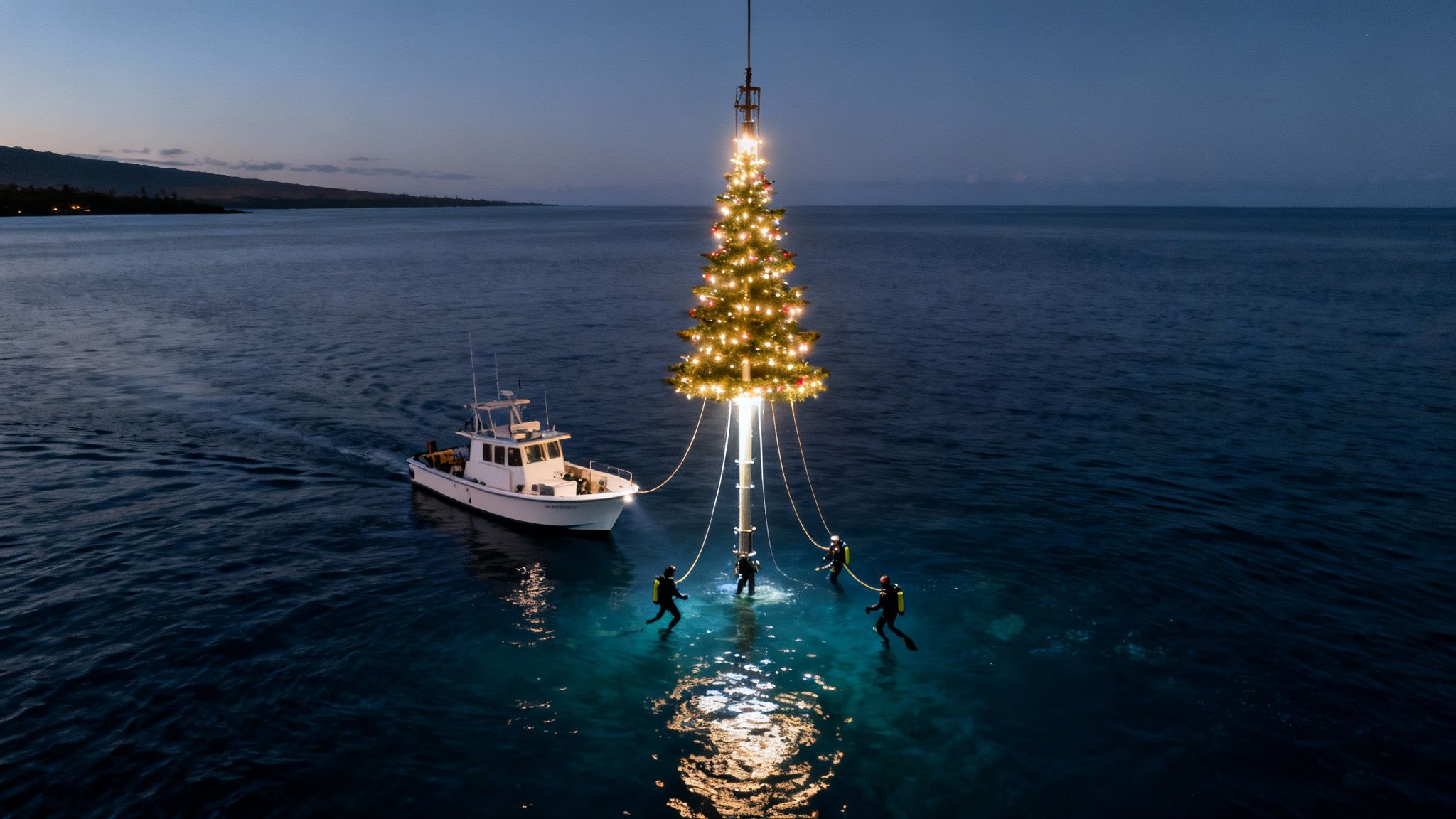
Once we're offshore and the last bit of light has faded, the real magic gets underway. The crew carefully deploys a special lighting rig that we suspend directly beneath the boat. We affectionately call it the "underwater Christmas tree" or a "downline." This powerful beacon cuts through the inky blackness, drawing in a galaxy of plankton and creating a brilliant oasis of life in the deep blue.
This illuminated downline is your anchor to our world. It’s the focal point for the entire dive, acting as both a visual reference and our primary safety system. Every diver gets securely attached to this line with a personal tether, which keeps the group drifting together as one single unit with the boat and the ocean currents.
This highly organized setup is the secret to what makes blackwater diving so incredibly safe. Instead of fumbling around in the dark, you are part of a controlled, drifting system. It frees you up to simply float, watch, and be completely mesmerized by the strange and wonderful creatures that emerge from the deep.
Why Kona Is The Perfect Stage
The Big Island's unique geography makes it the undisputed best place in the world for this type of dive. The incredibly deep water needed to witness the diel vertical migration is just a quick boat ride from Honokohau Harbor. Add in Kona's famously calm seas and predictable weather, and you have the perfect, stable conditions for a comfortable night on the water.
This incredible proximity means you get to spend less time traveling and more time actually diving. Every part of the experience, from the boat captain to the in-water divemaster, is handled by a seasoned crew that’s focused on your safety and making sure you have an amazing time. To see the full range of incredible scuba diving tours on the Big Island, you can check out our main page.
Here at Kona Honu Divers, we’ve spent years perfecting this extraordinary adventure to offer a safe, awe-inspiring window into a hidden realm. Our expertise and meticulous attention to detail ensure every diver feels completely secure while suspended in the profound, beautiful darkness of the Pacific. If this sounds amazing, you’ll probably love Kona’s other world-famous night dive—learn more about the manta ray night dive right here in our guide.
Mastering Your Gear and Safety Protocols
Let’s be clear: safety is the absolute bedrock of every mind-blowing blackwater diving experience. Drifting in the open ocean at night might sound intimidating, but it’s actually a tightly controlled and carefully planned dive from start to finish. Your success, comfort, and safety all come down to having the right gear and knowing the procedures like the back of your hand.
Think of your equipment as your personal life-support system in an alien world. You’ll need a powerful primary dive light to pierce the inky blackness and spot those tiny, often see-through critters. A reliable backup light is just as crucial—because in diving, redundancy is everything. Finally, a small tank marker light makes sure you’re always visible to the divemaster and your buddies.
The Pillars of a Safe Blackwater Dive
If there’s one skill to master for this dive, it’s buoyancy. Without the seafloor to give you any reference points, you need to achieve perfect neutral buoyancy to hang motionless and relaxed in the water column. This lets you hover effortlessly, avoid spooking delicate creatures, and save your energy for the whole dive. For more tips on dialing in your setup, check out our guide on the best scuba gear for beginners.
The tether system is your lifeline, literally. It connects you directly to the boat’s downline, creating a secure bubble in the vastness of the ocean.
- It keeps you connected. The tether ensures you can't drift away from the group and the boat. Simple as that.
- It gives you a reference point. In the featureless void, the line provides a physical anchor for your brain, helping with orientation.
- It maintains group integrity. The system keeps every diver within a manageable radius, making it easy for the in-water divemaster to supervise everyone.
While the divemaster manages everything underwater, a dedicated surface crew is always on watch, monitoring conditions topside. To give you even more of an edge, Kona Honu Divers provides complimentary Enriched Air Nitrox. Using nitrox lets you safely extend your bottom time, giving you more opportunity to witness the incredible vertical migration without bumping up against your no-decompression limits. This dive is one of many more experienced diving opportunities available.
Blackwater diving isn't a high-risk gamble; it's a calculated adventure built on layers of safety, professional oversight, and proper gear.
This meticulous approach is standard practice in a massive global industry. Recreational diving pumps between $8.5 and $20.4 billion into economies worldwide, and as the birthplace of blackwater diving, Kona's expert operators are a key part of that market. For true peace of mind on any remote adventure, it's also worth understanding emergency beacons like EPIRBs and PLBs, which provide a direct link to rescue services when you're far beyond cell signal.
How to Photograph Deep Sea Creatures
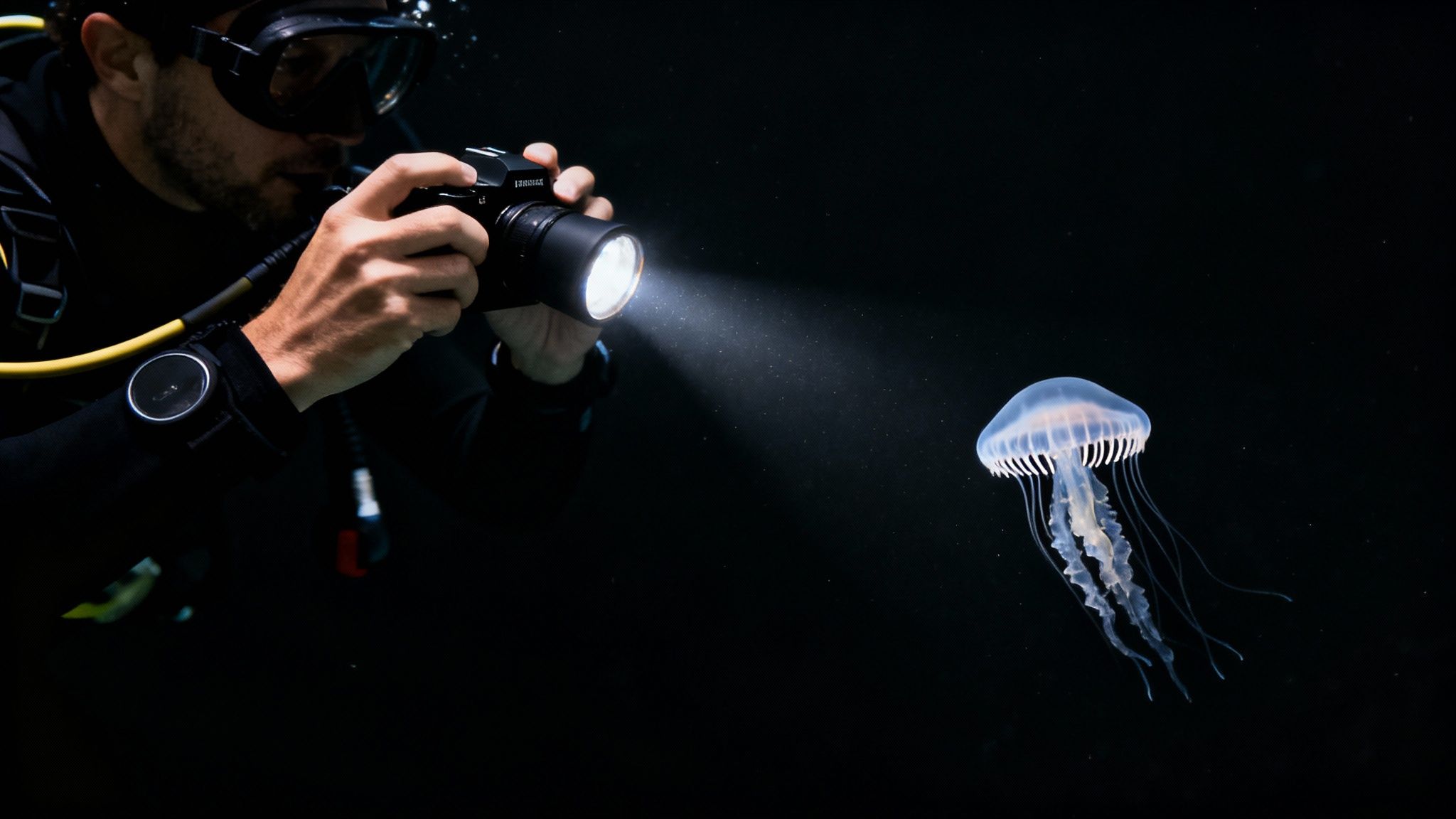
For underwater photographers, blackwater diving is the ultimate final frontier. It’s an incredible mix of high-stakes challenge and unbelievable reward. Nailing a perfect shot of the strange, often see-through creatures that drift up from the deep requires a totally different mindset than shooting on a sunlit reef.
The environment is absolute black, and your subjects are often tiny, jittery, and always on the move. Getting the shot comes down to mastering your camera settings and, most importantly, your lighting to deal with these unique conditions. It doesn't matter if you're using a simple point-and-shoot or a complex DSLR rig; the fundamentals are the same. You have to be fast, precise, and have a good dose of patience.
Nailing Your Camera and Lighting Setup
The main objective here is to make your subject pop against that perfect, inky-black backdrop. To do that, you need to get your strobes or video lights off your camera housing. This lets you create lighting angles that slash backscatter—that annoying blizzard of illuminated particles that can ruin an otherwise great photo.
Focusing is easily the biggest challenge out there. Most camera autofocus systems will hunt endlessly trying to lock onto a nearly invisible larval fish drifting in the void.
- Bring a powerful focus light: This is non-negotiable. A dedicated, strong focus light is your best friend. Many experienced blackwater shooters prefer a light with a red mode, which is far less likely to spook the delicate critters.
- Get comfortable with back-button focus: By separating the autofocus from your shutter button, you can lock focus once and then recompose the shot without your camera constantly trying to find a new target. It’s a game-changer.
- Give manual focus a try: For more advanced photographers, switching to manual focus with focus peaking offers the most precise control over what’s perfectly sharp.
The secret formula is a fast shutter speed to freeze the action, a small aperture (like f/8 or higher) to maximize your depth of field, and a low ISO to keep the image clean. Your strobes will do all the heavy lifting to light the subject perfectly.
Photographer Etiquette in the Big Black
Beyond just your camera skills, how you act in the water is hugely important. Remember, you’re part of a team, floating in the open ocean and connected by tethers. Keeping your gear and movements in check is key to a safe and successful dive for everyone.
Always be aware of where your tether is, making sure it doesn't get tangled up in your camera rig or anyone else's gear. Slow, deliberate movements are best to avoid scaring off the very creatures you came to see. And, of course, be mindful of your buddies. Never blast your powerful lights into another diver's eyes, and try not to hover directly below someone—your exhaust bubbles can drift up and photobomb their shot.
If you want a little inspiration, take a look through a gallery of beautiful Kona diving pictures to see what's possible when you get the technique just right.
Discovering a Hidden Universe of Marine Life
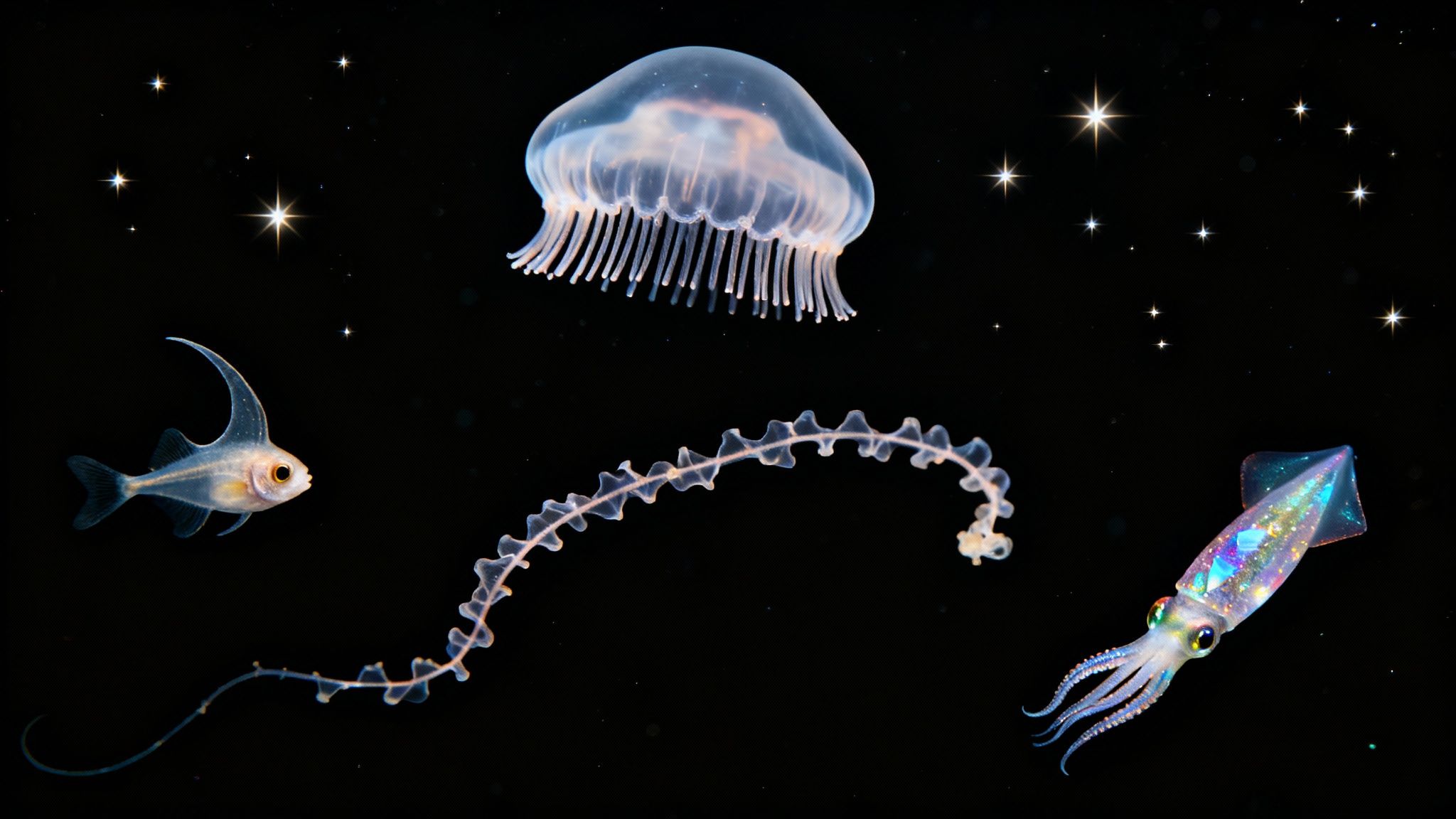
This is where the real magic of blackwater diving happens. As you drift in the vast, silent dark, the lights from the boat start to do their work. They act like a magnet, pulling a parade of bizarre and beautiful characters up from the abyss. This isn't just another dive; it's a treasure hunt where every flicker of movement reveals something more alien and wonderful than the last.
You'll quickly see that you've entered a world of miniatures. Many of the animals you'll encounter are in their larval, or juvenile, stages and look nothing like the adults they'll become. It’s like getting a rare glimpse into the secret baby photo album of the ocean, connecting the mysterious deep with the sunlit reefs we know so well.
Every single dive is a roll of the dice. You never know what you'll find, but you’re almost guaranteed to come face-to-face with creatures that look like they were pulled straight from a sci-fi film.
The Stars of the Abyss
The cast of characters is constantly changing, but there are a few regulars you’re likely to meet, each with its own incredible way of surviving out here in the open ocean.
- Larval Fish: These are often the highlight. You might see a baby flounder with an eye still on each side of its head, before it makes the long journey over to the other side. Or maybe a larval eel, called a leptocephalus, that looks more like a ghostly, transparent ribbon than a fish.
- Shimmering Ctenophores: Don't call them jellyfish! These comb jellies move using rows of tiny beating cilia that catch your light and shatter it into pulsating rainbows. It's an absolutely mesmerizing light show.
- Colonial Siphonophores: These aren't single animals but huge, drifting colonies of individual organisms all working as one. They can float past like living starships, some stretching to incredible lengths. Their most famous relative is the Portuguese man o' war.
- Cephalopods of the Deep: The abyss is home to some wild cephalopods. If you're lucky, you might spot a jewel-like diamond squid or a tiny, elusive pelagic octopus—creatures you have almost zero chance of seeing anywhere else.
More Than a Dive, It's Citizen Science
This incredible access to deep-sea life has turned blackwater diving into a powerful tool for marine biology. What started as a niche hobby has become a goldmine for scientific discovery.
For example, a recent project analyzing specimens collected during recreational blackwater dives right here off Kona identified 76 deep-sea organisms. Of those, 44 were a 99% match to existing genetic barcodes. This kind of collaboration between divers and scientists is rapidly expanding what we know about the deep ocean. You can discover more about these scientific findings directly from the research paper.
Each dive holds the potential for real discovery. You are floating through a living laboratory where new, and sometimes even undescribed, species can appear in your light beam at any moment. It transforms the experience from a simple observation into a genuine exploration of one of Earth's last true frontiers.
Your Blackwater Diving Questions Answered
Let’s be honest—the idea of dropping into the deep, dark ocean miles from shore brings up a few questions. And that’s a good thing! This isn't your average reef dive, and being prepared is part of the adventure. We’ve been running these trips for a long time, so we've put together answers to the most common things divers ask before taking the plunge.
What Certification Level Do I Need for Blackwater Diving?
Most reputable dive shops, including us here at Kona Honu Divers, will ask for an Advanced Open Water certification or an equivalent. But it's less about the card you carry and more about the skills you have in the water.
Two things are non-negotiable for this dive: rock-solid buoyancy control and being completely at ease with night diving. You’ll be suspended in the water column with no bottom in sight to use as a reference. The ability to hold your depth without even thinking about it is what makes this dive both safe and incredible.
Is Blackwater Diving Safe?
Absolutely. When you go with an experienced, professional crew, blackwater diving is an extremely controlled and safe activity. Our entire operation is built around managing the open-ocean environment, with your safety being the one and only priority.
We use a system of multiple safety layers to make sure everything runs smoothly:
- A Secure Tether System: Every single diver is attached to a brightly lit downline via their own personal tether. This line runs straight up to the boat, so there's zero chance of drifting away from the group or the vessel.
- In-Water Supervision: One of our expert divemasters is in the water with you the entire time. They're there to monitor depths, help with anything you need, and make sure dive protocols are followed.
- Surface Support: A dedicated captain and crew stay on board, keeping an eye on the big picture—tracking the boat's drift, monitoring conditions, and managing the dive from above.
What Happens If the Weather Is Bad?
Simple: we don't go. Your safety is never, ever worth gambling on. Our crew watches the marine forecasts and real-time conditions like a hawk.
If the weather kicks up—high winds, big swells, or ripping currents—we will cancel the trip. It's a tough call, but it's the right one. When this happens, we’ll work with you to reschedule for another night or provide a refund. It's always a good idea to double-check the specific cancellation policy when you book.
Will I Get Seasick?
It’s a real possibility, so it's best to plan for it. We're heading a few miles offshore where the boat will be drifting in open-ocean swells. Even on what feels like a calm night, there’s always some movement.
If you know you're prone to motion sickness, or even if you're just not sure, we strongly suggest taking a non-drowsy motion sickness medication. Make sure you take it well before the boat leaves the harbor, following the package directions. It's far better to be proactive so you can focus on the amazing creatures below instead of feeling queasy.
Ready to dive into one of the most unique underwater experiences on the planet? The team at Kona Honu Divers is here to guide you safely into the abyss.
You can book your unforgettable Kona blackwater dive tour with us today!