
Picture this: you're floating weightlessly in the deep, dark ocean, miles off the Kona coast. Above you, a brilliant blanket of stars; below you, thousands of feet of inky black water. This isn't your average night dive on a reef. This is a Kona blackwater dive, one of the most surreal and captivating underwater experiences you can possibly have.
It’s less about exploring a stationary reef and more about becoming part of a massive, living phenomenon.
What Is A Kona Blackwater Dive
A blackwater dive in Kona is a specialized night dive where you drift in the open ocean, safely tethered to a boat, and witness one of the planet's greatest spectacles. You're positioned directly in the path of the Diel Vertical Migration—the largest daily migration of life on Earth.
Every single night, a countless host of bizarre, bioluminescent, and often larval creatures travel from the abyss toward the surface to feed, and you get a front-row seat.
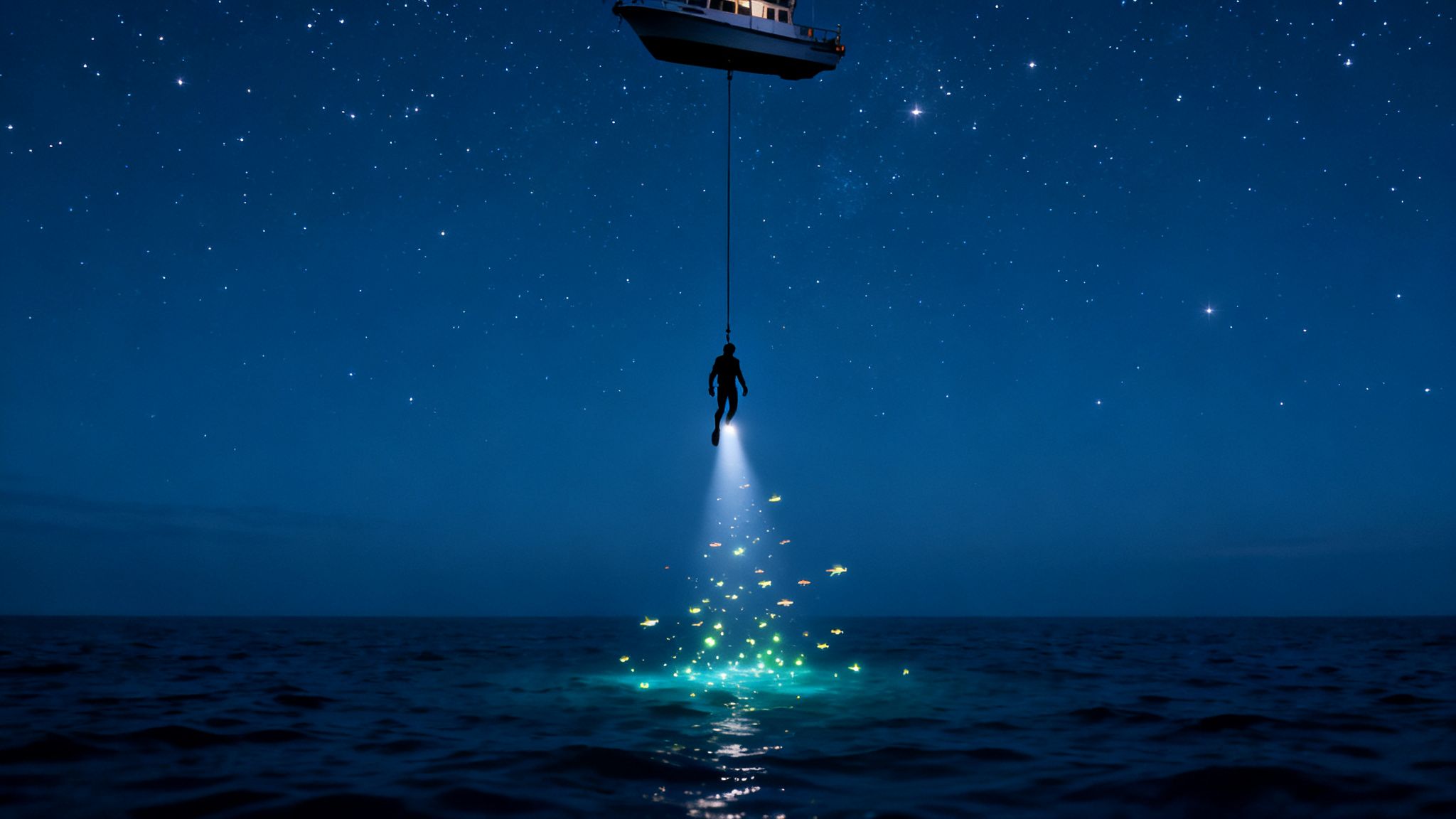
The experience is frequently compared to floating in outer space, but the strange, alien-like life forms swirling around you are very, very real.
It’s like being an astronaut discovering a new galaxy, except the aliens glow and they’re coming to you. You're tethered for safety, just drifting peacefully as the hidden universe of the deep sea reveals its most incredible secrets right in front of your mask.
The Original and Best Blackwater Experience
While the concept of blackwater diving has spread across the globe, it all started right here in Kona. The Big Island’s unique underwater geography, where the seafloor plummets to thousands of feet just a few miles from shore, creates the perfect, easily accessible stage for this nightly migration. Nowhere else can you get to this deep-water environment so quickly.
Here’s a snapshot of what happens on the dive:
- Drift Miles Offshore: We take you out into the open ocean, far from any reef, where the water below is thousands of feet deep.
- Stay Safely Tethered: You and the other divers are connected by horizontal tethers to a central downline from the boat. This keeps everyone together and at a consistent depth, typically around 50 feet, so you can relax and enjoy the show.
- Encounter Bizarre Creatures: Your high-powered dive light acts like a beacon, attracting an incredible array of larval critters, pulsating jellies, and other deep-ocean dwellers you’d never encounter otherwise.
Setting the Scene for an Alien World
The setup itself is brilliantly simple. The boat's lights attract plankton, and your personal dive torch illuminates the weird and wonderful creatures that come to feed on it. Your job is just to float, watch, and be amazed as a parade of life drifts past your mask.
This is a profoundly different kind of dive. You aren't swimming toward a static environment like a reef or a wreck; the environment is a living, moving river that flows right to you. One moment you might see a larval octopus no bigger than your thumbnail, the next a shimmering siphonophore that looks like a spaceship from another dimension.
It's an unforgettable adventure for experienced divers looking for something truly unique. Ready to see it for yourself?
You can book your own journey into the abyss with Kona Honu Divers on our celebrated Blackwater Dive tour.
Discover The Creatures Of The Deep
The real magic of a blackwater dive in Kona isn't just about floating in the dark; it's about the absolutely incredible parade of life that rises from the abyss to meet you. Every single night, countless tiny organisms make the largest daily migration of life on our planet, traveling thousands of feet toward the surface to feed. They do it all under the cover of darkness, and your dive light becomes a beacon in this living, moving current.
You'll be surrounded by a cast of characters that look like they were pulled straight from a sci-fi movie.
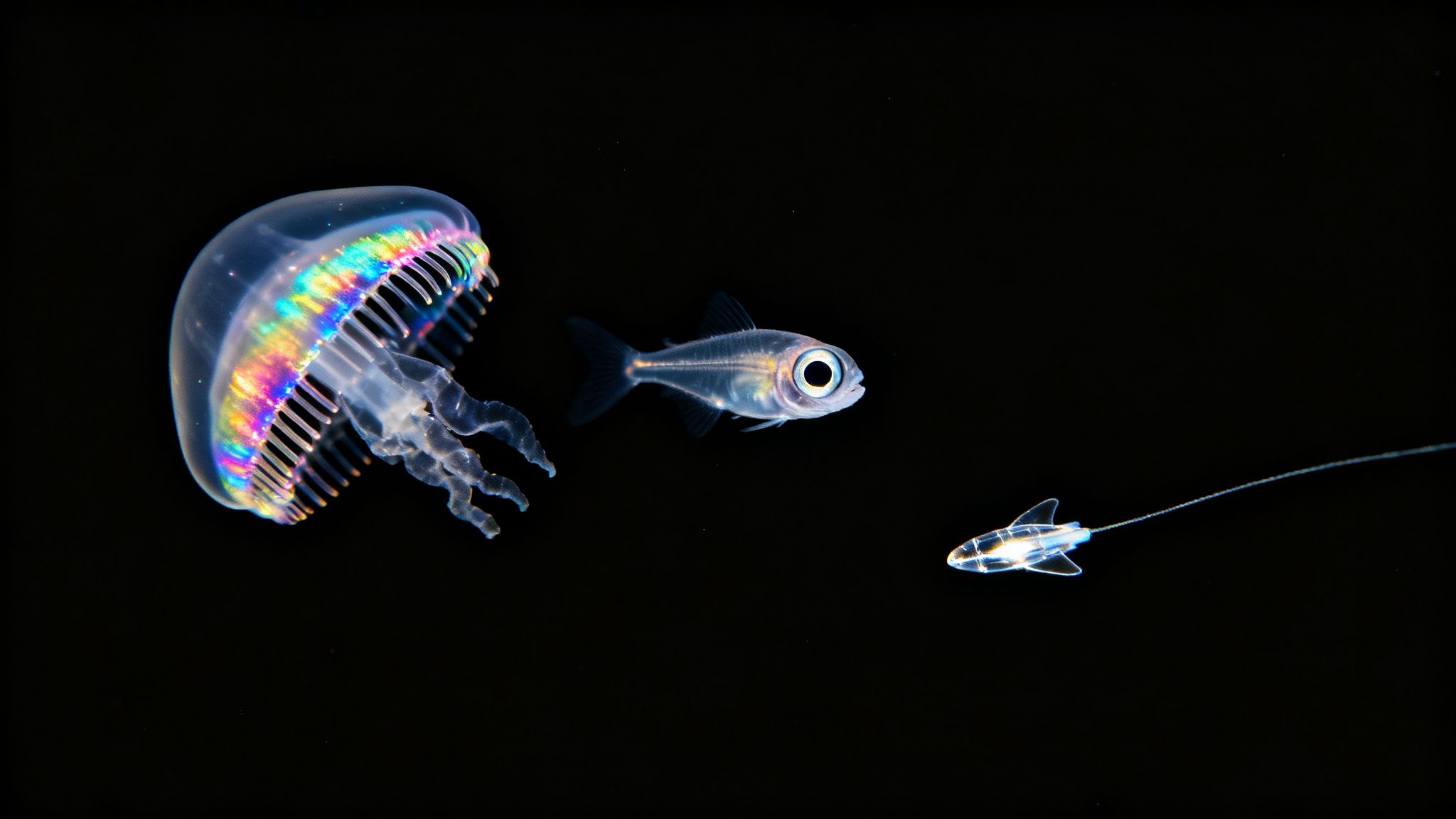
This dive gives you a front-row seat to one of nature's most profound and hidden spectacles. You're witnessing a vibrant, temporary ecosystem that literally materializes out of the void and vanishes completely by dawn.
An Alien Menagerie From The Abyss
Forget what you know about typical reef fish. The creatures you’ll meet out here are masters of survival in the open ocean, where there’s absolutely nowhere to hide. Many are in their larval stages and look nothing like their adult forms. Their primary defenses are being transparent or using bioluminescence—adaptations that make them both incredibly hard to spot and utterly mesmerizing when they drift into your beam.You can expect a constant stream of bizarre and beautiful organisms floating by. Some common sightings include:
- Pulsating Jellies and Ctenophores: Comb jellies drift past, refracting your light into shimmering rainbows that pulse down their bodies. You’ll also see other jellies trailing delicate, nearly invisible tentacles as they hunt for microscopic prey.
- Larval Fish and Cephalopods: Look closely for tiny, almost invisible larval fish. Often, all you'll see is a pair of silver eyes floating in the dark. You might also spot juvenile octopuses or squid, some no bigger than your fingernail, already showing off their mastery of camouflage.
- Pelagic Siphonophores: These are easily some of the strangest things you'll ever see. They aren't single animals but massive colonies of individual creatures working together. They can form chains stretching for several feet, looking like a glowing, alien spaceship drifting through the cosmos.
The sheer diversity is what gets you. One moment you're focused on a tiny, translucent shrimp with glowing antennae, and the next, a deep-sea squid with iridescent skin materializes from the darkness. It’s a constant, unpredictable flow of life.
This whole incredible adventure has deep roots right here in Kona. The blackwater dive was pioneered on the Big Island by hardcore divers fascinated by our unique underwater topography—the seafloor drops to abyssal depths just minutes from shore. What started as a word-of-mouth obsession grew into the world-class experience it is today. It's so significant that even NOAA researchers join commercial trips to study this amazing biological community. You can dive deeper into how Kona became the global epicenter for this dive in this fascinating article on Hawaii's most extreme scuba experience.
Why These Creatures Look So Strange
Those alien-like features you see are just brilliant evolutionary solutions for life in the open ocean. Survival out here boils down to a simple principle: eat and avoid being eaten.Transparency is a fantastic form of camouflage, making many organisms nearly invisible to predators. Bioluminescence, on the other hand, serves all kinds of purposes—it can attract mates, lure prey, or startle a predator with a sudden flash of light. Some squid, for instance, can release a cloud of glowing ink to completely disorient an attacker.
As you float there in the darkness, you're not just looking at weird animals; you're witnessing a masterclass in deep-sea adaptation. Every strange shape, glowing organ, and transparent body tells a story of survival in one of Earth’s most extreme environments.
Blackwater Dive Vs. Manta Ray Night Dive
Kona is world-famous for its night dives, and two experiences stand out above all others. While both happen after dark, they offer completely different adventures. Here’s a quick rundown to help you decide which one is right for you.| Feature | Blackwater Dive | Manta Ray Night Dive |
|---|---|---|
| The Vibe | A quiet, Zen-like drift in the open ocean, focusing on tiny, alien-like creatures. | An energetic, "underwater campfire" atmosphere, watching giant mantas swoop and feed. |
| Marine Life | Microscopic and larval creatures: jellies, squid, strange fish, and bioluminescent organisms. | Giant Pacific Manta Rays (up to 16 feet), plus reef fish attracted to the lights. |
| Depth | Drifting in the open ocean over thousands of feet of water, but divers stay at 40-50 feet. | A stationary dive on the sandy bottom at a much shallower depth of around 35 feet. |
| Activity | Floating calmly while tethered to a line, observing what drifts by your light. | Kneeling or sitting on the seafloor as mantas gracefully glide right overhead. |
| Best For | Experienced divers, macro photographers, and anyone fascinated by the weird and wonderful. | Divers of all levels (including snorkelers), and anyone wanting a guaranteed big animal encounter. |
Choosing between them really comes down to what you're hoping to see. Do you want the thrill of watching majestic giants perform an underwater ballet, or are you intrigued by the mysterious, alien world of the deep? Of course, the best answer is to do both!
Ready to meet these incredible creatures face-to-face? Book your spot on the next Kona Honu Divers blackwater dive and prepare for an experience you'll never forget.
How To Prepare For Your Blackwater Dive
A blackwater dive in Kona is easily one of the most incredible underwater experiences you can have, but it’s definitely not your average reef tour. Think of it as a specialized adventure that demands a solid base of skill, confidence, and the right mindset. Getting properly prepared is the key to not just staying safe, but being able to truly lose yourself in the alien world that appears in your light beam.
We classify this as an advanced diving opportunity, and for good reason. You’re miles offshore, at night, suspended over thousands of feet of water. Let’s walk through exactly what it takes to be ready for the abyss.
Diving Prerequisites and Essential Skills
To make sure everyone has a fantastic and safe time, we have some firm prerequisites for joining our blackwater dives. These aren't just arbitrary rules; the open ocean environment simply demands a higher level of comfort and skill from every diver in the group.
Certification and Experience Requirements:
- Advanced Open Water Certification: This is the absolute minimum. The training you receive in skills like deep diving and navigation builds the foundation you'll need out there.
- A minimum of 50 logged dives: This number is our benchmark for ensuring you've spent enough time underwater to be truly comfortable with your gear and basic procedures. It allows you to focus on the unique environment, not on fiddling with your equipment.
More than any number on a certification card, the single most important skill for a blackwater dive is mastery of buoyancy control. You’ll be hovering in mid-water with zero visual references—no reef below, no surface above.
Your ability to hold your depth and maintain a neutral position without even thinking about it is paramount. The biggest risks out there are unintentional ascents or descents, and pinpoint buoyancy is your best defense.
Be honest with yourself before you book. Are you constantly adding or dumping air from your BCD, or can you hang effortlessly in the water column? If you need practice, get it in calmer conditions until buoyancy becomes second nature.
Gauging Your Comfort in the Dark
A blackwater dive is a full-on sensory experience. For many divers, the thought of floating in the vast, dark ocean is a thrill. For others, it can be a bit much. It’s really important to know where you stand with darkness and the open ocean.
Ask yourself a few questions:
- Have you done a night dive before? How did it make you feel?
- Are you okay in deep water where you can’t see the bottom?
- How does the idea of being miles from shore, in the middle of the ocean at night, sit with you?
There's no right or wrong answer here, but being honest with yourself will tell you if this dive is a good fit. We want you to feel a sense of wonder, not a sense of anxiety. A calm, relaxed diver is a safe diver who will get the absolute most out of this incredible adventure. To get a better feel for the dive, check out our guide on the gear you will need for your Kona diving adventure.
Essential Gear for the Abyss
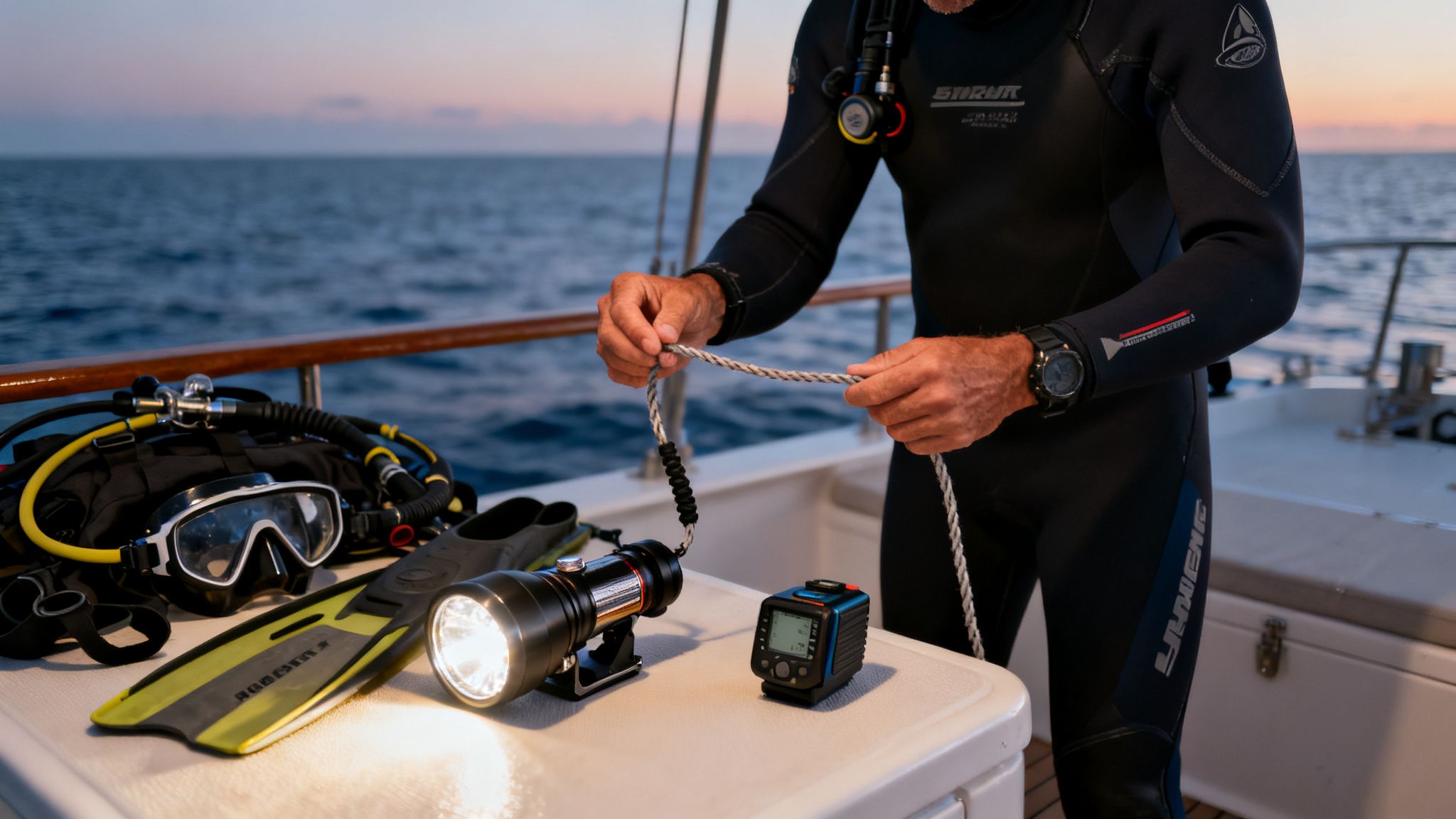
While we provide the tanks, weights, and high-quality rental gear, your personal equipment can make a huge difference in your comfort and safety. The most critical piece of gear you’ll be in charge of is your dive light.
A powerful primary dive light isn’t just a good idea—it's essential. This light is your window into the abyss, the beacon that attracts and illuminates the bizarre creatures rising from the depths. A bright, wide beam is what you want for the best viewing. Equally important is a reliable backup light. On the off chance your main light fails, a backup ensures you can safely signal your guide and finish the dive without issue. Getting your gear and your skills dialed in is the first step toward an unforgettable journey into Kona's deep-sea secrets.
Why Choose Kona Honu Divers For Your Dive
Let’s be honest: picking an operator for a blackwater dive in Kona is the most critical choice you’ll make. This isn't your standard reef tour. It's a highly specialized trip, miles offshore in the dead of night, where your safety and the crew's expertise are everything.
At Kona Honu Divers, we've poured years into perfecting this dive, creating an experience that's not only mind-blowing but built on a bedrock of safety.
From the moment you board, you’ll see what we mean. Our pre-dive briefings are incredibly thorough, covering much more than just the dive site. We walk you through every detail, from how our professional tether system keeps everyone connected and safe to the specific hand signals we use in the dark. Our goal is to make you feel completely confident so you can relax and just soak in the magic.
Expertise That Makes A Difference
Our dive guides are the core of our blackwater charter. These aren't just tour leaders; they are passionate experts who live and breathe Kona's offshore environment and the bizarre creatures that rise from the depths. With a combined 200 years of experience, our crew knows these waters intimately.
Their eyes are trained to spot the nearly invisible larval creatures and delicate, translucent jellies that most divers would swim right past. This is what turns a float in the dark into a guided safari through a hidden world. They’ll point out things you never knew existed, transforming your dive into something truly unforgettable. You can learn more about what sets our crew apart and why we’re known as a top dive operator on the Big Island.
A World-Class Tour From Start To Finish
A great dive is about more than just what happens underwater. We believe the entire experience should be seamless and comfortable. Our boats are spacious and stable, designed specifically with divers in mind to give you a solid, comfortable platform for your adventure.
We also know the little things make a big difference. That's why we provide free nitrox for all certified divers on this trip. It’s a small touch that helps extend your bottom time and adds an extra layer of safety, letting you focus completely on the incredible sights around you.
Our mission is simple: deliver a world-class experience built on a foundation of unwavering safety and genuine passion for the ocean. We handle all the logistics so you can have the adventure of a lifetime.
But you don't have to take our word for it. Hearing from other divers who have taken the plunge with us says more than we ever could.
Ready to see what’s really down there? Book your spot and get ready to discover a side of Kona you’ve never imagined.
Photography Tips For Capturing The Void
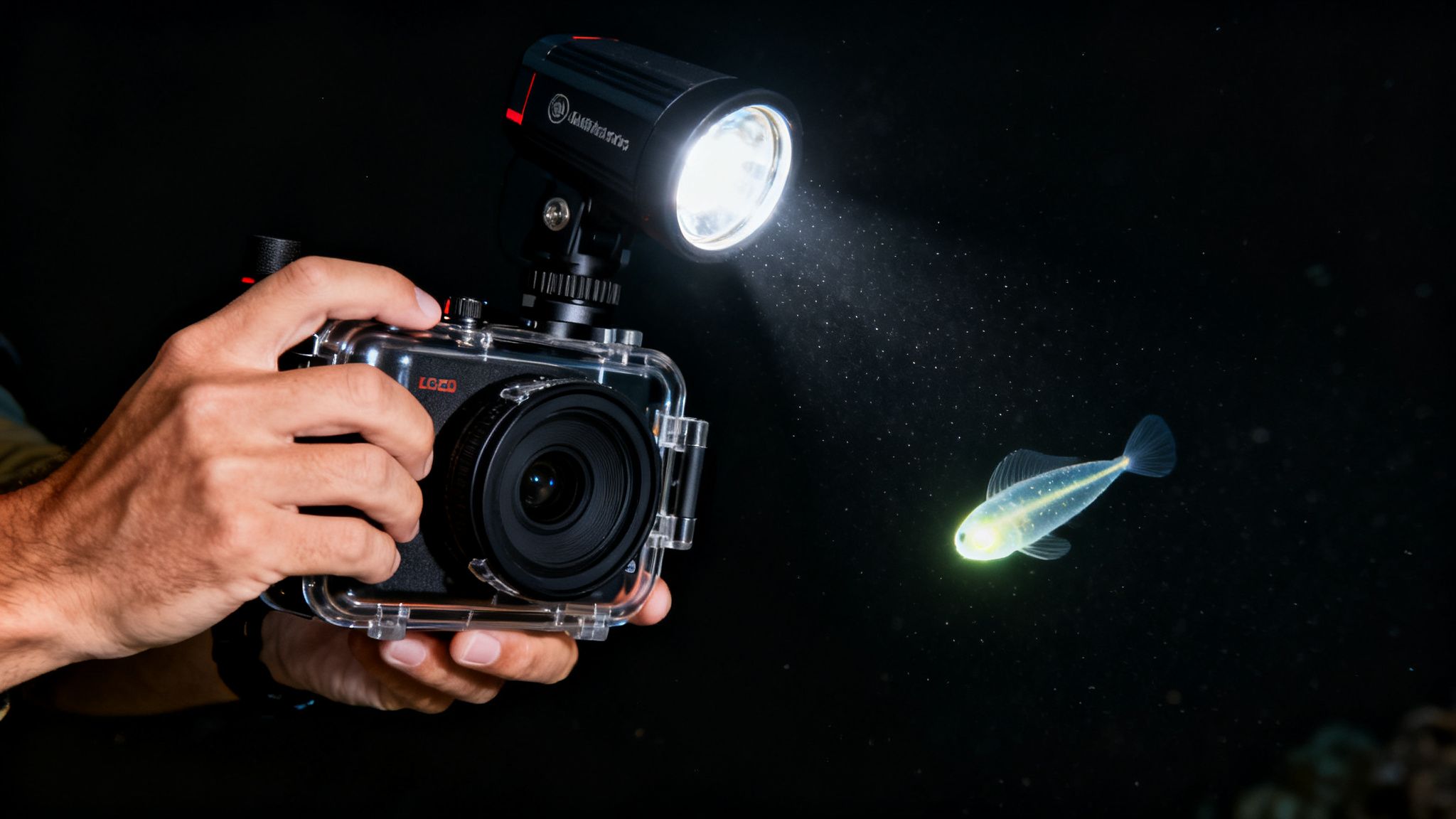
Trying to photograph the tiny, see-through, and often glowing creatures on a blackwater dive in Kona is one of the toughest—and most rewarding—challenges in underwater photography. Forget everything you know about shooting on a sunlit reef with predictable subjects. Out here, you’re chasing minuscule, fast-moving critters in pure, inky blackness. It’s a whole different ballgame, but with the right approach, you can walk away with some truly mind-bending images.
Dialing In Your Camera Settings
Your camera settings are where it all begins. The trick is to freeze the motion of your subject while getting a proper exposure against that perfectly black background. It’s a delicate balance.
Here’s a solid starting point to get you in the ballpark. Tweak from here based on your rig and the conditions.
- ISO: Start higher than you normally would, somewhere around 640 to 800. This gives your camera's sensor the light sensitivity it needs to work in the dark.
- Aperture: Stop down to a smaller aperture, like f/16 to f/22. This gives you a deeper depth of field, which is a lifesaver when trying to get a tiny, drifting critter entirely in focus.
- Shutter Speed: Max out your camera's sync speed. For most cameras, that’s going to be 1/200th or 1/250th of a second. This speed is what helps eliminate motion blur from you or the subject.
The secret is to let your strobes do all the work. That fast shutter speed makes the background go completely black, while the strobes fire a powerful burst of light that freezes your subject in stunning detail.
Mastering Your Lighting
Your lights are your everything out here. There's no ambient light to work with, so if your lighting isn't right, you're just taking photos of… well, black water.
A good set of external strobes isn't optional; it's mandatory. That blast of light is what illuminates the subject and freezes it in place. Just as critical is a powerful focus light. Your camera's autofocus system will hunt endlessly for these nearly invisible creatures without a strong, steady beam to lock onto. For a broader look at lighting in the dark, our guide to scuba diving at night has some great pointers that also apply here.
Strobe placement is also key to avoiding backscatter—those ugly white spots that ruin an otherwise perfect shot. The trick is to push your strobes way out to the sides and slightly ahead of your lens port. This creates a cone of light that illuminates your subject without lighting up all the particles floating right in front of your camera.
Focus and Composition Techniques
With your gear all set, the rest comes down to patience and technique. Hunting for a tiny, drifting organism in the dark takes a steady hand and a sharp eye. Use your focus light to slowly scan the water in front of you. When you see something, approach it slowly—sudden movements will send it darting away.
Try to fill the frame, but don't forget about the power of negative space. That endless black background is your canvas. Placing a weird larval fish or a glowing ctenophore slightly off-center often makes for a much more compelling photo than just sticking it in the middle. Let the void work for you and make your bizarre little subjects truly stand out.
Frequently Asked Questions About The Kona Blackwater Dive
Let's be honest: the idea of dropping into the pitch-black ocean, miles from shore, brings up a few questions. That's completely normal. The blackwater dive in Kona is unlike anything else, so it’s smart to get the full picture before you commit. We've compiled the most common questions our crew gets and answered them straight-up, so you can feel confident and ready for one of the most mind-blowing diving tours in Kona you'll ever do.
Is Blackwater Diving Dangerous?
This is always the first question, and for good reason. Safety is our absolute priority. While any kind of scuba diving has its inherent risks, a professionally run blackwater dive is a highly controlled and supervised experience—not a free-for-all in the open ocean.
Our whole safety system is built around the tethers. Every single diver is clipped onto a horizontal line, which is connected to a heavy, weighted downline dropped from the boat. This does two critical things:
- It keeps everyone together. No one drifts off. You're always connected to the group, the guide, and ultimately, the boat.
- It controls your depth. The tethers keep you at a consistent depth of about 50 feet, so there’s no chance of accidentally descending into the thousands of feet of water below.
On top of that, our experienced guides are right there in the water with you the entire time. You'll get a detailed pre-dive briefing covering every procedure and signal before you even think about getting in. And while we're in the open ocean where big animals live, encounters with things like sharks are incredibly rare on these dives. The real show is the bizarre, tiny stuff floating up from the deep.
How Is a Blackwater Dive Different From a Reef Night Dive?
Fantastic question. They both happen at night, but they are two completely different worlds. Think of a normal reef night dive like a walk through a familiar park after dark with a flashlight. You’re exploring a solid structure, following its contours, and looking for nocturnal critters in their homes. You always have the reef right there as a point of reference.
A blackwater dive in Kona is more like floating through deep space.
- The Setting: You’re not on a reef. You are suspended in the middle of the water column over thousands of feet of pure blackness. There is no bottom to see.
- The Goal: You aren't exploring a static place. You're positioning yourself to witness a massive natural event: the nightly vertical migration of deep-sea life toward the surface. The creatures come to you.
- The Animals: You'll see things you would never, ever find on a reef. We're talking about otherworldly larval creatures, glowing jellies, and critters that look like they were designed for a sci-fi movie.
A reef dive is about seeing what lives on the reef. A blackwater dive is about seeing what lives in the open ocean itself. If you're looking for a classic night dive with guaranteed large animal sightings, our world-famous Manta Ray Night Dive is an absolute must-do and a completely different kind of Kona adventure.
What Should I Bring On The Boat?
Packing is pretty simple. You just need the essentials for the dive and a few things to keep you comfortable before and after you hit the water.
Here’s a quick checklist:
- Cert Cards & Logbook: We'll need to see proof of your Advanced Open Water certification and logged dives.
- Your Personal Gear: We provide tanks and weights, but most divers feel more comfortable with their own mask, computer, and regulator setup.
- A Towel: A simple but crucial item.
- Warm, Dry Clothes: Don't underestimate this one. Even in Hawaii, the boat ride back can get chilly after a night dive. A sweatshirt or light jacket will feel like a lifesaver.
We take care of all the specialized gear like the tethers and lights, so you can just focus on the dive ahead.
Will I Get Seasick?
It's a definite possibility. We're heading a few miles offshore into the open ocean, where there can be some swell. If you're someone who is prone to motion sickness, you'll want to plan ahead for this.
The best way to deal with seasickness is to prevent it from ever starting. Once you start to feel queasy on the water, it's usually too late to turn it around.
If you know you might get sick, taking an over-the-counter medication is your best bet. The key is to take it well before the trip starts—usually an hour or more before we leave the dock—so it has time to kick in. Talk to your doctor about what's right for you. Staying hydrated and avoiding a big, greasy meal beforehand also helps a ton.
Ready to see a side of the ocean few people ever will? Our expert crew at Kona Honu Divers is here to safely guide you into the abyss for an experience that will completely change how you see the sea. Book your Black Water Night Dive and prepare to be amazed.