
Picture this: you're floating in a silent, inky void, miles from shore and suspended over thousands of feet of deep, dark ocean. It might sound like science fiction, but it’s the reality of a blackwater dive in Kona. This incredible adventure is often called a 'spacewalk' in the Pacific, and for good reason—it turns the deep ocean into an illuminated stage for creatures that rise from the abyss.
Why Kona is the Global Epicenter for Blackwater Diving
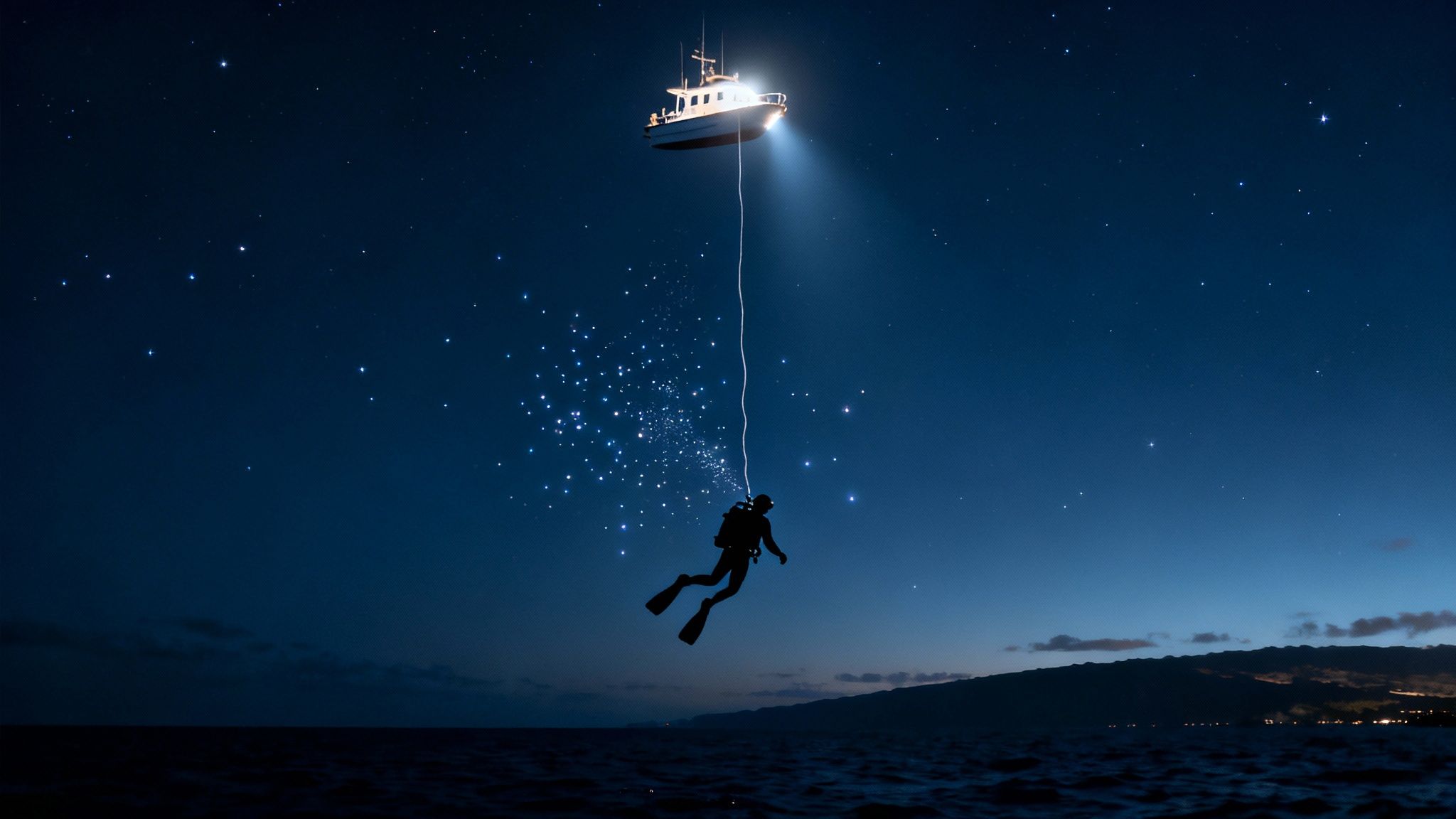
Kona isn't just a great place for blackwater diving; it’s where the sport was born and perfected. The secret sauce is the island's unique underwater geography. Just a few miles from the coast, the seafloor takes a dramatic plunge, giving dive boats easy access to the deep ocean channels essential for a true blackwater experience.
That quick drop-off is what makes Kona so special. Dive operators like us can get you miles offshore, positioning you perfectly above thousands of feet of water to witness one of nature's greatest shows.
A Dive Decades in the Making
The blackwater dive Kona is known for today is a surprisingly recent innovation, fueled by local curiosity. The whole concept of recreational blackwater diving started right here in the 1990s. A few pioneering operators began experimenting by dropping powerful lights into the deep offshore waters at night, just to see what would swim up from the darkness.
The Big Island’s geography was the perfect natural laboratory for this. The seafloor plunges to over 10,000 feet just a short boat ride from the Kailua-Kona coast, making these deep-water experiments possible. To dive deeper into the history, scuba.com has a great article on its origins.
This isn’t just another dive; it’s an expedition into the unknown. You're suspended in the largest living space on our planet, observing a migration of alien-like creatures that spend their entire lives in the deep sea.
What you're seeing is the diel vertical migration—the largest migration on Earth, happening every single night. Countless tiny organisms travel from the deep towards the surface to feed, and a blackwater dive places you right in their path. Your dive light becomes a beacon, attracting some of the most bizarre and beautiful life forms you can imagine.
This is a world away from a typical reef dive. It’s a rare glimpse into an ecosystem few will ever get to see, highlighting what makes Big Island scuba diving truly unique.
What Happens on a Blackwater Dive
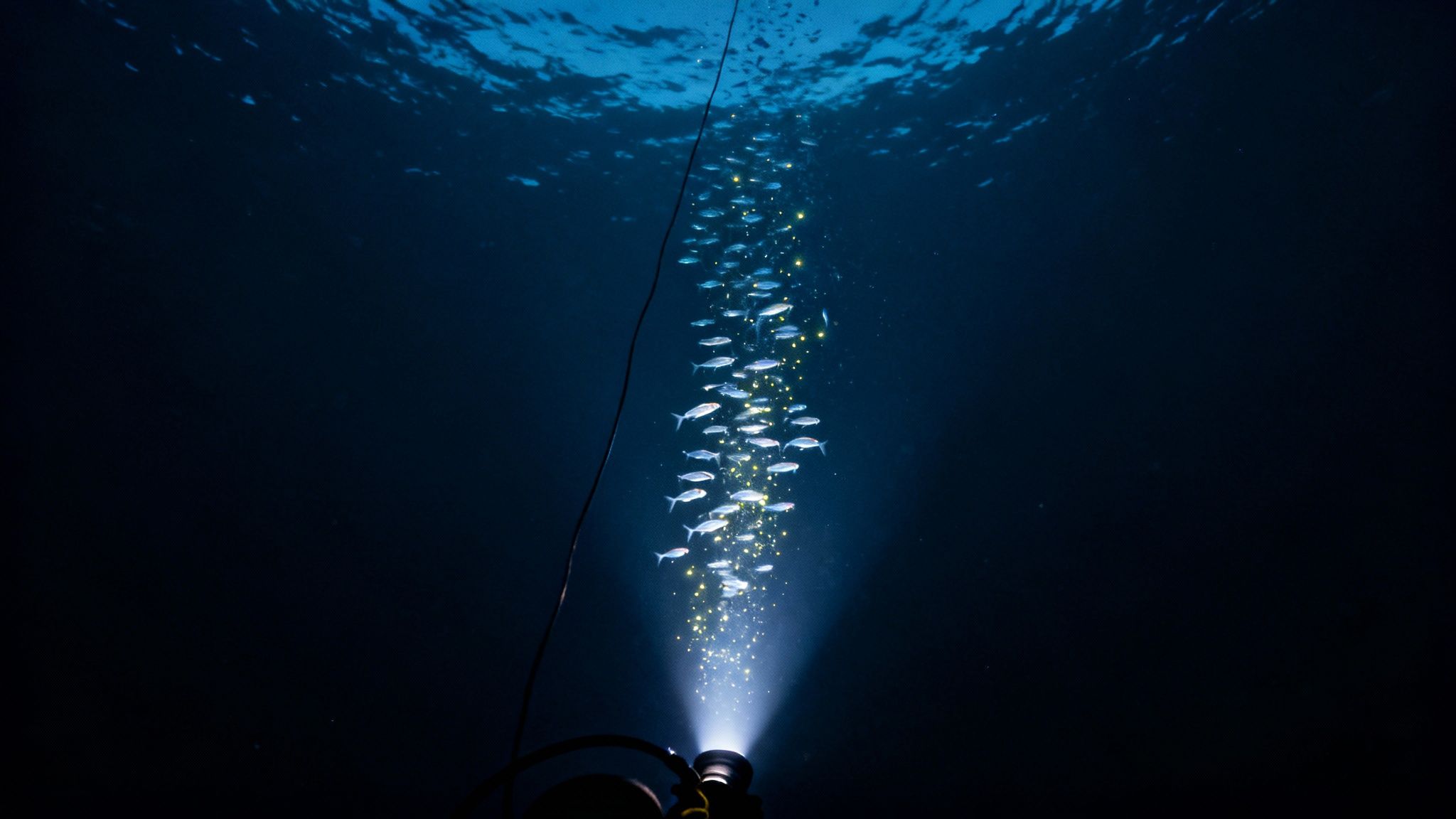
So, what’s it really like to drop into the open ocean at night? Forget everything you know about reef diving. A blackwater dive is a whole different animal. We head miles offshore, shut down the engines over thousands of feet of water, and suddenly our boat is the only point of light in an immense, dark Pacific.
Instead of swimming around to find things, you just… hang out. The dive is built around a heavy downline and tether system that dangles below the boat. This rig is your entire world out there—it's your safety line, your visual reference point, and the very thing that draws in all the weird and wonderful creatures you came to see.
Witnessing Earth's Largest Daily Commute
What makes this possible is a mind-boggling natural event called diel vertical migration. It's the biggest, most organized commute on the planet, and it happens every single night. Trillions of creatures—tiny larval fish, bizarre crustaceans, glowing jellies, and shimmering squid—rise from the crushing depths to feed near the surface, using the darkness as cover.
This is a cornerstone of the ocean's food web, a process that happens completely out of sight. A blackwater dive Kona style puts you right in the middle of it all.
You're essentially a spectator hanging in the void, watching an entire hidden ecosystem drift right past your mask. It's like having a front-row seat to one of nature's greatest, and most secret, shows.
The Tether System and Your Front-Row Seat
To keep everyone safe and focused, each diver is clipped onto the main downline with their own personal tether. This simple setup is absolutely critical out there.
- Safety: The tether keeps you connected to the boat as the current pushes everyone along together. No getting lost in the big, black blue.
- Reference: In total darkness, the line gives you a constant point of reference, making it much easier to manage your orientation and buoyancy.
- Proximity: It keeps all the divers clustered in the cone of light where the action is happening.
With the tether doing its job, you can relax, fine-tune your buoyancy, and give your full attention to the incredible critters appearing out of the dark. Your dive light becomes a spotlight on a personal stage, revealing a constant parade of life forms that look like they belong on another planet. That’s the real magic of it: a safe, controlled way to witness a truly wild and mysterious world.
Meet the Aliens of the Deep
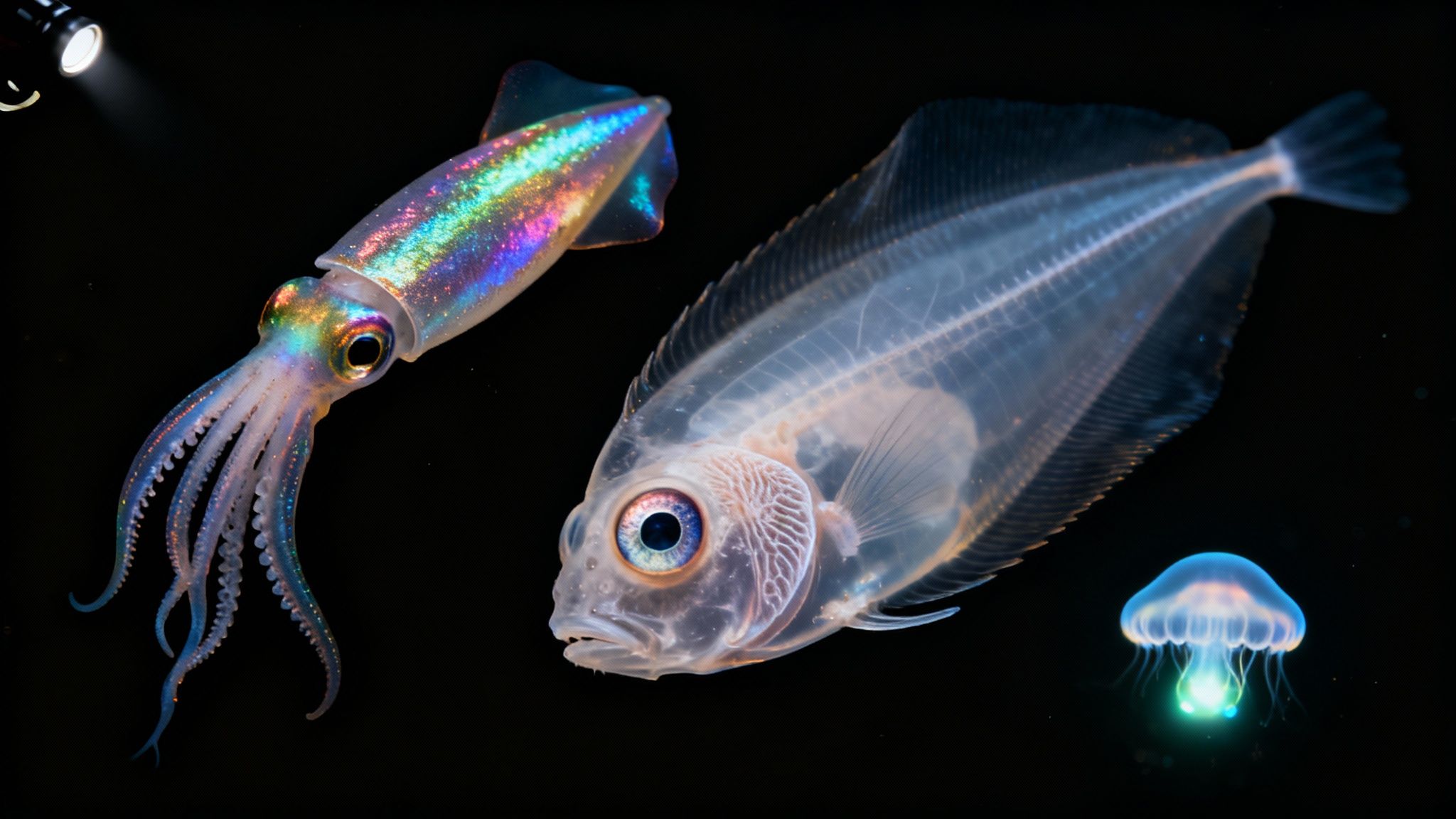
The real magic of a blackwater dive in Kona starts the moment you stop seeing the overwhelming darkness and begin to notice the tiny, otherworldly creatures drifting past your face. This isn't about spotting the familiar reef fish you see during the day. This is about meeting their larval forms—bizarre, beautiful, and so different they look like they’re from another planet.
Forget what you think a fish or squid looks like. Out here in the deep, you might see a larval flounder, almost totally transparent, its eye slowly migrating across its head toward its final position. Or maybe you'll cross paths with a bobtail squid no bigger than your thumbnail, flashing with iridescent colors as it catches your light.
Many of these animals are just temporary visitors to the upper water column. They spend their adult lives in the crushing pressure of the deep sea, making this your one and only chance to ever see them.
The Cast of Otherworldly Characters
The parade of life is constant and almost unbelievable. It’s a macro-photographer’s dream come true and a biologist's fantasy, with new subjects emerging from the black every few seconds.
Think of it as a treasure hunt where the jewels are alive and glowing. The sheer variety is what's truly mind-bending, and I can promise you that no two dives are ever the same. You are literally witnessing a part of the ocean that almost no one ever gets to see.
Here's just a taste of the alien-like life you might encounter:
- Larval Fish: Spot strange, see-through versions of familiar fish. Eels that look like glass ribbons, or tiny anglerfish with their bioluminescent lures already glowing.
- Cephalopods: Find jewel-like squid and octopuses, some trailing tentacles that are impossibly long compared to their tiny bodies.
- Crustaceans: See larval crabs and shrimp that look like spiky, ornate spaceships covered in intricate armor.
- Gelatinous Zooplankton: Float alongside an array of siphonophores and jellyfish, many pulsing with their own internal light and creating a hypnotic, rhythmic light show in the dark.
This dive is a profound reminder of how much of our planet remains unexplored. You are floating through a living gallery of nature’s most creative and bizarre experiments, many of which are rarely seen by human eyes.
This experience plugs you directly into the planet’s largest daily migration of wildlife. It's a scientifically fascinating event, and ongoing research highlights just how special it is. For example, some studies have shown that roughly 76% of the organisms seen on a Kona blackwater dive are bioluminescent—they can produce their own light. This just shows how deeply you're connecting with the mysterious biology of the deep ocean. You can dive deeper into these findings through NOAA's research repository.
This isn’t just scuba diving; it’s an expedition to an alien world that exists right here on Earth. If you're ready to meet these incredible creatures, Kona Honu Divers offers the premier Blackwater Dive tour to guide you safely into the abyss.
How to Prepare for Your Dive
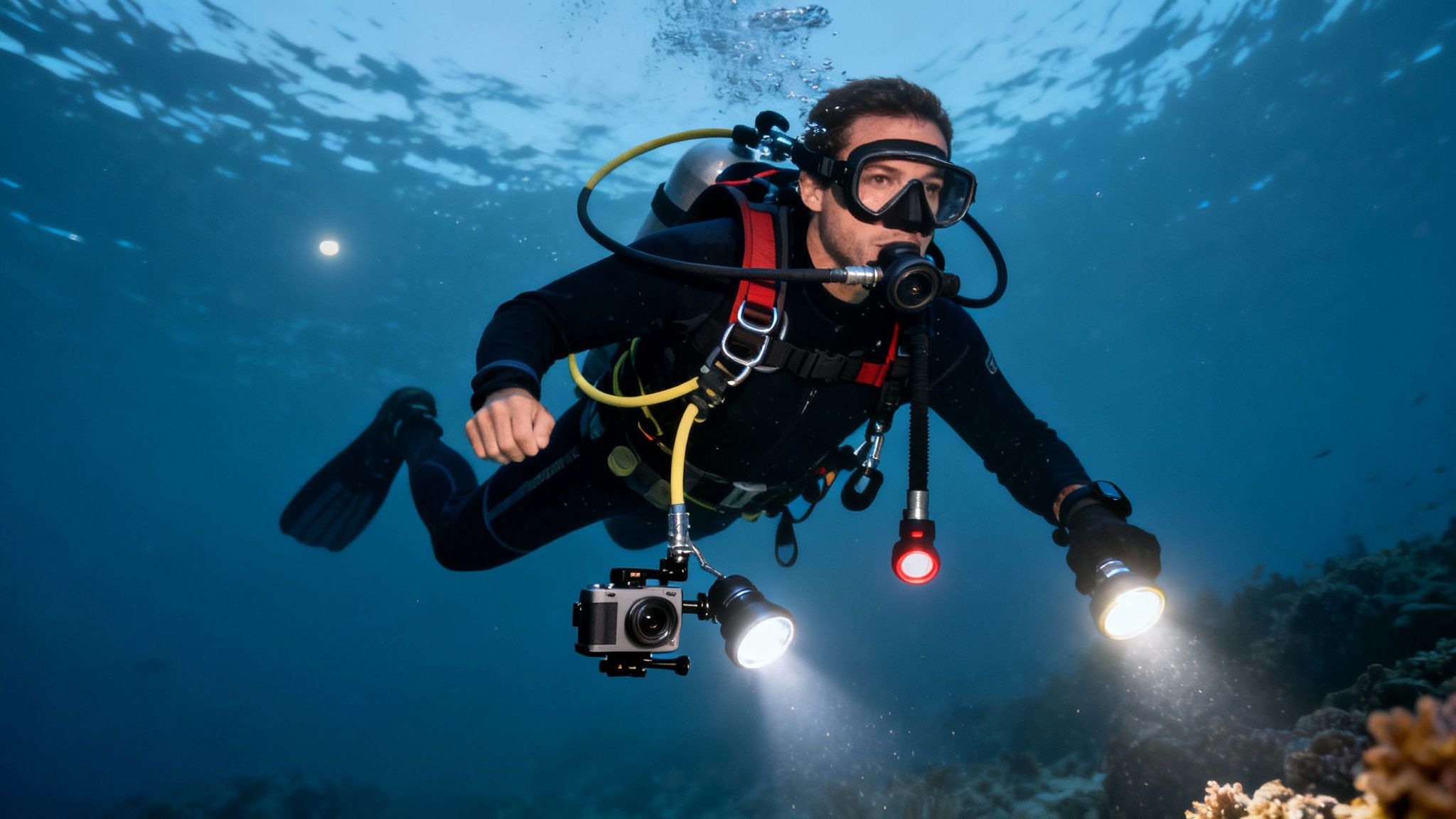
A successful blackwater dive in Kona all comes down to preparation. This isn't your typical reef dive you can just show up for; it's an adventure that demands a specific level of experience to keep you safe and comfortable while you're floating miles offshore in the dead of night.
The absolute must-have is an Advanced Open Water certification or its equivalent from another agency. We also need to see that you have recent night diving experience. This isn't just about ticking boxes—it's to make sure you're already familiar with the unique feeling and procedures of diving in the dark before you add the challenge of the open ocean.
But if there's one skill that trumps all others out here, it's impeccable buoyancy control. You’ll be suspended in the water column with no bottom below and no surface above to use as a reference. The ability to hover perfectly still is everything. It’s what keeps you safe, helps you enjoy the dive, and allows you to get a close look at the tiny critters drifting past.
Essential Gear and Photography Tips
We'll handle the specialized stuff, like the tether system and the big down-lights that attract all the creatures. You just need to bring your personal dive kit. For a full checklist, you can check out our guide detailing the gear you will need for your Kona diving adventure.
At a minimum, make sure you have these three things:
- Primary Dive Light: This is your lifeline and your lens into the abyss. Make sure it's powerful and fully charged.
- Backup Dive Light: Things can and do fail. A second, reliable light isn't a suggestion; it's a mandatory piece of safety gear.
- Dive Computer: With no visual cues for depth, your computer is the only thing telling you how deep you are and how long you've been there. It’s non-negotiable.
For you photographers, this is the ultimate macro test. You'll need a dedicated macro lens—a 60mm or 100mm is perfect—to capture the stunning details of these tiny, often see-through animals. You'll also need a good set of external strobes to make your subjects pop against that deep black background.
Given the unique logistics of a blackwater dive and the travel required to get here, good trip insurance is something we always recommend. Learning how to choose the right travel insurance for your adventure is a smart move that gives you peace of mind for what is truly a once-in-a-lifetime experience.
Choosing Your Expert Kona Guide
Let's be blunt: the success of your blackwater dive in Kona rests almost entirely on the shoulders of your guide and the quality of the dive operator. This is not just another reef dive. You're heading miles offshore, at night, over thousands of feet of open ocean. Your choice of a seasoned crew, like the one at Kona Honu Divers, is the single most important decision you'll make.
A top-notch operator does far more than just ferry you out to sea. They bring years of hard-won expertise, time-tested safety protocols, and custom-built lighting and tether systems designed specifically for this unique and demanding environment.
What was once a niche experiment has evolved into a well-oiled operation. The process is straightforward: boats travel several miles offshore, find water thousands of feet deep, and tether a small group of divers to a weighted line beneath the vessel. The safety record is stellar. To give you some perspective, local shops report shark sightings on only about 2 in 100 dives, and to date, there have been zero recorded shark attacks on blackwater divers. For a deeper look, check out this fantastic in-depth article on Kona's most extreme dive.
Why Experience Matters in the Deep
An experienced guide is the difference between a good dive and a mind-blowing one. They are absolute wizards at spotting the tiny, near-invisible critters that most of us would swim right past. It’s their trained eye for identifying larval fish, translucent squid, and bizarre-looking crustaceans that truly makes the abyss come alive.
Beyond spotting critters, a professional operation will always insist on small group sizes. It’s simply safer and makes for a much more personal and controlled experience when you're floating in the vastness of the open ocean. Choosing the right operator is crucial, and our guide on how to choose a Kona dive shop can help you weigh your options.
Here at Kona Honu Divers, we've built our reputation on years of leading these technical, awe-inspiring dives. Our team's passion and professionalism shine through, and we think our guest reviews speak for themselves.
Ready to see what's really down there? Book your spot on our world-class Blackwater Dive tour and come meet the aliens of the deep.
Your Questions Answered
It's totally normal to have questions before dropping into the deep for the first time. Blackwater diving is a world apart from any other kind of dive, and we want to make sure you feel completely comfortable and stoked for the adventure. Here are some of the most common things we get asked.
Is Blackwater Diving in Kona Safe?
Yes, absolutely. With a professional crew like ours, blackwater diving is a very safe and controlled experience. Your safety is our number one priority, and it all starts with a heavy-duty tether system. Every diver is securely attached to lines running from the boat, which means you’re always connected and drifting right along with us in a well-lit bubble of water.
Our guides are pros who live and breathe blackwater protocols. The pre-dive briefing is detailed and covers everything you need to know. And what about big predators? While you are in the open ocean, the risk is incredibly low. Shark sightings are extremely rare, and to put your mind at ease, there have been zero recorded shark-related incidents on any Kona blackwater dive. The real keys to a safe dive are listening to your guide and having your buoyancy dialed in.
What Certification Do I Need for This Dive?
You’ll need to be an Advanced Open Water certified diver (or hold an equivalent cert from another agency). Just as important as the card, though, is having recent dive experience, including at least one night dive. This just proves you’re comfortable in the dark before we add the extra layer of floating in the open ocean.
But if there's one skill that truly matters out there, it's rock-solid buoyancy control. You'll spend the entire dive hovering in the water column with no bottom or surface for reference. Being able to hold your depth without thinking about it is critical for your safety, your enjoyment, and for getting a good, stable look at all the tiny critters. If you want to brush up, joining one of our advanced dive trips is a great way to get sharp.
How Is This Different From the Manta Ray Night Dive?
Think of them as two completely different, world-class Kona experiences. They’re both at night, but that’s where the similarities end.
The Manta Ray Night Dive is like going to a blockbuster movie. You settle down on the sand in a shallow cove and watch as giant, graceful mantas perform an underwater ballet, swooping through the light beams to feed. It’s a huge, magnificent spectacle.
A blackwater dive, on the other hand, is like a deep-space treasure hunt. You’re drifting miles from shore over thousands of feet of water, actively searching for tiny, strange, and often larval-stage creatures migrating up from the abyss. The manta dive is a grand performance; the blackwater dive is a mysterious, microscopic safari.
When Is the Best Time of Year to Go?
One of the coolest things about the blackwater dive in Kona is that it's incredible all year long. The nightly vertical migration—the largest movement of animal life on the planet—happens every single night, like clockwork. That means the deep-sea critters are always making their journey toward the surface, no matter the month.
The summer months (May through September) might bring slightly calmer seas and warmer air, but the show underwater is consistently amazing. Some folks swear the new moon brings more creatures to the light, but honestly, we see incredible things every night. We always put safety first and only go out when the conditions are right, so any time of year is a good time to go.
Can I Bring My Camera on the Dive?
You bet! A blackwater dive is a macro photographer's dream. This is your chance to get shots of animals that most people will never see with their own eyes. But be warned: it’s also one of the toughest photo environments you’ll ever face.
To get the shot, you’ll need the right gear and great dive skills. A dedicated macro rig is a must:
- A Macro Lens: Something in the 60mm or 100mm range is perfect for getting those fine details.
- Powerful Strobes: You'll need external strobes to make your subjects pop against that inky black background.
- A Strong Focus Light: In the dark, a good, bright focus light is essential for your camera to lock on.
Just remember, you're drifting, and so are your tiny subjects. It takes a ton of patience and perfect buoyancy to get everything framed up. But the reward—truly unique, otherworldly images—is more than worth the effort.
Ready to dive into a whole new underwater universe? At Kona Honu Divers, our expert crew is waiting to guide you safely into the mysterious, mesmerizing world of the abyss.