
Picture this: you're floating weightlessly, miles from shore, in the profound, inky blackness of the open ocean. Suddenly, you're not alone. You're surrounded by a living galaxy of bizarre, glowing creatures. This isn't your average night dive; this is a blackwater dive in Hawaii, a journey into the largest migration on Earth.
For divers looking to experience everything the Big Island has to offer, a blackwater trip is just the beginning. Check out our other incredible Kona diving tours to complete your adventure.
What Makes a Kona Blackwater Dive So Unique
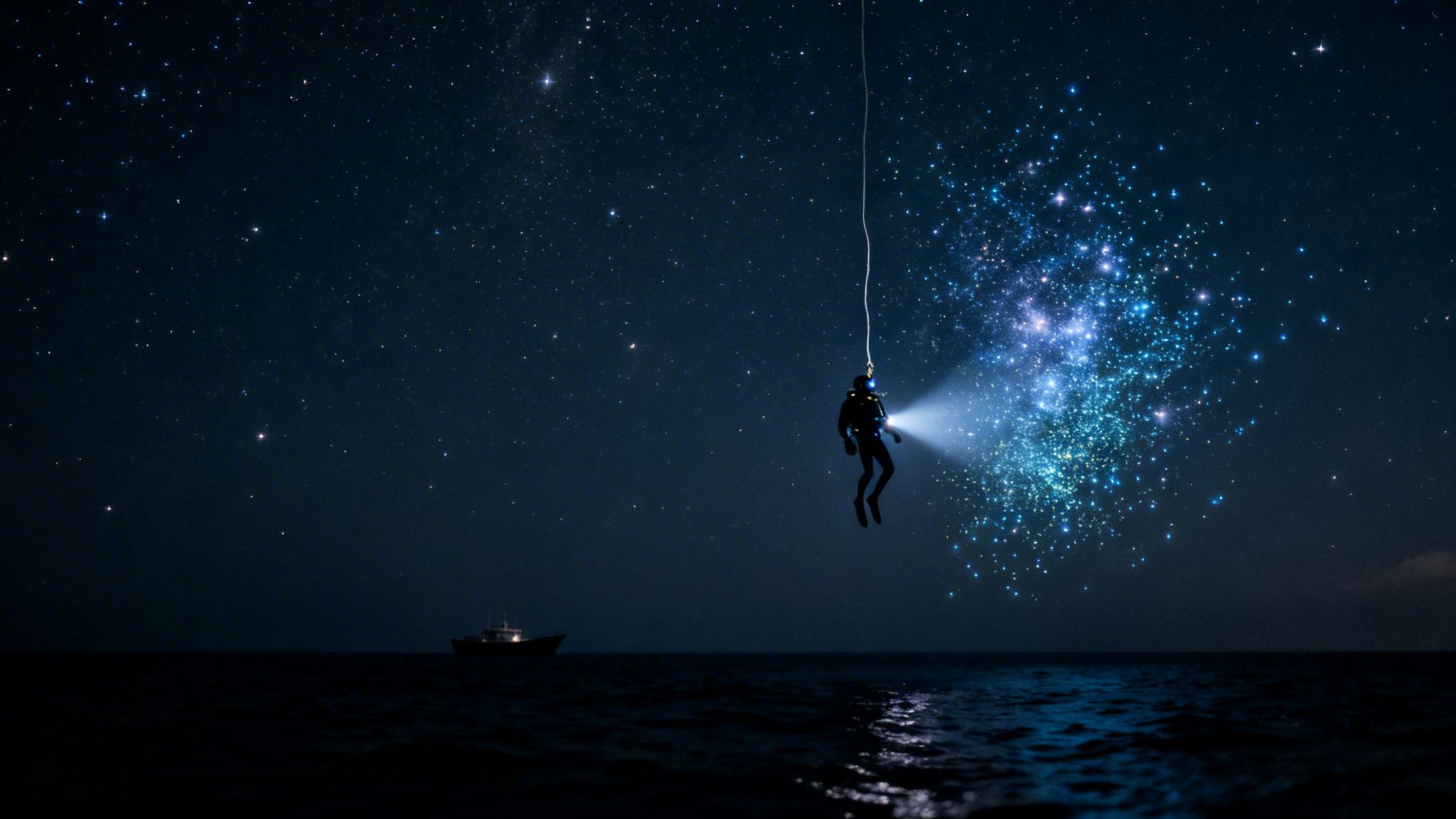
Unlike a typical night dive where you're exploring a familiar reef landscape, a blackwater dive is a completely different beast. It's an open-ocean, mid-water drift. You're tethered to a line connected to the boat, hovering in the deep blue as an incredible procession of deep-sea life makes its nightly vertical migration toward the surface.
It’s less about swimming and more about patient observation. You simply wait and watch as a living light show unfolds right in front of your mask.
The real magic is in the unpredictability. Every single dive is different. One night might reveal a cast of otherworldly larval fish, while the next brings pulsing jellyfish and iridescent squid. This unique style of diving is exactly why Kona is considered the undisputed global capital for this adventure.
Why Kona Is The Epicenter
So, what’s Kona’s secret? It all comes down to the incredible underwater geography right off our coast. The western side of the Big Island features a dramatic and sudden drop-off, with the seafloor plunging to depths of over 10,000 feet just a few miles from shore.
This deep oceanic trench acts as the perfect highway for the nightly vertical migration. Its close proximity to the coast means we don't have to travel for hours to access this amazing pelagic zone. This thrilling nighttime adventure was actually pioneered right here in Kona back in the early 2000s, turning the Big Island into the world headquarters for the sport.
Blackwater Vs. Traditional Night Diving
What really sets a blackwater dive apart from a standard night dive? Think of it this way: a regular night dive is like taking a walk through a familiar neighborhood after sunset to see how the daytime residents behave differently. A blackwater dive is like floating in deep space, waiting for alien life forms to drift past you.
Here’s a quick breakdown:
- Location: A traditional night dive is over a reef or wreck. A blackwater dive happens in the vast open ocean, over thousands of feet of water.
- Experience: On a night dive, the seafloor is always your reference point. During a blackwater dive, you're suspended in the water column, tethered to a downline from the boat.
- Marine Life: You’ll see familiar nocturnal reef creatures on a night dive. A blackwater dive reveals bioluminescent pelagic animals and the strange, fascinating larval stages of creatures you'd never otherwise see.
This completely distinct environment offers a rare glimpse into a world that very few people will ever get to witness. To get a better sense of our underwater world, learn more about what makes diving in Kona so unique.
Here's a quick look at the key elements that define this dive.
Blackwater Dive At A Glance
| Aspect | Description |
|---|---|
| Location | Open ocean, miles from shore, over water thousands of feet deep. |
| Environment | Mid-water column; divers are tethered to a downline from the boat. |
| Objective | Observe the nightly vertical migration of deep-sea pelagic life. |
| Marine Life | Bioluminescent creatures, larval fish, squid, jellyfish, and other rare organisms. |
| Skill Level | Advanced; requires excellent buoyancy control and comfort in the dark. |
This combination of factors creates a truly one-of-a-kind underwater experience that you just can't find anywhere else.
Meet the Creatures of the Vertical Migration
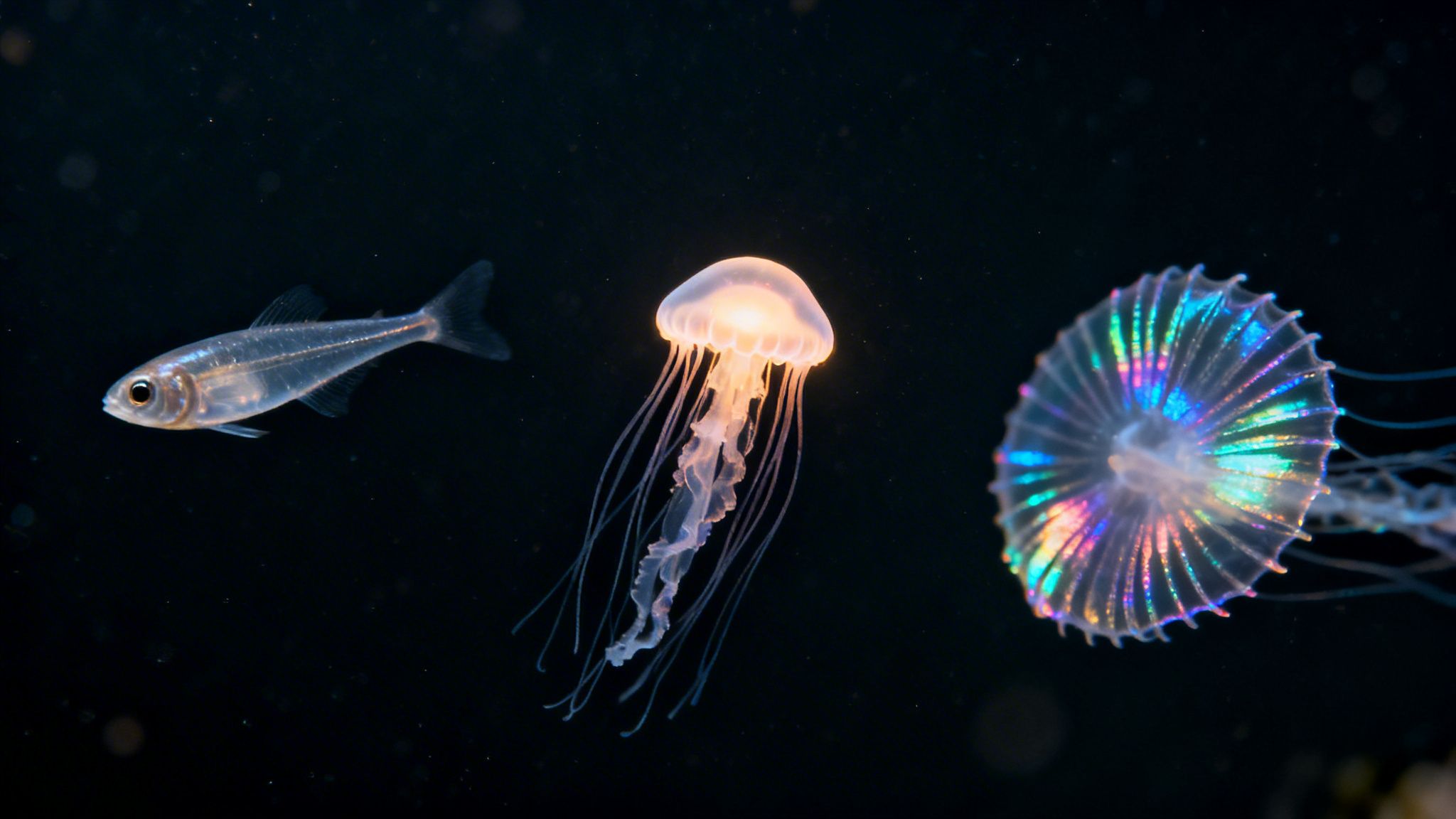
Every single night, something incredible happens just off the Kona coast. The largest migration on Earth, known as the diurnal vertical migration, kicks into gear. By sheer volume of life, nothing else compares. Countless tiny creatures rise from the crushing dark of the abyss, journeying toward the surface to feed in the relative safety of the night.
A blackwater dive in Hawaii is your front-row ticket to this mind-bending spectacle.
Forget about the reef fish you see during the day. This is a whole different world, populated by a cast of characters so strange and wonderful they look like they were pulled from a sci-fi blockbuster. You're meeting animals in their earliest, most vulnerable larval stages, and they often look nothing like the adults they'll one day become.
These tiny, frequently transparent drifters are the foundation of the ocean's food web. Seeing them in action is like getting a backstage pass to one of the most fundamental processes supporting our entire marine ecosystem—a world almost no one ever gets to witness firsthand.
The Larval Stage Light Show
One of the coolest parts of a blackwater dive is running into the baby versions of familiar sea creatures. These larval animals are often nearly unrecognizable, sporting wild and beautiful adaptations they need to survive out in the open ocean.
You might spot a larval flounder, which looks like a "normal" fish with one eye on each side before the great migration to one side of its head begins. Or maybe you'll cross paths with a leptocephalus, the bizarre, transparent, leaf-shaped larva of an eel.
Other common sightings include:
- Larval Squid: Teeny-tiny, perfectly formed miniatures of their parents, often so clear you can see right through them.
- Tripod Fish Larvae: Incredibly delicate, free-floating juveniles that will eventually grow the long fins they use to "stand" on the ocean floor.
- Snake Blenny Larvae: Long and eel-like, drifting along before they're ready to settle down on the bottom.
This pelagic phase is a high-stakes survival game. The creatures' transparency and bioluminescence are essential tools for hiding and communicating in the vast, inky blackness, creating an absolutely unbeatable opportunity for photographers.
Gelatinous Aliens and Pulsating Lights
Beyond the baby fish, your dive will be filled with an incredible variety of gelatinous animals. These alien-like beings drift, pulse, and glow, turning the dark water into a living galaxy of light.
Ctenophores, or comb jellies, are everywhere, and they are absolutely mesmerizing. They're not true jellyfish, but they steal the show with eight rows of cilia that refract your dive light into shimmering, rainbow-colored patterns that ripple down their bodies.
You're also almost guaranteed to see siphonophores. They might look like a single organism, but they're actually long, stringy colonies of individual animals all working together. Some can grow to astonishing lengths, earning them the title of the longest animals on the planet.
Throw in some pelagic nudibranchs, miniature squid, and all sorts of pulsating jellies with glowing tentacles, and you have the makings of a truly surreal experience. Every dive is a lottery; you simply never know what bizarre and beautiful creature will drift out of the darkness next.
What It’s Actually Like on a Blackwater Dive
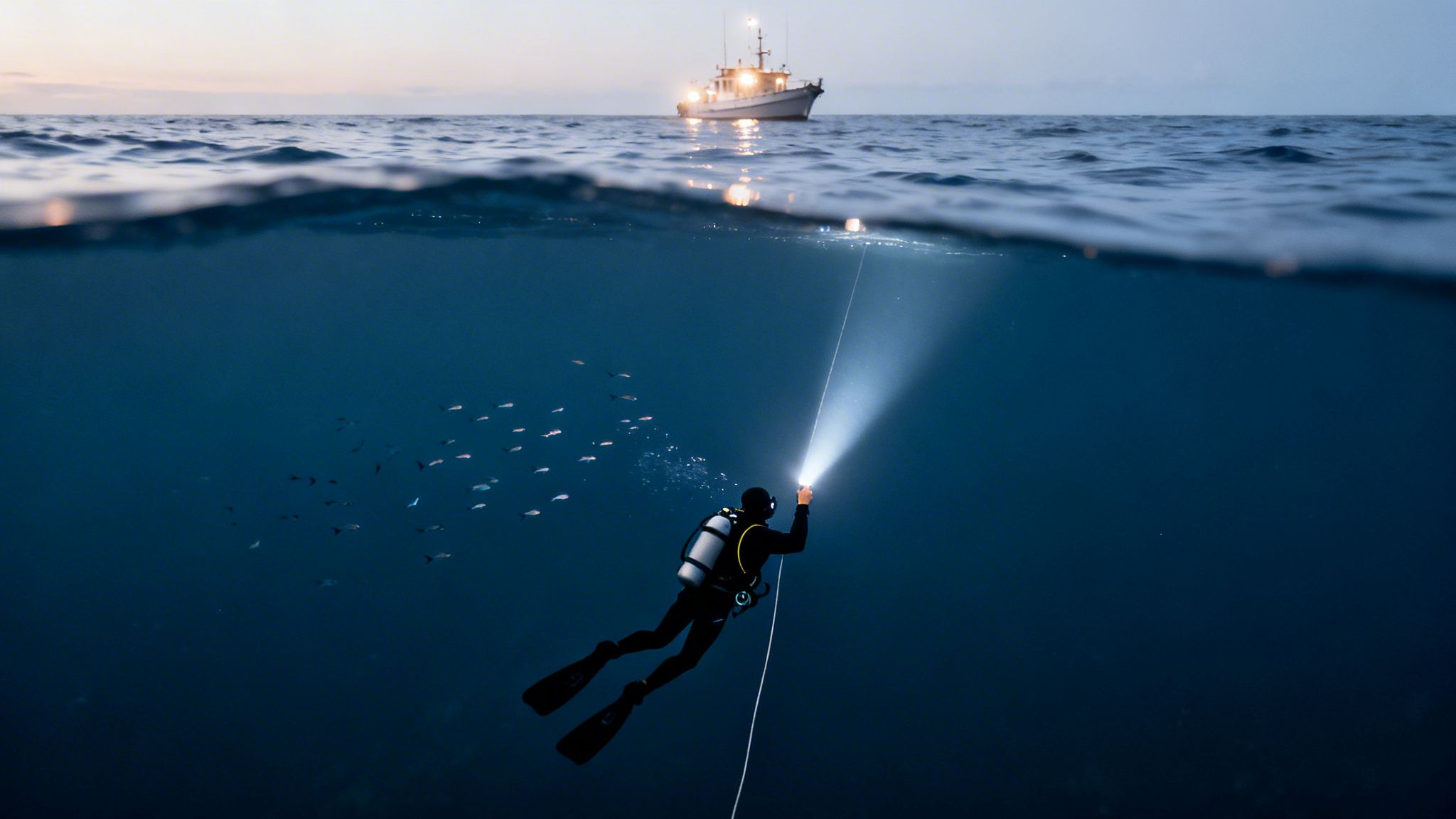
Let's be honest, the thought of jumping into the deep, dark ocean at night sounds a little intense. But the reality of a blackwater dive in Hawaii is a surprisingly calm and meticulously managed experience. We’ve fine-tuned every step to make sure you're safe, comfortable, and free to soak in the wonder of it all.
So, what should you expect when you join us for this trip of a lifetime?
It all starts on the boat with a solid pre-dive briefing. Your guides will lay out the whole plan, explaining exactly how our tether system works, running through all the safety protocols, and giving you a sneak peek at the kinds of alien-like creatures you're about to meet. This is the perfect time to ask any questions and get yourself settled before hitting the water.
Dropping into the Pelagic Zone
Once everyone is geared up, we'll make a giant stride entry and descend together into the darkness. We’re not heading for the bottom; instead, we'll level off at a comfortable depth, usually around 40 to 50 feet. At this point, you'll be connected by a short tether to a main line that hangs directly below the boat.
This tether system is the secret sauce. It keeps you connected to the boat and the rest of the group, so we all drift together as one unit. There’s absolutely no chance of getting separated or lost out there.
Forget about navigating a reef or kicking to keep up. Your only job is to dial in your buoyancy, relax, and float. The ocean current does the rest, bringing an incredible parade of deep-sea life right into your torch beam.
We spend a full 60 to 90 minutes in the water on these dives. This generous bottom time gives you a fantastic window to watch the vertical migration unfold. We hang powerful lights from the boat and your guide will have one too, creating a column of light that acts like a beacon for the bizarre and beautiful creatures rising from the depths.
A Calm, Controlled Drift
This isn't a strenuous dive. It’s a slow, gentle drift through the water column. You simply hover in place, turning slowly and scanning the darkness for the next little marvel to appear. Many divers find it almost meditative—a quiet, personal encounter with a universe most people will never see.
Here at Kona Honu Divers, we have this process down to a science, ensuring every diver feels completely secure and can lose themselves in the magic of the moment. Ready to see it with your own eyes?
Check out the details for the Kona Honu Divers Blackwater Dive tour and book your spot for an adventure you will never, ever forget.
Essential Gear and Safety for Blackwater Diving
When you’re floating in the middle of the open ocean at night, your gear and the safety procedures in place aren’t just details—they’re everything. A **blackwater dive in Hawaii** is unlike anything else; you have no reef, no bottom, and no landmarks to orient yourself. This makes your equipment and the dive operator’s safety measures the foundation of a successful, mind-blowing experience.Let's start with the most important piece of gear you'll carry: your dive light. It’s your window into this hidden world. You'll want a powerful primary torch, something with over 1,000 lumens, to slice through the inky black and spot the tiny, often see-through critters floating past. A reliable backup light, clipped securely to your BCD, isn't just a good idea—it's essential.
Safety First in the Deep Blue
The entire blackwater experience hinges on the robust safety system managed by professional operators like us at Kona Honu Divers. The heart of this system is a carefully designed tether line. This is non-negotiable. Every diver is connected to a main downline that drifts right along with the boat, acting as your lifeline in the dark. It completely eliminates any chance of getting separated from the group.
Before anyone even gets near the water, we run a thorough pre-dive briefing that covers every single aspect of the dive plan. We'll go over:
- Buddy Procedures: How to keep tabs on your buddy and communicate effectively when the only thing you can see is what's in your light beam.
- Light Discipline: The right way to use your powerful torch without blinding everyone else. This is also why photographers often prefer red focus lights.
- Emergency Plans: Simple, clear instructions on what to do in the unlikely event a situation arises.
The Importance of Buoyancy and Awareness
On a blackwater dive, perfect buoyancy control is an absolute must. Without any physical reference points, you need to be able to hang effortlessly in the water column. This is what keeps you from drifting up or down and gives you a stable, relaxed platform to watch the delicate dance of marine life unfold. Your guide is always there to help, but your own comfort and skill are key.
This isn't just a dive; it's a carefully orchestrated adventure. From our experienced guides in the water to the detailed safety briefings on the boat, we create a controlled environment so you can simply relax and witness one of the most unique underwater encounters on the planet.
We also keep our groups small. This ensures everyone gets personalized attention and allows our guides to constantly monitor the team. All these measures combined turn what might sound like an extreme sport into a surprisingly serene and secure float through an alien universe.
If you're looking for more information on what to bring, check out our detailed guide on the gear you will need for your Kona diving adventure.
Tips for Photographing Pelagic Wonders
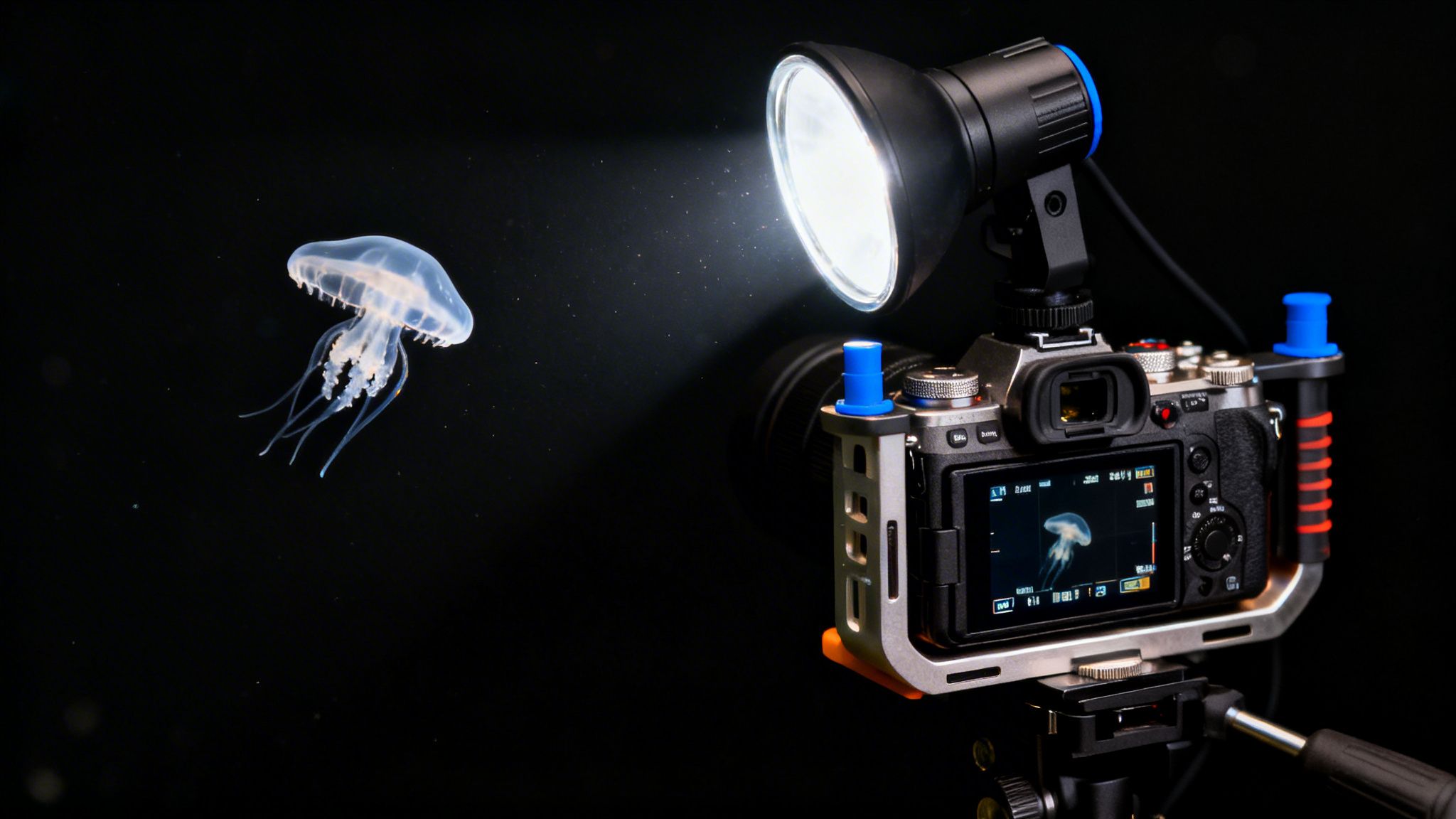For any underwater photographer, a blackwater dive in Hawaii is one of the most demanding yet rewarding experiences you can have. It’s a completely different ballgame. You're trying to capture sharp, vibrant images of tiny, often see-through creatures in absolute darkness. Forget about backgrounds—your subject is everything.
The whole game comes down to how you control your light. Since so many of these animals are almost invisible, backscatter becomes your number one enemy. The trick is to use snoots or diffusers on your strobes to shape and narrow the light beam. This makes your subject jump out from the void while keeping the illuminated particles in the water to an absolute minimum.
Dialing in Your Camera Settings
Nailing the right exposure in pitch black is a delicate dance. You have to be fast enough to freeze motion but careful not to completely blow out the highlights on a creature that might be glowing or transparent.
Think of these settings as a solid starting point, then adjust as you go:
- Shutter Speed: I usually start around 1/200s. This is fast enough to freeze the subtle movements from you and the subject drifting in the current.
- Aperture: Try f/8 to f/11 to begin. This gives you a reasonable depth of field, which is a lifesaver when you're trying to get a tiny, three-dimensional subject entirely in focus.
- ISO: Keep your ISO as low as you can, somewhere in the 100-200 range. This will keep your blacks clean and free of distracting digital noise.
Once you have this baseline, your strobe power becomes your primary tool. Tweak it up or down to get the perfect exposure on the animal itself without changing your other settings.
Pro Tips for Nailing Focus
Let's be honest, focusing on a moving speck in the dark is probably the toughest part of blackwater photography. That's why most seasoned shooters use a separate, powerful focus light. Using one with a red filter is a great pro-tip, as it’s less likely to spook the more light-sensitive critters.
A technique that truly changed the game for me is using back-button focus with continuous autofocus (AF-C or AI Servo). It separates the act of focusing from the act of taking the picture. You can track a creature's jerky movements with your thumb, and the second it’s sharp, you press the shutter. This gives you way more control and a much higher keeper rate.
Don’t get discouraged if you miss a few shots. Blackwater photography is a numbers game. Fire away! That one mind-blowing image often comes after dozens of near-misses, and it is always worth the effort. You’ll go home with photos of a hidden world most people don't even know exists.
Why You Should Dive With Kona Honu Divers
When it comes to something as specialized as a **blackwater dive in Hawaii**, the operator you choose makes all the difference. It’s not just about safety; it’s about having the deep-water expertise to turn a good dive into an unforgettable one.Our team at Kona Honu Divers brings a staggering 200+ years of combined experience to the table. We don't just know these waters; we've helped pioneer this very dive. Our knowledge of Kona's offshore currents and the strange, beautiful creatures that rise from the depths is something we've built over countless hours in the dark.
This isn't just a tour for us—it's a passion that bleeds into real scientific discovery. We’ve even collaborated on a study where our team carefully collected 76 larval fish specimens on our dives. This work led to groundbreaking DNA identification and helped export Kona's blackwater techniques to other dive destinations worldwide. It’s a perfect example of how adventure and science can come together.
It's All in the Details
We know that an amazing dive experience goes beyond what you see underwater. It’s about feeling safe, comfortable, and well-cared-for throughout the entire trip.
That's why we insist on small group sizes. This ensures you get the personal attention you deserve from our guides, never feeling lost in a crowd. Our boats are spacious and comfortable, but it’s the little things—like a hot shower waiting for you after a night in the ocean—that truly set the experience apart.
This commitment to quality is why our community has recognized our efforts. You can read more about why Kona Honu Divers was voted the best dive operator in Kona and see what makes our approach special. We work hard to make sure your adventure is thrilling, safe, and memorable from the moment you step on board.
But don't just take our word for it. Here's what other divers have said about their blackwater experience with us.
Your Blackwater Diving Questions Answered
Thinking about taking the plunge into the deep blue? It’s only natural to have a few questions before you head out into the dark. Here are the answers to some of the most common things divers ask us.
Is Blackwater Diving Actually Safe?
Absolutely, and we take safety extremely seriously. It might sound intimidating to be floating in the open ocean at night, but it's a very controlled and managed experience.
The key is the tether system that keeps every diver securely connected to the boat. Add in our experienced guides right there in the water with you, and Kona’s famously calm offshore conditions, and you have a surprisingly smooth and predictable environment perfect for certified divers.
What Kind of Certification Do I Need?
You'll need at least an Advanced Open Water certification (or an equivalent from another agency). The real non-negotiables are top-notch buoyancy control and being completely comfortable in the water at night. This is a great opportunity for more experienced divers looking for a unique challenge. For other advanced diving opportunities, check out our premium advanced dive tour.
Remember, you'll be hovering in the middle of the water column without the seafloor or a reef to give you a reference point. That takes a certain level of confidence and skill, which is what the advanced certification helps ensure you have.
How Is This Different From a Regular Night Dive?
It's a whole different world! On a typical night dive, you're exploring a familiar reef to see how it changes after sunset—watching the nocturnal critters come out to play.
A blackwater dive in Hawaii is a true open-ocean adventure. We head miles offshore, drop into the deep, and simply drift. Instead of reef life, you're witnessing one of the planet's greatest migrations: the bizarre and beautiful creatures that rise from the crushing depths every single night to feed.
When’s the Best Time of Year to Go?
That’s the beauty of diving in Kona—any time is a great time! The blackwater experience is incredible year-round.
Our ocean conditions are consistently calm, making it a reliable adventure no matter when you visit. While the specific cast of deep-sea characters might shift a little with the seasons, there's always an unbelievable "alien" fashion show happening down there, waiting for you.