
Picture yourself floating in the deep, silent expanse of outer space, surrounded by a universe of strange, glowing stars. Now, imagine that same sense of wonder, but this time, you're deep beneath the ocean's surface. That’s the feeling of a blackwater dive in Hawaii—an experience many divers call an alien safari in the deep blue.
What Is a Blackwater Dive in Hawaii?
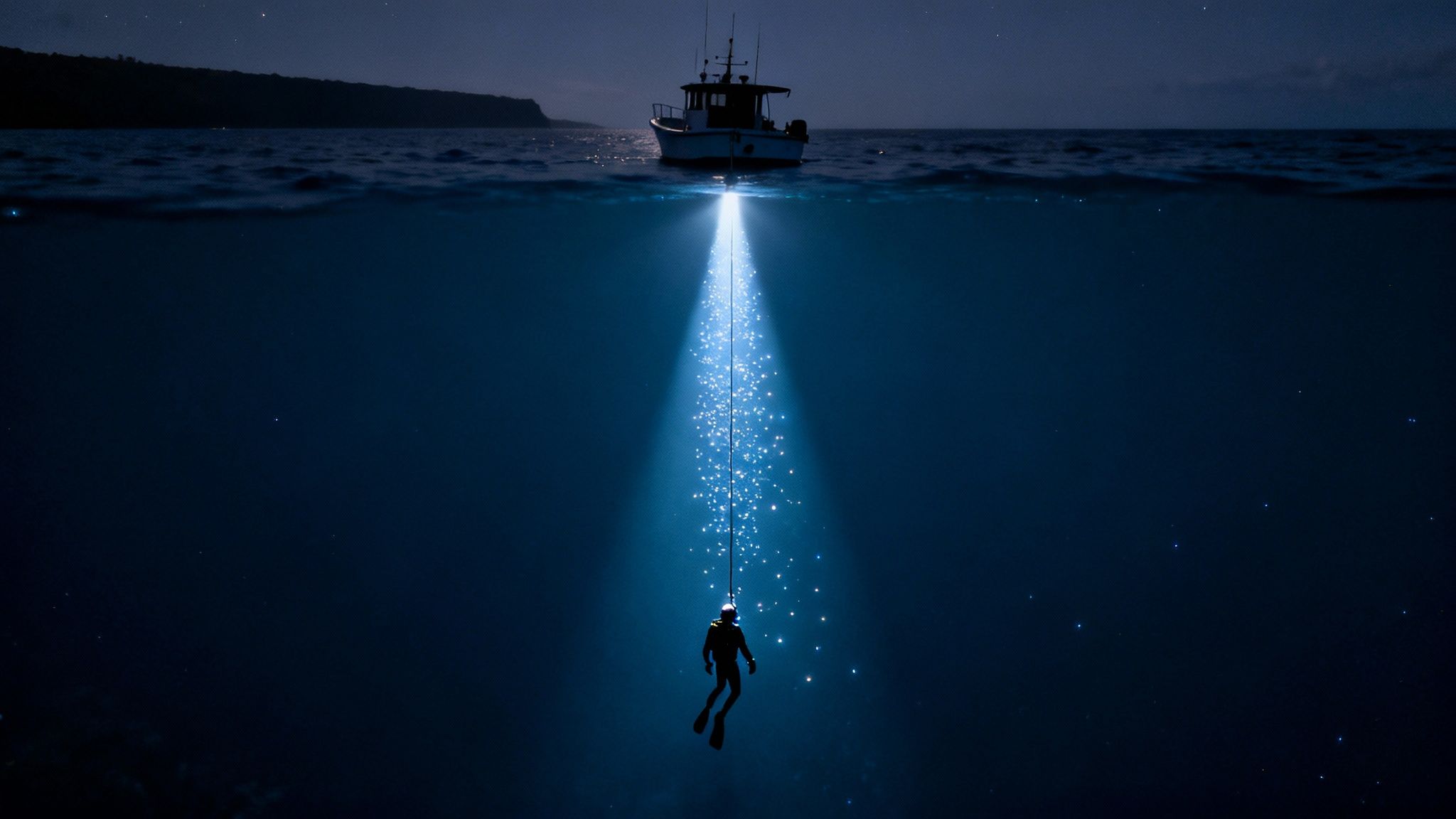
Unlike a typical night dive on a reef, a blackwater dive is a pelagic drift dive. We head out at night into the deep, open ocean, miles from shore. Here, you'll be suspended in the water column, hovering over thousands of feet of water while safely connected to the boat by a tether system.
Powerful lights hang below the boat, creating a cone of light in the darkness. This light attracts some of the ocean’s most bizarre and rarely-seen inhabitants, drawing them up from the abyss.
What you're witnessing is one of the planet's largest, yet most hidden, natural events: the diel vertical migration. Every single night, countless tiny, translucent, and often bioluminescent creatures journey from the deep sea toward the surface to feed, all under the cover of darkness.
The Global Epicenter of Blackwater Diving
When you hear experienced divers talk about modern blackwater diving, the conversation almost always leads back to Kona on the Big Island. The unique underwater geography right off the Kona coast makes it the undisputed global capital for this incredible type of dive.
The seafloor here plummets to over 10,000 feet (around 3,000 meters) just a short boat ride from shore. This gives us perfect pelagic conditions without a long journey. We can reach the ideal deep, open-ocean water in just 15–30 minutes, a trip that would take hours, if not all day, in other parts of the world. You can learn more about Kona's unique geography from the experts at PADI.
Blackwater Dive vs. Manta Ray Night Dive
Kona is also world-famous for another incredible night dive: the manta ray experience. While both happen after sunset, they couldn't be more different. The manta ray dive is a fairly stationary event in a shallow coastal bay, where divers often kneel on the sandy bottom and watch the show.
A blackwater dive in Hawaii, on the other hand, is a mid-water drift dive miles offshore. There's no bottom to see or touch, which is why it requires more advanced skills—especially rock-solid buoyancy control.
To make the distinction clearer, here's a quick comparison of these two world-class Kona dives.
Blackwater Dive vs. Manta Ray Night Dive Comparison
| Feature | Blackwater Dive | Manta Ray Night Dive |
|---|---|---|
| Location | Miles offshore, over thousands of feet of water | Shallow coastal bay (e.g., Garden Eel Cove) |
| Environment | Open ocean (pelagic) | Sandy bottom near a coral reef |
| Diver Position | Drifting in mid-water, tethered to the boat | Stationary on the seafloor |
| Marine Life | Larval fish, squid, jellyfish, pelagic critters | Giant manta rays, reef fish, eels |
| Skill Level | Advanced Open Water, excellent buoyancy required | All certification levels welcome |
Think of it this way: the manta ray dive is like watching a majestic, underwater ballet. The blackwater dive is a journey into a completely alien world, searching for tiny, otherworldly creatures you never knew existed.
Both are absolute must-do experiences in Kona, but they cater to very different diving styles and skill sets. If you're captivated by the idea of seeing giant, graceful mantas, our 2-Tank Manta Ray Dive Tour is an unforgettable night.
But for those who are ready to explore the abyss and see what comes up from the deep, the Kona Blackwater Dive is an adventure unlike any other.
Discovering the Creatures of the Deep
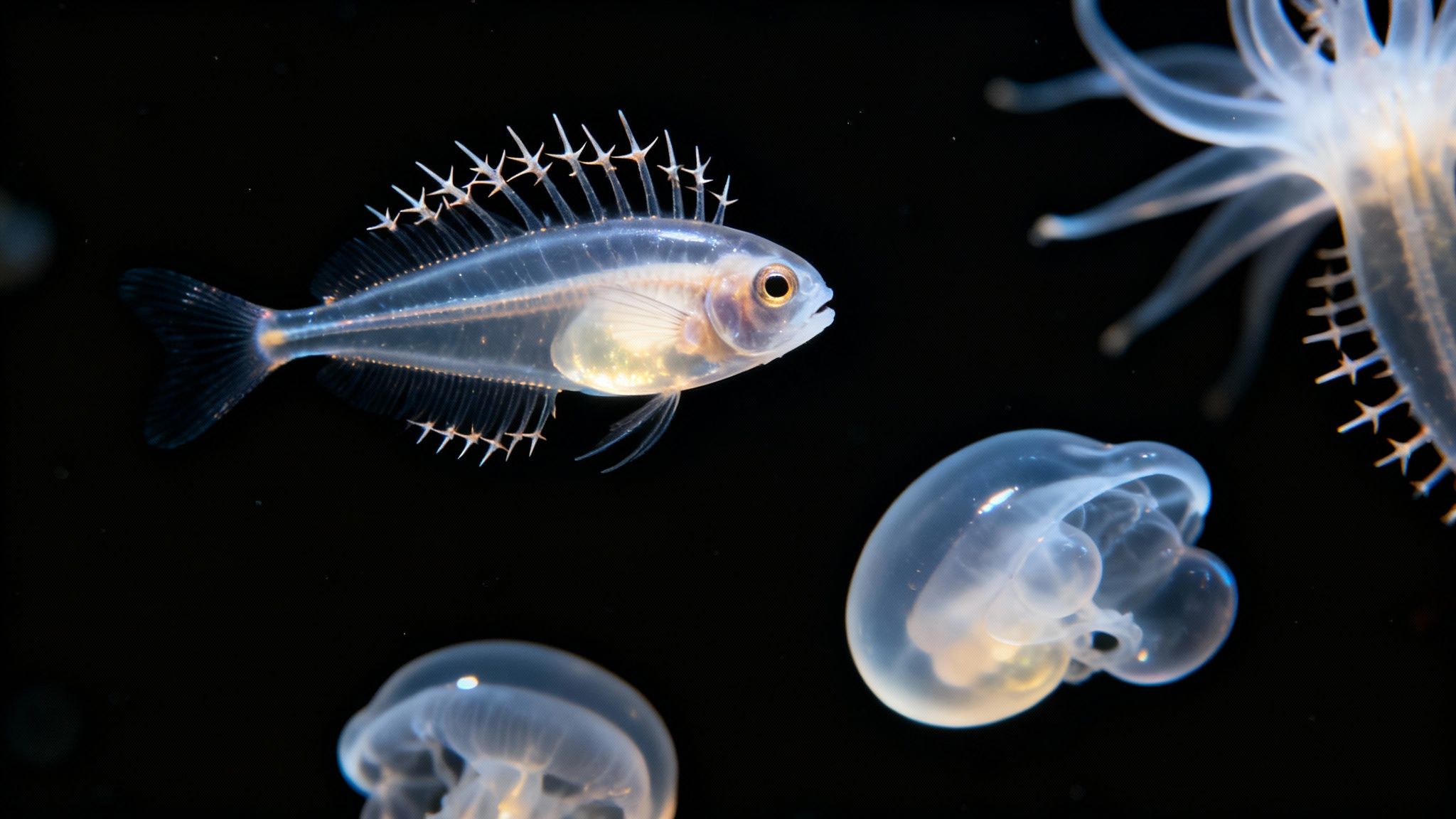
A blackwater dive in Hawaii is like dropping into a living galaxy. This isn't your typical night dive looking for sleeping fish. Out here, you're witnessing the largest migration on Earth, as billions of creatures rise from the crushing depths to feed near the surface under the cover of darkness. The beam of your dive light cuts through the void, revealing a hidden universe of life.
What really makes these dives so mind-blowing is that you're meeting animals in their earliest, most alien-like life stages. Many of the colorful reef fish we see during the day start their lives as tiny, transparent larvae floating in the open ocean. They look absolutely nothing like their adult selves, often covered in wild, spiny appendages and see-through bodies—all designed for survival in the big blue.
The Aliens of the Abyss
On any given night, you're greeted by a parade of otherworldly beings. Each one is a little masterpiece of evolution, perfectly built for a life spent drifting. The sheer variety is stunning, and no two dives are ever the same.
You never know what the ocean will serve up, but here are a few of the regulars in this deep-sea cast of characters:
- Larval Reef Fish: This is where things get truly weird. Think of a baby flounder that's still perfectly symmetrical, with one eye on each side of its head, or a larval eel that looks more like a delicate glass ribbon than a fish.
- Gelatinous Zooplankton: This group is the backbone of the open ocean. You’ll see siphonophores (bizarre, stringy colonial animals that can stretch for meters), ctenophores (comb jellies that light up with dazzling rainbow displays), and pulsating salps.
- Pelagic Cephalopods: Finding one of these is the holy grail for many blackwater divers. An encounter with a brilliant diamond squid or the almost mythical paper nautilus is the kind of moment that makes these dives so legendary.
The real magic of blackwater diving is its total unpredictability. You are exploring a truly alien world. Every flicker of bioluminescence or strange, transparent creature that drifts by could be something you've never seen before—or even something new to science.
This bizarre world of tiny, often translucent subjects is an incredible challenge for photographers and a dream come true for anyone fascinated by marine life. If you love the hunt for strange and wonderful creatures, you should also check out critter diving on the Big Island of Hawaii.
A Dive of Scientific Importance
More than just a thrilling adventure, every blackwater dive in Hawaii is a small expedition into one of the most mysterious ecosystems on the planet. The creatures that appear in your light are often so rare or fragile that they can only be observed right here, in their natural, open-ocean home.
The scientific value is huge. For instance, a NOAA study right here off the Kona coast involved 59 blackwater dives and documented over 3,200 individual organisms. The researchers discovered that roughly one in seven larval fish they found belonged to genetic lineages that were barely represented in global databases. You can dive deeper into their findings on the NOAA Repository.
This really drives home an incredible point: every trip out into the deep has the potential to contribute to science. You could genuinely be one of the first people to ever see a particular animal.
How to Prepare for Your Blackwater Adventure
A blackwater dive in Hawaii is one of the most mind-blowing experiences you can have underwater, but it’s not the kind of dive you just show up for. Unlike a mellow reef tour, this is a serious adventure that requires a specific skillset and a genuine comfort in the water. Preparation is everything.
This isn’t just about having a certification card—it's about having the right experience. Blackwater is considered an advanced dive for good reason. There’s no bottom for reference. The only things orienting you are the boat's lights far above and the thin tether line right beside you. This unique environment demands that you are completely self-aware and in control of every movement.
Essential Diver Prerequisites
Before you even think about booking, you need to be honest with yourself about your skills. Reputable operators like Kona Honu Divers have strict requirements, not to be gatekeepers, but to keep everyone on the boat safe.
Here’s the non-negotiable checklist:
- Advanced Open Water Certification: This is the absolute minimum. It proves you’ve had training beyond the basics, including deep diving and, critically, night diving.
- Recent Night Diving Experience: You must have logged at least one night dive within the last year. Diving in total darkness is a unique sensory experience, and we need to know you can handle it without issue.
- Masterful Buoyancy Control: This might be the single most important skill. You’ll be asked to hold your depth, perfectly still, in the middle of the water column for the entire dive. With no reef or seafloor to give you a visual cue, rock-solid buoyancy is the only thing keeping you with the group and preventing an unplanned ascent or descent.
What to Expect on Your Dive Trip
Knowing the game plan from the moment you step on the boat can help settle any pre-dive jitters, letting you focus on the incredible experience to come. A professional blackwater trip follows a very specific, thorough process.
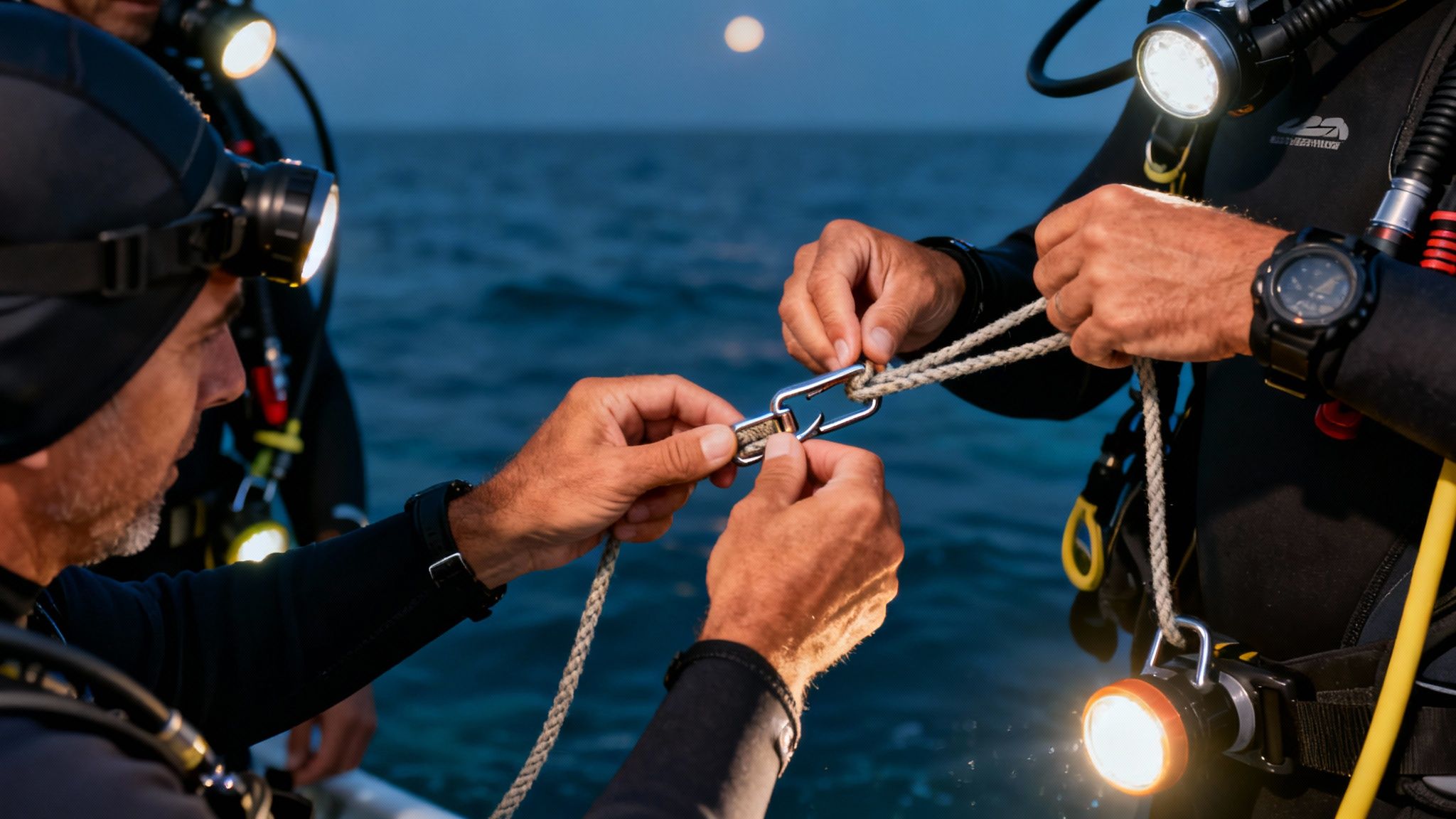
With Kona Honu Divers, your evening kicks off with one of the most detailed safety briefings you’ll ever get. The crew will walk you through every single step, from boat logistics to emergency procedures. A huge part of this is explaining the tether system. You'll see exactly how the weighted downline is set up and how each diver clips in with their personal tether, which keeps everyone connected to the system at a safe, predetermined depth.
This is your time to ask questions—any and all of them. The guides are specialists in this very specific type of diving, and their job is to make sure you feel 100% prepared before you even get your fins wet.
Gearing Up for the Abyss
While most of your standard scuba kit will do the trick, a few pieces of gear are absolutely critical for a blackwater dive. Your operator provides the specialized equipment like the tether system, but your personal gear is your responsibility.
- Dive Lights: A powerful primary light is a must, but a reliable backup light is mandatory. When you're drifting in the open ocean at night, redundancy is your best friend.
- Dive Computer: Your computer is vital for monitoring your depth. I highly recommend setting depth alarms to help you maintain your position without constantly staring at your gauges.
- Camera Gear: For the photographers out there, a red focus light is a game-changer. The harsh white beams from standard focus lights will send the delicate, light-sensitive critters scattering back into the darkness.
For a complete rundown of what to pack, our guide on the gear you will need for your Kona diving adventure is a fantastic resource to check out. Getting your gear sorted ahead of time means you can relax and truly immerse yourself in one of the most unique underwater adventures on the planet.
Choosing the Right Dive Operator in Kona
Let’s be real: when you’re floating in the open ocean, miles from shore, in the middle of the night… your dive operator is everything. They aren’t just your guide; they’re your lifeline. Choosing a top-notch company for a **blackwater dive Hawaii** adventure isn’t just about having a good time—it’s the most important safety decision you’ll make. This is where an experienced operator like Kona Honu Divers makes all the difference, turning what could be an intimidating experience into one of pure awe.
A serious, no-compromises commitment to safety is the bedrock of any legitimate blackwater operation. It all starts with a crew that knows this unique environment inside and out. These aren't just standard divemasters; they are specialists in open-ocean, pelagic diving. They have to understand the currents, anticipate the conditions, and master the specific protocols for managing a group of divers tethered in total darkness over thousands of feet of water.
Why Small Groups and Robust Systems Matter
One of the biggest factors in a safe and enjoyable blackwater dive is the size of the group. We intentionally keep our charters small, with a strict maximum of just six divers. A small group isn't just more comfortable; it allows our guides to give each person individual attention and maintain constant awareness of everyone in the water. No one ever feels lost in the dark.
This focused approach is built around a solid tethering system. A central, weighted downline hangs below the boat, giving everyone a stable vertical reference point in the vast blue. From there, each diver gets their own individual tether. This simple but critical setup makes it impossible to descend too deep or drift away from the boat, creating a secure bubble where you can relax and focus on the incredible creatures rising from the depths. Our guide on how to choose a Kona dive shop dives deeper into what separates a great operator from an average one.
The Value of Expertise and Professionalism
Blackwater diving is a high-value, low-volume activity for a reason. These specialized charters typically run between $175–$225 per person, a price that reflects the complex logistics, specialized gear, and high level of expertise required to run them safely. Keeping the groups small is essential for managing the tethers, lights, and providing the close supervision that this kind of dive demands. It all adds up to a safer, more personal experience.
But beyond the gear and systems, it's the people who truly make the dive unforgettable. Our guides are masters at spotting the tiny, often transparent critters you would almost certainly miss on your own. Their trained eyes can pick a larval flounder or a jewel-like squid out of the planktonic soup, turning a dark, empty-looking drift into a parade of amazing discoveries.
When you're ready for this once-in-a-lifetime adventure, putting your trust in the right hands is everything. You can book your Kona blackwater dive tour with a team that puts your safety and sense of wonder above all else.
Photography Tips for Capturing the Abyss
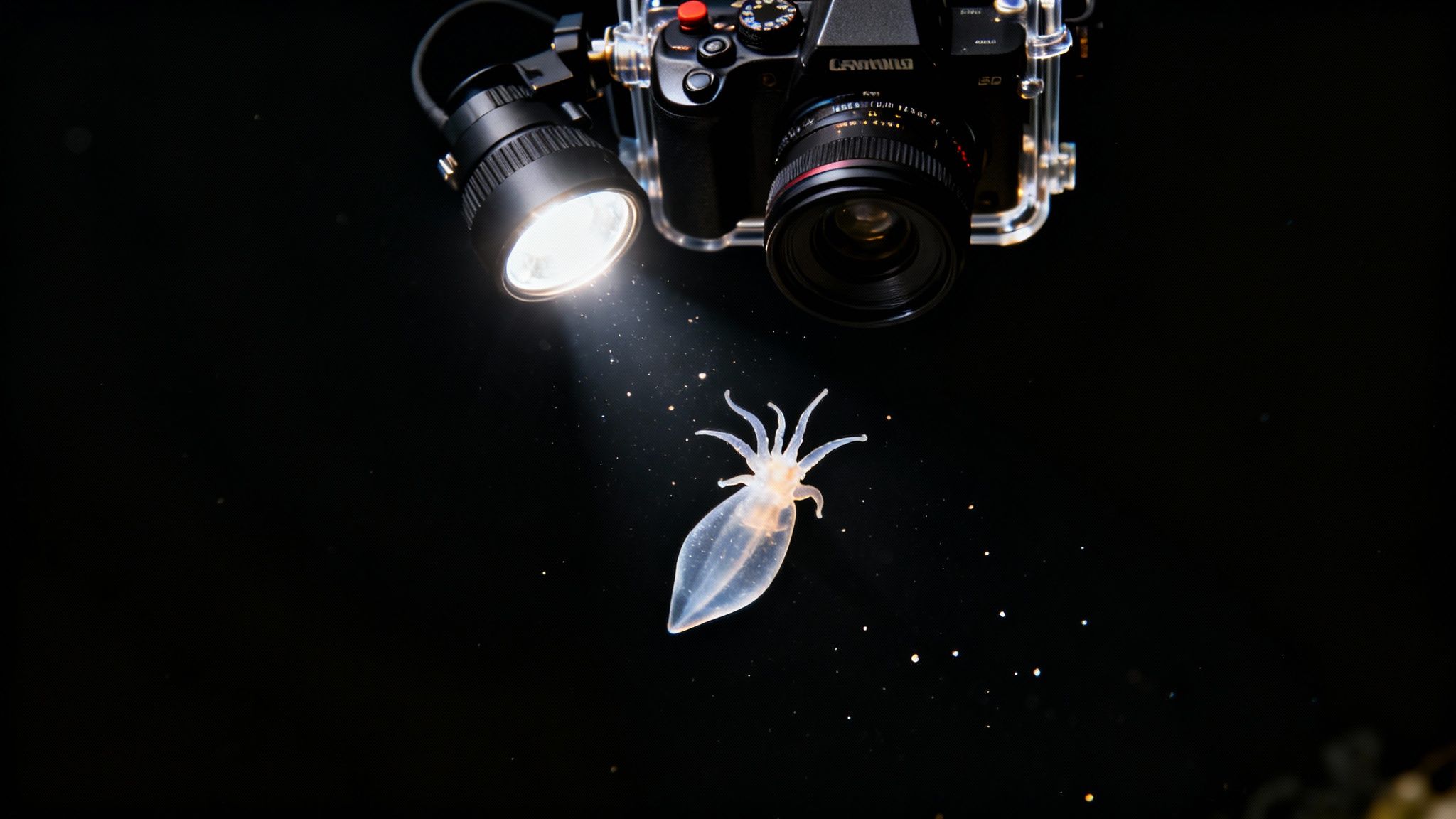
Let's be honest: photographing tiny, see-through critters zipping around in the open ocean at night is one of the toughest gigs in underwater photography. A blackwater dive in Hawaii will push your skills to the limit. But the reward? Images of creatures so bizarre and beautiful they look like they were dreamed up for a science fiction movie.
Success out here isn't about luck; it's about preparation. You can't just brace yourself on a sandy patch like you would on a reef dive. You're drifting, and so is your subject. It's a demanding, three-dimensional dance in the dark. You absolutely have to get your gear dialed in before you hit the water, because fumbling with settings in the pitch-black is a surefire way to go home empty-handed.
Go-To Camera Settings for Blackwater
While every dive is different, there's a solid baseline for camera settings that will get you in the ballpark. Think of these as your starting point for painting on a black canvas.
- Shutter Speed: You need speed to freeze motion—both the creature's and your own. I usually start at 1/200s or 1/250s to get crisp, sharp shots.
- Aperture: These subjects are tiny and three-dimensional. A deep depth of field is crucial to get as much of them in focus as possible. Start high, around f/16 to f/22.
- ISO: Your strobes are doing all the heavy lifting, so you can keep the noise down. Set your ISO low, around 200 or 400, and only bump it up if you absolutely have to.
The whole point of these settings is to make the background completely black. This ensures your strobes only light up the subject, making it pop right out of the void.
Mastering Your Light and Focus
Light and focus are everything in blackwater photography. You’re dealing with subjects that are often translucent and move erratically, which is a nightmare for most autofocus systems.
First off, strobes are non-negotiable. The pop-up flash on your camera is useless here. You need at least one, and preferably two, external strobes to have any control. The real trick is avoiding backscatter—those ugly white specks caused by your light hitting particles in the water. Position your strobes out wide and a little behind your housing, aiming them slightly outward. This "cross-lighting" illuminates your subject without lighting up the column of water right in front of your lens.
Your focus light is arguably your single most important piece of gear on this dive. But be warned: a bright white beam will send most of these light-sensitive critters scattering into the darkness. This is why a red focus light is the pro standard. Most deep-sea animals can't perceive red light, so you can get close and lock focus without scaring them off.
Actually getting focus is an art form. Many experienced blackwater photographers swear by back-button focus, which decouples the focus from the shutter button. It lets you lock onto a subject, then recompose your shot without the camera constantly trying to re-focus. It takes some practice to get the muscle memory down, but it's a game-changer in this environment.
The Right Lens and Post-Processing Tricks
For a blackwater dive in Hawaii, a macro lens is your best friend. You simply can't capture these details without one.
A 60mm macro lens is a fantastic all-arounder. It gives you a comfortable working distance and great magnification for most of what you'll encounter. If you're hunting for the really tiny stuff or want those tight, frame-filling portraits, a 100mm or 105mm macro lens will give you that extra reach.
Once you’re back on the boat with your memory card, a little love in post-processing can make your keepers truly shine. The goal is simple: make the subject stand out against that pure black background. In a program like Adobe Lightroom, you don't need to do much. A little boost in contrast, a touch of the "dehaze" slider to clean things up, and some careful adjustments to the highlights and shadows are often all it takes to bring out the alien-like, delicate features of these incredible animals.
Frequently Asked Questions About Blackwater Diving
A blackwater dive in Hawaii is the kind of experience you talk about for years. It’s so different from anything else in the scuba world that it naturally brings up a lot of questions. And that’s a good thing—it pays to know exactly what you’re getting into.
We've put together answers to the most common questions we hear from divers. Think of this as your pre-dive briefing, designed to help you decide if this unique adventure is for you and to make sure you feel completely prepared when you step on the boat.
What Certification Do I Need for a Blackwater Dive?
Officially, the minimum card you need is Advanced Open Water. But let's be real—the certification is just the starting point. What truly matters is your comfort and skill in the water. Any reputable operator is going to ask for proof of recent night diving (usually within the last year) and, most importantly, will want to be sure you have rock-solid buoyancy control.
These aren't just suggestions; they're essential for safety. You'll be floating in the middle of the water column with thousands of feet of ocean beneath you and no bottom for reference. Being able to hold your depth without even thinking about it is non-negotiable. Your guide needs to trust that you're a competent, comfortable diver who can handle a challenging environment. If you feel like you need to polish those skills, getting out on some advanced dive opportunities is the perfect way to build that confidence.
Is Blackwater Diving Dangerous?
Floating in the open ocean in the dead of night definitely sounds a little intimidating, right? But when you're with a professional, safety-obsessed crew, blackwater diving is an incredibly well-managed and safe activity. The common fear of getting "lost at sea" is something the entire safety plan is built to prevent.
The key is the tether system. Every single diver is securely clipped to a downline that runs straight back to the boat. This simple but effective system makes it physically impossible to drift away from the group or descend too deep. Add to that the standard practice of very small group sizes, and your expert guide can easily keep a close eye on everyone throughout the dive. For a certified diver who listens to the briefing and stays aware, it's an exceptionally safe adventure.
When Is the Best Time of Year for a Blackwater Dive in Hawaii?
This is one of the best things about diving here in Kona—there really is no "off-season." The Big Island's geography shields the Kona coast from the gusty trade winds, which means we get beautifully calm and comfortable sea conditions pretty much all year long. A blackwater dive in Hawaii is always on the table, no matter when you’re visiting.
While the conditions are consistently great, the cast of characters you'll meet changes with the seasons and even the moon phase. The great vertical migration is always happening, but who comes up from the deep depends on the water temperature and time of year. This is what keeps the dive so exciting. Even our local guides, who do this all the time, see something new on almost every trip. Every night is a completely new show.
Blackwater diving is often compared to a box of chocolates—you truly never know what you're going to get. One night might be all about larval fish and tiny squids, while the next could feature rare cephalopods or otherworldly jellies. That unpredictability is the heart and soul of the adventure.
How Is This Different from a Standard Reef Night Dive?
Comparing a blackwater dive to a reef night dive is like comparing a walk in a city park at night to floating through deep space. They are two fundamentally different experiences.
-
Reef Night Dive: You're exploring a familiar coral reef. You head down to the seafloor and use your light to spot the night shift: crabs, lobsters, sleeping parrotfish, and hunting eels. The reef structure itself is your environment, and you’re seeing the creatures that call that specific habitat home.
-
Blackwater Dive: This happens miles offshore in the deep, open ocean—the pelagic zone. There is no reef. There is no bottom. Your entire world is the inky black water column. The creatures you find aren't from the reef; they are deep-water migrators and drifters, many in bizarre larval forms that look nothing like the adults they'll become.
A reef dive shows you the nightlife of a coastal neighborhood. A blackwater dive introduces you to the mysterious, alien life of the vast open ocean itself.
Ready to take the plunge into one of the most unique diving experiences on the planet?
At Kona Honu Divers, we live to share the magic of Hawaii's underwater world. Whether you're ready to explore the abyss on our famous Blackwater Night Dive, glide with gentle giants on the Manta Ray Dive, or just explore our vibrant reefs, we have an adventure waiting for you. Our commitment to safety, small groups, and expert guides is what makes a trip with us an experience you’ll never forget.