
Picture yourself floating in the vast, silent expanse of outer space, surrounded by strange, glowing creatures that seem to have materialized from another dimension. That’s the closest I can get to describing a black water dive. This isn't your average night dive; it's an adventure that takes you miles offshore, suspended over thousands of feet of inky black ocean. You're heading out into the open sea to witness one of the planet's most mind-blowing natural events.
What Is a Black Water Dive?
Forget everything you know about exploring a reef at night. A black water dive is completely different. You'll drift in the open ocean, hanging in the water column as the boat travels miles from shore to a spot where the bottom is thousands of feet down—far deeper than any diver could ever go.
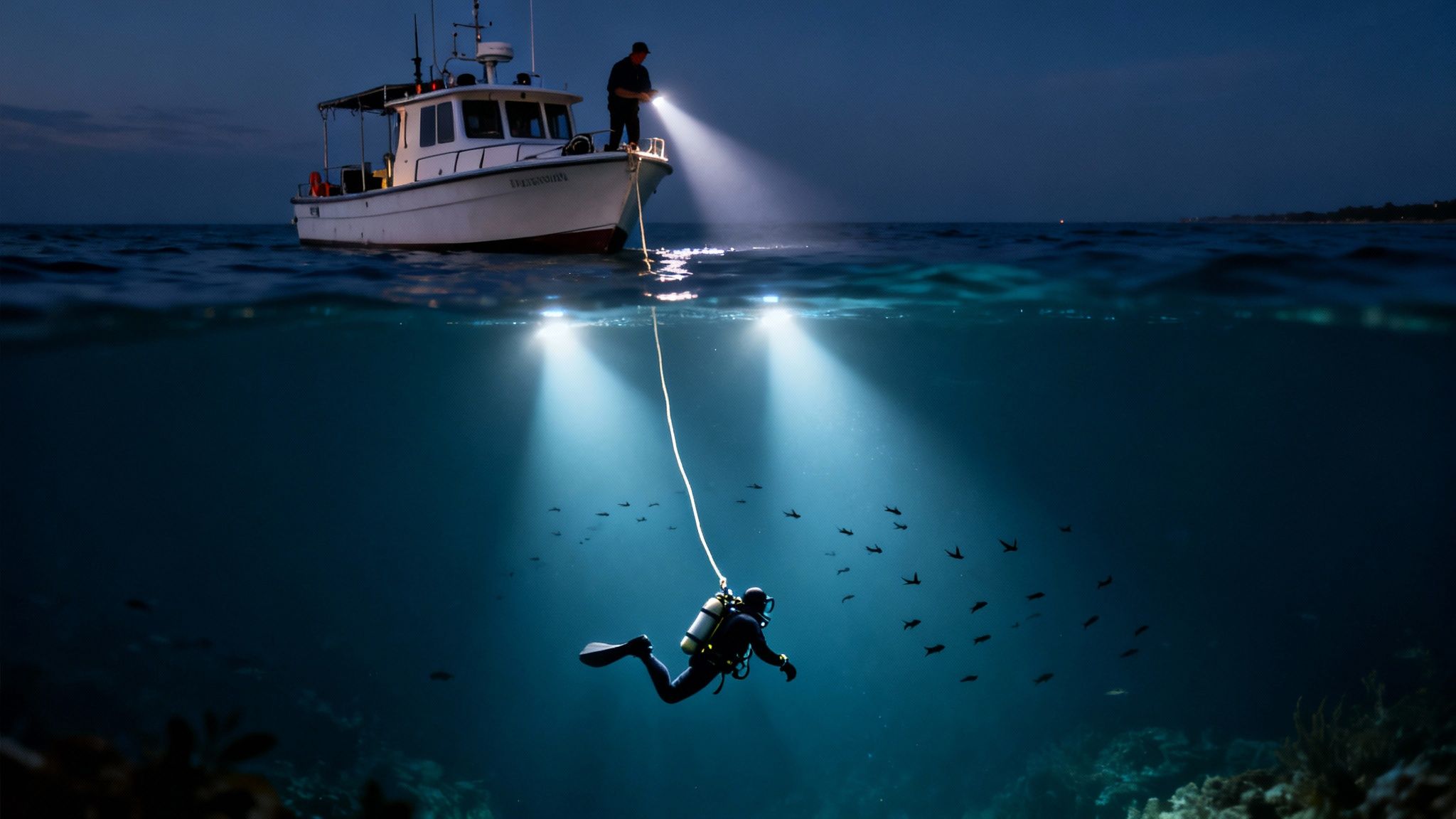
The crew suspends powerful lights beneath the boat, which create a beacon in the otherwise endless darkness. This cone of light is what draws up an incredible parade of deep-sea critters that migrate toward the surface after sunset to feed.
The Diel Vertical Migration
This nightly ascent is a natural phenomenon called the diel vertical migration. Scientists often describe this as the single largest daily movement of animal life on Earth. It's truly massive.
Every single night, billions of tiny zooplankton and the larval stages of fish and other invertebrates rise from depths of over 1,000 meters to feed in the upper 200 meters of the ocean. Before sunrise, they all sink back down into the abyss. It’s such a huge migration that sonar surveys actually show entire layers of life shifting hundreds of meters in just a few hours.
When you join a charter like the one offered by Kona Honu Divers, you get a front-row seat to this planetary-scale event. It’s like a treasure hunt for some of the most bizarre, beautiful, and often bioluminescent animals you’ll ever lay eyes on. You’re not just observing their world; you’re floating right in the middle of it.
Black Water Dive vs Standard Night Dive
It’s really important to get a handle on just how different this is from a typical night dive on a reef. While both happen after dark, the environment, the animals you see, and the overall feeling are worlds apart.
To put it in perspective, here's a quick comparison:
| Feature | Standard Night Dive | Black Water Dive |
|---|---|---|
| Location | Over a reef or known bottom structure, usually close to shore. | Miles offshore over deep, open ocean water (thousands of feet). |
| Reference Point | Divers use the seafloor and reef formations for navigation. | Divers are tethered to a downline from the boat and float in mid-water. |
| Marine Life | Nocturnal reef dwellers like eels, octopus, and sleeping parrotfish. | Strange, often transparent or bioluminescent deep-sea organisms. |
| The Experience | Feels like exploring a familiar neighborhood with a flashlight. | Feels like floating through deep space, discovering alien life forms. |
This unique style of diving is an absolutely thrilling adventure, and it’s made possible by expert operators who have dialed in the logistics and safety procedures. For example, the Kona Blackwater Dive tour with Kona Honu Divers is a true bucket-list experience for any adventurous diver visiting Hawaii. Their expertise is what allows for a safe and truly mesmerizing glimpse into this hidden world.
Why Kona Is the Birthplace of Black Water Diving
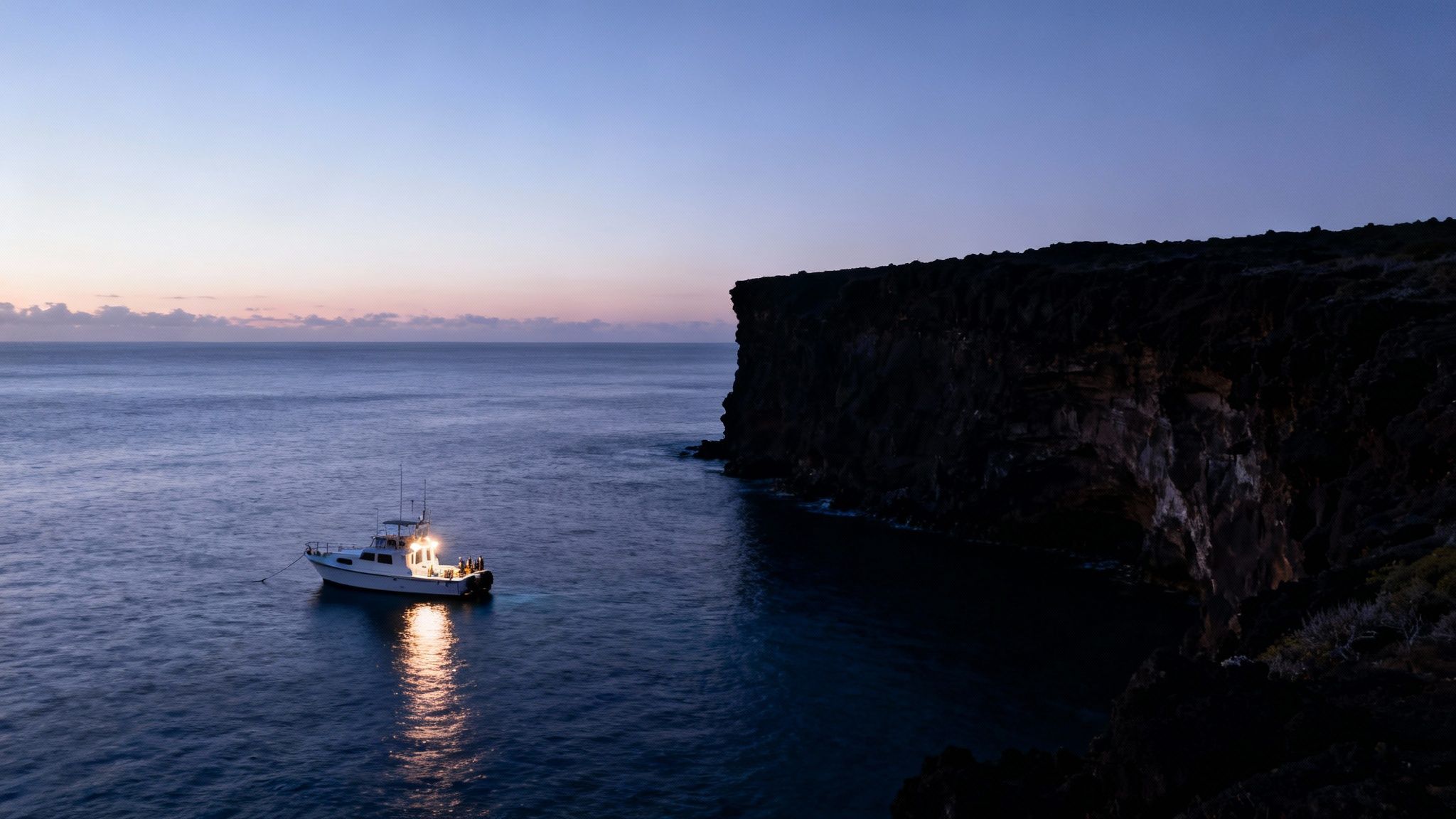
Black water diving isn't just something you can do anywhere. This one-of-a-kind experience has a true home, a place where it was born and perfected: right here in Kona, Hawaii. The "why" all comes down to the island's incredible and unique geology.
The Big Island is really just the peak of a massive volcanic mountain that rises from the deep ocean floor. Unlike places with wide, shallow continental shelves, Kona's coastline drops off a cliff. The volcanic slopes plunge dramatically into the abyss just a few miles from shore. This rare geography is the secret sauce that makes Kona the global epicenter for black water dives.
From Scientific Protocol to Epic Adventure
While scientists were studying deep-sea life using "bluewater" protocols back in the 1980s, the recreational dive we know today is a pure Kona innovation. It all started in the 1990s when some forward-thinking local dive operators saw the potential in Kona's deep backyard. They started motoring boats a short distance from the coast, dropping powerful lights over thousands of feet of water, and revealing a hidden universe.
The island’s volcanic landscape is what makes it all possible. The seafloor plummets to about 1,000 feet within just one mile of the coast. This means dive boats can get to the perfect open-ocean environment in less than 20 minutes. That combination of deep-water access and the calm, protected leeward coast created the perfect conditions to invent a new kind of diving. You can learn more about what makes Kona’s underwater environment so special in our detailed guide.
That pioneering spirit turned a scientific research method into a bucket-list adventure, cementing Kona's reputation as the official birthplace of black water diving.
The Kona Advantage
Getting to deep water so quickly isn't just about convenience—it fundamentally changes the entire experience. In most other parts of the world, you’d be looking at a long, often rough, multi-hour boat ride to find a suitable black water site. Here in Kona, the adventure begins almost the moment you leave the harbor.
This accessibility means more time in the water and less time traveling, giving you the best possible chance to witness the incredible vertical migration. It's the key reason Kona is still the most established and reliable place for this highly specialized dive.
This geological gift has allowed the local dive community to build expertise that you just won't find anywhere else. Generations of guides have spent countless nights in these waters, perfecting safety procedures and gaining a deep, intuitive understanding of the creatures that rise from the depths. It’s this deep-rooted knowledge that turns a wild concept into a safe and awe-inspiring reality. The island is a hub for all sorts of amazing marine encounters, including the world-famous Kona Manta Ray Night Snorkel guide.
This history of innovation, combined with the perfect natural setting, is why Kona isn’t just another spot for world-class diving tours—it’s the true home of the black water dive.
Discovering the Creatures of the Deep
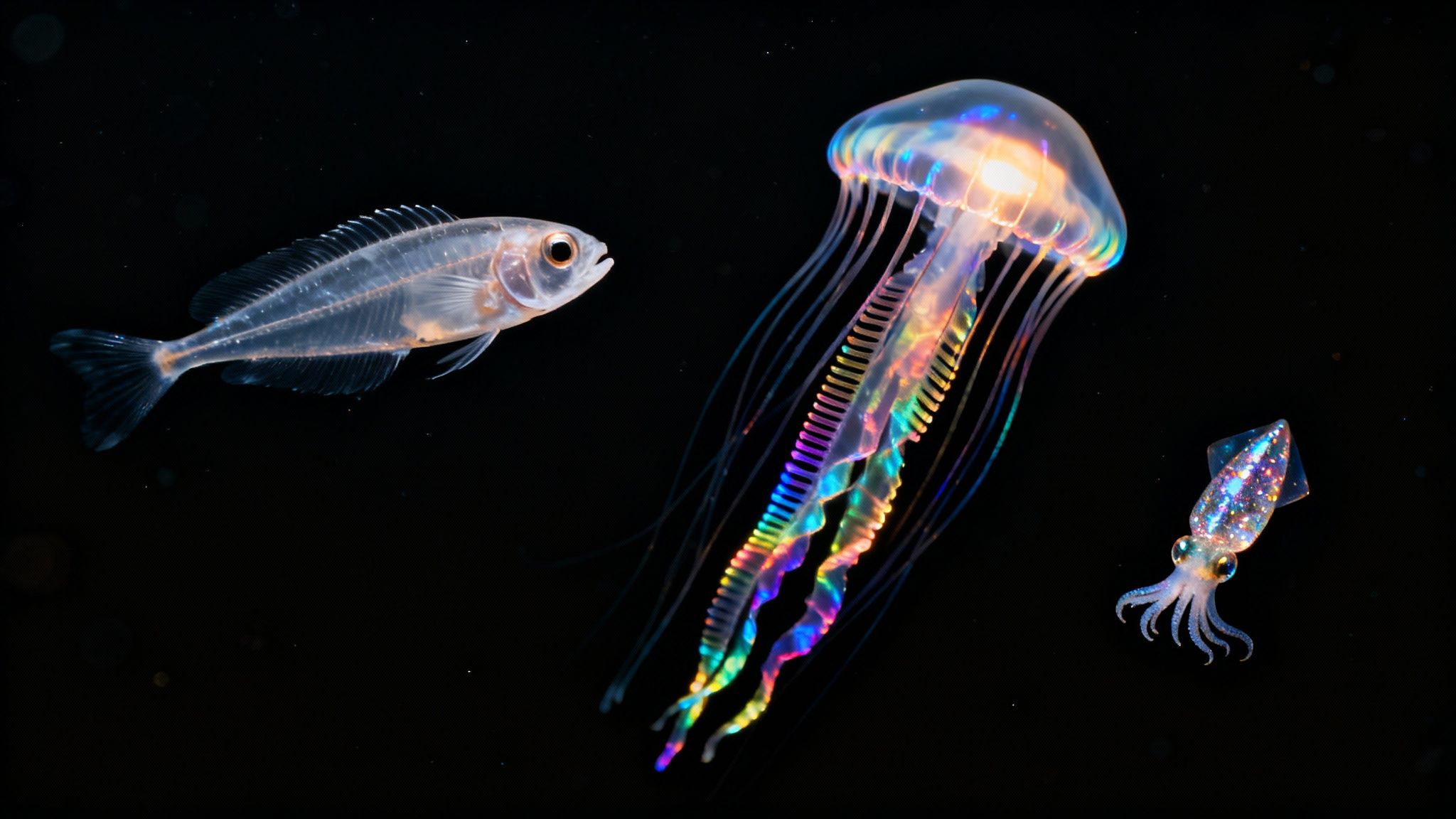
Forget everything you know about reef fish. A blackwater dive is your ticket to meeting the ocean's real-life aliens. We’re dropping into a hidden ecosystem, a world of creatures that spend their entire lives in the deep and only venture toward the surface under the cover of darkness. It's a surreal parade of bioluminescence, transparency, and body shapes so bizarre they seem conjured from a sci-fi novel.
The real magic is in the sheer unpredictability. You're drifting through the largest animal migration on Earth, and you have absolutely no idea what your light will catch next. Every flicker could reveal a larval creature so new to science you might be the first human to ever see it. This isn’t just a dive; it’s a genuine voyage of discovery.
Larval Creatures in Disguise
So much of what we see out there are animals in their larval, or juvenile, stages. They often look nothing like their adult counterparts, having developed wild and unique features to survive in the open ocean before they eventually settle on a reef.
Take a larval flounder, for example. As an adult, it's a flatfish chilling on the seafloor with both eyes on one side of its head. But as a larva? It's a perfectly symmetrical, free-swimming fish with one eye on each side, just like any other. You get a front-row seat to its incredible transformation in real-time.
Another favorite is the leptocephalus—the larval form of an eel. It’s a glassy, ribbon-like creature, so transparent it looks like a piece of cellophane drifting in the current. These are master-level adaptations for camouflage in the big blue.
The Pulsating and Glowing Wonders
Bioluminescence and iridescence are the true superstars of any blackwater dive. Your eyes will quickly lock onto the creatures that create their own light or reflect your beam in a dazzling, otherworldly show.
Ctenophores, or comb jellies, are often the main event. These gelatinous drifters aren't true jellyfish; they move using eight rows of tiny cilia that refract light, creating shimmering, pulsating rainbows that trail behind them in the dark. It’s mesmerizing.
And then there are the cephalopods. You’ll find tiny, jewel-like squid, some no bigger than your thumbnail, actively hunting right in front of you. If you’re really lucky, you might spot one of the deep's true legends, like a female Paper Nautilus (Argonaut) clutching her delicate egg case, or the jaw-dropping Blanket Octopus, whose females trail massive, web-like membranes.
A List of Potential Encounters
While every dive is a completely different experience, here are a few of the weird and wonderful organisms you might cross paths with:
- Tripod Fish Larvae: Before they become the iconic deep-sea fish that "stands" on the ocean floor, their larvae drift through the water column, almost completely transparent.
- Amphipods: These small, shrimp-like crustaceans are a crucial part of the food web. Some, like the Phronima, are famously alien-like and have a truly fascinating life cycle.
- Pelagic Seahorses: Unlike their reef-dwelling cousins, these seahorses live in the open ocean, often using their prehensile tails to cling to floating bits of sargassum or debris.
- Siphonophores: These aren't single animals but bizarre colonial organisms, like the Portuguese man o' war. They’re made of individual specialists linked together—some for floating, some for feeding, and others for reproduction.
The thrill is rooted in the unknown. Every single minute you spend floating in that blackness holds the potential for a once-in-a-lifetime encounter. Out here, you’re not just a diver. You’re an explorer on the edge of a vast, mysterious frontier, witnessing life that most people will never even know exists.
How a Black Water Dive Actually Works
The idea of floating in the open ocean at night, miles from shore, can sound pretty intimidating. I get it. But the reality of a black water dive is far from a haphazard leap into the unknown. These are incredibly well-orchestrated experiences, meticulously planned from start to finish.
A good professional crew transforms what sounds like a wild adventure into a smooth, safe, and truly unforgettable look into the abyss. The whole operation revolves around a system designed for one thing: getting you safely face-to-face with some of the planet's weirdest and most wonderful creatures.
It all starts with the boat ride. We head several miles offshore, out over water that’s thousands of feet deep. Once we find the right spot, the crew deploys the main attraction: a heavy, weighted line dropped straight down from the boat, rigged with an array of powerful lights. This glowing beacon cuts through the darkness, acting like a bug zapper for the deep. It draws in all the strange critters making their nightly vertical migration up toward the surface to feed. This simple, brilliant setup creates a private, illuminated stage just for you.
The Tether System and Dive Profile
So, how do you keep from drifting off into the big, dark blue? That's where the tether system comes in. Every diver is connected to the main downline by a shorter tether, usually around 10-15 feet long. It’s your lifeline.
This simple setup is what makes the whole thing possible. It keeps everyone together, prevents any chance of separation, and gives you a constant physical reference point in the blackness. Honestly, it’s what allows you to completely relax and just focus on the alien-like creatures floating past your mask.
The dive plan itself is surprisingly simple. Think of it as a highly controlled night drift dive. We keep the depths and times well within normal recreational limits, even though the seafloor is 5,000–10,000 feet below us.
Most black water dives are conducted between 30–60 feet (9–18 meters). We set up the downline, you clip in, and you get a solid 50–70 minutes of bottom time just floating and watching the show. It’s a beautifully managed system that makes this niche corner of diving accessible, as long as you’re with a professional crew that follows strict procedures.
Your Role and the Guide’s Expertise
While the crew has the boat and light rig dialed in, your job is all about buoyancy. This is non-negotiable. With no bottom to reference, your ability to hold your depth is everything. You need to be able to just hang there, perfectly still in the water column, without sinking or floating up.
Good buoyancy control isn't just for safety; it's about respect for the environment. These creatures are often tiny, gelatinous, and incredibly fragile. Slow, calm, and deliberate movements are the name of the game.
Your guide is the key to the whole experience. They’re much more than just a tour leader; they are your:
- Safety Officer: Constantly monitoring every diver, the gear, and the surrounding conditions.
- Creature Spotter: Their eyes are trained to spot nearly invisible, thumbnail-sized critters you’d swim right past.
- Marine Biologist: They can often identify the bizarre larval fish and invertebrates, giving you context for the incredible things you’re seeing.
A black water dive is definitely a more advanced experience, and it absolutely requires a solid foundation of dive skills. If you're looking for other ways to push your skills in Hawaii's unique underwater world, Kona has some incredible premium advanced dive tours that take you through deep lava tubes and to remote offshore pinnacles.
It’s this combination of a professional setup, a clear and simple dive plan, and an expert guide that makes a black water dive work so well. The system is designed to take an adrenaline-pumping concept and turn it into a safe, accessible, and profoundly moving adventure. Once you understand the mechanics, you can truly appreciate the expertise that goes into every single trip.
How to Prepare for Your First Black Water Dive
Ready to take the plunge into that inky black abyss? Thinking ahead is what separates a good dive from an unforgettable one. A truly epic black water dive is as much about your mindset and gear as it is about what you see. Getting everything squared away beforehand means you can relax, drop in, and just soak up one of the most surreal underwater experiences on the planet.
Let's be clear, though: this isn't a dive for someone fresh out of their open water course. Floating in the open ocean with no bottom in sight demands a solid set of skills to keep you safe, comfortable, and stress-free.
Essential Prerequisites and Skills
Before you even think about booking, take a moment for an honest self-assessment of your diving skills. Dive operators have these requirements for a reason—to keep everyone safe out there.
- Advanced Open Water Certification: This is the bare minimum. You need to be comfortable at depths greater than 60 feet and have a good handle on different diving situations, especially night diving.
- Rock-Solid Buoyancy Control: This is the single most important skill you can bring to a black water dive. Period. With no seafloor to give you a point of reference, you have to be able to hang perfectly still in the water column without even thinking about it. It’s absolutely non-negotiable.
- Recent Night Diving Experience: We highly recommend having a few recent night dives under your belt. You should be totally comfortable with night diving protocols, using a dive light for communication, and the unique feeling of being underwater after dark.
Your Black Water Dive Checklist
Showing up with the right equipment will make your dive that much smoother and more enjoyable. While your dive operator provides the big-ticket items, having a few key pieces of your own gear can make all the difference.
Here’s a quick rundown of what you’ll want to have sorted out before you get to the boat.
| Category | Requirement / Recommendation |
|---|---|
| Certification | Your Advanced Open Water card (or equivalent) and logbook. |
| Dive Gear | It's always best to bring your own mask, fins, and dive computer for comfort and familiarity. |
| Dive Light | A powerful primary dive light is a great idea. It can serve as a backup and is perfect for spotting tiny critters your guide might miss. For photographers, a red focus light is a must. |
| Camera Gear | Make sure your batteries are fully charged, you have empty memory cards, and a macro lens setup if you have one—it’s ideal for capturing the tiny, detailed subjects. |
| Exposure Protection | We strongly recommend a 3mm or 5mm full wetsuit. You'll be hanging pretty still in the water for about an hour, and you can get surprisingly chilly, even in warm Hawaiian water. |
| Post-Dive Comfort | Nothing beats having a warm, dry towel, a windbreaker or hoodie, and maybe even a beanie for the boat ride back to the harbor. |
For a more comprehensive look at what to pack, check out our guide on the gear you will need for your Kona diving adventure. A little preparation goes a long way.
Mental Preparation for the Deep
Your physical gear is only one part of the equation; getting your head in the right space is just as crucial. That initial sensation of floating in the deep, open ocean at night can be a bit disorienting, maybe even a little overwhelming at first.
The key is to relax, breathe slowly, and trust the system. Remember, you are securely tethered to the downline. The goal is to move as little as possible. Slow, deliberate movements are best for both conserving air and not disturbing the fragile marine life.
Train your eyes to look for subtle movements and strange shapes in the darkness just beyond the glow of the main lights. Scan your immediate area slowly, then let your gaze drift further into the black. The goal is to embrace the feeling of being suspended in outer space—it’s a huge part of what makes black water dives so magical. Arrive confident and prepared, and you've set the stage for one of the most incredible dives of your life.
Why Choose Kona Honu Divers for This Adventure
When you're planning to drop into the deep, dark ocean miles from shore, who you go with is the most important decision you'll make. This isn't your average reef dive. It's a highly specialized experience that requires serious expertise, iron-clad safety procedures, and an intimate knowledge of the local waters. For black water dives in Kona, the choice becomes simple: Kona Honu Divers.
These aren't folks who just added a trendy dive to their menu. The crew has over 200 years of combined professional experience, and they were part of the very community that pioneered this incredible dive right here in Kona. That kind of legacy means their understanding of the offshore environment is second nature. This isn't just a tour they run; it's an adventure they perfected.
An Uncompromising Commitment to Safety
Let's be clear: safety is everything on a dive like this. Kona Honu Divers gets it. They've built a culture around it, from their meticulously maintained boats and top-tier gear to the seasoned guides who know how to handle the unique challenges of an open-ocean night dive.
Every detail, from the thorough pre-dive briefing to the way they manage the tether system, is dialed in for your safety. That commitment is what allows you to let go, relax, and truly lose yourself in the alien world below, confident you're in the best possible hands. Their thousands of five-star reviews tell the story better than I can.
The Ultimate Kona Night Dive Experience
The black water dive really is the peak adventure in a place already famous for world-class diving. It's the perfect counterpoint to other incredible experiences, like the world-famous manta ray night dive. While both happen after dark, they offer completely different, yet equally mind-blowing, windows into the ocean's secrets.
By diving with the team at the heart of where it all started, you're doing more than just booking a trip. You're guaranteeing your adventure is managed by true professionals who are as passionate about the deep as they are dedicated to sharing it safely.
When you're ready for the real deal, book the Kona Blackwater Dive tour with the original experts.
Your Blackwater Dive Questions, Answered
Thinking about taking the plunge? It’s only natural to have a few questions before diving into the deep, dark blue. Here are some straightforward answers to the most common things we hear from divers.
Do I Need to Be a Hardcore Diver?
Not at all, but this isn't a dive for brand new beginners either. We’re looking for certified Advanced Open Water divers who are genuinely comfortable in the water.
The most important skill you'll need is solid buoyancy control. Think of it this way: you'll be floating in the middle of a massive water column with no bottom to reference. Maintaining your depth without thinking about it is key. Having some recent night diving experience under your belt is also a huge plus.
Is This Dive Actually Safe?
Absolutely. When you go with a professional crew like ours, safety is built into every step of the dive. It’s not just a suggestion; it’s a strict system.
You'll be connected to the boat via a tether line, which keeps everyone together and at a controlled depth. Our expert guides are always in the water with you, keeping a close eye on everything from conditions to diver comfort. They are your lifeline and safety net out there.
How Is This Different From the Manta Ray Dive?
It's like comparing a rock concert to a quiet, weird art gallery—both are amazing, but completely different vibes.
On the manta dive, you're stationary on the sea floor at about 35-40 feet, watching giant, graceful mantas swoop in to feed on plankton attracted by your lights. It’s a breathtaking spectacle.
A blackwater dive is a drift dive in the open ocean, floating over thousands of feet of water. You’re not watching giants; you’re hunting for tiny, bizarre, and often alien-like creatures—many in their larval stage—as they make their nightly vertical migration from the deep.
What About Sharks?
It's possible to see a shark, but it’s definitely not a common occurrence. If you do, it’s more likely to be an oceanic whitetip or a silky shark, not the typical reef sharks you might see closer to shore.
These encounters are very rare. Rest assured, our guides are pros at managing any and all wildlife interactions. Their top priority is making sure everyone has a safe, secure, and unforgettable experience.
Ready to experience one of the world's most unique underwater adventures? Kona Honu Divers offers expertly guided black water dives that will change the way you see the ocean.