
Forget everything you think you know about night diving. A black water dive isn't just diving in the dark; it's like a spacewalk in the deep ocean. You drift miles from shore, suspended in an inky blackness over thousands of feet of water, watching a universe of bizarre, glowing creatures materialize before your eyes.
It’s your front-row seat to the largest migration on Earth, a nightly event hidden from the world above.
What Is a Black Water Dive
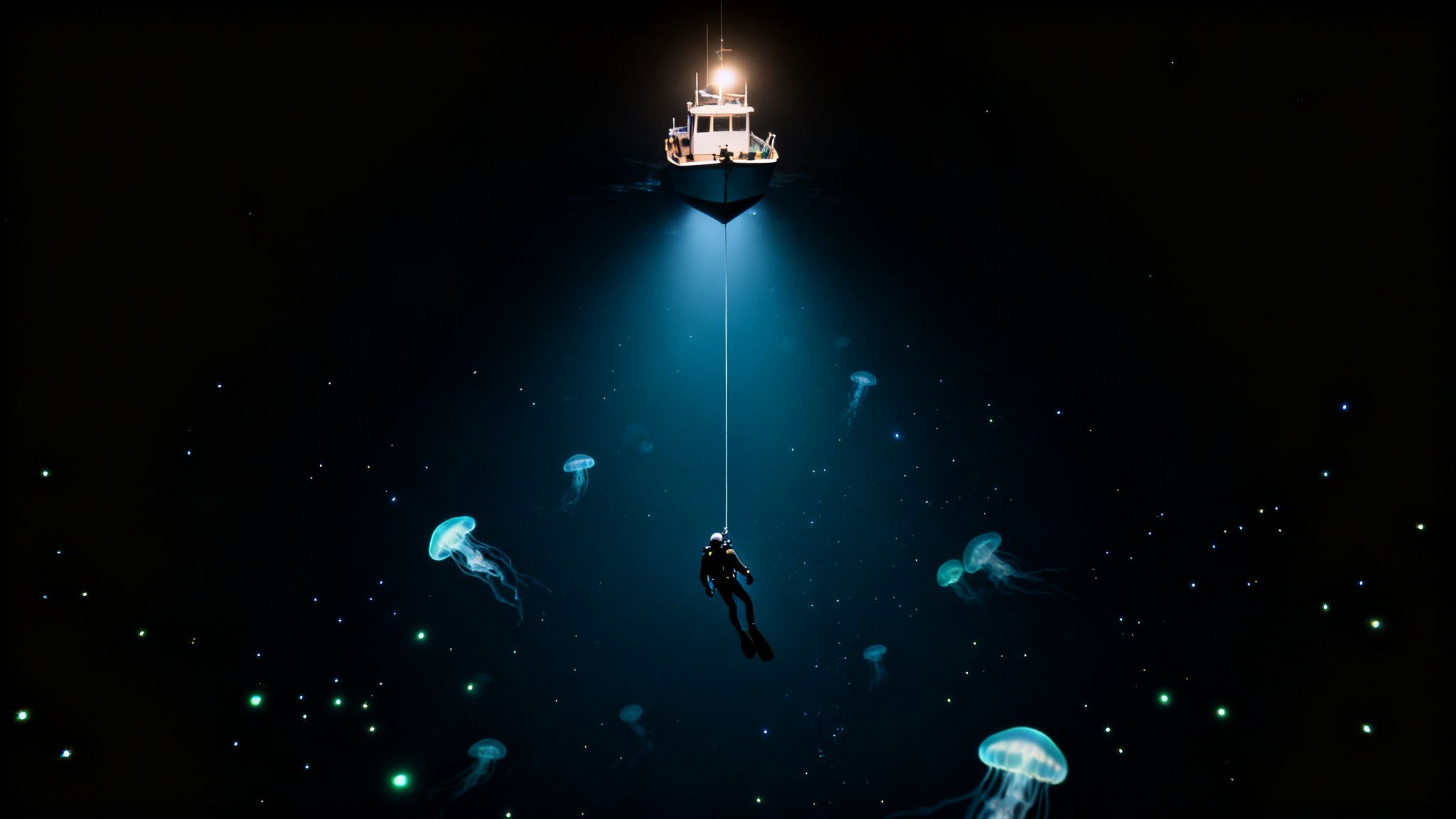
Picture yourself floating weightlessly, not over a familiar coral reef, but in the profound, open ocean. You’re safely attached to a tether that leads back to the boat, so there’s no chance of drifting away. Below you, there’s nothing but the deep blue abyss.
The boat hangs powerful lights into the water, creating a column of illumination in the void. This beacon doesn't just help you see—it attracts an unbelievable procession of life from the depths.
This whole experience is built around a massive natural phenomenon called the diel vertical migration. Every single night, countless tiny organisms journey from the crushing pressure of the deep sea toward the surface to feed, using the darkness as cover. We simply hang out in their path and watch the show.
An Alien World Appears Nightly
The creatures you'll meet on a black water dive look like they’re straight out of a sci-fi movie. Many are in their larval stages, completely translucent and looking nothing like their adult forms. It's a parade of the weird and wonderful.
On any given night, you might spot:
- Larval Fish and Eels: Think tiny, see-through ribbons that twist and dance in the light.
- Cephalopods: Miniature squid and octopuses, some no bigger than your thumbnail, jetting through the water column.
- Bioluminescent Jellies: Ctenophores and other gelatinous animals that create their own light, pulsing like living constellations.
- Strange Crustaceans: Otherworldly shrimp and crabs that spend their youth drifting in the open ocean.
This is often called a "pelagic safari" for a good reason. You don’t go looking for the action; the action comes to you. A constantly shifting cast of deep-sea characters drifts by on the current.
To get a better sense of how marine life transforms after sunset, you can also check out our guide on what makes scuba diving at night over a reef so captivating.
While the concept is similar (diving in the dark), a black water dive is a completely different beast.
Black Water Dive vs Traditional Night Dive
To put it in perspective, here’s a quick comparison highlighting the key differences between a black water dive and a standard reef night dive.
| Feature | Black Water Dive | Traditional Night Dive |
|---|---|---|
| Location | Miles offshore over deep, open ocean | Over a specific reef or coastal dive site |
| Environment | Open water column (mid-water) | Bottom-oriented, exploring a fixed structure |
| Marine Life | Pelagic, larval, and bioluminescent deep-sea life | Reef dwellers (eels, octopus, crabs, sleeping fish) |
| Diver Position | Suspended from a tethered line, drifting | Navigating freely over the reef |
| Primary Attraction | The "alien" creatures of the vertical migration | Observing nocturnal reef behaviors |
| Depth Reference | Only the downline and your dive computer | The seafloor provides a constant physical reference |
This table makes it clear: while both happen at night, the experience, the environment, and the creatures you'll see are worlds apart.
Why Kona Is The Perfect Location
A few destinations around the globe offer this unique dive, but Kona, Hawaii, is widely considered the best and safest place to try it. The island’s unique geography is the secret.
The seafloor drops off incredibly steeply just a few miles from shore, giving us quick and easy access to the deep-water environment where these creatures live. Better yet, the leeward side of the island provides exceptionally calm sea conditions most of the year.
This perfect combination of deep water so close to land and reliably calm seas makes the Kona blackwater dive a true bucket-list experience for adventurous divers. It’s more than just a dive—it's a journey into a hidden realm that only reveals itself long after the sun goes down.
The Science Behind The Deep Ocean Spectacle
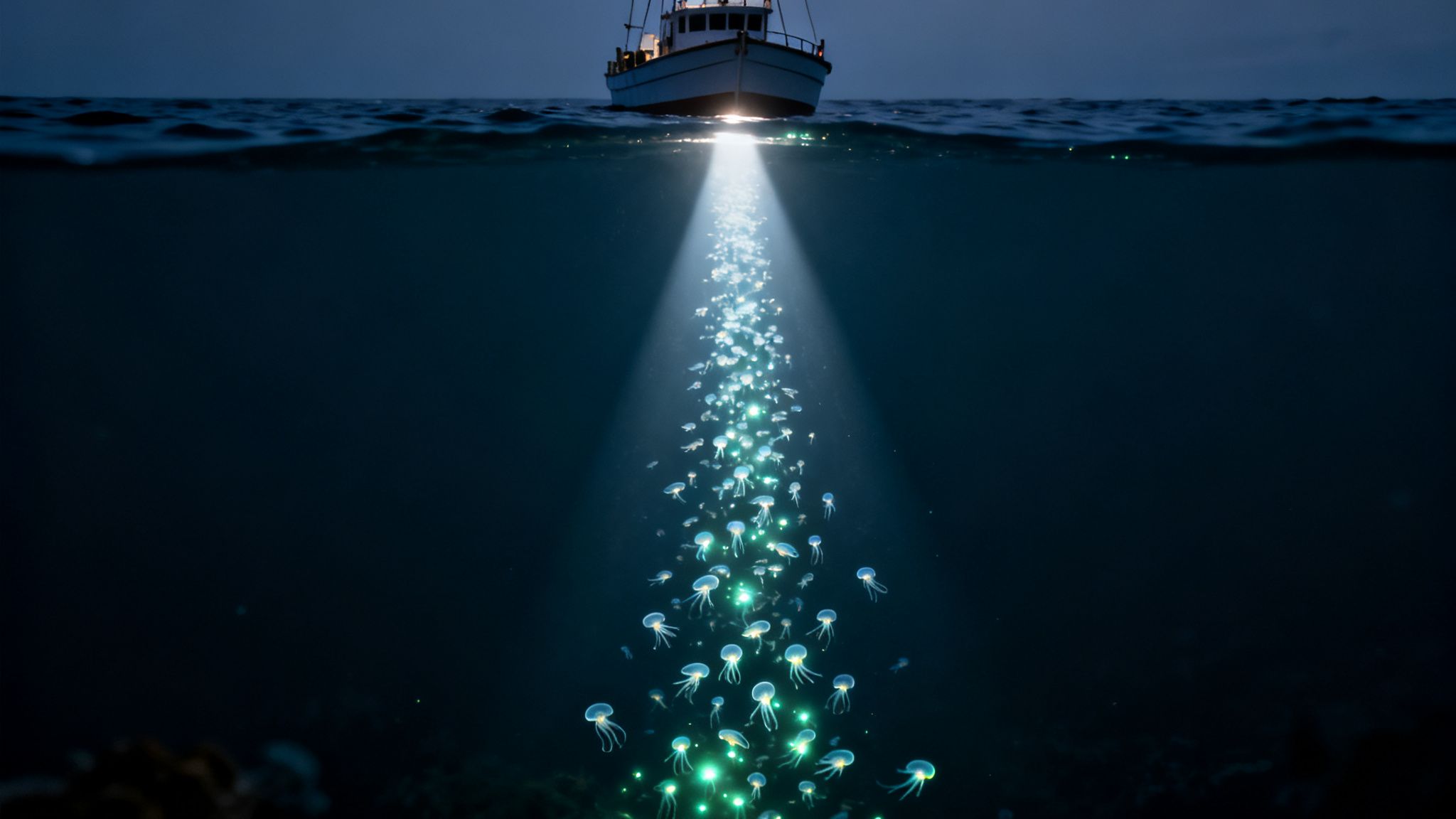
The incredible parade of life you see on a black water dive isn't just random chance. It’s driven by the single largest migration on Earth, a nightly event called diel vertical migration. Every single day, a massive, synchronized wave of life travels from the crushing darkness of the deep ocean toward the surface.
As soon as the sun goes down, a hidden world awakens. Billions of creatures—from nearly invisible zooplankton and tiny crustaceans to the strangest larval fish you can imagine—start their journey up from the twilight zone. They ascend hundreds, sometimes thousands, of feet to feed in the richer surface waters, all under the protective cloak of darkness.
This nightly commute is a cornerstone of the ocean's entire ecosystem. These animals come up to feast on phytoplankton, then sink back down into the abyss before sunrise to hide from daytime predators. It’s a rhythm as old as the ocean itself.
A Beacon in the Abyss
On a black water dive, we don’t go looking for the action; we let the action come to us. We position ourselves right in the middle of this massive migratory path. The powerful lights we hang from the boat act like a cosmic beacon, drawing in the weird and wonderful from the surrounding darkness.
This intense beam of light does two critical things for us:
- It punches through the black, revealing a universe that is otherwise completely invisible.
- It attracts and concentrates the migrating animals, creating a vibrant column of life for us to explore.
So many of these deep-water organisms are phototactic, meaning they are instinctively drawn to light. This behavior brings the entire parade right to our doorstep, transforming what looks like an empty void into a bustling metropolis of alien creatures. You're not just watching from the sidelines; you become a temporary part of this incredible, moving ecosystem.
The Stars of the Show: Larvae and Bioluminescence
What really makes a Kona blackwater dive feel like a trip to another planet is the cast of characters. You won’t see the typical reef fish you know. Instead, you'll meet them in their bizarre and beautiful baby phases, when they look nothing like their adult selves.
The deep, open ocean is the planet's biggest nursery. Countless reef and open-ocean species spend their youth drifting in the water column. A black water dive gives you a front-row seat to this secret chapter of their lives.
Many of these larval creatures are perfectly transparent, a brilliant camouflage strategy for surviving in the featureless blue. You can see right through them, spotting tiny organs and developing skeletal structures. It’s a rare glimpse into the very first moments of life for so many marine animals.
Some of the regulars you might encounter include:
- Larval Flounder: Before they flatten out and live on the seafloor, they swim upright, and you can actually see one eye slowly migrating across their head to its adult position.
- Eel Larvae (Leptocephali): These look like living glass ribbons, impossibly thin and clear as they ripple through the water.
- Juvenile Cephalopods: You might find miniature squid and octopuses, some smaller than a grain of rice, jetting through the blackness with surprising speed.
And then there's the magic of bioluminescence. This is nature’s light show, where creatures produce their own light through a chemical reaction. In the permanent darkness of the deep, light is the primary language used to find food, attract a mate, or scare off a predator.
Comb jellies, or ctenophores, are one of the most mesmerizing examples. They don't flash, but instead refract the light from your torch along their rows of cilia, creating shimmering, electric rainbows that pulse down their bodies. It’s like watching living constellations drift by. This is what turns a simple dive into an unforgettable journey.
From Scientific Discovery To Unforgettable Adventure
The incredible experience we now call a black water dive didn't start out as a tourist thrill ride. Its roots are firmly planted in scientific curiosity, beginning as a highly specialized method for marine biologists to study the strange and elusive creatures of the deep ocean.
For decades, researchers were the only ones who dared to drop into the open ocean at night. These early scientific dives were all about collecting and documenting specimens during the massive nightly vertical migration, a demanding and risky job reserved for a handful of experts trying to unlock the secrets of the abyss. Little did they know, their foundational work was proving that a hidden universe of life was just waiting to be discovered after sunset.
It wasn't until a few pioneers right here in Kona, Hawaii, started tweaking these scientific methods for recreational divers that the adventure really took off. They recognized the potential to turn a complex research dive into a jaw-dropping experience anyone with a C-card could try.
The Birthplace of an Adventure
Kona became the cradle of black water diving for a reason. Local divers started playing around with powerful lighting setups and, more importantly, developed the robust tethering systems that are now the gold standard for safety. These innovations were game-changers.
The tether system is what turned this from a high-risk scientific endeavor into a controlled, secure adventure. It keeps divers safely connected to the downline, which completely removes the primary danger of getting lost in the vast, inky blackness.
This obsession with safety and procedure is what allowed the black water dive to become a repeatable, accessible, and truly unforgettable trip. What started as a tool for science became a bucket-list adventure, cementing Kona's reputation as its official birthplace. For divers who have already experienced something like a night snorkel with manta rays Hawaii, a black water dive is the next step into the ocean's mesmerizing nocturnal world.
From Obscurity to Global Fame
The whole idea of recreational open-ocean night diving kicked off in Kona back in the 1990s and has since become a global phenomenon. While scientific institutions had established formal bluewater diving protocols in the 1980s, it took a while for the public to catch on.
The turning point came when National Geographic published a feature showcasing Christopher Newbert's mind-blowing photography from these dives. You can read more about this pivotal moment in diving history. That article threw the dive into the global spotlight.
Today, we proudly carry on that legacy, offering one of the most refined and thrilling black water experiences you can find anywhere. As pioneers in Kona diving, we continue the spirit of innovation that turned a scientific mission into the ultimate underwater adventure.
Essential Gear And Safety For Diving In The Abyss
Floating in the vast, inky blackness of the open ocean is an experience that demands specialized equipment and an unwavering commitment to safety. While the environment is about as extreme as it gets, the procedures we use at Kona Honu Divers make a black water dive a highly controlled and surprisingly secure adventure. The entire experience is built around managing the unique challenges of the abyss.
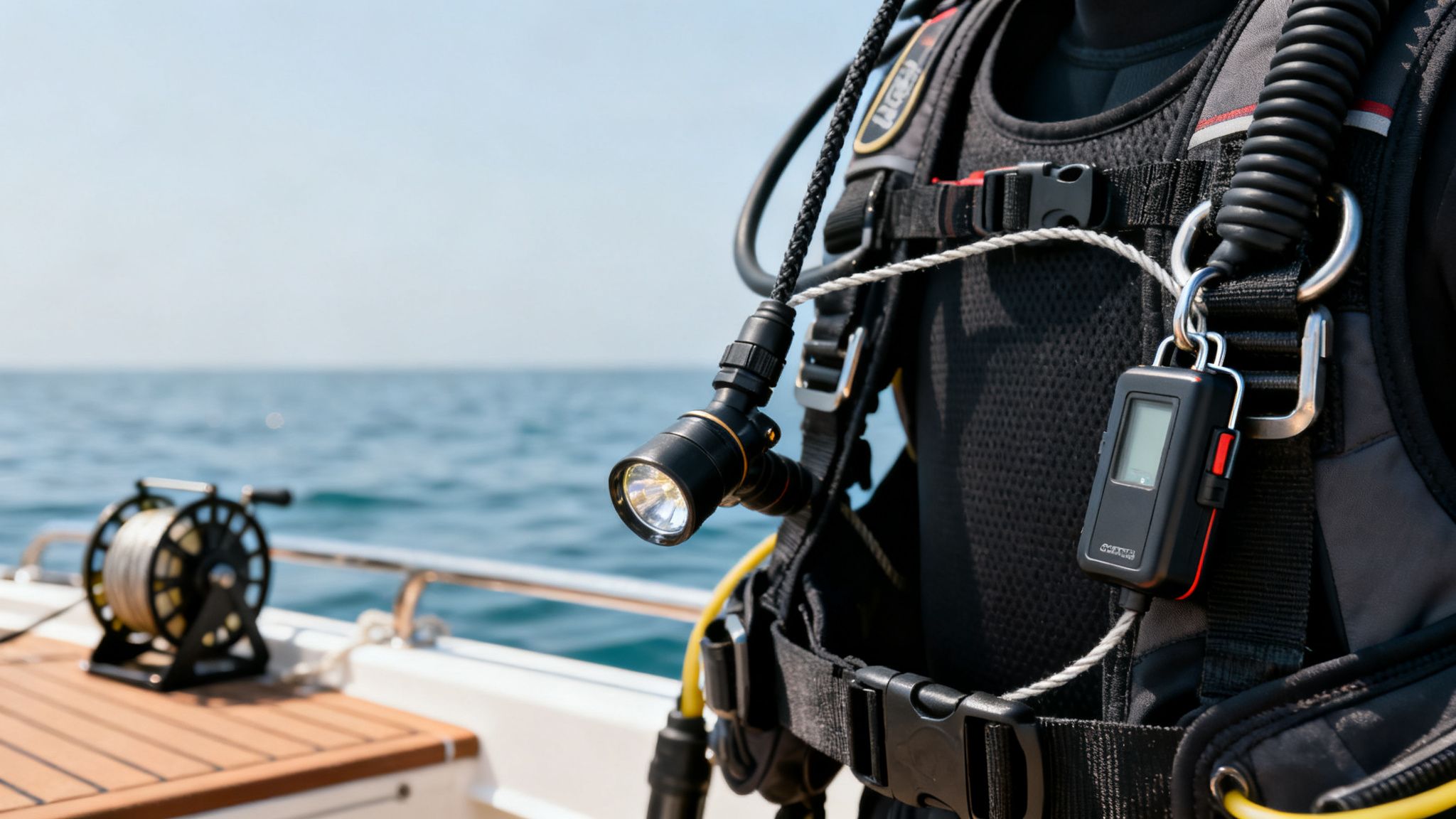
The heart of blackwater safety is the tether system. Every diver is securely clipped onto a short line, which is then attached to a main downline dropping from the boat. This simple but incredibly effective setup makes it impossible to drift away into the darkness, completely removing the biggest potential risk of open-ocean diving. That line is your constant point of reference, your anchor in the void.
This kind of focus on safety is what makes modern scuba possible. Between 2006 and 2015, US residents completed an estimated 306 million recreational dives, with a fatality rate of just 1.8 deaths per million dives. Diving isn't without risk, but with proper training and procedures, it's statistically very safe. You can actually see more of the diving safety statistics on Wikipedia.
Redundant Lighting And Buoyancy Control
Out there, in the total absence of natural light, your dive light isn't just a tool—it's your lifeline. Redundancy isn't just a suggestion; it's a hard and fast rule. Every diver must carry a powerful primary torch and at least one reliable backup. Losing your only light source would be seriously disorienting, so having a spare ensures you can always see, navigate, and signal.
Just as critical is flawless buoyancy control. With no seafloor to give you a physical reference point, you have to be able to hold your depth in the water column almost without thinking. This skill stops you from floating up or sinking down unintentionally, letting you hover perfectly still while observing the delicate creatures drifting by. It quickly becomes second nature.
The goal is to become a stable, weightless observer. Mastering your buoyancy allows you to blend into the environment, conserve energy, and focus entirely on the incredible spectacle unfolding around you.
This level of control is precisely why a black water dive is considered an advanced activity. It's not the time or place to be figuring out fundamental skills. For anyone just starting out, it's much better to get the basics down first. You can check out our guide on the best scuba gear for beginners to build that solid foundation.
Prerequisites For The Dive
To make sure every diver is ready for the unique demands of this dive, we have some strict prerequisites. These aren't meant to be exclusive, but they are absolutely essential for the safety and enjoyment of the whole group.
- Advanced Certification: An Advanced Open Water certification (or equivalent) is the minimum. This proves you have the necessary training for deep and night diving.
- Logged Dives: We look for a minimum of 25 to 50 logged dives. This tells us you have a comfortable level of real-world experience.
- Recent Dive Experience: You’ll need to have dived recently, especially at night. This ensures your skills are sharp and you're comfortable in low-visibility conditions.
These requirements guarantee that everyone on the line can manage their own gear, depth, and buoyancy. It creates a safe, relaxed atmosphere for the whole team. Before you even hit the water, our crew will run a detailed briefing covering every procedure, so you feel confident and prepared. While the setting might sound intimidating, the rigorous safety measures transform it into one of the most serene and awe-inspiring dives you'll ever do. For more experienced diving opportunities check out our advanced dive tour page.
Your Kona Honu Divers Black Water Experience
So, what’s it really like to drop into the deep for a blackwater dive? With Kona Honu Divers, a true pioneer of scuba diving Kona, Hawaii, the entire night is built around safety, your comfort, and giving you a front-row seat to one of the most incredible shows on Earth. This isn't just another dive on the log; it's a carefully orchestrated expedition into a hidden world.
The adventure gets real long before your fins touch the water. It all starts with a detailed pre-dive briefing where our crew walks you through everything. We’ll cover the unique procedures for this type of dive, explain exactly how the tether system works, and get you excited about the kinds of strange and wonderful creatures that might drift by. The goal is to make sure you feel confident and ready for the alien environment waiting below.
The Descent Into Darkness
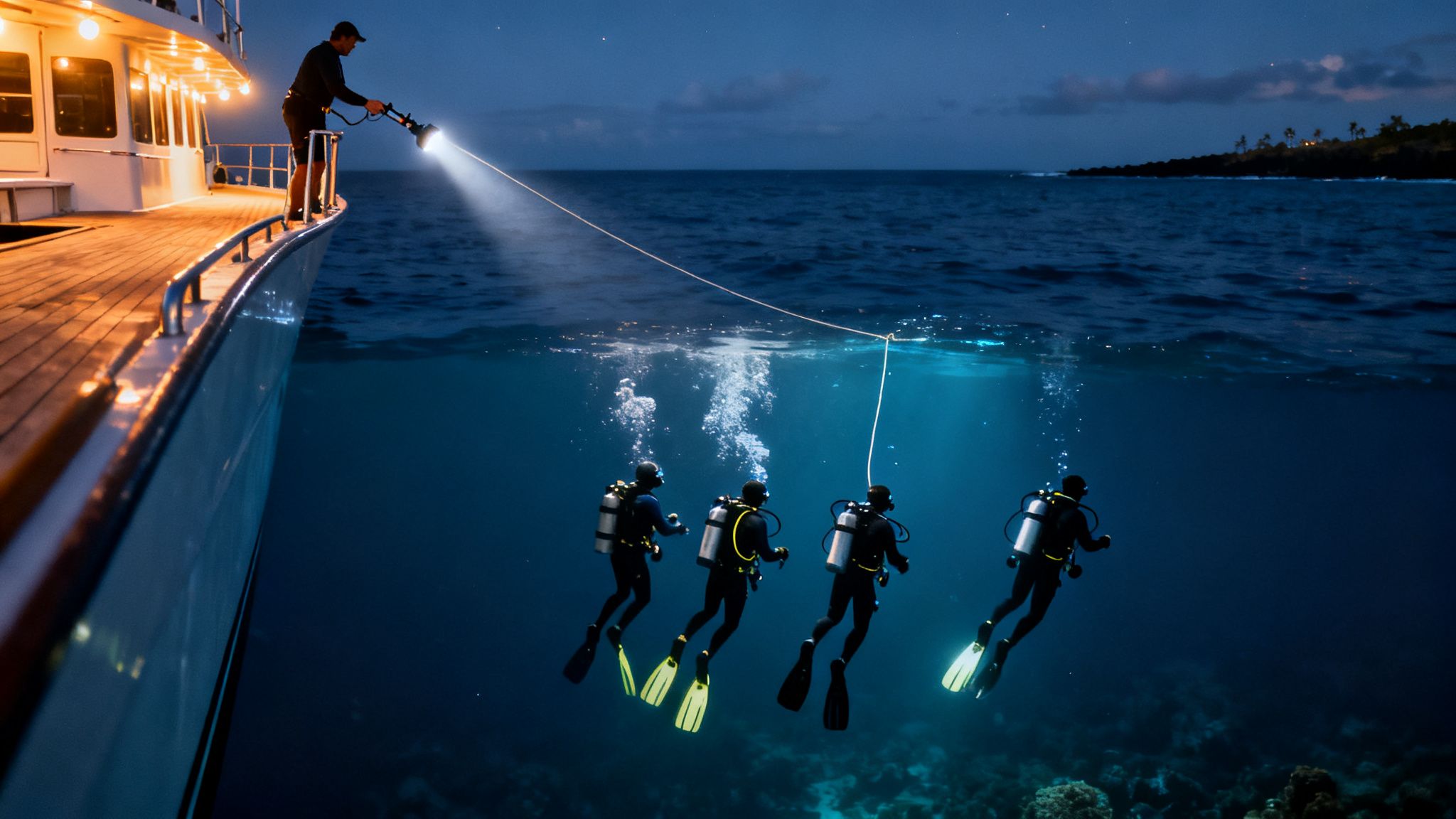
As you begin your descent, the familiar world dissolves. The surface disappears, and you enter a pure, inky blackness, with your only orientation point being the powerful, custom-built light rig dangling far below the boat. This isn't just a big flashlight; it's a beacon engineered to attract the bizarre and beautiful creatures on their nightly commute from the depths.
That rig carves out a column of light in the vast dark, and it doesn’t take long for the performance to start. Your world shrinks to the illuminated water around you as tiny, otherworldly organisms begin to materialize out of the black. Clipped safely to your tether, you become a silent astronaut, floating weightlessly while a pelagic safari comes directly to you. There's no swimming, no searching—you just hover and watch the universe unfold.
People often compare the feeling to floating in outer space. With no bottom in sight and surrounded by glowing, drifting life forms, you're completely immersed in a serene, almost surreal world.
We intentionally keep our groups small at Kona Honu Divers. This ensures you get a personal, uncrowded experience and allows our professional crew to provide individual attention. It’s how we maintain the highest safety standards, making your black water dive both mind-blowingly cool and completely secure. You’ll feel the crew’s professionalism and deep expertise every step of the way.
A Commitment To A Premier Experience
What truly sets this adventure apart is our crew’s absolute passion for it. These aren’t just guides going through the motions; they are bonafide experts who live for sharing the magic of the deep. Their enthusiasm is contagious, and their trained eyes are incredible at spotting the tiniest, most bizarre creatures that you would almost certainly miss on your own.
From nearly transparent larval fish to pulsating, bioluminescent jellies, they’ll point out a hidden world within a world. This dedication is why divers trust us for this unique experience. But don't just take our word for it—see what fellow divers have to say.
Ready to take the plunge into a world few ever get to see? You can learn more and check availability right on our Black Water Night Dive tour page.
Your Blackwater Diving Questions, Answered
Diving into the deep, dark ocean at night? It’s completely normal to have a few questions. Let's walk through some of the most common ones so you can feel confident and excited about this unique adventure.
Is Blackwater Diving Safe?
It might sound extreme, but yes, it’s incredibly safe. The entire dive is built around very strict safety protocols. The most important piece of gear is the tether system that connects you to a line running directly to the boat. You are always physically attached, which means there’s zero chance of drifting away into the black.
On top of that, we only take divers with advanced certifications and proven skills, especially rock-solid buoyancy control. You’ll have multiple lights, and our professional divemasters are in the water with you the whole time, keeping a close eye on everything. It's a very controlled, secure environment.
What Kind of Creatures Will I See?
This is where the magic happens. You’ll see a world of bizarre and beautiful animals that almost never come near a reef. You're basically intercepting the deep-sea nursery, and most of what you'll encounter is in its larval or juvenile stage. Think translucent, glowing, and utterly alien.
Some of the regulars on our blackwater dives include:
- Larval fish and eels that look like tiny, transparent ribbons.
- Miniature cephalopods—squid and octopuses no bigger than your thumbnail.
- Pulsing, vibrant jellies and comb jellies that light up the dark.
- All sorts of strange, otherworldly crustaceans just drifting by.
Honestly, every single dive is a surprise. That unpredictability is a huge part of the thrill.
What Are the Requirements for This Dive?
Because of the unique environment, you’ll need to be an Advanced Open Water certified diver. We also require a minimum of 25-50 logged dives, with some of those being recent night dives. The one non-negotiable skill is flawless buoyancy control. It’s always best to check our specific prerequisites before you book.
What if I Get Scared or Anxious in the Dark?
That’s a totally valid concern, and one we hear a lot. We tackle this head-on during our detailed pre-dive briefing. We walk you through every step of the dive, so you know exactly what to expect, which helps build a ton of confidence.
Knowing you're securely tethered to the line provides a huge sense of security. Once you're in the water, most divers find their focus shifts almost immediately to the incredible creatures appearing in their light beam. But if you feel uncomfortable for any reason, you can just signal the divemaster and easily make your way back up the line to the boat at any time.
Ready to witness the largest migration on Earth for yourself? Join Kona Honu Divers, the Big Island's premier dive operator, for an adventure you’ll be talking about for years. Our experienced crew is ready to guide you safely into the abyss for a night you'll never forget.