
Picture this: you're floating in absolute darkness, miles from shore. Below you isn't a familiar, colorful reef, but thousands of feet of inky black water. This isn't your typical night dive. This is blackwater diving—a journey into one of the most alien environments on Earth.
Journey into the Ocean’s Twilight Zone
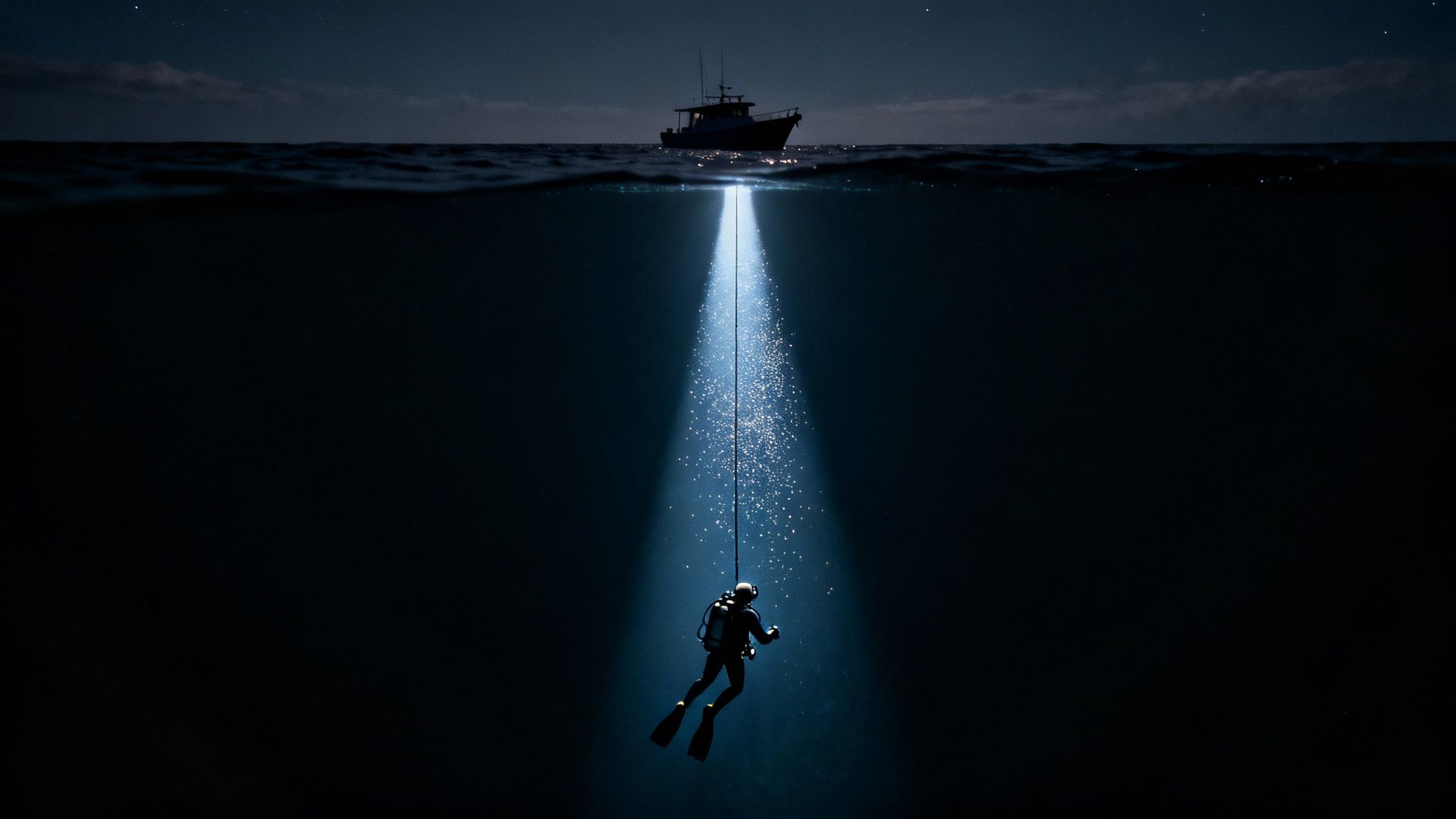
A blackwater dive is a specialized type of scuba diving where you drift in the open ocean at night, suspended over a vast, deep abyss. Instead of exploring a reef, you become a floating outpost in the middle of nowhere, safely tethered to a boat. Using powerful lights, you get a front-row seat to the largest migration on the planet.
Every single night, a countless number of deep-sea creatures make their way from the crushing pressures of the depths toward the surface to feed. This is called diel vertical migration, and a blackwater dive puts you right in the middle of it. The lights we suspend in the water create an illuminated stage, attracting some of the most bizarre and beautiful organisms you'll ever see.
How It Differs from a Standard Night Dive
While they both happen after dark, a blackwater dive and a standard night dive are worlds apart. A regular night dive usually means exploring a familiar reef or wreck in relatively shallow water, maybe less than 100 feet. You have the bottom as a reference point, and you're looking for nocturnal reef critters like crabs, lobsters, and sleeping parrotfish.
A blackwater dive throws all of that out the window. It’s a completely different kind of sensory experience.
- Open Ocean Setting: You’re in the pelagic zone—the open sea—not cruising over a reef.
- Profound Darkness: The darkness is total, broken only by your lights and the surreal glow of bioluminescent life drifting by.
- Unique Marine Life: You’ll see things you'd never find on a reef, many in their larval stage. These are the strange, translucent creatures of the deep.
- Drift Diving: There's no navigating a site. You simply drift with the current, letting the ocean's mysteries come to you.
Kona: The Birthplace of an Otherworldly Adventure
The idea of dropping into the abyss at night for fun has a home: Kona, Hawaii. While scientists have been studying the vertical migration for decades, recreational blackwater diving as we know it was born right here. In the 1990s, local dive pioneers started experimenting. They took boats out over Kona's dramatic offshore drop-offs, which plunge to depths of 300 meters or more just a mile from shore, and hung powerful lights in the water.
What they saw was mind-blowing. By the mid-90s, the first commercial trips were taking divers out to witness this incredible spectacle.
Kona’s unique underwater geography, with its steep volcanic slopes so close to shore, makes it the perfect stage for this adventure. It’s why our island is considered one of the best places in the world for this truly otherworldly dive. If you're ready to see it for yourself, we'd love to take you on a Kona Honu Divers blackwater excursion.
The Science of the Deep Sea Migration
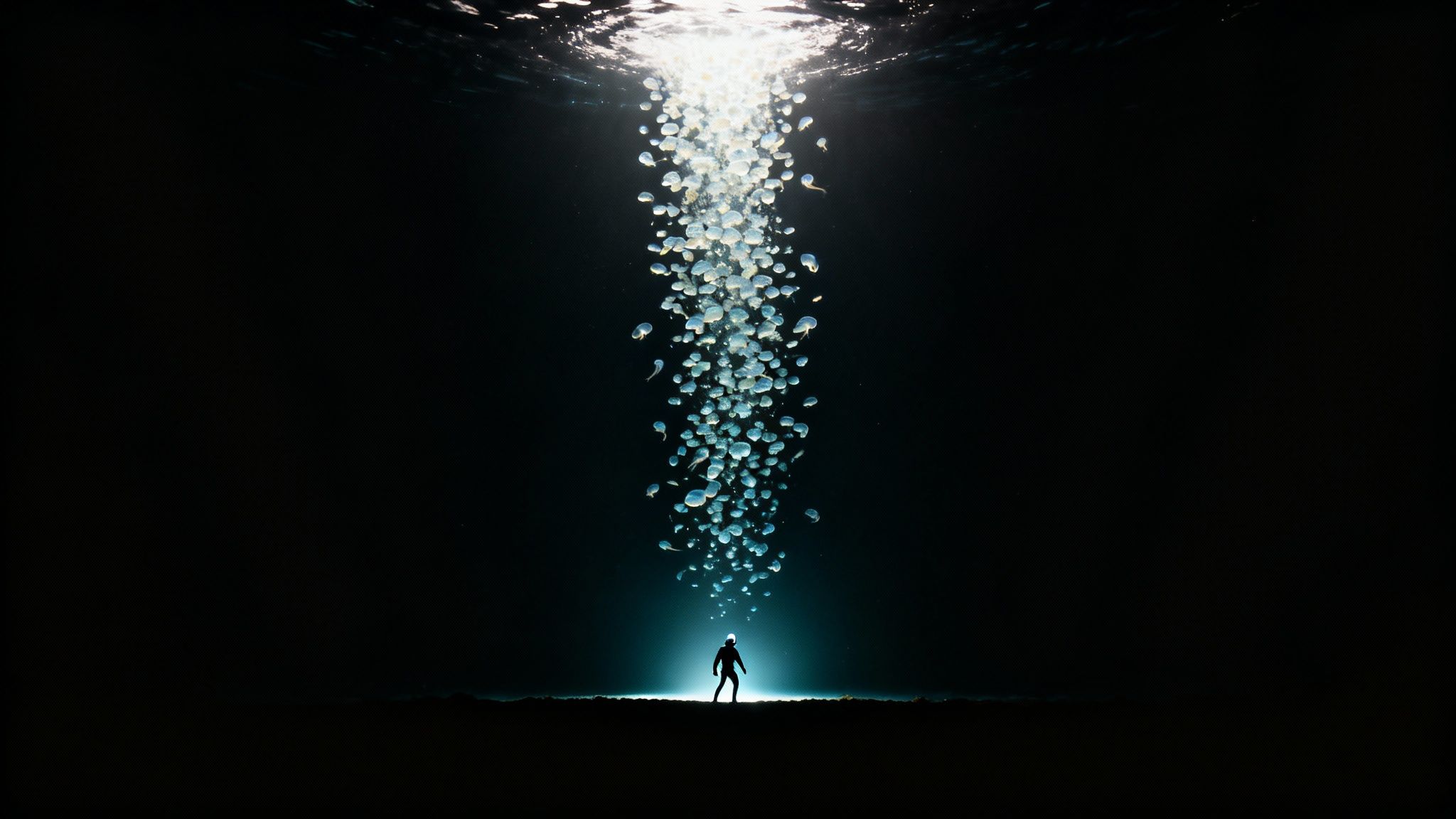
Every night, long after the sun has disappeared, something incredible happens in the ocean's depths. It's a silent, massive procession hidden from our view, and a black water dive is your front-row ticket to the show. This nightly spectacle is called the Diel Vertical Migration (DVM), and it’s the single largest migration of life on the entire planet.
Think of it as a vertical rush hour. Billions of tiny organisms journey from the crushing darkness of the deep sea up toward the moonlit surface. They make this trek for one simple reason: food. The surface waters are a buffet of phytoplankton—microscopic plants that are the very foundation of the marine food web.
During the day, these creatures retreat hundreds or even thousands of feet down to hide from predators. But once darkness falls, they rise to feast.
The Ocean's Great Commute
This daily commute is one of nature's most astonishing events. Every single night, the Diel Vertical Migration brings the ocean to life, moving a staggering amount of biomass from the abyss toward the surface. This migration spans an estimated 98% of Earth's habitable space in the upper ocean, with some organisms traveling vertically up to 1,000 meters each way.
Just off the Kona coast, the seafloor plummets to 300 meters deep only a mile from shore. This gives us an unparalleled opportunity to see densities of thousands of plankton per cubic meter. You can learn more about this "biological pump" from the NOAA Central Library website.
This nightly journey is far more than just a cool phenomenon; it’s a critical engine for the entire ocean's health. It's a cornerstone of the marine food web and plays a huge role in the global carbon cycle.
- Fueling the Food Web: This migration is the ultimate connector, transporting energy and nutrients between the deep sea and the surface. The tiny creatures that feed near the surface become food for larger predators, sustaining a complex and vital chain of life.
- The Biological Carbon Pump: When these organisms eat near the surface, they consume carbon. By carrying that carbon back down with them into the deep, they effectively lock it away, preventing it from re-entering the atmosphere.
Kona's Perfect Deep-Sea Theater
So, what makes Kona such a world-class spot for black water diving? It all comes down to the unique underwater landscape. The Big Island’s volcanic slopes drop off steeply, creating extreme deep-water conditions just a quick boat ride away.
This dramatic geography puts us right in the path of the Diel Vertical Migration without a long trip out to sea. Here, the abyss is practically on our doorstep.
When we suspend our lights in the water column, we’re essentially creating an illuminated stage in the vast, empty darkness. This light draws in the migrating organisms, transforming the black void into a vibrant, living theater filled with some of the most bizarre and beautiful creatures on Earth.
On a black water dive, you are witnessing this ancient, nightly rhythm of life firsthand. You’ll see larval creatures that look nothing like their adult forms—tiny, see-through squids, otherworldly jellies pulsing with their own light, and fish that look like they were pulled straight from science fiction. It’s a chance to see the ocean's hidden heart, beating in time with the setting and rising of the sun.
Discovering the Creatures of the Abyss
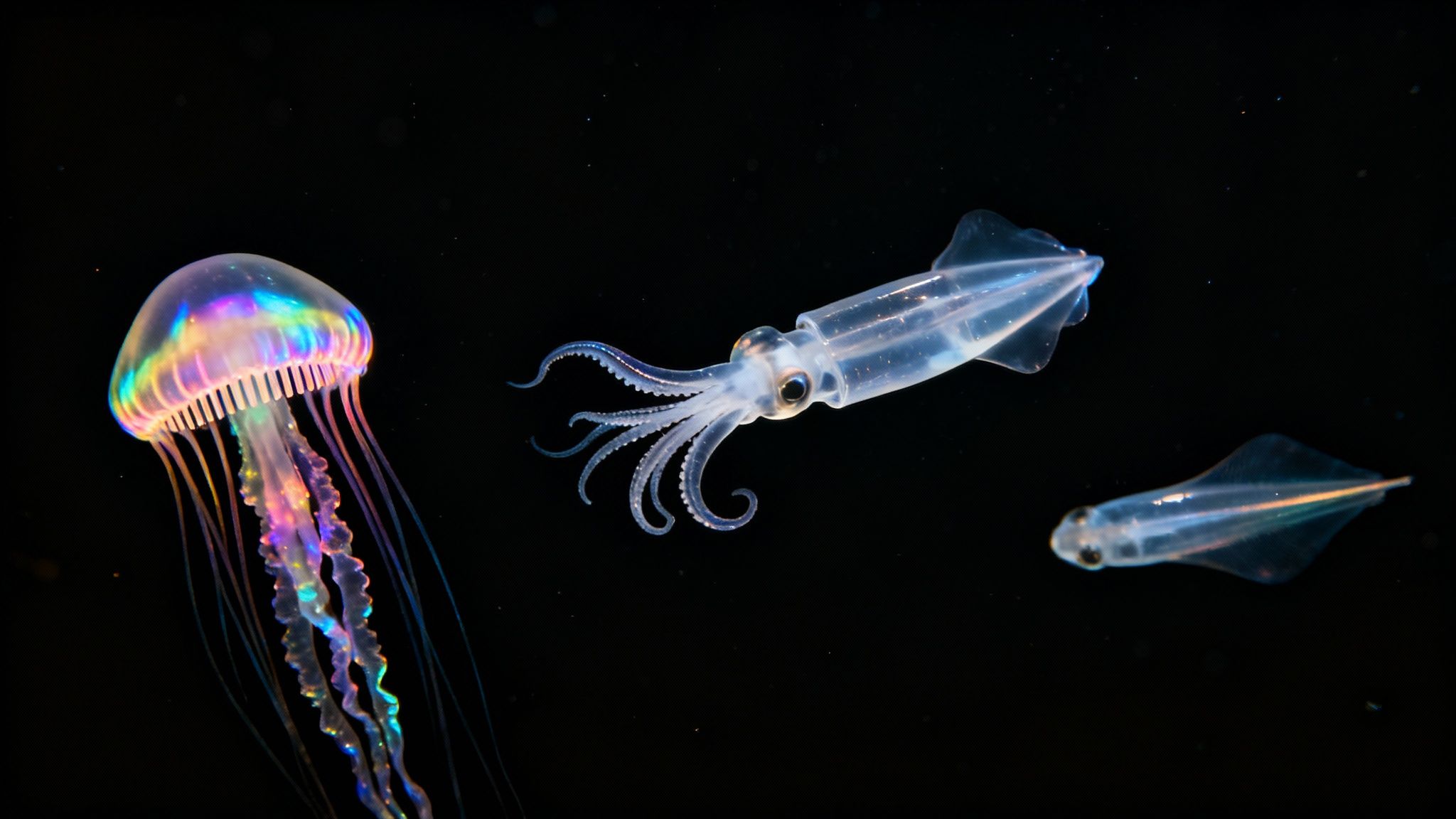Get ready to meet the neighbors you never knew you had. A blackwater dive introduces you to a cast of characters so wonderfully strange they feel like they’ve drifted in from another galaxy. Your dive light isn’t just a tool; it's a spotlight on a secret, living universe that awakens every single night.
You’re essentially floating through an open-ocean nursery. So many of these animals are in their larval stages, meaning they look absolutely nothing like their adult forms. It’s like discovering a caterpillar for the first time without having any concept of a butterfly.
Shimmering comb jellies, or ctenophores, pulse with internal rainbows of light. Delicate pelagic sea slugs drift by like alien spaceships, while nearly invisible glass squids materialize from the blackness only to vanish a moment later.
A Parade of Alien Characters
The sheer variety of life on a single dive is what really blows your mind. What looks like empty, black water one second will suddenly reveal itself as a bustling metropolis of tiny, translucent animals. Every flicker of movement becomes an obsession as you try to spot the next bizarre creature emerging from the abyss.
You just never know what you'll find, but here's a taste of what might swim into your beam:
- Larval Fish: Many famous deep-sea fish, like the tripod fish, start their lives as see-through, free-floating larvae. You might spot a tiny larval swordfish, a snake blenny, or even a juvenile flounder that still has one eye on each side of its head—before it undergoes its famous metamorphosis.
- Cephalopods: This is where things get truly weird and wonderful. We're talking tiny diamond squid, ghostly glass squid, and—if you’re incredibly lucky—the coveted larval blanket octopus. Spotting a fragile paper nautilus clutching its delicate shell is one of those moments you’ll talk about for the rest of your life.
- Jelly-like Drifters: The water is often thick with these gelatinous wonders. Comb jellies refract your light into a cascade of colors, and impossibly long, stringy siphonophores drift by like living, beaded necklaces. These are the true ghosts of the open ocean.
- Bizarre Crustaceans: Look closely for larval mantis shrimp, which look more like something out of a sci-fi movie than a crustacean. You might also encounter Phronima, a terrifying-looking amphipod that hollows out the bodies of other creatures to use as a mobile home.
For photographers, this is the ultimate macro challenge. Trying to capture these fast-moving, often translucent subjects takes skill, patience, and a whole lot of luck. The reward, though, is a portfolio of images that will make other divers green with envy.
Common and Rare Sightings on a Kona Black Water Dive
Every night, the Diel Vertical Migration brings a new cast of characters up from the depths. While each dive is completely unpredictable, we do see some regulars. This table gives you an idea of the diverse and often bizarre marine life you might encounter on a Kona blackwater dive.
| Creature Type | Common Examples | Rare and Exciting Finds |
|---|---|---|
| Cephalopods | Diamond Squid, Glass Squid | Larval Blanket Octopus, Paper Nautilus |
| Crustaceans | Larval Mantis Shrimp, Phronima | Deep-sea Amphipods, Pelagic Crabs |
| Fish | Larval Swordfish, Flying Fish, Tripod Fish | Ribbonfish, Oarfish, Anglerfish |
| Jellyfish & Siphonophores | Comb Jellies (Ctenophores), Salps | Venus Girdle, Portuguese Man o' War (surface) |
It's that unpredictability that makes these dives so magical. You aren't just looking at animals; you're witnessing one of the ocean's most fundamental processes—a nightly pulse of life that has gone on for millennia, completely hidden from us until now.
Seeing these creatures isn’t just about checking a box on a list. It’s about feeling a profound sense of pure discovery. When you lock eyes with a larval blanket octopus trailing its iridescent webbing, you’re connecting with a part of our planet that very few people will ever get to see.
It’s these fleeting, otherworldly encounters that make a blackwater dive in Kona an absolutely unforgettable adventure. Even the most seasoned divers come up humbled by the sheer strangeness and beauty of what rises from the deep.
How We Keep You Safe in the Deep
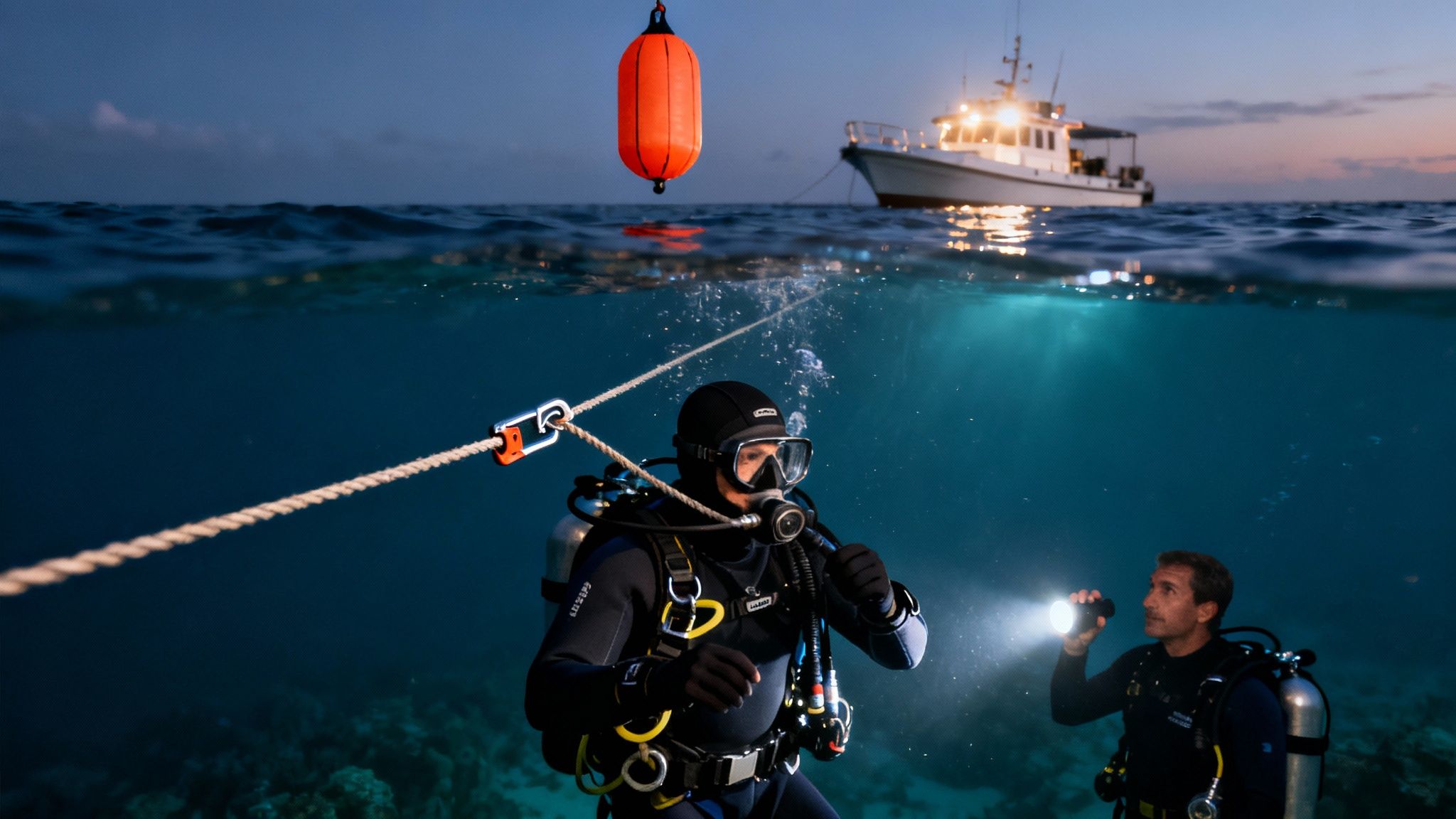
Let’s be honest: the idea of drifting miles from shore, with thousands of feet of pure black ocean beneath you, can sound intimidating. But a professional blackwater dive is far from a reckless leap into the unknown. It’s a carefully choreographed experience built on a solid foundation of safety procedures.
You might feel like you’re floating free in space, but you’re never truly alone or untethered. The heart of our safety system is a floating rig. On the surface, a big, brightly lit buoy lets the boat crew track our position at all times. Dropping down from that buoy is a weighted line that hangs to a depth of about 40-50 feet.
Every single diver is attached to this main line with their own shorter, 10-15 foot tether. This simple setup is incredibly effective. It keeps the whole group together and makes it impossible for anyone to drift away. You're always within a safe distance of the central line and, more importantly, your guide.
Finding Your Balance in the Void
While our tether system keeps you physically connected, your comfort and safety really come down to one core skill: excellent buoyancy control. On a reef dive, you have the bottom as a visual reference. Out here, there's nothing but water. You're essentially weightless, and being able to hold your position without sinking or rising is absolutely essential.
This is exactly why we require an Advanced Open Water certification. That training is where you really dial in the fine-tuning of your weighting and breathing to hang perfectly still in the water column. Constantly adjusting your depth is tiring, disorienting, and just not safe. The goal is to become a silent, stable observer, letting the incredible parade of deep-sea life drift right by you. If you feel a bit rusty, reviewing the basics of a scuba safety stop is a great way to brush up on those buoyancy skills.
A common misconception is that a blackwater dive is a free-for-all in the deep. The reality is a meticulously organized and supervised drift. Your divemaster is your anchor, your guide, and your safety net all rolled into one.
Your Guide and Your Gear
Your divemaster is so much more than a guide pointing out cool creatures. They are the safety officer for the entire dive, constantly monitoring everyone’s depth, checking that divers are comfortable, and managing the group’s position. Think of them as your direct line to the boat, trained to handle any situation that could pop up.
The final layer of safety comes down to having the right gear. When you’re in the profound dark of the open ocean, your light is your lifeline.
- Powerful Primary Light: You need a high-quality dive torch, not just to see the critters, but to signal your guide and stay oriented.
- Reliable Backup Light: Never dive with just one light. Every diver must carry a backup, just in case their primary fails.
- Personal Marker Light: A small light or strobe attached to your tank makes you instantly visible to the guide and the rest of the group.
The environment may be extreme, but the dive is managed with an uncompromising focus on safety. From the tether rig and skill requirements to the professional guide watching over you, every part of a blackwater dive is designed to create a secure bubble for an adventure you’ll never forget.
How to Prepare for Your Black Water Dive
A great **black water dive** starts long before you step on the boat. It’s a unique experience that calls for a specific set of skills, the right gear, and a mindset that’s equal parts calm and curious. This isn’t your everyday reef dive, and solid preparation is what turns a potentially nerve-wracking plunge into a night of pure magic.First things first, let's talk about experience. This dive is definitely not for beginners. We require every diver to have at least an Advanced Open Water certification (or an equivalent from another agency). That certification tells us you've got the foundational skills for deeper water and, most importantly, rock-solid buoyancy control—which is absolutely essential out there. For more experienced diving opportunities check out our advanced dive tour page.
We also can't stress enough how important recent night diving experience is. You’ll feel a lot more at ease floating over a 3,000-foot-deep abyss if you’re already comfortable being underwater in the dark. It just makes a huge difference.
Your Essential Gear Checklist
Having the right equipment is non-negotiable for both your safety and your ability to fully enjoy the dive. While we handle the specialized tether system, you'll need to bring your personal dive gear.
- Primary Dive Light: This is your most critical tool. You need a powerful torch with a strong, focused beam that can slice through the dark and illuminate tiny, often see-through critters.
- Backup Dive Light: Redundancy is key. Gear can fail, so a reliable backup light is mandatory. Make sure it's somewhere you can grab it in a split second.
- Exposure Protection: Even in Hawaii's warm waters, you'll be drifting more than swimming. A 3mm or 5mm full wetsuit is a good idea to keep you from getting chilled during the dive.
- Personal Marker Light: A small tank light or strobe makes you visible to the guide and the rest of the group, which is a simple but important safety measure.
For a more detailed list of what to pack for any Kona dive, take a look at our guide on the gear you will need for your Kona diving adventure.
Getting Your Head in the Game
Your mindset is just as important as your gear list. It's totally normal to feel a little anxious alongside the excitement for your first black water dive. The trick is to turn that nervous energy into sharp, focused awareness. A big part of that preparation involves knowing how to do a thorough risk assessment to understand and manage any potential hazards.
The goal is not to eliminate fear, but to replace it with fascination. Remind yourself that you are in a controlled, supervised environment. Trust your training, your guide, and your equipment.
Once you're in the water, keep yourself oriented to the downline. It’s your one constant reference point in a world of black. Focus on slow, steady breathing to stay relaxed, conserve air, and maintain perfect neutral buoyancy.
Instead of waving your light around like a search-and-rescue helicopter, try making slow, methodical scans of the water in front of you. Some of the most amazing creatures are incredibly small and delicate, and you’ll only spot them with a patient eye. When you show up prepared, both physically and mentally, you're setting yourself up for an unforgettable trip into the ocean's hidden world.
Your Adventure with Kona Honu Divers
Picking the right guide for a **black water dive** is everything. It’s what separates a good dive from an unforgettable one, and over the years, we’ve dialed in our process to make sure every single trip is exceptional. The moment you arrive, you’ll be greeted by our crew—a team of professionals who are genuinely passionate about what they do. We’ll get you settled and make sure you’re feeling confident long before we even cast off the lines.Once we’re on the boat, we’ll head offshore to the deep water just beyond the Kona coast. On the way out, our guides give a detailed pre-dive briefing. This isn't your standard "here's the plan" talk. We walk you through every step of our safety procedures, explain exactly how the tether system works, and show you photos of the strange and wonderful creatures you’re likely to meet down there. That way, you know what to keep an eye out for in the dark.
The Kona Honu Divers Difference
So, what makes our trip different? It boils down to our absolute focus on safety and creating the best possible environment for spotting wildlife. We’ve even invested in a custom-built light rig, a powerful setup that turns a huge patch of the ocean into an illuminated stage. This bright oasis in the dark water draws in a much higher concentration and variety of life, meaning you have a better shot at seeing something truly spectacular.
We also insist on keeping our groups small. A black water dive should feel personal and awe-inspiring, not crowded. Small groups mean a safer, more relaxed dive where our guides can give you their full attention. It lets them help photographers get the perfect shot and keep a close eye on every diver in the water.
Our crew isn't just there to keep you safe; they live and breathe this stuff. Their passion for the ocean's hidden world is infectious, and their expertise in spotting the tiniest, most bizarre creatures will transform your dive from a simple observation into a guided tour of an alien universe.
We've built our reputation on thousands of incredible dives, and we're proud of the trust our guests place in us. Their reviews really say it all.
From the moment you check in to your final ascent, our entire team is dedicated to giving you a world-class adventure. We bring together expert knowledge, top-of-the-line equipment, and a genuine love for what we do to create a black water dive that showcases the absolute best of Kona's nightlife. We'd love for you to join us and discover what’s waiting in the dark.
Ready to dive into one of the most unique underwater experiences in the world? Book your Black Water Night Dive with us today.
Your Blackwater Questions, Answered
Thinking about taking the plunge into the deep? It's a dive unlike any other, and naturally, people have a lot of questions. We've gathered some of the most common ones we hear from divers getting ready for this wild adventure.
What Certification Do I Need?
You'll need an Advanced Open Water certification (or an equivalent from another agency) to join us. The reason is simple: this dive is all about precision buoyancy. The advanced course hones that skill, which is absolutely essential for hovering safely in the open ocean after dark.
We also strongly suggest you have some recent night diving under your belt. It just helps you feel more comfortable and confident in the water when the sun goes down.
Is There a Chance I Could Get Lost?
Nope, not a chance. We've got a system that makes it impossible. Your safety is our absolute priority, so every single diver is connected to a central downline with their own personal tether.
That main line is then attached to a big, brightly lit float on the surface, which is connected to the boat. The whole group stays together as one unit, drifting with our guides right there with you.
How Is This Different From the Manta Ray Night Dive?
They're two completely different universes! The world-famous manta ray dive is incredible, but you're stationary on the seafloor in about 35 feet of water, watching the gentle giants swoop in to feed on plankton. It's a show.
A blackwater dive is an active exploration. You're drifting in the middle of the water column over thousands of feet of ocean, searching for the tiny, the weird, and the wonderful creatures that migrate up from the deep. It's a treasure hunt in the dark.
What Are the Best Camera Settings for This Dive?
Blackwater photography is a fantastic challenge, but incredibly rewarding when you nail the shot. First things first, you absolutely need a macro lens—a 60mm or a 100/105mm is perfect for capturing the tiny critters.
Here’s a good starting point for your setup:
- Powerful Strobes: These are non-negotiable. You need that quick burst of light to freeze the motion of subjects that are often zipping around.
- Fast Shutter Speed: Start at 1/200s or faster. Anything less, and you'll likely end up with motion blur.
- Mid-Range Aperture: Something around f/11 is a great place to begin. It gives you a decent depth of field for these small subjects.
- A Strong Focus Light: You can't shoot what you can't see! A bright focus light is crucial for locking onto your subject in the pitch-black water.