
A black water dive is an open-ocean night dive, but that description doesn't even begin to cover it. You're taken miles from shore, over thousands of feet of water, tethered to a boat, and left to drift in the immense, dark void. Using powerful lights, you'll witness an astonishing upward migration of deep-sea creatures coming to the surface to feed. It’s the closest thing to floating in outer space, surrounded by bizarre, bioluminescent life.
What Is a Black Water Dive?
Picture yourself floating weightlessly in the silent, black expanse of space, watching strange, glowing galaxies drift past your mask. That’s the feeling of a black water dive. This is a world away from a typical night dive on a coral reef; it's a plunge into the ocean's "inner space," an experience that completely redefines underwater adventure.
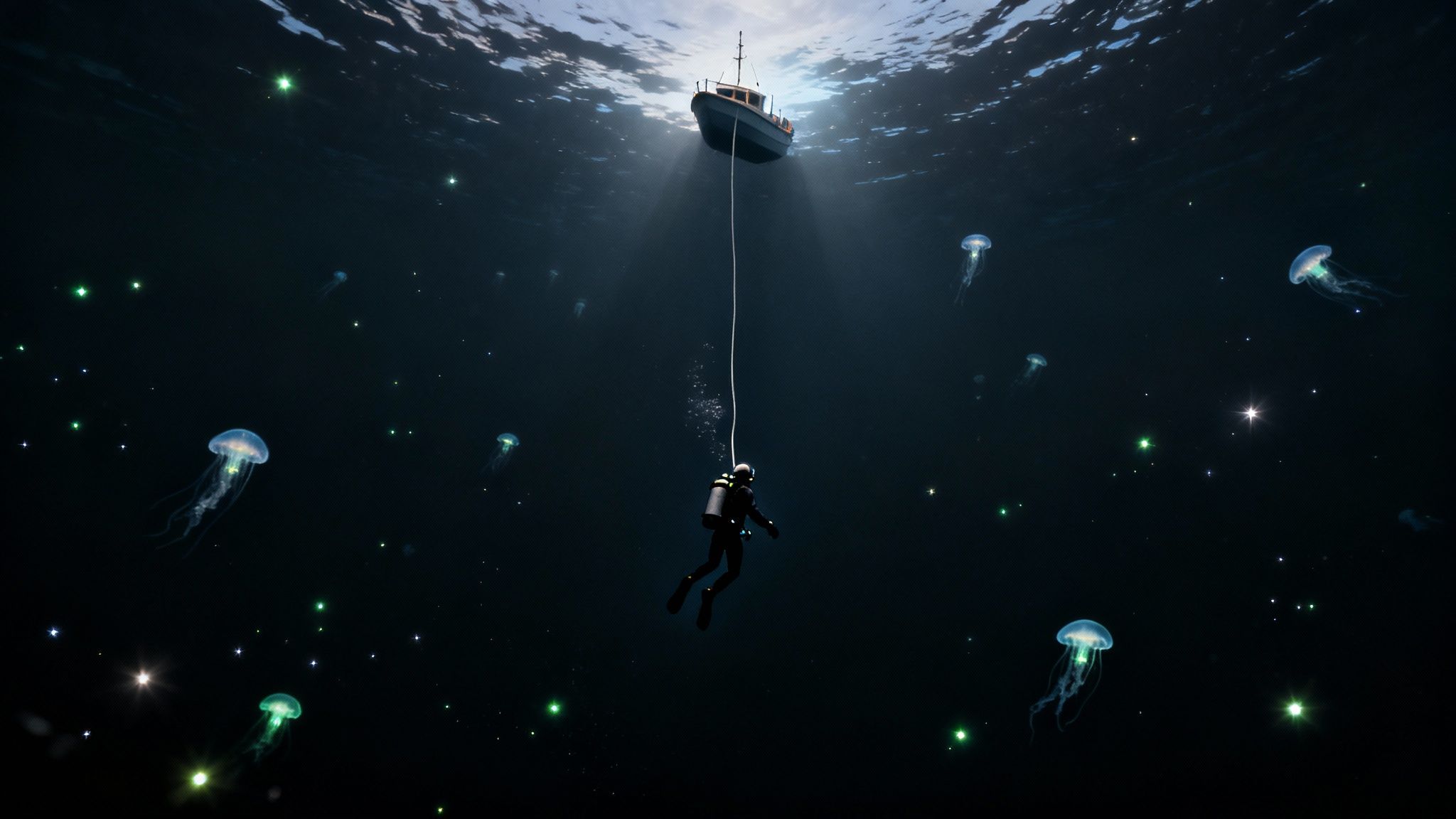
On a black water dive, we motor miles offshore where the seafloor is thousands of feet below. Once you’re safely tethered to the boat, you descend to a shallow depth and simply… float. The real show begins when the powerful down-lights are switched on, creating an illuminated stage in the vast darkness. This light attracts an incredible parade of deep-sea organisms rising from the abyss to feed—a nightly phenomenon known as the Diel Vertical Migration.
A World of Alien Creatures
Unlike a reef dive where you’re looking at a familiar ecosystem, a black water dive is all about chance encounters with the weird and wonderful. Many of the creatures you'll see are in their larval stages and look nothing like their adult forms.
Get ready to see things you’ve never imagined:
- Larval Eels: Transparent, ribbon-like creatures that drift like ghosts.
- Translucent Squid: Tiny, perfectly formed cephalopods with shimmering, iridescent skin.
- Pulsating Ctenophores: Comb jellies that refract your light, creating mesmerizing rainbow effects.
- Bioluminescent Wonders: Organisms that produce their own light, glowing with an ethereal internal fire.
A black water dive offers a front-row seat to the planet's largest nightly migration. It's an unpredictable and mesmerizing spectacle, filled with fleeting encounters you'll remember for a lifetime.
The Kona Connection
This extraordinary type of diving actually has deep roots right here in Hawaii. Recreational black water diving was born in Kona during the 1990s, evolving from scientific bluewater diving techniques. Local dive pioneers saw a unique opportunity thanks to the Big Island's incredible geography; the seafloor plummets to over 1,000 feet just a mile from shore, giving us easy access to the deep-water world where these creatures live. You can dive deeper into the history of this unique activity on PADI's blog.
Today, Kona is still the premier destination in the world for black water diving. A Kona black water dive with Kona Honu Divers isn't just another entry in your logbook—it's an opportunity to witness a hidden universe. For any certified diver looking for a truly unforgettable experience, this is it.
Witnessing the Ocean's Great Vertical Migration
Every night, an incredible event happens in the deep ocean, far beyond our normal view. A black water dive gives you a front-row seat to this spectacle, but what exactly are you seeing? You’re witnessing the Diel Vertical Migration—the largest migration on Earth by biomass, and it happens every single night.
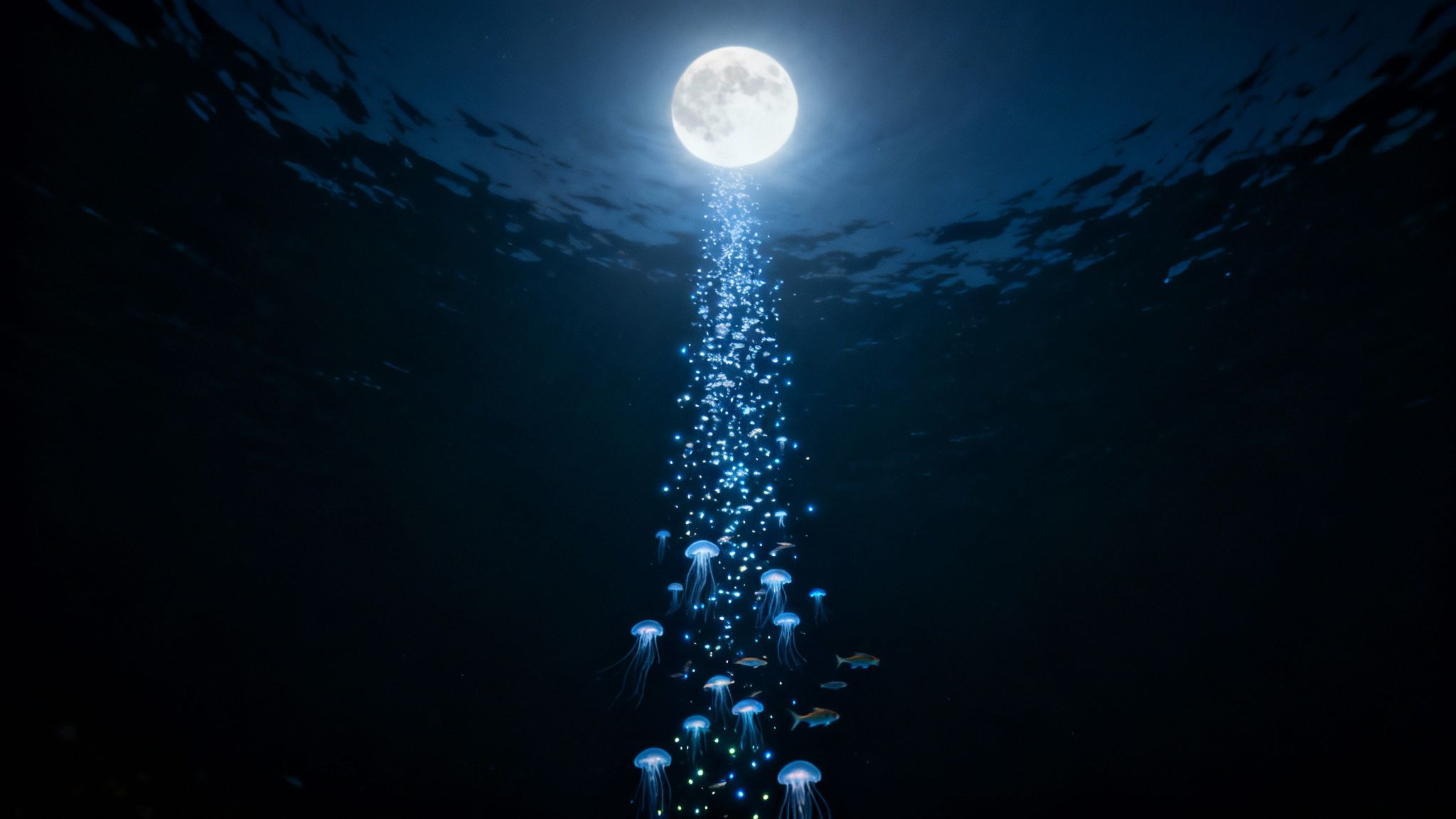
Think of it as a massive, silent ballet taking place in the dark. As the sun sets, trillions of tiny creatures begin an epic journey from the crushing depths up to the nutrient-rich surface. They come up to feed under the cover of darkness, a nightly ritual that forms the very foundation of the ocean's food web.
This migration is the whole reason blackwater diving even exists. Without this predictable movement of life, the open ocean at night would feel vast and empty. Instead, it becomes a living galaxy of bizarre and beautiful organisms.
The Cast of Characters from the Abyss
The creatures you'll encounter here are nothing like what you see on a coral reef. Many are in their larval, or juvenile, stages, looking completely different from their adult forms. They're often translucent, gelatinous, and many even have their own built-in light source—bioluminescence.
Your dive light will reveal a stunning variety of life that is rarely seen:
- Mesmerizing Ctenophores: Often called comb jellies, these aren't true jellyfish. They move using rows of cilia that refract light, creating shimmering rainbow displays as they drift past.
- Translucent Larval Fish: You might see the ghostly, ribbon-like forms of larval eels or the bizarre, asymmetrical larvae of flounders before one eye migrates to the other side of its head.
- Pulsating Jellies and Siphonophores: These complex organisms drift in the current, some glowing with an eerie internal light as they hunt for microscopic prey in the dark.
This living light show transforms the dive from a simple thrill into a profound encounter with one of the ocean's most vital processes.
From Deep-Sea Mystery to Accessible Wonder
For most of history, scientists only knew these creatures from samples dragged up in nets, often damaged from the rough journey to the surface. A Kona black water dive lets you see them in their pristine, natural environment, behaving as they have for millennia.
The sheer diversity is staggering. You might float past tiny, iridescent squid, strange crustaceans like amphipods, and even the beautiful and rare Paper Nautilus. Each creature is perfectly adapted for a life spent drifting in the vast, open ocean.
Floating in the dark, watching these alien life forms drift past, is a meditative and humbling experience. It’s a powerful reminder of how much life exists in the ocean that we have yet to discover.
The experience is a mix of science, mystery, and pure awe. You're not just a spectator; you're a visitor in a world that operates on a completely different set of rules, governed by darkness, pressure, and the nightly quest for food. It’s a chance to see life forms that very few humans will ever witness firsthand.
How We Keep You Safe in the Deep
Let's be honest: the idea of floating in the open ocean, at night, sounds a little intimidating. But the truth is, a black water dive with us is one of the most controlled and safety-focused experiences you can have. We’ve built our entire process around meticulous planning and rock-solid protocols, so all you have to worry about is soaking in the alien world around you.
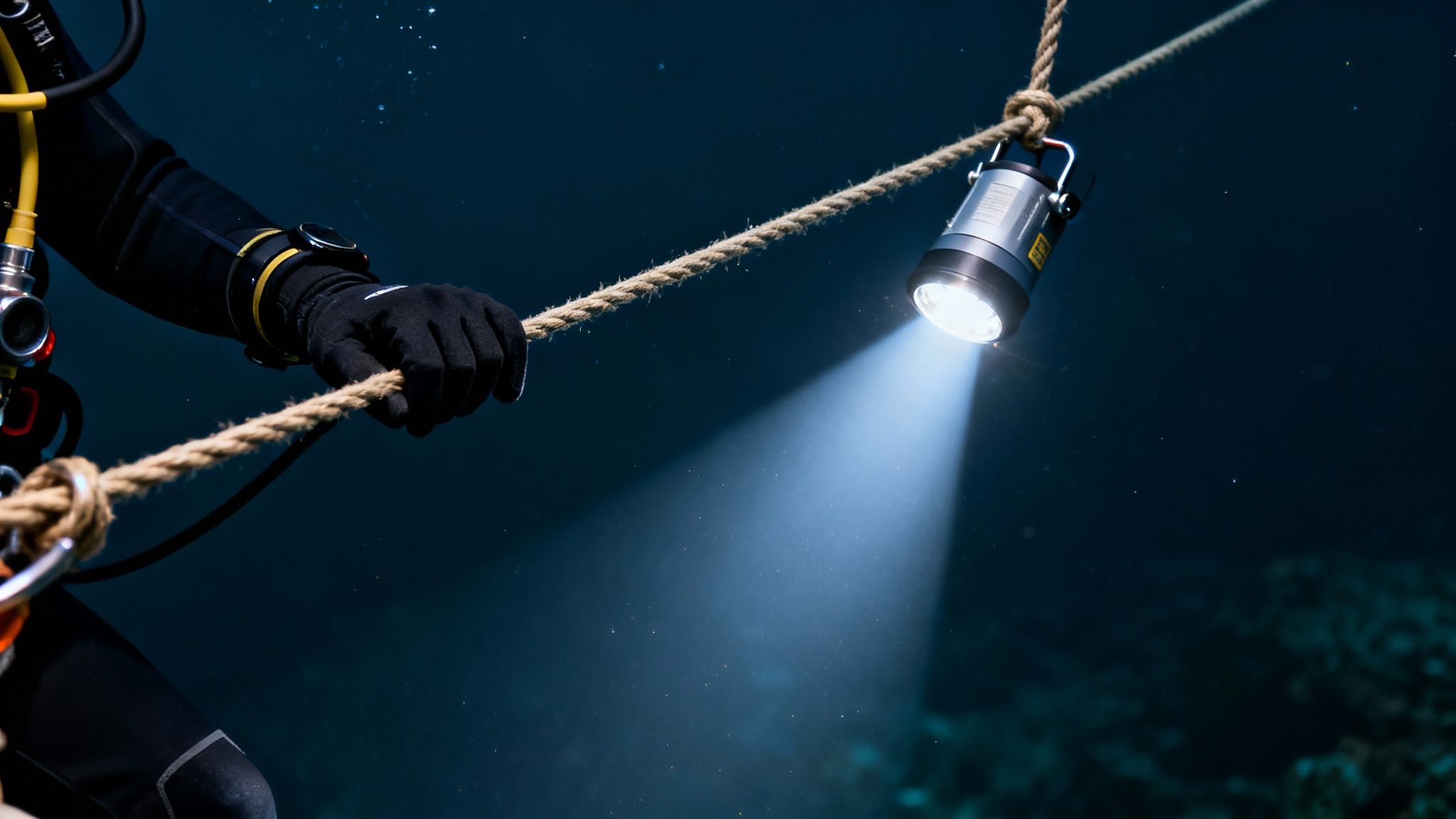
The centerpiece of our safety system is the robust tether connecting every diver to the boat. This isn't just some rope tossed over the side; it’s a heavy-duty downline system that gives you a constant physical and visual reference point in the darkness. You are never untethered, which means you can’t drift away from the group or the boat. It's your lifeline, allowing you to focus entirely on the incredible creatures emerging from the abyss.
The Right Guide and Gear Make All the Difference
On a black water dive, your divemaster is so much more than a guide—they are your guardian in this otherworldly environment. Our pros are experts in managing the unique dynamics of this very specific type of dive. From the detailed pre-dive briefing to their watchful eye in the water, their entire job is to make sure everything runs without a hitch.
Our powerful down-lights also play a huge safety role. They don't just attract the critters; they create a brilliantly lit "stage" in the middle of the ocean that serves as a beacon. This illuminated zone is your home base, making it incredibly easy to stay oriented and connected to the group. We take your well-being seriously, and you can see all our operational standards by reviewing the full Kona Honu Divers policies.
At its heart, a black water dive is a team effort. The tether system, powerful lighting, and your expert guide all work in concert to create a secure bubble of exploration in the immense open ocean.
Essential Gear for a Black Water Dive
While it's a night dive, black water diving has its own unique equipment needs. Here's a quick look at how the gear list differs from a standard reef night dive.
| Equipment | Standard Night Dive | Black Water Dive Specifics |
|---|---|---|
| Primary Dive Light | Bright enough to see the reef | Extremely powerful, often 10,000+ lumens, to penetrate the darkness and attract creatures. Backup light is mandatory. |
| Tether/Lanyard | Not typically used | Mandatory. A short lanyard with a sturdy clasp to connect you securely to the main downline. |
| Wetsuit | Standard thickness for local water temps | A bit thicker than usual is recommended. You're mostly stationary, so you'll get colder faster. |
| Buoyancy Control | Standard BCD and weight setup | Perfectly dialed-in weighting is critical. You must be able to hover effortlessly without sculling or kicking. |
| Photography Gear | Standard underwater camera rig | Specialized setup with strobes on long arms to minimize backscatter. A macro lens is essential. |
| Dive Computer | Standard | Must be easily visible, as you'll be monitoring your depth constantly in a featureless environment. |
Having the right equipment is non-negotiable. It's the foundation of a safe, successful, and truly mind-blowing dive.
Are You Ready for a Black Water Dive?
This adventure is perfect for certified divers who are already comfortable in the water, especially after dark. If there's one skill that matters more than any other, it's excellent buoyancy control. Being able to hold your depth without kicking, sculling, or making constant adjustments is absolutely crucial. It keeps you safe, helps you enjoy the dive, and protects the incredibly delicate creatures you’re there to see.
If you’re feeling a bit rusty or want to dial in your skills before heading out into the deep, we highly recommend getting a few more dives under your belt first. Our Premium Advanced Dive Trips are the perfect way to sharpen that buoyancy and build confidence.
Of course, all diving carries some inherent risk. Being a well-informed diver is part of being a safe diver. In the very unlikely event of an emergency, it's good practice to understand all aspects of dive medicine, including the potential contraindications of hyperbaric oxygen therapy.
Ultimately, our goal is to turn any apprehension you might have into pure confidence and wonder. Every single detail, from our gear to our procedures, is designed to ensure your journey into the ocean's hidden world is as safe as it is unforgettable.
Your Black Water Dive Experience from Start to Finish
So, what’s it really like to go on a black water dive? Forget everything you know about typical scuba diving. This is a carefully orchestrated journey into a realm few people ever get to see, and it starts long before you even get your feet wet.
Your adventure begins with an in-depth briefing at our shop. Here, you’ll meet the seasoned guide who will be your connection to the world above—your lifeline, quite literally—as you explore the open ocean.
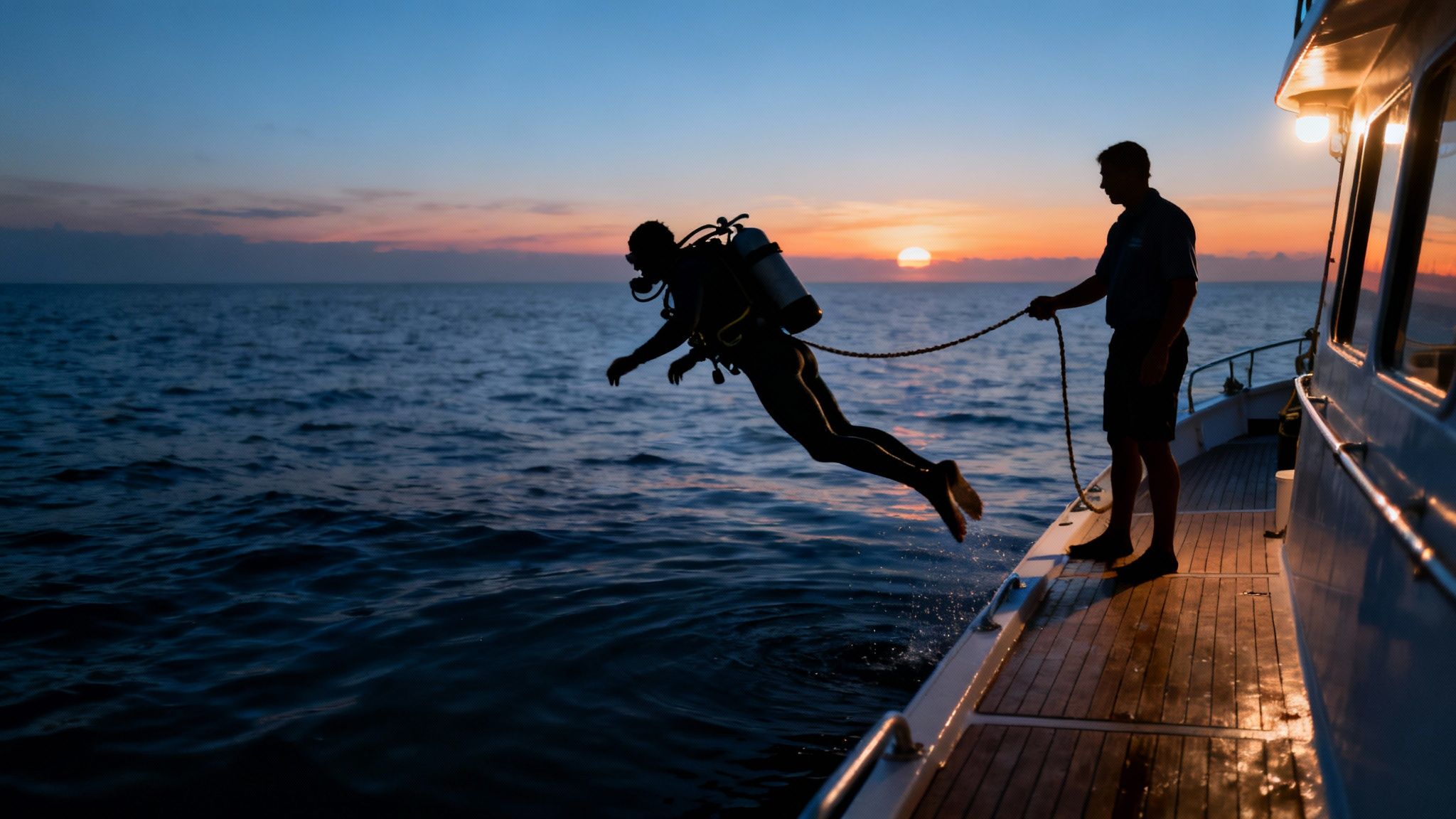
As sunset starts to streak the Kona sky with fiery colors, we head out to sea. The boat ride itself is part of the experience. We motor miles offshore, leaving the familiar coastline behind until we’re hovering over thousands of feet of inky-blue water. This quiet transit is the perfect time to prep your gear, give your camera a final check, and mentally prepare for what’s ahead.
Taking the Plunge into Darkness
Then comes the moment. The boat's engine cuts, and an incredible silence falls, broken only by the gentle sound of waves against the hull. Your guide gives the go-ahead, and you take that giant stride into the dark, welcoming the warm embrace of the Pacific.
The first sensation is pure awe. Your eyes slowly adjust to the deep, twilight blue as you begin a slow, controlled descent, following the main downline.
At about 40-50 feet, you’ll find your spot. You clip your personal tether to the line, dial in your neutral buoyancy, and just… hang there. It's a feeling that’s hard to describe—suspended in an infinite, three-dimensional space with no bottom in sight and no surface visible. There’s just the reassuring glow from the boat above and the security of the line. It's profoundly peaceful.
Then, the show begins. The high-powered down-lights switch on, piercing the abyss with a brilliant column of light. This is our stage, designed to attract the mysterious creatures migrating up from the deep.
A Universe of Drifting Life
At first, you have to train your eyes to see. You're looking for tiny, often translucent life forms. But soon, they appear. You’ll spot ghostly larval eels that look like ribbons of glass, iridescent ctenophores pulsing with internal rainbows, and perfectly formed juvenile squid—no bigger than a fingernail—shimmering as they dart through the light.
The experience is less about actively searching and more about letting the ocean reveal its secrets to you. You simply float, watch, and wait for the next bizarre and beautiful creature to drift into view. It is a profoundly serene and focused dive.
This calm, almost hypnotic state is a universe away from Kona’s other famous night dive. A black water dive is like a quiet float through deep space, while the manta ray night dive is like having a front-row seat at a spectacular underwater ballet. One is a meditative discovery of the strange and minuscule; the other is about being humbled by gentle giants. Both are quintessentially Kona, and neither will ever be forgotten.
The dive time seems to warp as you become completely absorbed in this living galaxy of plankton. Before you know it, it's time to slowly ascend, leaving the hidden universe behind. Back on the boat, beneath a canopy of brilliant stars, the excitement bubbles over as everyone shares stories of the alien-like creatures they encountered.
Curious to witness this yourself? You can find all the details and schedule your own adventure on our Kona black water dive tour page.
See what other divers thought of their experience with our world-class team.
Tips for Photographing a Black Water Dive
If you’re an underwater photographer, blackwater diving is the ultimate challenge. Forget colorful reefs and predictable fish—this is a whole different ballgame. It’s an exercise in patience and precision, but the payoff is unreal: photos of creatures so bizarre they look like they’re from another planet.
This isn’t your typical night dive. You're hunting for tiny, often see-through subjects that move erratically against a vast, inky-black canvas. It’s an incredibly high-contrast environment where your two biggest battles will be against backscatter and nailing the focus.
Dialing in Your Camera Settings
There’s no single set of "magic" numbers that works for every shot, but you absolutely need a solid starting point. The goal is to freeze your subject’s motion and capture its delicate details, all while keeping the background perfectly black.
Try starting with these settings, but be ready to tweak them on the fly:
- Aperture: Open it up wide. Something in the f/2.8 to f/5.6 range lets your strobes do all the heavy lifting.
- Shutter Speed: Go fast. Use your camera's maximum sync speed, which is usually around 1/200s or 1/250s. This freezes the action and kills any ambient light.
- ISO: Keep it low, ideally 100-200. You want a clean, noise-free background, and your strobes should provide all the light you need.
A powerful focus light isn’t just a recommendation; it's essential. Your camera's autofocus system will be completely lost in the dark without a bright, dedicated beam to help it lock onto a subject.
The Art of Strobe Positioning
Controlling backscatter is everything. Get this wrong, and your shot will look like you’re in the middle of a snowstorm. Out here in the open ocean, the water column is thick with tiny particles and microscopic life, all just waiting to reflect your flash.
The secret to a clean shot is lighting your subject from the sides, not from on top of your camera. This simple trick dramatically reduces the amount of light that hits the water between your lens and your subject.
This is where long strobe arms become your best friend. Push your strobes far out to the sides, and even angle them slightly behind your housing. This creates a cross-lighting effect that illuminates your subject beautifully while leaving the water directly in front of your lens in darkness. For more on specialized gear, check out our guide on the gear you will need for your Kona diving adventure.
Finding Art in the Emptiness
Composition in blackwater photography is a creative exercise in minimalism. With no reef to frame your shot, the creature itself is the entire story. That deep, black void becomes your canvas.
Use all that negative space to your advantage. It allows you to create striking, dramatic portraits that isolate your subject and highlight its alien-like details. To take your images to the next level, applying the principles of art photography can help you think about balance, texture, and form. Your goal is to move beyond a simple identification shot and create something that truly captures the mystery of this hidden world.
Ready to Dive Into the Abyss With Us?
A blackwater dive off the Kona coast is so much more than just another checkmark on a diver's bucket list. It’s a genuine encounter with a hidden, almost alien world. Pulling this off requires a lot more than just a boat and some lights—it takes deep local knowledge, a serious commitment to safety, and a real passion for the ocean’s most bizarre and beautiful creatures.
Here at Kona Honu Divers, that’s exactly what we provide. Our team lives and breathes this stuff. We don't just take you out on the water; we share our connection to the deep, ensuring your adventure is as mind-blowing as it is safe.
The Kona Honu Divers Difference
For a dive this specialized, who you go with really matters. Our crew is expertly trained to handle every single detail of a Kona blackwater dive, from reading the subtle offshore conditions to spotting the weird and wonderful animals that drift up from the depths. We intentionally keep our groups small for a reason—it means a more personal, uncrowded, and respectful experience with this incredibly fragile environment.
Our whole goal is to turn any nervousness you might have into pure awe. We want you to feel completely at ease so you can just soak in the spectacle floating all around you. We genuinely believe this is one of the most incredible adventures the ocean has to offer, and we can't wait to share it.
A blackwater dive really changes you. It connects you to the vast, unseen life that fuels our entire planet. Let our passionate guides show you the magic of the deep.
But don't just take our word for it. See what other divers have said about their own adventures with our team. We’re incredibly proud of the feedback we get, and it all comes back to our dedication to creating unforgettable underwater memories for every person who dives with us.
Your otherworldly adventure is waiting. This is your chance to witness something truly extraordinary—a journey into a living galaxy hidden right below the waves. Book your spot and get ready to see a side of the ocean you never even knew was there.
Your Blackwater Diving Questions Answered
Got questions? We've got answers. Here’s what divers often ask before taking the plunge into the big blue after dark.
Is a Blackwater Dive Scary?
It's natural to think floating over thousands of feet of dark ocean would be terrifying, but the reality is surprisingly peaceful. Most divers describe it as a calm, almost zen-like experience.
You're securely tethered to the boat, and your focus quickly shifts from the vastness of the ocean to the incredible, glowing creatures right in front of your face. It’s less like a scary plunge and more like floating through outer space, watching a living starfield drift by.
What Certifications Do I Need?
While an advanced certification is a great asset, what really matters is your comfort level in the water. You absolutely need to have excellent buoyancy control and some night diving experience under your belt.
If you're feeling a bit rusty or want to dial in those skills, jumping into one of our advanced courses is the perfect way to get your confidence rock-solid before the big night.
How Is This Different from the Manta Ray Night Dive?
Think of them as two totally different, yet equally amazing, nighttime worlds. The famous manta ray dive is all about staying in one spot on the ocean floor, watching a breathtaking ballet of giant, graceful animals. It’s a spectacular show.
A blackwater dive, on the other hand, is a drift dive in the deep open ocean. We're not looking for giants; we're hunting for the weird, wonderful, and often tiny alien-like creatures that rise from the depths. Honestly, every serious Kona diver should do both!
What About Seasickness?
Good question. We are offshore, and the boat is drifting, so if you're prone to motion sickness, it's a real possibility. We strongly recommend taking whatever preventative measures normally work for you on boat trips.
Popping a non-drowsy motion sickness pill beforehand can make the difference between a fantastic dive and a miserable boat ride. You want to be focused on the amazing critters, not on feeling queasy.