
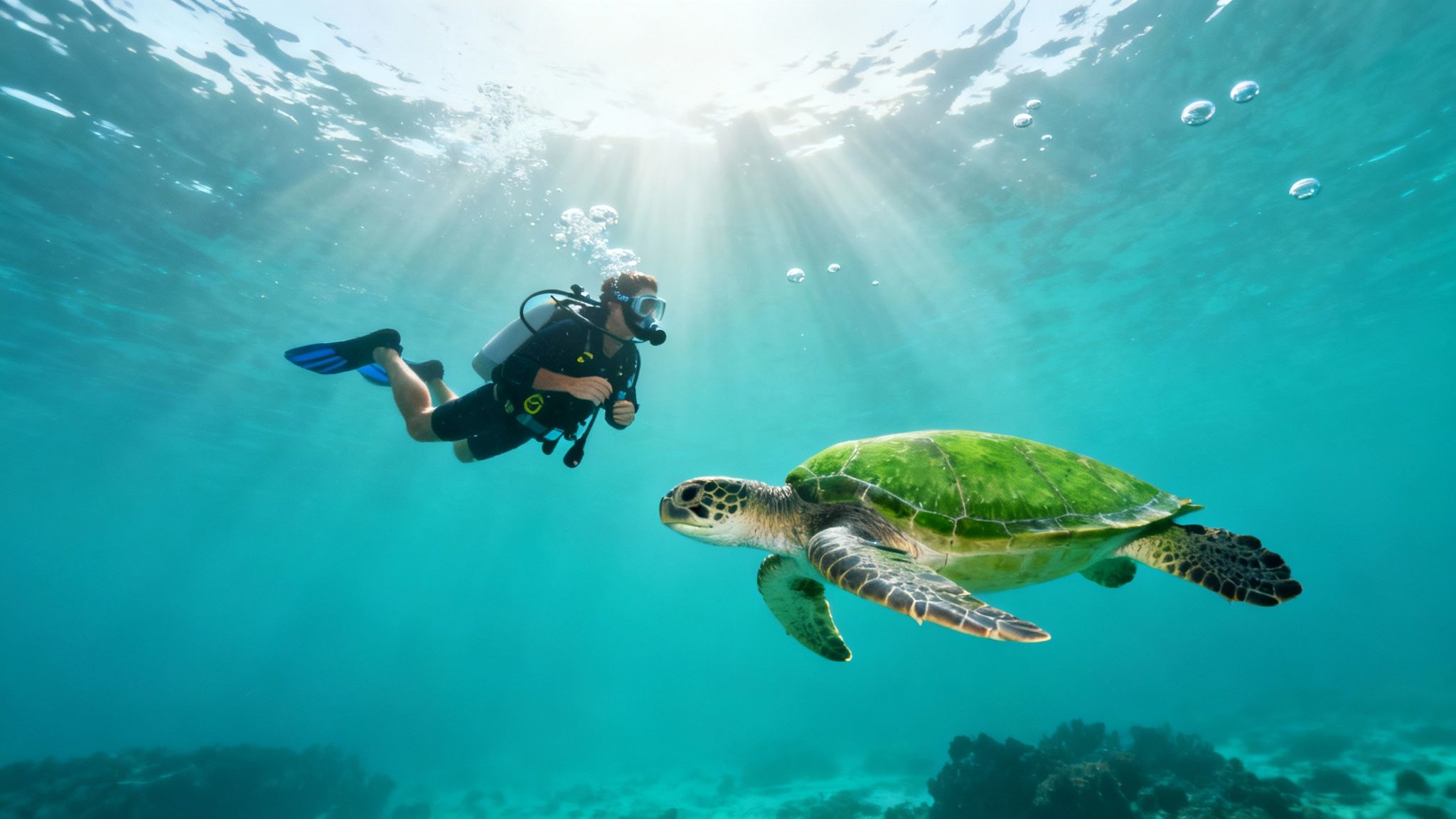
Imagine floating weightless in warm, crystal-clear blue water as a giant sea turtle glides silently past. That's the kind of magic you can expect from your very first scuba dive on the Big Island.
For anyone curious about breathing underwater, the calm, protected Kona coast is one of the best and safest classrooms in the world. It’s the perfect place to start your scuba adventure.
Your First Breath Underwater In Paradise
This guide is your complete roadmap, taking you from a curious beginner to a confident diver exploring one of the planet's most incredible underwater environments. We'll walk through exactly why the Kona coast is so special for new divers, covering everything from getting certified to what you might see on your very first plunge.
Think of this as your personal invitation to the underwater world. Our mission is to turn that dream of breathing underwater into a safe, thrilling, and unforgettable reality. Let's dive in.
What Makes This Experience Special
Learning to dive isn't just about the skills—it's about the place where you learn them. The Big Island offers a backdrop that very few locations can rival.
- Incredible Marine Life: From day one, you have a real chance of seeing Hawaiian green sea turtles (honu), schools of vibrant reef fish, and even playful dolphins.
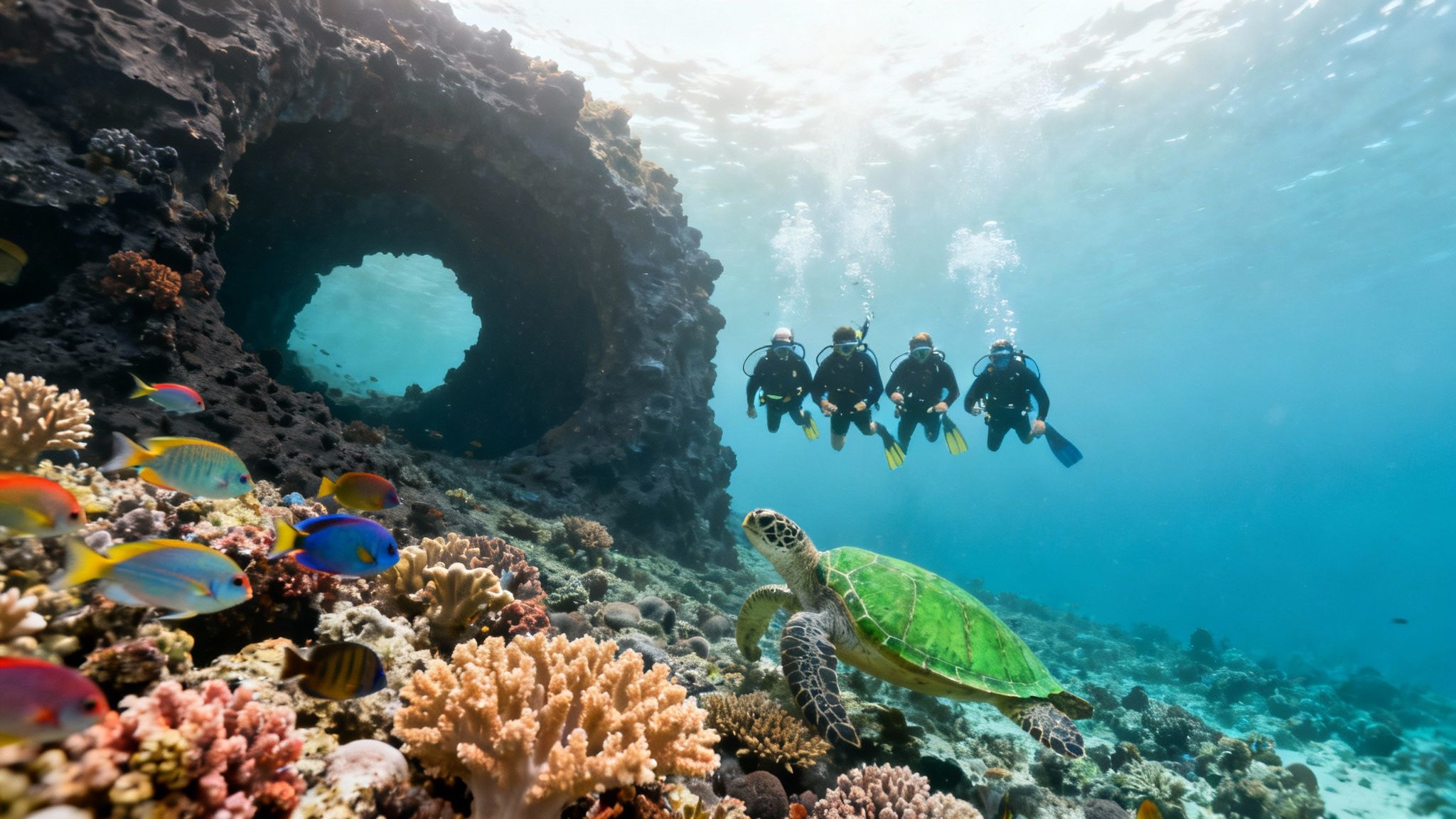
- Unique Underwater Terrain: The island's volcanic past has sculpted some truly mind-blowing underwater landscapes, with ancient lava tubes, dramatic arches, and sprawling coral gardens to explore.
- A Welcoming Dive Community: Here in Kona, we specialize in creating a supportive, fun atmosphere for beginners. You'll feel comfortable and safe with our team every step of the way.
Not certified yet? No problem. A fantastic first step is the Discover Scuba Dive in Kona, which lets you try diving under the direct supervision of a professional without committing to a full course. It’s the perfect way to test the waters and see Kona's beautiful reefs up close.
Why Kona Is the Perfect Place to Learn Diving
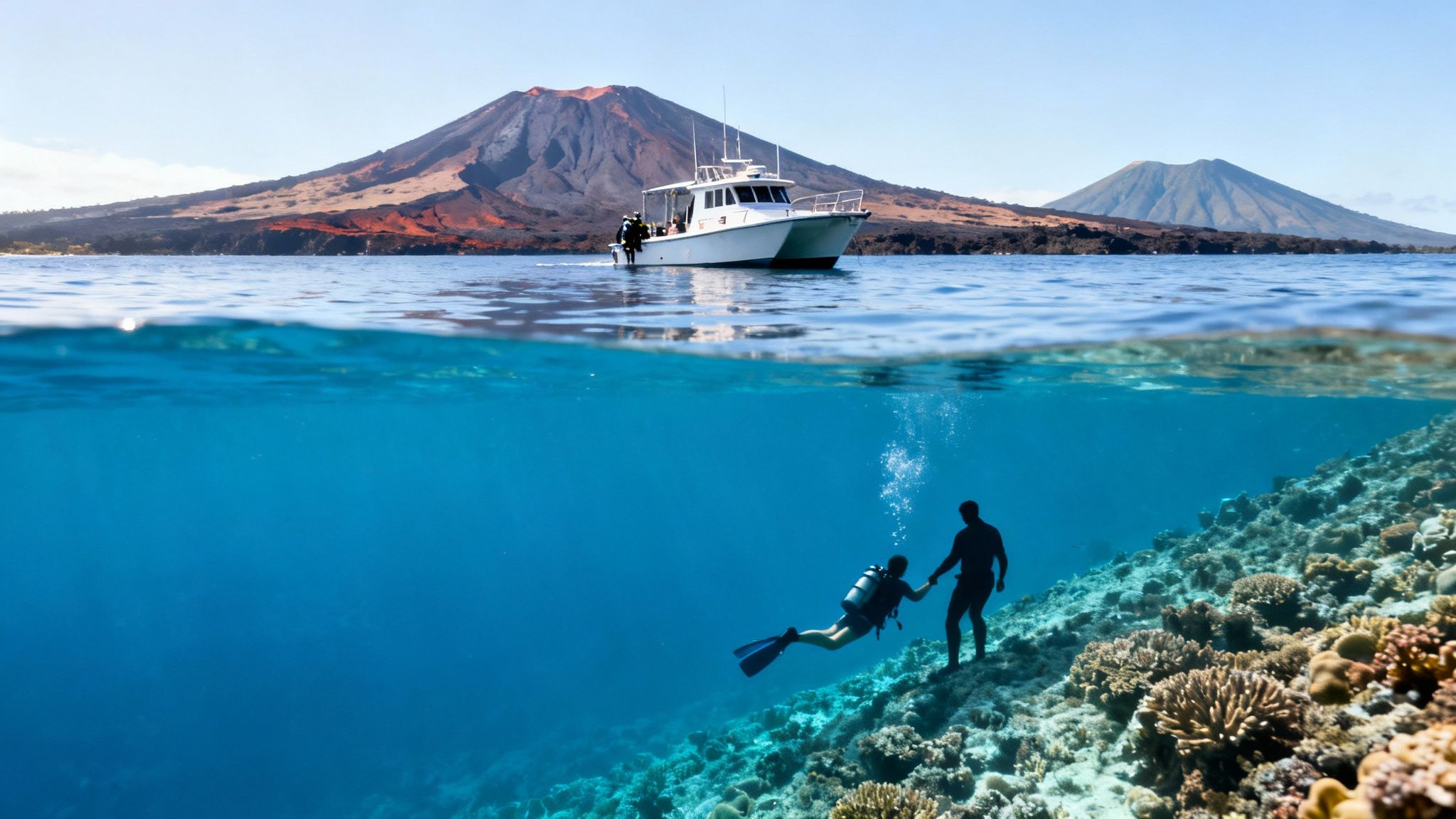
So, what makes the Big Island’s Kona coast the world’s best classroom for new divers? It all comes down to a bit of lucky geography. Think of the island’s massive volcanoes, Mauna Loa and Hualālai, as giant bodyguards. They stand tall, blocking the powerful trade winds that constantly sweep across the Pacific.
This natural shield creates an incredibly calm and protected underwater environment on the island's western shore. For anyone just starting their Big Island scuba diving for beginners journey, this is a total game-changer. It means less choppy surface water, far fewer strong currents, and conditions that often feel as placid as a lake.
This protected environment lets you build your skills and confidence without a fight. Instead of battling rough seas, you can focus on what really matters: your breathing, your buoyancy, and the unbelievable world unfolding all around you. It’s simply the ideal setting to master the fundamentals without any unnecessary stress.
An Ideal Underwater Classroom
But the calm waters are just the beginning of the story. The Kona coast also gives us year-round warm water, typically averaging a balmy 77-80°F (25-27°C). This comfortable temperature means you can relax and concentrate on your skills instead of shivering, making the entire learning process so much more enjoyable.
Visibility is the other superstar here. It’s not uncommon for it to stretch well beyond 100 feet, creating a crystal-clear window into the ocean. This incredible clarity is a huge safety advantage, letting you easily see your instructor and dive buddies. It also means you get a front-row seat to the vibrant coral reefs and the parade of marine life that calls them home.
These factors aren’t just nice perks; they create a safer, more comfortable, and visually stunning place to learn. This unique combination sets the stage for a lifelong passion for diving, starting with a first impression that’s pure awe, not anxiety.
The Kona Advantage: By the Numbers
For beginners, the Big Island is statistically one of the most forgiving places in Hawaii to learn scuba, thanks to its leeward Kona coast and naturally sheltered bays.
- Warm Water: The consistently warm temperatures mean most divers are perfectly comfortable in a thin 3mm wetsuit year-round.
- Stunning Visibility: Exceptional clarity helps new divers master buoyancy control and maintain awareness of their surroundings and their instructor.
- Calm Seas: The vast majority of boat diving happens on the west coast, where the volcanoes block the trade winds and dramatically reduce the surface chop that can intimidate newcomers.
While any ocean activity requires respect and caution, Hawaii's ocean safety concerns are overwhelmingly linked to unguided activities, not professionally supervised scuba courses with a reputable operator. To see how Kona compares to other popular training spots, take a look at the table below.
Kona vs. Other Dive Locations for Beginners
When you're choosing where to get certified, the environment plays a huge role in your success and enjoyment. Here’s a quick comparison of what you can expect in Kona versus other popular destinations.
| Factor | Kona, Big Island | Typical Caribbean Location | California Coast |
|---|---|---|---|
| Water Temp | 77-80°F (25-27°C) | 78-84°F (26-29°C) | 55-65°F (13-18°C) |
| Visibility | Consistently 80-100+ ft | Often 50-80 ft, can vary | Variable, often 10-30 ft |
| Currents | Minimal to none at beginner sites | Can be mild to strong, unpredictable | Can be strong and challenging |
| Surface Chop | Calm, protected by volcanoes | Can be windy and choppy | Often has significant swell and surf |
| Wetsuit Needed | 3mm | 3mm or less (skin) | 7mm with hood/gloves |
As you can see, Kona offers a "Goldilocks" combination of warm water, incredible visibility, and calm conditions that are just right for building a solid foundation in scuba.
"The first time you breathe underwater is a moment you never forget. In Kona, the calm, clear conditions ensure that moment is one of pure wonder, not worry. It’s about as perfect a start as you can get."
When you're ready to read the full analysis of Big Island dive conditions at ScubaDiving.com, you'll see why so many divers choose to start here. And once you decide to take the plunge, choosing the right operator is key. We specialize in creating a safe and encouraging environment for new divers, making sure your first breaths underwater are the start of an amazing journey.
Check Availability
Your Path to Becoming a Certified Diver
Getting scuba certified might seem like a huge undertaking, but it’s actually a fun, straightforward process designed to turn you from a total newcomer into a confident diver. The gold standard around the globe is the PADI Open Water Diver course, and it’s the perfect place to start your underwater adventure.
The whole journey is broken down into three simple, manageable parts. This isn't about throwing you in the deep end; it's about building your skills and confidence one step at a time, so by the time you hit the open ocean, you're more than ready.
Think of it like learning to drive a car. You wouldn't just jump onto a busy highway. You’d start with the driver's manual, practice in a quiet parking lot, and only then head out onto the road with an instructor. Scuba training follows that same safe, logical progression.
The Three Steps to Certification
The PADI course is designed to move you from theory to practice in a way that feels natural and builds confidence.
-
Knowledge Development (eLearning): This is the “book smarts” part, but you can do it from your couch! Long before you even pack your bags for Hawaii, you can complete all the theory online. You'll learn the key principles of scuba—from how pressure affects your body to how your gear works—through interactive lessons you can finish at your own pace. The best part? It means more time in the water once you get here.
-
Confined Water Dives: Now we get wet! In a calm, pool-like environment, your instructor will walk you through the essential hands-on skills. You'll take your first breaths underwater, get comfortable with your gear, learn how to clear your mask, and start mastering your buoyancy. It's a completely pressure-free setting to build your muscle memory.
-
Open Water Dives: This is the moment it all comes together. Over four dives in the beautiful Kona ocean, you’ll put all your new skills to use under the watchful eye of your PADI Instructor. This is your chance to explore real dive sites, spot sea turtles, and marvel at colorful fish while showing you've got what it takes.
The PADI system is trusted worldwide for one simple reason: it puts safety and skill mastery first. By the end of your course, you won't just have a certification card—you'll be a capable, self-assured diver ready for adventure.
Not Ready for a Full Course? Try a "Taster" Dive
If you're curious about diving but not quite ready to commit to a full certification, we've got the perfect option. The Discover Scuba Diving experience is a fantastic one-day "taster" session.
You’ll get to experience the pure magic of breathing underwater and see Kona’s incredible reefs with a professional guide right by your side. It’s all the thrill without the multi-day commitment, making it a perfect introduction to Big Island scuba diving for beginners.
Why Choose a PADI 5-Star Dive Center
When you’re learning a new skill like diving, who you learn from matters. A lot. Choosing a PADI 5-Star Dive Center like Kona Honu Divers means you're getting the absolute highest standard of training there is. That designation isn't just a fancy sticker; it’s a guarantee of excellence in safety, education, and service.
Here at Kona Honu Divers, we keep our groups small so you get plenty of personal attention from your instructor. Our whole team is focused on creating a supportive, fun, and safe environment where you can build your confidence. We believe a great first experience is the key to a lifelong love of diving.
To see exactly what’s included in the course, check out the complete details on our PADI Open Water certification course.
Exploring Kona’s Best Beginner Dive Sites
Alright, you've done the work and earned your certification. Now for the fun part: exploring some of the most breathtaking underwater scenery in Hawaii. The Kona coast is lined with dive sites that seem tailor-made for new divers, offering a perfect, gentle introduction to the Pacific's wonders.
Most of these spots feature calm water, almost no current, and ideal depths—usually somewhere between 30 and 60 feet. This lets you focus on your buoyancy and just enjoy the view without feeling rushed or out of your comfort zone. This is where your real adventure begins.
Picture yourself gliding next to a majestic Hawaiian green sea turtle, watching a cloud of yellow tangs drift over the reef, or spotting a shy octopus peeking out from its rocky den. Beginner sites in Kona are far from boring; they’re packed with life and cool geological features like ancient lava tubes and dramatic archways that make every single dive feel like a new discovery.
What Makes a Dive Site "Beginner-Friendly"?
Not all dive sites are created equal, especially when you're just starting out. An experienced crew—like ours at Kona Honu Divers—uses their deep local knowledge to hand-pick the best spot for the day's conditions, making sure every dive is both safe and unforgettable.
So, what are we looking for? Several key things make a site perfect for your first real dives:
- Shallow Depths: The best action is often in less than 60 feet of water, which is well within the limits for new divers.
- Minimal Current: Thanks to the Kona coast's protected layout, many sites have very little current. It makes for a relaxing, almost meditative experience.
- Easy Navigation: Sites usually have obvious natural landmarks, like a sloping reef or a big rock formation, making it easy to know where you are.
- Tons of Marine Life: You don’t have to go deep to see the good stuff! Turtles, eels, and thousands of colorful reef fish are everywhere in the shallows.
This magical combination means that being a beginner in Kona doesn't mean you miss out. Some of the most incredible marine encounters are waiting for you right from the start.
Why Kona's Biodiversity Is Perfect for New Divers
New divers on the Big Island get to experience a rare mix of unbelievable biodiversity in very manageable depths—something you just don't find at many other world-class dive destinations. Marine surveys have cataloged around 1,100 fish species here, with about 129 found nowhere else on Earth. You simply won't see these creatures in the Caribbean or the Red Sea.
Many of Kona's signature reefs are in that 30–60 foot sweet spot, perfect for Open Water students and newly minted divers. At our most popular sites, it's totally normal to see turtles, eels, and huge schools of fish in the first 40 feet. You never have to push your limits to get that "wow" moment. That's a huge advantage over destinations where the best encounters happen below 100 feet, leaving novices out of the action.
Being a new diver in Kona is special. You are immediately immersed in a world-class aquarium where the reef is healthy, the animals are plentiful, and the conditions are forgiving. It’s the perfect recipe for falling in love with the ocean.
While our boat charters get you to the most pristine offshore reefs, the Big Island also has some fantastic shore diving. Once you're feeling a bit more seasoned and want to explore on your own schedule, check out our guide to the best shore diving sites in Kona.
Choosing Your First Dive Adventure

Alright, you're certified and ready to explore the underwater world. So, where do you start? When it comes to Big Island scuba diving for beginners, your first big decision is how you’ll get in the water: from a boat or from the shore. While both are options, for anyone new to diving, one choice is a hands-down winner.
Boat diving is, without a doubt, the way to go. It offers a level of ease, safety, and access that shore diving just can't compete with, especially while you're still getting the hang of your gear and buoyancy.
Think of it this way: shore diving is like hiking to a remote campsite with all your gear on your back. It often means suiting up in a hot parking lot, clunking across sharp lava rock or sand, and then kicking for a long time on the surface just to reach the reef—all while carrying 40-50 pounds of equipment. By the time you actually start your dive, you're already tired. Boat diving is the complete opposite.
The Clear Advantages of Boat Diving
Jumping on a professional dive charter is like having a valet service for your underwater adventure. The boat cruises directly to the best part of the reef, so you can save every bit of your energy and air for what you came to do: dive. You gear up comfortably at your seat, get a final once-over from the crew, and take one big step right into the ocean.
But the perks go way beyond just skipping a long, sweaty walk.
- Access to Pristine Reefs: The most vibrant and untouched dive sites are almost always offshore, well beyond the reach of anyone kicking from the beach. These reefs are healthier, see less human traffic, and are absolutely teeming with marine life.
- Expert Guidance and Safety: When you're on a boat, you’re in the care of a professional crew from start to finish. They handle the navigation, give you a detailed briefing on the dive site so you know what to look for, and are waiting right there to help you back on board when you surface.
- Unmatched Comfort: A good dive boat is built for divers. At Kona Honu Divers, our boats offer shaded areas to relax, plenty of snacks and drinks, and even hot freshwater showers to rinse off with afterward. It turns the entire trip into a relaxing day on the water, not an exhausting chore.
All this support removes a ton of stress and logistical headaches, letting you focus entirely on the pure joy of exploring the reef. You can see all the incredible places our diving tours will take you.
The Manta Ray Night Dive: A Must-Do Adventure
One of the most legendary experiences in all of Hawaii is the world-famous Manta Ray Night Dive—and the best news is, it's incredibly beginner-friendly. Picture yourself kneeling on the sandy ocean floor in the dark as massive manta rays, with wingspans up to 16 feet, swoop and barrel-roll like acrobats just inches above your head. It’s a breathtaking spectacle you will never, ever forget.
While you can do this dive at a couple of locations, one spot is far and away the best: Garden Eel Cove. Its location in a bay naturally protects it from big ocean swells, which makes for a much calmer and more comfortable experience for everyone.
The viewing area at Garden Eel Cove is often called a natural amphitheater, and for good reason. It gives divers a front-row seat to watch the mantas feed in the light beams. Plus, the surrounding reef is healthier, making the whole dive, from descent to ascent, that much more beautiful.
The Manta Ray Night Dive is more than just a dive; it's a performance. Seeing these gentle giants move with such grace and power is a humbling, magical experience that stays with you forever.
Ready for an unforgettable night? Learn more and book your spot on the 2-Tank Manta Ray Dive at the superior Garden Eel Cove location.
Your Future Dive Adventures
Once you get a few dives logged and your confidence starts to build, a whole new world of possibilities opens up. As you become more comfortable in the water, you can look forward to more advanced dives that really push the envelope of underwater exploration.
For the truly adventurous at heart, the Kona Blackwater Dive is unlike anything else on Earth. On this unique night dive, you'll drift tethered to the boat in the deep, dark ocean miles from shore. Here, you'll witness the largest animal migration on the planet, as bizarre and beautiful bioluminescent creatures rise from the abyss. It’s often described as diving through outer space. Learn more about the Blackwater Dive tour.
As your skills grow, you might also find yourself drawn to exploring deeper reefs, intricate lava tube systems, and sites that require a bit more navigational know-how. Our premium advanced charters are designed for experienced divers who are ready for a new challenge and want to visit some of Kona's most exclusive and rarely-seen sites.
Your journey as a scuba diver is just getting started, and Kona’s incredible underwater landscape has a lifetime of adventure waiting for you.
Check Availability
Planning and Booking Your Kona Dive Trip
Alright, you've got the bug. The idea of gliding through Kona's clear, warm water is no longer just a daydream—it's a plan. So, how do you make it happen? The final, and most exciting, step is choosing the right people to guide you.
When you're new to diving, who you dive with matters more than anything. You want a team that puts safety first, provides gear you can trust, and has a real knack for making beginners feel completely comfortable and confident underwater.
Why Choose Kona Honu Divers
This is where Kona Honu Divers really shines. Their entire philosophy is built around creating a safe, supportive, and truly memorable experience, especially for new divers. They keep their groups small, which means you get one-on-one attention from instructors who are experts at calming nerves and building skills.
From the moment you connect with them, you'll feel their commitment. They treat everyone like ‘ohana (family), and their rental equipment is top-notch and meticulously maintained, so you don’t have to worry about a thing.
This focus on your well-being lets you simply relax and soak in the magic of Kona's underwater world. But you don't have to take our word for it—see what other divers are saying.
Booking Your Adventure
Getting your spot on a boat or in a course is easy, but a little planning goes a long way. It’s a good idea to book ahead, especially if you’re traveling during the busier seasons, to make sure you get the dates you want.
Whether you're signing up for the full PADI Open Water course, just want to try a Discover Scuba Dive, or you're ready for a guided trip, locking in your spot early is the key. You can explore everything they offer, from two-tank morning reef dives to the world-famous Manta Ray Night Dive, on their main diving tours page.
When you're ready to take the plunge, the button below will show you live availability for all their trips and courses. Your Kona adventure is just a few clicks away.
Check Availability
Got Questions? We’ve Got Answers for First-Time Divers
It's totally normal to have a bunch of questions buzzing around in your head before you take the plunge. In fact, we encourage it! Getting those questions answered is the best way to swap any pre-dive nerves for pure, unadulterated excitement.
We've heard just about every question in the book from new divers. Let's walk through the most common ones so you can feel confident and ready for your Big Island scuba diving adventure.
Do I Have to Be a Super Strong Swimmer?
This is probably the #1 question we get, and the answer usually surprises people: no, you don't need to be Michael Phelps. You just need to be comfortable and reasonably capable in the water.
To get certified, you’ll need to pass a basic water skills test. This involves floating or treading water for 10 minutes and swimming 200 meters without stopping. It’s not a race and there’s no time limit—it’s just to show you can handle yourself calmly. Once you have your gear on, it does most of the work for you anyway!
What Should I Pack for the Dive Boat?
Less is more. We handle all the heavy lifting and technical gear, so you can focus on the fun parts.
Just think about what you'll want before and after you get in the water:
- A towel for drying off.
- Reef-safe sunscreen (this is a big one for protecting our corals!).
- Sunglasses and a hat for the boat ride.
- A dry change of clothes for a comfortable trip back to shore.
That's it! Kona Honu Divers takes care of the rest. We’ve got all your scuba equipment covered, plus plenty of snacks and drinks to keep you happy and hydrated out on the water.
Are There Any Health Restrictions I Should Know About?
Safety is everything in diving, so good health is important. Before you dive with us—or anyone else—you'll fill out a standard medical questionnaire.
It’s really important to be completely honest on this form. Certain conditions, like asthma, epilepsy, serious heart problems, or recent surgeries, might mean you need a doctor's okay before you can dive. It’s not meant to be a barrier; it's a simple, crucial step to make sure your underwater experience is safe and incredible.
Your first dive is something you'll remember for the rest of your life. Here at Kona Honu Divers, our entire mission is to make that memory a fantastic one.
Check Availability