
Picture this: your first breath underwater. You're weightless, suspended in a brilliant blue world, watching a majestic Hawaiian green sea turtle glide effortlessly by. Getting your Big Island scuba diving certification is your passport to this incredible volcanic paradise, and this guide is the first fin kick on your journey.
Why Kona is the Perfect Underwater Classroom
There’s a reason so many people choose to get certified on the Big Island. The Kona coast, sheltered from the winds by the island's massive volcanoes, boasts some of the most consistently calm and warm waters you'll find anywhere. It's the perfect low-stress environment to build your confidence as a new diver.
Visibility is often stunning, frequently stretching beyond 100 feet. This crystal-clear water means you can easily watch your instructor, see your own gear, and soak in the incredible scenery all around you. It makes learning feel less like a lesson and more like a discovery.
The geology here is truly special. Ancient lava flows have sculpted an underwater world of dramatic arches, mysterious caverns, and intricate lava tubes, all colonized by vibrant coral and bustling with marine life. This isn't your average swimming pool—it’s a dynamic, living classroom.
What You'll Experience in Kona's Waters
Getting certified in Kona means you're not just practicing skills in a sterile environment; you're exploring from your very first dive. You’ll be mastering your buoyancy while a cloud of yellow tangs flits past or clearing your mask as a gentle honu (Hawaiian green sea turtle) curiously watches.
Your training dives aren't just lessons; they are genuine adventures. The Big Island's rich marine ecosystem becomes your classroom, making every moment of your certification journey memorable and exciting.
PADI itself recognizes the Big Island as a world-class training ground, with premier reef dives and even cavern explorations that are perfectly suited for beginners. To get a feel for the specific spots you might visit, check out the variety of Big Island diving tours that showcase these incredible sites.
As you start planning your PADI Open Water Course trip, thinking about where you'll stay is key. It's worth taking a moment to understand the differences between motels and hotels to find the right home base for your dive adventure.
Not quite ready to commit to a full course? No problem. You can still experience the thrill of breathing underwater. A Discover Scuba Dive in Kona is a fantastic way to dip your toes in and see if diving is for you.
Of course, the dive shop you choose makes all the difference. At Kona Honu Divers, we've built our reputation on a simple foundation: impeccable safety, small and personal group sizes, and a genuine passion for the ocean. We're here to make sure your first dive is just the beginning of a lifelong adventure.
Choosing Your PADI Open Water Course
So you've decided to get your Big Island scuba diving certification—great choice! The first name you'll see everywhere is PADI, the Professional Association of Diving Instructors. A PADI card is basically your passport to the underwater world, recognized at dive spots from Hawaii to the Red Sea.
The certification that starts it all is the PADI Open Water Diver course. Think of it as getting your driver's license for the ocean. The whole process is broken down into three logical, confidence-building steps.
The Three Pillars of PADI Certification
First up is knowledge development. This is the theory part where you'll get a handle on the fundamentals—everything from how pressure affects your body to how to plan a safe dive. It's the "why" behind what we do underwater.
Next, you'll gear up for your confined water dives. We do these in a pool or a very calm, pool-like ocean environment. This is where you get comfortable breathing underwater, learn to use your equipment, and practice core skills with an instructor right by your side. You’ll master skills like clearing your mask and learning to hover weightlessly, which is the secret to effortless diving.
Finally, the moment you've been waiting for: four open water dives in the Pacific. This is where it all comes together. You'll take the skills you mastered in the pool and apply them while exploring Kona's incredible coral reefs and ancient lava tubes.
Your Smartest Move: The PADI eLearning Option
Let's be honest, you're coming to Hawaii for the ocean, not a classroom. That's why the absolute best way to structure your course is by completing the knowledge development at home with PADI eLearning. It’s an online program you can work through at your own pace, on your own schedule, before your plane ever leaves the ground.
By knocking out the eLearning ahead of time, you swap classroom hours for more time in the water. Instead of spending a day of your trip staring at a screen, you'll be on the boat and ready to dive from day one.
There's a reason this is the most popular way to get certified. The number of people getting into diving is on the rise, and after a dip in 2020, the U.S. is now certifying around 60,000 new divers every year, with Hawaii leading the charge. You can explore more about scuba certification statistics and their recovery.
The Flexible Referral Option
What if you've already started the process? Maybe you did your pool sessions at your local dive shop but got stopped by cold weather. The PADI Referral program is perfect for this. You can complete the theory and confined water dives at home, then bring your paperwork to us here in Kona.
This allows you to jump straight to the main event: your final four open water certification dives in Hawaii's warm, crystal-clear ocean. It's a fantastic way to finish your training in a truly world-class destination. Find out more about how the PADI Open Water Referral works to see if it’s the right path for you.
Getting your scuba certification on the Big Island is so much more than just checking boxes. With the right dive shop and an instructor who’s truly passionate about the ocean, it becomes an adventure you’ll never forget.
What to Expect During Your Training Dives
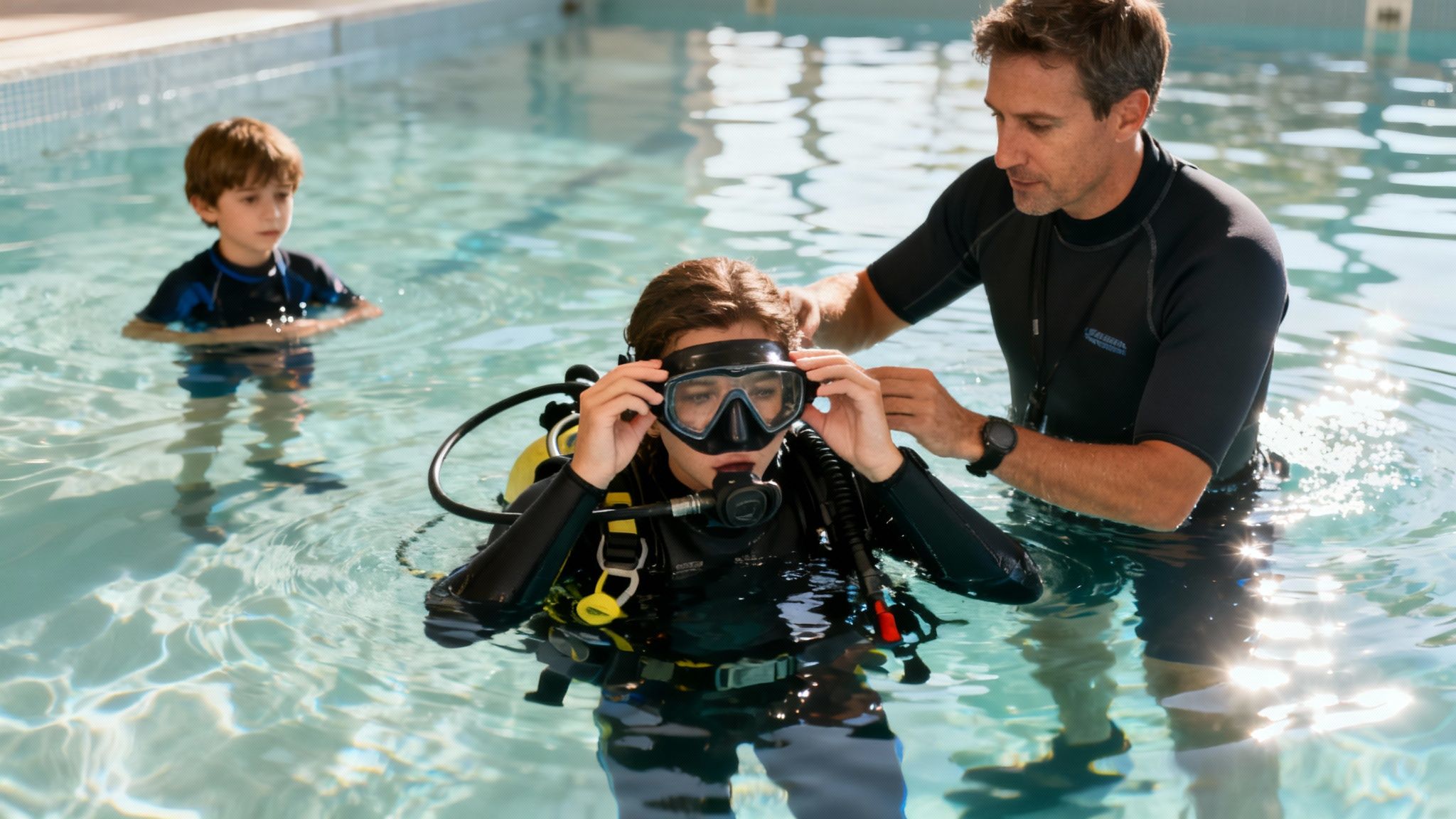
Getting your Big Island scuba diving certification is a genuinely thrilling experience, and the training is designed to build your skills and confidence step by logical step. The whole process is meant to take you from a curious beginner to a competent and comfortable underwater explorer.
Your journey starts before you even dip a toe in the water. The first piece is knowledge development, which you can knock out with PADI eLearning from home. This lets you get all the theory—the physics, safety rules, and gear ins-and-outs—out of the way on your own schedule. That way, your precious vacation time is spent where it counts: in the ocean.
Once you land in Kona with the bookwork done, the real fun begins.
Mastering Skills in a Calm Environment
Next up is your confined water training, which usually happens in a swimming pool. This calm, controlled environment is the perfect classroom for taking your very first breaths underwater. It's a completely stress-free space where you can focus on mastering the fundamental skills of diving.
With your PADI instructor right there beside you, you'll get familiar with all the scuba gear and practice a set of core skills. These are the absolute cornerstones of safe and fun diving:
- Mask Clearing: Learning how to push water out of your mask without having to pop up to the surface. It sounds tricky, but it's surprisingly simple.
- Regulator Recovery: Practicing how to find your primary air source if it ever gets knocked out of your mouth.
- Buoyancy Control: This is the big one—learning to achieve neutral buoyancy so you can hover effortlessly, like an astronaut in space.
- Emergency Procedures: Running through drills like sharing air with a buddy, so you're prepared and confident for any situation.
Here at Kona Honu Divers, we keep our student-to-instructor ratios small for a reason. It means you get the personal attention you need to turn any initial jitters into pure excitement as you nail each new skill.
Your First Plunge into the Pacific
After you’ve mastered the pool skills, it's time for the grand finale: four open water training dives. This is where everything you've learned comes together in the real world as you explore the incredible underwater landscapes of the Kona coast. These dives are the final hurdle to earning your Big Island scuba diving certification.
Think of your open water dives as more than just a test—they're your first real expeditions as a scuba diver. Each dive builds on the last, giving you a chance to practice your skills while being surrounded by the marine life that makes Kona famous.
We'll head out on one of our comfortable dive boats to some of Kona’s most beautiful and vibrant dive sites. You’ll descend with your instructor, dialing in your buoyancy and navigation while schools of colorful reef fish, ancient lava tubes, and maybe even a graceful Hawaiian green sea turtle swim by. That moment when you transition from the pool to the vast blue of the Pacific is something you'll never forget; it's the real start of a lifelong adventure. Once certified, you'll be ready to join our other amazing diving tours.
Why Kona Is the Ultimate Place to Learn Scuba
Let's be honest, not all classrooms are created equal. When you're learning to dive, your "classroom" is the ocean itself, and Kona is pretty much an Ivy League underwater university. Getting your Big Island scuba diving certification here is so much more than just ticking boxes and passing a test. It's about being immersed in a world-class environment from your very first breath underwater.
What makes it so perfect? You can thank the island’s massive volcanoes, Mauna Loa and Hualalai. They act as a giant natural barrier, shielding the Kona coast from the powerful trade winds that whip up the seas elsewhere. The result is water that's consistently calm, crystal clear, and warm—the perfect, low-stress setting for a new diver to build confidence and nail the basics without fighting currents or struggling to see.
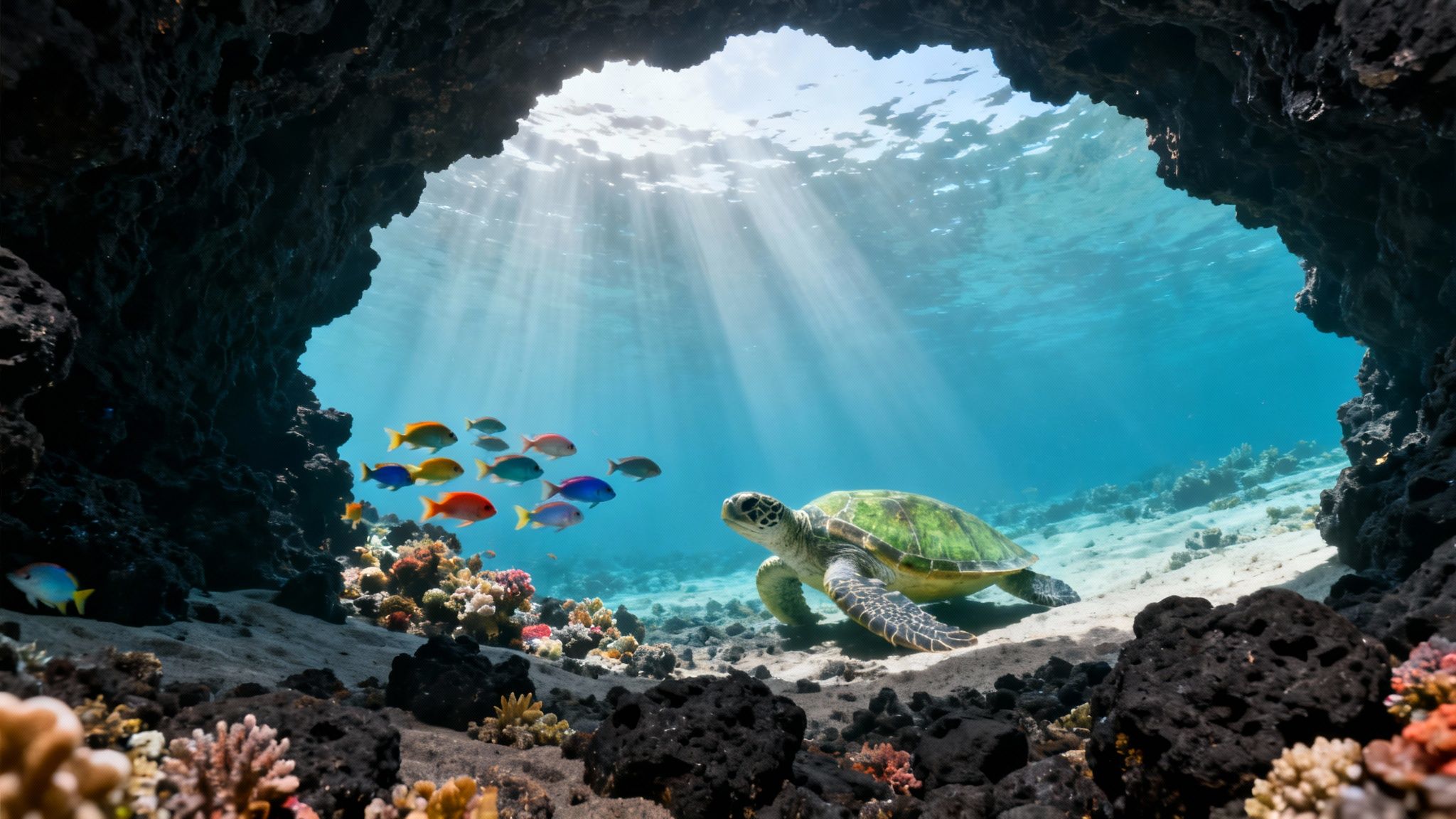
Imagine practicing your buoyancy skills while a gentle Hawaiian green sea turtle—a honu—glides past just a few feet away. That isn't a once-in-a-lifetime photo op; it’s just another day at the office when you learn to dive in Kona.
A Classroom Teeming with Life
The sheer amount of marine life you'll see on your training dives is mind-boggling. Kona's waters are a buzzing hub of activity, and your lessons will be accompanied by an incredible cast of underwater characters. Right from your very first open water dive, you'll be swimming with:
- Colorful Reef Fish: Schools of brilliant yellow tangs, intricate butterflyfish, and chubby parrotfish are everywhere you look.
- Hawaiian Green Sea Turtles: You're almost guaranteed to spot these serene reptiles snoozing on the reef or soaring through the water.
- Unique Critters: Keep your eyes peeled for moray eels poking their heads out of crevices, octopuses blending into the rocks, and maybe even a majestic eagle ray cruising by.
This constant interaction turns every training drill into a real adventure. Trust me, practicing how to clear your mask is a lot more motivating when a pod of spinner dolphins is leaping in the distance.
Explore an Otherworldly Volcanic Landscape
It’s not just about the animals, though. The underwater landscape itself is a huge part of the magic. Ancient lava flows have created a dramatic and complex seascape you simply won't find anywhere else. Instead of just hovering over a flat, sandy bottom for your skills practice, you'll be exploring some truly incredible geological formations.
You’ll get to navigate through massive underwater archways, peer into the dark mouths of old lava tubes, and drift along breathtaking volcanic drop-offs. This terrain makes every single dive feel like a true exploration, not just a lesson. You aren't just learning skills; you're learning how to be a diver in a genuinely otherworldly environment.
Earning your Big Island scuba diving certification in Kona means your training dives are more than just practice; they are profound encounters with nature. The combination of perfect conditions, abundant wildlife, and unique geology makes it an unforgettable place to begin your underwater journey.
Getting certified on the Big Island means jumping right into a biodiversity hotspot, and top-tier operators like Kona Honu Divers have the experience dialed in. They're consistently ranked as one of the best companies on the Big Island, known for their comfortable boats and amazing service. PADI recognizes several key sites around the island, giving you the perfect backdrop for the four open water dives your course requires. If you want a closer look at how a certification course is structured here, you can explore more about Big Island scuba programs.
This incredible environment is waiting for you. See all the amazing places your new certification will unlock by checking out Kona Honu Divers' diving tours page.
Life After Certification: Your Next Adventures
Congratulations, you're a certified diver! That new C-card in your wallet isn't just a piece of plastic; it’s your ticket to a whole new world of adventure. Finishing your Big Island scuba diving certification is a huge first step, but the real fun is just getting started. The skills you just mastered open the door to some of the most mind-blowing underwater experiences on the planet, and they're right here in Kona.
Your new certification means you’re ready to hop on the boat for guided dives and discover what lies beyond the training sites. Kona is famous for its staggering biodiversity and unique volcanic underwater topography, and you now have the skills to see it firsthand. From vibrant daytime reef explorations to the thrill of a night dive, your journey has just begun.
The World-Famous Manta Ray Night Dive
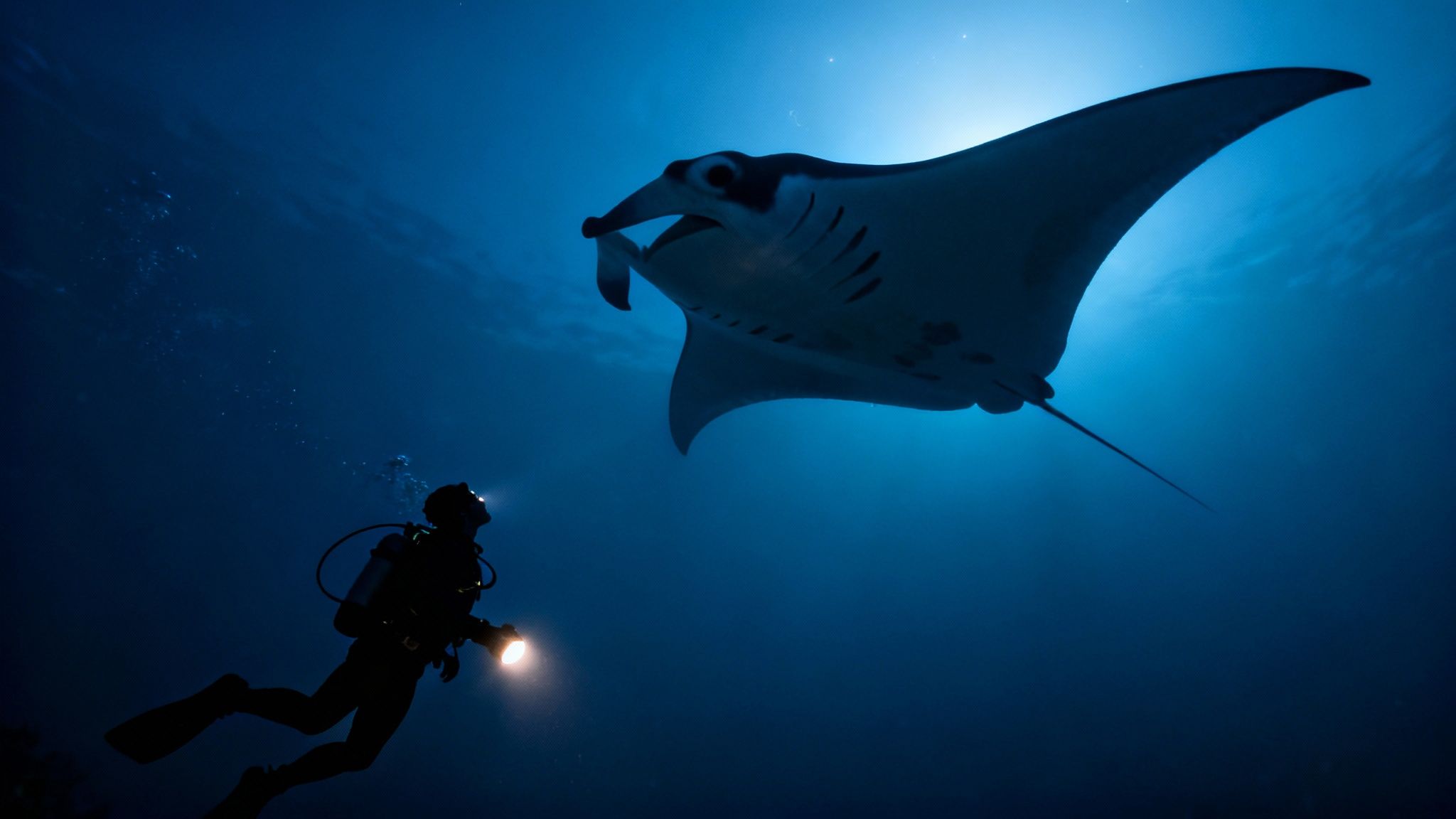
First on pretty much every new diver's bucket list should be the legendary Manta Ray Night Dive. This isn't just another dive; it's a profound, mesmerizing spectacle that has firmly put Kona on the global diving map. Just picture it: you're kneeling on the sandy ocean floor as giant, graceful manta rays, some with wingspans over 12 feet, perform a silent, aquatic ballet just inches above your head.
The setup is brilliantly simple. We place powerful lights on the ocean floor, which attract clouds of plankton—a manta's favorite meal. The mantas arrive for an all-you-can-eat buffet, swooping and gliding through the light beams to feed. It’s a completely natural encounter that leaves every diver utterly speechless.
We exclusively visit Garden Eel Cove for our manta dives. The site is naturally sheltered from ocean swells, making for a calmer and more comfortable experience. More importantly, its unique underwater "amphitheater" layout gives you a front-row seat for closer, more intimate, and totally unobstructed views of these gentle giants.
For many people, this one dive is the entire reason they got certified in the first place. It’s a powerful, humbling experience that connects you with one of the ocean’s most majestic creatures. You can learn more and book your spot on the manta ray dive tour page.
For the Truly Adventurous: The Kona Blackwater Dive
If you’re craving something that feels less like a dive and more like a journey to another planet, the Kona Blackwater Dive is your next mission. This is nothing like a reef dive. We head miles offshore into the deep, dark ocean at night. You'll be tethered to the boat, floating in thousands of feet of water.
As you drift in the inky blackness, you'll witness the largest migration on Earth. Strange and beautiful creatures, many of them glowing with their own light, rise from the abyss to feed near the surface. You'll see things most people don't even know exist—translucent larval fish, glowing squid, and alien-like jellyfish. It’s an exhilarating dive that pushes the very boundaries of underwater exploration. This is one of the more experienced diving opportunities in Kona.
Continue Your Education with Advanced Open Water
Your Open Water certification is your license to learn, and the adventure doesn't have to stop here. The natural next step in your dive education is the PADI Advanced Open Water Diver course. Don't let the name intimidate you; this course is less about stressful tests and more about building confidence by trying out different types of diving with an instructor by your side.
The course is built around five "adventure dives," which include two required dives:
- Deep Dive: You’ll learn the proper techniques for diving deeper, which opens up a whole new range of incredible dive sites that were off-limits before.
- Underwater Navigation: You’ll finally master that compass and learn how to use natural landmarks to find your way around underwater like a pro.
For your other three dives, you get to choose from a list of specialties like Peak Performance Buoyancy, Fish Identification, or even a Night Dive. Finishing this course makes you a much more capable and self-assured diver, ready for more challenging and rewarding adventures. You can learn more about how to continue your dive training with the PADI Advanced Open Water course.
Earning your certification is a huge accomplishment, and the whole team at Kona Honu Divers is excited to help you take that next step.
Your Top Questions About Scuba Certification Answered
Deciding to get your Big Island scuba diving certification is a huge step, and it's totally normal to have questions before you dive in. We hear these all the time from people just starting out, so let's clear up some of the most common ones to get you ready for the adventure.
Is Learning to Scuba Dive Dangerous?
This is probably the number one question on everyone’s mind, and it's a fair one. While any adventure sport has some level of risk, scuba diving has an incredible safety record, especially when you stick to the rules and get proper training. Modern dive gear is remarkably reliable, and organizations like PADI have spent decades perfecting their courses to be safe and conservative.
The whole point of the training is to build your confidence and skills one step at a time, so you become a safe, self-reliant diver. Honestly, the most critical safety decision you'll make is choosing a top-notch dive shop. An operator like Kona Honu Divers, with seasoned instructors and a serious commitment to safety, makes the whole process feel secure and fun, not stressful. We supervise every single step, from that first breath in the pool to your last dive in the ocean.
How Long Does It Actually Take to Get Certified?
For the full PADI Open Water Diver certification, you should plan on setting aside three to four full days. This timeline gives you enough breathing room to really soak up the information and practice your skills without ever feeling rushed.
But here’s a pro tip: you can get a huge head start by doing the bookwork at home with PADI eLearning. Knocking that out online means you show up in Kona ready to hit the water. From there, the hands-on part usually breaks down like this:
- One day in the pool (what we call 'confined water') to get comfortable and nail down the essential skills.
- Two days out on the boat for your open water dives, doing two dives each day to put all your new skills to use in the big blue.
It’s a great system that lets you make the most of your vacation time exploring Kona’s amazing underwater world.
Do I Have to Be a Super Strong Swimmer?
You definitely don't need to be Michael Phelps, but you do need to be comfortable in the water. Before we can issue your Big Island scuba diving certification, every student needs to pass a basic water-skills check. It's a simple safety measure to make sure you can handle yourself if you ever found yourself on the surface without your gear.
The requirements are very manageable and are more about comfort than athletic ability. You'll be asked to:
- Stay afloat by treading water or floating for 10 minutes without using any flotation devices.
- Swim 200 meters (or 300 meters if you use a mask, fins, and snorkel) without stopping.
There’s no time limit on the swim; we just need to see that you can confidently cover the distance.
What Does the Course Price Include?
Knowing what you’re paying for upfront is key. A quality certification course should be all-inclusive, with no surprise fees popping up later. When you book a PADI Open Water course, the price should cover everything you need from start to finish.
Generally, that package includes:
- PADI eLearning Materials: Your access code for all the online theory.
- Professional Instruction: All the time you'll spend with your certified PADI instructor.
- Pool Sessions: Use of the pool and all the instruction needed for your confined water training.
- Scuba Equipment Rentals: A full set of quality gear—mask, snorkel, fins, BCD, regulator, and tanks.
- Four Open Water Dives: The boat charter fees for the four required dives out in the ocean.
Before you book anywhere, always double-check what's included. A great shop like Kona Honu Divers will be completely transparent with their pricing so you can focus on what matters: the incredible feeling of learning to breathe underwater.
Ready to start your adventure? We're here to answer any other questions you have and help you take that first step.