
Picture this: you're floating, completely weightless, breathing easily as you drift past ancient lava tubes and coral gardens bursting with color. This isn't just a daydream. It's exactly what's waiting for you when you get your Big Island scuba diving certification. The calm, crystal-clear waters off the Kona coast make it one of the best classrooms on the planet, with amazing visibility and incredible marine life year-round.
Your Underwater Adventure Starts Here
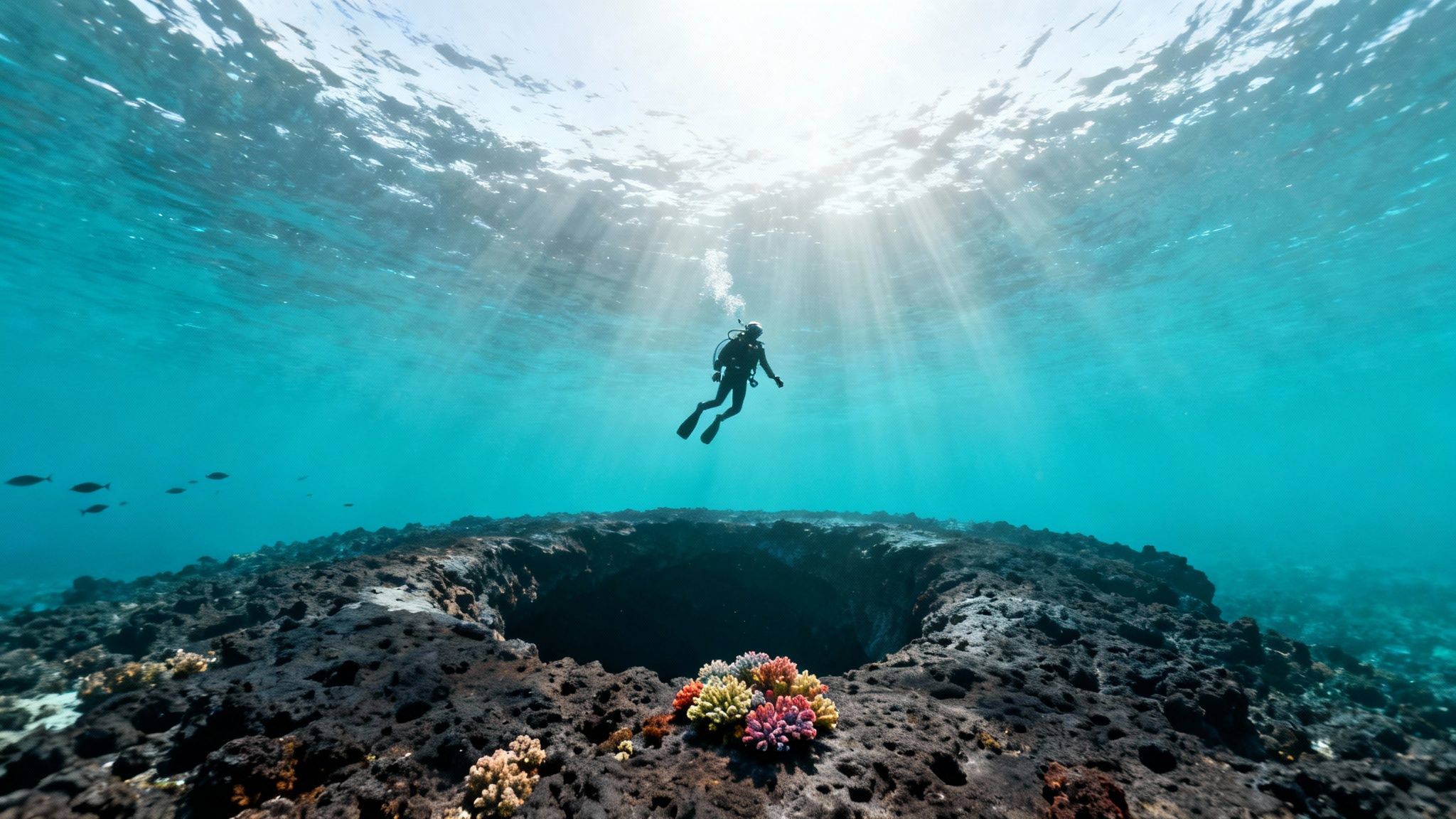
This guide is your step-by-step roadmap to becoming a certified diver here in paradise. We'll walk you through everything, from picking the right course to that first unforgettable plunge into the open ocean. Think of it as your pre-dive briefing for one of the greatest adventures you'll ever have.
Earning your scuba certification completely changes how you see the world. You’re no longer just someone looking at the ocean from the beach; you're exploring its hidden canyons, meeting its curious inhabitants, and discovering a sense of freedom you can't find anywhere else.
The Big Island’s Kona coast is a natural fit for new divers. Sheltered on the leeward side, it’s protected from the big ocean swells, which means conditions are almost always calm and clear. It’s the perfect environment for mastering the basics without fighting the waves.
A Big Island scuba diving certification is more than a plastic card—it's a passport to explore the 70% of our planet that lies beneath the waves. It's the beginning of a lifelong journey. We'll cover what to expect, how to plan your trip, and why getting certified right here is an experience you’ll talk about for years.
Why Kona Is an Ideal Place to Learn
The underwater landscape here is incredible, sculpted by thousands of years of volcanic activity. It makes for a seriously dynamic classroom. Many places start you off in a sterile swimming pool, but Kona has shallow, protected coves that feel like natural pools—except they’re already teeming with life. This makes learning the ropes exciting from your very first breath underwater.
Here’s what sets Kona apart for your scuba course:
- Exceptional Visibility: It’s not uncommon for visibility to exceed 100 feet. Seeing everything so clearly makes learning much more comfortable and awe-inspiring.
- Abundant Marine Life: On your training dives, you'll likely meet Hawaiian green sea turtles (honu), clouds of colorful reef fish, and maybe even see a pod of spinner dolphins playing in the distance.
- Year-Round Diving: With warm water and consistently calm seas, any time of year is the perfect time to get certified in Kona.
Here at Kona Honu Divers, our goal is to provide a world-class experience. Our expert instructors live and breathe diving, and their top priorities are your safety and your fun. We keep our groups small for plenty of one-on-one attention, helping you build skills and confidence at your own pace. We're dedicated to making your first underwater breaths the start of a lifetime of adventure. Check out our lineup of diving tours to see what's waiting for you once you're certified.
Choosing Your Scuba Certification Course
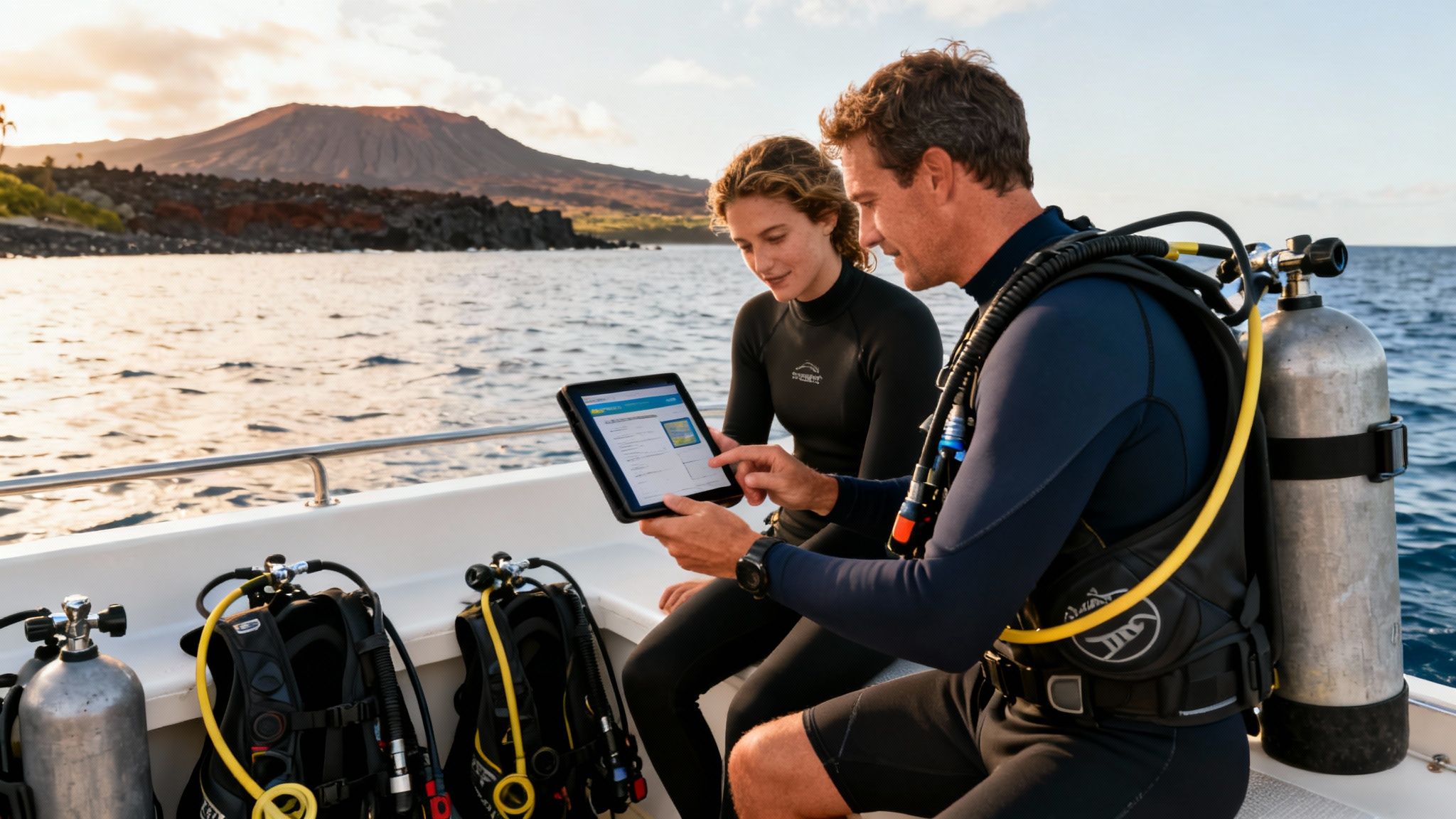
The first real step in your Big Island scuba diving certification adventure is picking the right course and the agency behind it. Here in Hawaii, your main choices will be the two giants of the diving world: PADI and SSI.
Honestly, you can't go wrong with either. Both PADI and SSI certifications are recognized and respected globally, meaning your certification card will work whether you're diving in Kona or the Red Sea. They both have rock-solid safety standards, but their teaching styles differ slightly. One might just click better with how you learn.
PADI vs. SSI: A Quick Comparison
Think of PADI (Professional Association of Diving Instructors) as the "master one thing at a time" approach. You'll learn a skill, practice it until you've got it down cold, and only then move on to the next. It’s a very linear, structured method that a lot of people appreciate.
SSI (Scuba Schools International) takes a more integrated approach. You’ll be introduced to a skill, practice it a bit, then move on to something else before circling back to reinforce what you learned earlier. This repetition is fantastic for building muscle memory and can feel more natural for some learners.
At the end of the day, the agency on your certification card matters far less than the quality of your instructor. Both PADI and SSI train excellent divers. The key is to find a dive shop and an instructor whose vibe matches yours.
To help you decide, here’s a look at how the two stack up on the Big Island.
PADI vs SSI Open Water Certification On The Big Island
| Feature | PADI (Professional Association of Diving Instructors) | SSI (Scuba Schools International) |
|---|---|---|
| Learning Philosophy | Sequential Mastery: You perfect one skill before you're introduced to the next. It's a very clear, step-by-step process. | Repetitive & Integrated: Skills are introduced and practiced in a cycle, reinforcing them over time to build confidence and muscle memory. |
| Course Materials | Student Purchase: You typically buy and own the digital or physical course materials for life. | Free Digital Access: The dive center usually provides free digital access to your course materials when you sign up with them. |
| Instructor Flexibility | Standardized Curriculum: Instructors follow a strict, globally consistent teaching order with very little room for variation. | Flexible Approach: Instructors have more freedom to adjust the sequence of skills based on your progress and the day's conditions. |
Ultimately, the differences are subtle. You'll learn the same critical skills with either agency and come out a safe, competent diver.
Your First Certification: The Open Water Diver Course
No matter which agency you choose, your journey will begin with the Open Water Diver course. This is the foundational certification, your passport to the underwater world.
Once certified, you'll be qualified to dive with a buddy to a maximum depth of 60 feet (18 meters) pretty much anywhere on the planet.
The course is broken down into three simple parts:
- Theory (eLearning): This is all the bookwork—learning the physics, safety rules, and terminology. You’ll almost always complete this online from home before you even pack your bags for Hawaii.
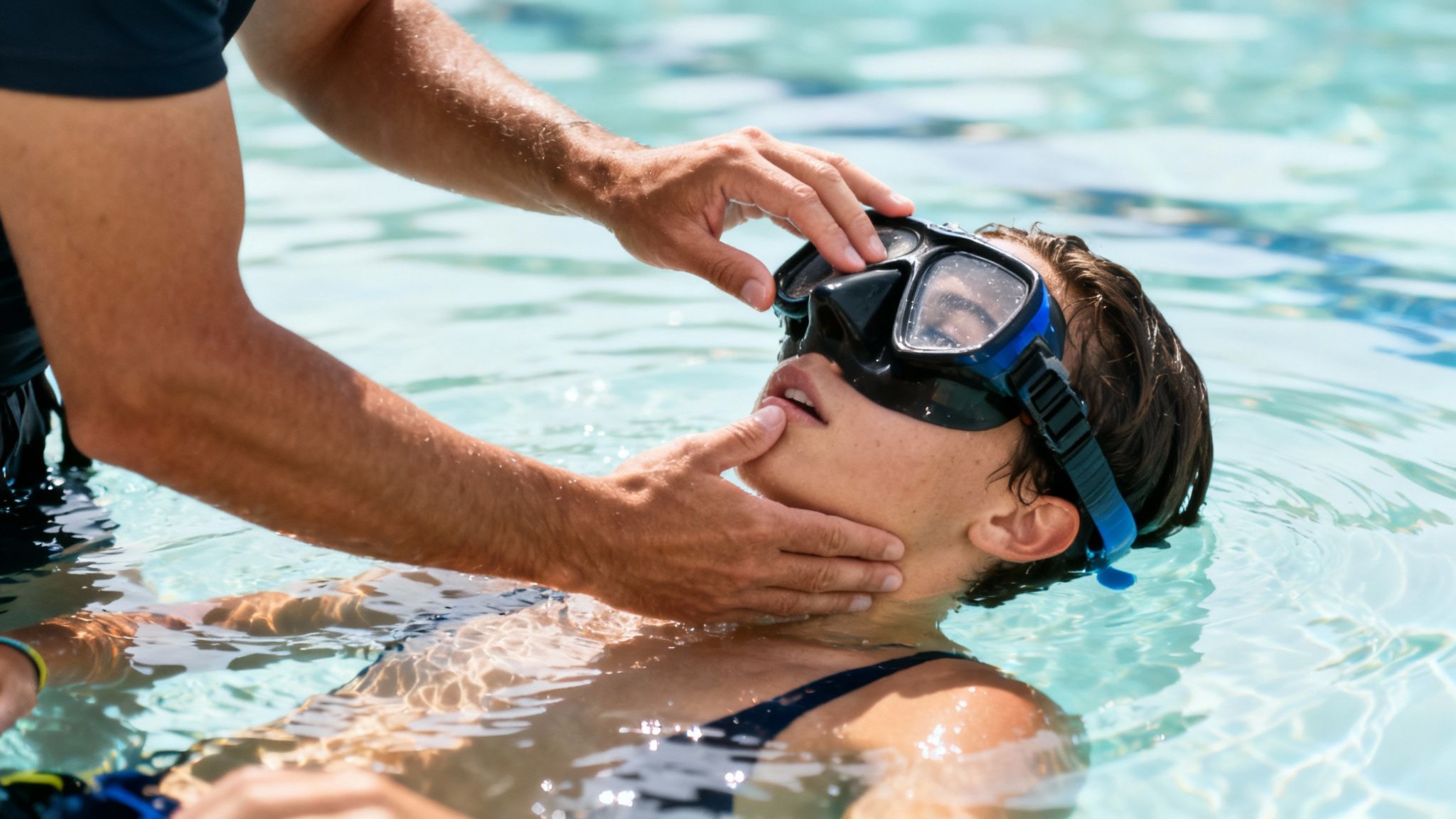
- Confined Water Training: Here’s where you get wet! In a pool or a calm, shallow bay, your instructor will teach you the hands-on skills, from clearing your mask to managing your buoyancy.
- Open Water Dives: This is what it's all about. You’ll complete four dives out in the ocean, putting your new skills to use while exploring Kona’s incredible reefs and seeing all the amazing marine life.
Not Ready for the Full Plunge? Try a Discover Scuba Dive
If you're pressed for time or just want to dip a toe in before committing, the Discover Scuba Diving (DSD) experience is perfect. It's a one-day, non-certification program that lets you experience the magic of breathing underwater with an instructor right by your side.
You won't get a certification card, but you'll get a real taste of what diving is like. A word of warning, though: after one DSD in Kona's beautiful waters, most people get hooked and sign up for the full Kona scuba certification course the first chance they get
Your Certification Journey Step By Step
Getting your Big Island scuba diving certification is a genuinely exciting adventure, and thankfully, it’s broken down into three simple, fun phases. This isn't about rushing you through; it’s a smart, progressive approach designed to build your knowledge and comfort in the water, making sure your first real dives are as safe as they are amazing.
The best part? You can get a head start before your plane even touches down in Hawaii. The first chunk of the course, the "classroom" part, is all done online, at your own pace.
Phase 1: Knowledge Development with eLearning
Think of this as your homework, but way more interesting. Instead of spending precious vacation hours in a stuffy classroom, you’ll knock out all the theory online. The eLearning modules cover the essential principles of diving—the physics of being underwater, how our bodies react, what all the gear does, and crucial safety protocols.
You can chip away at it on your laptop or tablet whenever you have a spare moment. This means when you arrive in Kona, you're not bogged down with theory. You’re ready to get wet and put that knowledge into practice.
Phase 2: Confined Water Training
Now for the fun part: taking your first breaths underwater. This phase happens in a swimming pool or a super calm, shallow ocean spot that feels just like one. With your instructor right there beside you, you'll get fully kitted up and start getting a feel for the equipment in a controlled, stress-free environment.
This is where you master the core skills every diver needs. We’re talking about the absolute essentials:
- Breathing Underwater: Getting into the rhythm of breathing through a regulator. It feels strange at first, then totally natural.
- Mask Clearing: Learning the simple trick to get water out of your mask without surfacing.
- Buoyancy Control: Finding that sweet spot of weightlessness. This is the magic of diving.
- Safety Procedures: Practicing vital skills like sharing air with your dive buddy.
Your instructor will walk you through everything step-by-step, making sure you’re confident and comfortable before you head out into the ocean.
Phase 3: Open Water Dives
This is it—the moment you've been working toward. You'll complete four open water dives in the incredible Pacific Ocean, exploring Kona's famous underwater landscapes. This is where you take everything you learned in the pool and apply it to a real dive scenario, with your instructor still there to guide you.
Each dive builds on the last. You'll put your skills to use while swimming over vibrant coral reefs and ancient lava formations. This is where the theory from your eLearning and the muscle memory from the pool all click into place, creating an unforgettable experience.
The PADI Open Water Diver certification on Hawaii's Big Island is a world-renowned program that has safely introduced millions of people to diving. Local shops typically run the course over 3-7 days. This timeline comfortably fits in 8 hours of pool training and two days for your four ocean dives, fully immersing you in the amazing marine environments around Kona and Hilo. You can explore the details of this globally recognized course structure and what it entails.
A common schedule for your Big Island scuba diving certification often looks something like this:
- Day 1: Getting comfortable in the pool and nailing down your confined water skills.
- Day 2: Your first two ocean dives! You'll explore down to a maximum depth of 40 feet (12 meters).
- Day 3: Your final two ocean dives, where you’ll certify by diving as deep as 60 feet (18 meters).
Once you’ve successfully completed all three phases, you'll officially be a certified Open Water Diver! This isn't just a piece of paper; it’s a lifelong pass to explore the other 71% of our planet. You’ll be ready to join incredible diving tours in Kona and start a lifetime of underwater adventures.
Understanding The Costs And Logistics
Let's talk about one of the first questions on everyone's mind: what is this actually going to cost? It's a fair question, and the good news is that budgeting for your Big Island scuba certification is pretty straightforward. Most reputable dive shops in Kona bundle everything into one price, so you won’t get hit with a bunch of surprise fees later.
Think of the course fee as an all-inclusive package for your training. It’s designed to cover all the essentials from the moment you sign up to the moment you get that shiny new certification card. This way, you can just relax and focus on the important stuff—like learning to breathe underwater and enjoying Kona's incredible marine life.
What's Included in Your Course Fee
When you book a full Open Water Diver course, you're paying for a complete experience. It's not just the dives; it's the entire educational package.
Here’s what you can almost always expect to be covered:
- Expert Instruction: All your time with a certified PADI or SSI instructor during pool sessions and your four open-water ocean dives.
- eLearning Access: The digital "textbook" and quizzes you'll complete at your own pace before you even get on the plane.
- Full Scuba Gear Rental: This is the big stuff—the tank, regulator (what you breathe from), and the BCD vest that helps you float. It's all professionally maintained.
- Certification Processing: The final admin fee to register your certification with the agency and issue your digital or physical card.
Potential Extra Costs to Consider
While the main course fee handles the heavy lifting, there are a couple of other things you might want to budget for. These are mostly personal preference items, not mandatory expenses.
The most common add-ons are what we call "personal gear"—your own mask, snorkel, and fins. You can definitely rent these, but most divers will tell you that having your own well-fitting mask makes a world of difference for comfort. You might also want to set aside a little for gratuities for your instructor and boat crew if they give you a fantastic experience. As you get all your gear together, it helps to follow a stress-free packing list for your adventure to make sure nothing gets left behind.
Typical Price Range for Certification
So, what's the bottom line? For a PADI Open Water Diver certification—the most recognized cert on the planet—you can expect to pay between $659 and $750 on the Big Island.
The lower end, around $659, is typically for a referral course. At the higher end, a full course usually runs about $750 and includes your pool session plus all four ocean dives. There are also separate costs for the eLearning portion (about $246) if you book it directly or add-ons like private instruction for an extra $300. You can learn more about the full cost breakdown to see exactly which option fits your plan.
What is a 'Referral' Course?
A referral is a brilliant time-saver. You do all the classroom work (eLearning) and pool training at a dive shop back home. Then you bring the signed paperwork to us in Kona, and you can jump straight into your four required ocean dives. No vacation time spent in a pool!
For a truly top-tier experience from start to finish, we always point people toward Kona Honu Divers. Their whole team is fantastic, with a perfect blend of professionalism, safety-consciousness, and genuine passion for diving.
Exploring The Best Dive Sites After Certification
Congratulations, you did it! You’re officially a certified scuba diver. That card isn’t just a piece of plastic; it’s your passport to a whole new world waiting just beneath the waves. Your adventure is just getting started.
With your Big Island scuba diving certification in hand, you've unlocked some of the most spectacular and unique dive sites on the planet, right here along the Kona coast. Now the real fun begins. You can finally venture beyond the training spots and experience the volcanic wonders that put Kona on every diver's map.
The World-Famous Manta Ray Night Dive
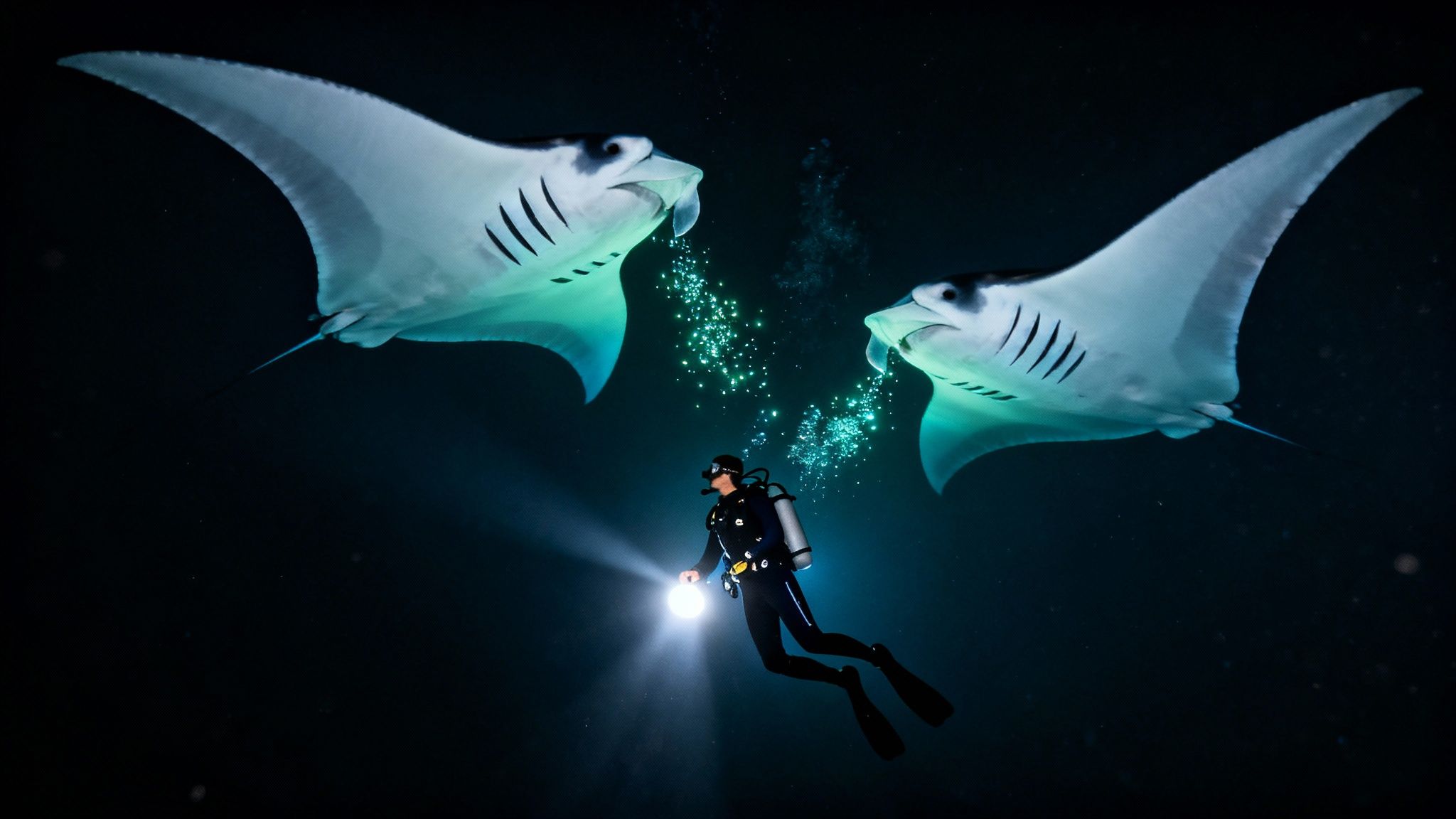
If there's one dive you absolutely have to do, it's the Manta Ray Night Dive. Honestly, words don't do it justice. Picture this: you’re kneeling on the sand in the dark, pointing your flashlight toward the surface. The light attracts plankton, and soon, massive manta rays with wingspans up to 12 feet swoop in, gliding and barrel-rolling just inches above your head. It’s an underwater ballet that will stick with you forever.
While you can do this dive at a couple of spots, the experience at Garden Eel Cove (Manta Heaven) is hands-down the best. The site is more sheltered from ocean swells, which means a calmer, more comfortable dive. More importantly, the underwater landscape creates a natural amphitheater, giving everyone a front-row seat for the show.
These aren't migrating mantas passing through; they're local residents. That means you can have this mind-blowing encounter any time of year, with a sighting success rate that hovers above an incredible 90%.
The Thrilling Kona Blackwater Dive
Feeling adventurous? For a dive that's completely out of this world, you have to try the Kona Blackwater Dive. Forget the reef. On this dive, you’ll be tethered to a line and drifting in the deep, dark open ocean miles offshore, with thousands of feet of water below you.
It's a journey into an alien world. Every night, countless bizarre and beautiful creatures rise from the depths to feed near the surface—the largest migration on Earth. Your light attracts them, revealing see-through squid, strange larval fish, and bioluminescent jellies that pulse with their own internal light. The whole experience feels less like diving and more like floating through deep space.
Daytime Adventures: Lava Tubes and Volcanic Reefs
Of course, your new C-card isn't just for night diving. The Kona coast is famous for its incredible underwater volcanic terrain, which is best explored with the sun shining overhead.
- Lava Tubes and Caverns: Imagine swimming through ancient lava tubes, passing under massive arches, and surfacing inside caverns where sunlight streams through cracks in the ceiling. These sites are a photographer's dream and feel like a true exploration.
- Vibrant Coral Reefs: Kona’s reefs are bursting with life. You'll find yourself surrounded by clouds of yellow tangs, spot shy octopuses tucked into crevices, and swim alongside graceful Hawaiian green sea turtles, or honu.
- Volcanic Pinnacles: Discover underwater pinnacles (pali) that shoot up from the seafloor, completely covered in coral and schooling fish.
Every dive reveals something new. To get a better sense of all the amazing environments you can now visit, take a look at our full guide to the best Kona dive sites.
Ready for the Next Step?
Your Open Water certification is your license to learn, and the journey doesn't have to stop here. As you get more comfortable, you'll naturally want to expand your skills. The Advanced Open Water Diver course is the perfect next step.
Don't let the name fool you; it's less about high-stress skills and more about trying out different kinds of diving with an instructor by your side. You’ll do five "adventure dives," including a deep dive and a navigation dive, and then choose three more that interest you, like night diving or improving your buoyancy. These advanced diving opportunities build your confidence, make you a more capable diver, and open up even more of the ocean to explore.
Frequently Asked Questions
Got questions about getting certified on the Big Island? You're not alone. Here are the answers to the questions we hear most often, designed to help you plan your dive adventure with total confidence.
What Is the Minimum Age to Get Certified?
Future ocean explorers can get started early! For PADI courses, the minimum age for a Junior Open Water Diver certification is just 10 years old. It's a fantastic way for kids to get in on the family's underwater fun.
Divers between 10 and 14 earn a junior certification, which just means they have a few extra safety restrictions, like shallower depth limits. The best part? Once they turn 15, that junior cert automatically upgrades to a standard Open Water Diver certification—no extra training needed.
Do I Need to Buy My Own Scuba Gear?
Nope, you don't need to show up with a truckload of brand-new gear. The cost of your Big Island scuba diving certification course includes the rental of all the essential life-support equipment.
We provide the big-ticket items, including:
- Regulator: The whole setup that lets you breathe easily from your tank.
- BCD (Buoyancy Control Device): The vest that helps you control your position in the water.
- Tank: Your personal supply of fresh, clean air.
- Weights: To help you descend smoothly and achieve that weightless feeling.
That said, most new divers quickly learn the value of owning their own "personal" gear—specifically a mask, snorkel, and fins. A mask that's fitted to your face is a game-changer; it means no annoying leaks and a much more comfortable, enjoyable dive. We can help you get fitted for the right gear right here at the shop.
What if I Have a Medical Condition?
Safety is, and always will be, our number one priority. Before you even touch the water, you'll need to fill out a straightforward medical questionnaire.
It’s just a series of yes/no questions about your health history. If you answer 'yes' to anything on the list, you'll simply need to get a doctor's signature on the form to clear you for diving. It's absolutely crucial to be honest here—it’s for your own safety as well as that of your instructor and dive buddies.
How Long Does My Certification Last?
This is one of the best parts of diving: your Open Water Diver certification is good for life! It never expires. Once you're certified, you've got a permanent ticket to explore the 71% of our planet that's underwater.
That being said, skills get rusty. If it's been a year or more since your last dive, we strongly recommend a quick refresher course. It’s a simple session with an instructor to run through the basics, knock the dust off your skills, and get your confidence back up before you head out on a boat dive.
Think of it like any other skill—you don't forget how, but a little practice helps. To get the full picture on why your card is forever but your skills need a tune-up now and then, check out our guide on how long a scuba diving certification lasts.
Can I Fly Right After Diving?
This is a big one: you absolutely cannot fly right after diving. You need to plan for a mandatory "no-fly" time after your last dive. The official rule from the Divers Alert Network (DAN) is to wait a minimum of 18 hours after your final dive before getting on a plane or even driving to a high altitude (like up Mauna Kea).
This is a non-negotiable safety rule to prevent decompression sickness, a serious condition often called "the bends." It happens when nitrogen absorbed by your body expands too quickly as pressure decreases. Always schedule your flight home with this waiting period in mind so you can wrap up your vacation safely.
Ready to take the plunge? Getting your Big Island scuba diving certification is an experience you’ll never forget, opening up a whole new world to explore for the rest of your life.
For an unforgettable certification experience with expert instructors and a focus on safety and fun, book your course with Kona Honu Divers. Start your underwater journey today!