
Picture this: you descend into warm, turquoise water, so clear it feels like flying. Below you, ancient lava tubes have formed a maze of dramatic underwater canyons and archways. This isn't a scene from a movie—it’s just what a typical day of Big Island scuba diving looks like. The Kona coast, in particular, is a world-renowned sanctuary for divers, promising unforgettable adventures in its calm, life-rich waters.
Welcome to Kona, an Underwater Paradise
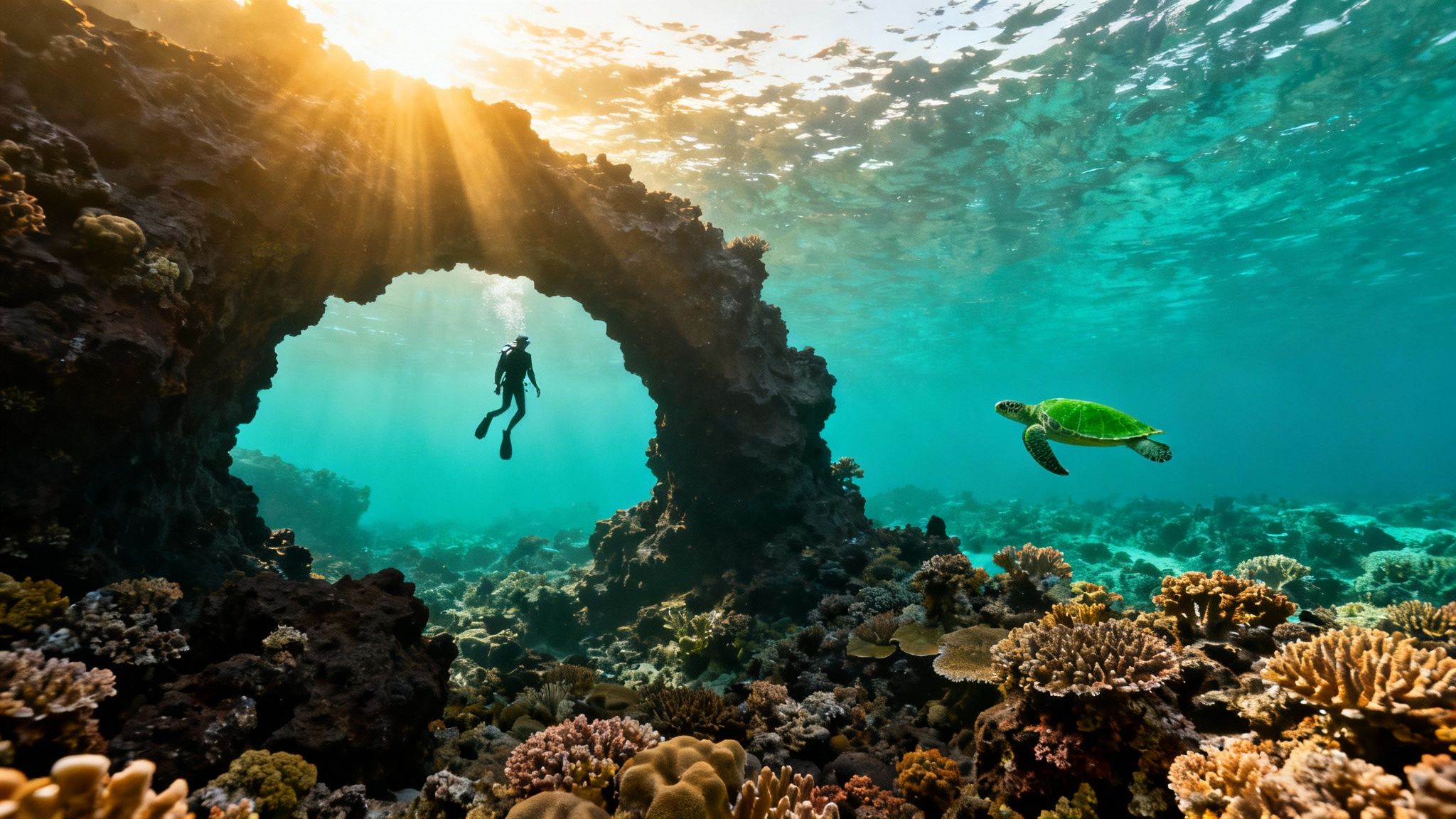
The moment you slip beneath the waves, you’re in a different world. Kona's leeward shores are naturally protected from the open ocean's rougher swells, which results in exceptionally calm and clear conditions. It’s the perfect playground for divers of every experience level.
What really sets this place apart is the geology. The same volcanic forces that shaped the island created a stunning subaquatic landscape. As a diver, you get to explore intricate lava tubes, glide through majestic archways, and drift along dramatic drop-offs that are home to an incredible cast of marine characters.
Discover a World of Marine Life
Kona's reefs are like bustling underwater cities, home to countless aquatic species. You’ll find yourself swimming alongside some of Hawaii’s most famous residents.
- Honu (Green Sea Turtles): It's an amazing feeling to watch these gentle giants glide effortlessly through the water or find them resting peacefully on the reef.
- Spinner Dolphins: Don't be surprised if a playful pod of spinner dolphins greets your dive boat—they’re known for putting on a fantastic acrobatic show.
- Vibrant Reef Fish: The coral gardens are a kaleidoscope of color, teeming with everything from bright yellow tangs to the unmistakable Moorish idol.
The Big Island has rightfully earned its spot as a global hub for scuba tourism, drawing over 100,000 diving visitors each year. Its reputation is built on two things: incredible water clarity that often exceeds 100 feet and a unique volcanic seascape that fascinates everyone from first-timers to seasoned pros. You can read more about what makes Big Island scuba diving so special on konahonudivers.com.
Whether your dream is the world-famous manta ray night dive or just a peaceful day exploring pristine coral reefs, Kona delivers a true bucket-list experience. Get ready to see for yourself why this corner of Hawaii is a top-tier destination for underwater exploration by exploring diving tours today.
Why Kona Diving Is a World-Class Experience
So what is it that really makes Big Island scuba diving a bucket-list destination for divers around the globe? It’s not just one thing, but a unique combination of geology and geography that creates something truly special. The secret to Kona's underwater magic lies with two massive volcanoes, Mauna Loa and Hualalai, which act as a natural shield for the coastline.
These colossal mountains block the powerful trade winds that batter other parts of Hawaii. This creates a calm leeward side where the ocean is almost always gentle and clear. For us divers, that translates to incredible, reliable conditions year-round, with calm seas and visibility that often stretches past 100 feet. It’s like Mother Nature built a perfect, protected playground just for us.
An Underwater Volcanic Playground
The calm water is just the beginning. The island's volcanic past has sculpted an underwater world unlike anywhere else on Earth. Ancient lava flows have created a dramatic and complex sub-aquatic architecture that you have to see to believe.
This isn't just a pretty backdrop; it’s a living, breathing ecosystem. The nooks, crannies, and caves formed by the lava provide the perfect home for a staggering amount of marine life, making every dive feel like a treasure hunt.
As you explore this incredible world, you'll swim through:
- Intricate Lava Tubes: Imagine gliding through natural tunnels and caverns that were once rivers of molten rock. They’re now peaceful sanctuaries for all sorts of fascinating critters.
- Dramatic Drop-Offs: There's nothing quite like the feeling of floating alongside a massive underwater cliff that plummets into the deep blue abyss. It’s a truly humbling experience.
- Caves and Archways: You can discover hidden grottos and swim through majestic arches, which make for some seriously epic photo opportunities.
This blend of crystal-clear conditions and one-of-a-kind volcanic topography is what makes diving in Kona so consistently amazing. It’s a paradise where brand-new divers and seasoned pros can both find their bliss, and it's why so many of us come back year after year.
Ready to see what all the fuss is about? At Kona Honu Divers, we have a whole range of diving tours designed to show you the very best of Kona’s underwater world. Our guides know these waters like the back of their hand and can’t wait to show you their favorite spots.
The Unforgettable Manta Ray Night Dive
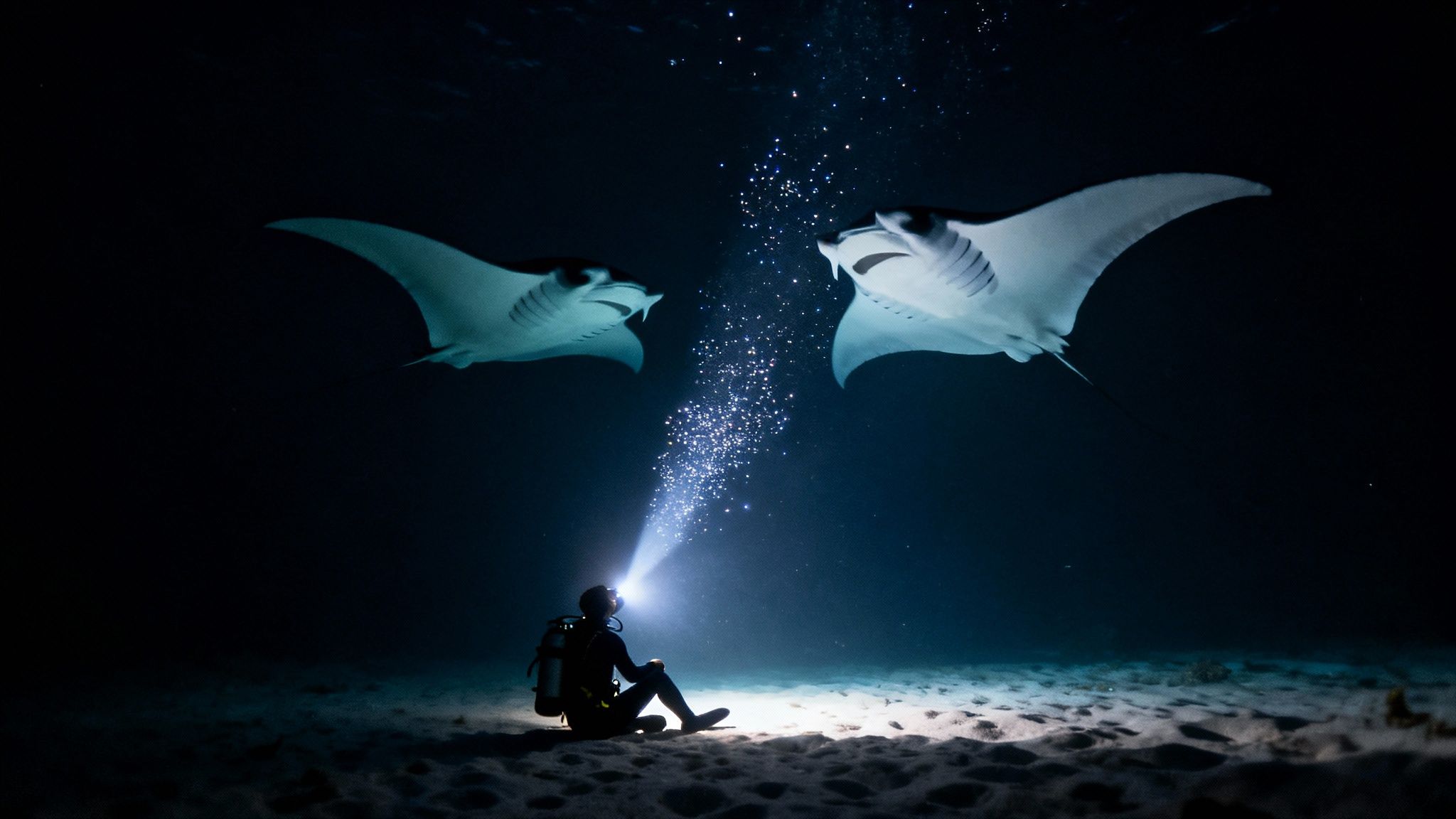
There’s one dive on the Big Island that everyone talks about, and for good reason. It’s the kind of experience that stays with you forever. Imagine dropping into the dark, quiet ocean just after sunset. You find your spot on the sandy bottom, aim your light toward the surface, and just… wait.
Then, out of the black, a massive shadow appears. It glides effortlessly into the light, followed by another, and then another. This is the world-famous manta ray night dive, the absolute signature adventure of Big Island scuba diving.
These aren't just fish; they're gentle giants, some with wingspans stretching over 12 feet. They perform a silent, graceful ballet just inches from your face, swooping and barrel-rolling through the light beams. Their cavernous mouths are wide open to filter the clouds of plankton drawn to the light. It's more than a dive; it's a powerful, almost spiritual moment with one of the ocean's most incredible animals. People come from all over the world for this, and Kona is simply the best place on Earth to experience it.
The Science Behind the Spectacle
So, how did this incredible underwater show even start? It's a fantastic example of a simple ecological connection. For years, lights from waterfront hotels would shine into the water, attracting swarms of tiny plankton—a manta's favorite food. The local mantas quickly learned that light meant a free meal, and an entirely new diving experience was born.
Today, we recreate this phenomenon in a way that's both controlled and respectful to the animals. Here’s how it works:
- A "Campfire" of Light: Our divers and snorkelers use powerful, eco-friendly lights, pointing them upward to create an irresistible beacon.
- The Plankton Buffet: This bright light attracts huge clouds of microscopic plankton, concentrating them into a floating feast.
- Ringing the Dinner Bell: The local reef mantas, who call the Kona coast home, see the lights and know it's time for their nightly meal.
This reliable feeding pattern has made the manta dive an incredibly consistent attraction and a cornerstone of Hawaii's tourism. While you can never 100% guarantee a wildlife sighting, the peak season from May to September sees success rates around 85%. It's not uncommon for divers to be surrounded by several rays on a single dive.
Your Front-Row Seat to Nature's Grandest Show
Getting in on this amazing experience is probably easier than you think. The excitement begins the moment you step onto the boat for a sunset cruise to the dive site. Before you hit the water, your expert guides at Kona Honu Divers will give you a full briefing. They'll cover everything you need to know, especially how to interact passively and safely with the mantas to protect both them and you.
If you want a deeper dive into what the trip involves, check out our complete guide to the Kona Manta Ray Night Dive. You can also book one of our top-rated manta ray dive tours to secure your spot.
Our team has this trip dialed in, making sure every diver has a magical, safe, and truly unforgettable night. But don't just take our word for it—see what other divers have to say about their own experiences.
Exploring Dive Sites Beyond the Mantas

The manta ray night dive is an absolute showstopper, no doubt about it. But think of it as the headliner for an incredible festival—there's so much more to see and do. The real magic of Big Island scuba diving unfolds when you start exploring the dozens of other world-class sites peppered along the Kona coast.
Once you venture beyond the mantas, you’ll discover an underwater playground carved by ancient volcanoes. We're talking dramatic lava tubes, stunning arches, and reefs absolutely teeming with life. Each spot tells a different story. To get a feel for the sheer variety, check out the incredible Kona dive sites Kona Honu Divers will take you to.
Lava Tubes and Turtle Hangouts
One of the coolest things about diving in Kona is navigating the underwater architecture left behind by ancient lava flows. These aren't just piles of rocks; they're magnificent natural sculptures that form breathtaking swim-throughs and tunnels.
A classic example is Golden Arches. As the name suggests, it’s famous for its majestic lava archways. Gliding through these feels like you’re exploring a submerged cathedral, with shafts of sunlight piercing the water from above. It’s also a great place to spot well-camouflaged frogfish, reef sharks, and the beloved Hawaiian green sea turtles, or honu.
Speaking of turtles, another can't-miss spot is Turtle Pinnacle. This site acts as a natural "cleaning station," where turtles gather to let smaller reef fish pick algae and parasites right off their shells. It’s an amazing chance to see these gentle giants completely at ease—a truly unforgettable experience.
Kona's Must-See Dive Sites
To give you a better idea of what's out there, here's a quick rundown of some of the most popular dive sites along the Kona coast and what makes each one special.
| Dive Site | Key Features | Common Marine Life |
|---|---|---|
| Golden Arches | Stunning lava tube arches and swim-throughs. | Frogfish, reef sharks, eels, honu (sea turtles). |
| Turtle Pinnacle | A natural cleaning station for sea turtles. | Dozens of turtles, butterflyfish, wrasses. |
| Suck 'em Up | A lava tube with a surge that "sucks" you in/out. | White-tip reef sharks, unique invertebrates, nudibranchs. |
| Au Au Crater | A collapsed lava dome with a crater-like shape. | Large schools of fish, eagle rays, garden eels. |
| Naked Lady | A dive boat wreck and surrounding reef. | Frogfish, moray eels, octopus, occasional manta rays. |
Each site offers a unique adventure, showcasing just how diverse the underwater landscape is here. From geological wonders to wildlife hotspots, there's always something new to discover.
The Ultimate Night Dive: Kona Blackwater
For divers who are truly up for anything, there's an experience that pushes the boundaries of night diving: the Kona Blackwater Dive. Forget the reef. This dive takes you miles offshore into the deep, open ocean, where you'll be suspended over thousands of feet of water while safely tethered to the boat.
The Blackwater Dive is often called a trip into inner space. You're floating in the dark, watching a nightly vertical migration as some of the ocean's most bizarre and beautiful creatures rise from the abyss to feed near the surface.
You will encounter life forms that look like they're from another planet:
- Bioluminescent Jellies: Pulsing with their own otherworldly light.
- Larval Creatures: See the transparent, juvenile stages of eels and fish.
- Pelagic Cephalopods: Meet squid and octopuses that spend their entire lives in the open ocean.
It’s a surreal and mesmerizing dive that offers a rare peek into a hidden world. If you're ready to see what comes up from the deep, you can book a Kona Blackwater Dive tour and witness the magic firsthand. For those seeking other thrilling challenges, Kona Honu Divers also runs a dedicated advanced dive tour to explore deeper sites with more complex terrain.
How to Get Your Scuba Certification in Hawaii
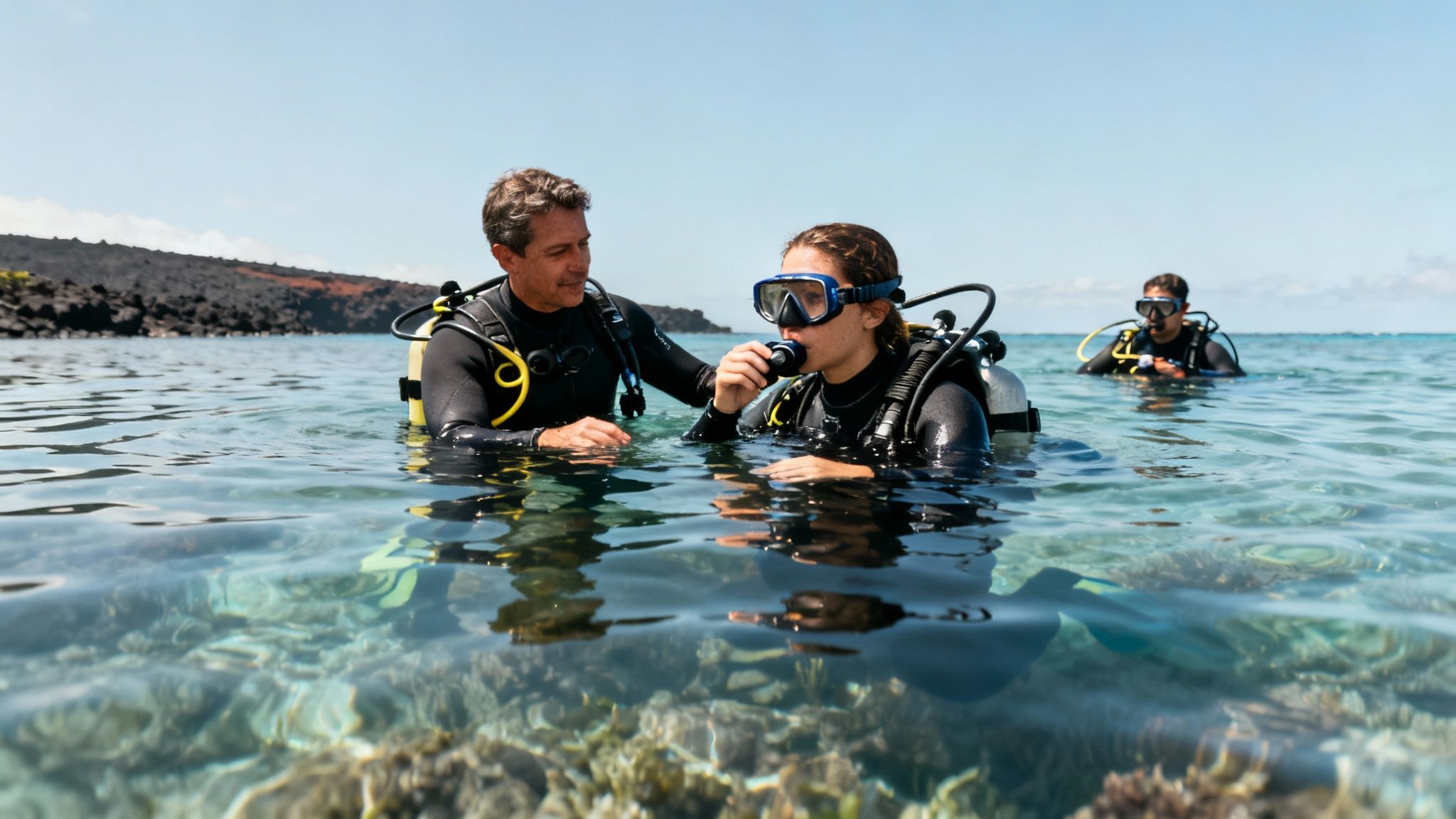
If you’ve ever imagined what it feels like to breathe underwater, there's no better place to find out than the warm, clear, and calm waters off the Kona coast. For a lot of people, the idea of getting scuba certified sounds a bit daunting, but the process is actually straightforward, safe, and an absolute blast—especially when your "classroom" is a vibrant Hawaiian reef.
Professionalism and safety are the absolute bedrock of Big Island scuba diving. The entire industry is well-regulated, which has led to an incredible safety record. Between 2009 and 2018, for example, scuba diving fatalities in Hawaii averaged just 2.8 deaths per year. That's a tiny number, especially when you compare it to snorkeling incidents, and it really shows how effective professional training and strict safety measures are. You can read more about Hawaiian water safety statistics on divernet.com.
Your First Steps Underwater
Not quite ready to commit to a full course? No problem. The perfect way to dip your toes in the water is with a Discover Scuba Diving (DSD) experience. Think of it as a test drive. It’s not a certification, but a guided introduction that lets you try out scuba gear and explore a real reef under the direct supervision of an instructor.
Here’s what a DSD usually involves:
- A quick and easy lesson on basic scuba safety and how the gear works.
- Practicing a few key skills in calm, shallow water until you feel comfortable.
- A real dive on a beautiful reef, typically no deeper than 40 feet, with your instructor right by your side.
This "try before you buy" approach is the best way to build some confidence and see if you fall in love with the underwater world.
Earning Your PADI Open Water Certification
If you get hooked after that first taste of diving (and trust us, most people do), the next step is the full PADI Open Water Diver certification. This is your global passport to underwater exploration, recognized everywhere you go. Learning in Kona gives you a massive head start; the conditions are so good that you’ll finish the course feeling like a natural.
The PADI Open Water course is all about turning you into a competent, self-reliant diver. It’s a mix of theory, skill practice in a controlled setting, and four real ocean dives where you bring it all together.
The whole process is broken down into three manageable parts:
- eLearning: You can knock out all the bookwork online from your couch before you even pack for Hawaii. This saves a ton of precious vacation time.
- Confined Water Dives: We find a calm, pool-like spot in the ocean where you'll get comfortable with essential skills, like clearing water from your mask or perfecting your buoyancy.
- Open Water Dives: This is where the real fun begins. You'll complete four dives on some of Kona's stunning reefs, showing off your new skills while exploring with your instructor.
Ready to take the plunge? We offer world-class instruction and will be with you every step of the way. Find out more about our PADI Open Water certification in Hawaii and start your adventure today.
Planning Your Big Island Dive Adventure
Alright, let's get you from dreaming about diving the Big Island to actually doing it. The good news is, it’s a lot simpler than you might think. With just a bit of forethought, you can make sure your trip is nothing but incredible underwater memories. And since Kona’s conditions are fantastic year-round, you really can’t pick a bad time to visit.
If there’s one piece of advice I can give you, it's this: book your dives ahead of time. I can't stress this enough, especially for the world-famous manta ray night dive. Those spots get snapped up weeks, sometimes months, in advance. Locking in your reservation early means you get to kick back and just get excited for the trip.
Gearing Up for Your Trip
You’ve got your certification card and your favorite swimsuit, but what else should you bring? While we take care of all the heavy lifting with professionally maintained scuba gear, there are a few personal items that will make your day on the water much better.
- Reef-Safe Sunscreen: This is a big one. It protects you and it protects the delicate coral we all love.
- A Reusable Water Bottle: Diving is thirsty work! Stay hydrated and help us keep the island beautiful by cutting down on plastic.
- A Towel and a Dry Bag: Simple, but essential. You’ll want a dry towel after a dive, and a dry bag keeps your phone and keys safe on the boat.
- Your Logbook: You’re going to see some amazing things down there. You’ll want to remember every detail!
Getting inspired for your trip is part of the fun. It's that same sense of excitement and preparation you see in people who undertake daring water adventures like paddleboarding from Mallorca to Ibiza. Bringing that spirit is what turns a good trip into an unforgettable one.
So, what’s a typical day with us look like? You’ll be welcomed aboard one of our comfortable boats by our crew. We’ll run through a clear safety briefing, head out to two amazing and distinct dive sites, and have plenty of snacks and drinks for you in between. Our guides handle everything, so all you have to do is enjoy the ride.
A little planning goes a long way. It’s the difference between a good vacation and a truly epic Big Island scuba diving adventure.
Your Kona Scuba Diving Questions, Answered
Planning a dive trip to the Big Island can bring up a lot of questions. Here are a few of the most common things people ask us before they arrive, with answers straight from our local experts.
What’s the Best Time of Year to Dive in Kona?
Honestly, there’s no bad time to dive here. Kona's secret weapon is its geography. The massive volcanoes on the Big Island shield the Kona coast from the trade winds, which means we get calm, clear water pretty much year-round.
Water temperatures are always comfortable, hovering around 75°F (24°C) in the winter and warming up to a lovely 82°F (28°C) in the summer. And while we see manta rays all the time, they tend to gather in even larger numbers from May through September.
Do I Need to Be Certified to Go Scuba Diving?
To join one of our regular boat dives, you'll need at least an Open Water certification (or an equivalent from another agency).
But if you're not certified, don't worry—you can absolutely still get in the water! Our Discover Scuba Diving experience is designed for beginners. It starts with a quick and easy lesson, followed by a shallow dive in the ocean with an instructor right by your side.
The incredible underwater world of Kona is open to just about everyone. Whether you're an experienced diver with hundreds of log entries or you're about to take your very first breath underwater, we have an adventure waiting for you.
Besides Manta Rays, What Else Will I See?
Kona's reefs are absolutely buzzing with life! On almost any given dive, you can expect to see Hawaiian green sea turtles (honu) gliding by, pods of playful spinner dolphins, and a kaleidoscope of reef fish—like butterflyfish, triggerfish, and parrotfish.
Look a little closer, and you might spot some of the reef's masters of camouflage, like frogfish and octopuses, or find a moray eel peeking out from its home. If you're here in the winter months (December-March), you might even be treated to the hauntingly beautiful songs of migrating humpback whales echoing through the water.
Ready to see it all for yourself? Let Kona Honu Divers show you why we think this is the best diving on earth. Take a look at our full lineup of diving tours and find the one that’s calling your name.