
Picture this: You're descending into crystal-clear water, the sun's rays dancing through the surface as you drift over a landscape shaped by volcanoes. This isn't just any dive—this is Big Island scuba diving, an experience defined by dramatic underwater lava tubes, ancient craters, and unforgettable encounters with majestic marine life.
The Kona coast, in particular, is a diver's dream. It offers some of the best diving conditions in all of Hawaii, thanks to calm, warm waters that make it a top-tier destination for divers of every skill level.
Your Essential Guide to Big Island Scuba Diving

Welcome to your deep dive into the underwater world of the Big Island. Here, ancient lava flows have sculpted a subterranean playground of arches, caves, and vibrant reefs bursting with life. From the protected coral gardens of Kealakekua Bay to the thrilling abyss of a blackwater dive, the Big Island serves up aquatic adventures you won't find anywhere else.
This guide is your compass for navigating the best the island has to offer. We'll explore the premier dive sites, share the secrets behind its most iconic marine encounters (hello, manta rays!), and give you the practical tips needed to plan your trip. Our mission is to get you ready for the incredible moments that await just beneath the waves.
What Makes Big Island Diving So Special?
The secret to Kona's incredible diving lies in its geography. The coast is shielded from the powerful trade winds by massive volcanoes, which creates remarkably calm and predictable conditions. This unique setup results in visibility that often clears 100 feet, letting you soak in every detail of the stunning underwater scenery.
Think of this guide as your personal divemaster. We'll cover everything from must-see spots to choosing the right operator. A great place to start is with a PADI 5-Star rated center like Kona Honu Divers, known for their focus on safety, small group sizes, and fantastic customer service. You can check out their diverse diving tours to see what kind of adventures are possible.
To give you a snapshot of what awaits, here’s a quick look at why divers from all over the world flock to these waters.
Big Island Scuba Diving At a Glance
This table gives a quick summary of the key features that make the Big Island an unforgettable scuba destination.
| Feature | Description | Best For |
|---|---|---|
| Manta Ray Night Dive | The world-famous dive where giant mantas glide overhead, feeding on plankton. | All certified divers; truly a "must-do." |
| Volcanic Topography | Underwater lava tubes, dramatic arches, and craters from ancient volcanoes. | Explorers and underwater photographers. |
| Exceptional Visibility | Consistently clear water, often exceeding 100 feet, especially along the Kona coast. | Divers who appreciate pristine conditions. |
| Rich Marine Life | A high concentration of endemic species, plus turtles, sharks, eels, and dolphins. | Anyone who loves marine life and nature. |
This table highlights the Big Island's unique offerings, but every dive here holds the potential for a new discovery.
While we're focused on the specifics of the Big Island, you can also explore some general insights into water sports and scuba diving to get a broader perspective on the activity.
Why The Big Island Offers Unforgettable Dives
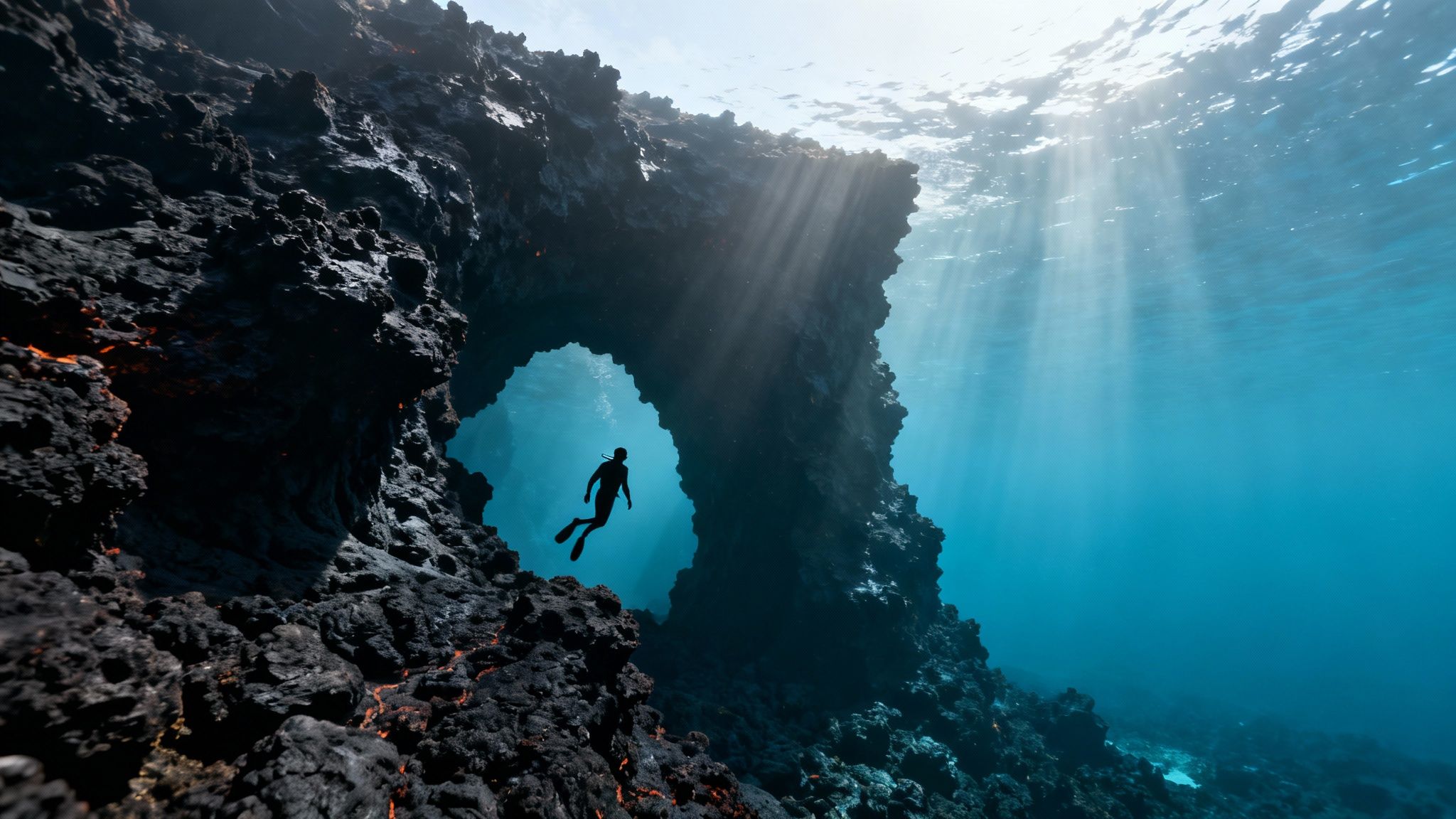
What makes a dive truly unforgettable? It's that perfect mix of jaw-dropping underwater scenery, vibrant marine life, and incredible conditions. That's exactly what Big Island scuba diving delivers, all thanks to a unique blend of geology and geography that creates a diver’s paradise.
The island’s story is literally written in lava, and that tale continues well below the surface. Ancient volcanic eruptions have carved out a dramatic seascape you won't find anywhere else. Imagine gliding along a sheer underwater cliff, exploring a massive lava tube, or swimming through a natural archway forged by molten rock.
This volcanic foundation is the secret to the island's world-class diving.
A Playground Forged by Fire
Forget the flat, sandy bottoms you might see elsewhere. The seafloor off the Kona coast is a dynamic, three-dimensional playground that provides the perfect habitat for a thriving ecosystem.
This complex topography, with its intricate lava tubes and rock formations, shelters an amazing diversity of marine life. It's not uncommon to spot Galapagos sharks or white tip reef sharks patrolling these ancient structures.
Every dive offers a new chance for discovery.
- Lava Tubes and Caves: These incredible swim-throughs and hidden grottos are where you’ll often find nocturnal creatures resting during the day.
- Pinnacles and Craters: Underwater volcanic cones rise from the depths, acting as magnets for massive schools of fish.
- Dramatic Drop-Offs: The island’s steep underwater cliffs plunge into the deep blue, making for some truly breathtaking wall dives.
An Isolated Oasis of Life
The Hawaiian Islands are one of the most isolated places on Earth. This remoteness has led to a fascinating evolutionary path for the local marine life. In fact, a huge percentage of the reef fish you'll see while diving the Big Island are endemic—they can’t be found anywhere else in the world.
The result is a dive trip filled with one-of-a-kind encounters. From the vibrant Hawaiian cleaner wrasse to the beautifully patterned Milletseed butterflyfish, you're constantly spotting species that exist only in this Pacific paradise.
You aren’t just looking at fish; you’re looking at Hawaii's fish. That high concentration of endemic species makes every single dive feel special.
Perfect Conditions Nearly All Year
Beyond the stunning terrain and unique wildlife, the Big Island serves up some of the most reliable and comfortable diving conditions you could ask for. This is especially true on the Kona coast, which is shielded from strong trade winds by the island's massive volcanoes.
This natural protection gives us consistently calm seas and phenomenal visibility that often tops 100 feet. The water temperature stays in a perfect 75-80°F (24-27°C) range all year long, so it's always a good time to get in the water. For a closer look at the timing, check out our guide to the best months to scuba dive in Hawaii.
And from December through March, there's an extra layer of magic. Divers are often treated to the haunting songs of migrating humpback whales echoing through the water—a powerful, underwater soundtrack that turns a great dive into a memory you’ll never forget.
Exploring The Top Big Island Dive Sites

Alright, let's talk about where you'll actually be blowing bubbles. The Big Island is sprinkled with incredible dive sites, each with its own personality. You've got everything from calm, protected bays bursting with fish to dramatic underwater canyons carved from ancient lava flows.
We’ll start with the most famous spot on the Kona coast and then explore a few other must-see locations. Every one of these sites gives you a unique window into why Big Island scuba diving is truly world-class.
Kealakekua Bay Marine Sanctuary
If there's one place you absolutely have to dive, it's Kealakekua Bay. It's the crown jewel, and for good reason. As a protected marine sanctuary, the place is just teeming with life. Fishing is completely off-limits, so the fish populations have exploded.
The conditions are usually fantastic, too. We’re talking crystal-clear water where it's not uncommon to have visibility well over 100 feet. You can see every detail of the vibrant coral gardens and the massive schools of fish that call this bay home.
It’s also the spot where Captain Cook first landed in Hawaii, so there’s a ton of history here. Getting to the best parts of the bay requires a boat, which is great because it helps keep the area pristine and uncrowded.
Golden Arches and Turtle Pinnacle
Moving along the coast, you'll find "Golden Arches," a site that’s a real favorite among local divers. It gets its name from the magnificent lava rock archways you can swim right through. There's nothing quite like gliding under a massive natural arch, watching the sunlight dance through the water from above.
The site is also a hotspot for marine life. You’ll often see schools of soldierfish hiding in the shadows of the arches, and it's a perfect place to hunt for eels and octopuses tucked away in the volcanic rock.
Just a quick boat ride from there is a spot we call "Turtle Pinnacle." This is a natural cleaning station for our beloved Hawaiian green sea turtles, or honu. You can hover back and watch as turtles patiently let smaller fish clean algae and parasites off their shells. It's an incredible behavior to witness up close.
Au Au Crater and Advanced Dive Sites
For a dive site that feels like you're on another planet, you have to check out "Au Au Crater." This is a massive, submerged volcanic crater that creates a seriously dramatic underwater landscape. You can explore along the crater's rim as it plummets into the deep blue or investigate the wild lava formations inside.
The structure of the crater acts like a magnet for marine life. We often see huge schools of fish, eagle rays cruising by, and even the occasional shark patrolling the deeper water. If you want to see even more of the sites we visit, check out this list of locations Kona Honu Divers will take you to when you dive the Big Island.
Now, for those of you with a few more dives under your weight belt, the Big Island has plenty to offer. The advanced sites often mean dealing with currents, deeper profiles, or navigating through complex lava tubes. The reward? Unique encounters and reefs that you'll have almost to yourself.
- Deeper Pinnacles: These are underwater mountains that rise from the seafloor, attracting bigger pelagic species from the open ocean.
- Drift Dives: Let the current do the work as you effortlessly fly over long stretches of beautiful reef.
- Complex Lava Tubes: Test your buoyancy and awareness as you navigate through intricate swim-throughs formed by ancient lava flows.
These dives are an absolute thrill, but they demand solid skills. If you're an experienced diver looking for that next-level adventure, we run specialized charters designed to explore these more challenging and rewarding locations. Check out our premium advanced dive tour for more information.
Experience The Magic of Manta and Blackwater Dives

While the Big Island’s daytime dives are absolutely world-class, the real magic truly begins after the sun sets. The Kona coast is home to two of the most unique and unforgettable night dives you'll find anywhere on the planet. These aren't just your standard reef dives in the dark; they are otherworldly experiences that will completely redefine what you think Big Island scuba diving can be.
First, you have the world-famous Manta Ray Night Dive, a spectacle so breathtaking it's consistently ranked as one of the best dives in the world. Then, for the truly adventurous soul, there's the Blackwater Dive—a journey into the deep open ocean to meet an alien world of strange, bioluminescent creatures.
Let's shed some light on these two incredible nocturnal adventures.
The Underwater Ballet of the Manta Ray Night Dive
Picture this: you descend to a sandy patch on the ocean floor, about 30-40 feet down, just as the last bits of daylight fade from the surface. Your guide sets up a "campfire" of powerful lights in the middle of the group, pointing them straight up. The beams cut through the dark water, attracting clouds of microscopic plankton—the manta rays' favorite meal.
And then, you wait. Before long, a massive, shadowy figure glides silently into the light. Then another, and another. These are Kona’s gentle giants, some with incredible wingspans exceeding 12 feet.
What happens next is pure, unadulterated magic. The mantas perform a graceful underwater ballet, swooping, gliding, and barrel-rolling just inches above your head as they feed on the plankton. It’s a mesmerizing and humbling experience that feels completely surreal. You’re not just an observer; you become part of their world.
The whole encounter is carefully structured to be safe for everyone—divers, snorkelers, and especially the mantas.
- For Divers: You’ll kneel or sit on the ocean floor, creating a stable, arena-like setting that allows the mantas to maneuver safely above you.
- For Snorkelers: You get a top-down view, holding onto a custom floating raft on the surface with lights shining down into the water, watching the same incredible show.
- For the Mantas: We follow strict guidelines, like never touching the animals, to protect the delicate mucous coating on their skin and ensure these encounters remain sustainable for generations.
This isn't just a dive; it's a profound connection with one of the ocean's most majestic creatures. The sheer grace and size of the mantas, set against the dark ocean, creates a memory you will carry with you forever.
Ready for the show of a lifetime? Kona Honu Divers offers an incredible Manta Ray Dive and Snorkel tour that gives you a front-row seat to this amazing spectacle.
A Journey Into the Abyss: The Blackwater Dive
If the Manta Ray Dive is a beautiful ballet, the Blackwater Dive is a trip to another dimension. This is easily one of the most unique and advanced dives you can do anywhere, and it’s a true Big Island specialty. The concept is simple but profound: at night, the boat takes you miles offshore where the ocean bottom is thousands of feet below.
You drift in the pitch-black open ocean, tethered to the boat at a depth of about 50 feet. It might sound a little intimidating, but what you’re about to witness is one of the largest migrations on Earth. Every single night, countless bizarre and fascinating creatures rise from the crushing depths to feed near the surface.
You will see things that look like they were pulled straight from a sci-fi movie:
- Bioluminescent Ctenophores: Pulsating with rainbow-colored lights as they drift past.
- Translucent Squids: Revealing intricate patterns and glowing internal organs.
- Larval Creatures: Tiny, alien-like organisms in their earliest stages of development.
This is not a reef dive. There is no bottom to see. It’s a sensory experience focused entirely on the strange, tiny, and often glowing life that forms the very foundation of the ocean’s food web. To get a better sense of this wild adventure, you can learn more about the Kona Blackwater Dive.
This dive is for experienced divers who are comfortable with night diving and have excellent buoyancy control. If you’re ready for a challenge that rewards you with a glimpse into a hidden world, book your spot on Kona Honu Divers' Blackwater Dive tour and prepare to see things few people ever will.
How To Choose The Right Kona Dive Operator
Picking the right dive operator for your Big Island scuba diving trip is probably the single most important choice you'll make. It’s the difference between just getting wet and having a truly incredible experience. A great shop doesn't just take you to a dive site; they ensure you're safe, comfortable, and see the very best of what Kona has to offer.
So, with a few solid choices along the coast, how do you find the perfect fit? This is about more than just booking a spot on a boat. You're looking for a team you can trust, gear that works flawlessly, and guides who know the local reefs like the back of their hand.
What Makes a Dive Shop Stand Out?
When you start comparing dive operators, a few things should be non-negotiable. These are the details that separate the great shops from the good ones and give you peace of mind from the moment you book.
Here's what I always look for:
- Safety Record & Credentials: A PADI 5-Star rating is a big deal. It tells you the shop meets the absolute highest standards for safety, training, and professionalism. A flawless safety record is everything.
- Small Group Sizes: This is a total game-changer. Smaller groups mean your guide can give you more personal attention, the dive site feels less crowded, and the whole vibe is just more relaxed and fun.
- Gear and Boat Quality: You want modern, well-maintained rental equipment. A comfortable boat with perks like a hot shower, plenty of shade, and an easy way to get in and out of the water makes all the difference on your surface intervals.
- True Local Expertise: Guides who have been diving these waters for years are priceless. They'll point out camouflaged critters you'd swim right past and know exactly where to find the cool stuff based on the day's conditions.
Meet Kona Honu Divers
When you put all that together, one name always seems to come up: Kona Honu Divers. As a PADI 5-Star Instructor Development Center, their commitment to safety and top-tier training is clear. But what really makes them special is their focus on small group sizes, which guarantees every diver gets the personalized experience they deserve.
Their boats are built for comfort, and their guides are some of the most genuinely passionate divers on the island. They aren't just leading a tour; they're sharing their love for Kona's underwater world, and that enthusiasm is contagious.
Of course, don't just take my word for it. Hearing from other divers is the best way to get a feel for a shop.
Other Respected Kona Dive Operators
The Kona coast is lucky to have a whole community of fantastic dive shops. Operators like Big Island Divers and Jack's Diving Locker have also built amazing reputations over the years for their professionalism and dedication to divers.
Big Island Divers is well-known for offering a wide variety of tours on their large, comfortable boat, making them a great option for groups of all sizes.
Jack's Diving Locker is a true Kona institution. They’ve been operating as a PADI 5-Star IDC dive center since 1981, making them a cornerstone of the local dive scene. With decades of experience, they offer everything from beginner courses to pro-level training and run a large fleet of boats. They are especially famous for their manta ray night dives, with reports showing divers have an 85-90% chance of seeing mantas on their trips—a testament to Kona's reputation as a world-class destination. You can read more about the Big Island's legendary scuba history and manta encounters here.
At the end of the day, the best shop for you comes down to what you're looking for. But if you focus on operators with a proven safety record, a genuine passion for the ocean, and a commitment to small, personal groups, you're sure to have the Big Island dive trip you've been dreaming of.
Ready to see what’s out there? Explore the incredible diving tours on the Kona coast and find your perfect adventure.
Common Questions About Big Island Scuba Diving
Planning a dive trip somewhere new always brings up a few questions. We get it. To help you get ready for an amazing Big Island scuba diving adventure, we've put together answers to the things we hear most often from fellow divers.
This quick guide should give you the confidence to plan your trip and get the absolute most out of your time in Kona's incredible underwater world.
What Is The Best Time of Year for Scuba Diving On The Big Island?
Honestly, there's no bad time to dive on the Big Island. The conditions here are remarkably consistent all year long. Water temperatures stay in that perfect sweet spot, usually hovering between 75-80°F (24-27°C), no matter when you visit.
If you’re looking for the flattest, calmest seas, the summer months (May to October) are prime time. The water is at its warmest then, which makes it an especially great period if you're a newer diver or just love that glassy ocean surface.
That said, winter (November-April) has its own unique magic. This is when the humpback whales make their annual migration. From December through March, it's pretty common to hear their hauntingly beautiful songs echoing through the water on a dive—an experience that will give you chills. While other parts of the island might see bigger swells in the winter, the Kona and Kohala coasts, where most of the diving happens, stay nicely sheltered and calm.
Do I Need To Be Certified To Go Scuba Diving In Hawaii?
Yes, if you want to join the boat charters exploring our stunning reefs and lava formations, you'll need at least an Open Water Diver certification. It’s all about making sure everyone in the water has the training to dive safely and confidently.
But what if you're not certified? You can absolutely still get a taste of the underwater world with a Discover Scuba Diving (DSD) program. Think of it as a "scuba test drive." A certified instructor will teach you the basics in a controlled setting and then guide you on a shallow, closely supervised dive.
It's the perfect way to see if diving is for you. Reputable dive shops like Kona Honu Divers run these programs all the time, offering a super safe and fun introduction to breathing underwater.
What Kind of Marine Life Can I Expect To See?
Get ready to be amazed. The marine life off the Kona coast is just teeming with activity. On any given dive, you're almost certain to see Hawaiian green sea turtles (honu) munching on algae, schools of colorful reef fish like butterflyfish and triggerfish, moray eels poking their heads out of lava tubes, and maybe even an octopus or a graceful eagle ray gliding by.
The Big Island is especially famous for its "big animal" encounters.
- Manta Rays: The legendary Manta Ray Night Dive gives you a front-row seat to watch these gentle giants feed on plankton. It's a true bucket-list dive.
- Dolphins and Whales: It's not uncommon to be greeted by a pod of playful spinner dolphins on the boat ride. In the winter, listening to the humpback whales is an experience you'll never forget.
- Sharks: You'll likely spot white tip reef sharks napping on sandy patches or tucked under ledges. They’re a common and very cool sight.
- Bioluminescent Creatures: For a truly unique adventure, the Blackwater Dive lets you witness bizarre and beautiful bioluminescent creatures that migrate from the deep ocean at night. It's like diving in outer space.
What Should I Pack for a Big Island Diving Trip?
Packing smart makes for a much smoother trip. First things first: don't forget your certification card and logbook!
For your surface intervals and time on land, make sure you have reef-safe sunscreen, a reusable water bottle, a good hat, and polarized sunglasses. The Hawaiian sun is no joke.
As for dive gear, a 3mm wetsuit is plenty for most people year-round. If you tend to get chilly, you might prefer a 5mm during the winter months. Don’t want to haul all your gear? No problem. Professional operators like Kona Honu Divers offer high-quality rental equipment—including regulators, BCDs, computers, and wetsuits. Of course, bring an underwater camera to capture it all, and having good dive insurance is always a smart move for peace of mind.
Ready to dive into the best the Big Island has to offer? The expert crew at Kona Honu Divers is here to guide you on an unforgettable underwater journey.
Explore our full range of dive charters and book your trip today!