
The Big Island of Hawaii isn't just another beautiful spot to visit; for scuba divers, it’s a legendary destination that offers some of the most profound and unique underwater experiences you can find anywhere on Earth. We're talking about vibrant coral reefs bursting with life, dramatic volcanic landscapes beneath the waves, and, of course, the world-famous manta ray night dive. It’s a bucket-list location for a reason.
Why the Big Island Is a World-Class Diving Destination
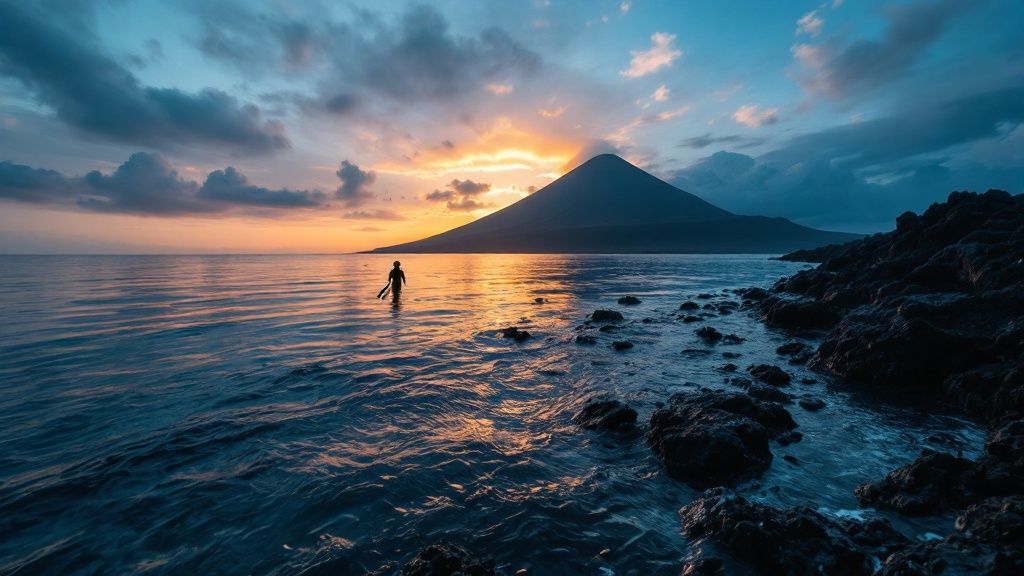
Welcome to the Big Island's underwater realm, a place where raw volcanic power has sculpted an incredible playground for marine life. Diving here is less like a casual swim and more like exploring a completely different planet. The island’s Kona coast, in particular, is a diver's dream, sheltered from the powerful trade winds and blessed with some of the clearest, calmest water you’ll ever see.
This special geography is exactly what makes Big Island scuba diving so spectacular. The island's fiery origins left behind a stunning underwater landscape of ancient lava tubes, massive archways, and towering pinnacles. These formations aren't just empty rock; they've become bustling cities for countless sea creatures.
An Unforgettable Underwater Environment
Just imagine floating alongside a majestic Hawaiian green sea turtle, or honu, as it glides effortlessly through the water. Or picture yourself watching the silent, beautiful ballet of giant manta rays feeding on plankton in the glow of your dive light. These aren't once-in-a-lifetime moments here; they're the signature experiences that define diving in Kona.
Here’s a quick look at the key ingredients that make diving here so special.
| What Makes Big Island Diving Unforgettable | |
|---|---|
| Feature | Description |
| Exceptional Visibility | The water clarity often pushes past 100 feet, giving you jaw-dropping, wide-angle views of the underwater world. |
| Unique Topography | Volcanic activity has carved out a diver's paradise of lava tubes, swim-throughs, and dramatic rock formations. |
| Abundant Marine Life | The reefs are absolutely teeming with life, including many species you can only find here in Hawaii. |
| Ideal Conditions | Water temperatures are a comfortable 75-80°F (24-27°C) all year long, so there's never a bad time to jump in. |
This winning combination creates the perfect stage for both incredible underwater photography and simply being present in a truly magical environment. You can get a deeper look at what makes the area so special in our complete guide to diving on the Big Island.
The Kona Honu Divers Experience
Whether you have thousands of dives under your belt or are just taking your first breath underwater, the Big Island has an adventure waiting for you. A top-tier operator like Kona Honu Divers can take your trip from just "great" to truly life-changing. We focus on safety, comfort, and getting you to the absolute best diving tours. With our expert guides and small group sizes, we’re all about helping you connect with the magic of Hawaii's ocean.
Exploring Kona’s Most Iconic Dive Sites
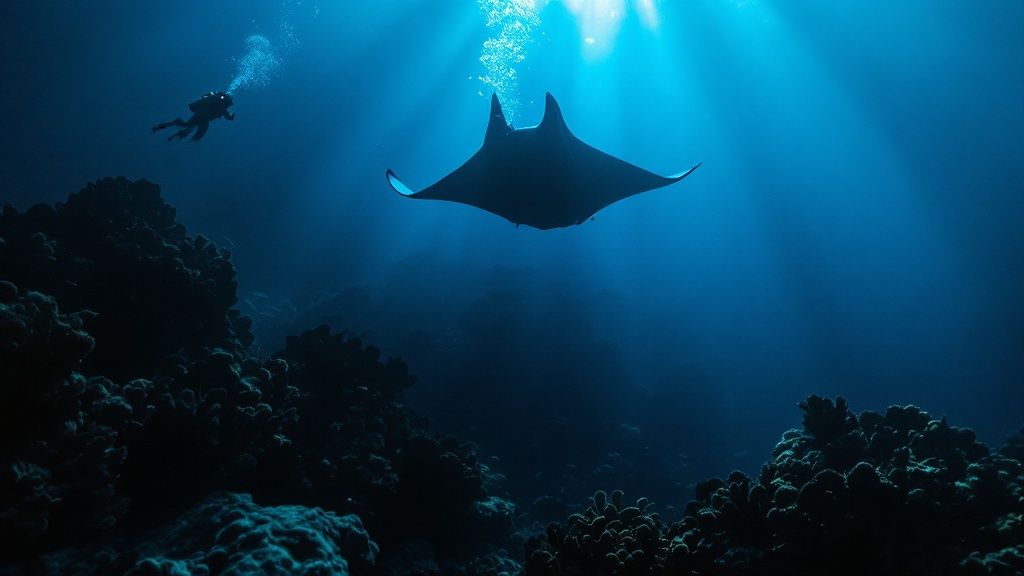
The Kona coast is basically a treasure map for divers. Its unique volcanic geology has sculpted an incredible underwater playground full of lava tubes, dramatic arches, and reefs teeming with life. Getting out and exploring these spots is what Big Island scuba diving is all about.
You can find everything here. From sun-drenched coral gardens perfect for your first dive to deep, intricate structures that will keep even the most experienced divers on their toes. Each site has its own story, told by the coral formations and the amazing creatures that call them home.
Dive Sites for Every Skill Level
Whether you’re about to take your first breath underwater or you’ve got thousands of dives under your weight belt, Kona has the perfect spot for you. The waters here are generally calm and protected, making it a fantastic place to learn. At the same time, the sheer variety of the underwater landscape means there’s always something new to discover.
- Beginner-Friendly Sites: Places like Turtle Pinnacle are a dream for divers of all levels. It’s famous for its "cleaning station," where Hawaiian green sea turtles (honu) line up to let little reef fish scrub their shells clean. It’s an unforgettable, peaceful experience in relatively shallow water with great visibility.
- Intermediate Adventures: Dive sites like Golden Arches put the island's volcanic history on full display. You can swim through massive lava rock archways and explore overhangs where schools of colorful fish, eels, and crabs hide out.
- Advanced Exploration: For certified divers who want to push their limits, Kona’s deeper sites offer a thrilling challenge. These areas can have stronger currents and more complex navigation, but the payoff is often a one-of-a-kind marine encounter.
The variety is just incredible. You could dive for a week straight in Kona and feel like you’ve been in a different ocean every single day. The trick is to match the dive site to your experience and comfort level for the safest, most memorable dive possible.
The World-Famous Manta Ray Night Dive
You can't talk about diving in Kona without mentioning the legendary Manta Ray Night Dive. This isn't just another dive—it's a world-renowned spectacle that’s consistently voted one of the best night dives on the planet. Honestly, it's an experience that defines Big Island scuba diving.
Picture this: you descend into the dark ocean as a "campfire" of powerful lights on the seafloor illuminates the water. This light attracts swarms of plankton, which brings in the stars of the show: giant manta rays. These gentle giants, with wingspans that can stretch over 15 feet, swoop and glide through the water in a mesmerizing feeding ballet, often coming within inches of the divers.
This is an absolute must-do for any certified diver visiting the island. Watching these massive, graceful creatures perform their underwater acrobatics right in front of you is something you will carry with you forever.
Opportunities for Advanced Divers
If you hold an advanced certification and are looking for a deeper challenge, Kona absolutely delivers. The underwater terrain here is more than just pretty reefs; it presents unique scenarios that reward skilled divers with truly special sightings.
Advanced dives often take you to deeper pinnacles, complex lava tube systems, and sites that demand pinpoint buoyancy control and sharp navigation skills. These environments are home to creatures you rarely see in the shallows, adding a whole new level of discovery to your dive log. For those with the right experience, an advanced dive tour is the perfect way to explore these incredible underwater landscapes.
The Kona coast has over 80 named dive sites, so the possibilities feel endless. To get a better sense of the variety, take a look at our detailed guide to the best Kona dive sites that we visit regularly.
The Unforgettable Kona Manta Ray Night Dive
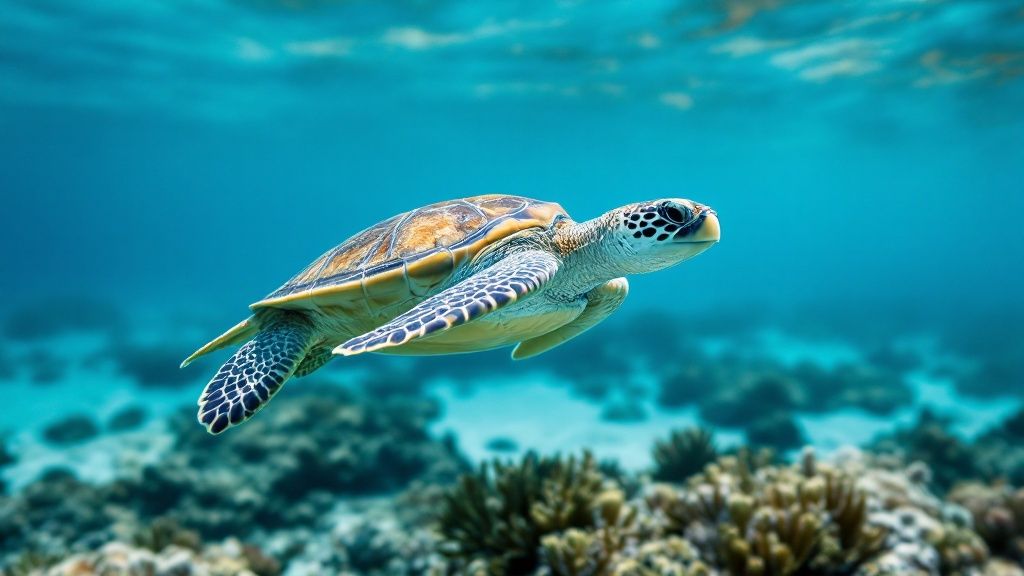
There are dives, and then there are experiences. The Kona Manta Ray Night Dive sits firmly in that second category. It’s consistently rated one of the best night dives in the world and for a very good reason—it’s an encounter that truly defines big island scuba diving.
Imagine this: the sun dips below the horizon, and you descend into the warm, dark Pacific. You and your group settle on the sandy ocean floor around a powerful light source, nicknamed the "campfire." This light cuts through the darkness, illuminating a brilliant stage for one of nature's most incredible performances.
How the Magic Happens
The science behind this encounter is surprisingly simple, but the result is nothing short of magical. The intense lights attract massive swarms of phytoplankton, tiny organisms that are the foundation of the ocean’s food chain. This plankton buffet, in turn, draws in the stars of the show: Kona's resident giant manta rays.
These magnificent creatures aren't just passing through; they're locals who have learned to show up for a reliable nightly meal. This means you have a fantastic chance of seeing them any time of year.
Diving with mantas is one of the most satisfying things a person can do in the water. It’s impossible to describe the feeling of watching a massive fish the shape of a stealth bomber coming into vision. It’s akin to watching your child ride a bike for the first time or finding a winning lottery ticket.
The Underwater Ballet
Once the mantas arrive, they begin their graceful feeding ballet. With wingspans that can stretch over 15 feet, they swoop and glide through the light beams, performing effortless somersaults to filter plankton with their cavernous mouths. It's not uncommon for them to pass within inches of your head, their massive bodies navigating around the divers with stunning precision.
This is a passive observation dive, meaning you'll spend most of your time kneeling or sitting on the seafloor, just looking up in absolute wonder. The entire experience is peaceful, mesmerizing, and for many, deeply moving.
To get a full picture of what this dive is all about, check out our in-depth guide to the Kona Manta Ray Night Dive.
Safety and Manta Etiquette
The Kona Manta Ray Night Dive is an incredibly safe and well-managed operation. These are gentle giants—they have no teeth, stingers, or barbs. Their only interest is the plankton. To keep it that way, and to protect these amazing animals, we follow a few strict but simple rules.
- Look, Don't Touch: A manta’s skin is covered in a protective mucous layer. Touching them can strip this away, leaving them vulnerable to infection.
- Stay Low: Divers are asked to remain on or near the sandy bottom. This keeps the water column clear so the mantas have plenty of room to maneuver.
- Light It Up: Point your dive light straight up into the water. This helps attract more plankton, which keeps the mantas engaged and feeding.
- Mind Your Bubbles: As a manta approaches, try not to exhale directly into its path.
Following these guidelines ensures the dive remains safe and enjoyable for both people and mantas, preserving this unique interaction for years to come.
Ready for an experience you’ll be talking about for the rest of your life? You can book this incredible encounter directly through the Kona Honu Divers Manta Ray Dive tour page. See what other divers are saying about their experience with us:
Check Availability
Discovering the Mystery of the Kona Black Water Dive
If you're a diver looking for something truly out of the ordinary, the Kona Black Water Dive is your ticket to another world. Forget everything you know about reef diving. This is a journey into the deep, dark, open ocean miles offshore, a pelagic drift that feels more like floating through outer space than swimming in the sea.
The concept is brilliantly simple. You head out at night, tether to the boat, and drift over thousands of feet of water. The boat’s powerful lights cut through the darkness below, attracting an incredible parade of creatures up from the abyss.
A Journey into the Deep
What you’re witnessing is the largest daily migration on Earth. Every single night, countless bizarre and often bioluminescent creatures travel from the crushing pressure of the deep to feed near the surface. These are animals that live their lives in total darkness, and this is your one chance to see them.
The life forms you’ll encounter look like they were dreamed up for a sci-fi movie.
- Larval Creatures: You'll see the see-through, juvenile forms of common reef fish and invertebrates, looking nothing like their adult selves.
- Bioluminescent Jellies: Pulsating jellies and shimmering siphonophores drift past, creating their own light in a mesmerizing, otherworldly display.
- Alien Cephalopods: Tiny, strange squids and octopuses materialize from the void—creatures you would never, ever see on a regular reef dive.
The Black Water Dive is a surreal experience for the advanced diver. It’s not about spotting big animals; it’s about the quiet thrill of discovering the small, the strange, and the utterly fascinating life that thrives in the open ocean. If you're an underwater photographer or an adventurer seeking a truly unique encounter, this is it.
Black Water vs. Manta Dive
People often ask how this compares to the famous manta ray night dive. While both happen after sunset, they are worlds apart. The manta dive is like attending a spectacular show—you stay in one spot in a well-lit, shallow area and watch these massive, graceful animals perform.
The Black Water Dive, on the other hand, is an active drift in the deep, inky blackness. The focus is on patient observation and the pure excitement of seeing what tiny, bizarre creature will emerge from the dark next. It’s a dive for those who are completely at home in the dark and fascinated by the ocean's hidden macro world.
Ready to float through inner space? You can learn more and book your spot on the Kona Honu Divers Black Water Dive tour.
How to Choose the Right Big Island Dive Operator
Picking the right company for your Big Island scuba diving trip can be the difference between a decent dive and a mind-blowing one. The operator you choose is more than just a boat taxi; they're your expert guides to a whole other world, and they hold your safety and enjoyment in their hands.
Think about it: the best operators are obsessed with the entire experience. Safety isn't just a box to tick; it's ingrained in everything they do. Their boats are clean, their gear is in top shape, and their guides know the Kona dive sites like the back of their hand. These are the people who can spot a perfectly camouflaged frogfish or a shy octopus tucked away in a crevice you’d swim right past.
What Defines a Top-Tier Dive Shop
A truly great dive shop, like Kona Honu Divers, stands out from the crowd in a few key ways. One of the biggest tells is their commitment to small group sizes. Fewer divers per guide means you get more personal attention, the dive site feels less crowded, and you can have a much more peaceful encounter with the local marine life.
It's also worth looking for the little things that show a shop really cares.
- Do they offer extras like complimentary Nitrox for certified divers, helping you extend your bottom time?
- Are their boats comfortable, with things like hot showers or shaded spots to relax between dives?
These details might seem small, but they make a huge difference in how your day on the water feels.
The hallmark of a great dive company is their ability to make you feel safe, confident, and completely immersed in the adventure. They handle all the logistics so you can focus on the magic unfolding beneath the waves.
The quality of diving in Kona is consistently top-notch, and recent reports from fellow divers confirm it. One diver on a three-week trip in 2023 raved about the professionalism across the board. They pointed out that crews consistently gave thorough 5-to-10-minute safety briefings and that the gear was in excellent condition, with Nitrox tanks filled well over 3100 psi—a great sign of meticulous maintenance. It's this friendly, knowledgeable, and customer-focused community that keeps divers coming back. You can read more about these firsthand Kona diving experiences and shop comparisons.
Reading Reviews and Making Your Choice
When it comes down to it, the best advice often comes from other divers. Spending some time reading recent reviews gives you an honest, unfiltered look at what you can expect. Look for patterns in the feedback—consistent praise for safety, amazing guides, boat quality, and friendly service are all green flags.
At Kona Honu Divers, we've worked hard to build our reputation. We live by the belief that every single dive should be remarkable, and our whole team is here to make that a reality. But don't just take our word for it; see what our guests have to say.
Once you've done your homework and found an operator that feels right, all that's left is to book your spot. A little research upfront ensures you’ll be in great hands, ready to explore the incredible underwater world that makes Hawaii one of the best diving destinations on the planet.
The Pioneering History of Kona Scuba Diving
Every legendary destination has its origin story, and the tale of Big Island scuba diving is one of pure passion, community, and an unquenchable thirst for adventure. The incredible dive scene we enjoy today wasn't just born; it was built by a handful of pioneers who first saw the magic hidden just beneath Kona’s calm, blue surface.
These early explorers were the ones who first charted the volcanic reefs, discovering the lava tubes and archways that make this place so unique. They laid the foundation for the entire community, all driven by a shared mission to reveal the ocean's wonders to the world.
Things really took off in the second half of the 20th century. This was when professional organizations like PADI started transforming scuba from a highly technical, niche hobby into something anyone with a sense of adventure could try. Suddenly, learning to breathe underwater was accessible, and Kona became the perfect natural classroom.
The Rise of a Diving Legend
A truly defining moment came in 1981 when Jack Clothier and his wife Tina opened Jack's Diving Locker. Jack was already a well-known figure in the dive world, and he put Kona on the map with his shop and its quirky, unforgettable motto: ‘Have a Wet Dream Come True.’
Tragically, Jack passed away only eight months after opening, but his vision lived on. Jeff and Teri Leicher took the helm, and through their hard work, they grew the shop into one of Hawaii's most respected dive operations. This was a turning point. Divers from all over the world started hearing stories about Kona's unique underwater landscapes and began flocking to the Big Island. You can dive deeper into how Kona's unique dive culture emerged.
Knowing this history really adds another layer to every dive you do here. You’re not just exploring a reef—you’re following in the fin-kicks of the trailblazers who first brought this underwater paradise to light. That legacy of passion continues today with every boat that leaves the harbor, connecting a new generation to the incredible world waiting just offshore.
Ready to become part of the story? See what modern adventures await on our Big Island diving tours.
Your Big Island Scuba Diving Questions, Answered
It’s totally normal to have a few questions when you’re planning a dive trip to a new place. To get you ready for an unforgettable adventure exploring the Big Island’s underwater world, we’ve put together some straightforward answers to the questions we hear most often.
Think of this as your pre-dive briefing. A little prep work now means you can relax and focus on what really matters—the incredible marine life and stunning volcanic reefs waiting for you.
When Is the Best Time to Dive in Kona?
Honestly, one of the best things about diving in Kona is that you can't really pick a bad time. Our famous manta rays are year-round residents; they don’t migrate, so they’re here every single night for their plankton feast.
The water is also incredibly inviting all year, typically hovering between a balmy 75-80°F (24-27°C). And while Hawaii does have a "rainy" season in the winter, Kona is tucked away on the leeward side of the island, which keeps it much drier and sunnier than other spots. That means great dive conditions are pretty much the norm.
Do I Need to Be Certified to Dive?
Yes, for almost all guided dives—especially the world-famous Manta Ray Night Dive—you'll need to show proof of your scuba certification. Dive operators will want to see your cert card, whether it’s from PADI, NAUI, SSI, or another agency, before you get on the boat.
But if you’re not certified yet, don’t let that stop you! The Big Island is a phenomenal place to learn. Dive shops all over, including us at Kona Honu Divers, offer everything from a one-day "Discover Scuba Diving" experience to a full Open Water certification course. It’s the perfect way to begin your life as a diver.
A Quick Tip: If it’s been a year or more since your last dive, hopping on a refresher course is a really smart move. It helps you get comfortable with your gear and review essential skills, making your dives safer and a lot more fun.
What Happens If We Don’t See Any Mantas?
While the manta dive has a ridiculously high success rate—we see them more than 90% of the time—they are wild animals, and nature doesn’t make guarantees. On the very rare night that the mantas decide to dine elsewhere, reputable dive shops have you covered.
It's an industry standard here to offer a "manta guarantee." If your dive is a no-show, most operators will let you come back another night for free. Just be sure to ask about the specific policy when you book. Pro-tip: schedule your manta dive early in your vacation, just in case you need to cash in on that second chance!
Is It Safe to Dive with Manta Rays?
Absolutely! Manta rays are the definition of gentle giants. These massive creatures can be intimidating at first, but they are completely harmless to people. They don’t have teeth for biting, stingers on their tails, or any barbs to worry about.
Their only mission is to filter-feed on tiny plankton. As they swoop and glide through the dive lights, they might get incredibly close, but they are amazingly graceful and spatially aware. The number one rule is simple: look, but don't touch. Touching their skin can remove its protective slime coating, leaving them vulnerable to infection.
Got more questions? Our team of dive experts is always ready to help you plan the trip of a lifetime.
At Kona Honu Divers, our passion is sharing safe, awe-inspiring underwater adventures. Take a look at all our Big Island diving tours and find the perfect one for you.
Check Availability