
For anyone chasing world-class underwater adventures, Big Island scuba diving is in a league of its own. The Kona coast, in particular, is legendary for its crystal-clear water, unique volcanic seascapes, and incredible encounters with massive marine life. It's a top-tier global destination for a reason.
From surreal night dives with giant manta rays to exploring ancient lava tubes, the Big Island delivers a stunning backdrop for any dive trip.
Why Choose The Big Island For Your Next Dive
The Big Island isn't just another pretty spot on the map; it's a living, breathing testament to the raw power of volcanic creation. Millennia of lava flows have shaped the underwater world here, carving out dramatic drop-offs, intricate archways, and vast cavern systems you just won't find anywhere else. This one-of-a-kind topography has become the perfect habitat for a staggering diversity of marine life.
Kona: The Heart of Hawaiian Diving
The Kona coast, tucked away on the island's sheltered western side, is the undisputed epicenter of this aquatic paradise. Huge volcanoes shield it from the prevailing trade winds, which means the water stays exceptionally calm and clear nearly year-round. It's no surprise the Big Island has become an international hub for diving, drawing around 150,000 dive tourists every year who log well over 100,000 certified dives.
Summer typically brings the flattest, calmest seas. Winter, on the other hand, offers an unforgettable underwater soundtrack: the hauntingly beautiful songs of migrating humpback whales.
If you're planning a trip, going with a professional, experienced operator is the key to unlocking the best dive sites the island has to offer. Kona Honu Divers is a premier choice, known for their solid commitment to safety, small group sizes, and deep, local knowledge of the dive sites. They've built their reputation on delivering exceptional and memorable experiences.
Choosing a top-tier guide ensures you not only see the best spots but do so safely and responsibly, making every moment of your dive count. Whether you're a brand new diver or a seasoned pro, booking with a trusted company makes all the difference. For a deeper look at what makes this place so special, check out our complete guide on Big Island scuba diving.
Comparing Day Dives And Night Dives In Kona
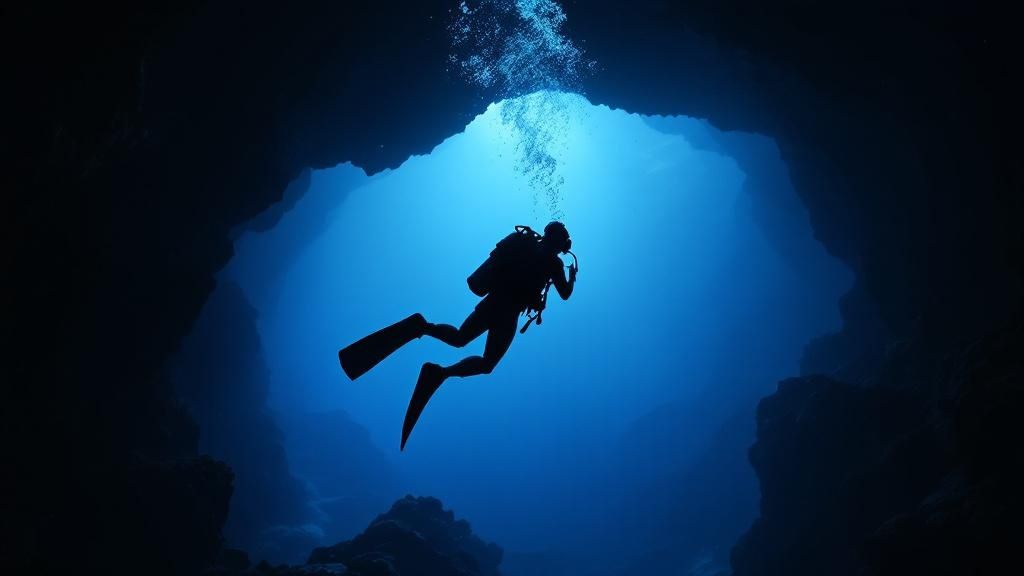
Choosing between a day and night dive in Kona isn't about which one is "better." It's about deciding which world you want to step into. Each offers a completely different lens on the exact same vibrant reef, revealing the dynamic, around-the-clock rhythm of life beneath the waves. The experience of Big Island scuba diving completely transforms once the sun goes down.
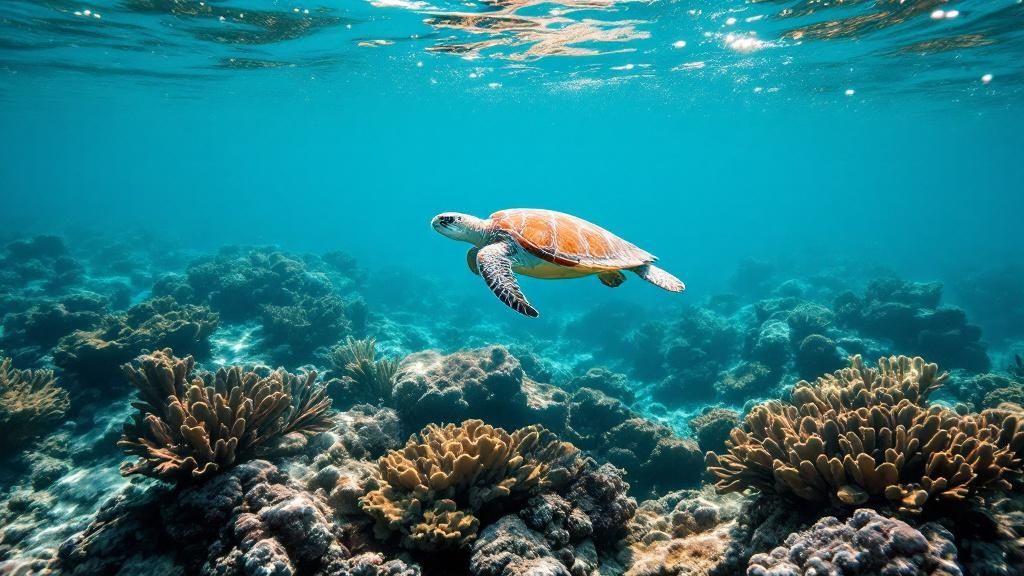
During the day, the Kona coast is an explosion of color. Sunlight streams through the famously clear water, lighting up ancient lava formations and sprawling coral gardens. This is the reef's rush hour, bustling with schools of fish, cruising green sea turtles (honu), and even the occasional pod of spinner dolphins playing in the distance.
Night diving, though, is a different kind of magic altogether. As daylight disappears, a whole new cast of characters emerges from the shadows. The reef you thought you knew becomes an alien landscape.
The World Awakens After Dark
The single biggest difference between day and night diving is the marine life you'll cross paths with. Daytime shows off the classic reef residents, but the nighttime shift belongs to the hunters and the shy creatures that avoid the sun.
-
Day Dives: Expect to see parrotfish munching on coral, clouds of butterflyfish fluttering past, and moray eels poking their heads out from their dens. The visibility is often spectacular, giving you those epic, panoramic views of the underwater topography.
-
Night Dives: This is when the predators come out to play. You might spot octopuses and squids gliding silently through the water, lobsters and crabs foraging on the ocean floor, and all sorts of shrimp with their distinct glowing eyes. The whole experience feels more focused, with your dive light acting as a concentrated beam of discovery.
Night diving in Kona turns the familiar into the extraordinary. Your dive light becomes a personal spotlight, revealing hidden behaviors and unique creatures that only come out after sunset. It’s an entirely separate adventure that showcases the full spectrum of marine biodiversity.
The Atmosphere And Required Skills
The vibe of a day dive is usually relaxed and scenic, perfect for just soaking in the grand scale of Kona's underwater architecture. Those wide-open views and bright conditions are fantastic for underwater photography and spotting marine life from afar.
By contrast, a night dive is an intimate and thrilling experience. Your senses are cranked up to eleven, and your attention is glued to the circle of light in front of you. This demands greater situational awareness, excellent buoyancy control, and being comfortable navigating in low-light conditions.
To help you decide what's right for you, let's break down the key differences side-by-side.
Day vs. Night Diving A Comparative Snapshot
| Decision Factor | Day Diving Experience | Night Diving Experience |
|---|---|---|
| Primary Marine Life | Colorful reef fish, green sea turtles, spinner dolphins, eagle rays. | Octopuses, squids, lobsters, bioluminescent plankton, manta rays. |
| Visibility & Light | Bright, ambient sunlight with long-distance visibility. | Limited to the beam of your dive light, creating a focused view. |
| Overall Atmosphere | Scenic, expansive, and vibrant. Great for wide-angle views. | Mysterious, intimate, and thrilling. Feels like exploring a new planet. |
| Skill Focus | Navigation, exploring large areas, general buoyancy. | Precise buoyancy, light handling, heightened situational awareness. |
For a lot of divers, the ultimate Big Island scuba trip includes both. There's nothing like experiencing a dive site like Garden Eel Cove during the day and then returning at night for the legendary Manta Ray Dive. It’s the only way to truly see its dual personality.
Kona Honu Divers offers a whole range of guided diving tours in Kona, Hawaii that cater to both day and night explorers. Whether you want to witness the daytime hustle and bustle of the reef or the silent, otherworldly ballet of a night dive, there’s an adventure waiting for you.
Experiencing The Manta Ray Night Dive
If there's one experience that defines Big Island scuba diving, this is it. The Manta Ray Night Dive isn't just another activity; it's a world-famous spectacle that put Kona on the global diving map. Descending into the dark ocean to watch these gentle giants perform an underwater ballet is something that will stick with you forever. It's consistently ranked among the best dives on the planet for a reason.
This iconic dive actually started by accident. Back in the early 1980s, Kona's diving pioneers noticed manta rays were drawn to hotel lights shining on the water, which attracted clouds of plankton. That simple observation has since evolved into a highly organized and sustainable ecotourism model, setting a standard for responsible marine life encounters. You can get the full story in our comprehensive guide to the manta ray night dive.
The Science Of The Manta Campfire
The magic behind the manta dive is surprisingly simple biology. The whole operation revolves around creating a "manta campfire" on the ocean floor. Dive operators set up powerful, eco-friendly lights in a central spot.
These lights attract massive clouds of phytoplankton—the tiny organisms that form the very base of the ocean food chain. For manta rays, this is an all-you-can-eat buffet. Drawn in by this dense concentration of their favorite meal, the mantas arrive to feed.
It’s a breathtaking spectacle. Divers kneel in a circle on the sand, pointing their lights upward. The mantas then glide, loop, and somersault just inches overhead, filtering plankton with their giant mouths. The result is an elegant, silent, and deeply moving performance.
What To Expect On Your Dive
Your adventure kicks off with a thorough briefing from your dive guide. They’ll cover everything from manta ray behavior and safety protocols to the single most important rule of the dive: observe only, do not touch. Manta rays have a protective mucus layer, and touching them can strip it away, leaving them vulnerable to infection.
Once you hit the water, you'll descend to a designated spot on a sandy bottom, usually between 25-40 feet. It’s an accessible dive, perfect for Open Water certified divers who are comfortable with night conditions.
- Your Position: You’ll be stationary on the bottom. This minimizes your impact and gives the mantas the freedom to move naturally.
- The Approach: The mantas are not shy. They will often glide right over your head, sometimes getting so close you can see the unique spot patterns on their bellies.
- The Sights: While the mantas are the main event, keep an eye out for other nocturnal creatures. Eels, octopuses, and crustaceans are often drawn to the light show.
This has become such a must-do for visitors that many seek out the epic Manta Ray Dive Kona for the ultimate experience. This incredible dive first took off as a commercial success after Jack’s Diving Locker was established in 1981, popularizing Hawaiian night dives. The resident reef mantas (Manta alfredi) can have wingspans up to 7 meters, creating an awe-inspiring sight when dozens gather to feed.
Top operators like Kona Honu Divers have perfected this unforgettable encounter, ensuring everything is managed for both diver safety and the well-being of the mantas. You can book their popular 2-Tank Manta Ray Dive here.
Choosing Your Advanced Diving Adventure
For certified divers hungry for something truly out of the ordinary, Big Island scuba diving opens up a world beyond the usual reef tour. After you've nailed the fundamentals, two very different paths for advanced divers emerge: the strange, almost alien world of the Kona Blackwater Dive, and the technical challenge of a deep reef dive.
Which one is for you? It really boils down to what kind of thrill you’re after.
The Blackwater Dive isn't about exploring a specific place—it's about drifting in the middle of the deep, open ocean at night. You're tethered to the boat, suspended over thousands of feet of water, watching the largest migration on Earth as bizarre, deep-water critters rise toward the surface to feed. It’s less of a dive and more of a sensory trip into another dimension.
On the other hand, advanced deep reef dives are all about precision, control, and skill. These trips take you to stunning underwater pinnacles and ledges far below the typical recreational sites. Here, the challenge is all about technical execution: managing your gas, perfecting your buoyancy, and navigating complex topography, all while seeing pristine, untouched marine environments.
The Blackwater Dive: An Otherworldly Experience
The Kona Blackwater Dive is easily one of the most unique night dives on the planet. Floating in the inky blackness miles from shore, you feel like a satellite in deep space, attracting life forms that look like they belong on another world. The big draw here isn't large animals, but the incredible micro-world of pelagic creatures.
- The Challenge: The biggest hurdle is mental. You have to be completely at ease with total darkness, the immense depth below, and the feeling of being in open water with no bottom in sight. Your buoyancy control has to be on point to avoid drifting away from the group tether.
- The Reward: You’ll see organisms few people ever lay eyes on, from ghostly, transparent larval eels to pulsing jellyfish and tiny, glowing squid. It’s a light show put on by nature itself, and a macro photographer’s dream come true.
The Blackwater Dive is a journey into the abyss. It messes with your sense of place and rewards you with a peek into a hidden ecosystem that comes alive in the dark, deep waters off Kona. It’s a must-do for the truly adventurous spirit.
For certified advanced divers ready to explore this final frontier, Kona Honu Divers offers a specialized Blackwater Dive tour.
Advanced Deep Reef Dives: Technical Mastery
If the Blackwater Dive is about cosmic wonder, then deep reef dives are about geological grandeur and technical discipline. These dives will test your limits, demanding solid planning and flawless execution. Dropping down to depths of 100 feet or more, you’ll get to explore vertical walls and ancient lava formations that are home to different species than the shallower reefs.
- The Challenge: There's a reason these dives require an advanced certification. You need to be sharp with your gas management, have a solid understanding of no-decompression limits, and be able to perform slow, controlled ascents. The environment can also be more demanding, with a chance of currents and cooler water temperatures.
- The Reward: The payoff is getting to explore pristine sites that most divers will never see. You might run into huge schools of jacks, larger predators like sharks, and unique underwater landscapes that are simply out of reach on shallower dives.
Hawaiian waters have a long history of deep-sea exploration. Back in 1984, the submersible Makalii was already doing dives down to 366 meters, setting the stage for both scientific discovery and recreational challenges. That legacy continues today, cementing the Big Island's reputation as a world-class diving destination. You can read more about Hawaii's history of deep-sea oceanographic missions on NOAA.gov.
For divers with the right training who want to push their skills, Kona Honu Divers runs an advanced dive tour specifically designed to explore these deeper, more demanding sites safely.
Navigating The Top Kona Dive Sites
The Kona coast is a diver’s playground, sculpted from ancient lava flows that created an incredible variety of underwater landscapes. Knowing which dive sites match your skill level is the secret to an unforgettable trip. We’ve got everything from calm, shallow bays perfect for your first breaths underwater to dramatic craters that will test the skills of even the most seasoned divers. No matter your experience, there’s a perfect spot for your **Big Island scuba diving** adventure.
Every site is a unique window into Hawaii's vibrant marine world. Picking the right one isn't just about safety—it's about putting yourself in the best possible position to see what makes Kona so special. Let's walk through some of the top spots so you can build a dive plan that fits you perfectly.
Pawai Bay For Beginner Divers
If you’re new to diving or just want a chill, beautiful day in the water, Pawai Bay is the place to be. Tucked away just north of Kailua-Kona, this protected bay is known for its calm, clear, and relatively shallow conditions, which makes it an ideal spot to get comfortable and build your confidence.
Depths here stay mostly between 20 and 50 feet, giving you plenty of bottom time to just relax and explore. The bay is nicely sheltered from the open ocean, so you'll rarely find any current to speak of. That calm setting lets you focus on your buoyancy and the incredible scenery without having to fight the water.
And the scenery is top-notch. Pawai Bay is packed with life, and you can expect to see:
- Honu (Green Sea Turtles): It's common to find these gentle giants resting on the sandy bottom or cruising gracefully past you.
- Colorful Reef Fish: The reef is buzzing with schools of yellow tangs, butterflyfish, parrotfish, and striking Moorish idols.
- Cool Lava Formations: You can explore interesting lava rock structures, find little swim-throughs, and peek into coral gardens that hide eels and octopuses.
Garden Eel Cove For Intermediate Divers
Once you’ve got your buoyancy dialed in and a few dives under your belt, Garden Eel Cove is a must-do. While it’s world-famous as a prime location for the Manta Ray Night Dive, it’s also a fantastic day dive offering more depth and some truly unique underwater sights.
The site gets its name from the huge colony of Hawaiian garden eels that populate a massive sand patch around 50 to 60 feet deep. It's mesmerizing to watch hundreds of these shy creatures poke out of the sand and sway in unison with the current. Besides the eel colony, the reef itself is more complex here, with cool ledges and coral heads that are fun to investigate.
Garden Eel Cove really shows off the incredible diversity of Kona’s dive sites. By day, it’s a dynamic reef with unique inhabitants; by night, it transforms into a world-class theater for the majestic manta ray ballet. Seeing it in both light conditions offers two completely different, yet equally amazing, experiences.
This site is a great next step for divers ready to explore slightly deeper profiles. The reef slopes gently, making for a comfortable descent, and the chance of spotting larger animals like eagle rays or cruising jacks adds a bit of extra excitement to every dive.
Au Au Crater For Advanced Divers
For divers ready for a real challenge, Au Au Crater represents the pinnacle of advanced **Big Island scuba diving**. This partially submerged volcanic crater is a stunning, dramatic landscape of lava tubes, massive archways, and sheer drop-offs that will absolutely thrill experienced divers.
This site is located further north and is more exposed to the open ocean, which means currents can be a real factor. You absolutely need solid dive planning and the skills to handle changing conditions. The reward, however, is huge. Depths here can easily push past 100 feet, and the underwater topography will take your breath away.
Diving Au Au Crater feels like you're swimming through an underwater cathedral. The highlight is a massive archway leading into a huge cavern where the light filtering down from the surface creates an almost surreal scene—a photographer's dream. Because of the depth and potentially tricky conditions, this site is strictly for advanced certified divers with rock-solid buoyancy and air management. If you're looking for a professionally guided trip to Kona's most demanding sites, Kona Honu Divers runs a premium advanced dive tour designed for exactly this kind of adventure.
How To Plan Your Big Island Dive Trip
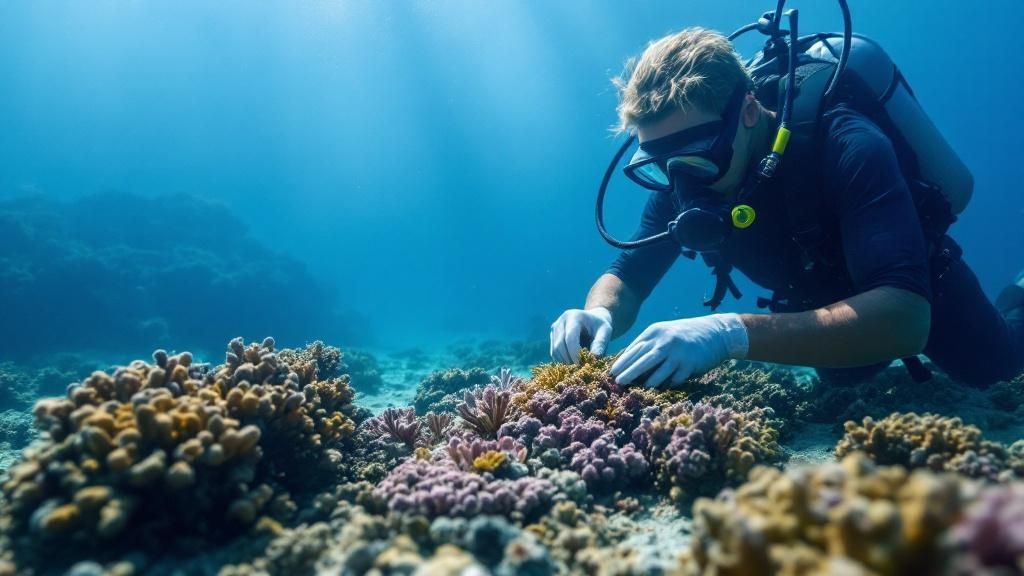
Putting together your dream Big Island scuba diving trip is half the fun, but a little smart planning can make all the difference. Nailing down the logistics ahead of time—from picking the best season to packing the right exposure suit—is what turns a good trip into an unforgettable one.
Your first big decision is when to come. The Kona coast has incredible diving all year long, but the seasons each have their own unique vibe. Summer, from roughly June to September, usually delivers the calmest seas and gin-clear water. If you're looking for exceptionally relaxed and easy diving conditions, this is your sweet spot.
Then there's winter. From December to March, the ocean can be a bit more dynamic and the water a touch cooler, but it brings something truly magical: humpback whale season. There's nothing quite like hearing the haunting songs of these giants echoing through the water during a dive. It's an experience you just can't get any other time of year.
Booking And Gearing Up
Once you have your dates locked in, booking your dive charters should be next on your list. The really popular trips, especially the Manta Ray Night Dive and advanced charters, can fill up weeks—sometimes months—in advance. Getting your spot locked in early with a top-notch operator like Kona Honu Divers secures your place on the boat and gives you the peace of mind to plan the rest of your vacation.
When you start packing, the single most important piece of gear to think about is your wetsuit. Here’s a quick rundown of what should be in your dive bag:
- Exposure Suit: A 3mm full wetsuit is just about perfect for most daytime dives here. For the night dive or if you tend to run cold, I'd strongly suggest bumping up to a 5mm.
- Dive Computer: Absolutely essential for safety, particularly if you're planning on multiple days of diving.
- Mask, Fins, and Snorkel: Bringing your own gear is always best. A perfect fit means a comfortable dive.
- Certification Cards: Don’t leave home without them! Having digital copies on your phone is also a great backup.
- Reef-Safe Sunscreen: This is a big one. It protects your skin and helps preserve Hawaii's fragile coral reefs for future divers.
Certification And Professional Guides
If you're not certified yet, you've picked an amazing place to learn. The calm, warm waters off the Kona coast create the perfect classroom for getting your Open Water certification. And if you're already a certified diver, it’s a great opportunity to expand your skills with specialties like Deep Diver or Night Diver.
No matter your experience level, diving with a professional guide is the key to a safe and mind-blowing trip. Local experts know these sites, the currents, and the marine life patterns better than anyone. They'll make sure you see the absolute best of what Kona has to offer, all while keeping you safe.
For a professionally managed and unforgettable Big Island scuba diving experience, from your very first open water dive to advanced explorations of remote sites, booking with an established operator is the best move you can make.
Frequently Asked Questions About Diving In Kona
Planning your first scuba trip to the Big Island always brings up a few questions. To make sure you're ready for an incredible underwater adventure, we've put together some straight-up answers to the things divers usually ask before they get here.
What Is The Water Temperature And What Wetsuit Do I Need?
The water in Kona is pretty comfortable all year. In the winter, you can expect temps around 75-77°F (24-25°C), and it warms up to a nice 79-81°F (26-27°C) during the summer months. For most daytime dives, a standard 3mm full wetsuit is all you'll need.
But if you're doing a night dive—like the Manta Ray or Blackwater dives—or you just get cold easily, grabbing a 5mm wetsuit is a good move. It'll keep you warm and comfortable for the entire dive.
Do I Need An Advanced Certification For The Manta Ray Night Dive?
Nope, you don't need to be an advanced diver for this world-famous dive. The Manta Ray Night Dive happens in a pretty shallow, sandy spot, usually only 25-40 feet (8-12 meters) deep. Any certified Open Water diver who feels comfortable in night conditions can jump in and have an amazing time.
If you want the full scoop on what it's like, check out our dedicated article on what you should know for the Manta Ray Dive in Kona.
When Is The Best Time Of Year For Big Island Scuba Diving?
Honestly, Kona is a fantastic place to dive any time of year. That's because we're on the leeward side of the island, which keeps the waters protected and calm.
The summer months, from about June to September, usually bring the flattest seas and incredible visibility. On the other hand, diving in the winter from December to March offers something truly special. The water might be a little cooler, but you'll often hear the incredible songs of humpback whales echoing through the water on your dives—an unforgettable experience.