
Picture this: you take your very first breath underwater, surrounded by curious green sea turtles and a world of vibrant coral. That's what getting your Big Island scuba certification is all about. It’s more than just a class; it’s your passport to a lifetime of exploring the incredible world beneath the waves.
With its famously calm, clear waters and mind-blowing marine life, Kona is easily one of the best places on the planet to learn.
Start Your Underwater Adventure in Kona
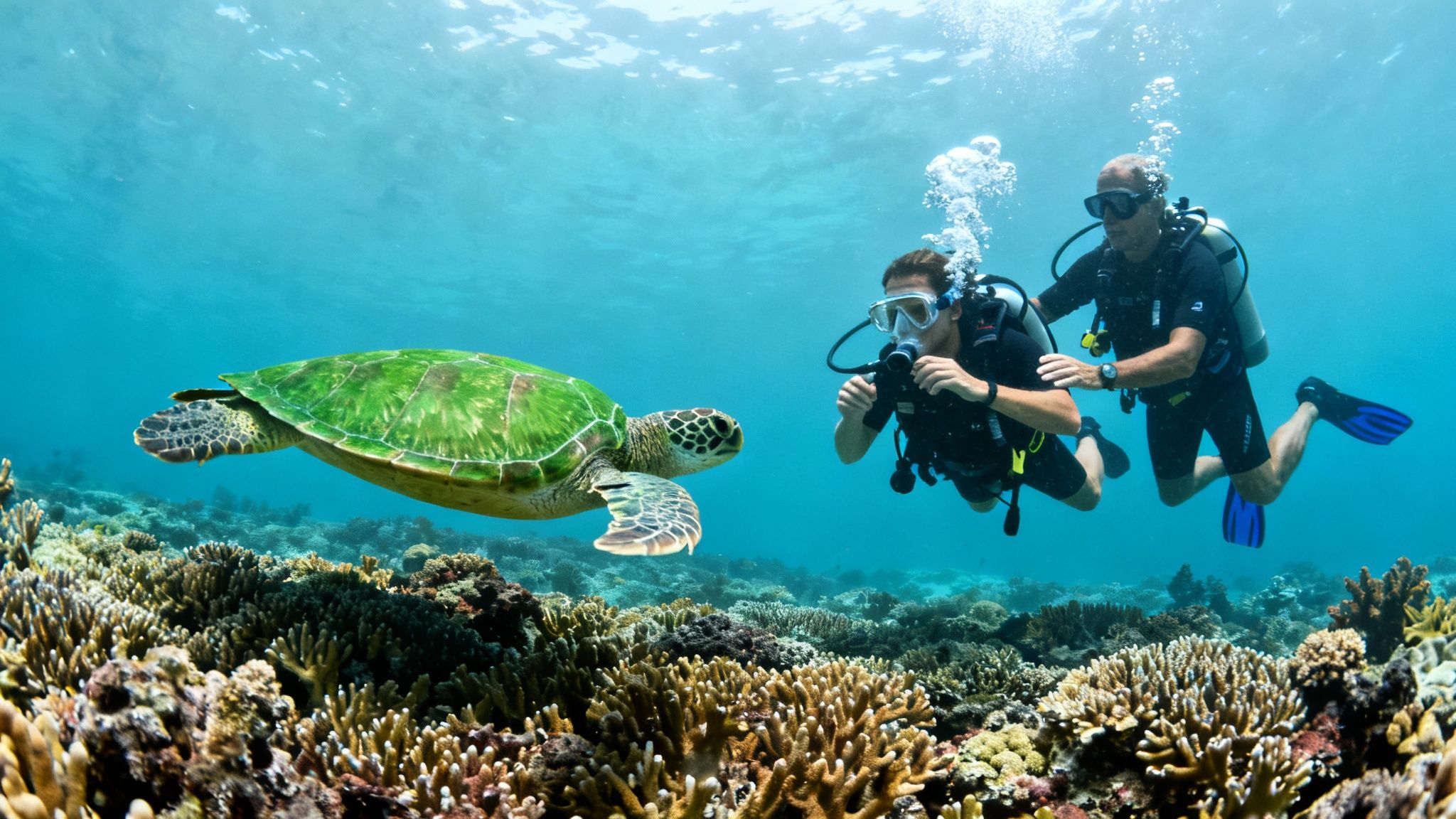
Learning to dive in Kona is an experience you'll never forget. The island's western coastline is naturally protected from the big ocean swells, which creates perfect, almost pool-like conditions for new divers. This consistent calm means you can focus completely on learning your skills without fighting against strong currents or murky water.
This guide will walk you through everything, from your first online lesson to your final dive in the open ocean. We'll break it all down so you know exactly what to expect.
Why Is Kona Such a Great Place to Learn?
The demand for scuba training has exploded recently, and that puts destinations like Kona in the spotlight. The dive industry across the United States has bounced back in a big way, especially in coastal hotspots.
Just look at the numbers: in 2023, Florida issued over 31,000 new open water certifications, and California wasn't far behind with 17,000. These stats show a massive national interest in diving, and Hawaii’s Big Island has carved out a reputation as a world-class training ground in this booming market. Even after the industry took a hit in 2020, people rushed back to outdoor activities, proving just how appealing learning to dive really is. You can learn more about the recent trends in open water certification.
Here at Kona Honu Divers, we offer top-notch PADI certification courses designed to turn your vacation into a life-changing adventure. Our whole philosophy boils down to three simple things:
- Safety Is Everything: We are absolutely serious about our safety standards. It’s our job to make sure you feel secure and supported from start to finish.
- Expert Guidance: You’ll be learning from experienced PADI instructors who are patient, give you personalized attention, and keep our groups small.
- A First-Class Experience: Our fleet is the best in Kona, offering comfort and amenities that make every part of your training that much better.
Choosing Kona Honu Divers for your Big Island scuba certification is an investment in a high-quality education. It's what prepares you for a future of amazing diving tours and a lifetime of underwater discovery.
Choosing the Right Scuba Certification Course for You
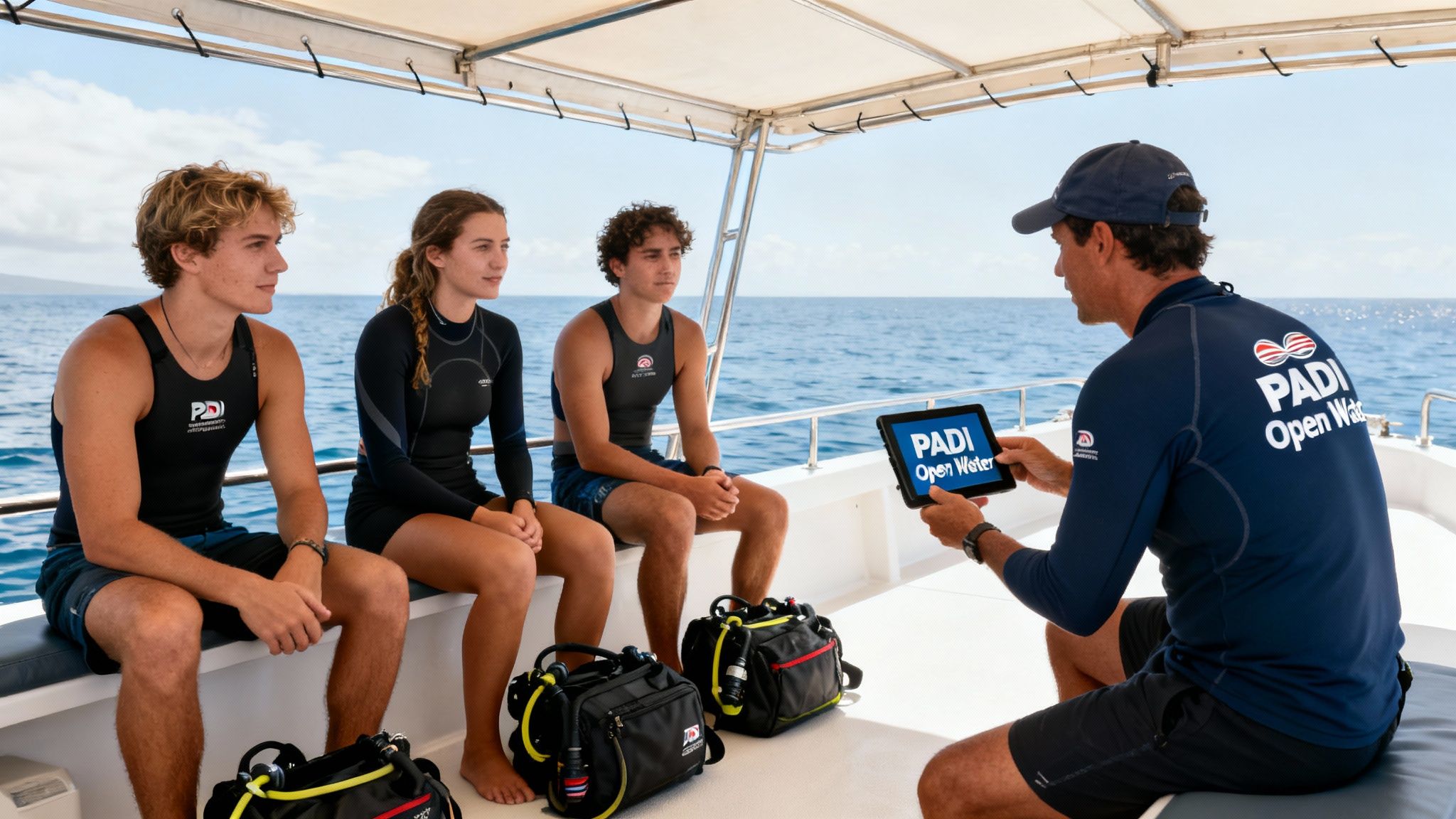
So, you're ready to start your Big Island scuba certification journey. The first step is figuring out which course makes the most sense for your vacation schedule and diving goals. Not all certification paths are created equal, and the best one for you really depends on how much time you have to spend with us in Kona.
For most new divers, the PADI Open Water Diver course is the gold standard. Think of it as the complete package—it takes you from knowing nothing about scuba to being a certified diver recognized anywhere in the world. This is your lifetime ticket to underwater exploration.
PADI Open Water Diver: The Full Experience
This is, hands down, the most popular scuba certification on the planet. Why? Because it covers everything you need to know from the ground up. You’ll tackle the theory online, master essential skills in calm, pool-like conditions, and then put it all into practice with four incredible open water dives in Kona’s stunning ocean.
Choosing this path means you get a complete, immersive learning experience right here in Hawaii. Our expert PADI instructors at Kona Honu Divers keep groups small, so you’ll get the personalized attention you need to become a confident and safe diver.
The Flexible Open Water Referral Program
What if your vacation time is tight? Don't worry, the referral program is the perfect solution. You complete all the academic and confined water (pool) sessions with a local PADI dive shop before you even leave home.
Then, you just bring your referral paperwork to us in Kona, and we’ll get you straight into the ocean to complete your four required open water dives. This is the ultimate way to skip the classroom and maximize your time exploring Kona’s vibrant reefs during your trip.
Key Takeaway: The referral program is all about saving your precious vacation time. Get the bookwork and pool skills done at home so you can jump right into Kona’s amazing underwater world the moment you arrive.
Discover Scuba Diving: A Taste of the Ocean
Maybe you’re not quite ready to commit to a full certification course. No problem at all! The PADI Discover Scuba Diving experience was designed just for you. It’s not a certification, but rather a one-day, guided adventure that lets you try scuba diving under the close supervision of an instructor.
You'll learn the basic safety rules, practice a few key skills in shallow water, and then go on a real dive to a maximum depth of 40 feet. It's the perfect, low-commitment way to find out if scuba diving is your new passion.
Deciding which option is best can feel like a big choice, so here's a quick breakdown to help you compare.
Big Island Scuba Certification Options at a Glance
| Course Option | Best For | Time Commitment | Outcome |
|---|---|---|---|
| Full PADI Open Water | The complete learning experience; becoming a certified diver from scratch in Kona. | 2-3 full days | A lifetime PADI Open Water Diver certification. |
| Open Water Referral | Maximizing vacation time; completing the fun part (ocean dives) in Hawaii. | 2 half-days | A lifetime PADI Open Water Diver certification. |
| Discover Scuba Diving | Trying scuba for the first time without committing to a full course. | 1 half-day | An amazing one-day experience, but not a certification. |
No matter which path you choose, you're taking the first step toward an incredible new adventure. You can find more details on our Kona scuba certification course page to see which one feels right for you.
Understanding the Certification Process From Start to Finish
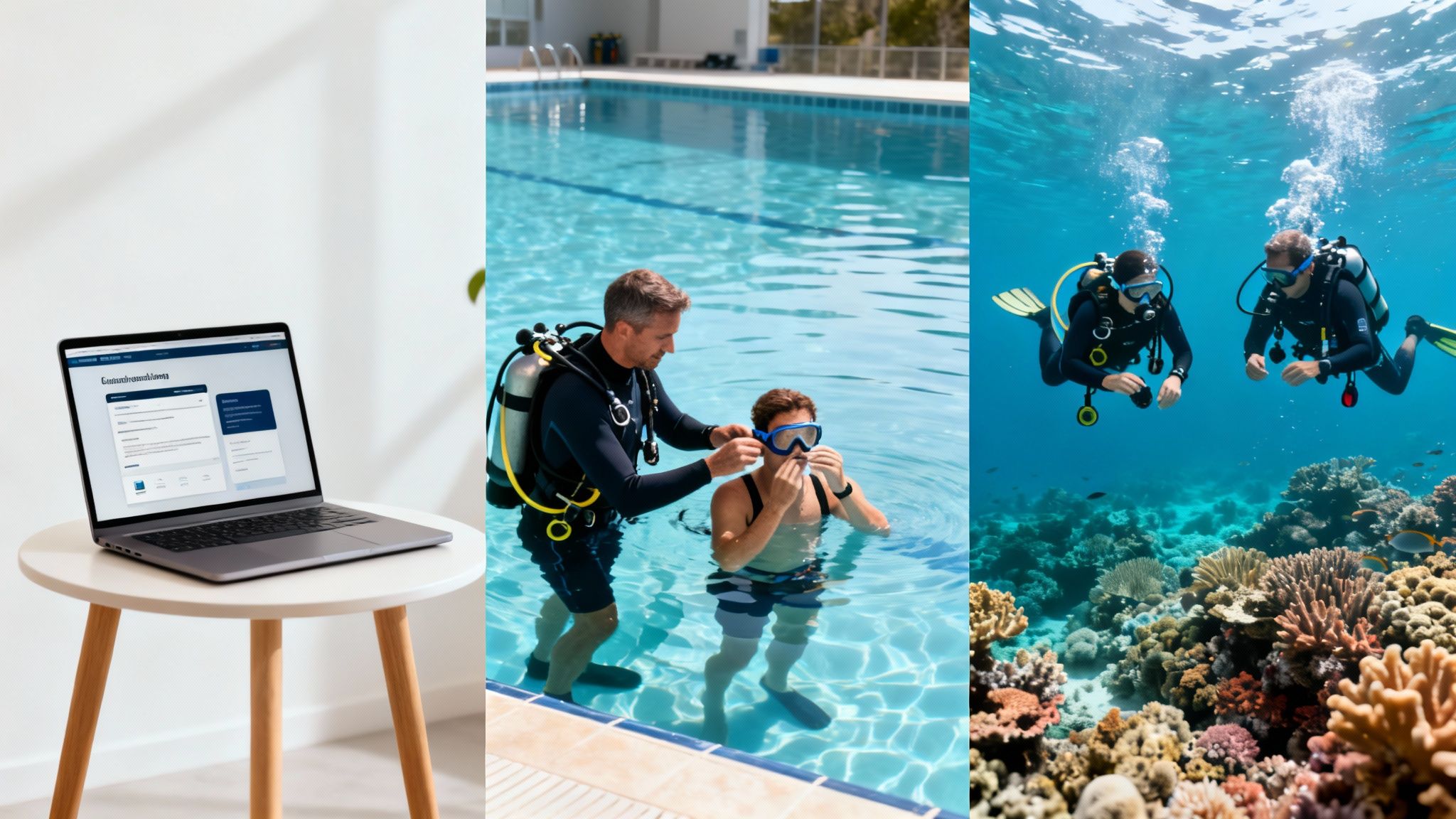
Getting your Big Island scuba certification might feel like a big undertaking, but it’s actually a really exciting journey broken down into three logical parts. The whole system is designed to build your skills and confidence step-by-step, taking you from theory to real-world practice.
This isn't about throwing you in the deep end. Far from it. The PADI training method is trusted worldwide because it's progressive—each new skill builds on the one you just mastered. You’ll never be asked to do something in the ocean that you haven't already nailed in a calm, controlled setting first.
Phase 1: Knowledge Development
First things first, you need to understand the "why" behind what we do underwater. This is where you’ll learn the fundamentals of dive physics, how your body reacts to pressure, how the gear works, and crucial safety protocols.
The best part? You can do this all online before you even leave for Hawaii. PADI's eLearning platform lets you work through the material at your own pace. Knocking this out ahead of time is a game-changer. It means your vacation is spent in the water, not in a classroom. You just show up in Kona with the theory already under your belt, ready to dive in.
Phase 2: Confined Water Dives
With the bookwork done, it’s time to get wet. The next step is a series of "confined water" sessions, which typically happen in a pool or a very calm, shallow ocean environment. Here, you’ll get comfortable breathing underwater for the first time and practice all the core skills with an instructor right by your side.
This is where you really build your foundation. You'll learn essential, hands-on techniques like:
- Putting your gear together (and taking it apart).
- Getting water out of your mask and regulator without surfacing.
- Learning to float neutrally, which we call buoyancy control.
- Running through key safety drills so they become second nature.
Practicing in this controlled setting is perfect for building muscle memory and confidence without any distractions. It makes the transition to the open ocean feel natural and easy.
Expert Insight: Take your buoyancy practice seriously in the pool. It’s the single most important skill you'll learn. Nailing it early on means you'll use less air, avoid damaging the fragile reef, and look like you've been diving for years.
Phase 3: Open Water Dives
This is it—the moment you've been working toward. It’s time to take everything you've learned and apply it in the real world: the incredible Pacific Ocean. Your Big Island scuba certification wraps up with four open water dives where you'll show your instructor you've mastered the skills from your pool sessions.
These aren't just tests; they are your first true underwater adventures. Guided by your instructor, you’ll explore some of Kona's amazing reefs, come face-to-face with vibrant marine life, and feel that incredible sense of freedom that only diving can give you.
After you successfully complete these four dives, you've earned it: you'll be a certified PADI Open Water Diver. That card is your passport to exploring the other 71% of the planet, opening up a lifetime of amazing diving tours and discoveries around the globe.
How to Prepare for Your Big Island Dive Course
Getting ready for your Big Island scuba certification starts long before you ever hit the water. A little bit of prep work ensures you show up in Kona feeling relaxed, confident, and ready for an unforgettable adventure.
Let's start with the basics. To enroll in a PADI Open Water Diver course, you have to be at least 10 years old. Divers between 10 and 14 earn a Junior Open Water certification, which comes with a few depth and supervision restrictions but gets them diving and building experience safely. You don’t need to be a competitive swimmer, but you do need to be comfortable in the water. That means being able to swim 200 yards (or snorkel 300 yards) and float or tread water for 10 minutes.
Medical Fitness and What to Pack
Before we get you in the pool, every student needs to fill out a standard PADI Medical Questionnaire. It’s a simple form that screens for health conditions—like certain heart or respiratory issues—that could be risky underwater.
Honesty is key here. If you answer "yes" to any of the questions, you’ll just need to get a doctor to sign off on the form, clearing you for diving before your course begins.
Once the paperwork is handled, it's time for the fun part: packing for your trip! You'll want to put together an ultimate packing list, but a few key items are absolute must-haves for your dive days.
Here’s a quick checklist of what to bring along:
- Swimsuit and Towel: An obvious one, but essential!
- Reef-Safe Sunscreen: Hawaii law bans sunscreens with oxybenzone and octinoxate. Please help us protect our reefs by sticking to mineral-based options.
- A Change of Clothes: Having something dry and comfortable to change into after your dives makes a world of difference.
- eLearning Completion Form: If you’ve already finished the online classroom portion, bring your certificate of completion.
Pro Tip: Leave your heavy gear at home. Kona Honu Divers provides all the essential equipment you'll need for your course—mask, snorkel, fins, regulator, BCD, and tanks. Our gear is top-notch and meticulously maintained for your safety and comfort.
The price of your certification covers everything you need: eLearning access, all your gear rentals, and the instructor-led training dives. No hidden fees, no surprises. With these details sorted, you can focus on the incredible experience waiting for you. Speaking of which, if you're planning your travel dates, check out our guide on the best months to scuba dive in Hawaii.
Why Kona Honu Divers Is a Top Choice for Certification
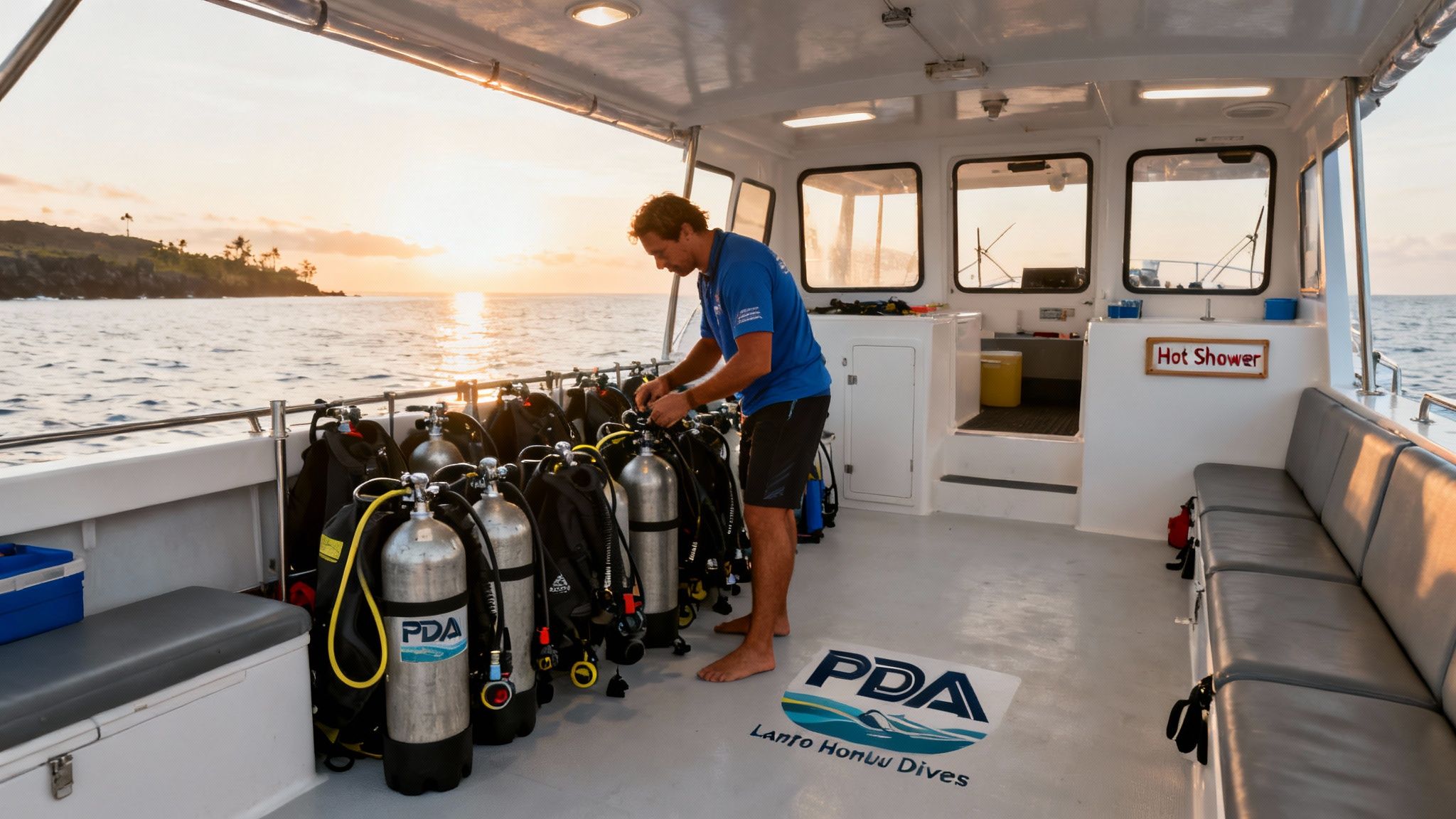
Picking the right dive shop for your Big Island scuba certification is a huge decision. After all, this isn't just about getting a card; it's about building a solid foundation for a lifetime of safe and amazing dives. While Kona has several great operators, we at Kona Honu Divers have built our reputation on quality, safety, and creating genuinely unforgettable experiences.
Our whole philosophy revolves around this idea. We maintain a stellar safety record, and our experienced PADI instructors are handpicked for their patience and ability to provide personalized instruction. Keeping our class sizes small is non-negotiable—it ensures you get the one-on-one time needed to truly master skills and feel confident in the water.
Unmatched Comfort and Premium Gear
You'll notice the difference the moment you step onto one of our boats. We've invested in a top-of-the-line fleet designed specifically for diver comfort. Forget feeling cramped and struggling to gear up. Our vessels are spacious, giving you plenty of room to move around and relax between your training dives.
It's the little things that make a big difference in your training day. Imagine rinsing off in a hot freshwater shower right after surfacing or finding plenty of shade to cool down and debrief. These comforts aren't just luxuries; they help you stay focused, relaxed, and ready to learn.
We're also meticulous about our gear. All rental equipment is regularly serviced and maintained to the highest standards. When your gear is reliable and fits well, you can stop worrying about your equipment and concentrate entirely on your skills and the incredible marine world around you.
An Experience That Lasts a Lifetime
Getting certified with us is just the beginning of the adventure. Once you're an Open Water Diver, a whole new world of exploration opens up, and we're here to guide you through it. We offer a full lineup of incredible diving tours so you can immediately put your new skills to the test.
Think about it: you could be exploring ancient lava tubes, drifting over vibrant coral reefs, or experiencing the world-famous Manta Ray Night Dive. That last one is a truly magical, must-do encounter for any diver visiting Kona. Your certification is a key, and we have all the doors waiting for you to unlock.
But you don't have to take our word for it. Hearing from fellow divers is the best way to understand the experience we provide.
Choosing Kona Honu Divers means you're investing in a learning experience that prioritizes your safety, comfort, and long-term passion for diving. Ready to start your adventure?
Life After Certification Unlocking Hawaii’s Best Dives
Getting your Big Island scuba certification isn't the finish line—it’s the starting gun. With that PADI Open Water card in your wallet, the entire underwater world of Hawaii opens up. Think of Kona's coastline as your new playground, full of ancient lava tubes, dramatic underwater pinnacles, and vibrant coral reefs absolutely buzzing with life.
Once you’re certified, you can hop on daily dive charters that hit all the best spots. Imagine dropping beneath the surface and watching a green sea turtle glide by, or having a massive school of yellow tang part around you. That certification is your all-access pass to seeing these incredible sights for yourself.
Continuing Your Diving Education
Your Open Water card gets you in the door, but some of Kona's most spectacular sights lie just beyond the 60-foot (18-meter) depth limit. That’s where the PADI Advanced Open Water course comes into play. It's the perfect next step, designed to build your confidence and expand your skills with an instructor right by your side.
The Advanced course gets you certified to dive deeper—down to 100 feet (30 meters)—which is the key to unlocking a whole new set of dive sites. You’ll become a much more capable and well-rounded diver by learning new skills and trying different types of diving, from deep dives to navigation challenges.
Take the Plunge: Going for your Advanced certification isn't just about going deeper. It makes you a safer, more confident diver and qualifies you for truly unique experiences, like exploring deeper wrecks or joining specialized advanced dive tours along the Kona coast.
Unforgettable Post-Certification Adventures
With your certification in hand, you’re ready for the really good stuff. The Big Island is famous for its incredible Kona Manta Ray Dive adventures. Picture yourself kneeling on the sandy bottom while majestic manta rays, some with wingspans up to 16 feet, perform an otherworldly ballet just inches over your head. It’s an experience that’s on just about every diver's bucket list for a reason.
If you're looking for something truly unique, the world-famous Kona blackwater dive is a must-do. We take you miles offshore into the deep, dark ocean to witness the bizarre and beautiful creatures that migrate toward the surface at night. It's like a trip to another planet.
Your new certification is more than just a piece of plastic; it's your key to unlocking these once-in-a-lifetime moments. To see everything that's waiting for you, check out our full guide to Big Island scuba diving.
Your Scuba Certification Questions, Answered
Think you're ready to take the plunge? It’s completely normal to have questions before you commit to getting certified. Here are a few of the most common things people ask us before signing up.
How Much of My Vacation Will the Course Take Up?
This is probably the most common question we get! Once you’re here on the Big Island, you can expect the in-water portion of your PADI Open Water course to take 2 to 3 full days. That covers your confined water skill-building and your four required open water dives.
The real time-saver? Do the online eLearning from your couch before you pack your bags. Knocking out the bookwork ahead of time means more time enjoying the island and less time in a classroom.
Is Scuba Diving Actually Safe?
It’s an adventure sport, so of course, there are risks, but diving is incredibly safe when you follow the rules and dive with a professional crew. The entire point of your PADI certification is to give you the knowledge and skills to be a confident and safe diver.
Your single most important decision is choosing a dive operator with a rock-solid safety record and experienced instructors. That's the foundation of a safe and enjoyable diving life.
What if I Have a Medical Condition?
Safety first, always. You'll fill out a standard medical questionnaire before we get in the water. If you have to answer "yes" to any of the conditions listed—things like serious heart or lung issues, for example—you’ll need to get a doctor to sign off on your form, clearing you to dive.
Pro Tip: Download and review the form long before your trip. Getting that signature can take time, and you don't want it to cause a last-minute scramble.
Do I Need to Buy All My Own Gear?
Nope, not at all! We provide everything you need to get certified. Your course includes all the essential scuba equipment: your mask, fins, regulator, and BCD (the vest that helps you float). We’ve got you covered.
Ready to stop wondering and start diving? At Kona Honu Divers, our experienced instructors and amazing dive boats are here to give you an unforgettable start to your underwater adventures. Let’s explore the magic of the Big Island together.