
Table of Contents
- Manta Night Dive and Night Snorkel Options
- Pack for Comfort and Control
- From Light Beam to Feeding Pass
- Why the Number of Mantas Changes
- Garden Eel Cove Compared With Keauhou
- What the Site Looks Like Underwater
- Arrange the Evening in Order
- Compare the Complete Price
- From Gear Check to Viewing Position
- During the Encounter and Return
- Separate Operational Practice From Proposed Rules
- Questions Worth Asking
- Do I Need Certification to See Manta Rays at Night?
- Will I Definitely See Mantas?
- Can I Touch or Ride a Manta if One Comes Close?
- How Long Is the Trip?
- What if the Site Changes?
- Build a Practical Itinerary
- Reserve the Appropriate Departure
More than 23,000 manta sightings involving 167 individually identified reef mantas were recorded at Kona's nighttime viewing sites in a University of Hawaiʻi study summarized by Kona Honu Divers. That's a remarkable record of recurring wildlife encounters, but it doesn't tell you whether your boat will be well managed, your viewing position comfortable, or your group properly supervised.
For a Big Island manta ray night dive, those practical details deserve as much attention as sighting rates. Garden Eel Cove is our default choice because its protected location, defined viewing area, and healthier surrounding reef make it a strong setting for a stationary dive. The right booking starts with the site, then the crew's safety systems, then your comfort in the water.
Manta Night Dive or Night Snorkel at a Glance
Certified divers should choose the Manta Ray Night Dive if they're comfortable underwater after dark. Non-divers and families can choose the surface-based Manta Ray Night Snorkel, with the planned option available from age five, subject to confirmation of the departure's eligibility requirements.
Scuba gives you an upward view from the designated sandy viewing area. Snorkeling gives you a downward view while floating at the surface. Neither requires chasing the animals, and neither should be chosen because it sounds more adventurous.
Manta Night Dive and Night Snorkel Options
| Traveler | What they need | Best option | Where you watch from |
|---|---|---|---|
| Certified scuba diver | Current certification and comfort underwater | Manta Ray Night Dive | Kneeling on the sandy bottom inside the light circle |
| Non-diver, family or snorkeler, age five and up | Comfort floating and breathing through a snorkel, plus confirmed age eligibility | Manta Ray Night Snorkel | Floating at the surface with lights aimed down |
| Experienced diver wanting more | Advanced diving experience and confirmed trip prerequisites | Premium Advanced 2-Tank Trip | Underwater at the selected dive sites |
| Diver interested in blackwater | Night-diving experience and confirmed eligibility | Black Water Night Dive | In the offshore water column |
| Diver new to manta etiquette | Optional education | PADI Manta Ray Diver specialty | Not applicable |
Our Manta Ray Night Dive and 2-Tank Morning Dive are open to all certified divers. Divers have seen mantas on 92% of Manta Ray Night Dive trips, but that history isn't a promise about your particular evening.
For a closer comparison of the perspectives, use our guide to snorkeling versus diving with manta rays.
Pack for Comfort and Control
- Exposure protection: Bring a properly fitted wetsuit or rash guard appropriate to your activity.
- Personal equipment: Pack a well-fitting mask, plus your dive computer, certification information, and logbook if you're diving.
- Before departure: Apply reef-safe sunscreen before entering the water if your outing begins in daylight.
- Afterward: Bring a towel, dry clothing, and a dry bag for your phone and keys.
The optional PADI Manta Ray Diver specialty covers biology, behavior, conservation, and respectful interaction. Explore the manta dive trip or full Big Island diving tour list to compare formats.
For different objectives, consider the Premium Advanced 2-Tank Trip or Black Water Night Dive. Confirm their experience requirements rather than assuming manta-dive eligibility carries over.
Why Manta Rays Gather Under the Lights
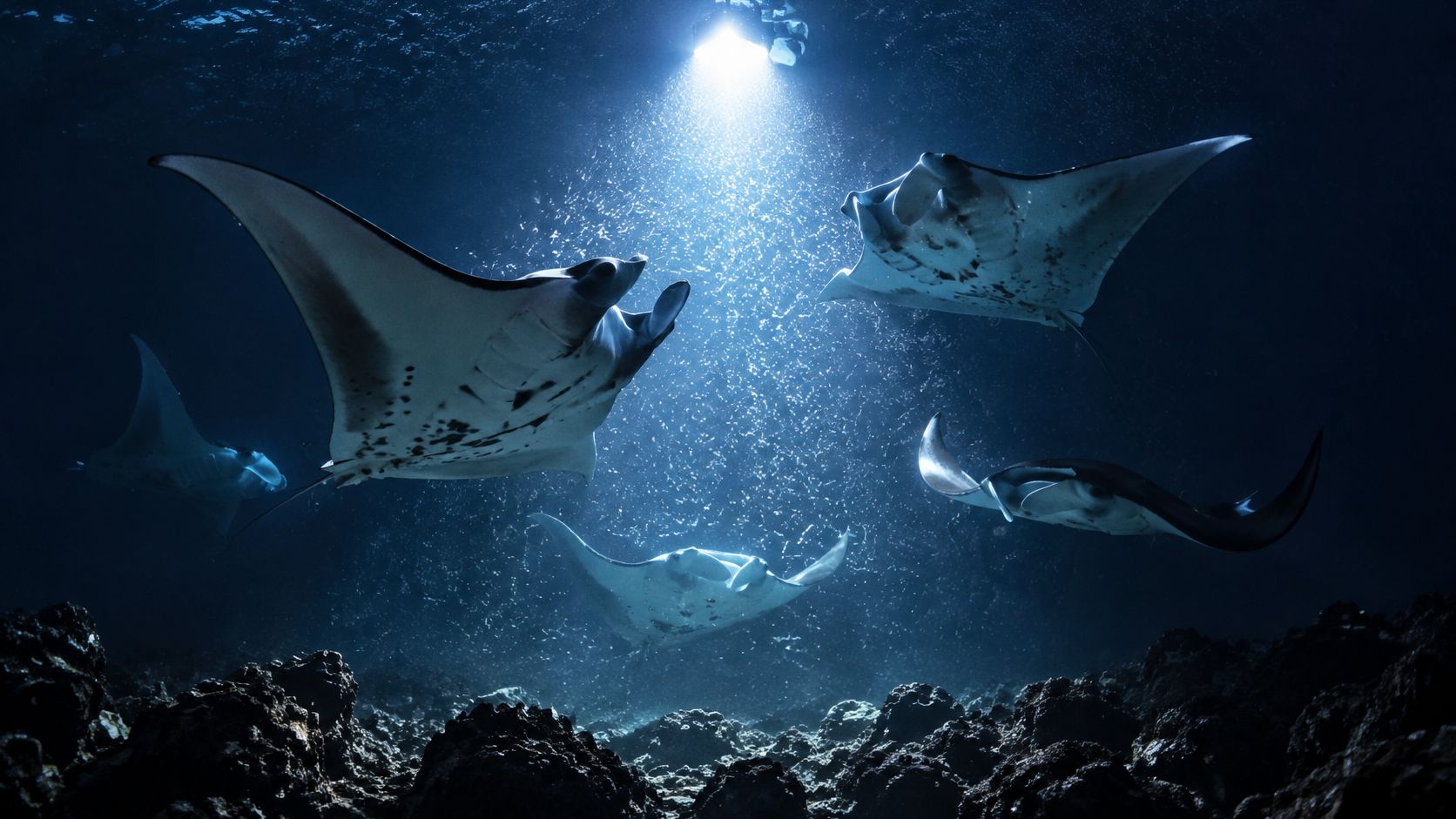
The lights work like a porch lamp drawing moths, except the animals gathering in the beam are plankton. The mantas follow that concentrated food, not an instruction from the crew.
This distinction matters. You're watching a feeding opportunity created by illumination, not a trained performance or a cleaning-station visit.
From Light Beam to Feeding Pass
Phototactic zooplankton move toward light and gather in the illuminated water. A manta opens its mouth and unfurls its cephalic fins, the lobes beside its head, to help funnel that plankton-rich water inward.
Inside, gill rakers retain food while water passes out through the gills. The Hawaiʻi Division of Aquatic Resources' manta-ray spotlight describes this feeding mechanism and identifies prey including euphausiids, copepods, mysids, decapod larvae, and shrimp.
Repeated passes let a manta work through the same productive patch. Chain formations and barrel rolls are feeding behaviors, not gestures aimed at the people watching.
Practical rule: Leave the illuminated feeding corridor open. Your best contribution is a predictable position, not a closer approach.
Why the Number of Mantas Changes
A University of Hawaiʻi study analyzed 13 years of observations collected from 2010 through 2022 and found that changes in aggregation size closely tracked zooplankton density. Food availability helps explain why the same viewing setup can produce very different evenings.
Darkness lets the lights establish a concentrated viewing area, while calm surface conditions make the operation easier to manage. Don't interpret that as a reason to select a particular moon phase or expect a guaranteed turnout.
On a productive evening, isolated passes may develop into a sustained flow of feeding animals. On another evening, the gaps may remain long, or mantas may not appear. Individual rays can return across nights, but they remain free to feed elsewhere.
Garden Eel Cove Versus Other Kona Night Sites
Garden Eel Cove is the superior default choice for our manta night dive. Its protected setting, better-defined viewing area, and healthier surrounding reef make it preferable for the complete dive experience, not just the possibility of a manta passing overhead.
Our go-to site is generally calmer and more protected from open-ocean swell. That protection is a reason to prefer it, not a guarantee that every departure will encounter flat water.
Garden Eel Cove Compared With Keauhou
| Site | Typical pattern | Crowding |
|---|---|---|
| Garden Eel Cove | Larger, more variable nighttime aggregations in a protected viewing area | Multiple boats can share a compact viewing area |
| Keauhou | Nearshore night feeding with strongly female-biased sightings | Ask how the operator manages shared-site traffic |
The long-term study published in Environmental Biology of Fishes found larger, more variable aggregations at Garden Eel Cove, while females accounted for 91% of Keauhou sightings. These are differences in recorded site use, not proof that one location will have more animals on your booking date.
The sites shouldn't be treated as interchangeable. Their animal-use patterns differ, and a traveler's experience also depends on the viewing layout and how crews organize their groups.
What the Site Looks Like Underwater
Garden Eel Cove, also called Manta Heaven, is the northern airport-side site near Kailua-Kona. A Garden Eel Cove charter description places it at approximately 30–45 feet, over a gently sloping sandy plain with scattered coral heads and lava-rock formations.
That layout gives certified recreational divers a defined place to observe while surface participants watch the same feeding activity from above. The reef surroundings also matter when judging the overall outing, rather than reducing the evening to a sighting count.
Choose Garden Eel Cove as your starting preference, but let actual ocean conditions decide whether the boat should go there.
Ask which site is planned before booking and whether the captain may relocate. A willingness to change sites for conditions is good judgment, not a failure to deliver the advertised experience.
Logistics, Timing and Pricing for Your Night Trip
Start with your booking confirmation, not a map search for the dive site. The meeting point is where you check in and board, which isn't necessarily the place name you've been reading about.
Confirm the address, vessel name, departure dock, and check-in time. Allow enough margin to sort equipment and listen to the briefing without rushing.
Arrange the Evening in Order
- Find the correct meeting point. Save the confirmation offline so poor reception doesn't leave you searching the harbor.
- Identify your vessel. Several boats may be preparing for nighttime wildlife trips, so match the boat and crew to your reservation.
- Check the schedule. Confirm both departure and expected return, especially if you have transportation or dinner reservations afterward.
- Verify the planned site. Ask the day before travel, then accept that the captain may reassess conditions before departure.
The feeding encounter takes place after dark, but your check-in or boat journey may begin before sunset. Our guide to the best time to see manta rays in Kona can help you distinguish wildlife timing from departure logistics.
Compare the Complete Price
Use the current booking page rather than an old quoted rate. A lower headline price isn't automatically the better value if you still need essential rental equipment.
Check whether the total includes tanks, weights, exposure protection, lights, and other rental gear. Clarify whether transport means the boat journey only, rather than assuming accommodation pickup is included.
- Meeting point: Confirm the exact address and check-in instructions.
- Vessel: Save the boat name and departure dock.
- Timing: Check departure, return, and expected in-water time.
- Equipment: Identify what's supplied and what you must bring.
- Cancellation terms: Understand weather cancellations, guest cancellations, and any no-sighting policy separately.
Don't assume a wildlife policy also covers a change of mind, a missed departure, or unsuitable personal equipment. Those are different booking questions.
How the Night Dive Unfolds, Step by Step
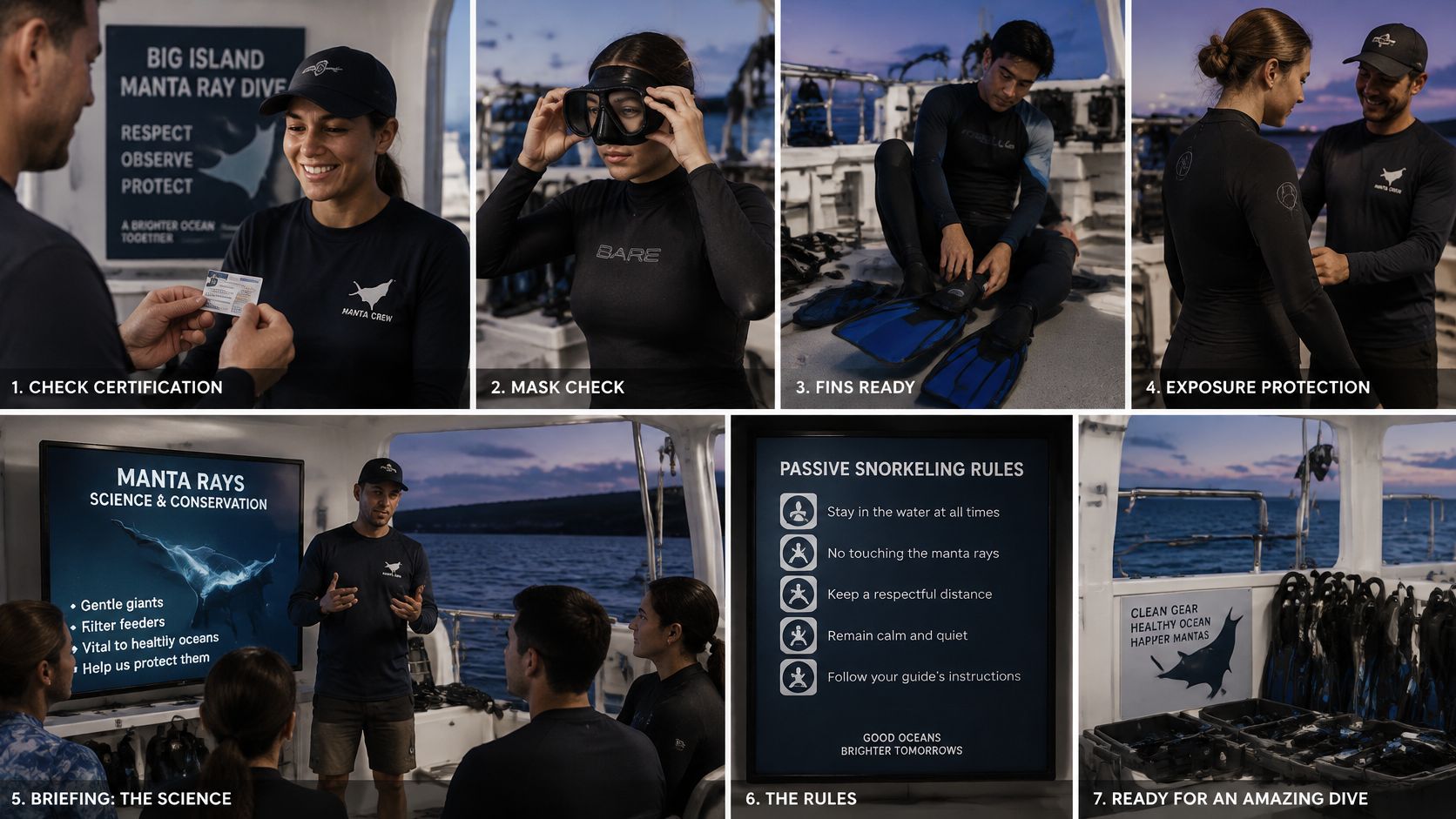
A successful manta dive is deliberately organized. The crew establishes where you enter, where you watch, and how you return, so you can concentrate on the animals without improvising underwater.
From Gear Check to Viewing Position
Check in and fit your equipment. Have your certification information ready, identify your buddy, and check your mask, fins, and exposure protection. Fixing an uncomfortable strap aboard is easier than adjusting it during the descent.
Listen to the detailed briefing. Our crew explains the science behind the encounter and the golden rules of passive observation. Pay particular attention to signals, entry procedures, and the return route.
Enter by the crew's designated route. Use the operator's line as instructed and remain with your buddy. Following the planned approach keeps your group together and avoids crossing another group's path.
Take the assigned viewing position. We position divers in a specific viewing area, kneeling only on the designated sand, with lights aimed upward into the water column. Surface participants direct their lights downward, while everyone leaves the central feeding space clear.
During the Encounter and Return
Keep your body and equipment low. Secure dangling gauges and avoid unnecessary fin movement. You'll reduce accidental contact and avoid stirring sediment into the viewing area.
Let the mantas choose their approach. Don't touch, chase, block, or ride them, and avoid directing exhaled bubbles toward a manta's face. The Love Big Island manta encounter guide explains these passive-observation practices and their role in protecting the animals' mucus coating.
Follow the in-water team. Experienced divemasters and instructors manage our group, so watch their signals rather than copying a neighboring operator's guests. Maintain controlled buoyancy because a feeding animal can turn across your viewing space unexpectedly.
Return and ascend along the designated line. Stay with your buddy and follow the crew's exit instructions. Don't leave the group to surface elsewhere because you think you recognize the boat's lights.
If photographs are important, review the manta night dive photo-package information before departure. Planning photography ashore helps you avoid making camera decisions while you should be listening to the crew.
The most satisfying encounter often feels surprisingly quiet. You stay in place, settle your breathing, and watch whatever passes the animals choose to make.
Safety, Crowding and Respecting the Mantas
A protected dive site can still be busy. The Underwater Atlas Garden Eel Cove guide reports that as many as 10 boats and approximately 80 divers and snorkelers may share the small site simultaneously.
That makes boat coordination and guest supervision central booking criteria. A high sighting rate doesn't explain how a crew prevents a surface swimmer from entering a maneuvering vessel's path.
Separate Operational Practice From Proposed Rules
A Hawaiʻi County boating-operations safety assessment identified vessel and participant numbers as factors increasing accident likelihood, reported no effective capacity controls at the assessed sites, and discussed scrutiny following a 2022 fatality during a manta operation.
The assessment also identified a regulatory gap around nighttime swimming and snorkeling near actively maneuvering vessels. That's a finding about the assessed arrangements, not a statement that every operator follows the same procedures.
Management measures discussed in 2023 were proposals, not adopted rules: 24 commercial boats, 60 passengers per site per day, viewing from 4 p.m. to 4 a.m., a two-hour visit limit, and one guide per eight customers, as described in the site guide linked above. Don't treat those proposed limits as proof of today's capacity or your departure's guide ratio.
Questions Worth Asking
- Guide coverage: How many guests will each in-water guide supervise?
- Boat spacing: How does the crew coordinate with neighboring vessels?
- Entry and exit: Who controls when guests enter and when the boat can maneuver?
- Surface exposure: How are snorkelers kept clear of vessel traffic?
- Site changes: Does the group-management plan change if the boat relocates?
Our experienced divemasters and instructors are in the water managing divers. Guests should also understand responsible and considerate diver etiquette before entering a shared wildlife-viewing area.
Legal protection is separate from operator etiquette. Capturing, possessing, abusing, or entangling rays in Hawaiʻi state waters is prohibited, with civil and administrative penalties potentially reaching thousands of dollars.
Returning mantas don't establish zero ecological impact. Treat their continued presence as a reason to preserve careful observation, not permission to relax it.
Frequently Asked Questions About the Night Dive
Do I Need Certification to See Manta Rays at Night?
No. Certification is required for the scuba option, while non-divers can observe from the surface; families considering the age-five-and-up snorkel option should confirm eligibility for their selected departure.
Will I Definitely See Mantas?
No sighting is guaranteed. Wild mantas decide where to feed, so book with realistic expectations and ask what the operator offers if none appear.
Can I Touch or Ride a Manta if One Comes Close?
No. Operator rules prohibit touching, chasing, blocking, and riding, while Hawaiʻi law separately prohibits abuse and other specified interference with rays.
Keep your hands to yourself even when an animal passes within reach. A close approach isn't an invitation to make contact.
How Long Is the Trip?
Confirm total trip length and planned in-water time for your specific departure. A combined reef-and-manta outing has a different schedule from a surface-only encounter, and neither should be planned from an unrelated tour description.
If depth is your main concern, review how deep the Kona manta ray dive is and discuss your comfort with the crew before booking.
What if the Site Changes?
A captain may choose another location when ocean conditions or recent animal activity make it preferable. Confirm the intended site before booking and again before travel, but recognize that safe decisions sometimes happen on departure day.
Booking perspective: A clear explanation of a site change is more useful than an inflexible promise to visit one location regardless of conditions.
Book Your Night Dive at Garden Eel Cove
Choose the scuba departure if you're certified and comfortable diving after dark, or the snorkel departure if you want to watch from the surface. Our manta dive takes place at Garden Eel Cove, with site protection and an organized viewing area central to the experience.
Kona Honu Divers offers the Manta Ray Night Dive alongside blackwater and daytime reef diving. Choose an outing for the underwater experience you want, rather than treating all night dives as interchangeable.
Build a Practical Itinerary
- For a certified diver: Plan a morning reef outing, leave time to rest, then join the Manta Ray Night Dive if the schedule and your dive planning allow. Don't book a supposed morning manta encounter when your objective is the light-based nighttime feeding event.
- For a non-diver family: Choose the Manta Ray Night Snorkel and confirm each person's age eligibility and water comfort before paying.
- For an education-focused diver: Ask about completing the PADI Manta Ray Diver specialty before the night dive, with course scheduling confirmed in advance.
Compare inclusions, confirm the planned site, and ask for the actual guide-to-guest ratio on your departure. Also check how rental sizing, cancellation terms, and no-sighting arrangements apply to your booking.
Reserve the Appropriate Departure
For certified scuba divers, use the scuba booking calendar and select the manta departure.
For surface viewing, use the Manta Ray Night Snorkel calendar after confirming your group meets the participation requirements.
Kona Honu Divers offers guided manta ray night diving at Garden Eel Cove, with a detailed briefing and experienced in-water supervision. Visit Kona Honu Divers to confirm your date, planned site, and guide ratio, then reserve the departure that matches your certification and comfort.