
Table of Contents
- What actually sets the count
- Snorkel versus the optional course
- Boats in the dark
- What a bump actually costs
- If you want a harder night
- How to lock the date
You're comparing two Kona boats for the same night, both promising mantas, and you still don't know which cove is worth the booking or what a quiet night means. A Big Island manta ray night is a wild feeding event, not a show with a headcount. Site, prey, and how still you stay decide the night.
Where and When to See Big Island Manta Rays
Choose Garden Eel Cove for a night dive or night snorkel. It is the protected basin with the better viewing area, the healthier reef, and generally calmer water than open-coast sites.
| Site | Aggregation pattern | Protection and reef | Best for |
|---|---|---|---|
| Garden Eel Cove | Larger, more variable aggregations | Protected location, better viewing area and better reef | Night manta dive and night snorkel (recommended) |
| Keauhou | Smaller aggregations, disproportionately female with high female site fidelity | More exposed coast, without that sheltered viewing basin | A smaller, female-skewed night group |
Long-term University of Hawaiʻi surveys at those two principal sites built a catalog of individually identified reef manta rays (Mobula alfredi) over more than a decade. Garden Eel Cove generally held the larger groups. Keauhou drew females more heavily, and rays moved between the two coves.
The practical difference is simple. Garden Eel Cove's protected basin gives the crew a stable place to set lights and gives you a sandy spot to kneel. Keauhou's exposure means swell can move both the setup and the animals.
What actually sets the count
The calendar is a weak promise. A 2025 University of Hawaiʻi study found that annual and seasonal changes in aggregation size closely tracked zooplankton density, and that Keauhou showed high female site fidelity. Plankton thick in the beam means more looping animals. A thin night can mean one or two rays, or a long wait. That is a natural outcome, not a failed trip. Seeing mantas and seeing a crowd are different results.
Practical rule: Book the boat that dives Garden Eel Cove, ask what the plankton and swell look like that afternoon, and keep a second night open.
Year-round timing, and why one month isn't a magic window, is laid out in when to see manta rays in Kona.
Certification and Physical Needs for Each Manta Trip
Match the trip to the card you hold and to whether you can stay still in the dark.
| Option | Certification needed | Physical demand | Position in the water |
|---|---|---|---|
| Manta Ray Night Dive | Certified scuba diver | Kneel on sand, hold still for long periods, steady breathing in dim light | Kneeling on the sandy bottom |
| Manta Ray Night Snorkel | Snorkeling skills and comfort in dark water | Float at the surface, stay calm and still | Floating at the surface |
| PADI Manta Ray Diver specialty | Certified divers, optional course | Classroom session plus a dive | Before the night dive |
The night dive is open to all certified divers. You don't need a night-diving specialty to join. Divemasters and instructors are in the water to manage the group, and the dive stays in one place rather than swimming a reef circuit. I would still skip it if your buoyancy is shaky. Kneeling on sand only works if you can settle, dump air, and stop finning.
Snorkel versus the optional course
The Manta Ray Night Snorkel puts you on the surface, so there is no scuba certification. You do need to be comfortable with a mask at night and willing to float without splashing. If you've never been in the ocean after dark, read whether you can scuba dive in Hawaii without certification and then pick the snorkel, not a rushed cert.
The optional PADI Manta Ray Diver specialty is for people who already dive. It covers manta biology, behavior, and conservation, and it teaches respectful interaction before the night dive. It is useful, not required.
Self-check before you pay: you can kneel without standing up, breathe slowly when the water goes dark, and keep fins off the bottom. If any of those is a no, take the snorkel or wait for a later session.
What Happens on a Manta Night Dive, Step by Step
This is a light-and-position setup, not a trained-animal performance. Kona Honu Divers' account of the night dive explains the mechanic: divers stay low and aim lights up, snorkelers aim lights down, plankton stacks in the beam, and mantas loop the lane.
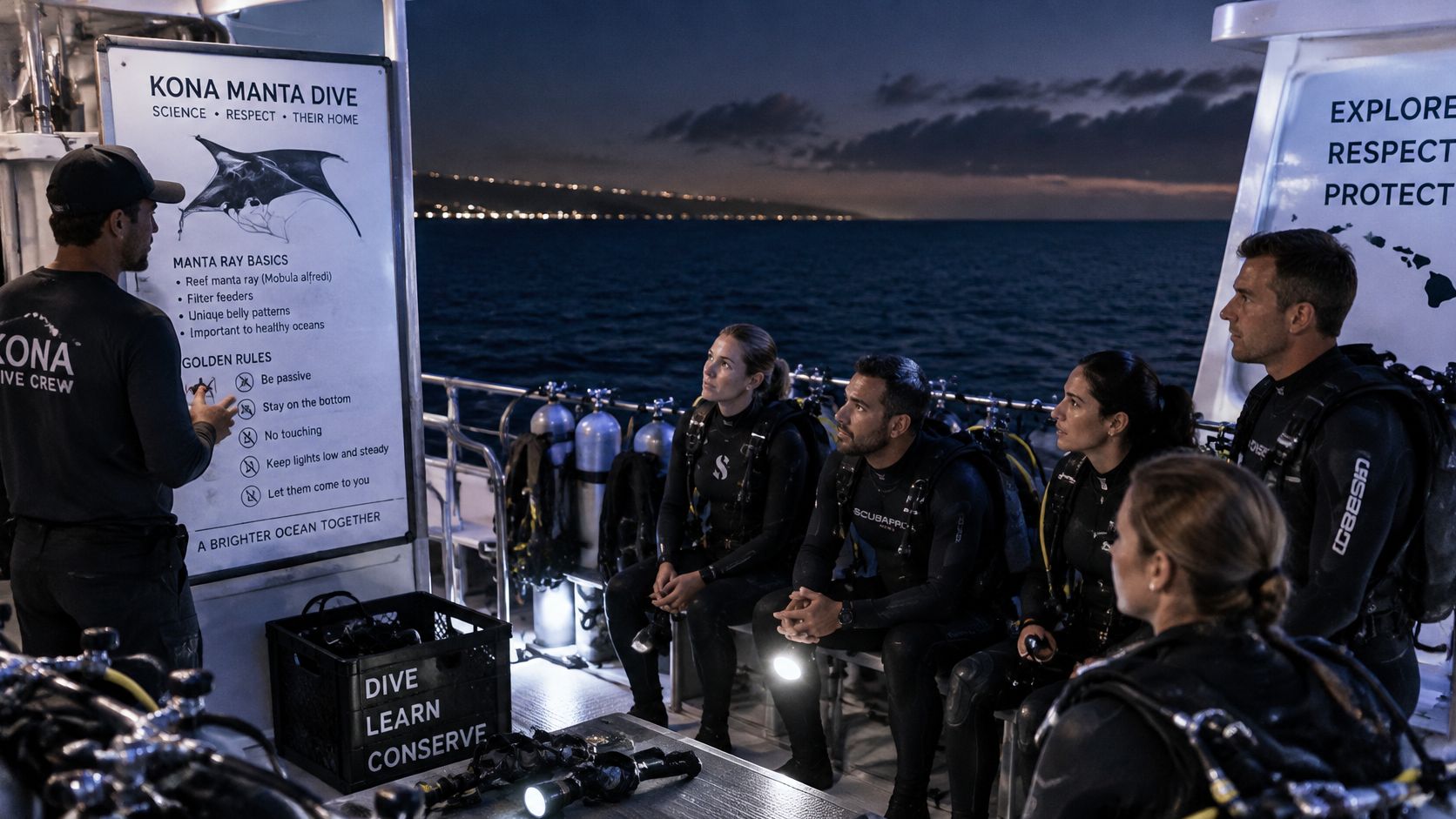
- Briefing on the boat. The crew explains why the lights work and the golden rules of passive observation. Listen here. Once you're on the sand, hand signals replace the lecture.
- Gear check and entry. Divers carry their own lights, drop in, and settle on sand. Snorkelers stay at the surface on flotation. Splitting the group keeps the middle of the water empty.
- Lights on the bottom. The crew sets a powerful set of lights on the seafloor so plankton gathers in one bright circle. You are not sitting in total darkness. Put lights on sand or rubble, never on live coral.
- Hold the lane open. Divers stay on or near the seafloor and point lights upward. Snorkelers point lights downward. Nobody parks in midwater, because a body in the column is a wall in the feeding path.
- Mantas arrive on their clock. They pass through the lit lane again and again, sometimes within inches, wings well over 12 feet across. Guides stay with the group so nobody drifts into that path.
- Watch and wait. Hold your kneel and let each animal choose the distance. A quiet ten minutes is normal. Chasing the first shadow usually scares off the second pass.
- Exit on the signal. The crew ends the dive, you ascend on plan, and the sighting gets logged. That log is how operators know who showed up.
A good view from the sand is simple. You are heavy and still, the beam is a column above your head, and a manta rolls through it with the mouth open, close enough to feel the wash, without you reaching.
Rules That Keep Mantas and Divers Safe
The “look but don't touch” line is not just etiquette. Hawaii marine-wildlife rules prohibit intentionally or knowingly capturing or entangling a shark or ray, alive or dead, or killing one, in state waters under HRS §§188-39.5 and 188-40.8. A related permit framework, still a proposal rather than a rule on every boat, considered 24 commercial permits in each of two zones, 60 passengers for hire per vessel within 24 hours, viewing from 4:00 p.m. to 4:00 a.m., two-hour shifts, and an 8-to-1 guide-to-customer ratio.
On the dive that law becomes five bans: don't touch, grab, chase, ride, or block a manta. Hold your kneel or your float. The ray sets the gap. Hands, knees, fins, and cameras stay off live coral.
Boats in the dark
Several vessels can share one cove. Unlit snorkelers and divers under the hull are hard to see. A safety assessment reported by SFGATE warned that boats were seen above minimum operating speeds and passing within roughly 10–20 feet of unlit snorkelers or directly over divers, and it called for substantial mitigation.
A careful boat sits off the viewing lane, lights its swimmers, briefs passengers before the splash, and calls the night when wind or traffic makes the site unsafe. Passive habits are spelled out in responsible diver etiquette.
Three rules on every encounter:
- Stay put. Let the manta close the distance.
- Stay off the animal and the coral. No hands, no rides, no fin kicks into the reef.
- Stay lit and clear of props. If you can't see the boat, the boat may not see you.
Why Kona’s Manta Population Depends on Careful Visitors
You are not dipping into an endless stream of passing giants. Kona's reef mantas are a small resident group that uses the same coastal feeding spots over and over.
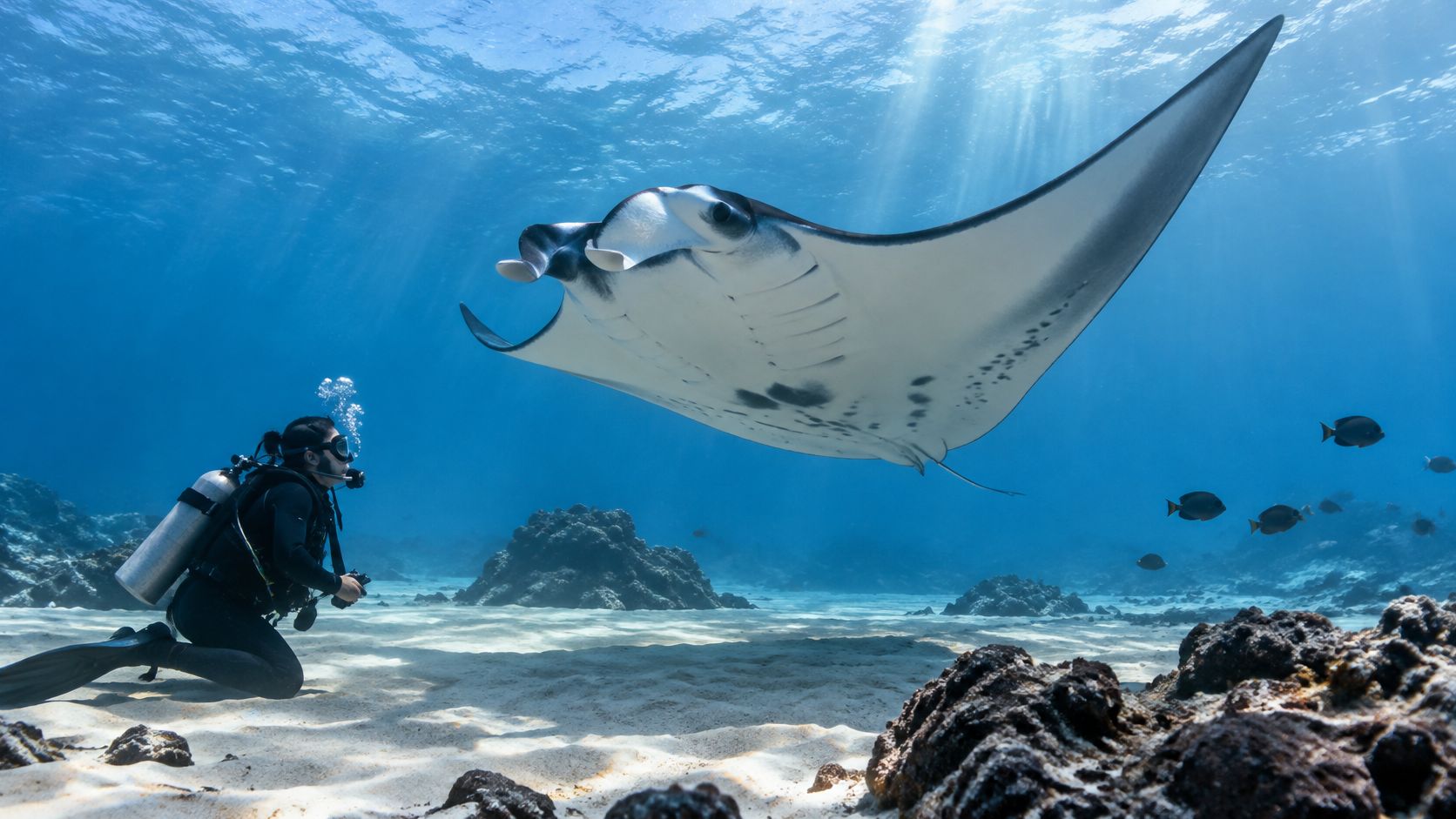
Federal conservation material reports that 76% of 105 manta rays observed during 15 years of Hawaiian surveys were re-sighted along the Kona coast. The same record describes reef mantas as resident where coastal productivity and predictable prey occur, with night feeding tied to zooplankton moving upward. Small island populations do not mix freely across deep channels.
What a bump actually costs
A strike, a blocked pass, or a night of boats sitting on the animals hits this local group. It does not get absorbed by a huge, well-connected regional stock. Surface feeding also puts rays in the path of hulls. Pulling them off a cleaning station or a feeding loop steals time from those jobs.
Aggregations have kept forming while tourism grew, which is real resilience. It is not proof that every extra boat, brighter lamp, or closer pass is harmless. Injury at one cove is injury to animals you may see again next year.
Belly spots identify individuals. If your guide logs a ray, that note is conservation data, not a souvenir. How we run boats around that limit is part of our eco-friendly practice.
Manta Ray Questions Visitors Ask Most
Can I see mantas without diving? Yes. The night snorkel is the surface seat, and the same seafloor lights make the feeding lane visible from above. Hold the float, keep your fins quiet, and look straight down.
Are mantas guaranteed every night? No. Divers have seen mantas on 92% of Manta Ray Night Dive trips, which is frequent and still not a promise. Prey thins out on some nights. A good crew will say so instead of inventing a backup animal.
Is it safe when several boats are out? It can be, when the boat holds a conservative position, briefs you before entry, and will shorten or cancel if the cove gets unsafe. Ask that question before you board, not after the lights go in.
Can I touch one? No. Grabbing, chasing, and riding are off limits, however close a wing comes. For the separate worry about a barb, see whether manta rays can sting you. Your job is still the same: watch, don't reach.
A lower count is still a real encounter. Treat it that way and you'll enjoy the animal in front of you.
Book Your Garden Eel Cove Manta Trip
If you're certified and you want the view from the sand, book the Manta Ray Night Dive at Garden Eel Cove. That is our go-to site because the cove is protected, the viewing area is better, the reef is healthier, and the water is generally calmer. If you want the same feeding lane from the surface, take the manta night snorkel instead of forcing a dive you're not ready for.
The night itself is stationary and closely supervised. Experienced guides keep the group safe and comfortable. Crew lights go on the seafloor to draw plankton, divers kneel on the sand, and snorkelers float above the beam. You can book the 2-tank manta dive and snorkel online, or scan the rest of the diving tours if you want a daytime reef dive on the same trip.
If you want a harder night
Certified divers who want more depth and range should look at the Premium Advanced 2-Tank Trip. Divers curious about open-ocean night water, rather than a sandy kneel under feeding rays, can add the Black Water Night Dive. Those are different dives. Don't treat them as a substitute for Garden Eel Cove if the manta lane is the reason you came.
How to lock the date
Night seats fill first in holiday weeks. Reserve the Garden Eel Cove night, then add a backup night so a windy cancellation doesn't end the trip. Confirm three things in the booking notes: that the boat uses Garden Eel Cove, what time the briefing starts, and what the weather call looks like if the cove is messy.
At Kona Honu Divers, check the dive seats on the booking calendar.
Snorkel seats, if the surface is your plan, are on the snorkel booking calendar.
Do these three things today. Confirm your certification matches the dive, or switch to the snorkel. Book a second night behind the first. Check the weather plan so a rough cove doesn't surprise you at the harbor.
Kona Honu Divers runs Garden Eel Cove manta nights for certified divers and for snorkelers who want the same feeding lane from the surface, with guides in the water and lights set for the animals rather than for a show. If a Big Island manta ray night is the reason you're coming to Kona, reserve the cove that stays calmer and gives you the clearer view. Visit Kona Honu Divers and lock the date before the week fills.