
Table of Contents
- A stationary dive still requires attention
- What repeated observations reveal
- Why this matters when booking
- Keep the feeding route predictable
- Don't try to repair a quiet night
- Garden Eel Cove vs Keauhou for Manta Night Dives
- Better layout doesn't mean guaranteed conditions
- From briefing to water entry
- Leave room in the evening
- Check the physical details before paying
- Handle seasickness and medication questions ashore
- Ask about conditions, not a magic moon phase
- Reserve with the right questions
- Make the rules operational
- Identification records aren't population censuses
- Final questions before reserving
The lights don't summon manta rays. They concentrate food, and the mantas decide whether feeding there is worth the effort. That distinction explains why a Big Island manta ray night can be extraordinary without ever being predictable: reef mantas respond to plankton availability and ocean conditions, not the number of people waiting underwater.
Why the Big Island Manta Ray Night Dive Is Unlike Anything Else
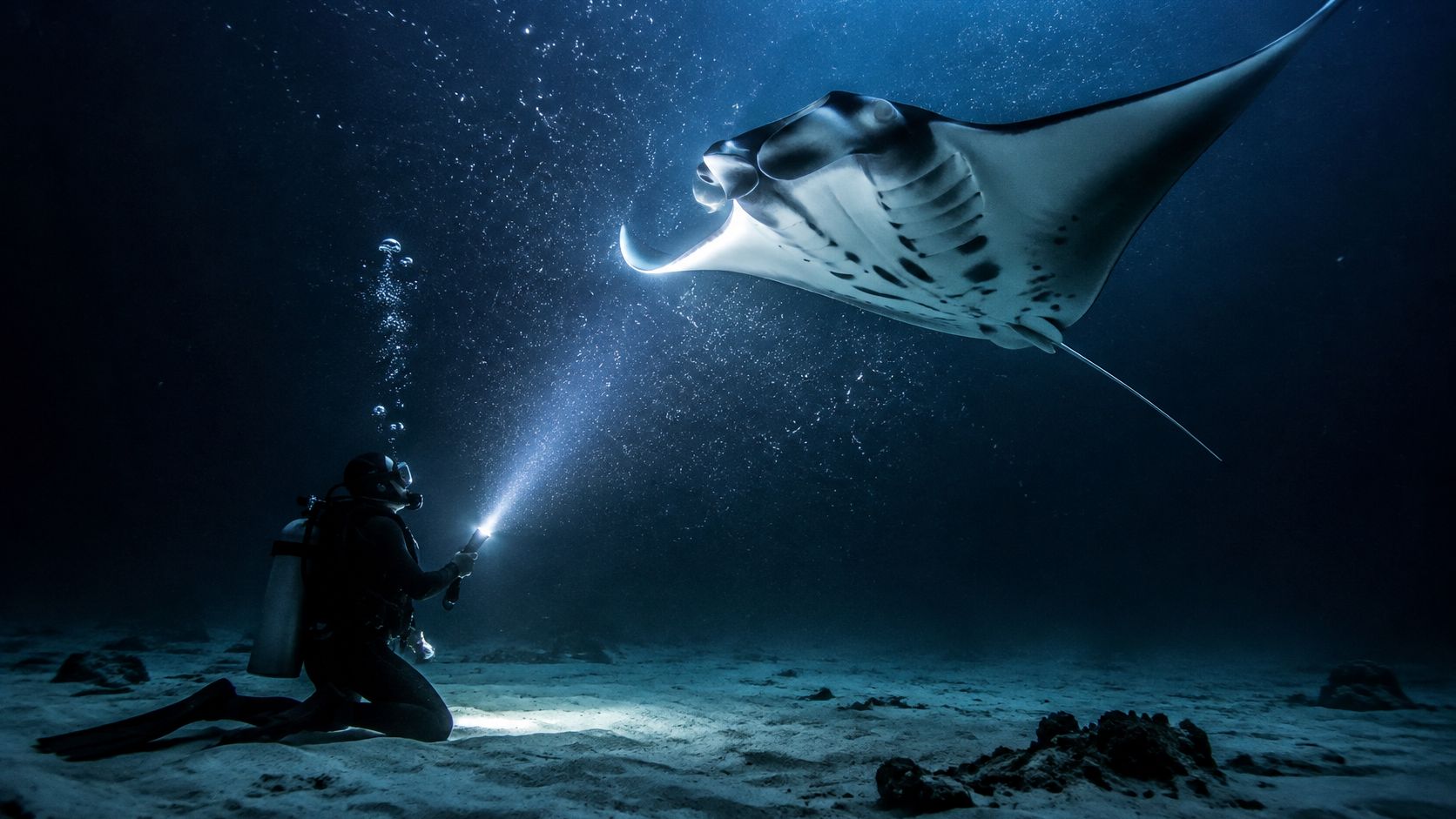
A manta passes close above a stationary diver, filling the light beam with its pale underside. The useful response isn't to swim after it or lift a camera into its path. It's to stay settled, breathe normally, and leave the animal room to complete its pass.
That's the defining feature of this dive. You aren't searching a reef with your flashlight. You're taking a position beside a feeding area and letting wildlife move around you.
A stationary dive still requires attention
The usual underwater arrangement puts divers near the sandy bottom with lights directed upward. Your guide determines the precise position, which might involve hovering close to the substrate or settling on an approved sandy patch. Kneeling isn't permission to land wherever you like.
Compared with a moving reef dive, the challenge changes. Instead of navigating from feature to feature, you're managing your breathing, position, equipment, and excitement while something remarkable happens nearby.
Practical rule: A close pass is something the manta chooses. It isn't an invitation to close the remaining distance.
Kona's appeal comes from the combination of resident animals, established feeding sites, and long-running observation. There's no need to claim this behavior is impossible elsewhere to appreciate how distinctive the local encounter is.
The scuba and surface-viewing formats give different participants ways to observe it, but neither is automatically suitable for everyone. Age, water confidence, mobility, and operator requirements still matter.
For a first visit, prioritize site selection and personal readiness over promises of spectacular photographs. A protected viewing area and a diver who can remain comfortable and predictable are more useful than an elaborate camera rig.
The Resident Manta Rays of Kona and How They Are Studied
Kona's reef mantas, Mobula alfredi, aren't interchangeable visitors arriving from an unlimited offshore population. Long-running identification work describes a relatively small community whose members are encountered repeatedly.
From 1992 through 2007, researchers completed 3,208 surveys, primarily at Keauhou and Ho'ona Bay, identifying 106 individuals recorded between 1 and 724 times; the same historical record cautiously suggested a population below 200 animals, without a completed formal mark-recapture estimate, and documented 30 new pups between 1994 and 2007, approximately 2 annually (historical Kona manta survey testimony).
Those figures describe a particular survey period, not a current head count. They also show why counting silhouettes during an occasional busy night isn't enough to understand the population.
What repeated observations reveal
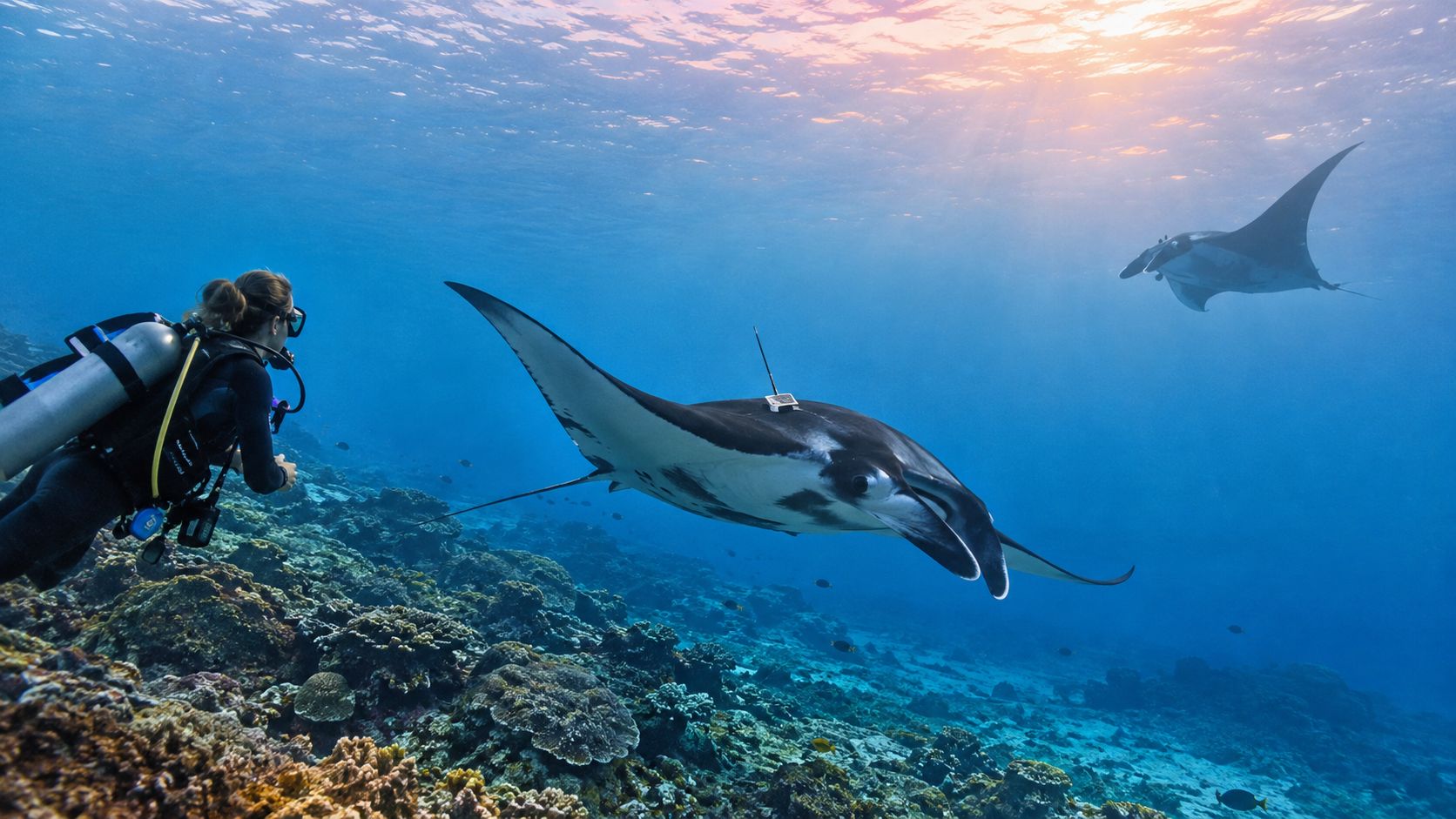
Photo-identification lets researchers connect encounters involving the same animal rather than treating every sighting as a new manta. For visitors, the important distinction is between individual animals, total sightings, and animals present on a particular night.
- Individual catalogs establish which animals have been documented across a survey's geographic area and duration.
- Repeat sightings help reveal recurring use of feeding locations.
- Pup observations provide a baseline for considering reproduction, not proof that the population is increasing.
- Uneven encounter histories mean a frequently photographed animal and a rarely photographed one shouldn't be assumed to use a site identically.
The modern Garden Eel Cove and Keauhou observations add another useful distinction: animals can share the same coastline while using particular sites differently. A familiar manta's absence doesn't, by itself, establish that anything has happened to it.
Why this matters when booking
Think of recognizable animals as residents with choices, not scheduled performers. An operator can choose a suitable site, organize the group, and explain the encounter, but can't require a particular manta to attend.
For background on the animals themselves, the guide to manta rays in Hawaii provides useful context before comparing tours.
How Plankton Lights Actually Attract Manta Rays
The mantas are feeding, not investigating divers. Underwater lights increase the visibility and local concentration of zooplankton, while mantas use specialized cephalic fins to guide water and prey toward their mouths; as large planktivores in generally nutrient-poor tropical water, they need concentrated prey to make feeding energetically worthwhile (research on Kona manta feeding behavior).
That explains why installing the same lights in the same place doesn't produce an identical night. Currents, prey availability, clarity, and seasonal productivity can change the feeding opportunity.
Keep the feeding route predictable
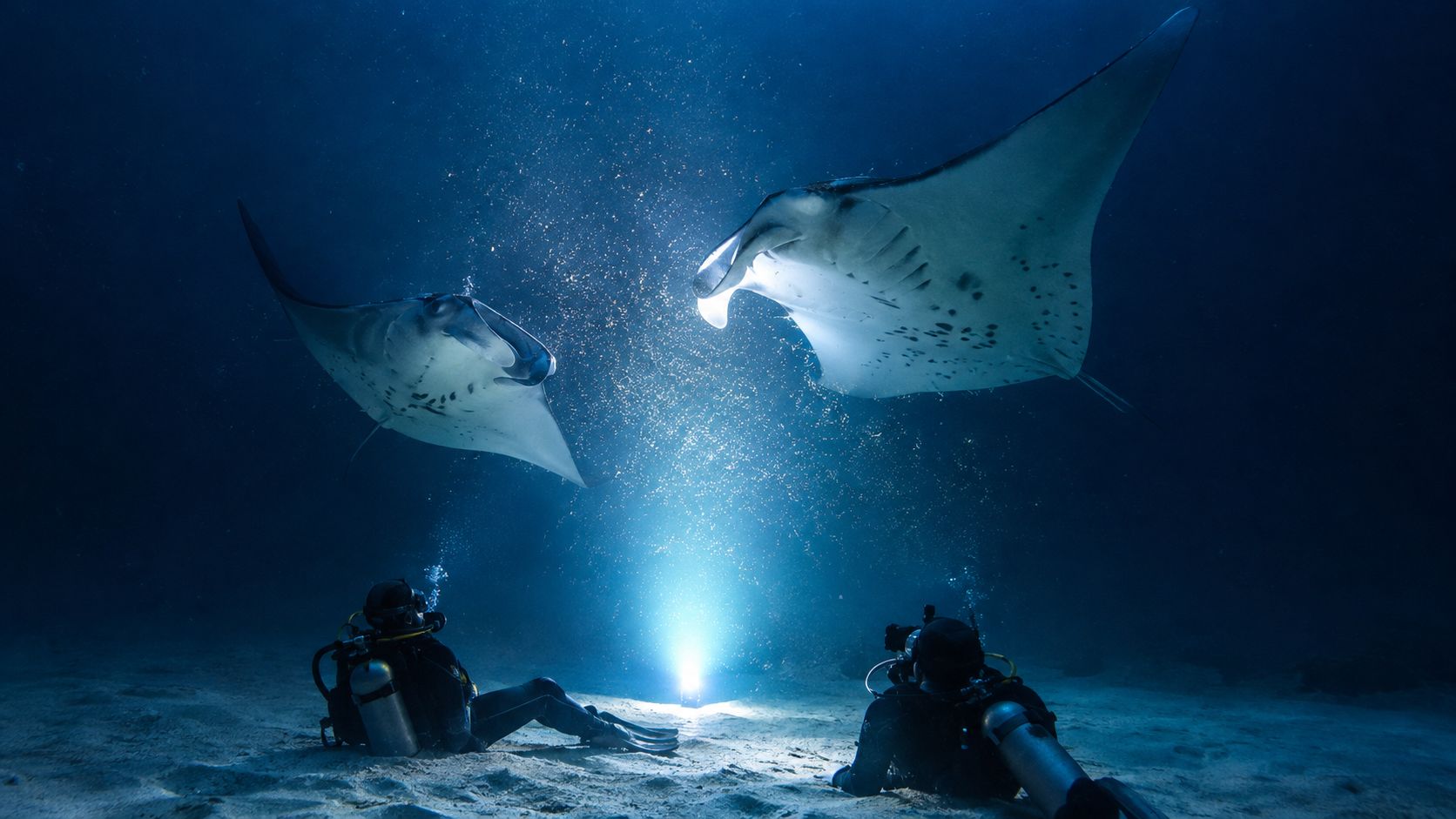
Your job is to avoid becoming an obstacle in the illuminated area. Before settling into position, establish control of your buoyancy and secure anything that could hang into the space above you.
- Adjust before the approach. Sort out your position while the space is clear, rather than making a large correction as a manta arrives.
- Keep fins quiet. Repeated kicking beside other observers creates unnecessary disturbance and makes your position less predictable.
- Follow the lighting briefing. Use the direction and placement your guide specifies instead of sweeping your beam around to follow every movement.
- Keep equipment close. A camera arm or loose accessory can occupy space your body doesn't.
The useful question isn't “How do I get closer?” It's “Am I leaving a clear route through the feeding area?”
Don't try to repair a quiet night
If mantas aren't feeding in front of you, swimming away from the group doesn't improve the food supply. Nor does adding frantic movement or redirecting your light independently.
Tell the guide if you're uncomfortable, drifting, or struggling to hold position. A controlled adjustment is better than silently fighting your gear.
Good observation often looks uneventful from the diver's side. That's the point: you're keeping your own movements small enough that the animals can continue making theirs.
Garden Eel Cove vs Keauhou for Manta Viewing
Garden Eel Cove is my preferred choice for a manta scuba dive because the viewing layout and protected setting work together. Also called Manta Heaven, it lies north of Kailua-Kona near Kona International Airport, with shelter from common southerly swells and a sandy observation area surrounded by reef habitat (Garden Eel Cove geography and dive-site description).
That combination matters more than a site nickname. Divers need somewhere appropriate to position themselves without occupying living coral, and a protected location can make holding that position more comfortable.
Garden Eel Cove vs Keauhou for Manta Night Dives
| Factor | Garden Eel Cove | Keauhou |
|---|---|---|
| Shelter | Protected from common southerly swells | Assess the actual forecast and operator's site decision |
| Viewing layout | Sandy viewing area beside surrounding reef | Ask how divers are positioned and separated from reef |
| Reef considerations | Strong combination of reef surroundings and an appropriate observation area | Don't assume comparative reef condition without site-specific evidence |
| Observed aggregations | Larger aggregations in the comparative dataset | Smaller aggregations in that dataset |
| Ecological role | Particularly reliable feeding area | Female-skewed visitation suggests additional ecological significance |
The 2010–2022 analysis covered more than 23,000 sightings of 167 identified mantas and found consistently larger aggregations at Garden Eel Cove; it also reported an approximately 1:1 sex ratio across the observed population, predominantly female visitation at Keauhou, strong female site fidelity there, connectivity between sites, more mobile males, and aggregation changes associated with zooplankton density (community-sourced Kona manta analysis).
Better layout doesn't mean guaranteed conditions
For a scuba visitor, Garden Eel Cove offers the stronger overall package: shelter, a better-defined sandy viewing area, and surrounding reef. That's a practical judgment about the dive experience, not a claim that every part of its reef is healthier than every part of Keauhou.
Keauhou remains an ecologically important location, not an inferior habitat just because fewer animals were observed there. Likewise, Garden Eel Cove's advantages don't override an unfavorable forecast.
Compare the proposed site and format on the manta ray dive tour page, then ask what would cause the crew to change the plan.
What to Expect on a Manta Dive or Snorkel
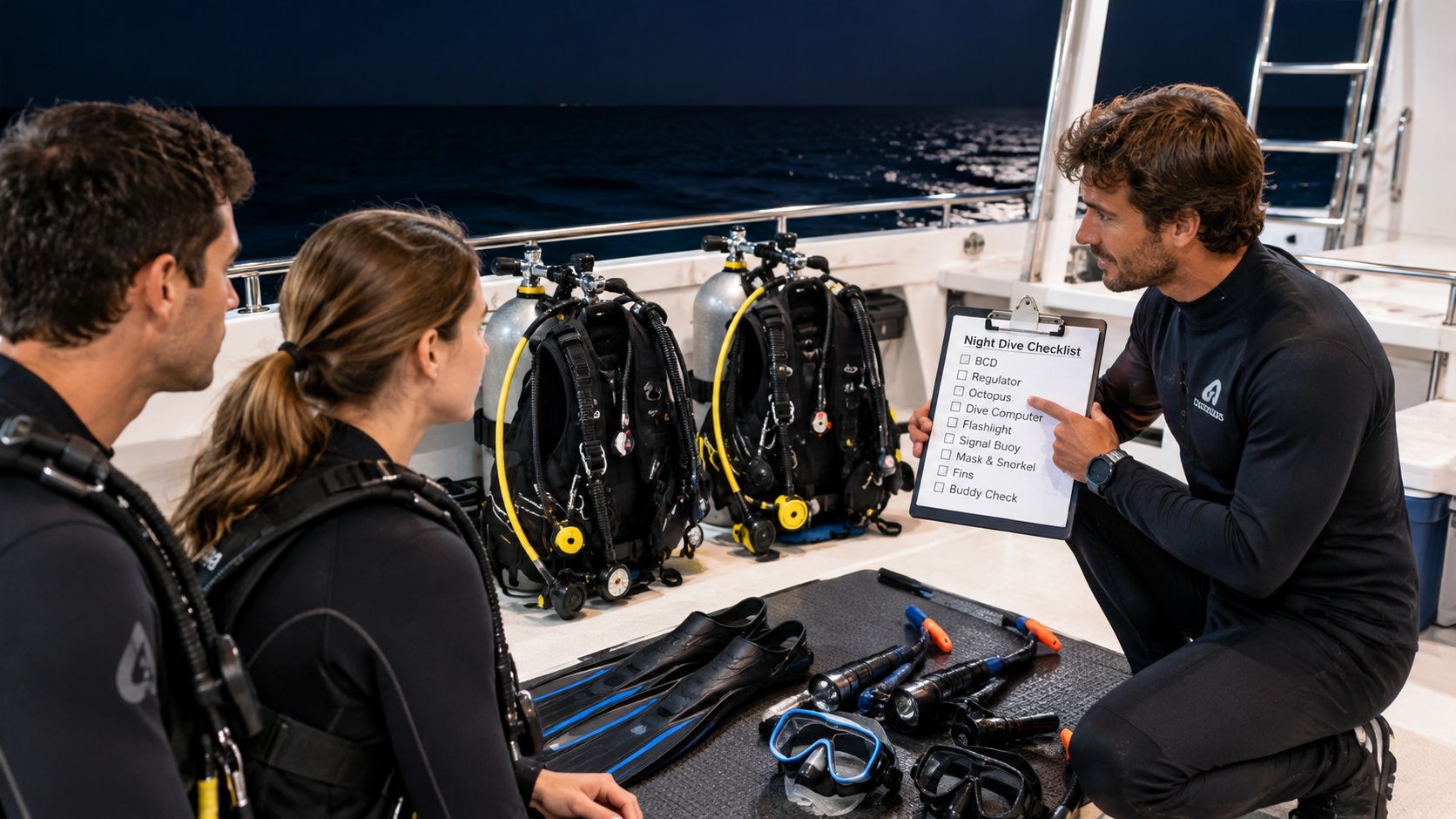
Treat check-in as the start of the dive, not just an equipment handover. Confirm your assigned gear, explain any concern about darkness or water entry, and listen carefully to the return-to-boat procedure.
The standard scuba setup places observers on or near the seafloor with lights directed upward while mantas feed above and around them; it's explicitly observational, with no touching, chasing, or pursuing (overview of Hawaii's nighttime marine encounters).
From briefing to water entry
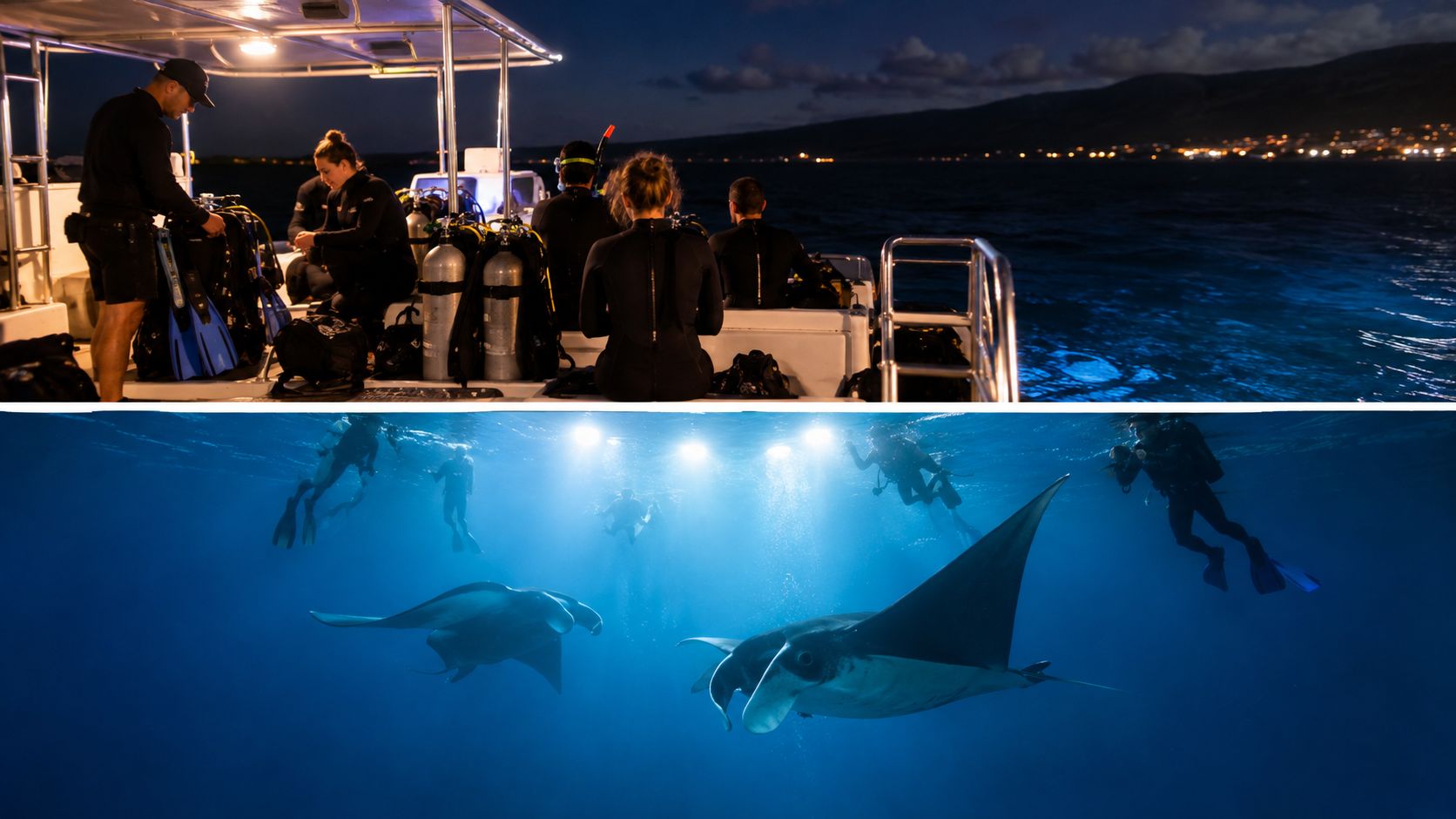
Ask the crew to explain the sequence before you're standing at the entry point. You should know where to wait, how to recognize your guide, and what signal to use if you want assistance.
For scuba, descend with the group and establish your position before concentrating on photographs. For snorkeling, confirm whether you'll use a surface float or line, where to place your hands, and how the guide wants your legs positioned.
- Camera preparation belongs before entry. Secure the housing and accessories, then keep the setup within your own space.
- Warmth planning means checking exposure protection before departure, not discovering discomfort after you're already waiting.
- Exit planning includes understanding the ladder procedure and keeping the boarding area clear.
Leave room in the evening
Don't attach a tight dinner reservation to an assumed return time. Confirm the actual itinerary, including whether the departure contains other diving and how the crew handles changing conditions.
After boarding, follow the equipment-stowage instructions before drying off. Ask where rinsing is available, and plan your hot shower at your accommodation unless the operator confirms otherwise.
If you're undecided about perspective and participation requirements, compare manta ray scuba diving and snorkeling before reserving. Choose the format you can manage comfortably, not the one that sounds more adventurous.
Gear, Skills and Physical Requirements for Manta Nights
The most useful qualification isn't enthusiasm. It's the ability to remain comfortable in the dark while following the guide's positioning instructions.
For the scuba version, confirm the accepted certification, recent-experience requirements, and any refresher recommendation directly with the operator. Don't assume a certification card alone answers whether this particular departure suits you.
Check the physical details before paying
- Water confidence matters for surface participants too. Describe your swimming ability accurately rather than assuming a float removes every requirement.
- Buoyancy control should be comfortable enough that you aren't using the bottom or another diver to manage your position.
- Knee and back limitations deserve a conversation about the planned viewing posture and possible alternatives.
- Boat access includes entry, exit, and ladder use, not just the time spent observing animals.
- Family participation depends on the operator's age, equipment-fit, and supervision policies. Get those answers for each child.
Bring a towel and dry outer layer, and ask which wetsuit, lights, tanks, weights, and other equipment are included. The night scuba diving guide is useful preparation for discussing unfamiliar procedures.
Handle seasickness and medication questions ashore
If you're prone to seasickness, discuss prevention with a pharmacist or clinician before the trip, particularly if you'll scuba dive. Product availability isn't evidence that something is appropriate for diving or for your medical circumstances.
Options sold include the Ship-EEZ Seasickness Patch, Dramamine pills, Bonine pills, Sea Band wristbands, and ginger chews. Check ingredients, warnings, and professional advice rather than treating those products as interchangeable.
Before departure: Tell the crew about discomfort early. Waiting until you're cold, nauseated, or overwhelmed makes an otherwise manageable situation harder to address.
Best Seasons, Conditions and Booking Tips for Manta Encounters
There's no defensible calendar shortcut that guarantees the best Big Island manta ray encounter. Choose a date that leaves flexibility in your itinerary, then let the operator assess the actual ocean conditions.
Genetic analysis supports a localized, island-resident population with limited inter-island exchange, potentially associated with nearby deep water and local feeding and cleaning habitats; residency doesn't mean every animal attends a viewing site every night (Hawaiian reef manta population-genetics research).
Ask about conditions, not a magic moon phase
The feeding relationship described earlier is more useful than an unsupported promise about a particular month or moon. The evidence discussed here doesn't establish a universal moon-phase or tide rule for choosing your departure.
Ask what recent conditions mean for the planned site. Swell direction, current, visibility, and the crew's ability to organize the group matter to the actual experience, even when mantas are present.
A responsible cancellation is evidence of a decision process, not evidence that you chose the wrong company.
Reserve with the right questions
Book once your travel dates are firm, especially when your group needs a particular departure. There's no universal advance-booking window that applies to every itinerary.
- Site choice should include the intended location and the conditions that would trigger a change.
- Group management should explain how observers are positioned and how guides correct poor behavior.
- Timing should specify check-in and departure rather than assuming every trip follows sunset identically.
- Policies should distinguish weather cancellation, guest cancellation, rescheduling, and a trip without sightings.
- Photography should clarify whether images are included or optional and how cameras are managed.
If photographs matter to you, review the manta night dive with photo package and confirm current details. For fitting the evening around other underwater activities, compare the available Kona diving tours.
A company that answers those questions plainly gives you something more useful than a wildlife guarantee: a clear understanding of what you're buying.
Conservation and Etiquette That Keep Kona Mantas Viewable
Protecting the illuminated observation area isn't enough. A locally associated manta population also depends on the surrounding feeding, cleaning, and transit habitats identified in the genetic research discussed earlier.
The comparative observation study found relatively stable aggregations despite increased tourism during its study period. That's encouraging evidence of adaptable foraging under those observed conditions, not permission to assume unlimited visitor pressure is harmless.
Make the rules operational
The familiar no-touching, no-chasing rules need to shape what you do underwater. Don't extend a hand because an animal passes close, rise into the feeding lane for a photograph, or follow a departing manta away from the group.
- Keep the route open. Stay within the guide's assigned viewing position instead of moving into an animal's approach.
- Protect the substrate. Use only the approved sandy area and never treat surrounding coral as a handhold or seat.
- Control your fins. Make necessary adjustments deliberately, with awareness of neighboring divers and the bottom.
- Accept correction immediately. If a guide repositions you, make the change before returning to your camera.
The responsible diver etiquette guide reinforces the wider principle: another animal's proximity doesn't give an observer ownership of the space.
Identification records aren't population censuses
Photo-identification is valuable because it connects encounters across time. It also requires careful interpretation: an accumulated catalog isn't the number of animals alive and present today.
Reporting dated September 23, 2026, describes 318 individuals identified around Hawaiʻi Island since 1979, alongside earlier reporting of more than 300 cataloged animals and over 10,000 sightings; those are cumulative identification records, not a simultaneous count (dated reporting on West Hawaiʻi manta identification). They shouldn't be compared directly with the older survey estimate as proof of population growth.
Final questions before reserving
Can a non-swimmer or young child participate? Don't assume so. Ask the operator to assess the person's abilities and its participation rules before paying; flotation equipment doesn't replace an honest suitability check.
How likely is a sighting? The long observation record supports these sites as established manta habitat, but it doesn't supply a guarantee for your departure. Ask for the operator's written no-sighting policy rather than accepting an unsupported percentage.
Is it worthwhile after diving elsewhere in Hawaii? If stationary observation of feeding wildlife appeals to you, it offers a different kind of attention from a moving reef dive. If waiting in darkness sounds uncomfortable, resolve that concern before booking.
What happens if conditions force a cancellation? Your booking terms should explain the refund or rescheduling options. Leaving flexibility in your stay gives you more practical choices, but doesn't create an entitlement to another departure.
The lasting value of good behavior is straightforward: visitors can observe these animals without insisting that the animals accommodate them.
Kona Honu Divers offers manta ray night diving and snorkeling experiences on the Kona coast. Visit to compare departures, discuss whether the scuba or surface format fits your abilities, and ask about Garden Eel Cove before reserving your night.