
When you slip beneath the surface of the Kona coast, you’re not just going for a swim—you’re entering a world sculpted by volcanoes. Ancient lava flows have frozen into a surreal landscape of arches, caves, and vast underwater structures, all teeming with life. This is what Big Island Hawaii scuba is all about.
The experience is defined by two things you'll notice immediately: shockingly clear water and incredibly calm seas. It’s this combination that makes the Big Island a premier spot for everyone, from first-timers to seasoned pros. The unique geology has created a perfect home for an amazing diversity of marine life, from fish you won’t see anywhere else to the gentle sea turtles and, of course, the world-famous manta rays that put Kona on the map.
Why The Big Island Is A World-Class Scuba Destination
The Big Island isn't just another pretty place to dive; it’s a paradise purpose-built by nature. The Kona coast, on the island’s western side, sits in the "shadow" of the massive Mauna Loa and Hualalai volcanoes. These giants act as a natural barrier, blocking the powerful trade winds that batter much of Hawaii.
The result? Year-round conditions that are consistently calm, comfortable, and clear. It’s this reliability that keeps divers coming back. We’re talking about underwater visibility that regularly tops 100 feet, letting you take in the full, dramatic scale of the underwater scenery. Imagine swimming through a massive lava tube or drifting alongside a deep volcanic pinnacle covered in life—that's a normal day here.
The Kona Coast Advantage
Plenty of dive destinations have beautiful reefs, but few can offer the kind of predictable calm you find in Kona. This makes it an ideal place to learn if you're new to diving, but it also means experienced divers can focus on exploration without fighting currents or rough seas.
It’s no surprise that the Big Island is a huge reason why the US scuba market is projected to hit USD 1,585 million by 2035. Word has gotten out about our protected waters and fantastic year-round diving. It truly is a world-class destination, and we're seeing more and more people flocking to Hawaii's shores to see it for themselves.
This unique environment also supports an incredible array of marine life, including many species you simply can’t find anywhere else on the planet.
The Big Island offers a rare combination of features that you'd be hard-pressed to find all in one place. Here’s a quick look at what makes it so special.
Top Reasons To Scuba Dive On The Big Island
| Feature | Why It Matters For Divers | Best For |
|---|---|---|
| Protected Kona Coast | Calm water and gentle currents mean less stress and more bottom time. It's simply a more relaxed and safe diving experience. | Beginners, photographers, and anyone who prefers calm conditions. |
| Volcanic Topography | Forget flat reefs. Here, you'll find lava tubes, archways, and dramatic drop-offs that make every dive an adventure. | Explorers, photographers, and divers who love unique underwater landscapes. |
| Exceptional Visibility | With visibility often over 100 feet, you can see entire reef structures and spot marine life from a distance. The views are epic. | All divers, especially those on their first tropical dive trip or who love wide-angle photography. |
| Diverse Marine Life | From green sea turtles and spinner dolphins to hundreds of endemic fish and, of course, the legendary manta rays. | Manta ray lovers, wildlife enthusiasts, and anyone hoping to see something truly memorable. |
Ultimately, the best way to experience Kona's underwater world is to go with people who know it inside and out.
Your Guide To Kona's Underwater World
At Kona Honu Divers, our crew lives and breathes these waters. We have an intimate knowledge of the dive sites—from the famous must-sees to the hidden gems—and a genuine passion for sharing the magic of this place with others. Our focus is on providing safe, unforgettable, and truly awe-inspiring diving tours on the Big Island that showcase the very best of Kona.
Experiencing The Legendary Manta Ray Night Dive
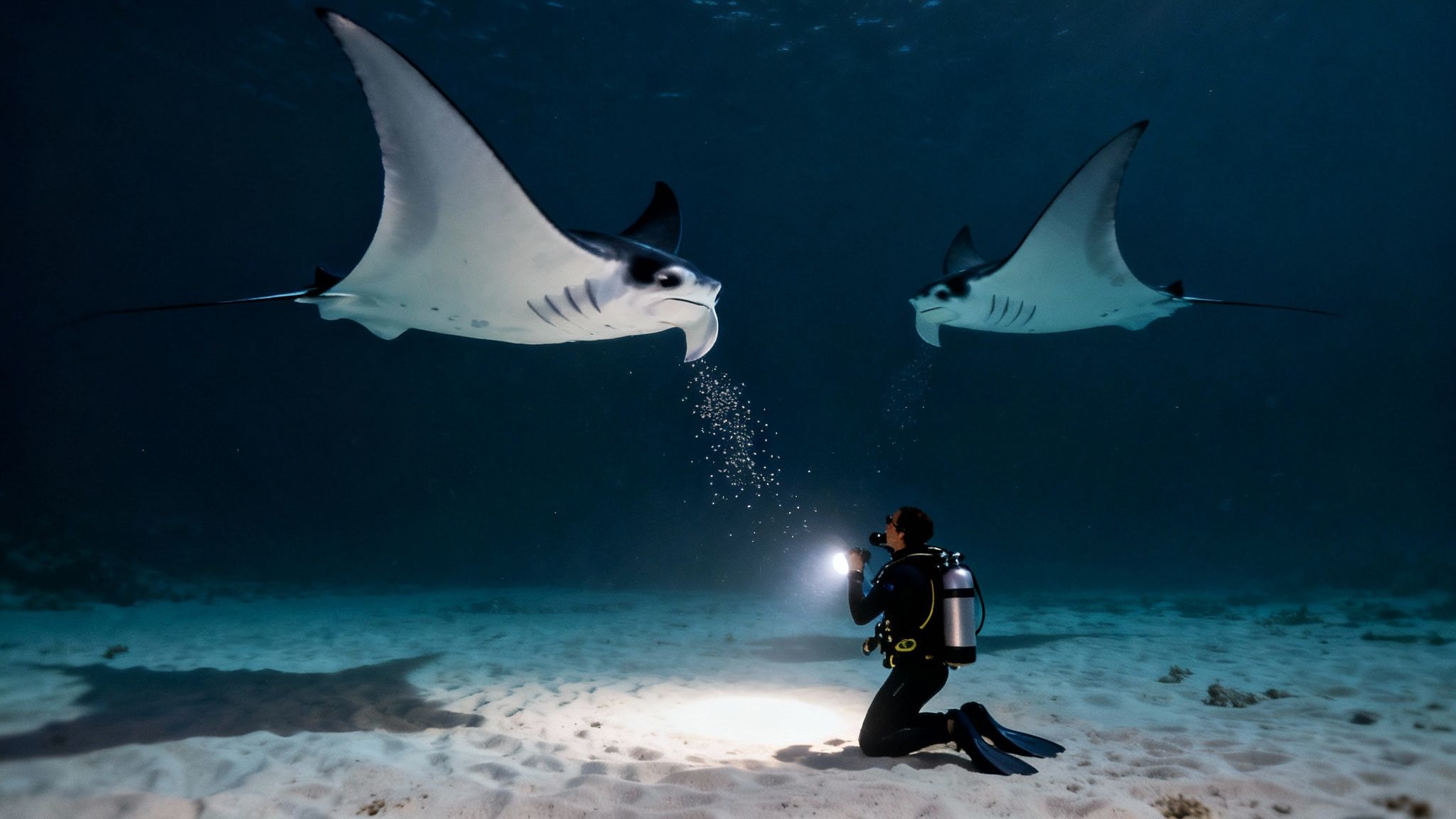
Of all the world-class dives out there, few even come close to the magic of Kona's Manta Ray Night Dive. This isn't just another notch on a diver's belt; it's an underwater ballet, a genuine spectacle of nature that happens right off our coast. It's consistently ranked as one of the best night dives on the planet for one simple reason: it is absolutely unforgettable.
The idea behind it is beautifully simple. We set up powerful lights on the ocean floor, aiming them straight up toward the surface. These beams attract thick clouds of plankton, the microscopic critters that are dinner for much of the ocean. Before long, this all-you-can-eat buffet draws in the main event: the gentle giants themselves.
You settle in on the sandy bottom, and these massive creatures, some with wingspans over 12 feet, glide down from the darkness. They perform a silent, graceful dance, swooping and somersaulting through the light to scoop up plankton, often passing just inches from your mask. It's an immersive, jaw-dropping experience that truly defines Big Island Hawaii scuba for divers around the globe.
Why Garden Eel Cove Is The Superior Choice
While you might hear about a couple of spots for this dive, they aren't all created equal. For a truly top-tier experience, Garden Eel Cove (sometimes called Manta Heaven) is the place to be. It's located just north of Kona, and its position gives it some major advantages over the other sites.
First off, it's more protected from the southern swells that can occasionally stir things up at the other spots. That usually means calmer water and a more comfortable time for everyone, both on the boat and under the surface.
The viewing area itself is also just plain better. The seafloor at Garden Eel Cove forms a sort of natural amphitheater, which lets us find a good spot without kicking up sand or disturbing the environment. Plus, the surrounding reefs are healthier and more vibrant, giving you a beautiful backdrop while you wait for the show to start.
The sheer number of mantas that consistently show up at Garden Eel Cove makes for a more dynamic and reliable spectacle. It gives you the best possible chance to witness this natural wonder in all its glory.
What To Expect On The Tour
Your adventure kicks off with a thorough briefing from our expert crew. We'll go over manta ray behavior, what to expect, and the safety rules that keep both you and the mantas protected. The number one rule is simple: look, but don't touch. Touching a manta can damage the protective mucus layer on its skin.
Once we descend to the viewing area, you’ll settle onto the sand and aim your light upward. And then, you wait. The first time you see that huge silhouette gliding into the light is a moment that will be burned into your memory forever. As more mantas arrive, the underwater stage comes alive. You can learn more about the science and wonder of the manta ray night dive to get the full picture.
What's amazing is how reliable this experience is. Our success rate for sightings is a staggering 85-90%. Thanks to nutrient-rich waters upwelling from the volcanic slopes, the local manta population has been thriving here since the 1990s. We're not just talking about one or two, either—recent dive logs have shown incredible numbers. We’ve seen nights with 23 mantas, another with 32, and one with 20 just a week later. These gentle giants show up for dinner almost every single night.
At Kona Honu Divers, we specialize in making this a safe, respectful, and breathtaking experience, running dedicated trips to this premier location. Check out our manta ray dive tours for more information.
Exploring Kona’s Top Dive Sites Beyond The Mantas
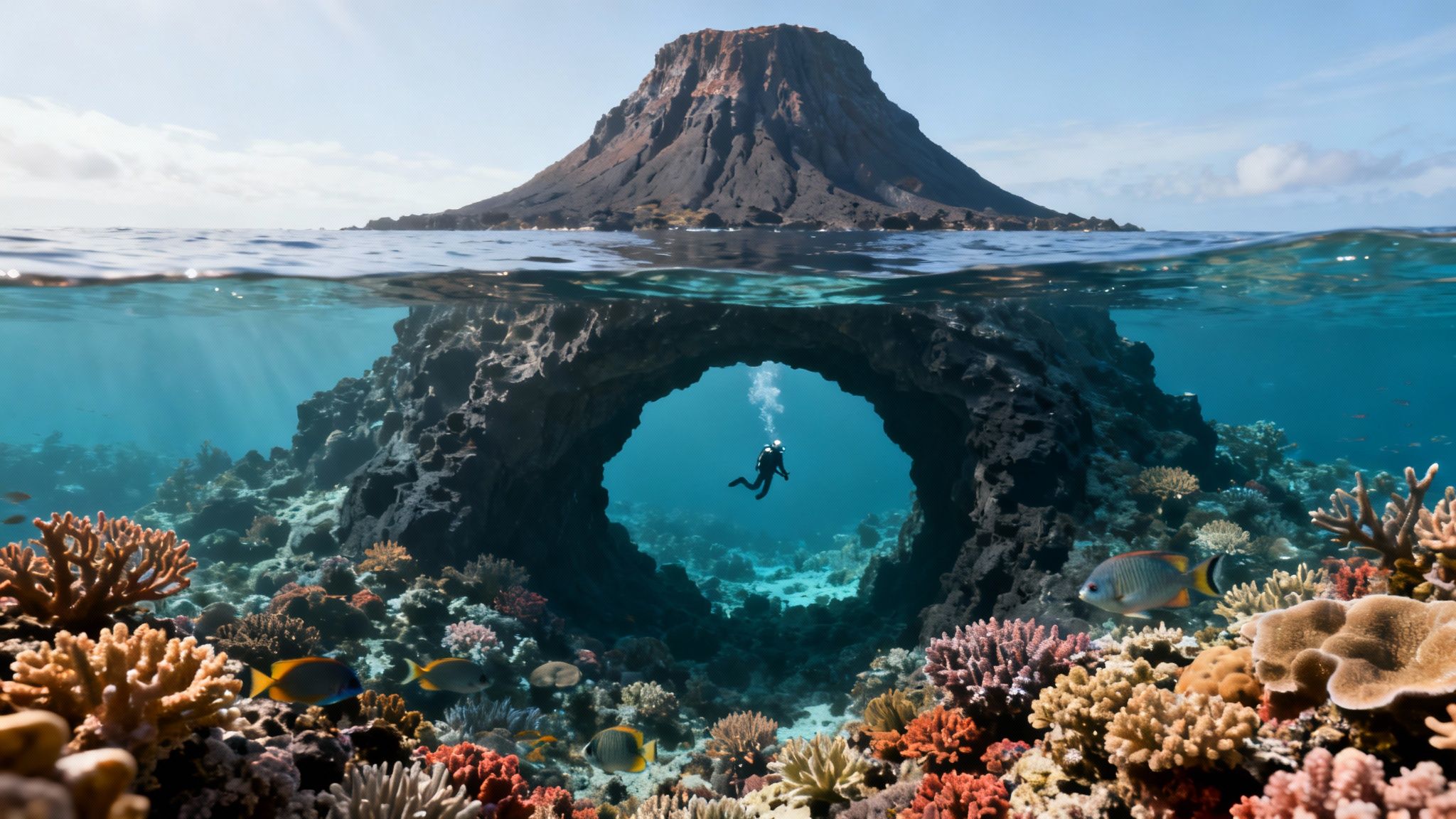
As unforgettable as the Manta Ray Night Dive is, it’s really just the beginning of what Big Island Hawaii scuba has to offer. Think of it as the headliner, but the Kona coast has a whole festival of world-class dive sites, each offering a unique window into the island's volcanic soul and the incredible life it supports.
Once you move beyond the mantas, you’ll discover a world of staggering diversity.
Imagine descending along a massive lava pinnacle that just drops into the deep blue, its walls plastered with coral and teeming with fish. Or picture yourself gliding through a sun-drenched underwater archway, navigating the same path lava once took centuries ago. This isn't a special occasion—it's just another amazing morning of diving in Kona.
It’s out here, on these reefs, that you really get a feel for the island’s one-of-a-kind underwater architecture. The dramatic, volcanic topography creates an endless supply of nooks, crannies, and swim-throughs, providing a home for an incredible variety of marine creatures.
The Crown Jewel: Kealakekua Bay
Of all the fantastic sites here, Kealakekua Bay is the one that truly stands out. As a protected Marine Life Conservation District, it's basically a thriving, underwater sanctuary. The bay is also where Captain Cook first landed in 1779, which adds a fascinating historical layer to every dive.
Because fishing is strictly prohibited, the ecosystem has absolutely exploded. You'll find yourself surrounded by massive schools of reef fish, see green sea turtles so relaxed they barely notice you, and drift over some of the healthiest coral gardens in all of Hawaii. And the visibility? It often pushes past 100 feet. It’s the perfect spot for a classic 2-tank morning trip, showing off the very best of Kona diving. You can get even more insights about this premier scuba site on the Kona coast.
Kealakekua Bay isn't just a dive site; it's a living aquarium. The sheer density of life and the pristine condition of the reef make it an unforgettable experience that highlights the importance of marine conservation.
Exploring these different underwater environments is what really lets you grasp the full scope of what makes Kona so special. Each site presents a different combination of marine life and geology, meaning there's always something new to discover.
A Spectrum of Underwater Adventures
The sheer variety of dive sites along the Kona coast means you can find exactly the kind of dive you're looking for. From shallow, sun-drenched reefs perfect for photographers to deeper structures for more advanced divers, the options are practically endless.
Here’s a quick look at the different types of dive sites you’ll find along the Kona coast and what makes each of them tick.
Kona Dive Site Comparison
| Dive Site Type | Typical Marine Life | Best For Divers Who… |
|---|---|---|
| Lava Tubes & Archways | Eels, frogfish, crustaceans, and shy reef fish seeking shelter. | Enjoy exploring unique geological formations and want to practice buoyancy control. |
| Coral Gardens | Huge schools of butterflyfish, tangs, wrasses, and green sea turtles. | Are new to diving, love underwater photography, or simply want a relaxing, colorful dive. |
| Volcanic Pinnacles & Walls | Larger pelagic species on occasion, reef sharks, and diverse vertical ecosystems. | Have good buoyancy and are comfortable with deeper dives and potential currents. |
This incredible variety is exactly why so many divers fall in love with Kona. On a single trip, you can have completely different experiences—one day you're swimming through a dark, ancient lava tube, and the next you're drifting over a vibrant, sunlit coral field. It's this range that keeps divers coming back year after year.
At Kona Honu Divers, we know these sites like the back of our hand. Our experienced guides will help you choose the perfect spots based on your comfort level and what you want to see, making sure every single dive is one for the logbook. Take a look at our diverse diving tours to see what kind of adventures are waiting for you.
Advanced And Unique Diving Experiences In Kona
For divers who've logged hundreds of hours and think they've seen it all, Kona has a few secrets left to share. While our vibrant reefs and world-famous manta dives are spectacular, there's another side to Big Island Hawaii scuba that will truly test your skills and expand your idea of what's possible underwater.
We're not talking about your average reef tour. We're talking about experiences that unfold in the vast, deep blue, far from the sunlit coral gardens. These are the dives that require a cool head, sharp skills, and a serious sense of adventure.
If you’re ready for the next level, Kona delivers some of the most profound underwater encounters on the planet.
The Kona Blackwater Dive: A Spacewalk In The Abyss
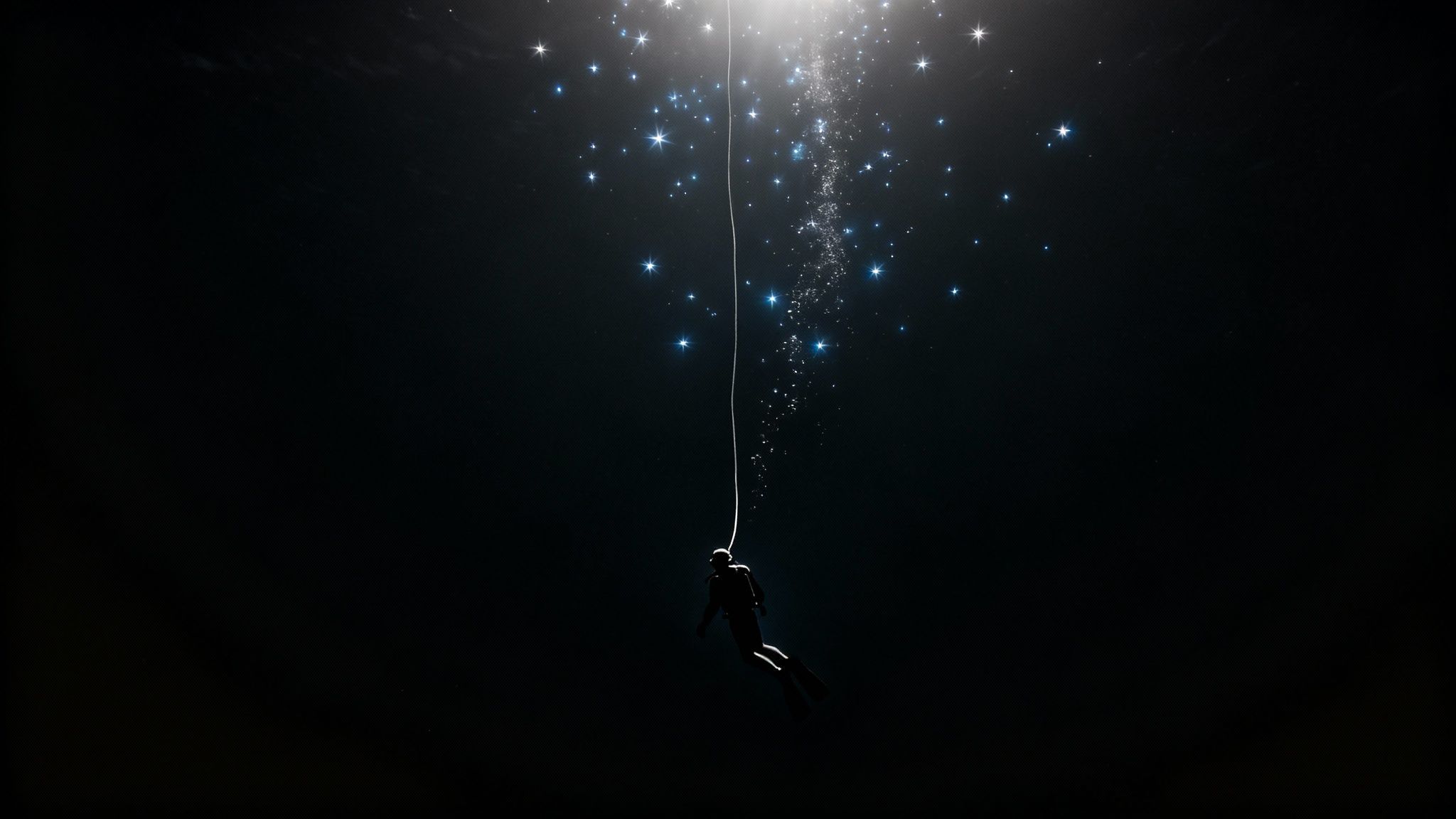
Picture this: you're floating miles offshore, suspended in thousands of feet of inky black water. It’s the middle of the night. The only thing connecting you to the world above is a tether to the boat, and the only light is the narrow beam from your torch cutting through the darkness.
This is the legendary Kona Blackwater Dive. It's not a reef dive; you'll never see the bottom. Instead, you become a silent observer in the middle of the largest migration on Earth, as countless strange and wonderful creatures rise from the abyss to feed near the surface. You're waiting right in their path.
What emerges from the dark is a parade of some of the most bizarre and beautiful bioluminescent life you can imagine. You'll see translucent larval creatures that look nothing like their adult forms, jellyfish pulsing with internal light, and tiny organisms that seem like they were designed for another world entirely.
It's a humbling, mind-bending, and utterly surreal experience. To truly grasp what it's like, you have to read our full breakdown of the Kona Blackwater Dive. For divers with the right credentials and nerve, it’s an absolute must.
The Blackwater Dive is a profound reminder of how much of the ocean remains unexplored. It’s an encounter with life forms so alien and beautiful that it fundamentally changes how you see the underwater world.
Ready to take the plunge into the abyss? Our specialized Blackwater Dive tour is designed for experienced divers seeking this one-of-a-kind adventure.
Pushing The Limits With Advanced Charters
Beyond the blackwater experience, Kona’s volcanic underwater landscape offers incredible playgrounds for advanced divers. The coastline is laced with deep pinnacles, intricate lava tube systems, and remote sites that act as magnets for big pelagic animals. These spots demand excellent buoyancy control and a calm, confident mindset in deeper water.
Here’s a taste of what you might explore on an advanced charter:
- Deep Pinnacles: Descend onto submerged volcanic spires that rise from the seafloor, often swarming with schools of fish and patrolled by sharks.
- Complex Lava Tubes: Navigate through winding, cavernous tunnels forged by ancient lava flows—a true test of skill and a thrill for explorers.
- Remote Pelagic Sites: Head to spots further offshore where the chances of encountering eagle rays, oceanic whitetip sharks, or even whale sharks dramatically increase.
These trips are built for seasoned divers looking to get off the beaten path and see the wilder side of Kona. If that sounds like you, our premium advanced dive tours will give you the challenge and reward you’re searching for.
How To Plan Your Big Island Scuba Trip
Alright, now that you've got a taste of the incredible diving waiting for you on the Big Island, let's get into the nitty-gritty of planning your trip. A little preparation goes a long way in making sure your adventure is everything you dreamed it would be. Here’s what you really need to know about conditions, gear, safety, and certifications to pull off the perfect Big Island Hawaii scuba vacation.
One of the absolute best things about diving the Kona coast is its incredible consistency. We have the island's massive volcanoes to thank for blocking the trade winds, which leaves our waters remarkably calm and clear pretty much all year. This means you can book a trip for just about any month and count on having a great time in the water.
Understanding Kona's Diving Conditions
You can leave your thick wetsuit at home. Water temperatures here are beautiful year-round, hovering between a comfortable 75°F (24°C) in the winter and a downright balmy 81°F (27°C) in the summer. For most people, a 3mm or 5mm wetsuit is all you'll ever need.
And the visibility? It's what Kona is famous for. It’s not unusual to have visibility clear past 100 feet, letting you soak in the dramatic lava formations and spot wildlife from way off. While conditions are almost always stellar, there are some subtle seasonal shifts. For a full breakdown, check out our guide on the best months to scuba dive in Hawaii.
Gear, Certifications, and Free Nitrox
We get it—hauling your own gear across the ocean is a major pain. That's why diving with an operator that has high-quality, well-maintained rental equipment is such a relief. At Kona Honu Divers, we're serious about our gear. Everything is proactively serviced and in top shape, so you can just show up and dive with confidence.
Whether you're curious about breathing underwater for the first time, need a quick skills tune-up, or you're ready to level up your certification, we've got you covered. Our instructors can lead you through everything from a PADI Discover Scuba Diving experience to your full PADI Open Water Diver certification, and beyond.
Here's a huge perk for certified divers: Kona Honu Divers provides free Nitrox. Diving on enriched air can mean longer bottom times and feeling less tired after your dives, which lets you make the absolute most of every tank.
The Importance of Safety Protocols
Let's talk about the most important thing: safety. The ocean is powerful and beautiful, and it demands respect. A truly safe dive operation isn't just about ticking boxes; it's about a deep-seated culture of looking out for one another.
This really boils down to a few key things:
- An Experienced Crew: You want guides who know these sites like the back of their hand—the currents, the critters, and all the little secrets.
- Solid Briefings: A pre-dive briefing should be clear, thorough, and tell you exactly what the plan is, what safety procedures are in place, and what you can expect to see.
- Well-Maintained Boats: Your dive boat should be designed for diving, fully stocked with safety equipment, and run by a licensed captain who knows their stuff.
Here at Kona Honu Divers, our crew's commitment to your safety is everything. Seriously. With a combined experience of over 200 years, our entire focus is on creating a secure, comfortable environment where you can truly relax and just enjoy the magic of Kona's underwater world. It's a commitment our guests feel and trust.
Your Kona Scuba Diving Questions, Answered
Alright, let's wrap this up by tackling some of the questions we hear most often from divers planning a trip to the Big Island. Getting these final details sorted out will help you book with confidence and make sure your underwater adventure is everything you're hoping for.
We'll cover everything from the best time of year to visit to what your options are if you're not yet certified. Think of this as your final checklist before you're ready to dive into Kona's incredible waters.
What Is The Best Time Of Year For Scuba Diving On The Big Island?
One of the absolute best things about diving in Kona is that there’s really no "off-season." The Kona coast is tucked away in the protective lee of the massive Mauna Loa and Hualalai volcanoes, which blesses us with incredibly calm and clear conditions almost every single day of the year.
Water temperatures stay very comfortable, hovering around 75°F (24°C) in the winter and warming up to a balmy 81°F (27°C) in the summer. While you might see humpback whales more in the winter, the vibrant reefs and their amazing residents are here waiting for you year-round. You can truly book for any month and expect fantastic diving.
What Marine Life Can I Expect To See?
The amount of life here is just staggering. On almost any dive, you’re practically guaranteed to see Hawaiian green sea turtles (honu) cruising by or just chilling on the reef. We often see playful spinner dolphins from the boat, and sometimes they'll even zip by us underwater.
The reefs are packed with a wild variety of tropical fish you can only find in Hawaii—butterflyfish, triggerfish, tangs, and so many colorful wrasses. You’ll also find moray eels peeking out from lava tubes, camouflaged octopus, and whitetip reef sharks napping on the sandy bottom. And, of course, the showstoppers are the majestic manta rays on the night dive and the surreal, glowing creatures on the blackwater dive.
I Am Not Certified Can I Still Scuba Dive?
Absolutely! If you’ve never dived before but are eager to see what it's all about, you can join a Discover Scuba Diving experience. It’s a super safe and fun way to try scuba for the first time with one of our instructors right by your side in shallow, calm water.
No experience is necessary. If you get hooked (and we find that most people do!), you can often count that first dive toward your full PADI Open Water Diver certification, which you can easily complete in just a few days of your vacation.
Do I Need My Own Dive Gear?
Nope, you don't need to drag all your gear across the ocean unless you really want to. At Kona Honu Divers, we provide top-of-the-line, well-maintained rental equipment that's serviced constantly for your safety and comfort. This includes everything you need:
- Regulators
- Buoyancy Control Devices (BCDs)
- Wetsuits
- Masks, fins, and snorkels
If you have your own gear that fits you perfectly, feel free to bring it along! And for our certified divers, it's worth remembering that we offer free Nitrox to help you get a little more bottom time and feel less tired after your dives.
Why Should I Choose Kona Honu Divers?
Picking the right dive shop is probably the most important decision you'll make for your trip. Kona Honu Divers has built its reputation on a few key things: an unshakeable commitment to safety, a crew of incredibly experienced and passionate divers, and service that goes above and beyond. Our team has a combined 200 years of experience—we know these waters like the back of our hands.
Our boats are big, comfortable, and designed specifically for divers, complete with hot showers and plenty of shade. We deliberately keep our groups small for a more personal and relaxed experience, and we make sure to hit the absolute best sites, including the premier location for the manta ray night dive. When you combine expert guides, great gear, and a genuine love for what we do, you get a truly unforgettable and safe adventure.