
Table of Contents
- The certification rule before you book
- Four conditions, four separate checks
- Why a “good month” can still be a quiet manta night
- How to sit so the animals can feed
- Judge the site the morning of the dive
- Add the real total
- How to bend the table to your dates
You booked the week, packed the card, and already have three friends arguing over the “best” dive on Hawaiʻi Island. One wants mantas after dark. One wants lava tubes in the morning. One just wants flat water and a turtle. Those wishes rarely share the same morning.
Surface calm, current, surge, and visibility do not move together. A glassy harbor can still sit over a pushy current on an exposed lava shelf, and a famous site name does not choose the dive. The day's swell and the night's plankton do.
I would match the dive to your goal and your recent logbook before you lock dates. Big Island diving runs from sheltered reef mornings and shore entries to manta nights and offshore night work, and not every trip fits every card. Count your logged dives, note how long it has been since you were in the water, and keep one day you can move if the ocean does not cooperate.
Best Big Island Dive Sites by Goal and Certification
Start with the goal, not the postcard. Match the Best for column to what you came to see, then check the experience level before you commit to a night or a deeper profile.
| Dive site | Best for | Experience level | Dive style |
|---|---|---|---|
| Garden Eel Cove (Makako Bay) | Manta ray night dives with larger aggregations | Open Water and up | Night, boat |
| Keauhou Bay | Manta night dives and reef viewing | Open Water and up | Night, boat |
| Old Kona Airport Marine Life Conservation District | Protected shore entries and reef life | Novice to advanced | Day, shore or boat |
| Kona reef and lava-tube sites | Coral gardens, lava tubes and swim-throughs on 2-tank trips | Any certified diver | Day, boat |
| Blackwater night dive | Deep-water night encounters with open-ocean life | Experienced divers | Night, boat |
Garden Eel Cove (Makako Bay) and Keauhou Bay are the two main night manta sites, and certified divers reach them by boat. Garden Eel Cove is the first pick when the goal is a manta night in a more protected setting. Keauhou is the useful alternative when that bay is busy or the morning swell points you elsewhere.
The Old Kona Airport Marine Life Conservation District gives shore divers a partly protected cove at the beach's northwestern end, the usual entry for snorkelers and shore scuba. A second entry at the southeastern end works in calm to moderate conditions, where the lava shoreline forms a semiprotected basin. Commercial activity there, from a mooring or from shore, needs a permit.
Reef and lava-tube mornings are the two-tank routine. Coral gardens, lava tubes, and swim-throughs are where green sea turtles and moray eels show up often. That style suits any certified diver who is current on buoyancy. The blackwater night dive is a different job. You are offshore after dark, managing lights and trim with no reef as a reference, so it belongs to experienced divers.
The certification rule before you book
For most of our regular dive charters, divers need at least an Open Water Diver certification from a recognized agency such as PADI, SSI, or NAUI. If you are still working toward that card, scuba classes are the path, not a night boat. Night dives usually need a few logged night dives first, because lights, navigation, buoyancy, and buddy contact have to be managed together.
Practical rule: Novices stay on sheltered daytime sites. Intermediates take manta nights at Garden Eel Cove or Keauhou. Advanced divers look at blackwater or an advanced long-range trip.
Before you pick the deeper or night option, count your logged dives, note when you last dived, and be honest about moderate current. A card that has sat in a drawer for two years is not the same as a card you used last month.
When to Dive the Big Island and What You Will See
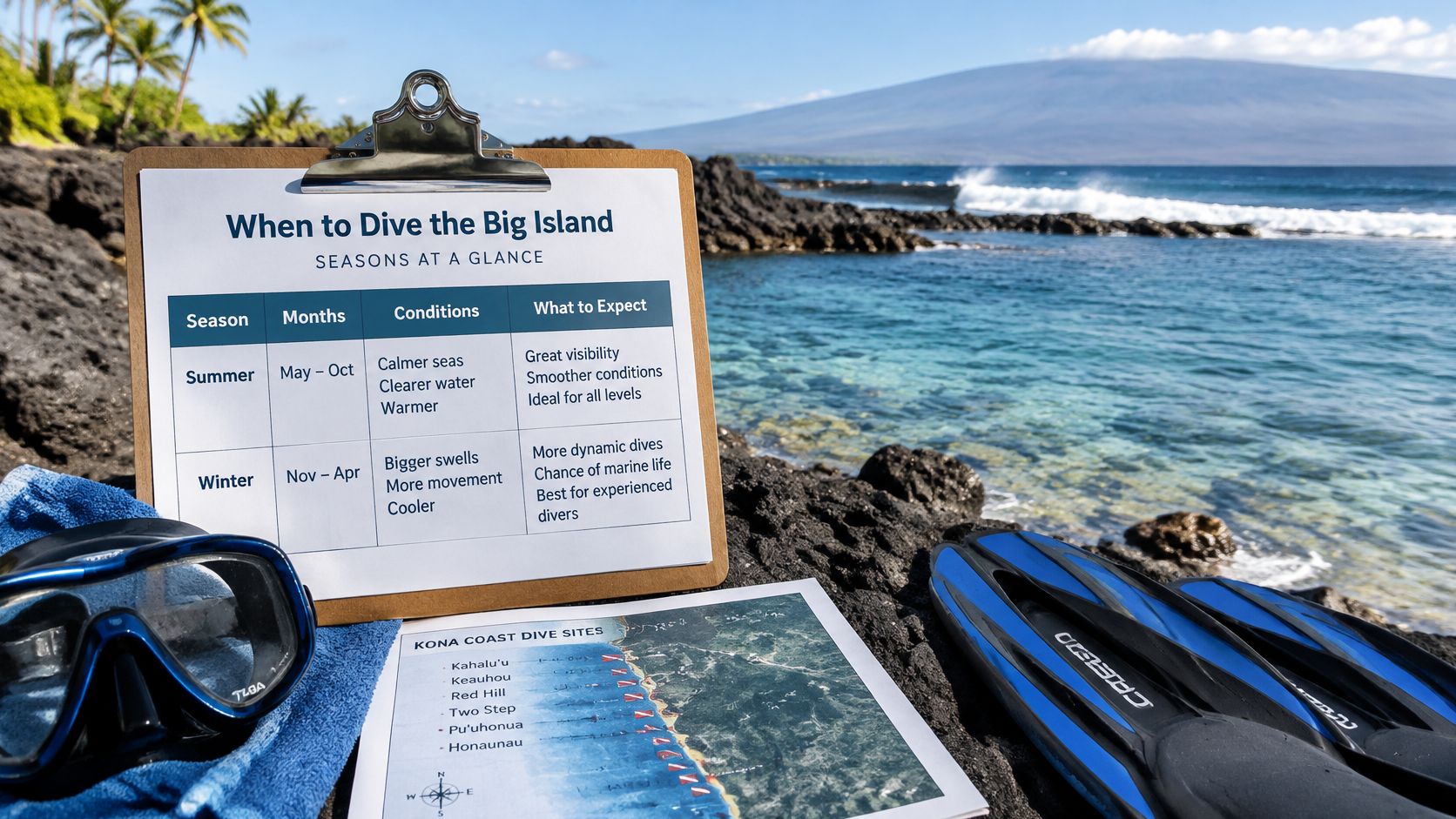
Diving in Kona is available year-round, with warm, clear water. The season changes comfort and the surface more than it decides whether you can dive at all.
| Season | Typical conditions | Wildlife highlights | Planning note |
|---|---|---|---|
| Summer (May to September) | Generally calmer west-coast water, warm and clear | Turtles, reef fish, manta night aggregations that follow plankton | Calmer water favors night dives |
| Winter (November to March) | Larger swells possible on exposed sites | Reef life steady; humpback whales seen from boats | Check swell daily and favor sheltered sites |
| Shoulder months (April and October) | Variable, often calm mornings | Reef life steady; manta nights depend on plankton | Flexible for scheduling around other activities |
Summer, roughly May through September, usually brings the calmest west-coast water, which is why night boats are easier to run. Winter, roughly November through March, can put larger swells on exposed sites, so check the swell each morning and favor a sheltered bay. April and October are shoulder months. Mornings are often workable, then the wind fills in.
A more detailed month-by-month look sits in our guide to the best months to scuba dive in Hawaii.
Four conditions, four separate checks
Do not trust a calm surface by itself. Current, surge, and visibility can each be poor while the harbor looks flat, or fine while a wind line chops the ride out. Check swell direction, then ask what the water is doing under the boat. West-side water often stays clear because this coast gets less muddy river runoff than the windward side, but clarity is not the same thing as an easy entry.
On the reefs, green sea turtles, moray eels, reef fish, and reef sharks are the regular cast. In winter, humpback whales are a surface sighting from the boat, not something you chase underwater.
Why a “good month” can still be a quiet manta night
Reef manta rays (Mobula alfredi) show up when zooplankton is thick enough to feed on, not because the calendar says so. A 2010–2022 dataset of more than 23,000 sightings of 167 individually identified mantas found that seasonal and annual changes in aggregation size closely tracked prey availability, and Garden Eel Cove generally supported larger aggregations than Keauhou, which showed strong female site fidelity and a female-biased visitation pattern, according to the University of Hawaiʻi scholarspace record.
Schedule the manta night early in the trip and keep one flexible day for weather or a thin plankton night.
Treat the sighting as an ecological outcome, not a guaranteed show. How you sit in the water once you are down is its own subject.
Manta Ray Night Dives at Garden Eel Cove and Keauhou
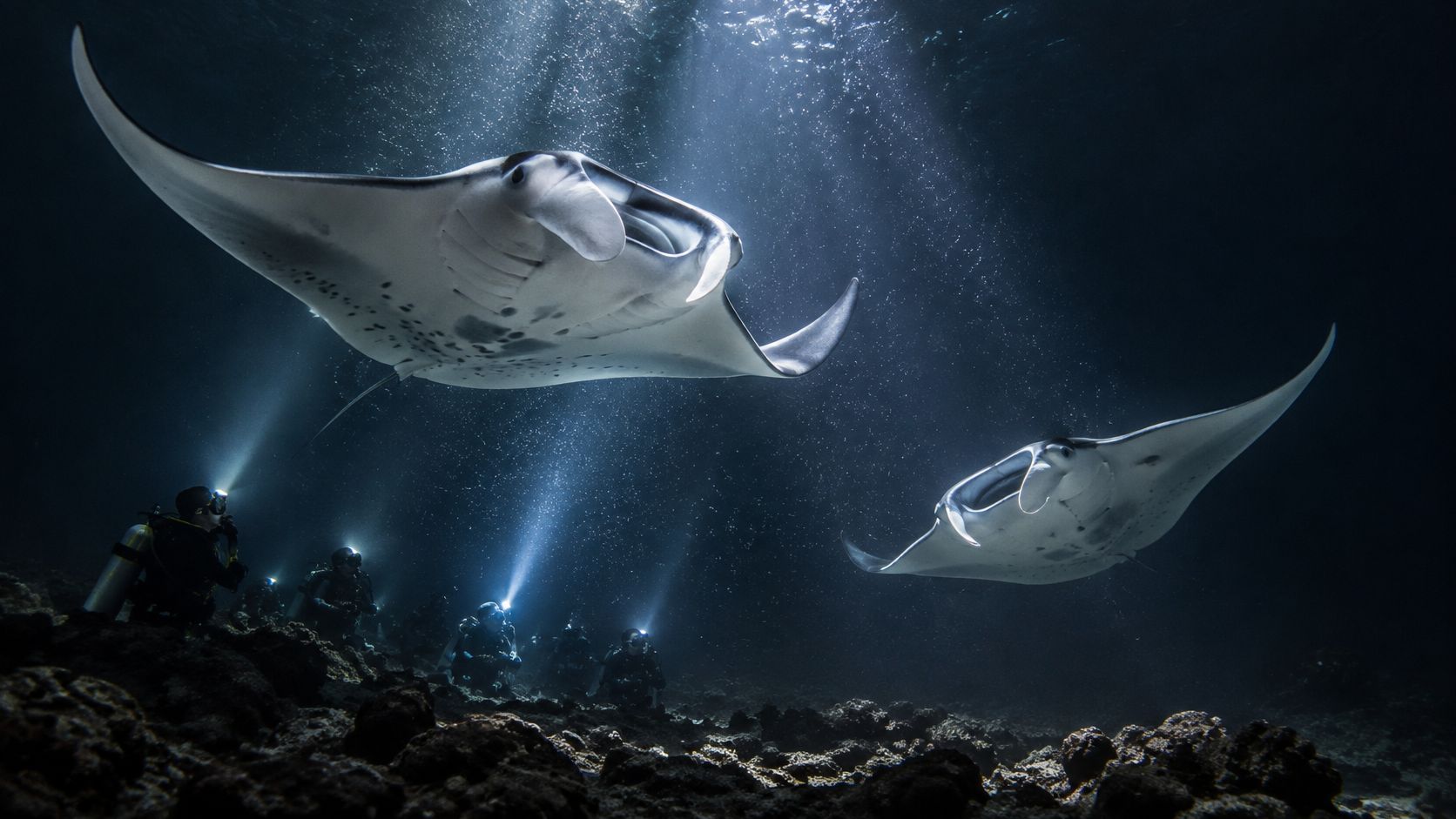
A manta night dive is a feeding event. Reef mantas come to lights after dark because those lights concentrate plankton. Nobody is training the animals, and nobody should promise a head count.
The Hawaiʻi Department of Land and Natural Resources identified two nighttime locations because mantas regularly congregate there to feed on plankton after dark: Makako Bay, also called Garden Eel Cove, and the coastline fronting Sheraton Keauhou Bay. Proposed management steps at those sites included prohibiting anchoring, limiting commercial operators, prohibiting rafting, and restricting live boating, all aimed at safety in a small piece of water.
Garden Eel Cove is the stronger choice for a manta dive tour. Its protected setting gives a better viewing area and access to better reefs than more exposed alternatives. Keauhou still works as a second site when you want a reef-and-manta combination, not as the default first pick.
Our 2-tank manta dive and snorkel is built around that choice.
How to sit so the animals can feed
- Stay low. Remain on the sand, rubble, or boulder bottom. Hovering in the water column puts you in the flight path.
- Do not touch mantas or corals, and do not chase. Pursuit breaks the feeding loop and risks a collision with a wing that can span several feet.
- Keep the central feeding corridor open. Mantas need open water to turn. A ring of divers closing the middle is how people get bumped.
- Hold lights upward. The beam should light plankton in the water column, not blast into an animal's face or pull it down onto divers. Snorkelers at the surface point lights down. Divers on the bottom point lights up.
Sightings are not guaranteed, and they change night to night with the food in the water. Crowding changes the feel of the dive even when animals are present. Many people who come to watch mantas say they felt crowded by snorkelers, boats, and other divers, so favor an operator that keeps the group small and does not stack vessels on top of one another.
If the bay is already a parking lot of lights, a quieter night on a movable date beats forcing tonight's famous site.
Gear, Rentals and Site Safety Before You Go
Fit beats brand, and a night dive without a backup light is a bad plan. Sort what you carry and what you rent before you worry about which lava tube is “the one.”
| Item | Bring or rent | Why it matters |
|---|---|---|
| Mask and snorkel | Bring if you have a fitted mask | A good fit matters more than brand |
| BCD and regulator | Usually rent | Ask for a recent service date |
| Wetsuit | Bring or rent, most often 3 mm | Dives are long; warmth reduces fatigue |
| Dive computer | Bring if owned | Tracks depth and no-decompression limits |
| Dive light for night dives | Bring a primary and a backup | Needed for manta and blackwater dives |
| Surface marker buoy and reel | Bring | Makes you visible to boat traffic |
A mask you have already tested in a pool will not flood on a surgey exit. Rental BCDs and regulators are normal. Ask when they were last serviced, and do that ask at booking, not on the dock. A 3 mm suit covers most Kona days. Longer dives get cold even in warm water, and cold divers burn gas and lose trim. If you own a computer, bring it. Rental computers work, but you already know your own. Scuba rentals cover the bulky pieces if you would rather not fly with a regulator.
Judge the site the morning of the dive
A calm surface does not mean calm water underneath. Kona's west coast can offer clear water because it has relatively limited sediment-bearing river discharge, but exposed lava-rock sites can still develop surge, localized current, or difficult entries when swell and wind change, as our Kona diving conditions notes lay out. Pick the site from a same-day read of swell direction, entry and exit, current, and your own experience. Visibility alone is a weak reason to commit.
Lava rock makes exits harder than descents. An easy step-in can become a climb out once a set stands up on the shelf. For newer divers, a sheltered site and a conservative turnaround pressure matter more than a landmark. Experienced divers still save gas with a controlled descent and stable trim when current is up.
On night and advanced dives, confirm four things in the briefing: gas requirements, maximum depth, emergency procedures, and the current plan. Lights, navigation, buoyancy, and buddy awareness all load at once.
Before you leave the dock:
- Check the forecast. Swell direction, not just wave height.
- Confirm the entry type. Boat ladder, protected cove, or open lava.
- Decide the turnaround. Pressure or time, agreed with your buddy.
- Change sites if it deteriorates. Forcing the original plan is how exits get ugly.
Costs, Logistics and Trip Planning Questions
The trip price on a webpage is not the cost of the day. Ask these before you pay, and write the answers down so the briefing matches what you were told.
- Where does the boat leave, at what time, and how long is the run to Garden Eel Cove or Keauhou on a night dive? A late harbor and a long ride eat the evening if you also have an early flight mindset the next morning.
- Is rental gear included, and when were the regulator and BCD last serviced? “Included” and “recently serviced” are different sentences.
- What is the minimum certification and logged-dive count for that specific trip? A morning reef boat and a blackwater boat are not the same bar.
- What is the cancellation and weather-reschedule policy? You want a manta night that can slide onto the flexible day you already protected.
- How many boats and people share the site? Kona manta sites can involve more than 30 tour boats and approximately 300 participants per day, and nighttime congestion raises the chance of a serious accident, according to a Hawaiʻi County assessment. A smaller boat is not a luxury here. It is how you keep space in the feeding corridor.
- Does the operator hold the permit required for commercial activity in a designated area such as Makako Bay or the Old Kona Airport district? If the answer is vague, pick another boat.
Add the real total
Stack tanks, nitrox, rentals, and any harbor or park fees on top of the advertised trip price. Two divers who “booked the same tour” can land on different bills once one rents a computer and the other brings one. Nitrox is worth asking about on repetitive days because it changes your no-decompression margin, not because it is a souvenir.
Where you sleep changes the morning more than people expect. A long drive from the north end of the island to a Kona harbor before sunrise is its own fatigue load. Our notes on the best places for divers to stay on the Big Island are the practical filter: harbor time, not the resort brochure.
Keep one written note per operator. If the dock briefing contradicts it, you still have the promise in front of you.
Sample Big Island Dive Itineraries
Trip length sets the mix. The manta night is the piece you protect, not the piece you wedge between two other bookings.
| Trip length | Early days | Middle days | Final days |
|---|---|---|---|
| 3 days | Morning 2-tank reef dive on arrival | Manta night dive at Garden Eel Cove | Rest day, optional snorkel |
| 5 days | Orientation and reef dive | Old Kona Airport day dives | Blackwater night dive, with manta night on a flexible day |
| 7 days | Reef dives on arrival | Mix of shore and boat days | Advanced long-range day mid-week, manta night as weather backup |
A three-day trip has almost no slack. Dive the reef on the morning you arrive, put Garden Eel Cove in the middle, and leave the last day for rest or an easy snorkel. If that middle night is flat on plankton, you do not have a second chance, which is why a five-day trip is kinder.
On five days, use the first day to shake out gear and buoyancy. Old Kona Airport in the middle gives you shore and boat variety without committing every morning to a harbor call. Blackwater sits late, only if your logbook supports it. Read the blackwater diving requirements before you pencil it in, and keep the manta night on a day you can slide.
A seven-day trip can mix shore and boat days without stacking fatigue. Put an advanced long-range day in the middle of the week, after you are diving well and before you are thinking about the airport. Hold the manta night as the weather backup, not as the celebration on the last night.
How to bend the table to your dates
Put night dives on days you can move. Place anything deep after a night of sleep, not after a red-eye. I would leave at least one full day between your last deep dive and any flight, and I would not drive to high elevation on that same day either.
Choose the trip length first. Then mark one flexible slot for the manta dive and refuse to fill it with a dinner reservation or a summit plan. Everything else can shuffle around that square.
Book Your Big Island Dive Days
You already know the site logic, the season checks, and the card you need. Booking is the part that locks a boat to a morning you can use.
Kona Honu Divers is in Kona, on the Big Island. Groups stay small, and the attention starts when you step aboard, not halfway through the first descent. The booking page is also where Early Diver Discounts and free Nitrox with dive packages are listed, so compare those against the questions you already wrote down rather than against a headline price alone.
Pick dates that still leave a movable slot for mantas. Confirm the certification and the logged-dive count for that exact trip before you pay. A reef morning and a blackwater night are not interchangeable reservations, and a card you have not used in a long time is a reason to say so at booking, not at the ladder.
Kona Honu Divers runs Kona reef mornings, manta nights at Garden Eel Cove, blackwater trips, and longer charters for divers who are ready for them, with small groups and a crew that treats conditions as a daily decision. If your dates, card, and flexible manta slot are ready, see what is on the board at Kona Honu Divers.