
Picture yourself dropping into warm, impossibly clear water, with sunlight streaming down through the blue to light up ancient lava tubes and reefs bursting with color. That’s scuba diving in Kona, and it's the beating heart of the Big Island’s underwater world. What makes it so special? Unlike other spots in Hawaii, the Kona coast is naturally sheltered, which means the water stays exceptionally calm and clear, making it a dream for year-round diving.
Why Kona Is a World-Class Scuba Hawaii Destination
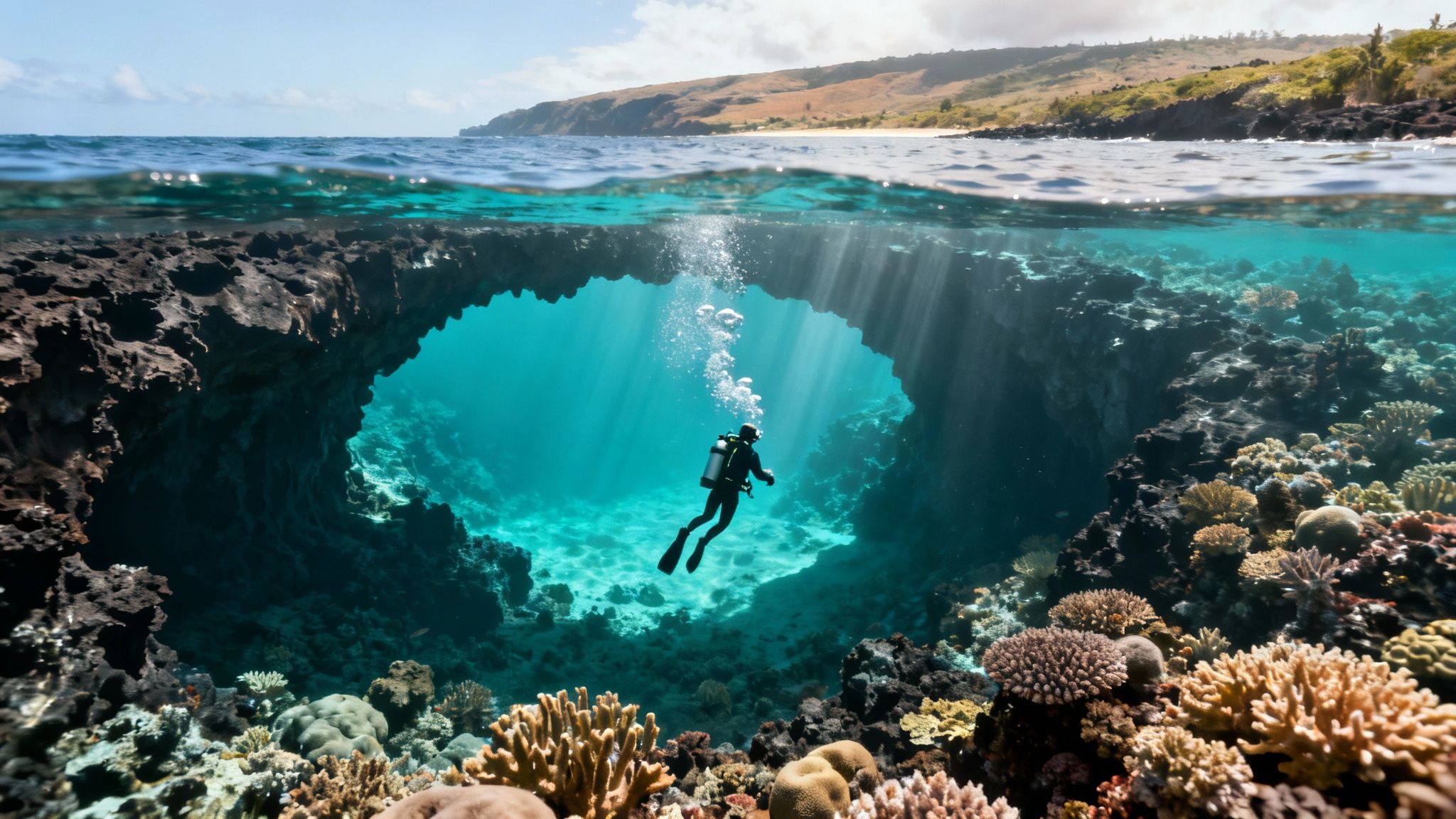
The Big Island's Kona coast isn't just a great place to dive; it's a world-class destination, and we have its unique geology to thank for that. The colossal volcanoes, Mauna Loa and Hualalai, act as a massive shield, blocking the powerful trade winds that batter other coastlines. The result? Consistently calm seas and incredible visibility that often pushes past 100 feet.
This natural protection creates a perfect underwater playground. It's gentle enough for new divers to feel comfortable and confident, yet filled with dramatic topography that keeps even the most seasoned veterans coming back. The seafloor here is a direct reflection of its volcanic past, sculpted into breathtaking drop-offs, arches, and intricate lava tubes you simply won't see anywhere else. Over time, these formations have transformed into a thriving haven for a huge diversity of marine life.
A Sanctuary for Marine Life
Kona's waters are absolutely electric with life, from tiny, vibrant critters hiding in the coral to some of the ocean's most majestic giants. The reefs are healthy and act as a sanctuary for an incredible variety of tropical fish—think butterflyfish, triggerfish, and the endemic Hawaiian cleaner wrasse darting all over the place.
But the real magic often comes from the larger animals you'll likely run into.
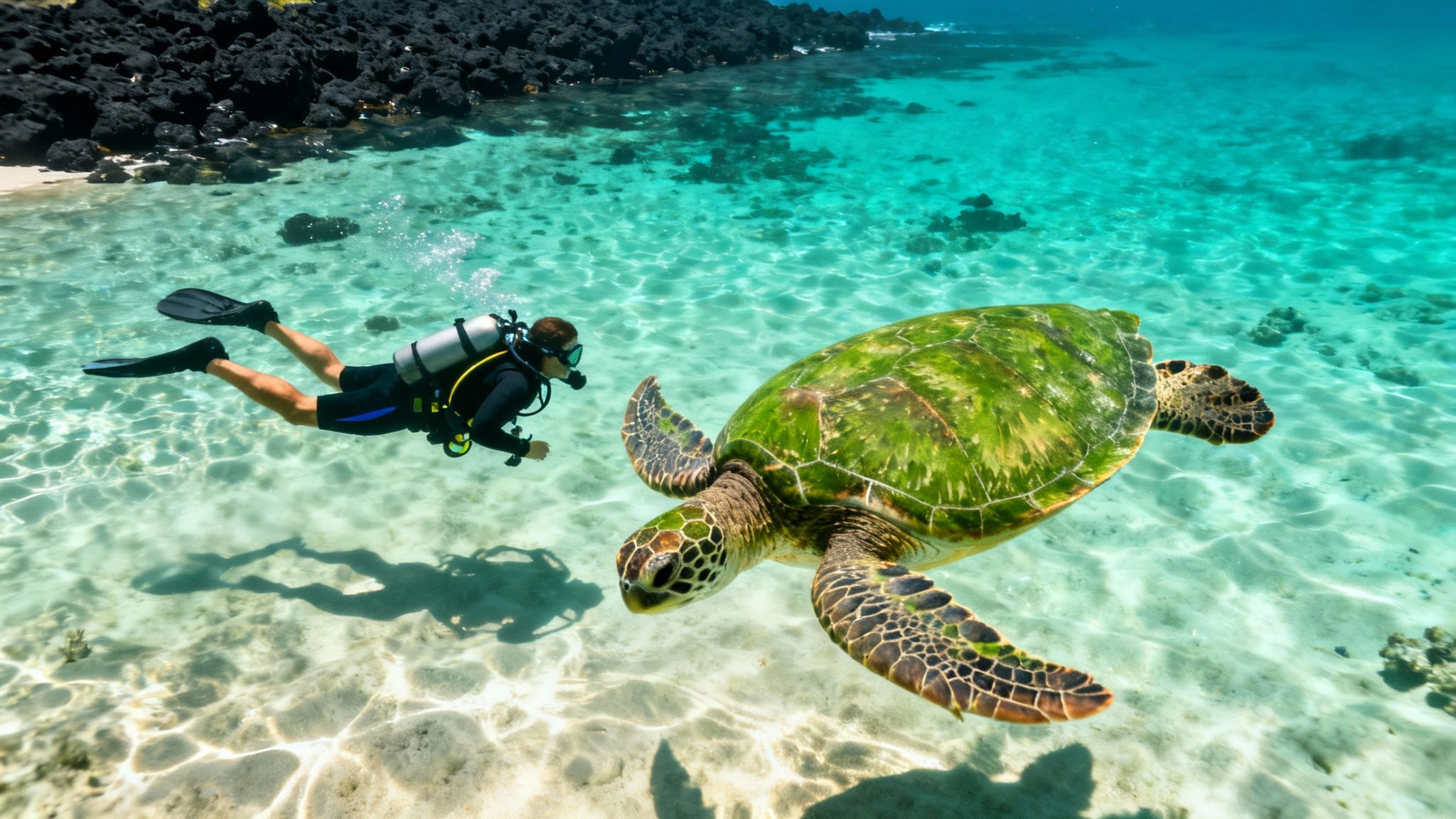
- Green Sea Turtles (Honu): You'll see these gentle giants everywhere. They’re often just chilling on the reef or gliding effortlessly through the water right beside you.
- Spinner Dolphins: It's not uncommon for pods of spinner dolphins to cruise by, putting on a spectacular acrobatic show during your surface interval.
- Manta Rays: Kona is legendary for its manta ray population, offering one of the most reliable and awe-inspiring night dives you could ever imagine.
This incredible biodiversity is a huge part of why Hawaii's recreational scuba scene is so vibrant, with over 1.5 million dives happening across the islands each year. That sheer volume really speaks to its status as one of the premier diving markets in the U.S. You can learn more about just how popular Hawaii is for divers and what drives its active scene.
This powerful mix of pristine conditions, unique underwater landscapes, and a mind-boggling amount of wildlife is what makes every single dive on the Big Island an adventure. At Kona Honu Divers, we run expert-guided diving tours designed to show you the absolute best of this underwater paradise.
Exploring the Top Dive Sites Along the Kona Coast
The Kona coast isn't just a place to dive; it's an underwater treasure map. Dozens of world-class sites are dotted along its protected shoreline, each offering a completely different adventure. You can find everything from laid-back shore dives perfect for a lazy afternoon to dramatic offshore pinnacles buzzing with life. Figuring out your scuba Hawaii game plan starts right here, with some of the best spots on the planet.
Some of the most cherished sites are literally just a few steps from the road. At these spots, you can gear up, walk right into the famously calm, clear water, and just go. They’re fantastic for divers of all levels who love the freedom of diving on their own schedule without sacrificing an ounce of quality.
Of course, hopping on a boat opens up a whole other dimension of Kona diving. A quick ride with a top-notch crew like Kona Honu Divers gets you to pristine, remote locations that are impossible to reach from the beach. These sites often boast more dramatic underwater landscapes and a much higher concentration of marine life.
Legendary Shore Dives
When people talk about shore diving on the Big Island, one name always comes up: Two Step. Located at Honaunau Bay, it gets its name from the natural lava rock "steps" that make getting in and out of the water a breeze. Once you're in, you're in a shallow, sun-drenched bay where you can spend an hour swimming alongside Hawaiian green sea turtles (honu) as they graze on algae. It's a must-do for new and seasoned divers alike, known for its healthy coral and frequent spinner dolphin sightings.
Think of a shore dive like Two Step as your own private aquarium. The easy entry and mellow depths mean you get tons of bottom time to focus on photography or just soak in the incredible amount of life, all without being tied to a boat schedule.
Another local favorite is Pu'uhonua O Honaunau, right next to the national historical park. This spot has a totally different vibe, with fascinating underwater topography like small caverns and swim-throughs carved by ancient lava flows. It's a great place to hunt for eels, octopuses, and all sorts of colorful reef fish hiding in the nooks and crannies.
Premier Boat Dive Locations
If you're after those epic, jaw-dropping underwater scenes, a boat dive is the way to go. These trips take you to sites that truly show off the grand scale of Kona's volcanic origins.
- Golden Arches: This is a photographer's paradise. The main feature is a massive lava archway absolutely covered in golden sea cucumbers and sponges. It’s big enough to swim through and is often framed by huge schools of bright yellow tangs, making for a picture you'll never forget.
- Turtle Pinnacle: No prizes for guessing what you'll see here. This underwater pinnacle is a natural "cleaning station" where sea turtles line up to let reef fish pick parasites off them. It's an incredible piece of animal behavior to witness firsthand.
- Manta Heaven: While it's world-famous for the manta ray night dive, this spot is an amazing daytime dive, too. The reef is vibrant and bustling, with fields of garden eels poking out of the sand and huge coral heads that act as apartment buildings for countless critters.
And that's just scratching the surface. An experienced operator like Kona Honu Divers knows the secret spots and has the permits to get you to the most pristine locations, making every single dive feel like a new discovery. When you go out on their Big Island diving tours, you're not just getting a ride; you're getting an expert guide to show you the very best Kona has to offer.
The World-Famous Manta Ray Night Dive Experience
There are some dives you never forget, and then there’s the Kona manta ray night dive. This isn't just another dive—it’s an experience that consistently tops the charts as one of the best underwater adventures on the planet. For many who visit for scuba in Hawaii, this encounter becomes the defining moment of their trip, a memory that truly lasts a lifetime. You're not just observing marine life; you're getting a front-row seat to one of nature's most incredible performances.
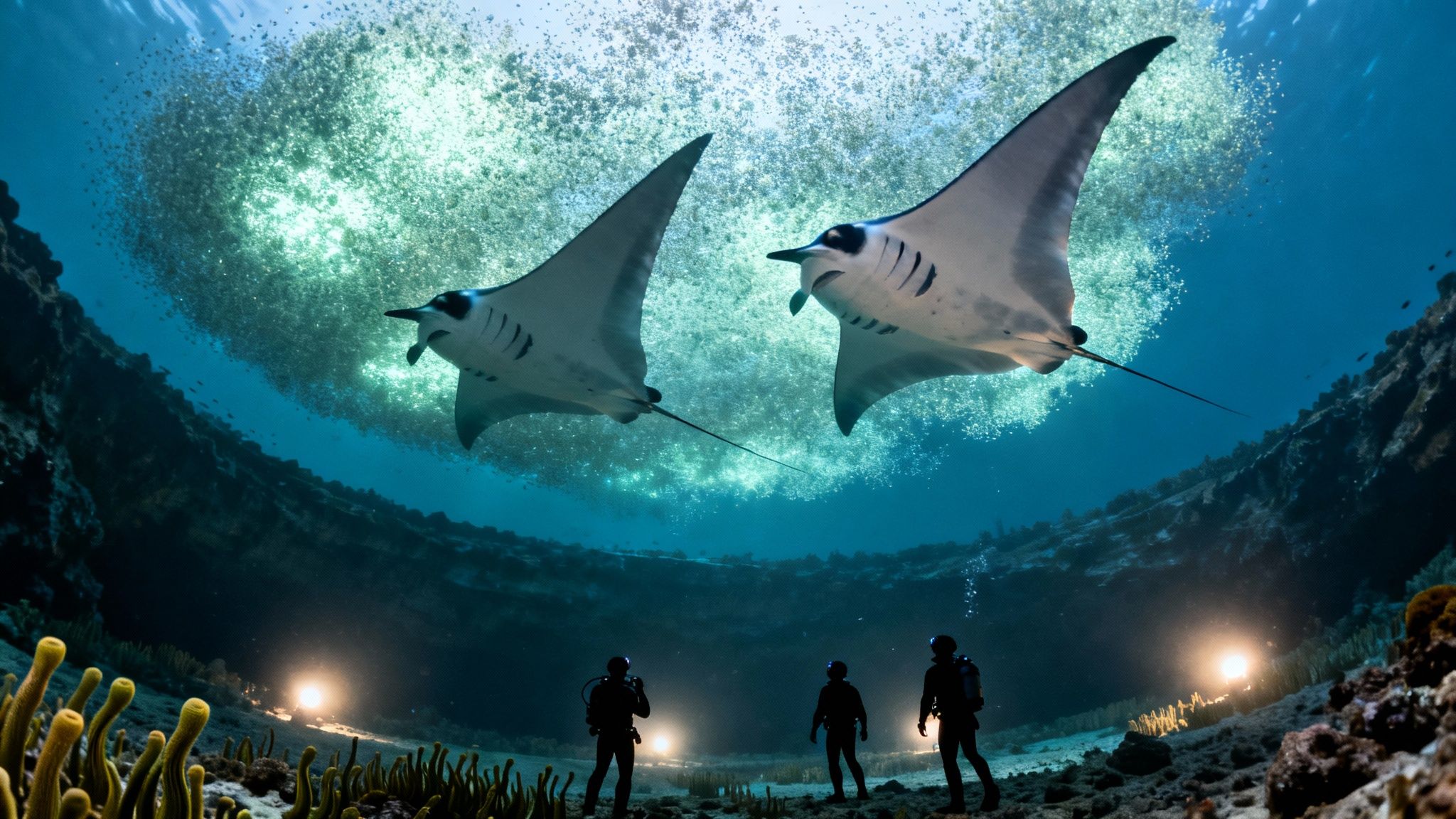
The genius behind this dive is its elegant simplicity. After the sun goes down, powerful lights are placed on the ocean floor. These lights act like a giant magnet for plankton, the microscopic organisms that manta rays love to eat. In no time, the light beams are thick with plankton, creating an irresistible buffet that draws in the giant, gentle rays from all around.
As a diver, your job is simple: be a quiet, respectful spectator. You'll descend to a designated spot on the sand, get comfortable, and just watch the show happen above you. The manta rays, some with wingspans stretching over 15 feet, will glide and barrel roll just inches from your face, scooping up plankton in a beautiful, silent ballet.
Why Garden Eel Cove Is the Premier Choice
While a couple of spots host the manta dive, Garden Eel Cove is the superior choice for the dive tour because of its protected location, a better viewing area, and healthier reefs. Tucked away near the airport, its location offers natural protection from the open ocean swell, which means the conditions are almost always calmer and safer. This makes a huge difference, especially on a night dive where comfort and control are key.
The underwater landscape at Garden Eel Cove is also perfectly suited for the experience. It’s shaped like a natural amphitheater, allowing divers to settle into a better viewing area without crowding each other. This setup gives everyone an amazing, unobstructed view and, more importantly, keeps the group organized to minimize any disturbance to the rays. On top of that, the surrounding reefs are simply more vibrant.
Choosing a dive at Garden Eel Cove means you’re setting yourself up for a more intimate and reliable encounter. The calmer water and superior layout create a peaceful, awe-inspiring atmosphere where the mantas can perform their feeding dance without fighting strong currents.
At Kona Honu Divers, we run our manta ray dive tours exclusively at Garden Eel Cove because we're committed to providing the safest and most breathtaking experience possible. Our guides are experts at positioning you for the best view while upholding the highest standards of respectful marine life interaction. You can get the full scoop on this adventure in our guide to the manta ray snorkel and dive in Kona.
What to Expect on Your Manta Dive
Your adventure kicks off with a thorough briefing from your divemaster. They'll walk you through exactly what will happen and cover the strict rules for interacting with the mantas. The golden rule is simple: never touch a manta ray. Touching them can remove their protective mucus coating, leaving them vulnerable to infection.
Here’s a play-by-play of what the evening looks like:
- Sunset Departure: The trip begins with a beautiful boat ride out to the site as the sun dips below the horizon, lighting up the sky.
- The Descent: Once darkness sets in, you’ll follow your guide down to the "campfire"—the circle of lights on the seafloor—at a mellow depth of about 30-40 feet.
- The Show Begins: After finding your spot on the sand, you'll switch on your dive light and aim it straight up. It usually doesn't take long for the first graceful shadows to appear.
- An Underwater Ballet: For the next 45-50 minutes, you'll be completely captivated as these majestic creatures swoop and soar through the light beams, often coming close enough for you to feel the water move as they pass.
The whole experience is deeply peaceful and a bit surreal. The only sounds you'll hear are your own bubbles and the silent, powerful grace of the mantas. It’s a moment of pure, unfiltered connection with the ocean that will stick with you long after you're back on the boat. This dive isn’t just something to check off a list; it’s the pinnacle of many divers’ careers and a memory you will cherish forever.
Discovering Specialty Dives for the Adventurous
While the vibrant Kona reefs could keep you busy for a lifetime, some of the most profound scuba Hawaii encounters happen when you push the boundaries. For the thrill-seekers and the truly curious, the Big Island is home to specialty dives that will completely flip your perspective on what an underwater experience can be.
These aren't your typical reef tours. These are expeditions into entirely different worlds.
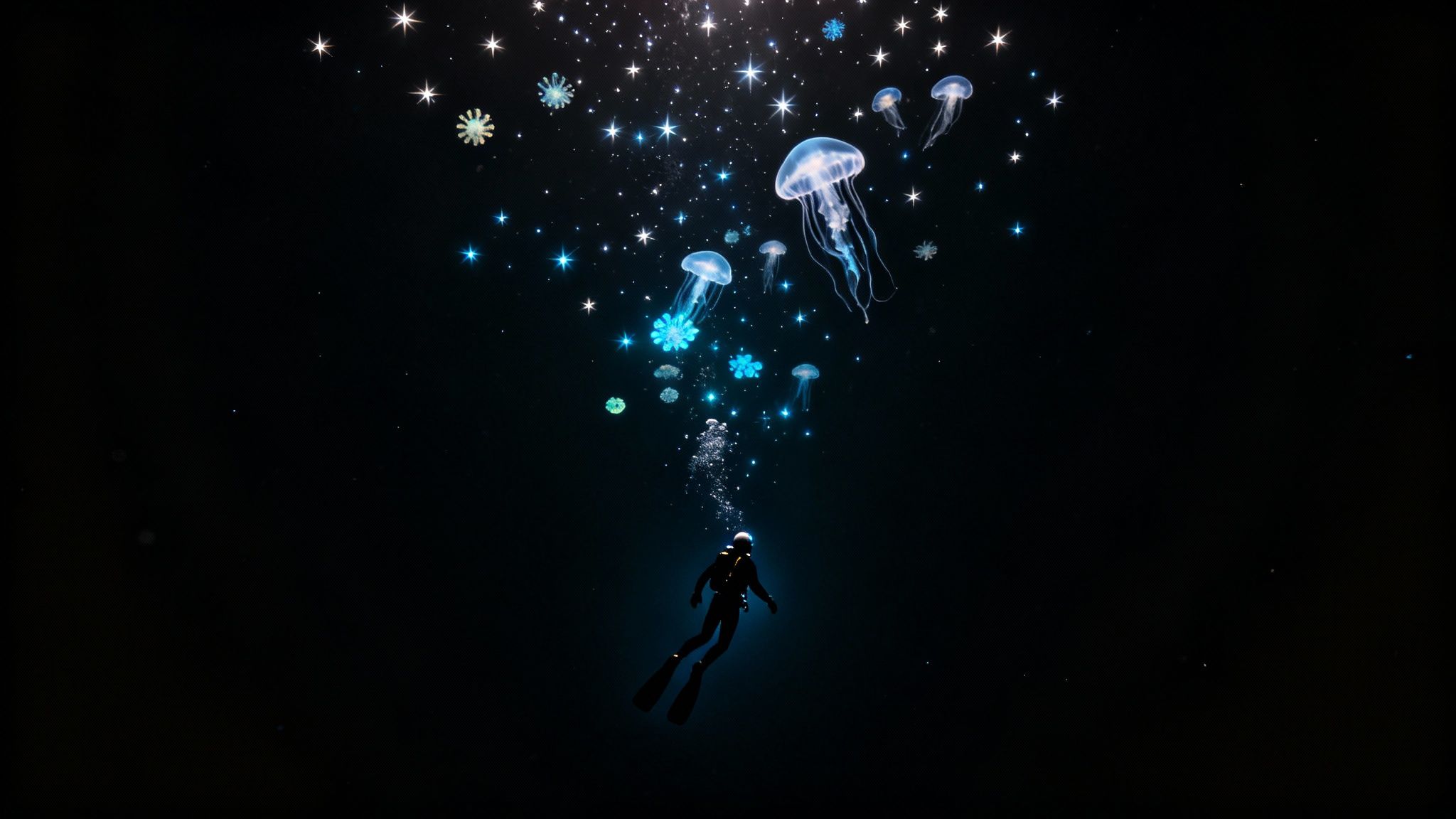
If you’re ready for something that feels more like floating through outer space than swimming in the ocean, the Kona Blackwater Dive is your ticket. It's an experience that’s nearly impossible to describe, but one you'll absolutely never forget. Picture this: you're suspended in the deep, inky black of the open ocean at night, miles from shore, just watching as a hidden universe drifts right past your mask.
This isn't a dive to the bottom; it's a drift through the middle. You'll be over thousands of feet of water, safely attached to a tethered downline with your guide and group. As you hang there in the darkness, you become a spectator to the largest migration on Earth, as bizarre and often bioluminescent creatures rise from the abyss to feed.
The Famous Kona Blackwater Dive
The blackwater dive is a whole different ballgame. Forget about navigating a reef—here, you’re simply an observer as a vertical current of pelagic life comes to you. Many of the creatures you'll encounter are in their larval stages, looking nothing like their adult forms and appearing utterly alien.
You’re likely to see things like:
- Shimmering Ctenophores: Comb jellies that pulse with their own internal, rainbow-colored light shows.
- Translucent Squids: Tiny, see-through cephalopods darting through the darkness on the hunt.
- Strange Larval Fish: Bizarre-looking juveniles that are almost never seen by human eyes.
This dive is a total sensory reset. The profound darkness, the silence of the open ocean, the sudden flash of a glowing creature materializing out of nowhere—it’s a feeling of pure, unadulterated discovery.
Because you’re diving at night in the deep open ocean, this is rightly considered an advanced dive. It takes a skilled crew and specialized gear to pull it off safely. Operators like Kona Honu Divers have perfected this, turning a potentially intimidating concept into a mesmerizing and safe adventure. If you're ready to see what comes up from the deep, you can book an expert-led Blackwater Dive tour and witness it for yourself.
Pushing the Limits with Advanced Dives
For divers who've put in the time, logged the dives, and earned the certifications, Kona opens up a whole new tier of challenging sites. These advanced dives aren't just about going deeper for the sake of it; they're about exploring more complex topographies and seeing marine life that thrives in the cooler, deeper waters. These are more experienced diving opportunities.
These sites often mean navigating dramatic drop-offs, underwater pinnacles that seem to rise from nowhere, and potentially stronger currents. It's here that all your training in buoyancy control, gas management, and situational awareness really comes into play. You need to be on your game.
The reward for that extra effort is spectacular. You get the chance to spot species you’d completely miss on shallower reefs—think larger pelagics, different kinds of sharks cruising the edges, and unique critters hiding out in the deeper volcanic rock formations. This is for the diver who has mastered the fundamentals and is hungry for the next level of exploration.
Kona Honu Divers runs a Premium Advanced 2-Tank Trip built specifically for this kind of diver. Led by seasoned guides who know these deep sites like the back of their hand, these trips promise a thrilling and safe adventure into Kona's wilder side.
How to Plan Your Perfect Big Island Dive Trip
A great dive trip is all in the planning, but don't worry—organizing your Kona scuba adventure is easier than you think. The Big Island really takes the guesswork out of it. With its reliably calm, clear waters and a year-round diving season, you can spend less time stressing and more time getting excited.
One of the first questions people ask is, "When should I go?" The simple answer? Anytime. Summer, from May to October, gifts us with bathwater-warm seas, often hitting a toasty 80°F (27°C) and conditions that are frequently glassy-calm. Come winter (November to April), the water cools down just a bit to around 75°F (24°C), but you get an incredible trade-off: the chance to hear humpback whale songs echoing through the water on your dive. It's a truly magical experience. No matter when you visit, visibility is consistently amazing, often stretching beyond 100 feet.
Gear, Training, and Gas Choices
The age-old question: pack it or rent it? Bringing your own mask, fins, and dive computer is always a smart move since you know they fit and work for you. But lugging a heavy BCD and regulator set across the Pacific? Save yourself the headache and airline fees by renting that gear locally. Reputable shops keep their equipment in top-notch condition, so it’s a solid, convenient choice.
What if you're not certified yet? You could get your Open Water certification in a chilly quarry back home, or you could do your training dives here in Kona's warm, vibrant ocean. Honestly, it's a no-brainer. Imagine seeing a green sea turtle glide by on one of your very first dives—that’s how you start a lifelong love affair with diving.
Pro Tip: Seriously consider getting Nitrox certified before you arrive. Diving with Enriched Air Nitrox means you get longer no-deco times and shorter waits between dives. On a two-tank trip, that adds up to significantly more time underwater exploring the reef.
Being a Responsible Diver
When we slip beneath the waves, we're guests in a fragile, living world. The future of Kona’s reefs is in our hands—and fins. The most important thing you can do is dial in your buoyancy. A single misplaced fin kick can destroy coral that took decades to grow. And of course, never chase, touch, or crowd the marine life. Just observe from a respectful distance, and you'll witness natural behaviors that you'd otherwise miss.
These simple acts of conservation are what keep our underwater world healthy and thriving. It's a big deal, not just for the ecosystem, but for the entire dive community. Globally, dive tourism is a massive industry—some estimates value it at over $11 billion—and places like Hawaii are at the heart of it all. Responsible diving ensures this beautiful resource is here for generations of divers to come.
Finally, let’s talk budget. Costs can swing depending on how many days you dive, what gear you rent, and which charters you book. To get a clear picture, check out our guide on how expensive it is to scuba dive in Hawaii. It'll help you map out your expenses so your trip is as stress-free as it is unforgettable.
Choosing the Right Dive Operator in Kona
Let’s be honest, the dive operator you choose can make or break your entire scuba trip in Hawaii. It’s the single biggest factor that separates a decent dive from a truly incredible one. Anyone can take you out on a boat, but a top-notch operator puts your safety first, every single time. That means meticulously cared-for gear and dive plans that are executed flawlessly.
But it's about so much more than just safety. Think of it this way: you wouldn't hire a mountain guide who just silently points you up the trail. You want someone who knows where to find the hidden waterfalls and can tell you the stories behind the landscape. The best dive shops in Kona do exactly that for the underwater world.
What Sets a Premier Operator Apart
A standout company like Kona Honu Divers gets all the little details right, and those details add up to a huge difference. One of their core philosophies is keeping dive groups small. This isn't just a small perk—it fundamentally changes the dive. You get a more personal and relaxed experience, and you're never just another face in a crowd. Your guide can actually give you individual attention, pointing out that elusive octopus you would have otherwise missed.
Their guides are true local experts who know these reefs intimately. They’ve spent years learning the currents, figuring out where the turtles like to hang out, and discovering the most brilliant coral gardens. This kind of deep local knowledge turns a simple dive into a fascinating tour of a living, breathing ecosystem.
On top of that, you'll be on comfortable, well-equipped boats built with divers in mind. A smooth ride and thoughtful amenities make the whole day more enjoyable. If you want to dive deeper into this, we've put together a full guide on how to choose a Kona dive shop.
Valuable Perks That Enhance Your Dive
The best operators also offer real value that goes beyond just the time you spend underwater. Kona Honu Divers, for example, has a couple of great perks that can genuinely improve your trip (and your budget).
- Early-Diver Discounts: It pays to plan ahead. Booking your dives in advance often means you can lock in a better price, freeing up more of your vacation fund for other island fun.
- Complimentary Nitrox: This is a huge win for certified Nitrox divers. Getting free Nitrox lets you safely extend your bottom time and shorten your surface intervals. Put simply, it means more time exploring underwater.
In the end, choosing an operator is about finding a team that’s genuinely committed to making your dive unforgettable. You want to dive with pros who are not only safe and skilled but who are also passionate about showing you the magic of Kona’s underwater world. When you book with a team that prioritizes quality over quantity, you’re setting yourself up for an exceptional experience from the moment you step on the boat.
Your Top Questions About Scuba Diving in Hawaii Answered
Planning a dive trip to the Big Island always brings up a few questions. Here are the straight-up answers to the things we get asked most often, helping you get ready for an amazing time in the water.
What's the Best Time of Year to Dive in Hawaii?
You can find great diving here any day of the year, but if you're looking for the absolute best conditions, aim for the summer months. From May to October, the seas are typically flatter and the water is at its warmest.
That said, winter diving has its own magic. From November to April, you have the incredible chance to hear humpback whales singing during your dive—an experience that will stay with you forever. The Kona coast is on the leeward side of the island, which means it’s sheltered from the major weather, giving us fantastic and protected scuba Hawaii conditions all year long.
Do I Need to Be Certified to Try Scuba Diving?
Not at all. If you're curious about breathing underwater but aren't certified, you can jump right in with a "Discover Scuba Diving" experience.
Reputable shops like Kona Honu Divers offer these introductory courses. You'll get a quick, easy-to-understand lesson on the basics, followed by a shallow dive in the ocean with an instructor right by your side. It’s the perfect way to test the waters without committing to a full certification course.
What Kind of Marine Life Will I See on the Big Island?
The Big Island’s volcanic coastline is a magnet for incredible marine life. On just about any given dive, you're likely to spot green sea turtles (honu), playful spinner dolphins, and graceful eagle rays. We also have plenty of white-tip reef sharks relaxing on the sand and a kaleidoscope of reef fish, from butterflyfish to triggerfish.
For something truly unique, specialty dives like the Manta Ray Night Dive or a Blackwater Dive will introduce you to a whole different cast of characters. You can see it all by checking out the different diving tours on the Big Island.
Is the Manta Ray Night Dive Safe for Beginners?
Absolutely. The world-famous manta ray night dive is incredibly safe, even for newly certified divers or those with just a few dives under their belt. The whole experience takes place in a shallow, calm, and protected bay.
Professional operators like Kona Honu Divers run a tight ship. We give a comprehensive safety briefing beforehand and have plenty of experienced guides in the water to make sure everyone feels comfortable and safe. You’ll be stationary on the bottom for most of the dive, so the focus is purely on the breathtaking spectacle happening right above you.
There's no tricky navigation—just hold on and enjoy the show. If this sounds like your kind of adventure, the 2 Tank Manta Dive Tour is one you'll never forget.