
You've got a few open days in Kona, a certification card somewhere on your phone, and several dive trips that sound equally appealing. A morning reef charter looks straightforward. The manta night dive is hard to pass up. Blackwater sounds fascinating, but you're not sure whether it matches your experience.
The right choice starts with your certification, recent diving, comfort with depth, and the day's conditions, not the most dramatic trip description. Scuba diving Kona, Hawaii, can mean a relaxed reef tour, instructor-led first breaths underwater, or a demanding night in open ocean. Book the trip you can comfortably manage, then build your week around it.
Kona Dive Trips Compared at a Glance
Kona dive trips by diver type and prerequisite
| Trip | Best for | Prerequisite | Main draw |
|---|---|---|---|
| 2-Tank Local Morning Dive | Certified divers wanting variety | Open Water certification | Morning coral gardens, lava tubes, and arches |
| Premium Advanced 2-Tank Trip | Experienced divers | Certification, logged experience, and trip-specific approval | Deeper, remote sites and drift dives on the scheduled daytime departure |
| Manta Ray Night Dive | Divers wanting close wildlife encounters | Scuba certification and comfort diving after dark | Reef mantas feeding after sunset |
| Black Water Night Dive | Experienced night divers and photographers | Open Water certification plus the operator's experience and recency requirements | Open-ocean animals drifting up in the dark |
| Morning Introductory Scuba Dive | Beginners | No certification needed, subject to medical screening and instructor approval | First guided breathing underwater during a morning outing |
| Private charter | Groups wanting a tailored outing | Each participant must meet the requirements of the selected activity | Custom departure schedule and suitable sites |
A certification card establishes your training level. It doesn't automatically make every departure a good fit. Someone who recently learned in a sheltered lagoon may need a different first outing than someone who regularly manages current, boat ladders, and night entries.
Kona Honu Divers runs this range of trips, including private outings. Compare departure options on the Kona scuba diving tours page.
What a two-tank trip actually means
A two-tank charter means separate dives with a surface interval between them, using a fresh cylinder for the next descent. It isn't one continuous dive with extra air strapped to you.
The second dive is usually shallower and more relaxed than the first. That gives you another site to explore without making both profiles equally demanding. Your guide still adjusts the plan around conditions, gas use, and the group's capabilities.
Allow time beyond the underwater portion. Check-in, equipment setup, the boat ride, briefings, and the surface interval all belong in your schedule. Don't book a tightly timed land activity immediately after the expected return.
Choose the comfortable starting point
The morning reef trip gives certified visitors a useful introduction to local entries, equipment, and volcanic terrain. It also lets you assess your weighting and confidence before adding darkness or open-ocean task loading.
A private boat offers scheduling flexibility, not an exemption from training limits or weather decisions. Mixed groups should choose an outing around the least-experienced participant's suitable activity rather than expecting everyone to complete the same dive.
Practical rule: Certified divers should start with the morning two-tank trip. Uncertified visitors should start with an introductory dive.
Certification, Courses and Nitrox Basics
For most regular charters, we require at least an Open Water Diver certification from a recognized agency such as PADI, SSI, or NAUI. That qualification allows diving to 60 feet (18 meters) with a buddy. Bring your C-card, even if you've booked and paid online.
Before booking, open your digital card and check that your name, agency, and qualification are readable. Save an offline copy rather than relying on dockside reception. Tell the crew about junior restrictions, specialty training, and how recently you last dived.
Kona scuba course options by experience level
| Course | Who it suits | Prerequisite | What it unlocks |
|---|---|---|---|
| Introductory scuba dive | Beginners with no certification | No certification; medical screening and instructor approval | Guided shallow diving with an instructor |
| Open Water Diver | Beginners wanting certification | Medical questionnaire, swimming assessment, and course eligibility | Dives to 60 ft with a buddy on suitable regular charters |
| Advanced Open Water | Certified divers building skill | Open Water certification | Supervised depth and navigation practice |
| Enriched Air (Nitrox) | Certified divers wanting more no-decompression flexibility | Open Water certification and course eligibility | Enriched air use on suitable trips |
| Rescue Diver | Experienced divers | Advanced-level training and current first aid training, subject to agency requirements | Rescue techniques for buddy and group safety |
Put training before the tour reservation
Complete the medical questionnaire first. An answer requiring medical clearance can change your timeline, so don't leave it until boarding. Choose a course that fits your available days, then arrange recreational departures around the instructor's schedule.
An introductory dive isn't a substitute for certification. It offers a supervised first experience, while Open Water training teaches the planning, equipment, and emergency skills needed for buddy diving. Advanced training adds practice, but completing a course doesn't instantly make difficult conditions routine.
If your basic skills feel rusty, book a refresher before a specialty outing. You should be comfortable clearing a mask, recovering a regulator, controlling an ascent, and checking gas without needing repeated prompts. Review the scuba classes and refresher options before committing your vacation days.
Pack for comfort and equipment checks
Bring the items you'll use, keeping valuables and unnecessary electronics ashore.
- Swimsuit and rash guard: Arrive ready to change into exposure protection.
- Reef-safe sunscreen: Apply it before boarding and use clothing for additional sun protection.
- Towel and dry bag: Keep dry clothing separate from wet equipment.
- Logbook and C-card: Have both available for the crew's experience check.
- Personal medications: Keep them labeled and disclose relevant conditions during screening.
- Camera housing: Inspect its seal and controls before taking it onto the boat.
For rental equipment, the crew helps fit your mask, regulator, and BCD. Breathe through the regulator, operate the inflator and dumps, and check that you can reach releases without struggling. Speak up before departure if the mask pinches or the BCD shifts around your torso.
Understand nitrox before using it
Enriched air, or nitrox, contains more oxygen than regular air. On suitable profiles, it can extend no-decompression time. It doesn't make your cylinder last longer, remove decompression risk, or permit deeper diving.
Use it only with the Enriched Air certification and an analyzed tank. Check the oxygen percentage, establish the maximum operating depth, and set your computer to the actual mix before descending. Never assume the previous setting is correct.
Confirm whether nitrox is included when booking, and check the cylinder you'll breathe. Pack light, confirm rental sizes early, and ask before you assume.
Best Kona Dive Sites and What Makes Each One Special
Say you're comfortable on reefs but haven't spent much time around walls or lava formations. The useful question isn't which site has the most impressive name. It's whether you'll have a clear route, manageable depth, and an exit you can use comfortably.
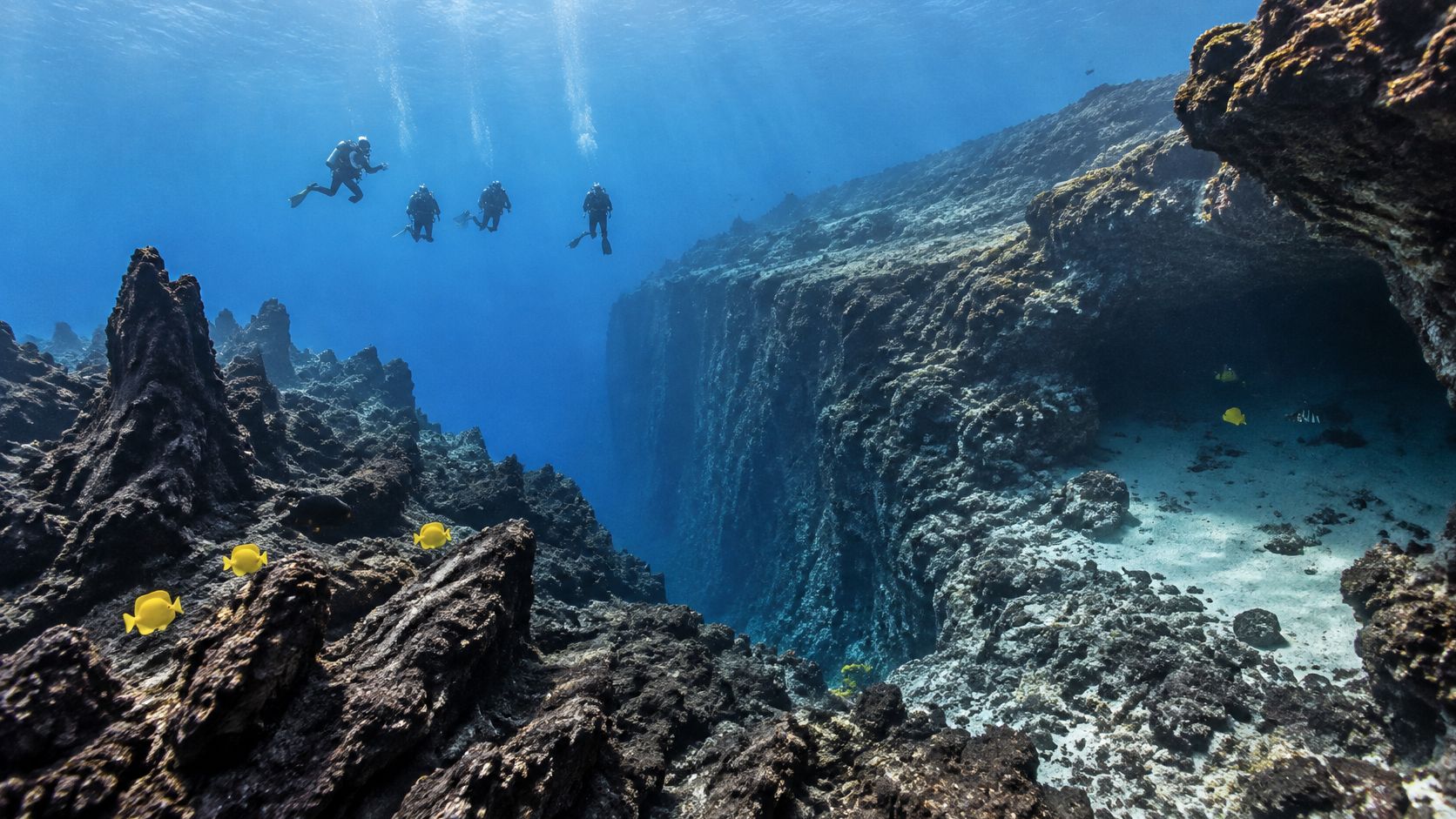
Kona's terrain reflects its volcanic foundation. The USGS geological description of Kona's coastal lava flows describes basalt from Mauna Loa and Hualālai layered around an ancient carbonate reef. For divers, that means ledges, cavities, lava fingers, and abrupt changes in depth rather than a uniform reef slope.
Kona dive sites compared by feature and best-fit diver
| Site | Main feature | Entry | Best for |
|---|---|---|---|
| Old Kona Airport Marine Life Conservation District | Lava fingers to about 50 ft, followed by a steep drop | Shore through a partially protected cove | Prepared shore divers and photographers |
| Garden Eel Cove | Protected location, better viewing area, and better reefs for the manta outing | Boat | Manta night dives |
| Manta Heaven | Highest observation count among the established sites in the long-term manta study | Boat | Observing returning mantas |
| Manta Village | Another major established manta aggregation site | Boat | Manta night dives |
| Pawai Arches | Arches and lava formations | Boat | Confident divers interested in structure |
| Open-ocean blackwater zone | Deep water beyond the reef | Boat | Experienced night divers and photographers |
Match the terrain to your skills
At Old Kona Airport, the shallow lava fingers reach roughly 50 ft before the bottom drops rapidly into deeper water. Keep your planned depth on your computer, not in your impression of how close the bottom looks.
The Hawaiʻi Division of Aquatic Resources' Old Kona Airport description places the district offshore between the airport area and Kailua Lighthouse, identifies a no-boating zone, and describes the partially protected entry cove at the beach's northwestern end. Protected access doesn't mean an entry remains safe when swell increases.
Use the Big Island shore-diving guide to assess access logistics before choosing independent shore diving. Carrying equipment over uneven ground and returning through moving water can be harder than the dive itself.
Look beyond the site name
Garden Eel Cove and Manta Heaven refer to the same established manta area, so don't count them as separate destinations when comparing itineraries. Manta Village offers another established nighttime aggregation location.
At Pawai Arches, enjoy the formations without assuming that every opening is an appropriate swim-through. Maintain an unobstructed route to open water unless you have the training and equipment for an overhead environment. Blackwater, meanwhile, replaces reef landmarks with a boat-based reference system.
The state's marine conservation guidance explains how protected areas restrict extraction and support non-extractive recreation. Identify the exact management boundary, don't feed fish or collect organisms where prohibited, and keep fins clear of coral and lava habitat.
Choose the site by skill and surface conditions. Confirm boundaries, the return route, and the planned depth before the first descent.
Manta Night Dives and What to Expect Underwater
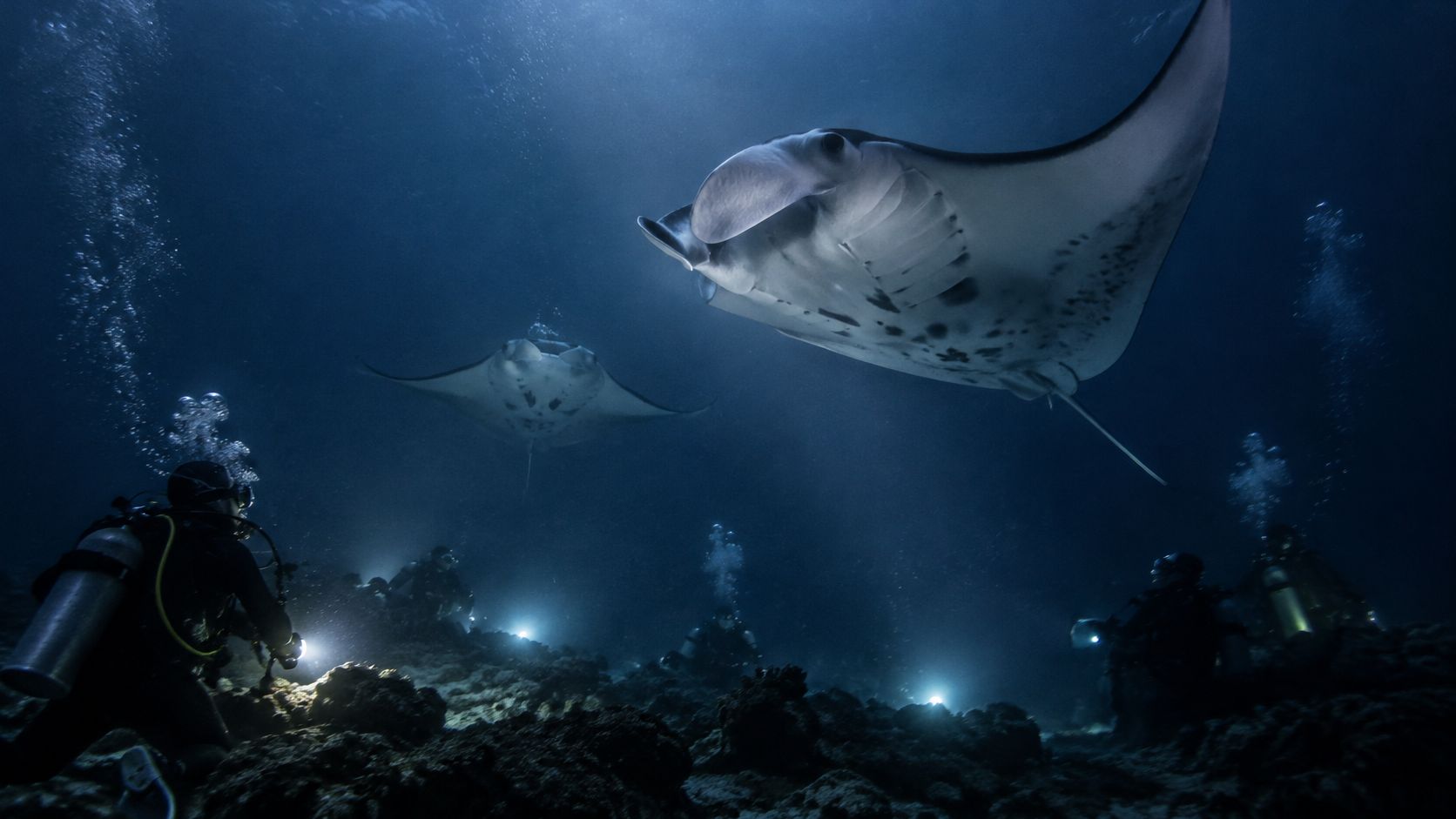
After sunset, lights concentrate zooplankton, and reef mantas may arrive to feed through the illuminated water. You're watching wild animals choose where to swim, not attending a scheduled performance. Even at established feeding sites, the number of mantas and the pace of the encounter can change.
The six-year manta observation study recorded 25,444 observations of 118 individually identified reef manta rays at Manta Heaven and Manta Village, with 39 individuals detected on more than 10% of study nights. Repeated observations demonstrate site loyalty, but they aren't a sighting probability for your booking.
Why some nights are better
A 2025 University of Hawaiʻi study covering 13 years of community records found broadly stable aggregations despite increased tourism, with prey availability closely associated with seasonal and annual changes in manta numbers. That supports realistic expectations: a quiet evening doesn't necessarily indicate a damaged population, and a busy evening doesn't prove that every interaction is harmless.
Garden Eel Cove is the superior choice for the manta dive because of its protected location, better viewing area, and better reefs. Those features make the overall outing worthwhile beyond the moment a manta passes overhead. They don't cancel weather concerns or guarantee more animals on a particular night.
Choose the manta ray dive tour for feeding behavior and patient observation, not for the freedom to swim alongside the animals.
Follow the night in sequence
- Arrive ready to listen. Resolve equipment concerns before the boat reaches the site, rather than trying to troubleshoot while others enter.
- Learn the lighting and signals. Confirm where your light points, how the guide communicates, and what you should do if separated.
- Enter with your buddy. Establish control before descending and follow the guide to the designated viewing position.
- Stay still and observe. Keep hands, fins, and camera equipment out of the feeding path. Don't pursue an animal that turns away.
- Debrief after the exit. Tell the guide about buoyancy, lighting, or spacing problems while they're fresh in your mind.
The Kona manta night-dive guide can help you prepare for the format before departure. A camera is optional; reliable position control isn't.
A close pass is something the manta chooses. It isn't permission to reach upward, touch, or follow.
Mantas may change course or stop feeding around people. Give them room to continue naturally, even when another group has a better angle. Stillness and patience produce better observation than chasing, and they leave the feeding lane open for the next pass.
Advanced, Blackwater and Photography Dives for Experienced Divers
A blackwater dive suits someone who can hold depth and manage equipment without a reef beneath them. The boat takes you into open ocean at night, where animals such as salps, siphonophores, and ctenophores become the subjects. If darkness already consumes most of your attention, leave the camera ashore or build experience on conventional night dives first.
A summary of NOAA-supported pelagic observations near Kona describes recreational diver surveys over 19 months, with a model explaining 43% of observed biodiversity variation. Water temperature, bathymetry, and the El Niño–Southern Oscillation index were the strongest predictors. That helps explain why successive outings can offer substantially different subjects.
Choose the challenge you actually want
The Black Water Night Dive is about small open-ocean life, controlled observation, and working without familiar bottom landmarks. Don't mistake the lack of a reef for a lack of complexity. You still need dependable buoyancy, buddy awareness, and the ability to follow the boat's positioning system.
Read the Kona blackwater preparation guide and confirm trip-specific eligibility before reserving. Open Water certification is a foundation, not sufficient evidence by itself that you're ready.
The Premium Advanced 2-Tank Trip suits certified, experienced divers seeking deeper sites, drift dives, and remote reef locations. Here the trade-off is different: you gain access to more demanding terrain, but gas use, current assessment, and coordinated ascents require closer attention.
Choose advanced reef diving if structure and moving along a site interest you most. Choose blackwater if you're comfortable hovering and patiently searching a small illuminated space.
Make photography secondary to diving
- Set up before descent. Secure the housing, check controls, and choose a starting exposure on deck. Establish buoyancy before lifting the camera to your face.
- Control lighting direction. Use diffused strobes and angle them away from directly illuminating the water in front of the port. A dim, adjustable focus light can help keep excessive glare under control.
- Approach without grabbing. Move slowly with small fin inputs. Never hold coral, pin an animal in place, or use a buddy as an unstable camera platform.
- Shoot, then check. Between short shooting sequences, check depth, gas, your buddy, and your position relative to the guide.
- Accept the missed frame. If a subject moves beyond your planned area, let it go. No photograph justifies losing the group or exceeding a limit.
Fish feeding and aquarium-fish collecting are prohibited in the Kona Coast managed area. Photograph natural behavior rather than arranging an encounter through disturbance.
Camera priority: If you can't maintain position while looking away from the screen, you're carrying more task loading than you can comfortably manage.
Advanced and blackwater outings work best for divers with logged experience who can hold position, communicate clearly, and solve ordinary equipment problems without losing control in the dark.
Best Season, Conditions and Safety Checks
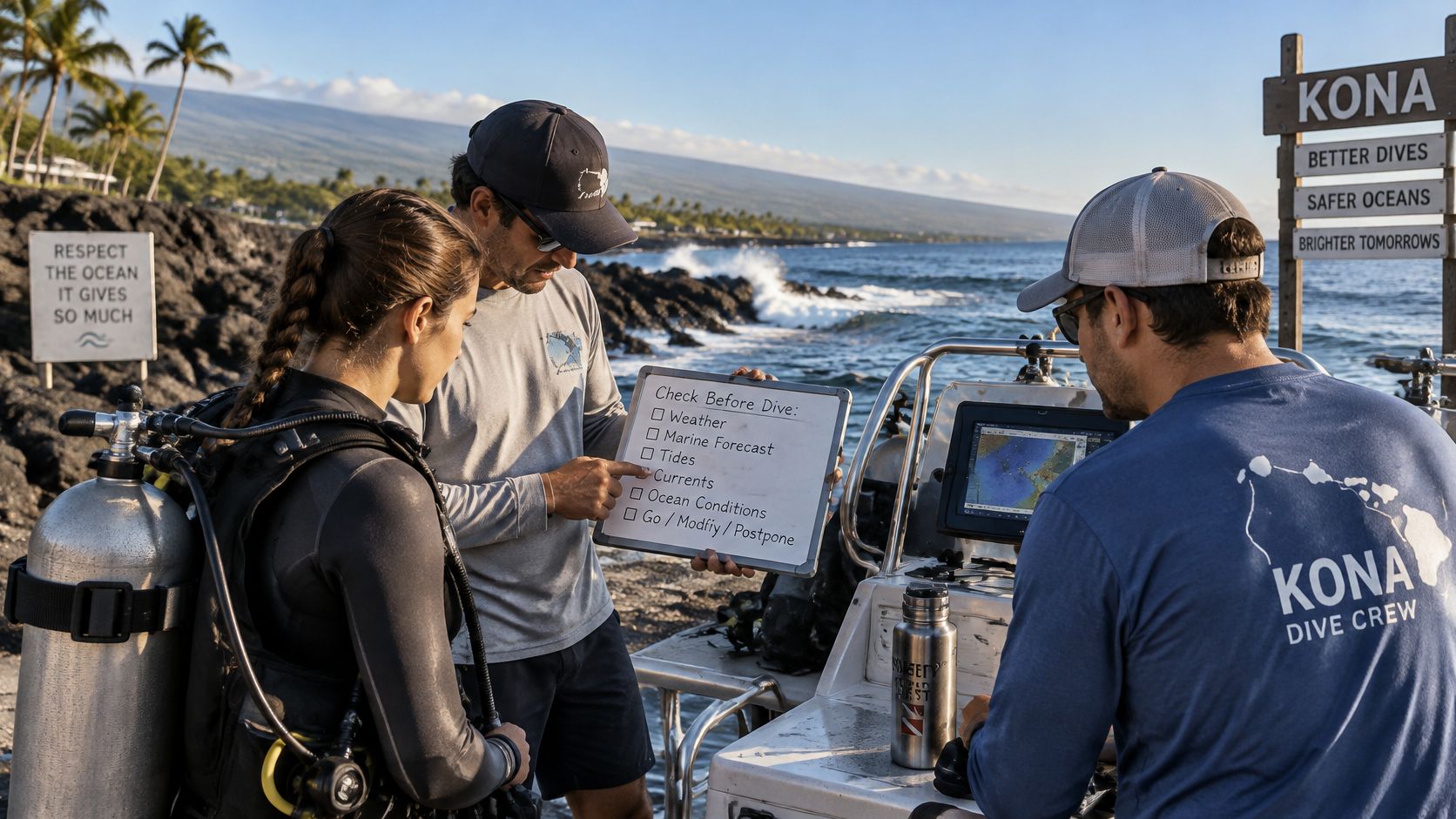
NOAA's marine-conditions guidance advises checking weather, marine forecasts, tides, and currents before entering or traveling on the water, and changing plans when conditions are unfavorable. That advice matters at every stage of a boat dive, from leaving the harbor to climbing the ladder afterward.
Diving in Kona is available year-round, with warm water and generally clear visibility in every season. That describes the destination, not a promise about tomorrow's sea state. Check the forecast the day before and reassess with the crew on departure day.
Use the forecast instead of a seasonal shortcut
Wind affects boat handling and surface comfort. Swell can make a sheltered-looking shore entry difficult, while current can change the effort required to return to the exit. Tide also matters when assessing exposed rocks and access points.
The guide to Hawaii's best scuba-diving months can help with broad vacation planning. For the actual dive decision, use current conditions and the guide's site assessment rather than a general claim that a particular month is always calm.
Wear exposure protection for your own tolerance, especially when combining repeated dives and evening boat rides. Feeling chilled, tired, or distracted is a reason to simplify your schedule, not squeeze in another departure.
Make medical and travel decisions early
Complete the medical questionnaire carefully. If an answer requires clearance, resolve it before the trip. Don't dive with a cold or congestion, and don't use medication to force an equalization problem past the screening process.
Avoid flying too soon after diving. A 12-to-24-hour interval is commonly discussed, but it isn't a universal clearance for every profile or person. Follow current diving-medical guidance, your computer, and the more conservative advice appropriate to your dives; leave additional room rather than scheduling a flight at the edge of a minimum.
Plan elevation changes too. Mountain drives and high-altitude sightseeing need consideration alongside flights. Put those activities before the diving portion of your vacation where practical.
Treat night safety as an operating system
The state's manta-viewing boating and safety assessment identifies concerns associated with congested operations involving boats, snorkelers, and scuba divers. Calm water doesn't remove the risks created by multiple groups sharing the same space.
Darkness reduces visual references. Surface lights can make it harder to distinguish signals, while cameras, buoyancy adjustments, and nearby divers compete for attention. Ask how the crew manages transfers, group spacing, surface pickup, and emergency communications.
- Confirm the forecast: Review it the day before and accept a site change or cancellation when necessary.
- Arrive early: Use briefing time to learn entry procedures, light signals, and the exit route.
- Check your buddy plan: Agree on separation procedures and how you'll communicate a problem.
- Carry appropriate lights: Know your primary and backup equipment before entering.
- Agree on an abort signal: Anxiety, equipment trouble, or poor control is enough reason to end the dive.
Either buddy can end the dive. Make that agreement before entering, when nobody is distracted or worried about disappointing the group.
Plan Your Kona Dive Week and Book
- A three-day certified plan: Start with the morning two-tank trip on day one. Book the Garden Eel Cove manta outing on day two. Keep day three free of daytime diving so you can rest before a blackwater night dive, provided your experience meets its requirements.
- A five-day advanced plan: Use the same progression, adding a Premium Advanced 2-Tank Trip and a training day if an Enriched Air course fits your goals. Arrange course timing with the instructor rather than assuming every available vacation day should contain a demanding dive.
These are sample schedules, not reasons to override fatigue or weather. Keep the final departure separate from your flight and any elevation-sensitive travel. If conditions interrupt the plan, preserve the suitable dive rather than forcing the original order.
Build confidence before adding complexity
A typical Kona Honu Divers dive day begins with arrival and gear setup, followed by a briefing on site conditions and entry style. The deeper or more condition-sensitive site comes first, followed by a surface interval and a more relaxed second dive.
Use that first outing to establish a comfortable routine. Check whether your weighting lets you hold a stop, whether you can read your computer easily, and whether rental equipment feels familiar. Tell the guide about any problem before reserving a more demanding departure.
For a mixed-experience group, don't require everyone to follow the advanced itinerary. A beginner can train while an experienced partner takes a suitable charter. Shared vacation time doesn't require identical underwater plans.
Book in a practical order
- Confirm certification and readiness. Have your C-card, recent diving history, and any required medical clearance available.
- Check the forecast. For bookings made well ahead, keep the itinerary flexible and reassess conditions close to departure.
- Book the morning trip first. Give yourself a straightforward local starting point before specialist outings.
- Add a night dive. Choose the manta outing or blackwater according to your experience and interests, not based solely on the remaining calendar slot.
- Reserve early for popular dates. Leave room for rest and possible weather changes rather than filling every morning and evening.
- Compare live prices. Current rates appear on the tours page and in the booking system. Check gear inclusions, course charges, and cancellation terms before committing.
Don't compare bookings solely by the headline price. A useful comparison includes the activity you'll complete, required equipment, eligibility, departure logistics, and how comfortably the schedule fits your trip.
Leave room to change the plan
The strongest itinerary has a clear first choice and an acceptable alternative. A reef departure can still make sense when a more exposed site doesn't, and a rest day can be the right decision after a tiring night.
Bring your actual experience to the booking conversation. A clear description such as “comfortable on shallow reefs, rusty with night diving, and still improving buoyancy” is more useful than calling yourself advanced because of a card.
Choose the first suitable departure, then add complexity only where it fits. The booking system lets you check current availability without relying on an old price or an assumed schedule.
Kona Honu Divers offers guided reef trips, manta nights, advanced and blackwater dives, and training for visitors building their skills. Visit Kona Honu Divers to choose a departure that matches your certification, recent experience, and available days, then confirm the details before booking.