
Picture this: you're descending into warm, impossibly clear turquoise water, weightless. All around you, vibrant coral gardens burst with color, growing over ancient, underwater lava formations. This isn't a dream—it's what's waiting for you when you go scuba diving on the Big Island of Hawaii.
The Kona coast, in particular, is a global hotspot for diving, known for some of the most consistent and spectacular underwater conditions you'll find anywhere.
Embark on an Unforgettable Underwater Journey
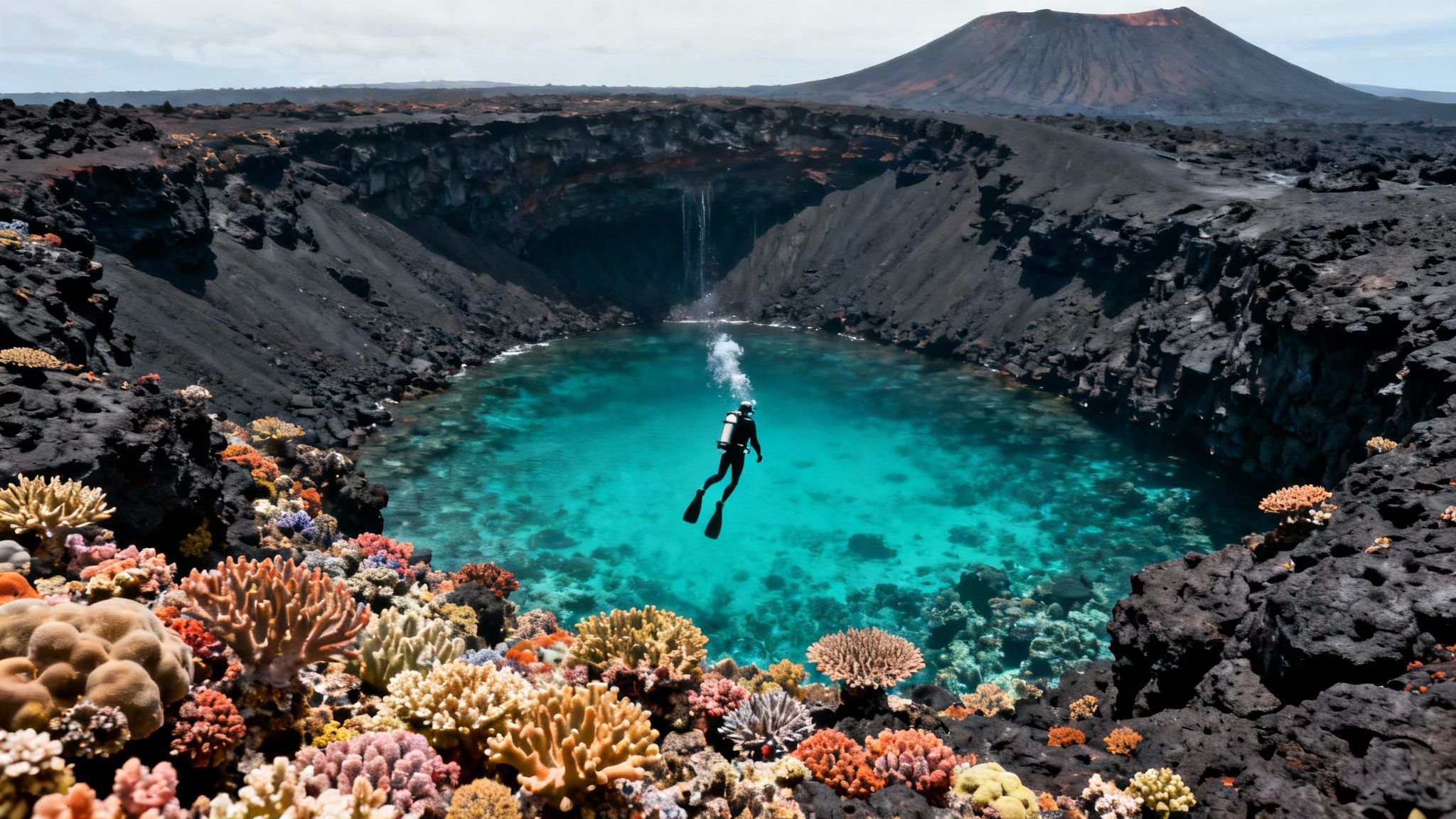
Think of this guide as your personal introduction to Kona's legendary diving scene. We'll explore how the island's volcanic past sculpted an incredible underwater playground, full of dramatic lava tubes, massive archways, and serene coral gardens. It's a landscape unlike any other.
We'll also dive into the experiences that truly define scuba diving on the Big Island, like the world-famous Manta Ray Night Dive or the surreal Blackwater Dive. These aren't just dives; they're encounters with some of the most fascinating creatures thriving in the Pacific.
What Makes Big Island Diving So Special?
The Big Island isn't just another tropical destination; it hosts some of the most unique and biologically rich dive sites on the planet. A perfect example is the Kealakekua Bay Marine Life Conservation District. This protected sanctuary, established way back in 1969, covers roughly 4,000 acres of pristine ocean.
What does that mean for divers? For starters, the water clarity is just phenomenal, with visibility often pushing past 100 feet. Because the bay has been a no-take zone for decades, the marine life has absolutely flourished. It's a bustling underwater metropolis, home to over 500 species of fish and invertebrates. You can get a closer look at the Big Island's diverse marine ecosystems to really appreciate its complexity.
To make sure your adventure is safe, memorable, and absolutely top-notch, going with an experienced operator is key. We highly recommend Kona Honu Divers; their local knowledge and commitment to safety have earned them a stellar reputation, backed by countless glowing reviews from divers just like you.
Ready to see it for yourself? Take a look at their diving tours page to get a feel for the different trips they offer. An underwater paradise is waiting.
Why the Kona Coast Is a Diver’s Paradise
So, what makes Kona the heart and soul of scuba diving on the Big Island of Hawaii? It all comes down to the island’s incredible geography. The two massive volcanoes, Mauna Loa and Hualalai, act as a natural wall, shielding the entire western coast from the powerful trade winds that hammer the rest of the Hawaiian islands.
This creates a diver’s dream scenario: waters that are consistently calm, clear, and predictable. While other spots in Hawaii might be blown out by rough seas, Kona often feels more like a giant, placid lake. It’s a place you can dive comfortably just about any day of the year, with visibility that often pushes past 100 feet, revealing every detail of the world below.
A Volcanic Underwater Playground
But the calm surface is only half the story. The real magic lies beneath, where millennia of volcanic activity have sculpted an absolutely breathtaking underwater landscape. Forget flat, sandy bottoms—the seafloor here is a dramatic world of ancient lava flows frozen in time.
As a diver, you get to explore:
- Dramatic Drop-Offs: Sheer underwater cliffs that plunge into the deep blue, often patrolled by larger pelagic species.
- Intricate Lava Tubes: Amazing caverns and swim-throughs carved by molten rock, now providing shelter for all kinds of unique critters.
- Towering Pinnacles: Volcanic spires that rise from the depths, acting as cleaning stations and magnets for marine life.
- Majestic Archways: Naturally formed arches that make for incredible photo ops and fun swim-throughs.
This rugged volcanic terrain is the perfect foundation for a thriving, vibrant ecosystem. It’s where you’ll find Hawaiian green sea turtles (honu) resting on coral heads, pods of spinner dolphins cruising the coastline, and countless fish that you won’t see anywhere else on the planet. In fact, over 20% of Hawaii's reef fish are endemic, meaning this is the only place in the world to find them. You can learn more about what makes diving in Kona so unique right here on our blog.
It’s this perfect marriage of protected waters and a dynamic, volcanic seascape that puts the Kona coast on every diver's must-visit list, no matter their experience level.
The real magic of Kona is how the island's geology directly translates to a better diving experience. The volcanoes don't just create a calm surface; they've sculpted a complex, beautiful, and thriving ecosystem below.
To help you plan, here’s a quick look at what to expect from the water conditions throughout the year. As you can see, there really isn’t a bad time to dive in Kona.
Big Island Dive Conditions by Season
| Season | Water Temperature (Avg.) | Visibility | Common Marine Life Sightings |
|---|---|---|---|
| Winter (Oct – Apr) | 75-78°F (24-26°C) | Excellent (80-120+ ft) | Humpback Whales (songs), Turtles, Eagle Rays, Dolphins |
| Summer (May – Sep) | 79-82°F (26-28°C) | Excellent (100-150+ ft) | Manta Rays, Turtles, Colorful Reef Fish, Dolphins |
Ultimately, whether you're gliding over a shallow reef or exploring a deep volcanic ledge, the prime conditions on the Kona coast set you up for a scuba diving Big Island Hawaii adventure that is as safe as it is unforgettable.
Experience the Legendary Manta Ray Night Dive
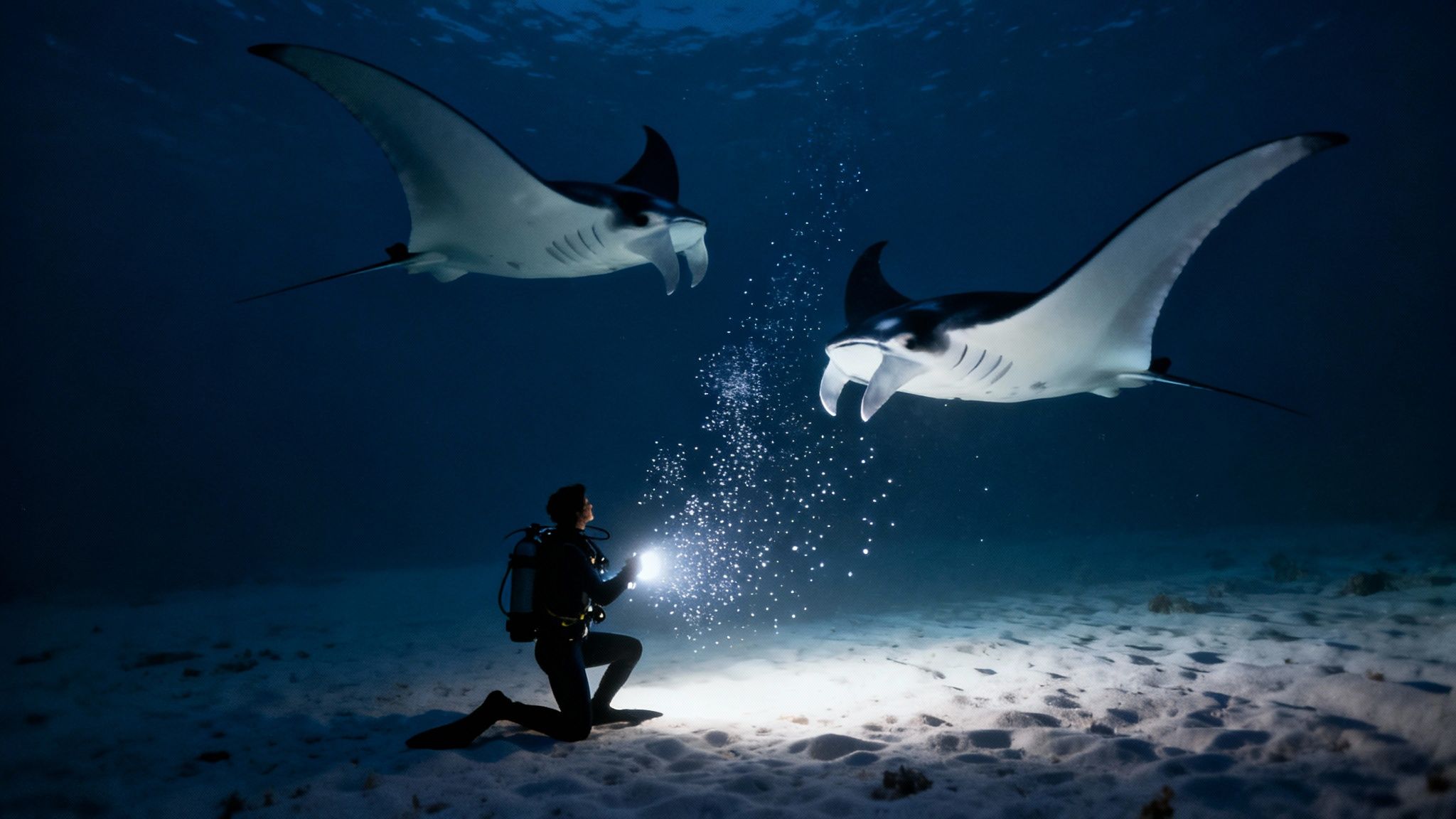
Of all the incredible things you can do while scuba diving Big Island Hawaii, one experience consistently tops the list. It’s more than just a dive; it’s an underwater ballet, a true spectacle that has earned its place on bucket lists around the globe: the Manta Ray Night Dive.
Picture this: you're kneeling on the sandy ocean floor as the last light of day fades away. Your group's dive lights all point upward, creating pillars of light that slice through the dark water. Soon, tiny organisms called plankton are drawn to the beams, forming a shimmering, soupy cloud. Then, out of the blackness, they arrive.
Giant manta rays, some with wingspans stretching over 12 feet, glide effortlessly into the light. They perform graceful somersaults and barrel rolls, feasting on the plankton buffet you’ve helped create. They swoop just inches over your head in a silent, majestic dance, their massive forms silhouetted against the lights. It's utterly breathtaking.
Why Garden Eel Cove Is The Premier Location
You can see mantas at a few spots, but not all sites are created equal. For the absolute best, most reliable experience, Garden Eel Cove (also known as Manta Heaven) is the undisputed champion. It has a few key advantages that make it the superior choice for your dive tour.
First off, its location is naturally protected from the open ocean swells. This almost always means calmer conditions, which makes for a much more comfortable and enjoyable dive—something that’s especially important at night.
The underwater landscape at Garden Eel Cove is also perfectly suited for viewing. The large, sandy bottom creates a kind of natural amphitheater—a better viewing area where divers can settle in without harming any of the delicate coral. This setup gives everyone a front-row seat to the show.
And it’s not just about the sandy patch. You're surrounded by some of the most vibrant and healthy reefs on the Kona coast, so you’re immersed in a thriving ecosystem, adding another layer of magic to this world-famous dive.
The Manta Ray Night Dive isn’t just about watching from a distance; it’s about participating. You become part of the environment—your light attracts the plankton, and the plankton brings the mantas. It’s a beautiful, symbiotic performance that connects you directly to the rhythm of the ocean.
A Reliable and Unforgettable Adventure
One of the best things about this dive is its remarkable consistency. The scuba diving on the Big Island of Hawaii is a huge draw for a reason, and this dive is a massive part of that. The Kona coast hosts over 10,000 manta ray dives every year, and operators report a sighting success rate of an incredible 85-90%.
That high success rate, especially at a prime spot like Garden Eel Cove, means you’re almost guaranteed an unforgettable encounter. When you go with a top-tier operator like Kona Honu Divers, you know the experience will be magical and conducted with the utmost respect for the animals. Our crew knows exactly where to position everyone for the best views while prioritizing both safety and conservation. You can dive deeper into the details in our guide to seeing manta rays on the Big Island.
This is more than just another dive in your logbook. It’s a profound connection with one of the ocean's most graceful giants—an experience you’ll be talking about for years to come.
Explore Kona’s Most Spectacular Dive Sites
While the Manta Ray Night Dive gets most of the spotlight—and for good reason—it’s really just the opening act for scuba diving on the Big Island of Hawaii. The Kona coast is absolutely packed with world-class dive sites, each one offering a completely different window into the island’s volcanic soul and vibrant marine life.
Forget the idea that it's all about mantas. On any given day, you could be drifting through ancient lava tubes, floating over pristine coral gardens, or exploring dramatic underwater cliffs. It’s this sheer variety that really shows you what Kona diving is all about, from the tiniest endemic critters to graceful sea turtles.
Let's dive into a few must-see spots you can explore with Kona Honu Divers.
Golden Arches: A Photographer's Dream
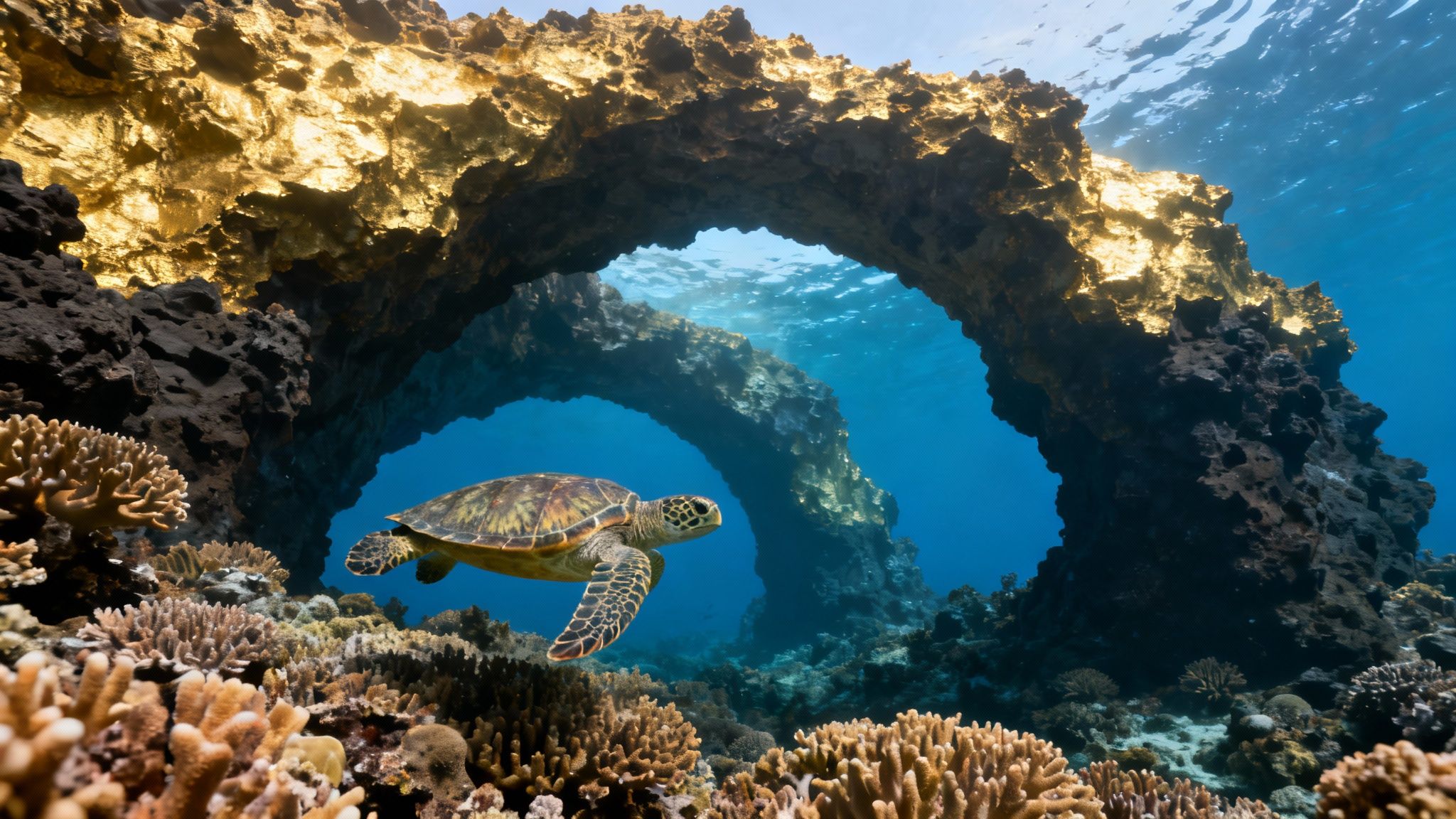
If you're looking for a truly breathtaking dive, Golden Arches is it. The site is named for a series of incredible lava rock archways that form natural swim-throughs. When the sun hits just right, beams of light filter down through the water, lighting up the arches like a submerged cathedral. It's an absolute favorite for underwater photographers.
The terrain here is classic Kona: a beautiful mix of rugged volcanic formations and healthy coral. As you glide through the arches, you’ll almost certainly be greeted by schools of bright yellow tang and curious butterflyfish. Keep an eye on the crevices, and you might just spot a shy octopus. It's a fantastic intermediate dive that perfectly captures the magic of Kona's underwater architecture.
Golden Arches is more than just a dive site; it's an underwater art gallery sculpted by nature. The way the light plays through the lava formations creates a truly immersive and almost spiritual experience for divers.
Turtle Pinnacle: A Bustling Cleaning Station
Picture an underwater spa day for Hawaiian green sea turtles (honu), and you’ve got Turtle Pinnacle. This site is a submerged volcanic cone that rises from the seafloor, acting as a natural “cleaning station.” Turtles flock here to let smaller fish, like the Hawaiian cleaner wrasse, nibble away algae and parasites.
This fascinating relationship gives divers a front-row seat to watch turtles in a completely relaxed, natural state. It’s pretty common to see several honu just chilling out, patiently waiting their turn for a good scrub. The pinnacle itself is also buzzing with all sorts of other marine life, making it an amazing dive for any skill level.
Au Au Crater: A Unique Geological Dive
For a dive that feels like you’ve landed on another planet, Au Au Crater is simply unreal. This partially submerged volcanic crater delivers a geological experience you won’t find anywhere else. The massive crater walls create a naturally protected bay where marine life thrives, but the structure itself is the main event.
You really get the sense that you’re swimming inside a volcano. The crater’s rim is covered in delicate finger coral, and if you look closely at the sandy bottom, you’ll often find garden eels swaying in the current or a well-camouflaged frogfish. Because it’s so protected, the visibility is usually crystal clear with calm conditions, making it a great spot for most certified divers. This dive is a powerful reminder of the volcanic forces that shaped this entire island, both above and below the waves.
While Kona offers incredible diving, those interested in discovering other iconic diving destinations might want to learn more about places like iconic diving destinations like the Galapagos Islands.
These are just a few of the incredible sites waiting for you. Each location tells a different story about the dynamic environment of the Big Island. You can experience all of these underwater wonders and more on one of the many diving tours offered along the Kona coast.
Challenge Yourself with Advanced Dives
For those of us who have logged serious bottom time, the real excitement comes from pushing our own boundaries. Once you've seen countless beautiful reefs, you start looking for something truly different, something that gets your heart pumping. If that sounds like you, then scuba diving on the Big Island of Hawaii has a few adventures that feel like they’re from another planet entirely.
We're talking about dives for the confident, experienced diver who’s ready to see what lies beyond the usual spots. Two experiences really stand out for advanced divers: the otherworldly Kona Blackwater Dive and deep explorations along remote volcanic walls. These are a world away from a standard reef tour; they demand skill, composure, and a genuine thirst for adventure. Kona Honu Divers has built a reputation for guiding experienced divers on these next-level trips.
The Kona Blackwater Dive: An Otherworldly Journey
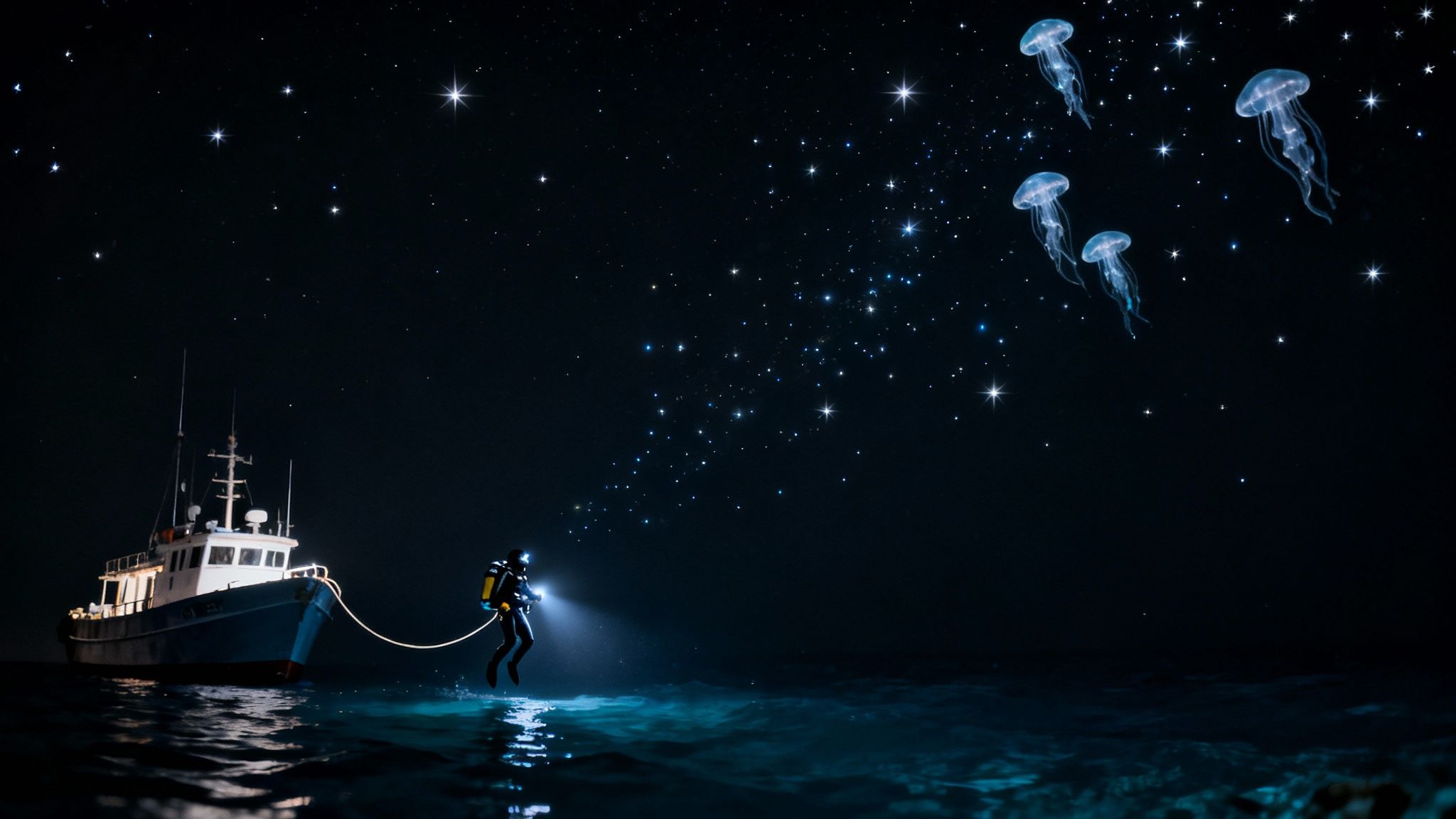
Picture this: you're suspended in the deep, inky blackness of the open ocean. You're miles offshore, with thousands of feet of water beneath you, connected to the world only by a tether to the boat. This isn't just a dive; it's like a spacewalk in inner space. This is the famous Kona Blackwater Dive, a mind-bending experience where you witness the largest migration of life on our planet.
Every single night, a countless number of bizarre, bioluminescent creatures rise from the abyss to feed near the surface. You simply drift in the dark, your dive light illuminating a parade of alien-like larval fish, strange pulsating jellies, and shimmering translucent squids. It’s a humbling, mesmerizing encounter with life forms that most people don't even know exist.
Because you’re in the open ocean, at night, and over profound depths, this dive is strictly for advanced divers with a calm demeanor. If you think you're ready for one of the most surreal adventures in the diving world, you can learn more about the Blackwater Dive tour and see if it's the right kind of challenge for you.
Exploring Deep Walls and Remote Pinnacles
Beyond the blackwater experience, the Big Island’s dramatic volcanic geology creates incredible opportunities for advanced deep dives. The Kona coast is literally lined with sheer underwater cliffs and isolated pinnacles that plunge far beyond recreational limits. These sites offer a rare glimpse into pristine, untouched environments, letting you escape the crowds and see the ocean in its wildest state.
On these dives, you'll often discover:
- Pristine Coral Formations: The deeper reefs are often better preserved from environmental stress and showcase entirely different species of coral.
- Unique Marine Life: The deep is home to different characters, from elusive anglerfish to larger pelagic species that patrol the drop-offs.
- Dramatic Topography: There's nothing like drifting along a deep, vertical wall to appreciate the sheer scale of Hawaii's underwater volcanoes.
Advanced diving in Kona is about more than just hitting a certain depth. It’s about gaining access to a completely different part of the ocean's ecosystem—a place where the environment feels more raw, the creatures are more unique, and the sense of exploration is profound.
These dives aren't for everyone. They require specific training, flawless buoyancy control, and a solid understanding of deep dive protocols. But for qualified divers, they offer the ultimate reward. Kona Honu Divers runs premium advanced trips specifically designed for experienced divers who want to explore these exclusive, deeper sites safely with a top-notch crew.
How to Choose the Right Dive Operator in Kona
Let’s be honest: your scuba diving Big Island Hawaii adventure is only as good as the crew you're with. Choosing the right dive operator is probably the most critical decision you'll make. It can be the difference between a decent dive and an absolutely unforgettable one.
With plenty of options lining the Kona coast, it pays to know what to look for. The goal is to find a crew that makes your underwater experience safe, comfortable, and downright magical.
A great starting point is to check for professional credentials. Keep an eye out for a PADI 5-Star rating. This isn't just a fancy sticker on the window; it’s a mark of a professionally run operation committed to top-notch training, safety, and service.
Key Factors for Selecting a Dive Shop
Beyond the official ratings, a few practical details really separate the great operators from the merely good ones. Here's what I always tell people to look for:
- Small Groups: This is a big one. Smaller groups almost always mean a better, more personal experience. You get more attention from your guide, feel less like a herd of cattle underwater, and have a much better shot at spotting shy marine life.
- Boat Comfort: You'll be spending a fair bit of time on the boat, not just in the water. Look for well-maintained, spacious vessels. Little things like a marine head (a proper toilet), a freshwater shower for rinsing off, and shaded areas to relax between dives make a huge difference.
- Experienced Guides: A passionate, knowledgeable guide who knows the local sites like the back of their hand is priceless. They’re the ones who can point out that cleverly hidden octopus or a rare nudibranch you’d otherwise swim right past. They also know how to tailor the dive plan to the day's conditions and the group's skill level.
Kona Honu Divers is a perfect example of an operator that nails these points, focusing on intimate group sizes and premium service to create a truly exceptional day on the water. You can see what fellow divers have to say about their trips.
Other Highly-Rated Kona Operators
To give you a well-rounded picture, a few other reputable companies also serve the Kona coast. Big Island Divers is one of the largest on the island. As a PADI 5-Star IDC dive center, they certify hundreds of new divers every year and are a major player in an industry that brings in an estimated $20 million in yearly revenue.
Jack's Diving Locker is another long-standing, respected operator known for their comprehensive training programs and a welcoming, family-friendly vibe.
Ultimately, the best choice really boils down to your personal style and what you’re looking for in a dive trip. For a more detailed breakdown, check out our complete guide on how to choose a Kona dive shop.
Frequently Asked Questions About Big Island Diving
Thinking about scuba diving on the Big Island? You've probably got a few questions buzzing around. We hear them all the time, so we’ve put together answers to the most common ones to help you get ready for an unforgettable underwater adventure.
What’s the Best Time of Year to Dive?
The short answer? Anytime. Kona's dive conditions are incredible year-round, thanks to the massive volcanoes that block the wind and keep the western coast calm and clear.
- Summer (May-September): This is when you'll find the warmest water, hovering around a balmy 80°F (27°C). The seas are typically flat-calm, like glass. It's pure bliss.
- Winter (October-April): The water cools down just a bit, averaging 75°F (24°C). But the real magic of winter is the humpback whales. You might not see one underwater, but hearing their haunting songs echo through the water on a dive is an experience you will never, ever forget.
Do I Need to Be Certified for the Manta Ray Night Dive?
If you want to scuba dive with the mantas, then yes, you absolutely need to be a certified diver.
But don't worry—this mind-blowing experience is still open to everyone. We offer a snorkeling option from the very same boat. Snorkelers get to hang onto a custom-made light raft that floats on the surface, giving them a perfect bird's-eye view of the giant mantas gracefully barrel-rolling in the light beams just below.
Besides Manta Rays, What Other Marine Life Will I See?
While the mantas are definitely A-listers, the waters here are packed with an amazing cast of characters. On almost any dive, you can expect to run into Hawaiian green sea turtles, curious octopuses, and schools of playful spinner dolphins. The lava rock reefs are also full of moray eels peeking out from their hideouts.
The reefs are painted with a rainbow of fish, many of which are endemic—meaning you can only find them here in Hawaii. Keep a sharp eye out for bizarre-looking frogfish, and if you’re really lucky, you might even see something bigger like a whale shark or tiger shark cruising by in the blue.
Is It Safe to Scuba Dive on the Big Island?
One hundred percent. When you dive with a professional, reputable PADI 5-Star shop like ours, scuba diving on the Big Island of Hawaii is incredibly safe. We follow strict safety protocols, our gear is perfectly maintained, and our divemasters know these sites like the back of their hands.
For extra peace of mind on your trip, it's always a good idea to have comprehensive travel insurance. The most important thing is to listen carefully to your guide's briefings and always dive within your training and comfort level. Do that, and you're set for a safe and amazing time.
Ready to jump into Kona's crystal-clear waters? The expert crew at Kona Honu Divers is excited to show you the very best the Big Island has to offer, from majestic manta rays to stunning, life-filled reefs.