
Picture this: you're weightless, descending into the deep blue of the Pacific. Sunlight streams through ancient, underwater lava tubes, illuminating the water around you as a majestic Hawaiian green sea turtle glides effortlessly past. This isn't just a dream; this is what scuba diving on the Big Island is all about. The Kona coast, in particular, is an underwater playground, shaped by volcanic fire into a paradise for divers.
Why The Big Island Is A World-Class Diving Destination
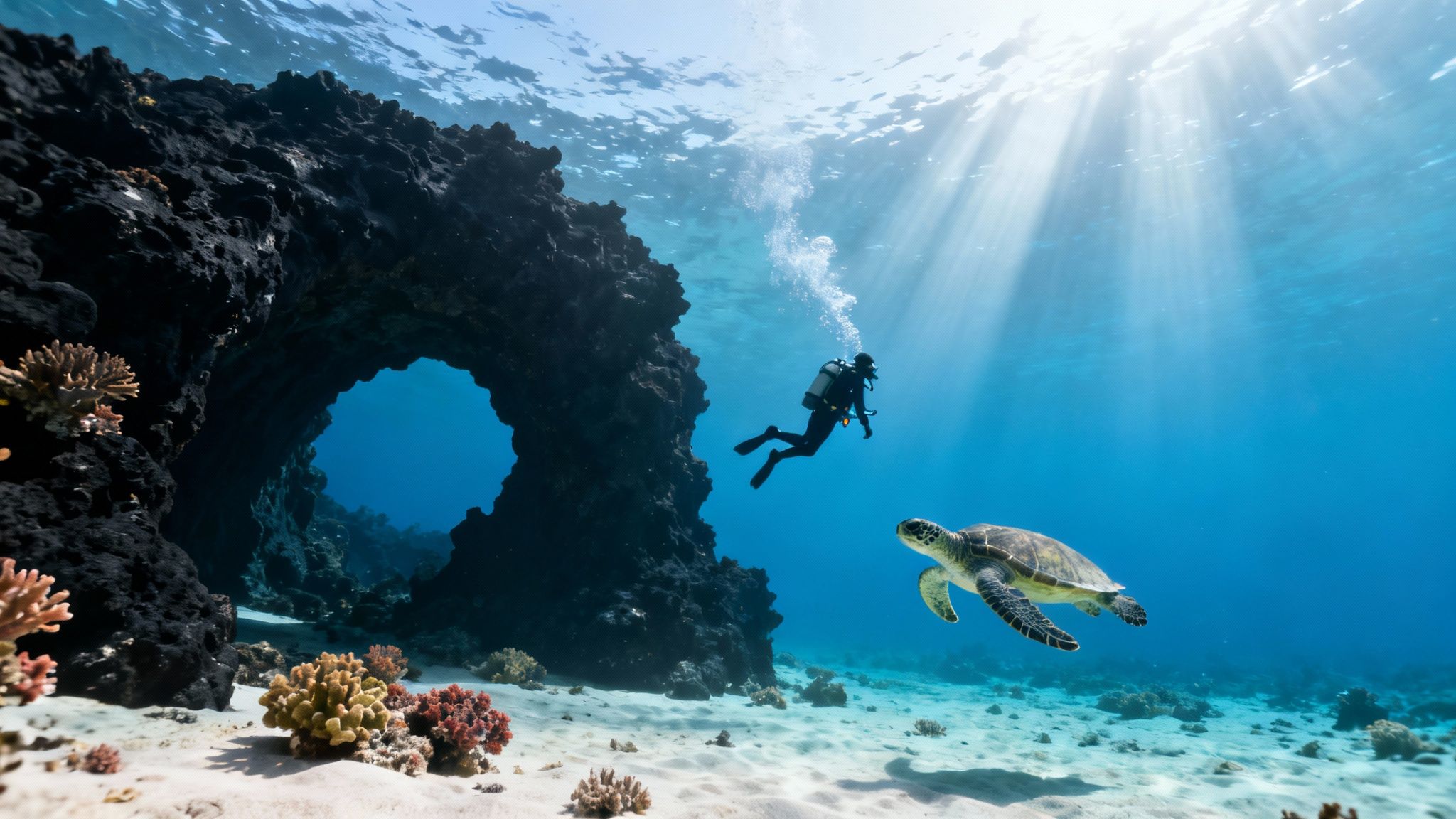
The secret to the Big Island's incredible diving lies in its fiery past. The same volcanic forces that created the island itself also sculpted a dramatic and breathtaking underwater world. This unique geology is what sets Kona apart from anywhere else on Earth.
Forget gentle, sandy slopes. Here, the ocean floor is a testament to the island's volcanic origins. On any given dive, you might find yourself exploring:
- Ancient Lava Tubes: Imagine swimming through massive, hollowed-out tunnels and caverns that were once channels for molten lava.
- Dramatic Drop-Offs: Experience the thrill of gliding alongside steep underwater cliffs that disappear into the deep blue abyss.
- Intricate Archways: Navigate through stunning natural arches and swim-throughs, all encrusted with life.
- Pristine Coral Gardens: Discover vibrant, healthy coral reefs that have found the perfect foundation on the volcanic rock.
A Sanctuary for Unique Marine Life
This one-of-a-kind underwater landscape provides the ideal habitat for a staggering amount of marine life. The scuba diving industry on the Big Island is one of Hawaii's most established, built on a long history of sharing this incredible ecosystem with visitors. With at least 50 recognized dive sites, from shallow, sun-drenched reefs to deep-water adventures, the sheer variety is hard to beat. You can get a closer look at the island's top-rated dive sites and their volcanic features.
Every dive is a chance for a new encounter, from the famous manta rays that perform their nightly ballet to tiny, vibrant fish that exist nowhere else on the planet. The island's waters are a haven for Hawaiian green sea turtles, playful spinner dolphins, and countless other species. While the Big Island offers something truly special, you can also find a wide variety of general scuba diving opportunities in other incredible destinations around the world.
Your Expert Guide to Kona's Underwater World
To truly unlock the magic of Kona's underwater world, you need a guide who knows these waters intimately. Kona Honu Divers offers expert-led diving tours that take you to the very best spots this aquatic wonderland has to offer. With a deep respect for the ocean and a commitment to keeping their groups small, they make sure every dive is safe, personal, and absolutely unforgettable.
Experiencing the Famous Kona Manta Ray Night Dive
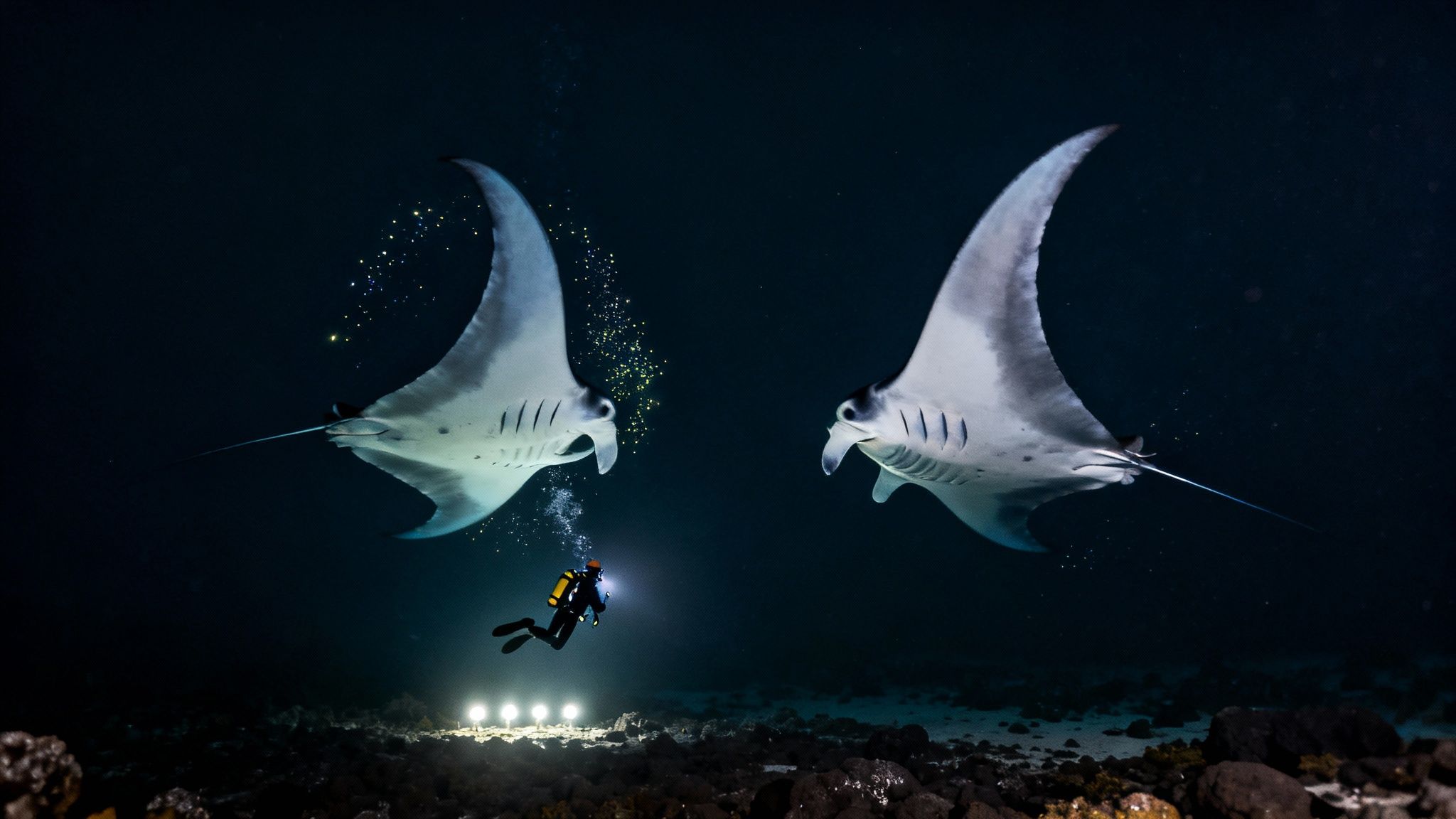
Picture this: you descend into the warm, inky black of the Pacific after sunset, your dive light cutting a path through the darkness. Below, a circle of powerful lights creates an otherworldly glow on the seafloor, like an underwater campfire. You settle in, and then it happens—a massive, graceful shadow emerges, barrel-rolling just inches over your head. This isn't science fiction; it's the world-famous Kona Manta Ray Night Dive, a true bucket-list experience for anyone scuba diving on the Big Island Hawaii.
This encounter has rightfully earned its spot as Hawaii’s most iconic underwater adventure. It's a beautifully simple concept that produces a truly profound result, bringing divers face-to-face with one of the ocean's most majestic creatures.
The magic all starts when dive operators place powerful, stationary lights on the ocean floor, usually around 30 to 40 feet deep. These beams act like a giant magnet for plankton, drawing the microscopic organisms in from all around. In just a few minutes, the water column turns into a swirling, all-you-can-eat buffet for Kona’s resident manta rays. Lured by the promise of an easy meal, these gentle giants, with wingspans stretching over 12 feet, glide in to feast in a mesmerizing underwater ballet.
What to Expect on Your Manta Adventure
Your journey begins on the boat as the sun dips below the horizon, painting the Kona coast in brilliant colors. The crew will walk you through a detailed briefing, covering how to interact with the mantas safely and respectfully. The number one rule? Never touch a manta ray. Doing so can strip away the protective mucous layer on their skin, making them vulnerable to infections. You’ll learn to stay low to the seafloor and simply let these magnificent animals be the ones to approach you.
Once you’re in the water and settled into your spot around the lights, the real show begins. You’ll be positioned with other divers in a semi-circle, aiming your dive light up to create a concentrated column of plankton. The anticipation in the water is electric. Soon, the first mantas arrive, swooping and soaring in effortless somersaults and barrel rolls as they filter feed. It's an incredibly moving experience to see such enormous animals move with such grace, often coming so close you can feel the water displaced by their wings.
The Kona manta ray dive is one of the most reliable wildlife encounters you can find anywhere. The primary dive site, often called "Manta Village," boasts an incredible 85–90% success rate for sightings. It’s no wonder over 10,000 divers a year make the trip! On any given night, you might see just a couple of mantas or over a dozen.
Ensuring a Safe and Memorable Encounter
The success of this incredible dive hinges on experienced operators who understand manta behavior and are committed to ocean conservation. Professional guides ensure everyone follows strict guidelines to protect both the animals and their habitat.
Reputable companies offer expertly guided manta ray dive tours that give you a front-row seat to this natural wonder. For those who want to learn even more, check out this Ultimate Adventure Guide to the Kona Manta Ray Night Snorkel. Joining a well-run tour doesn’t just guarantee an unforgettable dive; it ensures you’re contributing to the responsible and sustainable future of one of the ocean's greatest spectacles.
Exploring Top Dive Sites Along the Kona Coast
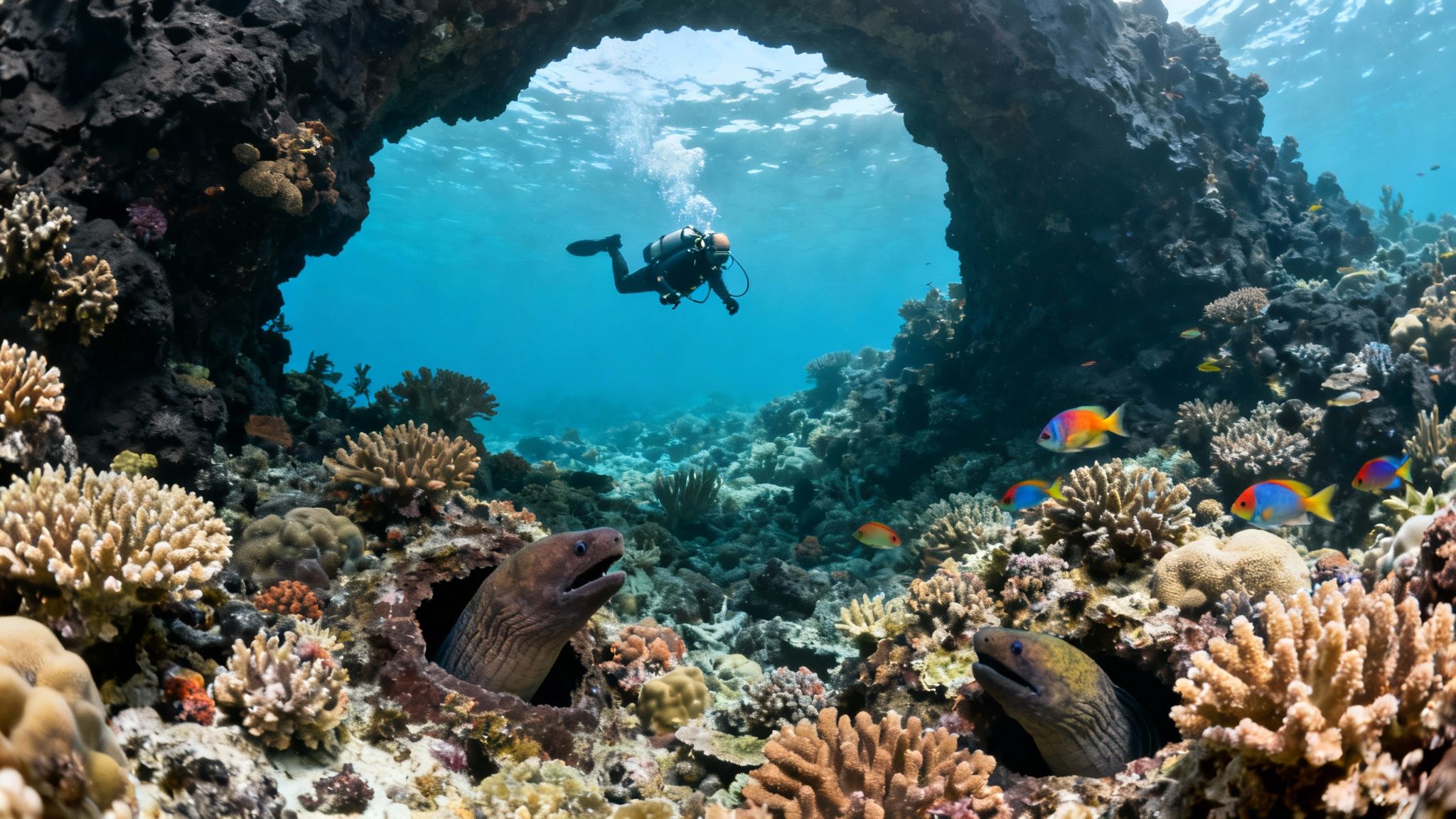
While the Manta Ray Night Dive gets a lot of the glory, the Kona coast is packed with world-class dive sites that offer something unique every time you get in the water. The island's volcanic past has left behind an incredible underwater playground.
Think of it this way: no two dives here are ever the same. One day you could be drifting over peaceful coral gardens, and the next, you're navigating a maze of ancient lava tubes. This sheer variety is what makes Big Island diving so unforgettable.
Kealakekua Bay: A Pristine Marine Sanctuary
If there's one spot that truly captures Kona's magic, it's Kealakekua Bay, home to the Captain Cook Monument. This isn't just a historical landmark; it's a protected Marine Life Conservation District, and you can see the results the moment you dip below the surface. The bay is a perfect example of a healthy, thriving coral ecosystem. It’s also naturally sheltered from wind and strong currents, which often means the water is as smooth as glass.
Since its protection began way back in 1969, the bay has become a genuine sanctuary. With fishing banned, the ecosystem has flourished without human interference. We're talking about over 400 species of fish and 100 species of algae calling this place home, all supported by vibrant coral colonies.
This protection is a huge reason the visibility here is legendary, often clearing 100 feet. It’s the perfect place to spot Hawaiian green sea turtles, pods of spinner dolphins, and even hear the songs of humpback whales in the winter.
Lava Tubes And Volcanic Formations
Beyond the bay, the Kona coast is famous for its dramatic underwater topography. Ancient lava flows have created a spectacular landscape of lava tubes, swim-throughs, and massive archways—a true playground for divers. Exploring these formations feels like venturing into another world, with sunlight filtering through cracks in the volcanic rock, illuminating colorful sponges and corals.
These structures are also prime real estate for all sorts of fascinating marine critters. It’s common to find:
- Shy Frogfish: These guys are masters of camouflage, often looking exactly like a piece of sponge.
- Curious Moray Eels: You’ll see them peeking out from crevices in the lava rock, keeping an eye on passing divers.
- Nocturnal Creatures: Even during the day, a good guide with a light can point out lobsters, crabs, and shrimp hiding in the dark corners of a lava tube.
Navigating these sites takes a bit of skill and a lot of local knowledge. This is where having an experienced guide really pays off, making sure you can safely explore the best of these incredible environments.
To give you a better idea of what's out there, here’s a quick look at some of the most popular sites we visit.
Quick Guide to Popular Kona Dive Sites
| Dive Site | Key Feature | Average Depth | Common Marine Life |
|---|---|---|---|
| Kailua Pier | Muck diving & critter finding | 20-40 ft | Frogfish, octopus, nudibranchs, seahorses |
| Golden Arches | Lava archways & swim-throughs | 30-50 ft | Eels, soldierfish, turtles, occasional reef sharks |
| Turtle Pinnacle | Turtle cleaning station | 30-60 ft | Hawaiian green sea turtles, eels, butterflyfish |
| The Hive | Unique lava dome formation | 40-70 ft | Large schools of fish, moray eels, rare crustaceans |
| Suck 'em Up | Lava tube with surge action | 40-60 ft | Lobsters, shrimp, reef fish seeking shelter |
This is just a small sample, of course. The best site for any given day is always changing.
Choosing The Right Dive Site For You
With so many amazing options, picking the perfect spot really comes down to the daily ocean conditions and your own comfort level. A site that's calm and clear one day could have a bit more current the next.
This is exactly why diving with a local operator is so important. We have the up-to-the-minute knowledge to choose the absolute best site for a safe, fun, and spectacular dive. Whether you’re a brand-new diver looking for a calm reef or an experienced pro ready for a challenge, the Kona coast has an adventure waiting for you.
Advanced and Specialty Diving Adventures
So, you've logged your fair share of bottom time and you're starting to get that itch for something… different. Something truly extraordinary. If that sounds like you, then the Big Island is ready to deliver. Once you venture beyond the stunning shallow reefs, a whole other world of unique challenges and frankly mind-bending encounters opens up. This is where you put your skills to the test, and the payoff is the kind of dive story most people only dream about.
The same volcanic forces that sculpted the island's coastline also created an incredible playground for advanced divers. Think intricate lava tube systems that snake through the depths, forming complex networks that demand real skill and confidence to navigate. These sites are often deeper and can have currents that bring in the big stuff—pelagic species that make for a serious adrenaline rush.
The Kona Blackwater Dive: An Underwater Spacewalk
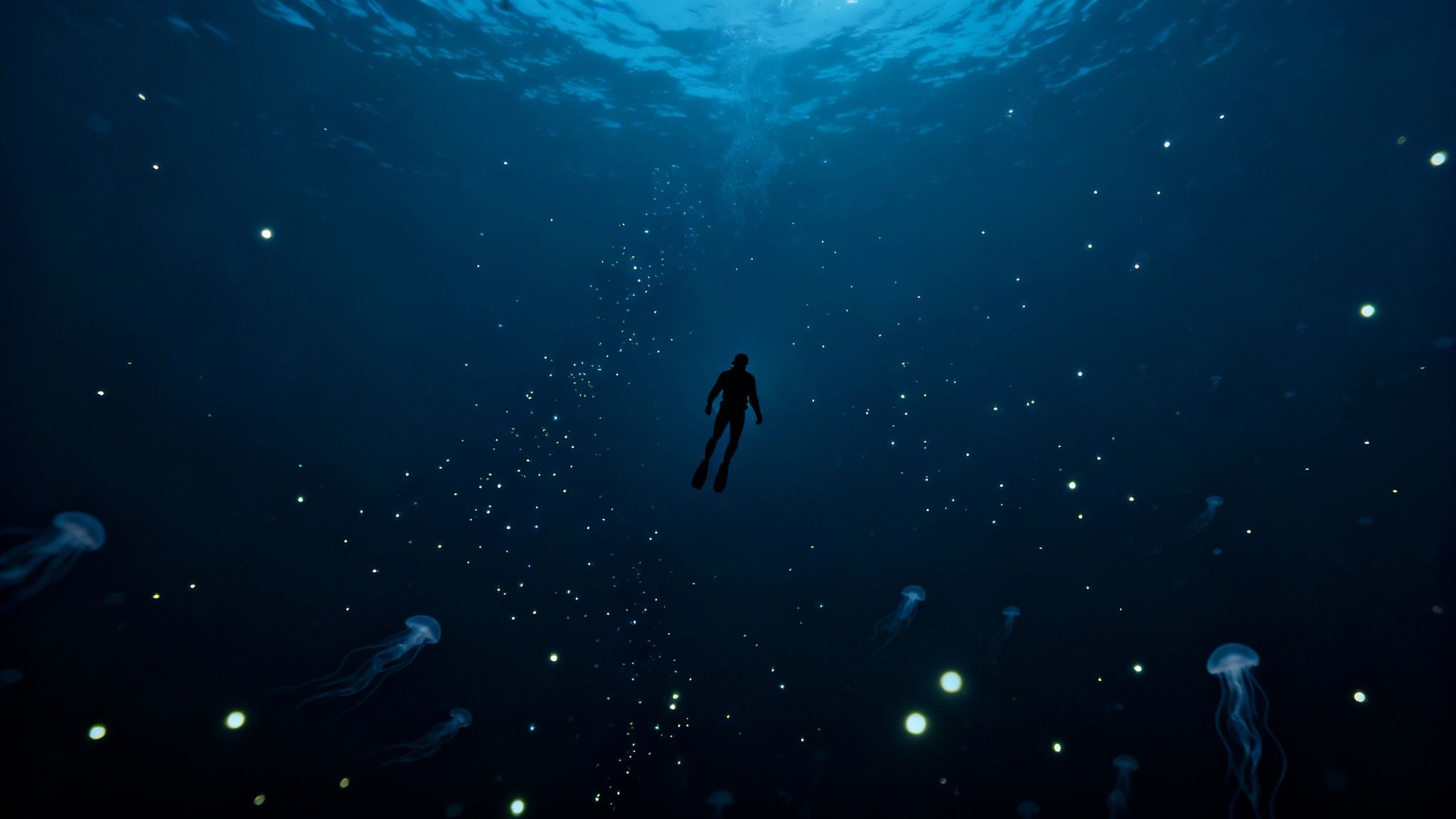
Picture this: you're suspended in the deep, dark ocean, miles from shore, with thousands of feet of water below you. You're tethered to the boat, just drifting in the blackness, when suddenly, strange, almost alien-like creatures begin to appear out of the void.
This isn't science fiction. It's the legendary Kona Blackwater Dive, and it’s arguably one of the most surreal experiences you can have while scuba diving on the Big Island Hawaii.
This is absolutely not a reef dive. It's a pelagic adventure that puts you right in the middle of the largest migration on Earth—one that happens every single night. Countless tiny, bizarre, and often bioluminescent creatures journey from the deep ocean toward the surface to feed, and you get a front-row seat to the whole spectacle.
People often call it an "underwater spacewalk," and that’s the perfect description. You’re floating in an endless black universe as weird and beautiful life forms drift past like distant galaxies. It’s a dive that will completely redefine what you thought was possible underwater.
The setup for this dive is highly specialized. A heavy downline with a "sea anchor" keeps divers stable as they drift with the current. Each diver is clipped to this line with a tether, so there's zero chance of getting lost in the dark. You simply hang out at a depth of around 50 feet and wait for the magic to happen. The creatures you'll see are unlike anything on a reef—think larval fish, translucent squids, and gelatinous organisms pulsing with their own light.
If you're ready for this truly unique adventure, you have to check out Kona Honu Divers' Blackwater Night Dive tour.
Mastering Lava Tubes and Deeper Sites
For divers who get a thrill from exploring structure, Kona's advanced dives into its volcanic topography are a must. These aren't just simple swim-throughs; you'll be navigating complex systems of interconnected lava tubes and caverns. These sites demand excellent buoyancy control and total awareness, especially when you're in an overhead environment.
Going deeper brings different rewards, too. The currents that sometimes sweep these sites act like a magnet for larger marine life. It's common to run into pelagics that you'd rarely see on the shallower reefs, including:
- Schools of Jacks: Huge groups of these powerful fish are often seen patrolling the outer reef walls.
- Reef Sharks: Whitetip reef sharks are common, but heading deeper increases your chances of spotting other species like Galapagos or sandbar sharks.
- Eagle Rays: Watching these graceful rays glide effortlessly in the currents along a deep drop-off is a sight you'll never forget.
These dives are perfect for certified divers looking to push their skills and see a completely different side of Kona’s underwater world. They require more experience and a high level of comfort in the water, but the payoff is an unforgettable adventure into the heart of the island’s volcanic landscape. Kona Honu Divers runs trips specifically for more experienced divers, which you can find on their premium advanced dive tour page.
Why Choosing the Right Dive Operator in Kona Matters
When you're planning to go scuba diving on the Big Island Hawaii, picking your dive operator is a huge decision. It's not just about getting a spot on a boat; you're handing over your safety and the quality of your entire underwater experience to a team of professionals.
The right crew can turn a good dive into a memory you’ll treasure forever. The wrong one? You could end up on a crowded, rushed trip that feels more like a cattle call than an adventure. Your operator is your guide, your safety net, and your key to unlocking the best of Kona’s underwater world.
The Kona Honu Divers Difference
This is where we feel Kona Honu Divers really shines. Their entire approach is built on a deep respect for the ocean and a serious commitment to making every dive exceptional for their guests.
The biggest factor here is their dedication to small group sizes. A lot of operators try to maximize every trip by packing the boat. Kona Honu Divers does the exact opposite, and that one decision changes everything about your dive.
What does this actually mean for you?
- More Personalized Attention: Your guide is right there with you, not 50 feet away managing a huge group. They can point out a rare octopus hiding in a crevice or help you tweak your buoyancy.
- A Less Crowded Dive Site: Imagine seeing a beautiful reef without a dozen other divers kicking up sand all around you. It's a more peaceful, natural experience.
- A Relaxed Atmosphere: There’s no rush to get in and out of the water. You get the time and space you need to really soak it all in.
This approach lets you have a much more intimate encounter with the marine life. The animals aren't stressed, and you get to observe them behaving naturally.
Guided by the Spirit of 'Honu' and 'Aloha'
Kona Honu Divers is named after the 'Honu'—the Hawaiian green sea turtle. In Hawaiian culture, the Honu represents wisdom, endurance, and living in harmony with the sea. That’s the philosophy that guides everything they do.
Their team members are more than just dive professionals; they're passionate ocean advocates who live and breathe the spirit of 'aloha.' They’ve earned their spot as a "Green List" operator by committing to sustainable and responsible tourism, which means they're actively protecting the reefs you're there to see. If you want to dive deeper into what makes a great operator, check out our guide on how to choose a Kona dive shop.
Choosing an operator is choosing a philosophy. With Kona Honu Divers, you're choosing a team that prioritizes the health of the ocean and the quality of your experience above all else.
You don't have to take our word for it. Their reputation is backed by countless reviews from divers who have seen their incredible service firsthand.
When you book with Kona Honu Divers, you're not just another name on a manifest. You become part of their 'ohana' (family). You’re signing up for an authentic, responsible, and truly unforgettable Hawaiian diving adventure.
Your Top Questions About Diving in Hawaii, Answered
Thinking about a scuba trip to the Big Island? You probably have a few questions. We get it. To make your planning easier, we've pulled together answers to the most common things people ask us.
Consider this your final run-through before you jump into Kona’s incredible underwater world. We want you to feel confident and excited, not uncertain. From the best season for diving to what your non-diving friends can do, we’ve got you covered.
What’s the Best Time of Year to Dive the Big Island?
Here’s the great news: Kona is a world-class diving destination all year long. The Kona coast is tucked away on the leeward side of the island, which means it’s protected from the major trade winds and ocean swells. The result? The water is usually calm and clear whenever you decide to visit.
Water temps are always pleasant, hovering between a comfortable 75°F and 80°F (24-27°C).
- Summer (May to September): This is when you'll find the absolute calmest, glassiest conditions. The water is at its warmest, making for super smooth boat rides and long, relaxing dives.
- Winter (December to March): The water might be a few degrees cooler, but this is peak humpback whale season. There's nothing quite like hearing their haunting songs echo through the water during your dive—it's a truly profound experience.
Honestly, there's no wrong time to dive in Kona. It just depends on what you're looking for: the warmest water or the magical soundtrack of the whales.
Do I Have to Be Certified to Scuba Dive in Hawaii?
Yes, if you want to join a boat dive and explore Kona's stunning coral reefs and volcanic ledges, you’ll need to be a certified diver. Make sure you bring your certification card (from PADI, NAUI, or any other recognized agency) to show the dive shop.
But what if you're not certified? You're not out of luck! Most dive operators offer a "Discover Scuba Diving" program. It’s a fantastic, non-certification experience where an instructor teaches you the basics in a safe, controlled setting and then guides you on a real, shallow dive. It’s the perfect way to test the waters without committing to a full course.
Just keep in mind, for those bucket-list dives like the Manta Ray Night Dive or exploring the deeper sites from a boat, a full scuba certification isn't just a recommendation—it's required for your safety.
Besides Manta Rays, What Other Marine Life Will I See?
The manta rays might get all the fame, but the waters off the Big Island are absolutely packed with other amazing marine life. The island's underwater volcanic terrain creates a perfect, complex habitat for a huge diversity of creatures.
On any given dive, you have a great chance of running into some of these local residents:
- Hawaiian Green Sea Turtles ('Honu'): You'll see these gentle giants on almost every dive. They're often found cruising gracefully over the reef or just chilling out on the bottom.
- Eels: Keep an eye on the nooks and crannies in the lava rock! You can spot everything from the fierce-looking viper moray to the rare and beautiful dragon moray.
- Colorful Reef Fish: The reefs are a whirlwind of color, with massive schools of yellow tangs, delicate butterflyfish, and big parrotfish chomping away on coral.
- Spinner Dolphins: You'll often see them playing on the surface from the boat, but it’s a truly special moment when a pod glides by underwater during your dive.
- Cool Critters: Kona is a macro photographer's dream. Look closely for perfectly camouflaged frogfish, shy octopuses, and vibrant nudibranchs.
This incredible biodiversity means no two dives are ever the same.
What Should I Pack for My Big Island Dive Trip?
Packing for a Kona dive trip is pretty simple, but there are a few things you can bring to make your life a lot more comfortable. While a great operator like Kona Honu Divers will have all the main gear you need, bringing a few personal items can make all the difference.
Here’s a quick checklist of things you won't want to forget:
- Your C-Card and Logbook: Don't leave home without them! You can't dive without your certification card, and you'll definitely want to log all the amazing dives you're about to do.
- Reef-Safe Sunscreen: Help us protect our reefs! Standard sunscreens have chemicals that bleach coral. Look for mineral-based sunscreens with zinc oxide or titanium dioxide.
- Your Own Mask and Dive Computer: If you have them, bring them. A mask that fits your face perfectly is priceless, and it's always best to use a dive computer you're already familiar with.
- Reusable Water Bottle: Staying hydrated is crucial. An eco-friendly reusable bottle is perfect for having water on the boat.
- A Light Jacket or Rash Guard: Even on a warm day, the boat ride back can get a little breezy and cool once you're wet.
- Underwater Camera: You’re going to see things you’ll want to remember forever. Don't forget your camera!
With these essentials in your bag, you're all set for an unforgettable scuba diving Big Island Hawaii adventure.
Ready to take the plunge? The expert crew at Kona Honu Divers is waiting to show you the best of Kona's underwater world. They are obsessed with safety, small groups, and showing deep respect for the ocean and its inhabitants.
Check out their full range of diving tours and book your adventure today!