
Ask any seasoned diver what their favorite, most impactful course was, and you’ll almost always hear the same answer: Rescue Diver. It's known for being one of the toughest, but also the most rewarding, non-professional certifications you can earn. This course fundamentally changes your focus from simply managing your own dive to looking out for the safety and well-being of everyone in the water with you.
It's the training that turns you from a good diver into a great dive buddy—one who can spot a problem before it starts and confidently manage an emergency if one arises.
Why Rescue Diver Training Changes Everything
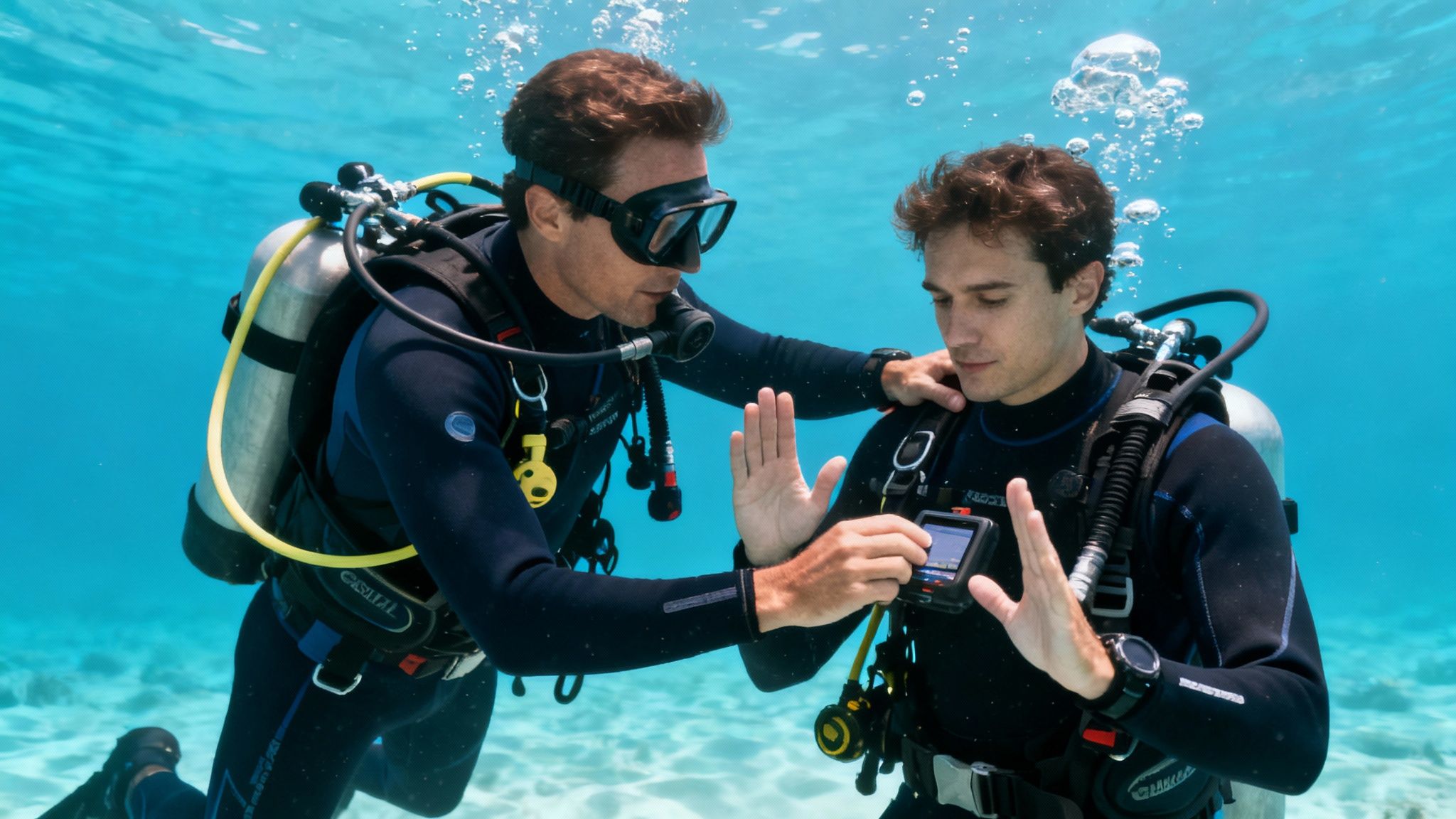
Picture this: you’re on a stunning reef dive, but you notice your buddy is struggling a bit. Before Rescue training, that moment might fill you with a knot of anxiety. What do you do? After the course, you feel a sense of calm control. You have a mental checklist and the skills to back it up.
That's the core transformation of the Rescue Diver certification. It’s not just another card for your wallet; it’s a total overhaul of your mindset and skills. You go from being a passenger on the dive to an active, aware, and capable partner.
A New Level of Underwater Confidence
So many divers say their confidence skyrockets after this course. It's not just about memorizing emergency steps from a book. It’s about building true situational awareness—the kind that helps you prevent problems in the first place. You learn to read the room, so to speak, but underwater.
This newfound confidence doesn't just make your dives more enjoyable; it makes you a better buddy for everyone around you. People feel safer diving with someone who is prepared, observant, and capable of helping out.
The change in perspective is huge. You go from thinking, "What if I have a problem?" to "How can I make sure we all stay safe?" That proactive mindset is the real sign of a certified Rescue Diver.
The Most Rewarding Challenge
There's a reason divers consistently call this course the most challenging and fulfilling training they've ever done. It definitely pushes you, both mentally and physically, but the return on that effort is immense. You'll learn to think on your feet and stay calm under pressure.
That feeling of knowing you can handle a tough situation is a game-changer. The course gets you there by focusing on a few key areas:
- Problem Prevention: Learning to spot and fix the little things before they snowball into big emergencies.
- Self-Rescue: Before you can help anyone else, you need to be able to help yourself. This is the foundation.
- Buddy Assistance: Gaining practical skills to help a tired, panicked, or even unresponsive diver at the surface and below.
- Emergency Management: Knowing how to take charge, coordinate a response, and administer first aid or emergency oxygen.
Master these skills, and you become the diver everyone wants on their boat and the buddy everyone trusts.
What to Expect During Your Rescue Diver Course
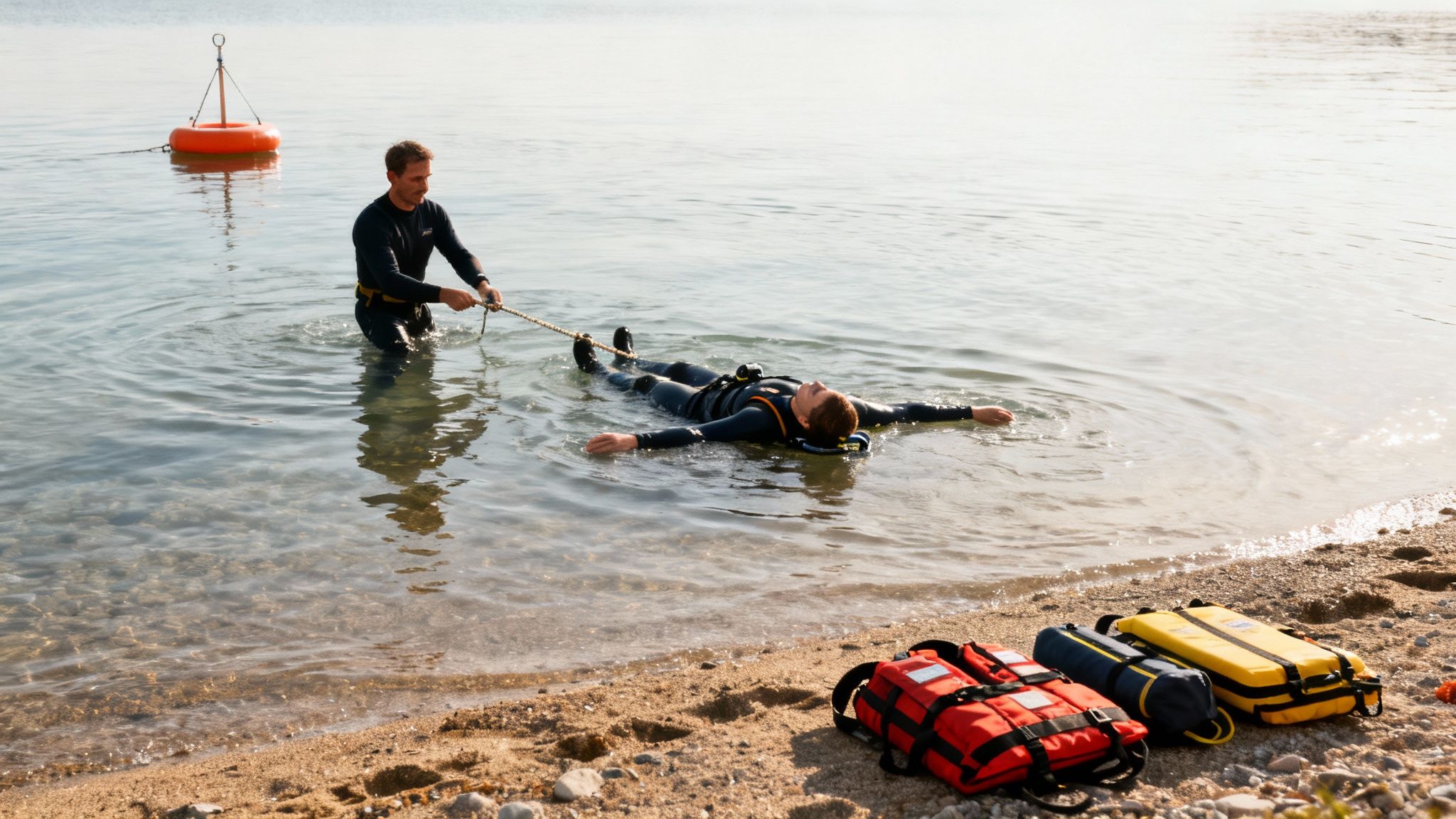
The Rescue Diver course isn't just another certification card; it's a fundamental shift in how you dive. The training is thoughtfully structured to build your skills and confidence from the ground up, moving you from theory to real-world application.
The whole process is broken down into three distinct phases: knowledge development, confined water skills, and open water scenarios. Each step builds on the last, ensuring you not only understand what to do in an emergency but, more importantly, why you're doing it. By the time you’re done, you'll have the muscle memory and mental clarity to act effectively when it counts.
Stage 1: Knowledge Development
Before you even think about getting wet, the journey begins with the academic side of things. This phase lays the critical groundwork for everything you'll practice in the water and is usually done through flexible eLearning you can complete at your own pace.
You'll go deep into the psychology of rescue, exploring how stress impacts divers and learning to spot the subtle clues of a problem long before it becomes an emergency. It’s a fascinating look into the human side of diving.
Here’s a snapshot of what the curriculum covers:
- Self-Rescue: The first rule of rescue is not becoming a victim yourself. You'll learn to manage your own problems first.
- Recognizing Diver Stress: You’ll become an expert at identifying the tell-tale signs of anxiety, fatigue, or panic in other divers.
- Emergency Management: This involves creating an emergency assistance plan, knowing who to call, and managing an accident scene with confidence.
- Equipment Problems: The course will refresh your knowledge on common equipment issues and how to handle them for yourself or your buddy.
Think of this as the blueprint for your hands-on training. For those involved in creating dive training programs, understanding the principles of creating effective educational videos can make this foundational learning even more powerful for students.
Stage 2: Confined Water Training
With the theory locked in, it's time to translate that knowledge into action. We head to a calm, controlled environment—like a pool or a quiet, shallow bay—to start building muscle memory for the core rescue skills.
The goal here is simple: repetition and refinement. In this stress-free setting, your instructor will guide you through a series of hands-on exercises, letting you perfect your technique without worrying about waves or currents. You’ll practice everything from simple surface assists to more complex procedures.
This stage is all about building a reflexive response. When an actual emergency happens, you won't have time to think—you need to act. Confined water training engraves these skills into your memory.
Some of the key skills you'll master include:
- Assisting a tired or panicked diver on the surface.
- Performing in-water rescue breaths effectively.
- Getting an unresponsive diver out of the water.
- Using different techniques to bring a diver to the surface safely.
This phase is absolutely essential. It ensures you can perform every skill smoothly before we ramp up the intensity in the final stage.
Stage 3: Open Water Scenarios
This is where it all comes together. In the open water, your instructor will run you through realistic emergency scenarios that challenge you to apply everything you've learned. These aren't simple drills; they are dynamic, unfolding problems that demand you think on your feet and act decisively.
You might be tasked with executing an underwater search pattern for a "missing" diver or responding to a simulated emergency on the boat. Each scenario is a comprehensive test, pushing you to manage an entire incident from the moment it starts to its resolution.
This is the final step that truly forges you into a Rescue Diver. You'll leave the course with a newfound confidence and the proven ability to handle real-world problems with skill and composure.
Mastering the Core Skills of a Rescue Diver
The Rescue Diver course is where it all clicks. This isn't about just reading theory; it's about building muscle memory and genuine competence for when things don't go as planned. And the first person you learn to save? Yourself.
Before you can be of any use to anyone else, you have to be completely solid in your own gear, buoyancy, and mindset. We drill down on self-rescue first, teaching you how to calmly handle problems like a sudden cramp, a minor gear hiccup, or getting snagged on something. The idea is to build such a strong foundation of self-reliance that most potential problems never get a chance to escalate.
Once you’re dialed in, your awareness expands outward to your dive buddies. You'll learn to become a keen observer, looking beyond your own gauges to really see what's happening with your team.
Recognizing and Managing Stress in Other Divers
A diver in trouble rarely goes from zero to a hundred instantly. There are almost always little signs that something’s off, and a certified Rescue Diver knows exactly what to look for.
This part of the training is more about psychology than pure physical skill. You’ll learn to read the subtle tells of a diver who is starting to feel stressed.
- Early Warning Signs: Look for wide eyes that don't blink much, a breathing rate that's way too fast, or jerky, inefficient finning. These are the first clues that a diver is getting anxious or working too hard.
- Growing Stress: If you see a diver fixating on their pressure gauge or making the same pointless movement over and over, their stress level is rising.
- Full-Blown Panic: This is the danger zone. It’s often marked by a total loss of control, like bolting for the surface or ripping off their own mask.
Learning to spot these signs means you can step in early. A simple hand signal to slow down, offering a buddy a moment to rest on the surface, or even just helping them fix a loose fin strap can completely de-escalate a situation before it becomes a real emergency. This focus on proactive problem-solving has made the Rescue Diver certification a global standard for serious divers since the early 2000s. It's the bridge between advanced training and the professional levels, and the prerequisites ensure divers have solid core skills before tackling it. To dig deeper, check out this in-depth analysis of diver rescue skills and how standards have evolved.
Essential In-Water Rescue Techniques
Okay, so you've spotted a problem. Now what? The course dedicates a huge amount of time to practicing in-water rescue skills until they feel like second nature. You'll work your way up from simple assists to complex, high-stress scenarios.
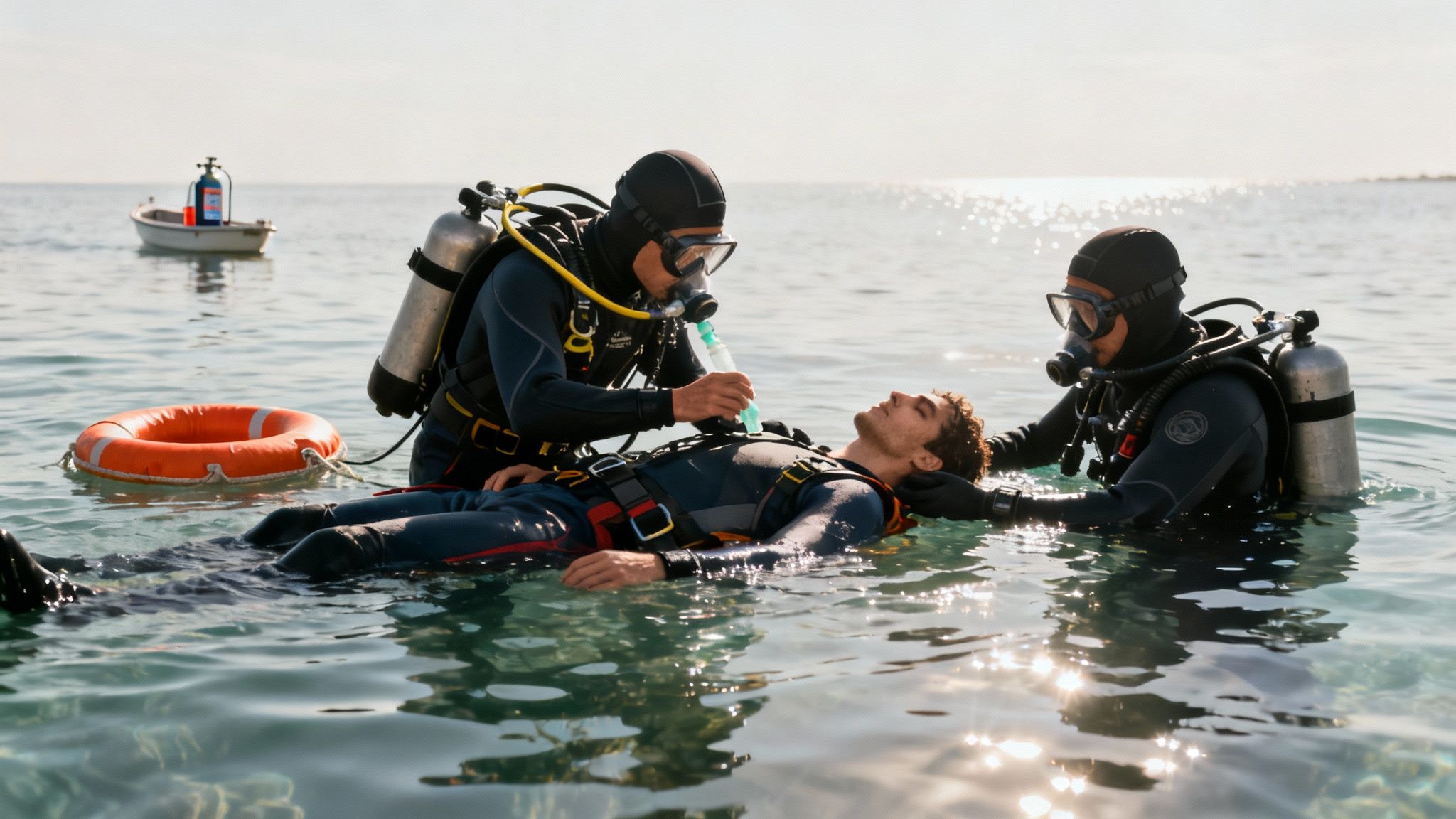
First, you'll master how to help a tired diver at the surface, giving them buoyancy and towing them back to the boat or shore without wearing yourself out. From there, you'll move on to one of the most critical skills you can learn: giving effective rescue breaths in the water to a diver who isn't breathing, all while getting them to safety.
A key principle you'll hear over and over is to "stop, think, then act." Rushing into a rescue without a plan can create two victims instead of one. We drill this methodical approach into every single response.
The scenarios get more intense from there. You'll practice bringing an unresponsive diver up from depth in a controlled ascent, protecting their airway and managing buoyancy for two people. Once you’re on the surface, you’ll learn several different techniques for getting them out of the water—a tough job that’s much more about proper technique than brute strength.
Search and Recovery and First Aid
What if a diver goes missing? The last thing you can do is panic. The Rescue Diver course gives you a toolkit of systematic underwater search patterns, like the expanding square or the U-pattern, so you can organize a search that is calm, effective, and efficient. You’ll learn how to manage the search and give everyone a role to play, giving you the best shot at a good outcome.
The final piece of the puzzle is what to do after the rescue. Your training isn’t complete until you’re confident in emergency first aid. This means assessing a diver’s condition, managing injuries, and, crucially, administering emergency oxygen. Supplying 100% oxygen is one of the most important first aid steps for nearly any scuba-related incident, and knowing how to do it right can make all the difference. These skills turn you into a true first responder on any dive boat.
Choosing the Right Place for Your Rescue Training
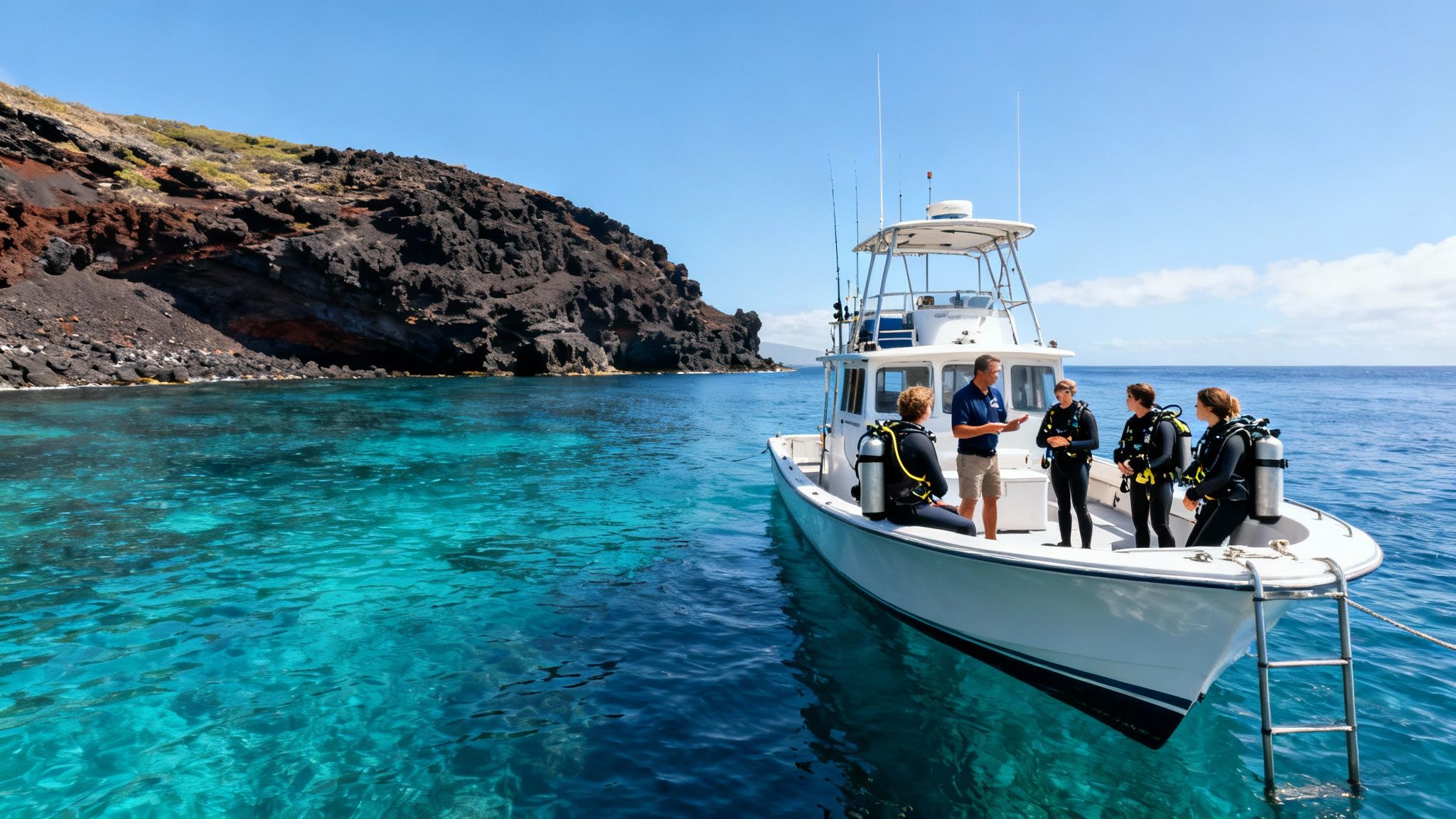
Where you earn your rescue diver certification matters just as much as what you learn. Think of it like learning to drive a car—you wouldn't want your first time handling an emergency stop to be in the middle of a blizzard. The right environment lets you build real confidence and muscle memory that becomes second nature, so you're not just certified, you're truly capable.
That's where Kona comes in. The conditions here create the perfect natural classroom for you to master these critical skills.
Why Kona Is the Perfect Underwater Classroom
The Big Island’s Kona coast is famous for a reason: the water is almost always incredibly clear and calm. While rough conditions can be a great test after you’ve mastered the basics, learning the fundamentals of rescue diving is much more effective when you aren’t fighting a ripping current or struggling with five-foot visibility.
Kona’s gentle seas mean we can run complex, realistic scenarios safely and precisely. You can fully focus on nailing your search patterns, perfecting rescue breaths, and managing a simulated emergency without extra environmental stress.
The goal isn't just to pass the test; it's to forge genuine competence. Kona's reliable conditions let us create challenging scenarios in a controlled setting, which is the fastest way to build the real-world confidence you need.
Applying Your Skills to Real Kona Dives
The skills you pick up in your rescue course here aren't just theoretical. They apply directly to the kind of scuba diving in Kona, Hawaii you’ll actually be doing around the island.
- Boat Diving Proficiency: A huge part of diving in Hawaii is done from a boat. You'll get hands-on practice managing situations from the deck, a skill you’ll use on every single trip.
- Buddy Awareness: That famous manta ray night dive? Your new level of situational awareness will make you the best buddy in the water, ensuring everyone has a safe and unforgettable experience.
- Problem Prevention: You'll learn to see the little things—a loose tank strap, a buddy who looks a bit anxious—and sort them out before they can ever dream of becoming big problems on a beautiful reef dive.
This practical application is what our training is all about. Choosing your certification spot is a big deal, and knowing what to look for in an operator is key. You can learn more about how to choose a Kona dive shop to make sure you're setting yourself up for success.
The Kona Honu Divers Advantage
Here at Kona Honu Divers, we’re firm believers that top-tier training requires personal attention. That’s why we keep our rescue diver certification classes small. It’s not a numbers game for us. This guarantees you get plenty of one-on-one time with our seasoned instructors to ask questions, repeat a skill until it clicks, and get feedback that’s specific to you.
We don't just run you through a curriculum; we're passionate about building competent, self-reliant divers who are ready for anything. It’s about deeply understanding why you’re doing something, not just checking a box.
This focus on quality training reflects a global trend. The dive industry is growing, with over 2.4 million people signing up for scuba courses each year. And more than 55% of those certifications happen in prime destinations like Hawaii, which shows just how much divers value excellent instruction in amazing locations.
We're proud to be part of that, helping to shape the next generation of safe, confident divers right here in paradise.
So, You’re a Rescue Diver. What’s Next?
Earning your Rescue Diver certification is a huge milestone. Seriously, take a moment to appreciate it. But this isn't the finish line; it's the beginning of a whole new chapter in your diving journey. The skills you just mastered—the calm thinking, the heightened awareness, the ability to solve problems under pressure—are the keys to unlocking the most rewarding experiences scuba has to offer.
You're not just a passenger on a dive anymore. You've proven you can stay cool when things get real, making you the kind of diver everyone wants as a buddy.
The Path to Going Pro
For a lot of divers, the Rescue course is the spark that lights the fire to turn a passion into a profession. If that sounds like you, the next logical step up the ladder is the PADI Divemaster course. This is where you make the big shift from looking after yourself and a buddy to guiding and mentoring other certified divers.
The Divemaster program is where your rescue training really gets to shine. It takes those foundational skills and builds on them, polishing your leadership abilities, honing your in-water skills to a razor's edge, and taking your dive theory knowledge to a whole new level. It's an intense but incredible experience that gets you ready to lead certified divers and help instructors with their courses.
Think of the Rescue Diver course as the final prerequisite before you enter the world of PADI Professionals. It's the essential bridge, ensuring you have the mindset and the chops to become a true underwater leader.
Becoming a Divemaster is one of the most fulfilling things you can do, letting you share your love for the ocean every single day. If you're ready to explore that path, you can find out everything you need to know about getting your PADI Divemaster certification in Kona.
Unlocking Advanced Diving Adventures
Even if a pro career isn't on your radar, your Rescue certification makes you a much more capable and confident diver, ready for more specialized adventures. That sharp situational awareness you've developed is exactly what’s needed for dives that demand a bit more focus and skill. You're perfectly primed to handle the unique challenges of Kona's most spectacular underwater experiences.
- Blackwater Dives: There's nothing quite like a Blackwater Dive. You'll drift in the deep, dark ocean at night, surrounded by some of the weirdest and most wonderful bioluminescent creatures you'll ever see. Your rescue training adds that extra layer of comfort and confidence needed for such a unique dive.
- Advanced Dive Tours: Feel like tackling something a little more challenging? Our advanced dive tours will take you to deeper reefs and through intricate lava tube swim-throughs, where solid buoyancy and awareness are a must.
Here at Kona Honu Divers, we're all about helping you push your boundaries and keep exploring. Whether your goal is to go pro or just to see more of the incredible underwater world, we’ve got the expert guides and the perfect Kona diving tours to help you get there.
Your Questions About the Rescue Diver Course, Answered
It's smart to have questions before jumping into a course as important as Rescue Diver. This isn't just another certification; it’s a big step up in your diving journey. Let's tackle some of the most common things people ask so you know exactly what to expect from this incredibly rewarding experience.
How Physically Demanding Is the Course?
This is a great question, and the answer might surprise you. While there's definitely a physical side to it, the course is really about brains over brawn. We focus on technique, leverage, and smart thinking—not brute strength.
Our instructors are fantastic at showing you how to work efficiently. You'll learn methods that work for any body type or fitness level, proving that being a good rescuer is about what you know, not how much you can lift.
How Long Does the Certification Take?
You can typically complete the whole course in two to three jam-packed days. We've structured the schedule to flow perfectly from one stage to the next.
You'll start with the knowledge development, move on to practicing skills in calm, confined water, and then put everything into practice during realistic open-water scenarios. It’s also good to think about the bigger picture of your dive education; understanding how long a scuba certification lasts helps you plan for the future.
What’s the Toughest Part?
If you ask our former students, most will tell you the final scenarios are the most challenging part—but also the most rewarding. These drills are designed to feel real, putting you under a bit of managed stress to see how you react. It’s a test of your new skills and your ability to think clearly when things get chaotic.
But here’s the key: our instructors are right there with you, creating a safe space to learn and be challenged. Pushing through that moment and realizing you can handle it is what makes this course so empowering for so many divers.
Is It Worth It If I Don’t Plan to Go Pro?
One hundred percent, yes. Think of this course as the ultimate buddy-system upgrade. The skills you learn make you a safer, more aware, and far more confident diver on every single dive you do from now on.
You'll learn to spot small problems before they become big ones, making you the kind of diver everyone wants to have in their group. It’s also a crucial step for anyone who might someday consider professional training. In fact, initiatives like PADI's Women in Diving highlight this course as a key milestone, encouraging more women to step into leadership roles. You can read more about how the tide is turning for women in diving and see why this training is so valuable.