
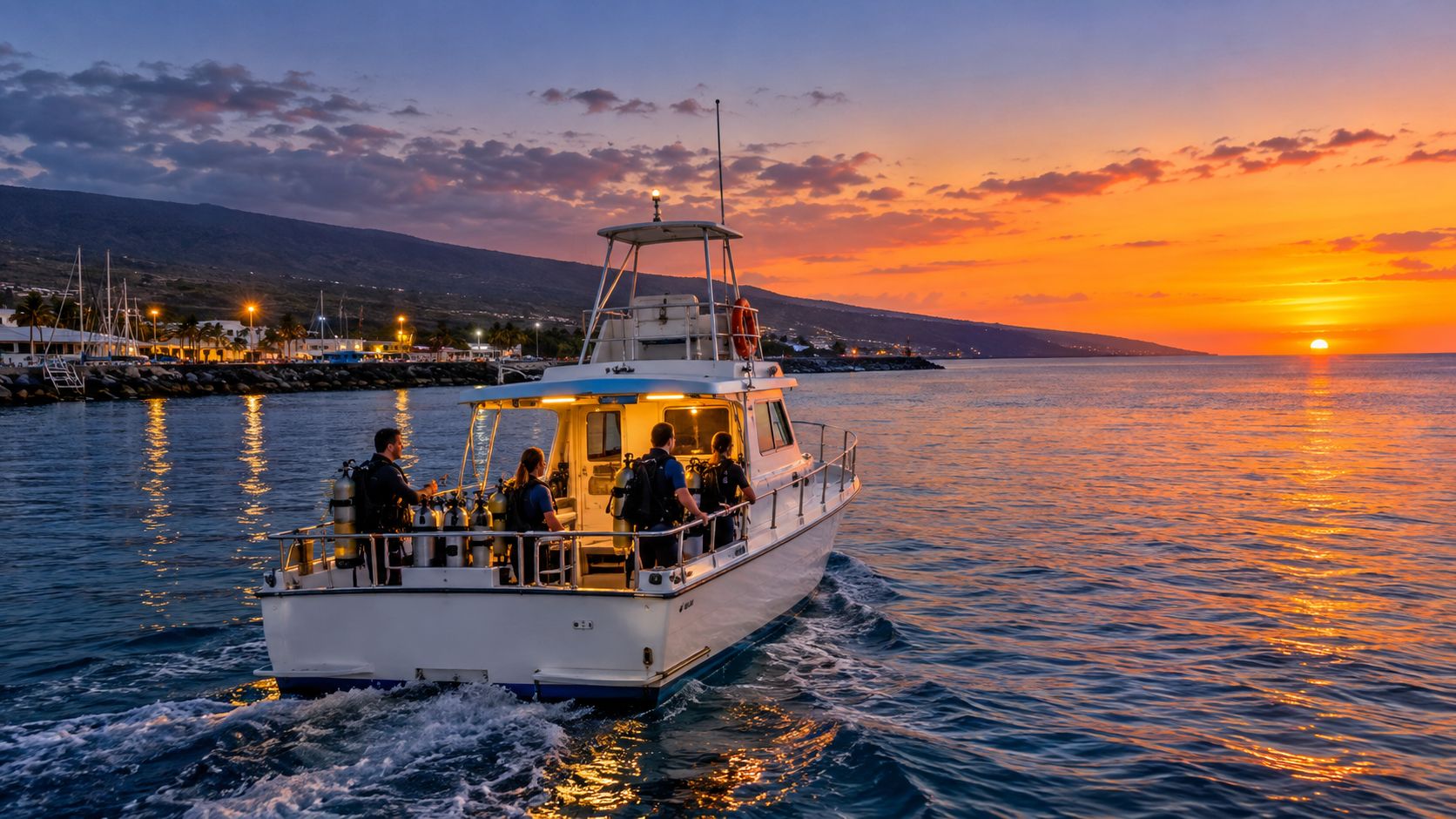
You've probably seen the photographs: a manta's white underside rising out of black water, wings spread wide, while a diver's light catches the curve of its body. The actual experience is quieter and more physical. You leave the harbor at dusk, enter the ocean after dark, settle into position, and wait for wild animals to choose the light.
For a night manta ray dive in Kona, the most important decisions aren't only whether to dive or snorkel. You'll also want to consider the site, your comfort in dark open water, the boat ride, and how you'll behave inside a feeding area. Garden Eel Cove is my preferred choice for first-time divers because its protected setting, sandy viewing area, and stronger historical aggregation record make the experience easier to manage.
What the Night Manta Ray Dive in Kona Actually Feels Like
At Honokohau Harbor, the last daylight usually fades while the crew prepares the boat. The ride out can feel relaxed and scenic, or it can remind you that the Pacific is still an ocean after sunset. Once the boat reaches the viewing area, the briefing is short and practical: where to sit, how to hold your light, how to stay clear of the mantas, and what to do if you need help.
Divers enter the water and descend to a sandy bottom at approximately 30 to 40 feet, a depth described for Garden Eel Cove by this Kona dive-site overview. You kneel or settle near the edge of the group, inflate your buoyancy control carefully, and look upward. Snorkelers remain at the surface, usually near a flotation structure, while divers form a low viewing area below.
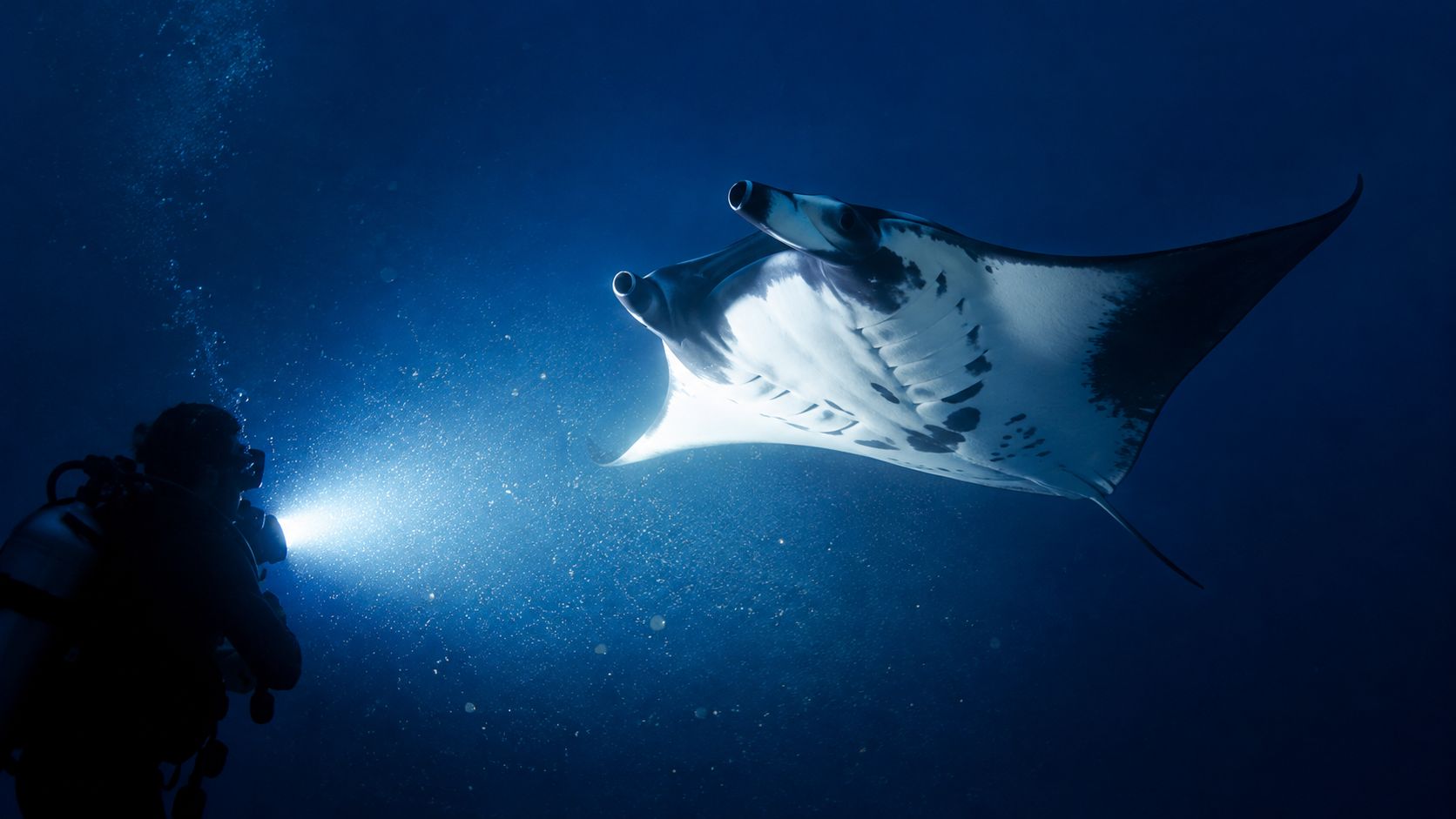
The first few minutes underwater can feel strangely empty. Your eyes adjust to the darkness, your bubbles drift upward, and the light above seems to create a glowing doorway in the water. Then a shadow crosses the beam. It may look distant at first, but the shape grows until you realize that the moving surface above you is the underside of a manta, not a school of fish.
Calling it a night dive doesn't mean you're exploring a reef in darkness. The activity is a stationary nighttime feeding observation built around submerged lights. The lights concentrate plankton, and the mantas arrive to feed in that illuminated water column. You may feel a cool layer across your chest, hear breathing and bubbles around you, and notice that the encounter depends more on patience than swimming.
What surprises beginners: The mantas do the traveling. Your job is to stay calm, hold position, and let the animals decide how close they want to pass.
Some encounters are graceful, with a single manta making broad passes. Others become busy, with feeding chains and barrel rolls above the lights. The experience can be excellent even when horizontal visibility isn't perfect, because the animals are following prey concentrated in the light field.
For visual examples of the setting and animal behavior, browse Kona manta ray dive pictures. The photographs can't reproduce the darkness, the sound of your breathing, or the moment a manta turns its white belly toward you, but they'll give you a useful sense of the viewing angle.
Why the Mantas Come to the Lights
The simplest version is light draws plankton, plankton draws mantas. The lights aren't bait, and the mantas aren't approaching because they're curious about divers. They're responding to a temporary concentration of food.
Reef manta rays, Mobula alfredi, are suspension feeders. Their cephalic fins, the rolled structures beside the mouth, help funnel plankton-rich water into the open mouth. Gill rakers then retain the prey while water passes out through the gill openings. The Hawaiʻi Department of Land and Natural Resources explanation of sharks and rays describes this filter-feeding mechanism and the role of the manta's feeding structures.
At night, zooplankton move through the water column. Artificial lights make some of that prey more concentrated near the illuminated water, creating a temporary feeding lane. The mantas arrive because that lane contains food, not because the dive group has trained or fed them.
That explanation makes the positioning rules easier to remember:
- Divers point lights upward. The beam helps build the illuminated water column above the sandy bottom.
- Snorkelers stay at the surface. Diving down places a swimmer inside the feeding lane and can interfere with the mantas' approach.
- Everyone stays still. Rapid finning scatters plankton, disturbs other guests, and makes the feeding area less orderly.
- Nobody touches or pursues a manta. The animal must be able to turn, bank, and leave without avoiding hands, cameras, or fins.
A feeding manta may open its mouth and glide directly through the light. It may also barrel-roll repeatedly when prey is especially concentrated. Group size and activity change with plankton density, currents, and conditions in the water column, so a quiet start doesn't mean the session is over.
The practical idea: You're not waiting for a trained animal to perform. You're observing a feeding response and trying not to disrupt it.
That's why stationary diving works so well. A diver on the bottom gives the manta open water overhead, while an active swimmer creates turbulence and unpredictable movement. You'll get a better view by lowering your effort, not increasing it. This guide to diving with manta rays explains the encounter from the diver's perspective, including the importance of remaining in position.
Garden Eel Cove vs Keauhou and Why Site Choice Matters
Site choice changes the feel of the night more than many first-time guests expect. In Kona, the two main manta viewing areas are Makako Bay, also known as Garden Eel Cove, and the coastline fronting Sheraton Keauhou Bay. Hawaiʻi's Department of Land and Natural Resources names both in its discussion of commercial manta viewing and site management in this state agency update on manta operations.
If you are trying to choose one for a first outing, I usually steer people toward Garden Eel Cove when the operator's route and conditions make that possible. The reason is practical. The site is typically more sheltered, and the sandy viewing bottom described earlier gives divers a clear place to settle without pressing into coral. For anxious divers, that matters. For snorkelers and nervous swimmers on a night boat, it often helps to know the in-water setup is built around a familiar, repeatable viewing pattern rather than a loose drift. See the full manta ray night dive overview for how the dive is commonly run.
Garden Eel Cove also has the stronger historical record for bigger groups of mantas. A six-year monitoring account covering January 1, 2009, through December 31, 2014, reported manta appearances on approximately 92% of monitored nights at Manta Heaven, the name commonly used for Garden Eel Cove, and described generally larger aggregations there than at Keauhou. That gives the site a strong reputation, but it does not promise a certain kind of night. Plankton, current, weather, and animal movement still decide the actual encounter. The historical Garden Eel Cove monitoring account is useful background if you want to understand where that reputation comes from.
| Factor | Garden Eel Cove | Keauhou Bay |
|---|---|---|
| Physical setting | More protected, with a defined sandy viewing area | Coastal viewing area fronting Sheraton Keauhou Bay |
| Diver position | Bottom-based viewing over sand or rubble | Bottom-based viewing, subject to local conditions |
| Historical aggregation pattern | Generally larger aggregations | Predominance of female visitors and strong female site fidelity |
| Best fit | First-time divers, photographers, and guests who value a sheltered setup | Visitors interested in a distinct site with important female residency patterns |
Keauhou is not the lesser version of the experience. It is different. A 2010 through 2022 community-science dataset covering both sites compiled more than 23,000 sightings representing 167 individually identified reef manta rays. The study found movement between Garden Eel Cove and Keauhou, while Garden Eel Cove consistently supported larger aggregations and Keauhou showed a predominance of female visitors and high female site fidelity. The full Kona community-science study explains that pattern in detail.
So the decision is less about picking a "better" site and more about matching the site to the night and to your comfort. Mantas use both areas. Operators also adjust for sea state and recent sightings. If you want the setup that usually feels simpler and more reassuring on a first trip, Garden Eel Cove remains the safer recommendation.
Certification, Comfort, and Whether the Dive Is Right for You
A manta encounter can be gentle for the animals and still feel demanding for a person. Darkness, open water, cool exposure, a boat ladder, and the need to remain calm all matter. Choose the format that matches your current comfort, not the version that sounds most adventurous.
Certified divers
Certified divers should be comfortable descending at night, controlling buoyancy, and staying stationary near a sandy or rubble bottom. You won't swim after the mantas. You'll settle into the viewing formation, keep your hands and equipment out of the flight path, and let the animals pass overhead.
A recent refresher can help if you haven't dived for a while. You'll need to manage mask clearing, regulator use, buoyancy, and controlled movement without turning the feeding area into an obstacle course. If your last dive was long ago or night conditions make you tense, consider a refresher before booking, such as Big Island scuba certification and training.
Uncertified beginners
An uncertified person shouldn't join the scuba portion just because the depth is modest. Scuba requires appropriate training, equipment familiarity, and the ability to respond calmly underwater. A beginner who wants to experience the mantas should look at the snorkel format or complete proper certification first.
Surface snorkelers
Snorkeling removes the need for scuba certification, but it doesn't remove the need for water comfort. You'll remain at the surface, use a mask and snorkel, and follow the flotation arrangement supplied by the crew. You must be able to breathe through the snorkel, stay with the group, and avoid diving down into the manta feeding column.
People who are anxious in dark water often find it helpful to keep one hand on the flotation support and focus on slow breathing. Tell the crew before entering the water if you're worried. If you become uncomfortable, signal early rather than trying to push through panic.
Companions and personal limits
A non-diving companion may be able to join the boat without entering the water, but policies vary by operator and vessel. Ask before booking whether a companion can ride along, snorkel, or remain aboard, and ask how the crew handles someone who decides not to enter.
Motion sensitivity can affect the trip before the mantas appear. Darkness may also magnify ordinary sensations, including boat movement, bubbles, and the cool thermocline. Medical conditions, recent illness, pregnancy, breathing problems, and medication questions deserve a conversation with a healthcare professional and the operator before departure.
A good decision test: If you can remain calm, follow a fixed position, communicate discomfort, and accept that the mantas control the encounter, the experience may suit you. If dark open water causes intense distress, snorkeling with strong flotation support or staying aboard may be the wiser choice.
Gear, Packing, and Seasickness Preparation
The goal is to arrive warm, comfortable, and ready to listen. Operators commonly provide the core equipment, including a wetsuit, mask, snorkel, fins, weights, and the boat. Confirm the exact inclusions with your chosen company because equipment packages and policies can differ.
Pack the items that solve the problems people notice only after the sun goes down:
- Swimsuit: Choose a secure fit that won't shift under a wetsuit or harness.
- Rashguard: A thin layer can reduce rubbing and add warmth beneath the wetsuit.
- Towel and dry clothes: The ride back can feel colder once you're wet and stationary.
- Reef-safe sunscreen: Apply it well before entering the water and follow the operator's guidance.
- Motion-sickness remedy: Choose a product you've used safely before, and check medication instructions.
- Warm layer: A windbreaker, fleece, or light jacket can make the return boat ride much more comfortable.
Experienced divers often add a low-volume mask, which can make equalization and mask management less awkward at night. A small red light is useful when handling camera settings on the boat, while a hood or beanie can help on repeat dives if you chill easily.
Handling the boat ride
The crossing from Honokohau Harbor can be calm or choppy depending on wind. Sit where the crew recommends, look toward the horizon, avoid heavy meals immediately before departure, and tell the crew as soon as nausea begins. Waiting until you feel severely ill makes recovery harder and can affect your time in the water.
For a fuller pre-trip routine, read this guide on how to avoid seasickness on a boat. Common options include the Ship-EEZ Seasickness Patch, Dramamine pills, Bonine pills, Sea Band wristbands, and ginger chews. Check labels carefully, especially if you're combining products or taking prescription medication.
Don't test a new medication for the first time on the boat. Ask a pharmacist or clinician about timing, drowsiness, interactions, and whether a patch or pill is appropriate for you.
Underwater Photography and Videography at the Light Circle
Manta photography in Kona is an upward-looking exercise. The animals pass above you, the light source sits below or near the viewing formation, and the surrounding water remains dark. That combination produces dramatic images, but it also creates difficult exposure and focus decisions.
Start with a wide-angle lens or action-camera field of view. A fast shutter helps reduce blur from the manta's movement, a wider aperture admits more light, and a higher ISO may be necessary in the dark. Turn a red filter off or keep it minimal because the scene is lit by artificial light rather than sunlight.
Build the shot before the manta arrives
Frame the illuminated water column first. Focus on the area where the manta is likely to pass, using continuous autofocus if your system tracks well in darkness or manual focus if you can lock a reliable distance. Waiting until the animal is directly overhead often leaves too little time to find focus and compose.
If you use strobes, angle them outward rather than blasting the center of the water column. The goal is to light the animal without creating a cloud of backscatter from plankton. A dome port can help with wide-angle composition, while a polarizing filter may reduce unwanted reflections in suitable conditions. Those choices often matter more than just using a camera with more megapixels.
Action-camera users can mount a small light on a stick and aim it upward, but the light must remain controlled. Don't sweep it across another diver's eyes, and don't wave the camera through the manta's path to chase a closer frame.
Photographer's rule: Settle on the bottom, point the camera upward, and let the manta enter your composition. A close image is never worth following an animal.
Flash and continuous-light etiquette matters for both people and mantas. Keep equipment compact, avoid blocking the viewing lane, and never aim a bright light directly into another diver's face. If a manta changes direction because of your position, lower the camera and give it space.
The strongest footage often comes from patience. A slow pass, a turn, or a barrel roll gives you time to hold the frame. Rapid finning, chasing, and repeated repositioning usually create shaky video, backscatter, and a poorer experience for everyone nearby.
Booking Logistics, Boat Day, and the No-Touch Code of Conduct
A smooth trip begins with matching the booking to your actual ability. Tell the operator whether you're certified, snorkeling, recently refreshed, prone to seasickness, traveling with a non-participating companion, or bringing substantial camera equipment. Those details affect the right tour format and the support you'll need.
Kona Honu Divers offers manta trips alongside its wider Kona diving tours. Its listed boat amenities include shaded seating, storage, and hot showers, and the operator describes free nitrox for certified divers. For the manta-specific option, review the two-tank manta dive and snorkel tour and confirm the current departure, site, inclusions, and participant requirements before paying.
What the boat day looks like
Check-in takes place at the harbor, followed by gear preparation and a briefing. The crew will explain how divers form the viewing area, how snorkelers use flotation, where lights point, and how to signal if something feels wrong.
At the site, follow the divemaster's formation rather than creating a personal viewing spot. Keep your gear over sand or rubble, preserve room for manta movement, and maintain neutral buoyancy whenever you move.
The no-touch code has a reason behind every part:
- No touching: Hands and equipment can injure or stress the animal.
- No chasing: A manta must be able to leave without being pursued.
- No blocking the light circle: The feeding lane needs open water and stable illumination.
- No diving down from the surface: Snorkelers should remain above the light structure rather than entering the manta corridor.
- No standing on coral: The sandy viewing arrangement protects the reef from fins, knees, and equipment.
- No lights into eyes: Photographers should protect both fellow guests and the animals from poorly aimed beams.
- No bubbles directly into a passing manta's face: Time your breathing when possible so bubbles don't rise into its approach path.
Use the pre-dive briefing as a working plan, not background noise. If you're uncertain about your position, ask before entering the water. A calm group creates a better viewing area than a crowded group of people trying to improve their own angle.
Conservation, Research, and Leaving the Site Better Than You Found It
Kona's night manta experience depends on a relatively small, resident reef manta population. Photo-identification work along the Kona Coast from 1992 through 2007 identified 106 individual manta rays, while earlier assessments suggested that the local population probably numbered fewer than 200 animals. The same historical program recorded 3,208 surveys, primarily at Keauhou and Ho'ona Bay nighttime aggregation sites. Those findings are summarized in the Hawaiʻi legislative testimony on manta research.
Long-term observation matters because individual mantas can be recognized by their underside markings. The later community-science dataset described earlier recorded 167 identified reef manta rays across Garden Eel Cove and Keauhou during 2010 through 2022, showing how repeated visits can build knowledge rather than merely produce photographs.
The animals are also strongly coastal. Telemetry found no tracked individual deeper than 1,000 feet, and no photo-identification or acoustic-telemetry evidence showed movement between the Kona and Maui populations. That makes local behavior especially important. What happens at Kona's feeding sites can't be treated as a minor detail in a broad, interchangeable wildlife attraction.
Turn observation into useful information
If the crew or research program welcomes observations, record:
- Time and approximate depth: Note when the manta activity begins and the viewing depth.
- Conditions: Include current, visibility, and general water-column conditions.
- Animal count: Record the number of individuals you can identify without guessing.
- Behavior: Describe straight passes, barrel rolls, feeding chains, or changes in approach.
- Site details: Note whether the encounter occurred at Garden Eel Cove or Keauhou.
Leave the site with the same care you brought into it. Use reef-conscious sunscreen practices, keep your fins off the bottom, ask the divemaster about unusual behavior, and share observations rather than promising future visitors a guaranteed show. Avoid posting precise location pins in ways that could pressure less-managed sites.
A respectful night dive isn't passive. You hold position, protect the feeding lane, and accept that the mantas remain wild. That restraint is what keeps the encounter meaningful for the next group and less disruptive for the resident animals.
Kona Honu Divers offers guided manta ray night dives and snorkel options, with crew support for the boat briefing, gear setup, and stationary viewing that this experience requires. Visit Kona Honu Divers to review the current tour details, check whether Garden Eel Cove is available for your date, and choose the format that matches your certification and water comfort.