
Table of Contents
- The payoff is the perspective
- Your position affects the feeding space
- Before departure and during the briefing
- Sunset, descent, and the viewing period
- What long-term observations reveal
- Why the whole site matters
- Separate the crowding questions
- Assess your readiness honestly
- Pack for the actual dive
- Solve darkness before adding more light
- Don't mistake access for permission
- Questions to settle before paying
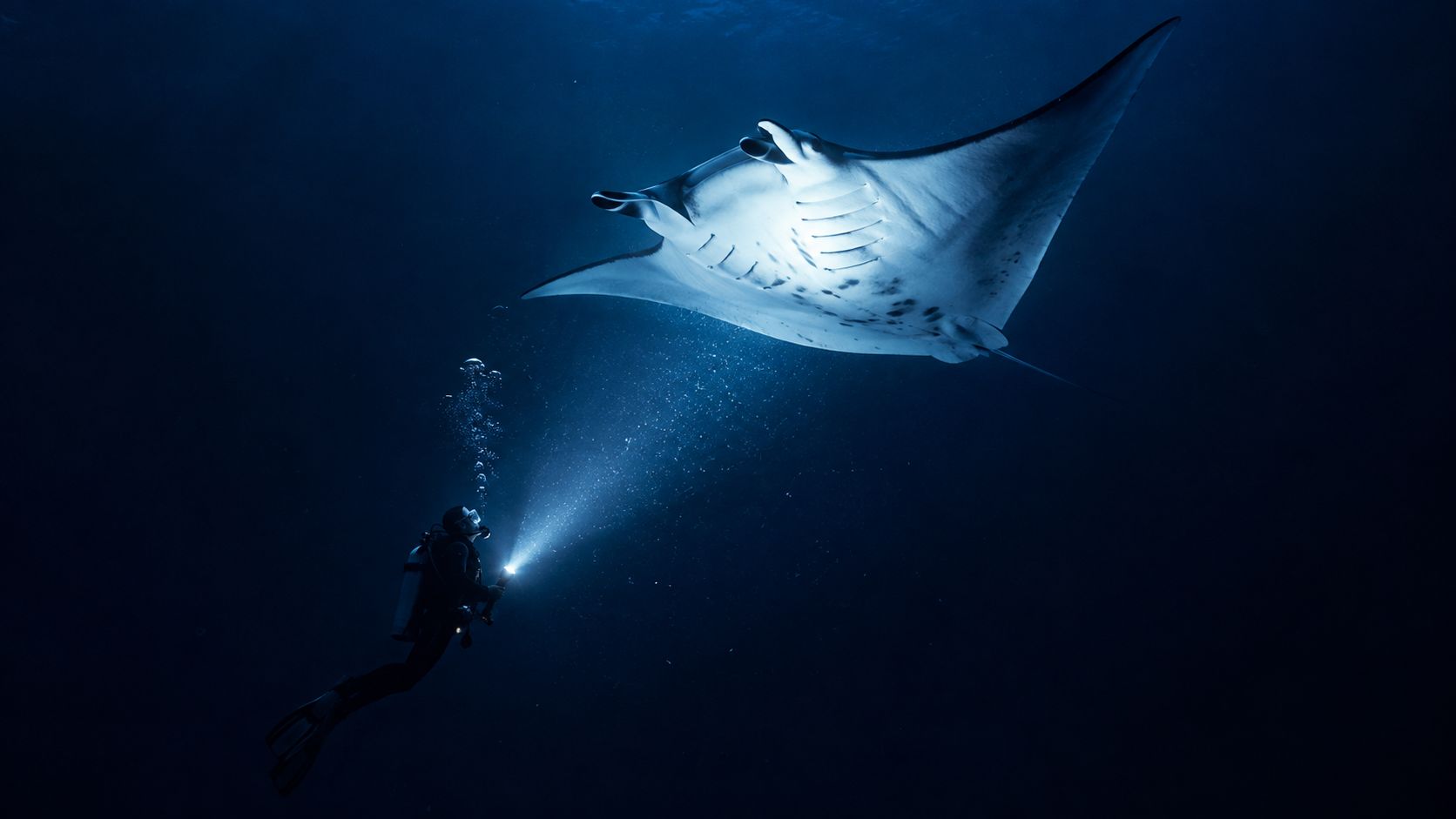
You settle near the sandy bottom, steady your breathing, and look into the light above you. A manta glides overhead, and for a moment the hardest part of the dive is remembering not to lift your hands.
What a Night Manta Ray Dive Actually Feels Like
A night manta ray dive is less about swimming after wildlife and more about learning to stay still while something extraordinary happens nearby. Your world narrows to your buddy, your guide, your instruments, and the illuminated water above the viewing area.
That stillness can surprise divers who expect a moving reef tour. Once you're positioned, the task is to watch without drifting upward, blocking another diver, or getting so absorbed that you forget your air supply.
The payoff is the perspective
From below, you see the animals turn, approach, and pass through the illuminated water. You aren't directing the encounter. Your guide establishes a viewing position, but the mantas decide whether and how they approach.
That makes this activity appealing if you enjoy observing behavior rather than covering distance. It also means patience matters. An empty light field isn't an invitation to leave your group and search the darkness.
First-dive mindset: Treat the manta encounter as a real scuba dive with wildlife viewing, not a performance that makes ordinary dive checks unnecessary.
For the scuba experience, Garden Eel Cove is my preferred choice because its protected location, defined viewing area, and surrounding reefs make a stronger overall dive setting. That preference concerns the quality of the dive, not a promise that wildlife will appear.
The useful questions go beyond whether mantas come close. Where will your group wait? How crowded will the site be? Can you hold your position comfortably after dark?
A suitable operator should answer those questions plainly. The memorable part may be the manta overhead, but your comfort depends on the briefing, the layout, and the people managing the dive.
How the Manta Encounter Is Engineered
The lights attract plankton, not mantas directly. Artificial illumination concentrates light-responsive zooplankton, and reef mantas then pass through that concentrated food with their mouths open. The mechanism and its positioning implications are described in this explanation of Kona's light-based manta encounter.
Think of insects gathering around a porch light. It's a useful analogy for concentration, although the underwater scene involves drifting prey, moving water, and animals filtering food as they swim.
The encounter is engineered in the sense that people create a temporary feeding patch. It isn't a trained routine, and a bright light doesn't function like a command to appear.
Your position affects the feeding space
The brightest water isn't necessarily where your body belongs. Divers should stay below and outside the main feeding corridor, leaving room for mantas to bank and turn.
A common beginner mistake is rising for a better view. Another is making repeated fin corrections that stir sediment. Both can undermine the conditions everyone came to enjoy.
Diver Rules During a Night Manta Encounter
| Diver Action | Why It Matters | What To Do Instead |
|---|---|---|
| Rising into the illuminated corridor | Reduces maneuvering space and increases contact risk | Hold the guide-designated position below the feeding path |
| Sweeping a light after a departing manta | Moves illumination away from the intended viewing arrangement | Keep the beam aimed as briefed |
| Chasing an animal | Interferes with its chosen route | Let it leave and choose whether to return |
| Kicking close to sediment | Can reduce visibility for the group | Establish buoyancy and use small, deliberate movements |
| Reaching toward a close pass | Creates unnecessary contact risk | Keep hands and equipment close to your body |
If an animal changes course near you, don't assume it wants interaction. Check your position and light placement, then follow your guide's direction.
There's also a limit to what the visible plankton patch explains. Marine-megafauna researchers describe reef mantas making nighttime dives to approximately 672 meters, or 2,200 feet, likely following vertically migrating zooplankton, in their guide to manta feeding ecology. Your viewing area is a temporary opportunity within a much larger feeding environment, not the animal's entire world.
A Typical Kona Night Manta Dive Itinerary
Your evening starts with logistics, not wildlife. Arrive at the stated meeting location ready to confirm equipment fit, discuss recent diving experience, and tell the crew about anything that could affect your comfort.
Don't save important questions for the water. If you haven't used the rental buoyancy compensator before, ask for a walkthrough while you can hear the answer clearly.
Before departure and during the briefing
- Check your equipment: Confirm weighting, regulator function, instrument access, and how your lights attach.
- Learn the route: Ask how the group will enter, descend, find the viewing area, and return.
- Review communication: Know the signals for discomfort, low air, light trouble, and ending your dive.
- Understand the exit: Listen carefully to the boat's ladder and boarding procedure.
On a two-tank outing, expect a separate reef dive before the manta portion, with a surface interval between dives. Confirm the actual sequence with the operator rather than assuming every evening follows an identical schedule.
Sunset, descent, and the viewing period
A scientific description of Kona's established manta-viewing operations places dives soon after sunset, around 18:00, or 6:00 p.m., with seafloor lights at approximately 10 meters, or 33 feet, and dives lasting about one hour. These are planning references, not guaranteed departure times or personal bottom-time allowances.
Follow the descent your guide briefs. At the viewing area, settle only where directed, whether that means hovering close to the bottom or taking an approved position on suitable sand.
Your air supply, comfort, and the guide's instructions determine when you leave. A manta arriving late doesn't extend your dive plan.
After the ascent, complete the crew's boarding procedure before discussing what you saw. Dry clothing helps make the harbor return more comfortable.
For dinner and transportation, use the operator's confirmed return window. Sunset varies, boat schedules vary, and a wildlife outing shouldn't be squeezed between inflexible evening reservations.
Garden Eel Cove Versus Keauhou Bay
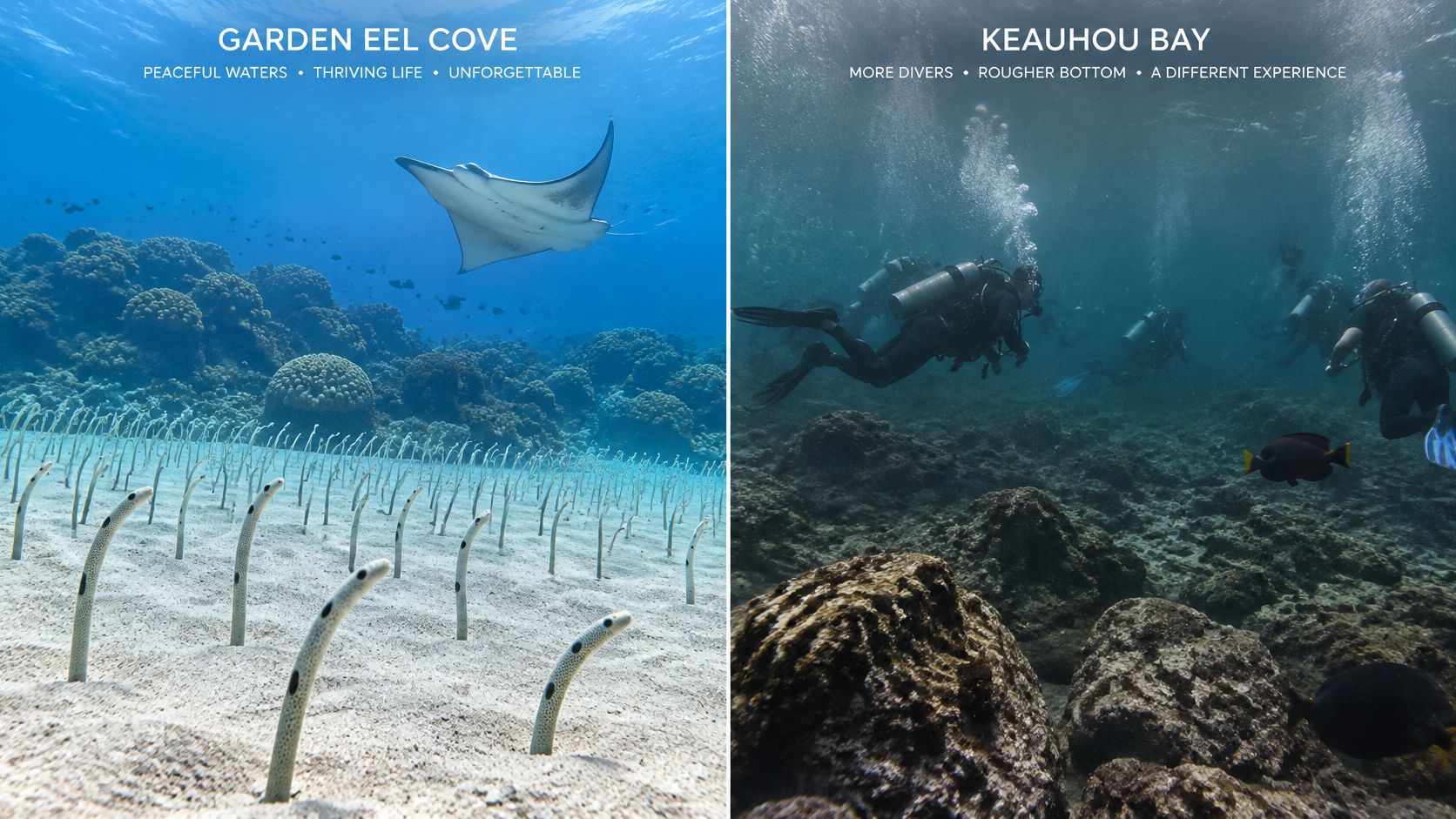
Garden Eel Cove is the superior choice for the scuba tour, in my editorial judgment. Its protected location, better-defined viewing area, and better surrounding reefs make the complete diving experience more appealing, rather than merely offering a place to wait for mantas.
Keauhou deserves respect as an important manta habitat. Choosing Garden Eel Cove for a dive isn't the same as saying Keauhou matters less ecologically.
What long-term observations reveal
A University of Hawaiʻi study of Kona's nighttime manta aggregations analyzed more than 23,000 sightings of 167 individually identified reef mantas over 13 years, from 2010 through 2022. It found consistently larger aggregations at Garden Eel Cove and stronger female use at Keauhou, alongside high female site fidelity there and connectivity between the locations.
Those differences suggest the sites serve different ecological functions. They don't establish that every evening at Garden Eel Cove will outperform every evening at Keauhou.
| Comparison | Garden Eel Cove | Keauhou viewing site |
|---|---|---|
| Scuba setting | Preferred for protection, viewing organization, and surrounding reefs | An alternative established feeding location |
| Observed manta use | Larger aggregations in the long-term study | Stronger female use in the same study |
| Booking priority | A clear viewing layout and worthwhile reef component | Understanding how the operator organizes the specific site |
| Important limitation | Protection doesn't guarantee calm conditions | Wildlife importance doesn't automatically make it the better scuba setup |
Why the whole site matters
A defined perimeter helps divers understand where to settle and where to leave space. Better surrounding reefs also add value to a trip that includes a reef dive before the nighttime encounter.
For names and layouts, use this comparison of Manta Heaven and Manta Village. Garden Eel Cove is also called Manta Heaven, while the Keauhou-area experience is commonly called Manta Village.
When comparing a Garden Eel Cove manta dive tour, ask whether conditions support the planned location. A good site preference should never override the captain's assessment of the ocean that evening.
Crowding, Capacity, and Real-World Safety
Crowding isn't just a complaint about atmosphere. In darkness, limited space can complicate positioning, separation, and access to the surface.
A survey of 444 manta-tour participants found that 82% felt crowded by snorkelers, 78% by boats, and 69% by scuba divers. The manta-tourism research and safety material submitted to Hawaiʻi County also identifies vessel and participant numbers as accident-risk factors and describes inadequate effective capacity controls at the time assessed.
Separate the crowding questions
- Boat congestion: Ask how the crew manages entry, pickup, and emergency access around other vessels.
- Surface density: Ask how surface participants remain separated from the scuba group and its ascent route.
- Underwater density: Ask how guides establish viewing positions without forcing divers into one another.
- Light and visibility: Ask what happens if competing beams, suspended sediment, or glare make orientation difficult.
These are related problems, but a small group on your boat doesn't mean an uncrowded site. Other operators may already be present.
The practical concern is a chain of small corrections. A diver moves to avoid someone's fins, enters another person's light beam, and then drifts closer to the feeding space. Good organization reduces the need for those corrections.
Booking question: “How do you decide the viewing area is too crowded, and what do you do then?”
Families and groups should also ask how buddies stay together and how a participant exits early. Novice divers need an answer they can follow underwater, not just reassurance that a guide will be nearby.
Review responsible and considerate diver etiquette before departure, but don't confuse individual manners with site management. Both matter.
A quieter arrangement may give you more room and fewer accidental contacts. It still can't guarantee mantas, and wildlife expectations shouldn't pressure anyone to remain in conditions they find unsafe.
Who Can Go and What Gear to Bring
Start with eligibility, then consider equipment. Ask the operator to confirm certification requirements, age restrictions, medical screening, and whether your recent experience suits a night dive.
Open Water certification is a sensible starting point for the conversation, not permission to assume every certified diver is ready. If you're uncertified, ask whether the operator offers a separate Discover Scuba pathway and whether it applies to this activity. Don't assume an introductory experience includes the manta night dive.
Assess your readiness honestly
- Buoyancy: Can you remain at a chosen depth without repeated finning?
- Attention: Can you monitor air and your buddy while something exciting happens?
- Darkness: Are you comfortable using instruments and signals with limited visual references?
- Space awareness: Can you watch overhead without rising into animals, other divers, or equipment?
An animal passing above you doesn't turn this into a technical overhead-environment dive. It does require awareness of the space above your head and a clear plan for leaving the viewing area.
Pack for the actual dive
Choose exposure protection with the crew's advice, especially if you get cold while relatively still. Bring a familiar mask, suitable primary and backup lights, and surface-signaling equipment appropriate to the operator's procedures.
A compact save-a-dive kit can include compatible mask and fin straps, plus small spares you know how to use. Keep it on the boat rather than adding loose items to your underwater setup.
Ask what rental gear is included, whether a dive computer is supplied or available, and what you're expected to bring. Don't treat a general equipment description as confirmation of a particular booking's inclusions.
If you're weighing surface viewing against scuba, this guide to choosing snorkeling or diving with mantas can help frame the decision.
The final preparation is mental: you don't need to follow every animal. You need to make the dive comfortably within your abilities.
Photography Tips for the Manta Encounter
The manta approaches, your camera hunts for focus, and your instinct is to move closer. That's exactly when you should hold your position.
Build the photograph around the dive plan, not the other way around. If operating a camera prevents you from checking air, holding depth, or following the guide, leave it secured and enjoy the encounter.
Solve darkness before adding more light
For a camera with manual controls, try a wide aperture and raise ISO as needed, checking the balance between noise and motion blur. A fast wide-angle lens can help frame a close pass without requiring you to back away or pursue the animal.
There isn't one camera category that automatically performs best at the viewing depth. Compare low-light focusing, usable high-ISO output, lens coverage, and how easily you can operate the housing by touch.
- Set up beforehand: Confirm focus behavior and controls before entering.
- Keep equipment compact: Avoid extending camera arms into the feeding corridor.
- Let the animal enter the frame: Don't follow a departing manta to rescue a composition.
- Ask about lighting rules: Get approval before using strobes, focus lights, or video lights.
If the guide permits a red focus light, keep it directed toward the bottom when it isn't needed, rather than tracking animals with it. Use video lights conservatively and skip strobes when the briefing prohibits them or when managing them compromises your position.
Don't mistake access for permission
A marine-megafauna review of manta tourism describes short-term responses including altered course, swimmer avoidance, and interrupted feeding, while noting uncertainty about long-term population effects. That supports a precautionary approach, not a blanket claim that every managed encounter is harmless or damaging.
For composition ideas, examine these Kona manta dive photographs before packing. Then give yourself permission to miss a shot. A photograph isn't worth disrupting the feeding route or losing awareness of your buddy.
Booking, Policies, and Frequently Asked Questions
Book for the site, operating plan, and your readiness, not a promise of the closest possible pass. Garden Eel Cove remains my preferred scuba setting, but the right decision also depends on conditions and how the crew manages the group.
Review the current tour listing for the two-tank dive and surface-viewing options. Confirm rental inclusions, custom-boat arrangements, computer availability, free nitrox eligibility for appropriately certified divers, and whether an early booking discount applies.
Questions to settle before paying
- What if weather changes? Read the booking and cancellation policies and ask how operator cancellations differ from guest cancellations.
- What if no mantas appear? Confirm the current wildlife policy. Don't assume a refund or another trip is automatic.
- What if I need to cancel? Check the applicable deadline and exclusions before completing payment.
- What if the crew cancels? Ask whether the booking qualifies for rescheduling or a refund, and how that process works.
Book early enough in your stay to leave room for a changed plan. Keep your confirmation and contact the booking team directly if conditions disrupt departure.
Compare the broader Kona diving tours if you're planning multiple outings. Experienced divers can separately review the blackwater night dive and advanced long-range dive tour, each with its own suitability considerations.
Kona Honu Divers offers a two-tank outing pairing a reef dive with the nighttime manta encounter at Garden Eel Cove. Visit Kona Honu Divers to check availability, confirm equipment and certification requirements, and choose an evening that leaves room for weather-related changes.