
You booked a Kona night on the water, and the group chat is already split. One friend swears every trip is packed with animals. Another came back from a quiet night and thinks the whole thing is a coin flip. Both can be right, because manta rays in Hawaii do not show up on a schedule. They show up where the food is, at a handful of coastal feeding spots, and those spots do not behave the same way.
The useful question is not "Will I see one?" It is "Which site, which way of being in the water, and which boat match how these animals live?" For a night on Hawaii's Kona coast, I would start at Garden Eel Cove. The records back that choice, and they also show why a calm, well-run night can still be a small one.
Where to See Manta Rays on the Kona Coast
For a night manta dive on the Kona coast, Garden Eel Cove is the strongest choice. It is not the only feeding spot, and it is not a promise. It is the site with the better documented habit of drawing larger gatherings, plus water that is easier to watch them in.
A University of Hawaiʻi analysis of community records covered 13 years, from 2010 through 2022, at Garden Eel Cove and Keauhou. The set held more than 23,000 sightings of 167 individually identified reef manta rays. Garden Eel Cove consistently supported larger aggregations than Keauhou. Keauhou drew smaller nights and was visited predominantly by females, with high female site fidelity. Males moved between the two places more often. A Kona site comparison reaches the same practical split. These two coves, about a short boat ride apart, are not interchangeable.
Garden Eel Cove sits in a pocket naturally sheltered from the open ocean, so the water is calmer and clearer than a more exposed ledge on a bumpy night. You are looking over healthy reef, not a featureless sand patch in a chop. On our Manta Ray Night Dive, divers are set in a specific viewing area at that established site, rather than drifting wherever the boat happens to stop. We often take the manta charter there for that reason.
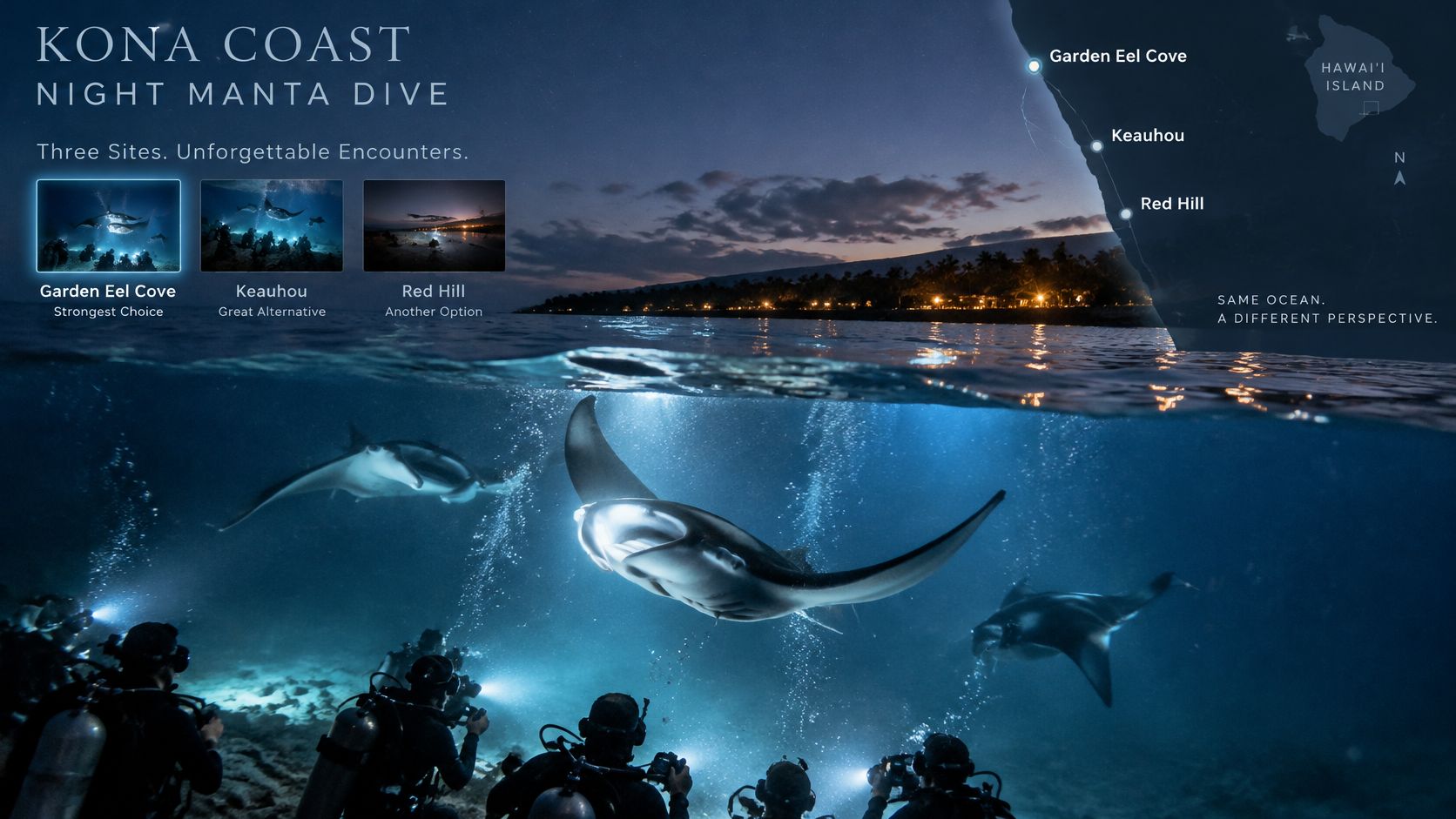
How the known night spots compare
| Site | Typical Experience | Aggregation Pattern | Best For |
|---|---|---|---|
| Garden Eel Cove | Night manta dive, our usual charter site | Larger, more variable gatherings in sheltered water | Divers who want the strongest sighting odds |
| Keauhou | Night manta viewing | Consistently smaller gatherings, mostly female mantas | Visitors who accept fewer animals per night |
| Manta Village | Night feeding station off Keauhou Bay | A long-used south Kona station, often the busier boat scene | Shorter runs when you are staying near Keauhou |
| Manta Heaven | Night feeding station | The north-shore name tied to the Garden Eel Cove area and its larger gatherings | Divers and snorkelers headed north of Keahole |
| Kohala coast feeding site | Night feeding station | A separate north-coast station, not part of the Kona pair | Visitors already based on the Kohala coast |
Practical rule: A sheltered, well-placed site raises your odds. It cannot promise the same number of animals every night, because aggregation size still tracks how much zooplankton is in the water.
What You Are Actually Watching
The animals on a Kona night are reef mantas, Mobula alfredi. They are not the more migratory giant manta. Reef mantas stay near productive coastal habitat with predictable plankton. Giant mantas range more widely when prey shifts. If you treat every huge wing overhead as the same wandering species, you will misread why the same individuals keep turning up off this one island.
Residency is the part most visitors never hear. NOAA's summary of Kona Coast photo-identification found that 76% of 105 reef manta individuals seen across 15 years of surveys were resighted along the Kona coast. Hawaiian island populations are genetically differentiated, and females reproduce at the island where they were born. A manta off Kona is largely a Kona animal. It is not a visitor passing through from Maui.
The belly is the name tag
Each manta carries a unique ventral spot pattern. Researchers match those spots the way you would match a face. On a slow pass, the white underside with its black marks is the frame worth keeping. The blue-gray back tells you almost nothing about which animal just looped through the light.
Nothing in that circle is trained, and nothing is on a timetable. The boat's lights work like a lamp over a porch. Plankton crowds into the bright water. The manta works like a moving sieve. Cephalic fins unroll and funnel that water toward an open mouth, and gill rakers strain the plankton out. Barrel rolls and short feeding chains let the same animal pass through the thickest patch again.
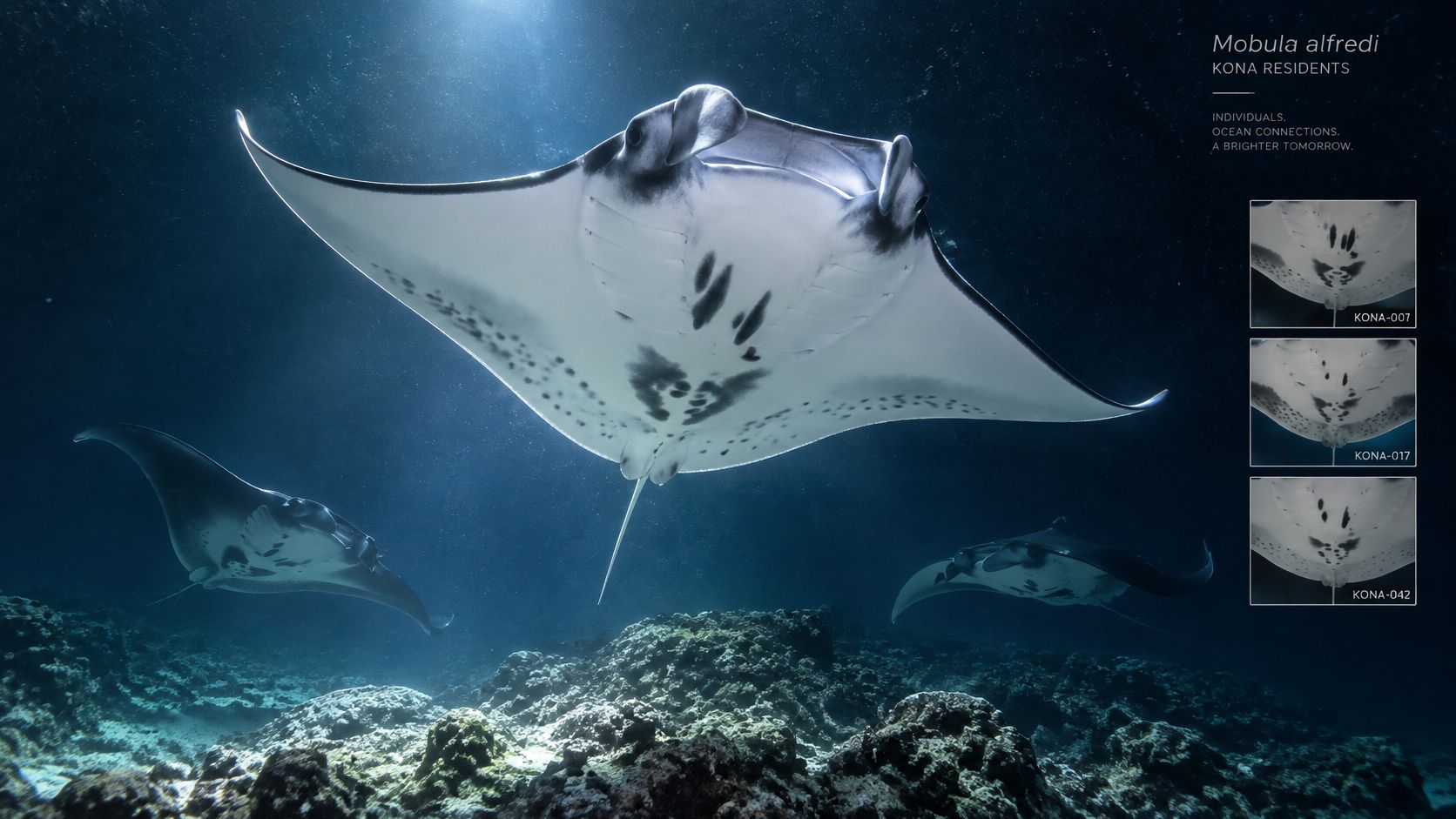
Watch three things on a close pass. The mouth is open. The cephalic fins are unrolled, not tucked. The spotted belly is square to you for a second or two.
A feeding pass repeats. The animal leaves the light, turns, and comes back through the densest water, sometimes in a chain with others. A brief visit is one sweep and a fade into the dark, mouth closing as it goes. If you only see the second, you still saw a wild animal checking a food patch. You did not see a show that failed to start.
When to Go and What Changes Your Odds
There is no single best month. Manta presence follows food, not the calendar, which is why a "peak season" promise falls apart the week the plankton thins out. A regional overview of Kona night diving puts the mechanism in a straight line. Artificial lights attract and concentrate zooplankton in a lit column. Reef mantas enter, open their mouths, and pass or barrel-roll through the densest patch while they filter. The same overview names three known feeding stations off the Kona coast: Manta Village, Manta Heaven, and a further station off the Kohala coast. Presence still depends on where the plankton stacks up that night.
A 2026 analysis of those same community records found both Garden Eel Cove and Keauhou stayed predictable nighttime feeding locations under years of tourism and artificial light. Predictable does not mean identical. Aggregation size was positively associated with zooplankton density, and Garden Eel Cove's nights were larger and more variable. Females accounted for 91% of sightings at Keauhou. A good week at one cove can still be a thin week at the other. For a fuller look at season versus conditions, see what time of year actually changes a Kona manta trip.
What moves the odds
- Plankton density: More food in the lit water means more reason for a manta to stay and loop.
- Site choice: Garden Eel Cove tends toward larger gatherings. Keauhou tends toward fewer animals, mostly females.
- Sea and wind: A rising swell or a hard afternoon wind can cancel the night or push the boat off the preferred cove.
- Booking demand: The most popular trips, including the manta ray night dive, often sell out weeks ahead.
Pick a flexible date window and hold a backup night. A typical evening starts before full dark, with the briefing done while you can still see the boat deck. Lights go in, plankton gathers, and the session may be a handful of animals or a crowd of them. Judge the trip by the latest conditions report and the last few nights of sightings, not by the month printed on your airline ticket.
Choosing Between a Night Snorkel and a Night Dive
The split is physical, not a matter of who is the "real" diver. On the night snorkel you float at the surface and look down. On the night dive you kneel on the sand in a lit viewing area, and snorkelers can still be above you on the same trip. If you want the longer comparison, read whether snorkeling or diving is the better manta night before you book.
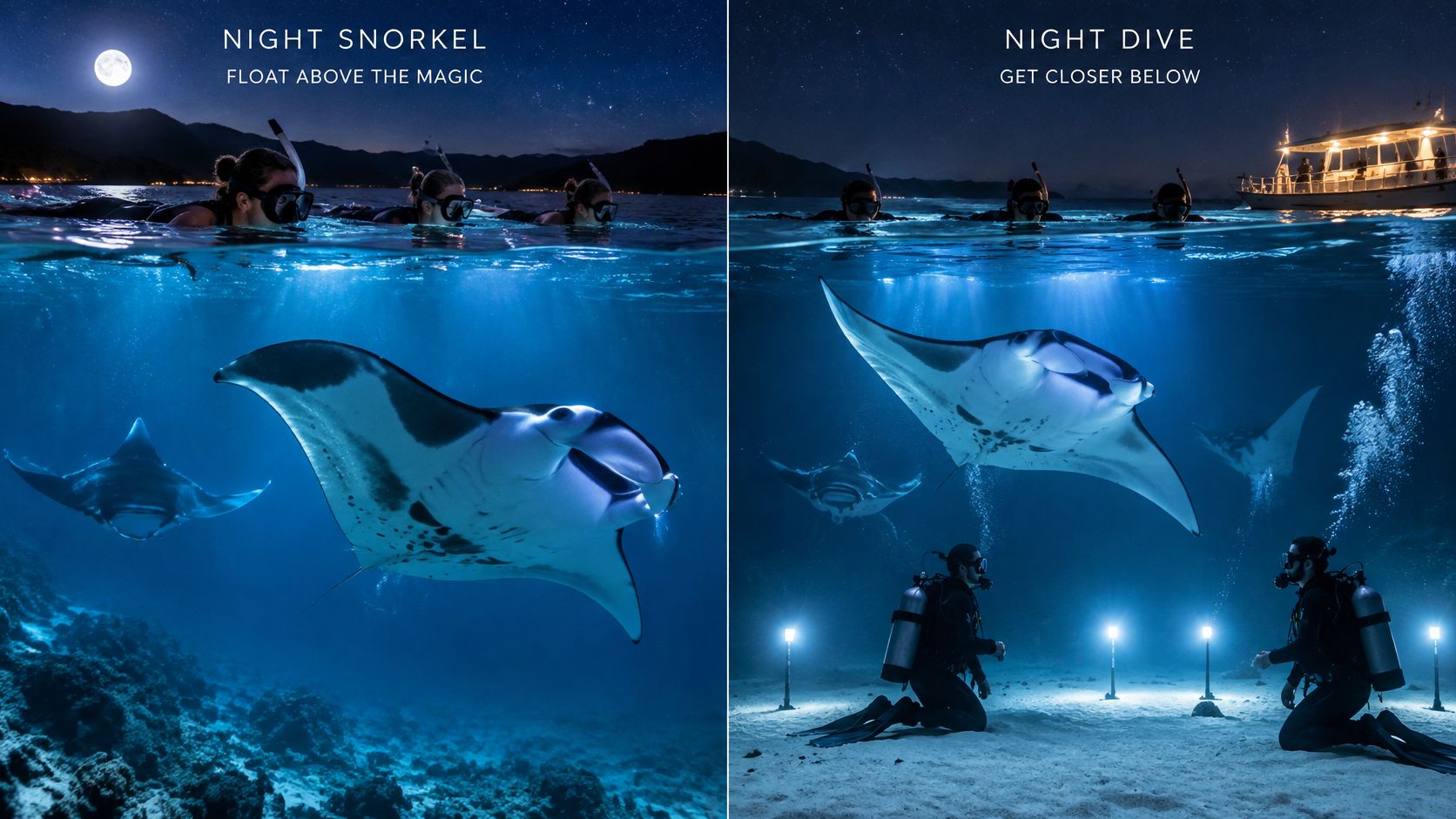
Powerful dive lights make a bright circle on the seafloor. You are not kneeling in a blackout. You can see your buddy, the sand, and the open mouths coming through the beam. Before anyone enters, the crew runs a briefing on the science of the aggregation and the rules of passive observation. That briefing is the difference between a calm night and a cluster of people swimming into the animals' line.
Match the trip to what you can already do
| Experience | Where You Are | Certification or Prerequisite | Who It Suits |
|---|---|---|---|
| Manta Ray Night Snorkel | On the surface, floating | Comfort floating with a mask and snorkel, no scuba card | Snorkelers who want to see mantas without diving |
| Manta Ray Night Dive | On the seafloor, kneeling in a lit viewing area | PADI Manta Ray Diver specialty taken before the dive | Divers and snorkelers from beginner to advanced levels |
| 2-Tank Manta Charter | Two dives from a dive boat | Open Water certification or higher, and a dive within the past 2 years | Certified divers wanting a full dive day |
| Premium Advanced 2 Tank Trip | Advanced two-tank dive trip | Recent logged experience beyond basic Open Water | Experienced divers seeking a premium advanced trip |
The flagship night dive suits people from first-ocean nights through longtime divers. The 2-tank manta charter is stricter. You need Open Water or higher, and you need to have dived within the past two years. I would not treat a dusty card from a decade ago as "close enough." If you are sorting every Kona scuba option, not only the night, the diving tours page lays the daytime reefs next to the manta trips.
For the manta night itself, I would still ask for Garden Eel Cove. The sheltered viewing area matters more when you are kneeling in one spot for the whole dive.
Comfort in the dark decides this, not the size of your logbook. A newer diver who stays on the sand will see more, and bother the animals less, than an experienced diver who cannot stop finning after the beam.
Safety, Conservation and Responsible Viewing
Easy access is the trap. Lights, boats, and a crowd in black water are what make the night possible, and they are also what can hurt people and animals. A Hawaii County safety assessment of manta viewing documented boats operating near unlit snorkelers and submerged divers at the main Kona sites. The busiest nights exceeded 290 people in the water, and capacity controls were historically inadequate. "Don't touch" is not a safety plan.
Before you pay, ask five plain questions. How many people will be in the water with you? Where do the boats hold? What is the visibility cutoff for cancelling? How are snorkel groups kept off the divers? Who is the emergency lead if someone panics? If the answers are fuzzy, pick another boat. Our night dive is stationary and closely supervised, and experienced divemasters and instructors are in the water with you. That is the standard I would want on any boat, including ours. The habits that keep a night boring, in the best way, are spelled out in responsible diver etiquette.
In the water, do these five things
- Stay with your designated group. Wandering toward another boat's lights is how people end up in a propeller lane.
- Remain in your assigned surface or seafloor zone. Snorkelers up, divers down, and nobody trading places mid-session.
- Never enter boat corridors. The gap between hulls is a work zone, not a viewing spot.
- Keep clear of manta flight paths. A blocked loop makes the animal turn away, and it puts a wing into someone's mask.
- Do not touch or chase. Contact strips the mucus that protects the skin, and a chase is how people get separated from the group.
Why a few animals matter so much
These are small, home-bound groups. A NOAA-led genetic study identified 318 unique manta rays around Hawaiʻi Island beginning in 1979, and about 600 in Maui Nui beginning in 2005. The estimated breeding piece was only about 104 adults off Hawaiʻi Island. Lose a handful of mature animals and you cut the next generation, because Maui animals are not going to restock Kona.
Hawaii prohibited killing or capturing manta rays in 2009. The threats that remain are ordinary and local. Boat strikes, habitat loss, and fishing-line entanglement all happen near the same coast you are visiting. Hawaiʻi's Division of Aquatic Resources tells anglers to move or retrieve lines when mantas are in high-use areas, to use barbless non-stainless hooks on monofilament or fluorocarbon, and, if an animal is hooked, to cut the line as close to the hook as possible and release it promptly. Offshore, NOAA rules say mobula rays, including manta and devil rays, may not be retained or landed in the applicable WCPFC and IATTC areas.
The night is low-risk and low-impact when boats cap the crowd and guests stay put. It is neither of those things when everyone piles into the same beam.
Photographing Mantas Without Disturbing Them
You get the frame only if you stay still and let the animal come to you. A manta that veers off because you kicked toward it is a missed photo and a worse night for everyone behind you.
- Skip a strobe blasted into the face. The boat lights already build the scene. A hard flash in the eyes makes an animal break the pass, and it blows out the white belly you wanted.
- Use the team's lights, a high ISO, and a fast shutter. Barrel rolls are quick. A fast shutter freezes the wing. High ISO keeps the shot from going black once the animal leaves the brightest part of the beam.
- Go wide for the pass, tighter for the spots. A wide lens holds the whole wingspan as it crosses the light. A closer frame on the belly is what makes the animal identifiable later.
- Shoot from the sand, low, and slightly up toward the mouth. That angle shows the open mouth and the cephalic fins. It also keeps you out of the swimming lane.
- Leave your buddy and the hull out of the frame. A manta cropped by a fin or a ladder reads as a crowd shot, not a wildlife shot.
- Take a few belly frames, then stop. Those spots are the photo-ID mark. Ask the operator whether it passes images to a local identification project, then put the camera down.
A fogged or flooded dome port will ruin the night before you see an animal. Test the housing in a sink or the rinse tank that afternoon, with the same port and the same o-ring you will dive.
Build a short story instead of one hero frame. Three passes in a row, a feeding chain, or two animals crossing the beam tell a viewer what the night felt like. If the site is already over capacity, lower the camera. No still is worth adding one more body to a packed aggregation. If you want to see how disciplined shooters frame Kona water without turning the dive into a chase, look through Kona dive shop photo sets before you pack the rig.
Frequently Asked Questions for Divers and Tourists
Will I see mantas every night?
No. Aggregation size tracks zooplankton, so Garden Eel Cove can be busy on Tuesday and thin on Wednesday. Treat a high recent run as encouragement, not a contract.
Do I need to dive?
No. The night snorkel keeps you on the surface. The night dive puts certified divers on the seafloor in a lit circle, sometimes with snorkelers above them.
Are the mantas trained or scheduled?
No. Lights gather plankton, and mantas arrive to feed on their own. If the food patch is elsewhere, they will be elsewhere.
Which species will I see?
Mostly reef mantas, Mobula alfredi, the coastal species. Giant mantas range more widely and are not the animal a Kona night is built around.
Can I touch or chase them?
No. Stay out of the flight path and let the animal approach. Mantas do not have a stingray barb, which is the usual worry behind whether a manta can sting you, and that still does not make contact acceptable.
What if no mantas show up?
Use the operator's latest sighting note and the sea conditions, then use the backup night you held when you booked. One empty beam is weather and food, not a failed island.
Do I need certification?
Only for the dive options. The snorkel does not take a card. The night dive and the 2-tank charter do, and the prerequisites sit in the comparison table in the snorkel-versus-dive section above. Read that row before you pay, especially if your last dive was more than two years ago.
Choosing a Kona Operator and Booking Your Night
Apply the same checklist to every boat, including ours. A pretty website does not tell you where you will kneel, who will be beside you, or what happens if the cove is crowded.
| Criterion | What Good Looks Like | Red Flag |
|---|---|---|
| Dive site | Garden Eel Cove or another named, documented feeding site | Vague "the manta spot" with no site named |
| Supervision | Experienced divemasters and instructors in the water | Guides who stay on the boat, or no stated ratio |
| Briefing | Crew briefing on manta science and passive observation | A skipped or rushed talk on the way out of the harbor |
| Group size | A stated maximum and a managed in-water count | No limit, and several boats sharing one beam |
| Certification fit | Clear prerequisites, such as Open Water and a recent dive | Nobody asks when you last dove |
| Sighting claims | A sighting rate tied to a real record | A near-perfect promise with no source |
Red flags stack. A boat that will not name the site usually will not name a group cap either. Manta sightings in Kona often exceed a 90% success rate, and that figure is only useful next to last night's actual count. I would rather hear "four animals at Garden Eel Cove yesterday, plankton was thin" than a slogan.
How we line up against that list
We take manta charters to Garden Eel Cove, the sheltered cove with calmer, clearer water. The night dive is stationary. Divers kneel on the sand in a set viewing area while snorkelers stay at the surface, and lights on the seafloor are what draw the plankton in. Divemasters and instructors are in the water, and the briefing on passive observation happens before anyone splashes.
Book the Garden Eel Cove manta night, pick the snorkel, the night dive, or the 2-tank charter that matches your certification, and keep a second night open. Before you leave the hotel, confirm the latest sighting report, the group size, whether rental gear is on your booking, and the check-in time. Those four answers tell you more than any highlight reel.
Kona Honu Divers runs guided manta nights at Garden Eel Cove for snorkelers and certified divers, with lights, a set viewing area, and crew in the water. If you want that night matched to your certification, your dates, and a backup plan when the plankton shifts, visit Kona Honu Divers and check the manta schedule before the popular nights fill.