
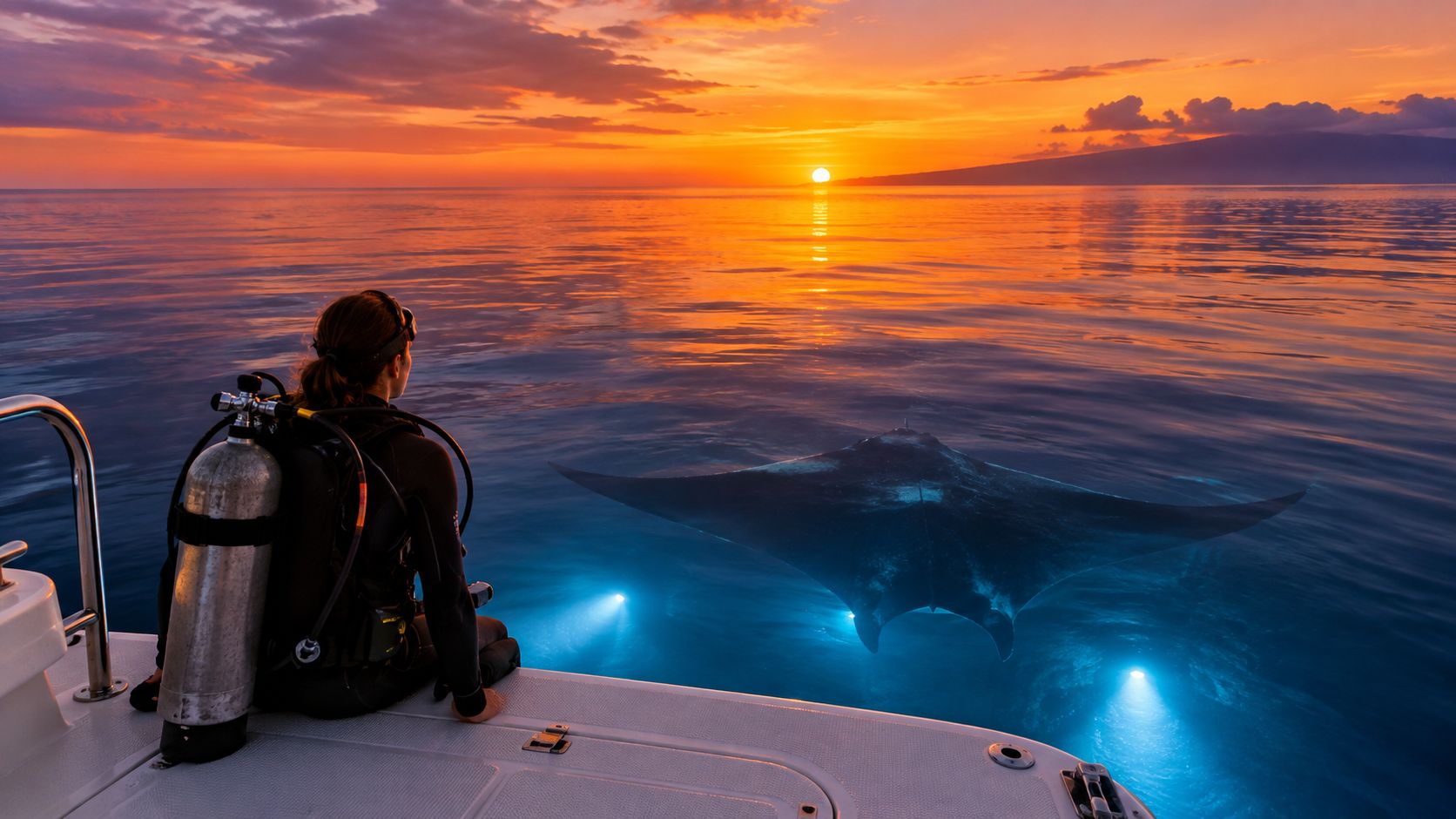
You can be on the boat, watching the last orange light drain out of Kona's sky, when the crew drops the first glow into black water and the whole deck goes quiet. Then a shadow rolls up underneath the lights, broad as a doorway, turning on its side so the white belly catches the beam. That's the moment people remember, not because it's dramatic in a loud way, but because it feels close, calm, and wild at the same time.
manta rays in Hawaii are one of those encounters that rewards people who understand what's happening below the surface. Families, first-time snorkelers, certified divers, photographers, and anyone who wants a real wildlife experience can have a great night here, but only if they know the species, the sites, and the behavior that makes the encounter work. The good nights start long before anyone gets in the water, and they're built on positioning, light discipline, and respect for a feeding animal.
What It Feels Like to Meet a Manta in Kona
The boat ride out has a certain stillness to it. People finish their coffee, zip wetsuits, and keep looking over the rail because everyone knows the water will change character once the lights go down. When the first manta appears, it doesn't come in like a predator. It glides in from the dark, almost unhurried, then turns through the light as if it already knows the route.
That first pass changes the energy on board. Snorkelers float a little higher, divers stop fidgeting, and even the crew goes quiet for a beat because the animal's size and control are impossible to ignore. It's a close encounter, but it shouldn't feel like a chase. The better it's run, the more it feels like being admitted to a feeding station the rays were using long before the boat arrived.
The best manta nights feel calm, not crowded.
This guide is for the person who wants the practical version, not the postcard version. A first-time snorkeler needs to know whether the surface setup will feel comfortable, a certified diver needs to know why bottom position matters, and a photographer needs to know how to get the shot without turning the encounter into a disturbance. You'll also want a clear read on what the sites do differently, what a charter looks like, and how to pick an operator that understands the animal side of the experience.
Understanding the Reef Manta Rays of Hawaii
Hawaiʻi's reef mantas are Mobula alfredi, and that matters because these aren't roaming pelagic giants passing through by chance. They're island-associated animals with strong site fidelity, which means they return to familiar places instead of ranging widely across the archipelago. For a visitor, that's why Kona can produce such reliable encounters, but it also means each local population deserves careful handling.
What their biology means in the water
A manta is built for feeding on dense patches of zooplankton. The broad body, the cephalic fins at the front, and the huge mouth work together like a living sieve, funneling microscopic prey toward the gills as the animal swims or barrel-rolls through the water column. At night, lights concentrate plankton near the surface, and that's when the mantas rise to feed.
Their behavior explains almost every part of the tour. They're filter-feeders, not hunters, so they don't want to tangle with people. They're also slow to mature and reproduce infrequently, which makes each individual ray more important than a casual wildlife encounter might suggest. In practical terms, the experience works because the animals choose the feeding path and the people stay out of it.
A good mental model is simple. If the lights create the dinner table, the manta decides when and how to take the seat. Guests who understand that usually have the better night.
Practical rule: If the ray has to change course because you drifted into its lane, you're no longer observing, you're interfering.
Their feeding also isn't random. Fine-scale plankton availability shapes when and where the rays show up, so a familiar reef can feel alive one night and quiet the next if prey conditions shift. That's why veterans pay attention to current, tide, and the way the lighted water looks before dropping in. The animal isn't “missing,” it's responding to food.
Garden Eel Cove vs Keauhou and Why Site Choice Matters
If you want to see why Kona manta trips are not interchangeable, start with the sites themselves. The 2025 University of Hawaiʻi study pulled from more than 23,000 sightings of 167 individually identified manta rays recorded from 2010 through 2022 at Garden Eel Cove and Keauhou. The pattern was consistent. Garden Eel Cove supported larger aggregations, while Keauhou showed especially strong residency among females. The study also found an approximately balanced 1:1 overall sex ratio across both sites, and aggregation size tracked zooplankton density, which matches a feeding system shaped by prey availability. University of Hawaiʻi study
Why Garden Eel Cove is the stronger tour choice
Garden Eel Cove gets the nod for most visitors because it is easier to manage in the water. The site is usually more protected, so snorkelers and divers have a better chance of holding position without sliding into the feeding lane. The reef shape also gives the lighted viewing area a clearer boundary. That matters when a manta is banking through the lights and everyone on site has to stay still.
Keauhou is still a real manta site, and the study makes that plain. Its stronger female residency suggests the area may play a role beyond simple nighttime feeding, which is a good reason to treat it with care. A diver who already knows the routine can have a solid night there. For a first charter, though, Garden Eel Cove is usually the cleaner choice because the water often gives crews more room to control the group and keep the encounter orderly.
| Feature | Garden Eel Cove | Keauhou |
|---|---|---|
| Aggregation pattern | Consistently larger | Strong female residency |
| Water feel | More protected and usually calmer | Valid feeding site, but often less forgiving for beginners |
| Viewing area | Better-defined for positioning | Important ecologically, but more site-specific behavior matters |
| First-time value | Stronger choice for a standard charter | Better for visitors who already know the setup |
That difference matters because manta viewing is a behavior problem, not just a location problem. The site sets the stage, but your body position, fin control, lights, and bubbles decide whether the animals can feed cleanly. Garden Eel Cove gives the crew a better shot at keeping that balance intact, which is why experienced operators treat it as the more reliable default for most guests.
What to Expect on a Manta Ray Night Dive or Snorkel
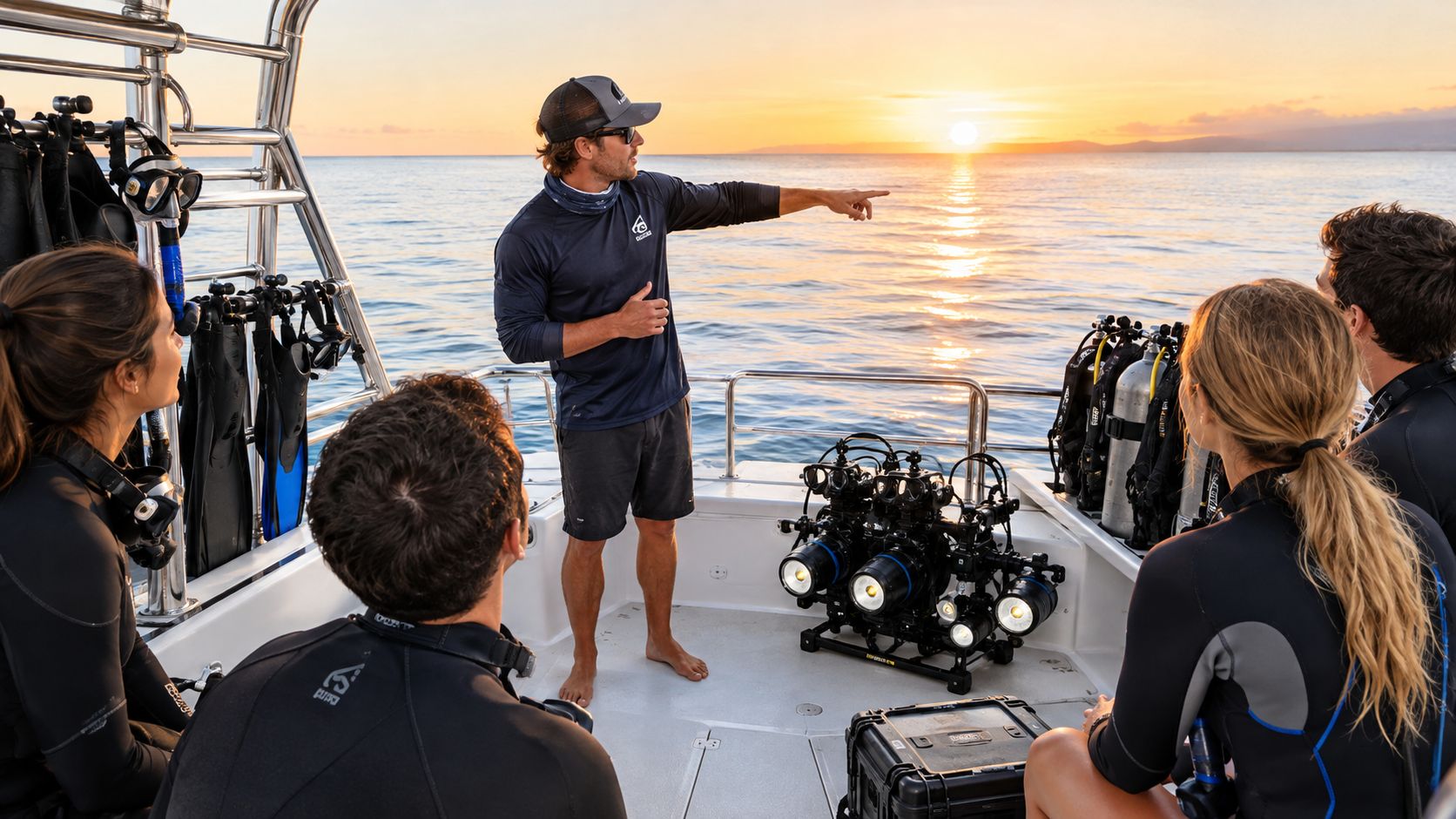
The routine on a good charter is straightforward, which is part of why the experience works so well. You board before sunset, the crew runs a clear briefing, and the boat heads out while the sky is still holding some color. By the time you reach the site, the lights are already part of the plan, not a surprise.
How the setup usually works
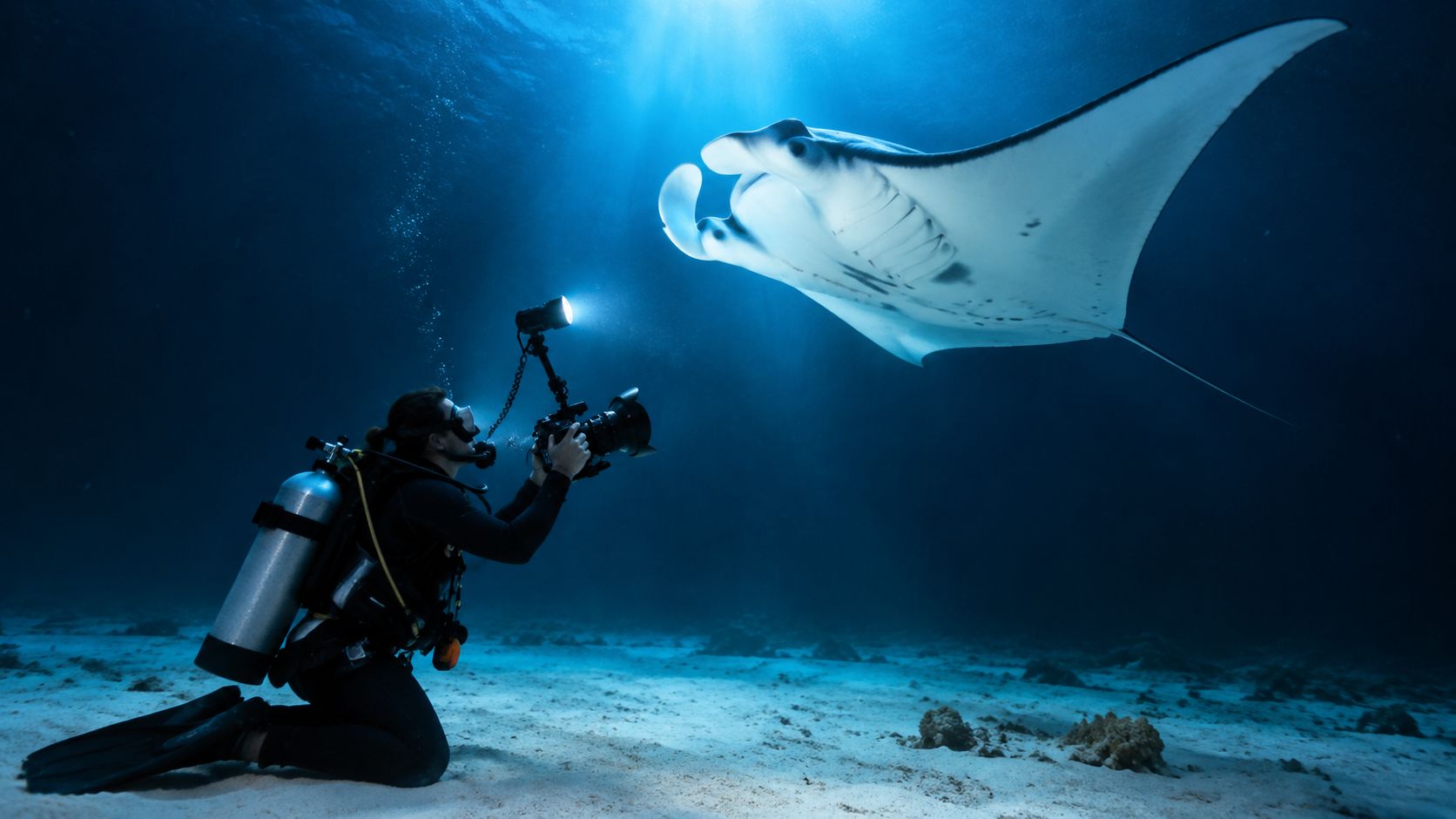
Snorkelers float on the surface inside the light circle, usually holding a stable position so they can watch the water column below. Certified divers kneel or settle on the sandy bottom, holding position without wandering into the feeding lane while their lights point upward. In both cases, the animals are the ones moving through the light, and that's the right direction of traffic.
The better operators are honest about changing conditions. If the plankton layer looks thin, swell starts building, current shifts, or visibility drops, they may adjust the plan, shorten the bottom time, or move if conditions allow. Night diving is always a live read, not a guaranteed stage show, and that's especially true because encounter rates track prey density and local oceanography.
If you're deciding between the two versions of the tour, comfort and control matter more than ego. Snorkeling usually makes sense for strong swimmers, families, and anyone who wants a surface view without certification. Diving makes sense for certified guests who want the lower-angle perspective and can stay still on the bottom without finning at the wrong moment. For a deeper comparison, this guide on whether it's better to snorkel or dive with manta rays is worth reading before you book.
Bring a swimsuit, towel, a warm layer, and a sense that the conditions, not the calendar, decide the night. If you're motion-sensitive, deal with that before boarding. If you're unsure about comfort in the water, snorkel is the simpler path.
Behavior-Based Etiquette That Protects the Animals
Most manta etiquette gets reduced to “don't touch.” That part is right, but it misses the bigger issue: your body position, fins, bubbles, and lights change how the mantas can feed.
A snorkeler who drifts into the lit corridor makes the animal adjust its approach. A diver who kicks toward an arriving ray takes away turning room. A stray fin can hit the manta's protective mucus layer, which helps guard against infection, so even a brief brush matters. Research summarized in Hawaiʻi County testimony has described possible effects from human encounters, including stress, injury, disease, altered feeding, and habituation, which is why a calm-looking encounter is not automatically a low-impact one. Hawaiʻi County testimony on manta encounters
The positioning habits that work
Stay at the edge of the light, not in the middle of it. Keep fins tucked behind your body, especially if you are on the surface and drifting. Hold still enough that the manta can choose its own line, and never reach out when it comes close. That last part gets overlooked because the animal may feel close enough to touch, but the right move is still to let it pass.
Good encounters are made by restraint, not by following the animal around.
Bubbles and fast camera movements can startle rays, especially when you are in the part of the water column they expect to stay open. A good guide keeps divers settled and tells snorkelers exactly where not to drift. That may feel strict, and it should. Kona's manta encounters are feeding observations around light and plankton, not handling sessions, and the animals should always control their distance.
The 2025 University of Hawaiʻi study cited earlier found relative stability in both aggregations through 2022, despite increased tourism. That is not a reason to relax the rules. It is a reason to keep the rules tight, because stable ray behavior does not excuse sloppy behavior from the people watching them.
For a cleaner set of expectations, this responsible diver etiquette guide matches how a careful manta charter should be run.
Photography and Light Setup for Manta Night Shoots
Manta photography at night rewards discipline more than gear obsession. You're working in dark water, shooting a moving subject, and trying to preserve the feeding scene instead of washing it out. That means your first job is light control, not chasing a dramatic frame.
Settings and light choices that hold up underwater
For wide-angle work, start with a fast-enough shutter to freeze the animal's turn, then use ISO as the variable that helps you keep exposure usable without smearing the motion. High ISO brings grain, but slow shutter brings blur, and blur is usually the worse trade in a manta encounter. A wide, soft beam angled slightly downward usually gives a better result than a hard blast straight into the water, because it keeps the subject visible without blowing out the highlights.
Strobes are often more trouble than they're worth here. They kick up backscatter from plankton and can spook rays that are already moving through a crowded light field. A red focus light is a better tool for setup and framing because it helps you compose without adding the same level of disturbance.
Composition should work with the animal's path. Silhouettes against the glow can be stronger than trying to fight for perfect illumination, and barrel-rolls shot from below often show the full shape of the manta better than a side-on pass. If a ray banks toward you, hold your position and let the frame happen, but don't drift into its path just to fill the viewfinder.
For photographers who want a practical example of how operators think about these conditions, this manta ray dive photo guide is a useful reference. The best manta shots usually come from boats that enforce light discipline instead of letting every guest improvise.
Conservation, Protection Laws, and Choosing a Responsible Operator
Hawaiʻi made a clear legal move on June 5, 2009, when the state enacted protection that made it illegal to kill or capture manta rays. That matters because the population here isn't a giant open pool of animals that can absorb local pressure without consequence. A genome-wide analysis found contemporary effective population sizes of about 104 breeders around Hawaiʻi Island and 129 in Maui Nui, with low genetic diversity and strong female philopatry, which means localized mortality can't be balanced by a steady influx from elsewhere. NOAA on reef manta genetics
Why your charter choice matters
The legal protection was followed by a global analysis of 4,001 dive observations from 13 Hawaiian sites. After controlling for diving effort and location, the probability of seeing a manta increased by approximately 10% per year during the preceding decade, and Hawaiʻi had the highest sighting frequency in the study, with manta rays recorded at 73 of 538 surveyed sites, or 14%, visited between 2000 and 2012. Those numbers don't mean there's no risk. They do show that legal protection and long-term tourism management can support a visible population when people take the rules seriously. PLOS ONE study
That's where operator selection becomes conservation, not just convenience. Look for manta-specific experience, clear positioning briefings, small groups, and a hard line on touching, chasing, or crowding. Identification photo contributions are a plus because repeated ID work strengthens the long-term record the researchers rely on.
One operator that works this way is Kona Honu Divers, which runs manta charters to Garden Eel Cove and puts a strong emphasis on briefing, positioning, and low-impact viewing. Their eco-friendly approach fits the kind of charter that keeps the encounter centered on the animals rather than on guest traffic. If you're choosing a boat, that's the standard to look for.
Planning Your Trip and Picking the Right Charter
The easiest way to decide is to match the trip to the kind of night you want. If you're a non-diver or first-timer in the water, a manta snorkel is the simplest entry point. If you're certified and want the classic bottom-view encounter, book the night dive. If you're experienced and want a different kind of dark-water adventure beyond the manta site, a blackwater dive is the more advanced lane, and Kona blackwater night diving fits that style of trip.
A practical booking filter
Ask whether the operator goes to Garden Eel Cove, how they brief body position, and whether they're willing to shorten or reschedule when conditions don't support a good encounter. Check recent trip reports for consistency, not just for hype. If you're traveling with kids or mixed experience levels, ask about age, comfort, and in-water support before you reserve a place.
For experienced divers who want more than a single-feature night, the premium advanced two-tank trip is the right kind of add-on to compare against a manta night. If you're building a full Kona dive week, the Kona diving tours page is a clean place to compare options, and this Big Island stay guide for divers can help you keep the logistics simple.
A manta encounter is at its best when the animals behave naturally, and that doesn't happen by accident. It happens when the site is chosen well, the briefing is disciplined, and the people in the water know how to stay out of the feeding lane.
Kona Honu Divers runs manta ray charters, snorkel trips, and other guided dives with the kind of briefing and in-water discipline that helps these nights work properly. If you're planning manta rays in Hawaii, visit Kona Honu Divers to compare the manta dive and snorkel options, then book the charter that matches your comfort level and your goals.