
Table of Contents
- What each condition feels like
- What to have in the bag
- How they move in the beam
- A simple camera plan
- Questions to ask before you hand over a card
You're standing on the Kona harbor wall at dusk, bag packed, trying to decide whether tonight's boat is worth the money. The coast looks calm. Someone nearby says every manta rays Big Island trip is the same. It isn't. What you see, and how safe the water feels, depends on the site, the spacing, and how many boats share the light.
Where to Find Manta Rays on the Big Island
Two places on the Kona coast hold reef manta rays after dark with enough consistency to plan a trip around them. Garden Eel Cove, also called Makako Bay, is the stronger of the two. Keauhou Bay, also called Kaukalaelae Point, is the other.
A 2025 University of Hawaiʻi study looked at community records from 2010 through 2022 at those two sites. The set held more than 23,000 sightings of 167 individual reef manta rays. Garden Eel Cove consistently supported larger aggregations than Keauhou. Keauhou was visited predominantly by females, and those females showed high site fidelity. Animals moved between the two sites, and males generally appeared more mobile. Across both locations the sex ratio was about 1:1. Aggregation size rose and fell with zooplankton density. The researchers also reported relative stability in both aggregations and found no evidence in that dataset that current activity had reduced the population's viability.
The same two coves are the ones the state singled out for rules. Hawaiʻi's Division of Boating and Ocean Recreation estimated that 60 to 70 viewing vessels were bringing guests close to feeding mantas there. The proposal would cap commercial viewing permits at 24 in each zone, limit vessels to no more than 60 passengers for hire in a 24-hour period, and run operations in two-hour shifts. Site choice is a traffic decision, not just a scenery one.
| Site | Also Called | What the Research Shows | Practical Note |
|---|---|---|---|
| Garden Eel Cove | Makako Bay | Consistently supports larger aggregations than Keauhou; a regulated viewing zone | Protected, calmer water with a better viewing area; the site used for Kona Honu Divers' manta night dive |
| Keauhou Bay | Kaukalaelae Point | Smaller aggregations, visited mostly by females with high site fidelity; a regulated viewing zone | Confirm with your operator how many boats and guests share the water |
Garden Eel Cove sits in a sheltered pocket. The viewing area stays put when a light swell is running, and the reef around the sand is in better shape than an exposed stretch of coast. That's why it's the stronger choice for a first night, and why it's the cove we use for the night dive. If you want a wider look at daytime scuba diving along the Kona coast, the same shoreline logic applies: protection beats a famous name.
Before you pay: Ask which cove the boat uses. If the crew can't name Garden Eel Cove or Keauhou, or the plan is a pile of boats on one light, pick another night.
Plankton, Swell and Conditions That Change Your Odds
The calendar is the weak predictor. Plankton in the water on that night is the strong one. When zooplankton is thick, more mantas show up to feed. When it's thin, the same cove can look empty even if the boat is full. A quiet Tuesday in March can beat a holiday Saturday.
| Condition | Why It Matters | What to Expect |
|---|---|---|
| Calm, protected water | Keeps the viewing area steady and reduces surge around the light | Easier for beginners and families; a comfortable first encounter |
| Strong surface swell | Makes the water rough and can make the viewing area less safe | Operators may move site or cancel; reschedule if the forecast is poor |
| High zooplankton density | Drives larger aggregations | Bigger groups on plankton-rich nights; ask the operator about the outlook |
| Snorkel versus dive | Snorkelers feel surface conditions more than divers do | Non-divers should check the swell forecast before choosing the snorkel option |
What each condition feels like
Calm water is the night you want if this is your first time in the dark ocean. You kneel or float without fighting a push. The light stays in one patch of sand, and the ray's path is easy to follow.
Swell changes the job. A short, steep chop slaps the hull, rocks snorkelers on the surface, and can shove a kneeling diver off the sand. Crews will shift coves or cancel rather than force a bad entry. Take the reschedule. A cancelled night is cheaper than a rough one you don't enjoy.
Plankton is the dinner bell you can't see from the parking lot. Ask the crew what the last few nights looked like, not what the brochure promises for the month. A plankton-rich evening pulls a larger group into the beam. A thin night may still produce one or two animals, and that's a real encounter, just a quieter one.
Snorkelers live on the surface, so wind and chop land on them first. Divers a few meters down feel less of it. If you're staying up top, read the swell forecast the afternoon of the trip. If you're certified and the surface looks messy, the dive is often the steadier seat.
Hold two or three open nights, read the cancellation rule before you pay, and keep one backup evening. One thin night shouldn't sink the trip. The best season for diving in Kona is really a weather window, not a single calendar month.
How the Manta Night Dive Works, Step by Step
Most first-night nerves come from not knowing the order. The dive is stationary. You aren't chasing anything across a reef.
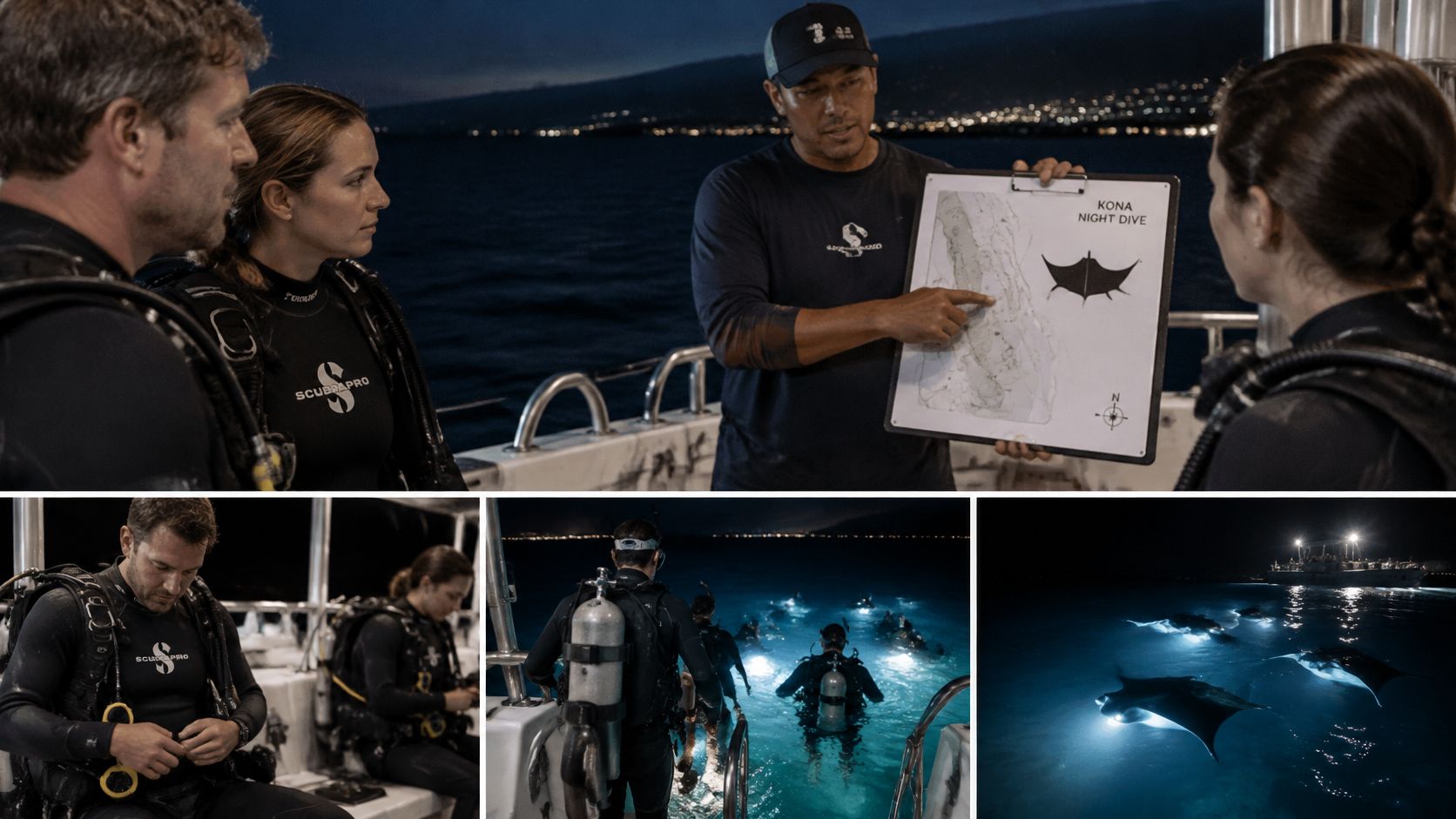
The boat briefing is where the night starts. Listen before you kit up.
Briefing on the boat. The crew walks through why the lights work and the rules of passive watching: no touching, no chasing, and stay in the spot you're given. That talk is the whole safety plan in ten minutes. If a point is unclear, ask it on deck, not after you're in the dark.
Get into your spot. Certified divers drop to the sand and kneel in a set viewing area, lights pointed up. Snorkelers stay on the surface, holding a float over that same glow. Divers watch the belly pass overhead. Snorkelers watch the wing from above. Same animals, two seats.
Lights on the seafloor. The crew sets a powerful cluster of lights on the bottom. Plankton drifts into the beam, and the patch becomes a bright circle you can see from several meters away. You are not swimming in a blackout. If you've only done scuba diving at night on a reef with a handheld torch, this feels more like kneeling in a lit room.
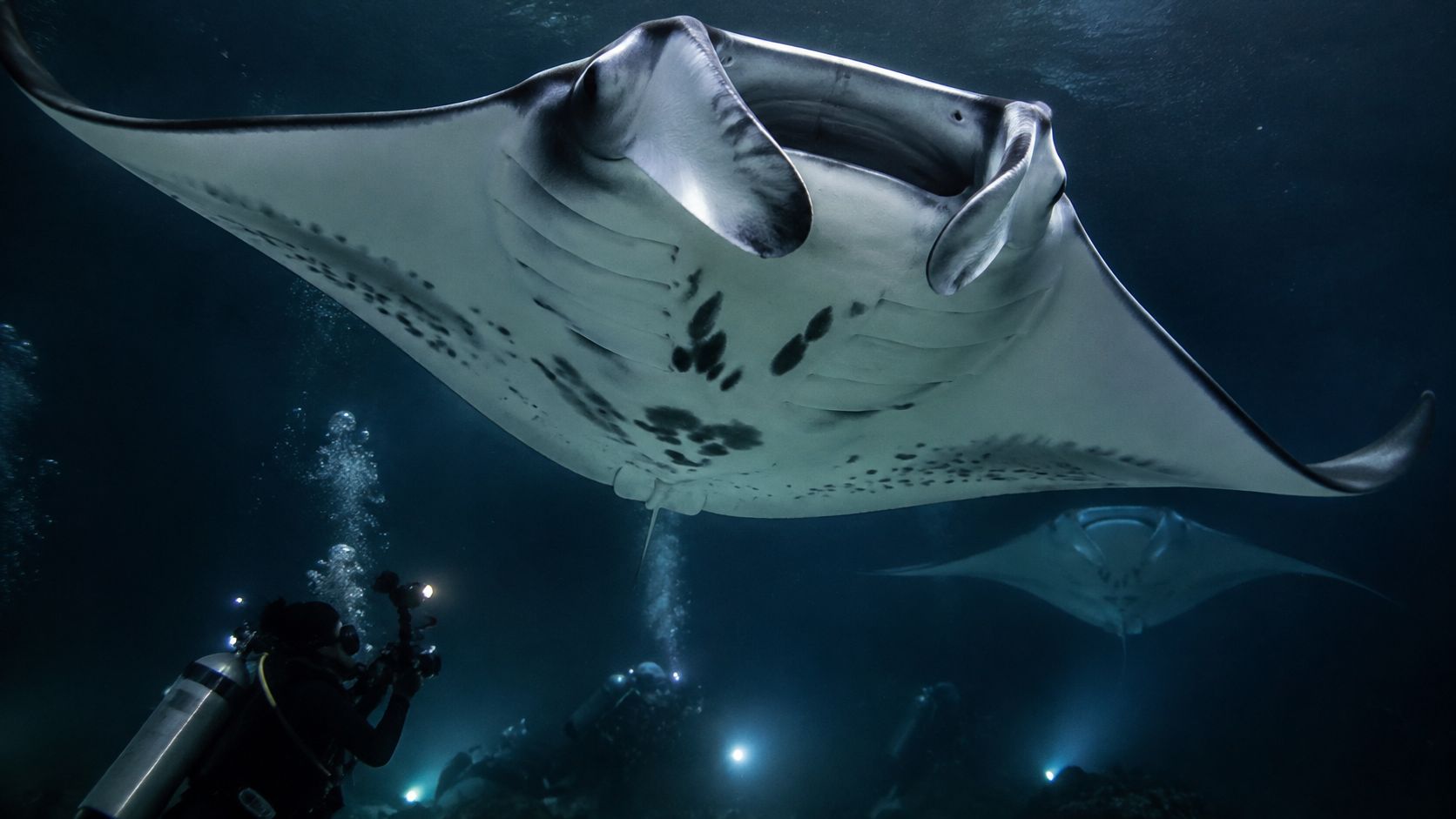
Mantas come in to feed. They loop through the plankton, sometimes passing inches from a mask. Mouths are open, cephalic fins curled, bodies rolling to stay in the food. You don't swim toward them. They already know where the meal is.
Stay put while the crew manages the group. Experienced divemasters and instructors are in the water with you. If someone drifts, a guide resets them. The dive stays in one place on purpose, so bubbles, fins, and cameras don't turn the sand into a traffic jam.
Exit on the signal. When the crew calls it, you rise slowly, do your safety stop if you're on scuba, and climb out without a sprint for the ladder. Warm layers go on as soon as you're dry. A small light in your bag stays off until you're back aboard, so you aren't waving a second beam at the animals.
What to have in the bag
Wear the suit you'll dive in under a dry layer for the ride. Pack a towel, a warm top for the return, and a camera only if you can hold it without leaving your kneel. Leave the bulky floaty toys. The boat already has the light.
Success on this night is small and specific. A wing crosses the group. A ray turns tight in the beam and comes back for another pass. You climb the ladder unhurried, still able to describe the spot pattern you just saw.
What Manta Rays Do Up Close and How to Photograph Them
The animal in the beam is larger than many expect, and it isn't armed. The giant manta ray, Manta birostris, is listed as threatened under the U.S. Endangered Species Act. Hawaiʻi's Department of Land and Natural Resources, cited in NOAA recreational wildlife guidance, reports wingspans of 22 feet or more, from nearshore water to depths of at least 120 feet. They're filter feeders. Cephalic fins funnel plankton-rich water into a wide mouth. No teeth, no tail stinger, and they're treated as harmless to people. On our night dive, the animals overhead commonly show wingspans well over 12 feet, which is already enough to fill a mask.
That size sits on a slow life history. Gestation runs about 13 months, births are few, maturity comes late, and migration is limited. A chase or a hand on the skin isn't a harmless photo trick. It's pressure on an animal that replaces itself slowly.
How they move in the beam
A feeding manta doesn't need you to move. It loops, banks, and sometimes passes close enough that you feel the push of water. Knees stay on the sand. Fins stay still. If you lift off to “get the shot,” you become an obstacle in the only lane that matters.
Kona's animals are individuals, not a blur of visitors. Photo identification in Kailua-Kona began in 1991, matching belly spots plus scars and fin marks. One six-year catalog in a NOAA repository report logged 25,444 observations of 118 reef manta rays, 19,841 at Manta Heaven and 5,603 at Manta Village, with 66 males and 52 females. A separate Kona catalog of 146 reef mantas had no matches with 290 animals from Maui. Genomic work summarized by NOAA Fisheries describes Hawaiʻi Island's reef mantas as a small resident stock of a few hundred animals, with females generally reproducing near the island where they were born. Vessel strikes and entanglement aren't replaced by newcomers from Maui.
A simple camera plan
- Use the light already on the sand. Rest your elbows. A wide-angle lens fits the wingspan. Skip flash, which can break a feeding pass.
- Expose for dark water, then focus on the belly. The spot pattern is the animal's name. Keep hands and fins out of the frame.
- Hold your kneel and let the ray come to you. That single habit makes the sharper photo and the smaller disturbance. A Kona manta night dive with a photo package is built around that same still position, not a swim-after.
Choosing a Lower-Risk Tour Without the Crowds
People book the night with the most rays and the most reviews. That's the wrong score. Spacing, supervision, and boat traffic decide whether the hour feels calm or like a parking lot with wings.
A Hawaiʻi County survey of 444 participants found that 82% felt crowded by snorkelers, 78% by boats, and 69% by scuba divers. Crowding isn't only a mood problem. The same record notes stress, altered feeding, avoidance, disease exposure, and injury for the animals, plus poor awareness and vessel traffic for guests. Independent marine-life guidance in that county file reports avoidance in 31% of interactions when people came within 3 meters, against 3.4% at 4–5 meters. Long-term population effects of those short reactions are still unmeasured. You don't need the long-term number to choose a wider gap tonight.
Questions to ask before you hand over a card
- How many people are in the water with you, not just how many the boat can hold.
- Where you kneel or float, and who moves you if you drift into the ray's line.
- How the boat stays clear of swimmers and of other hulls.
- Surface or scuba, so you know if you'll be on the chop or on the sand.
- What the lights do, and whether guests are allowed to add their own beams.
- What the emergency plan is if someone panics, cramps, or separates from the group.
- What happens when the cove is already full. A good crew leaves or delays. A weak one stacks another boat on the same sand patch.
Families and uneasy swimmers should hear this plainly. The mantas aren't the threat. Dark water, other people's fins, and hulls moving overhead are. A crowded night is physically tiring and mentally loud even when every animal is gentle. A child who can snorkel in daylight may still hate a packed, black cove.
The lower-risk night is often the one with fewer bodies and a named supervisor in the water, not the one advertising the biggest pile of rays. Read how a crew handles responsible diver etiquette and see if their answers match.
Go if they name the cove, cap the group, and tell you what they do when boats stack up. No-go if the answer is “we'll see when we get there.”
Book a Manta Night Dive at Garden Eel Cove
Garden Eel Cove is the night we run because the cove is protected, the viewing sand is clean, the surrounding reef is healthier, and the water is generally calmer than the open coast. Bigger aggregations matter. A steady place to kneel matters more.
There are two ways onto that light. The Manta Ray Night Dive is open to all certified divers, beginner through advanced, and it's a stationary dive with guides in the water. The 2-Tank Manta Dive and Snorkel adds an earlier reef dive, then the night at Garden Eel Cove, with a surface option so non-divers can watch from above the same beam. You can book the 2-tank manta dive and snorkel online. If you're comparing daytime boats as well, the Kona diving tours page lists the other trips beside it.
On these nights, divers have seen mantas on 92% of Manta Ray Night Dive trips. That's a high rate, not a promise. Plankton and swell still get a vote, which is why the two- or three-night window from earlier still applies.
Snorkelers who want the surface seat, with a float and a guide, can book the manta snorkel through Kona Snorkel Trips on the button below. Confirm the cove and the headcount the same way you would for scuba.
Pick the date window from the swell and the plankton outlook, confirm Garden Eel Cove and the number of people in the water, then book the seat that matches how you want to watch.
Kona Honu Divers runs the Manta Ray Night Dive and the 2-tank manta charter from Kona, with lights on the sand at Garden Eel Cove and guides in the water for certified divers and snorkelers. If you want that stationary night rather than a crowded chase up the coast, look at the trips on Kona Honu Divers and hold a backup evening so weather can move without cancelling the week.