
You're usually deciding this after dinner, staring at a phone screen, trying to figure out whether a manta ray night snorkel is going to be magical or just cold, crowded, and exhausting. Good news, the Big Island does this better than almost anywhere else because Kona's manta encounters are tied to a real feeding pattern, not a gimmick. The bad news, not every operator, site, or departure time gives you the same night in the water.
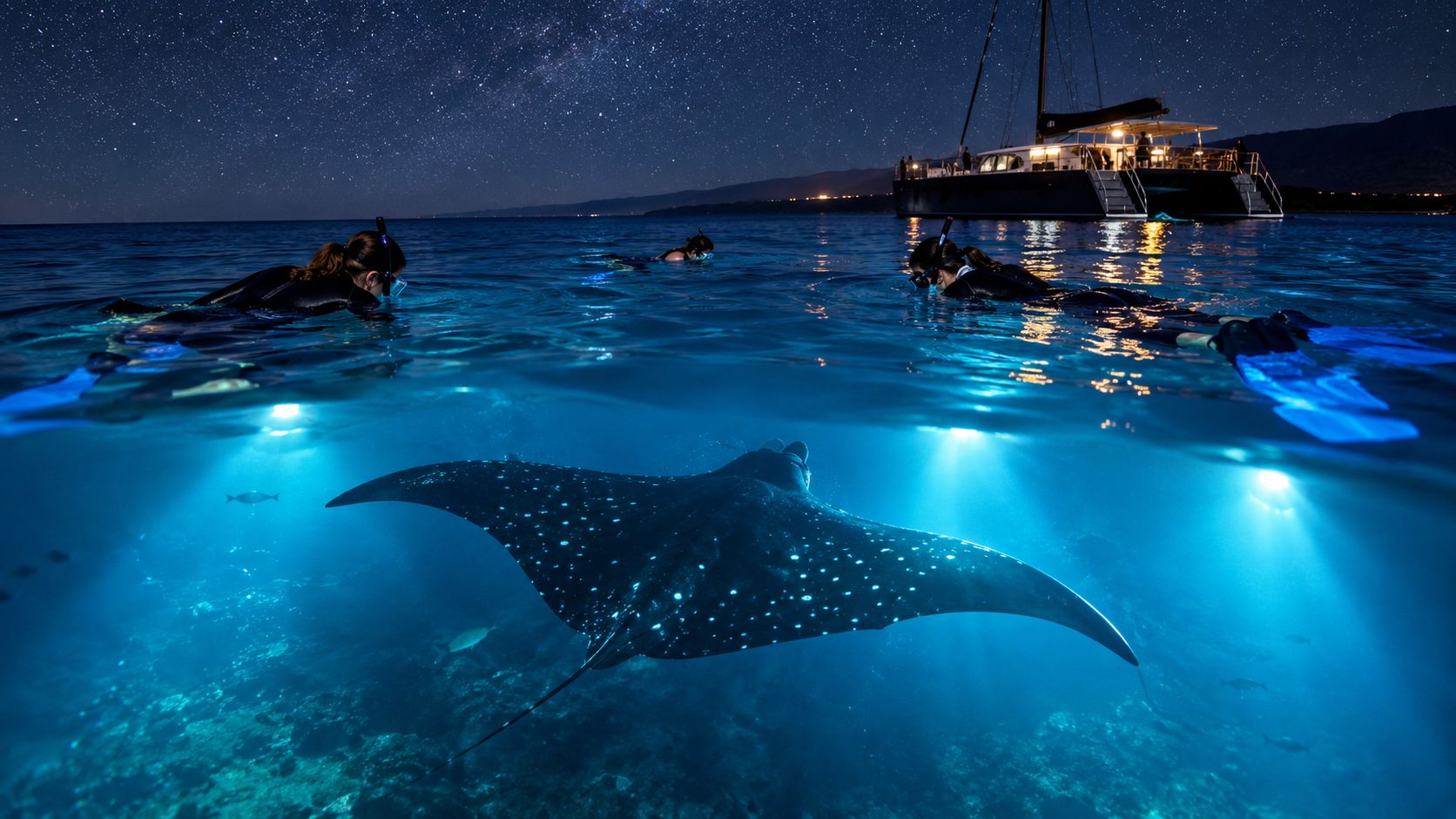
If you want the short version, manta ray snorkeling Big Island is a guided night snorkel over illuminated water where plankton gather and mantas come in to feed. These are wild animals, not aquarium props, so the smart booking decision is less about hype and more about site, crowding, and how well the crew handles the water. If you're a confident swimmer who's fine being outside after dark, this can be a great fit. If dark water, surface chop, or crowd density will ruin your night, book something easier and stop pretending you need to force it.
For the snorkel-versus-dive decision, read whether it's better to snorkel or dive with manta rays. That choice matters before you start comparing boats, because snorkeling puts you at the surface the whole time while the mantas feed beneath you.
What Manta Ray Snorkeling on the Big Island Actually Involves
The Kona manta experience is a nighttime surface snorkel, not a daytime reef float and not a chase. Boats anchor near an illuminated area, the lights pull plankton into the water column, and the mantas arrive to filter-feed. Hawaiʻi's Division of Aquatic Resources describes that feeding process clearly, including how mantas unfurl their cephalic fins to funnel water and prey through the mouth and gill rakers, and why the lighted plankton cloud works without baiting the animals (DAR manta ray overview).
Who should book it
Confident swimmers usually get the most out of it, because staying calm and horizontal is the whole game. Families with older kids can do well if everyone listens, floats comfortably, and doesn't panic in the dark. If someone in your group hates open water at night, gets cold fast, or needs constant hand-holding to snorkel, a daytime reef trip is the smarter call.
The history matters too. Kona's nighttime manta viewing started in 1991 near the former Kona Surf Hotel, at a tiny scale, then expanded into nightly operations as the lights concentrated plankton and the rays kept showing up. That became a predictable wildlife encounter tied to feeding ecology, not a random luck-based boat ride (historical overview).
Practical rule: if you're booking this for the scenery alone, you're thinking about it wrong. Book it because you want a controlled, guided, after-dark encounter with wild manta rays, then choose the operator and site that make that encounter calm.
What matters before you book
Lock in four things first, site, operator, departure time, and whether your group can handle surface-only snorkeling in the dark. Those decisions affect the night more than the marketing copy does. The rest of this article breaks down the site choice, how to judge a crew, when to go, what the trip feels like, and how to avoid the common mistakes that turn a good manta outing into a stressful one.
Comparing the Two Main Manta Viewing Sites Near Kona
The two practical options are Garden Eel Cove near the airport side of Kona and the Sheraton Kona site near Keauhou. I'd pick Garden Eel Cove for most snorkelers without hesitation. It's the more sheltered site, the surface is usually easier to manage, and the viewing setup tends to feel more open once everyone is in position.
Garden Eel Cove vs Sheraton Site at a Glance
| Factor | Garden Eel Cove | Sheraton Kona Site |
|---|---|---|
| Shelter | Better protected, calmer surface conditions are more common | More exposed feel on many nights |
| Viewing layout | Usually more open, easier to hold a clean viewing line | Can feel tighter depending on boat density |
| Reef structure | Strong ecological draw for mantas and a well-known aggregation point | Works, but the setup is less forgiving when conditions are busy |
| Crowd feel | Often better for organized surface control | Closer to many hotels, so convenience is strong |
| Best use case | Most first-time snorkelers and anyone who values stability | Calm nights, shorter transit expectations, hotel convenience |
The edge here isn't just comfort. A protected site usually gives the crew more room to manage swimmers, lights, and the boat without turning the surface into chaos. That matters because the manta encounter is supposed to be a controlled feeding window, not a floating pileup.
The Sheraton site has one real advantage, convenience. If you're staying nearby and the ocean is calm, it can absolutely work. But proximity to your hotel doesn't automatically make it the better choice for the night, and on a crowded departure that convenience won't save you from a cramped viewing line.
If you care most about a stable snorkel and a cleaner look at the mantas, choose the site that gives the crew more room to work.
NOAA's long-term photo-identification work shows why these locations matter in the first place. Researchers have identified only 318 unique reef manta rays around Hawaiʻi Island since 1979, and NOAA estimates about 104 adult breeders on Hawaiʻi Island (NOAA-linked genomic summary). That's a concentrated resident population, not a limitless flow of passing animals, so a site that reduces surface mess and lets the mantas feed cleanly is the better pick.
Choosing a Tour Operator You Can Trust
Don't book on price alone. Cheap manta trips can be fine, but cheap and crowded is a lousy combination at night, especially if you're nervous, cold-sensitive, or bringing a first-timer. You want a crew that runs a disciplined surface operation, not a boat that dumps people over the side and hopes for the best.
What to check before you pay
A good operator should answer these questions without hedging. What kind of boat do you use, how many snorkelers are on my departure, and what's the guide-to-guest ratio? Do you use a snorkel ring or equivalent group-control device, how do you orient lights, and what happens if someone gets anxious or can't hold position?
Ask this directly: “How do you manage non-swimmers and cold guests if the water gets rough or a participant panics?”
Boat stability matters at night. A more stable platform lowers the chance that boarding, gear fitting, and exit feel rushed or awkward, and it gives the crew more control during the briefing and return. You also want a crew that briefs the non-contact rule, hand signals, light direction, and spacing before anyone jumps in.
Kona Honu Divers offers a manta ray night snorkel option for guests who want the snorkeling side of the experience without the scuba component, and you can check the tour details on the manta snorkel booking page. I'd put them on the shortlist if you want a crew that treats the surface setup as the main event instead of an afterthought.
Red flags that should make you walk
- Vague briefing language: If the crew can't explain how they manage lights, spacing, and entry, skip it.
- Packed loading: If the boat looks overfilled before departure, the water will feel worse.
- No clear float plan: If they can't explain how weaker swimmers stay comfortable, that's a problem.
- Hype over process: If the pitch is all about “guaranteed mantas” and nothing about control, go elsewhere.
For a more detailed checklist on what a disciplined manta operator should look like, use this Kona dive company guide as a reference point. The core idea is simple, the best nights usually come from lower-density departures, better preparation, and a crew that keeps the surface organized.
Timing, Weather, and What to Wear on the Water
The manta trip runs year-round, but conditions still change the night. Winter swells can make the ride rougher, summer trade winds can push surface chop around, and moonlight changes how dramatic the feeding lights feel. If you want the strongest contrast in the water, darker nights are usually better because the plankton response is easier to see and the light field does more of the work.
What I'd book and what I'd skip
If you have flexibility, choose a night that isn't dominated by bright moonlight. If the forecast looks messy, don't talk yourself into it just because you're already on vacation. A slightly less convenient night beats a miserable one almost every time.
For timing guidance, check the best time to see manta rays in Kona before you pick a date. That helps you think about conditions instead of just assuming every calendar slot is equal.
What to wear is straightforward. Bring a wetsuit, a rashguard if you run cold, reef-safe sunscreen applied well before you get on the boat, a towel, a dry bag, and a charged phone or simple camera. If you get motion sick, handle that before you leave the dock, because once the boat is moving in the dark, you've already waited too long.
For seasickness and nausea prevention, these products are commonly bought ahead of time: Ship-EEZ Seasickness Patch, Dramamine pills, Bonine pills, Sea Band wristbands, and ginger chews. Pick the option you already know works for you instead of experimenting the night of the tour.
Cold-water reality: first-timers often underestimate the chill. The water can feel cool enough that a wetsuit top stops the whole experience from becoming a long shiver.
What Happens Step by Step on a Manta Snorkel Trip
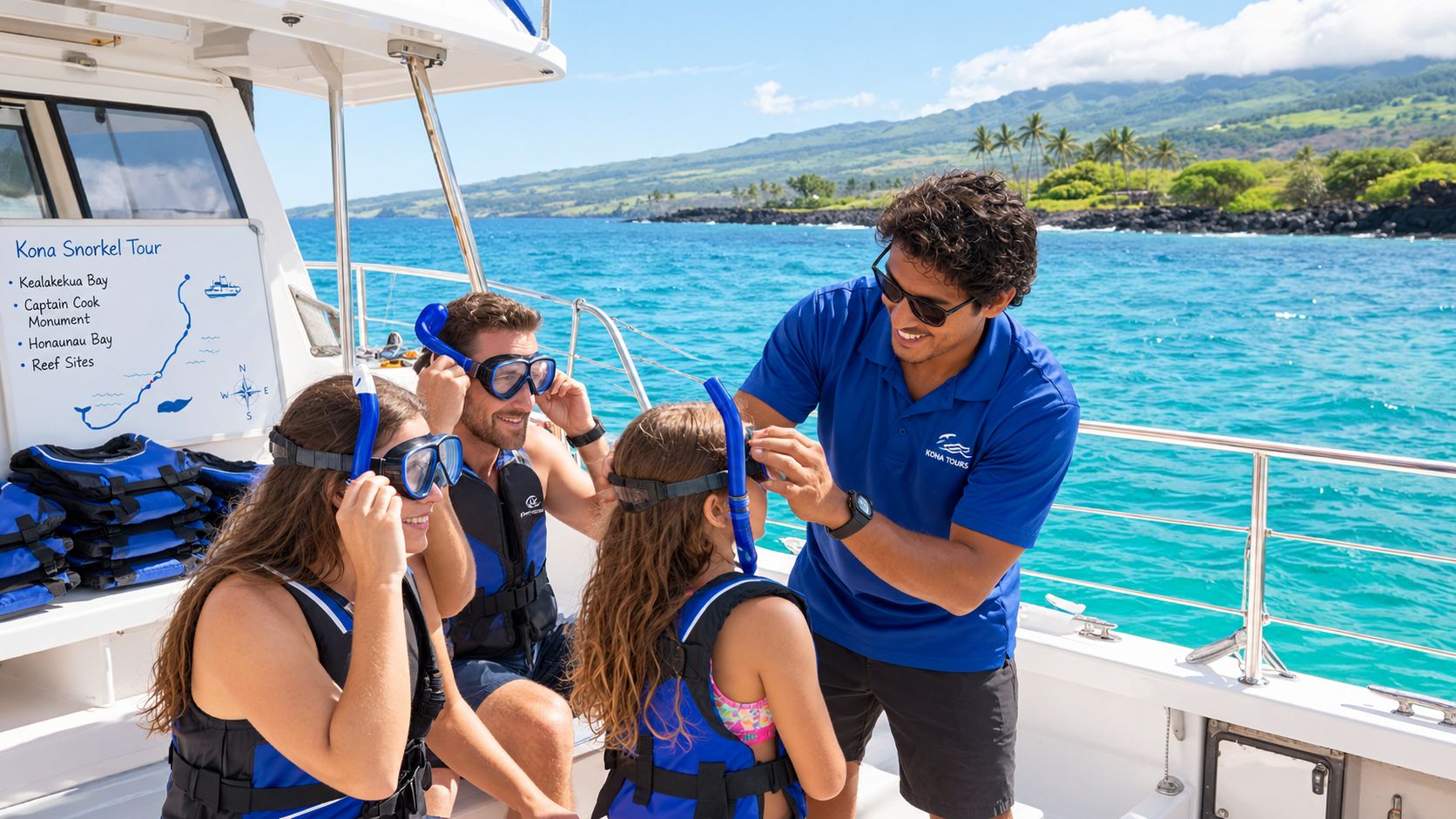
The trip should feel organized from the moment you check in. You'll get gear fitted, the crew will walk through the route, and then someone should explain exactly where your light goes, how the formation works, and how to avoid drifting into the feeding area. That briefing isn't fluff. It's the difference between a calm float and a bunch of people kicking around in the dark.
The sequence on the water
First comes dock check-in and gear sizing. Then you get the safety briefing, where the non-contact rule, hand signals, and light orientation should be stated plainly. If the crew rushes this part, the trip usually feels rushed later too.
Next is the ride out, which is often the point where the ocean temperature and the darkness start to sink in. That's normal. The smart move is to put on the wetsuit, settle your breathing, and avoid fighting the anticipation.
Once the boat stops, entry should be controlled, not chaotic. Depending on the boat, that might be a step-in from a platform or a giant stride from a low swim step. In the water, your job is simple, stay calm, stay horizontal, keep fins below the surface, and aim your light downward so the plankton stay in the light field where the mantas can feed.
Keep your head down, stay still, and let the mantas come to the light.
Most trips give you roughly a half hour to a little longer in the water, depending on conditions and the operator's schedule. Then the crew brings everyone back aboard, counts heads, and heads in. The night is supposed to feel tightly managed, because that's what keeps the encounter smooth for both guests and animals.
If you want a snorkel-only version of this experience, stick with the manta snorkel option rather than a mixed scuba-and-snorkel setup. Mixed boats can work, but the surface group sometimes gets less attention than it should when the deck is split between divers and snorkelers.
Crowding, Sighting Reality, and Why Less Can Mean More
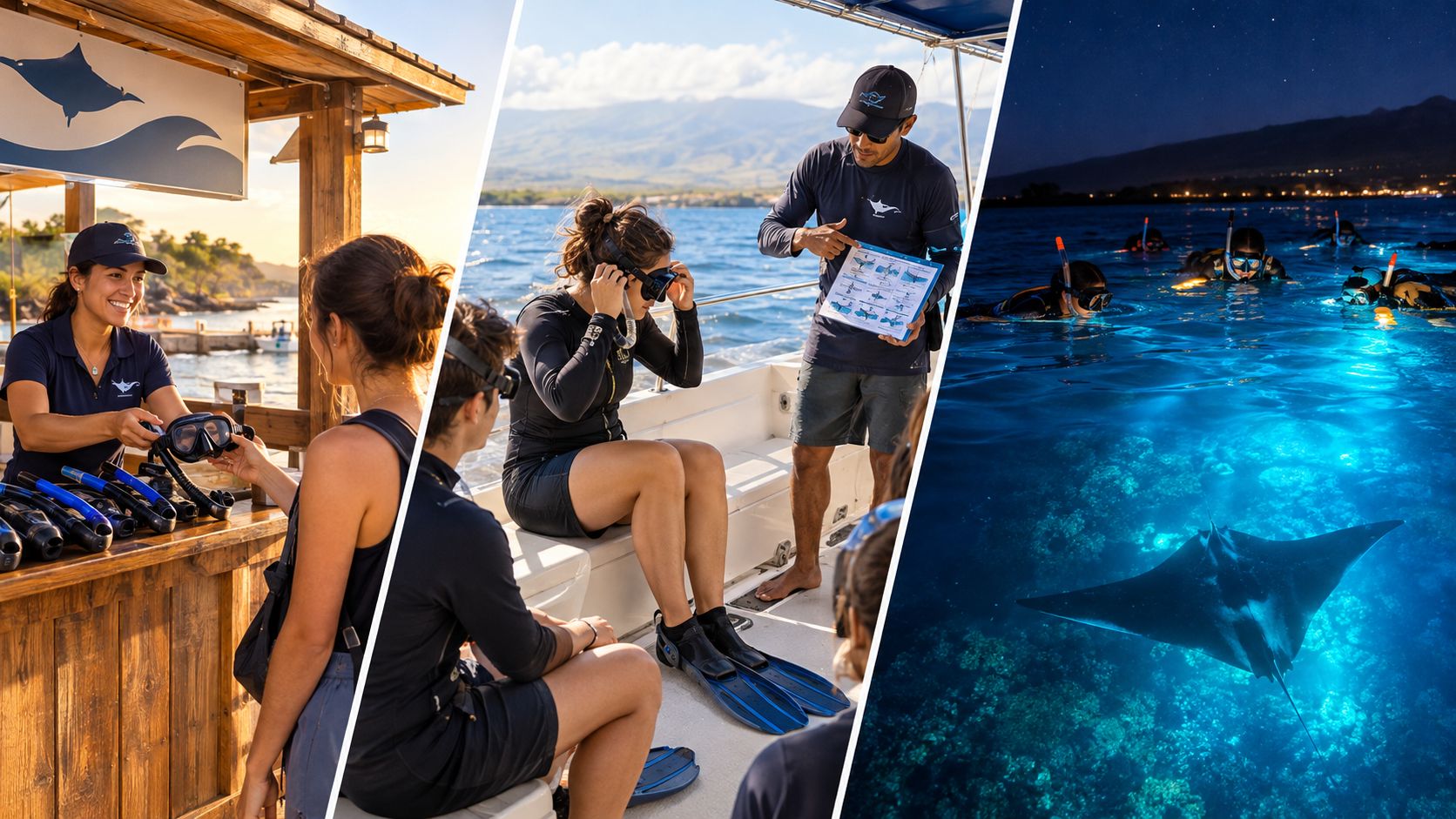
Crowding is the part brochures gloss over. A peer-reviewed survey of 444 manta-viewing participants in Hawaii found that some sites can receive up to 30 tour boats and 300 participants per day, and that 82% of respondents felt crowded by snorkelers while 78% felt crowded by boats (participant crowding study). That is not just a comfort problem. It changes how good the night feels from the water.
What those numbers mean for your booking
The same study found average acceptable limits of about 52 snorkelers, 32 scuba divers, and 11 boats at one time, but 77% encountered more snorkelers than their norm, 67% more divers, and 68% more boats. People who felt crowded were less satisfied and less likely to come back.
Book the smaller or lower-density departure whenever you can. A full boat with a loud sales pitch may still produce manta sightings, but it usually gives you a worse viewing line, less room to settle in, and more splashing around your mask. I would take a quieter boat and a cleaner setup every time.
For a clear sense of what a well-run encounter looks like, see these Kona manta ray dive pictures. Keep the photos in perspective, though. The key booking question is how many people you are sharing the water with.
What to ignore
Skip operator sighting percentages as a comparison tool. They are marketing, not a shared dataset. Mantas are wild animals, so the better question is whether the operator gives you a controlled, comfortable attempt.
Garden Eel Cove usually wins on that count. It tends to handle crowds better than the alternative site, and that matters because the best night is not the loudest one or the most packed one. It is the one where fewer people are in the water, the boat feels organized, and the mantas can move through naturally.
Safety, Etiquette, and When to Stay on the Boat
Manta rays are not dangerous in the way people usually fear. They don't bite like sharks, and the main risk is the interaction between darkness, boats, currents, crowding, and bad participant behavior. Hawaiʻi's Division of Boating and Ocean Recreation treats pelagic manta rays (Mobula birostris) as an Endangered Species Act-listed species in the islands, and the state asks people who hook or encounter one to release it with minimal injury and to report the encounter at 1-888-256-9840, option 5 (state marine species guidance).
Non-contact is the whole rule
Don't touch, chase, block, feed, or ride a manta. That's not just etiquette, it's protection for the animal's mucus coating and its normal feeding behavior. If a manta comes close, hold position and let it move past you.
For the crew-side etiquette and spacing standard, use responsible diver etiquette guidance as a benchmark for what a good operator should reinforce before anyone enters the water. If you're on a boat and the briefing skips the non-contact rule, that's a bad sign.
When to stay on the boat
Stay aboard if you're getting cold, panicky, or too seasick to keep your breathing steady. Stay aboard if your swimming is shaky enough that you can't keep horizontal without effort. Stay aboard if you're trying to force the experience for someone else and you already know you're not comfortable in the dark water.
A responsible operator should tell you this plainly, no manta sighting is worth turning a family night into an emergency. The right call is sometimes to watch from the boat, or to book a calmer daytime snorkel instead.
If no mantas appear, that doesn't mean the tour was a failure. It means you participated in a wildlife encounter with a real animal, not a guaranteed attraction. First-time snorkelers, older travelers, and kids should choose this only if they're already comfortable floating at night and listening to directions under pressure.
Kona Honu Divers runs guided ocean trips on the Big Island, including manta-focused snorkeling for guests who want a well-managed night on the water. If you're ready to book a trip that treats crowding, comfort, and safety as part of the experience, visit Kona Honu Divers and choose the manta option that fits your group.