
Table of Contents
- Timing factors that change your odds
- What the operating boundaries protect
- A practical boat bag
- Set the camera before entry
- Hold a position that leaves room to feed
- When a manta comes very close
- Questions that determine your fit
You're comparing evening tours, checking the ocean forecast, and wondering whether floating in dark water will feel peaceful or intimidating. A manta ray snorkel in Kona can be remarkably calm, but the experience depends on more than whether a ray appears. Your comfort on the boat, the guide's positioning, and your willingness to stay still all matter. Plan for a wildlife encounter, not a performance, and you'll make better decisions before you ever leave the harbor.
What a Manta Ray Snorkel Involves in Kona
You're off Kailua-Kona at dusk, with boats waiting nearby and a bright light cutting into dark water. If mantas arrive to feed, you watch them turn and loop through the illuminated plankton beneath the surface. You don't need to follow them around the bay.
This is a feeding encounter, not a show. The lights concentrate plankton, and the plankton attracts feeding mantas. Guests float at the surface beside a guide-controlled setup while the animals choose their routes through the light field.
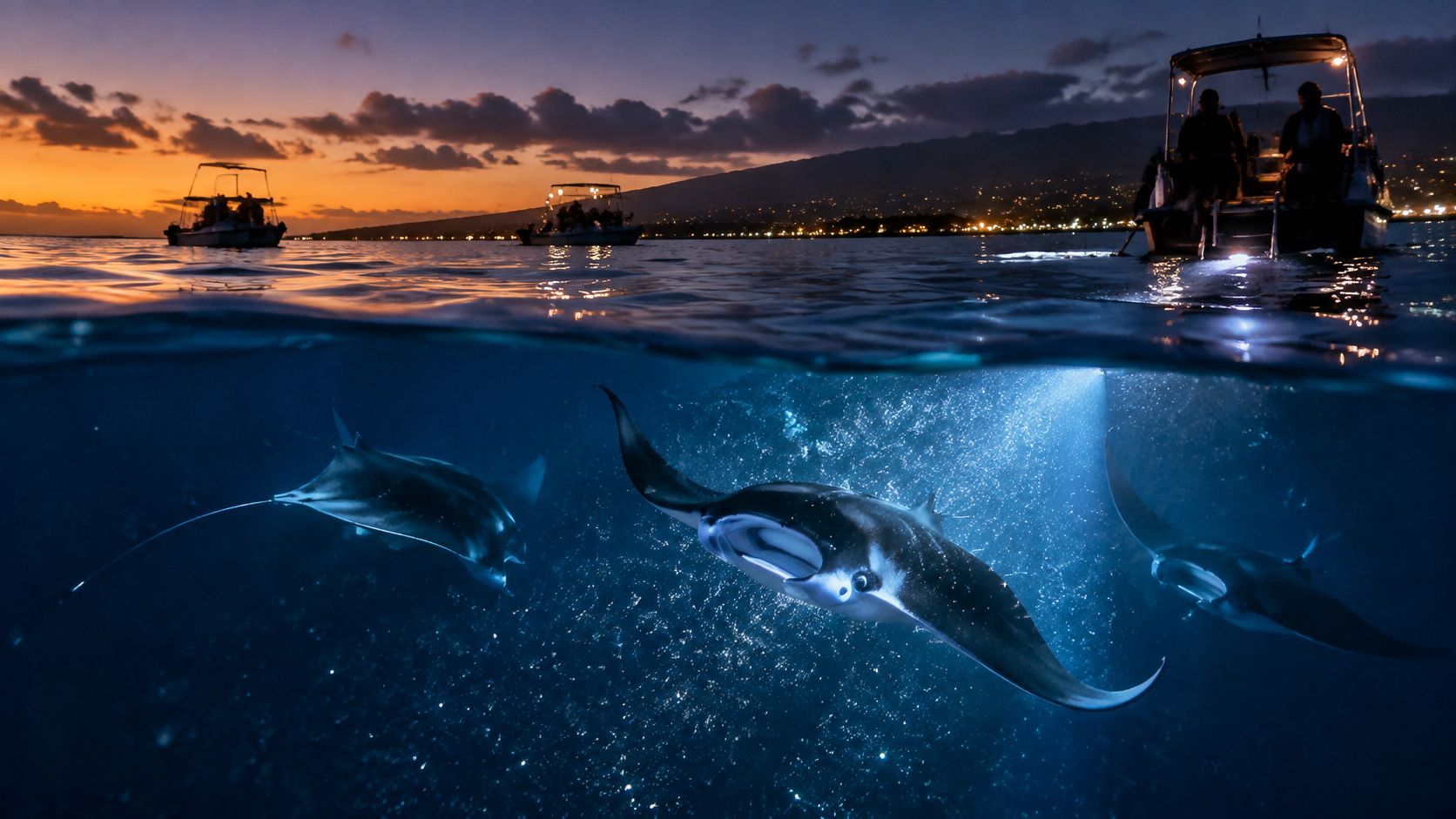
A peer-reviewed assessment of Kona manta tourism documents encounters beginning in 1984 at Keauhou Bay, commonly called Manta Village, and at Hoona Bay and adjacent Makako Bay, associated with Garden Eel Cove or Manta Heaven. These established viewing locations sit offshore along Hawaiʻi Island's west coast and are primarily reached by commercial tour boats.
For a first outing, expect:
- A briefing before entry. The crew explains how to enter, where to float, and how to return to the boat.
- An uncertain wait. A lit feeding area doesn't mean a manta will appear immediately.
- Wildlife without a guarantee. Sightings are common, but no single night comes with a promise.
- Other groups nearby. You may share the viewing area with several boats, so your guide's ability to organize the group matters.
The background on manta rays in Hawaii helps explain why passive viewing works. For planning purposes, though, your first decision is simpler: choose an evening when you'll be comfortable enough to watch patiently.
When to Go for the Best Manta Sightings
Choose the calmest forecast within your travel window. A darker sky is appealing, but it won't compensate for a surface that makes you tense, nauseated, or unable to keep your face comfortably in the water.
Night snorkels operate year-round, so you're usually choosing an evening rather than chasing a short season. Winter swell can make some nights rough, while an otherwise promising evening can become unsuitable when local conditions change.
Timing factors that change your odds
| Factor | Best choice | Why it matters |
|---|---|---|
| Season | Year-round; plan around swell | Winter swell can roughen the water on some nights |
| Moon phase | Darker nights near the new moon | Stronger light contrast; a bright full moon can change feeding |
| Sea state | Calm, low swell | Calmer water makes floating easier and reduces seasickness |
| Departure time | Evening departure around sunset | Viewing starts after dark |
| Weather window | Calm forecast with a backup evening | A rough forecast can cancel or move a trip |
Treat moon phase as a secondary consideration, not a sighting predictor. Darker nights give the artificial lights stronger contrast, but a lunar calendar can't tell you whether animals will enter a particular light field.
Sea state has a more immediate effect on your experience. Chop makes it harder to settle your breathing, keep a mask clear, and remain comfortably positioned. A confident daytime swimmer can still dislike bobbing at the surface after dark.
Practical rule: Don't trade comfortable water for a supposedly perfect moon. Pick the calmer evening and leave room in your itinerary for a change.
Evening departures commonly fall around sunset, but check the actual schedule rather than assuming every trip starts at the same time. A sunset boat ride and after-dark viewing are different parts of the outing.
Use the guidance on the best time to see manta rays in Kona to compare conditions. Keep a backup evening available before you commit to other nonrefundable plans.
Local Rules and Etiquette for Manta Viewing
Guide coverage is a useful booking check. The Hawaiʻi administrative rules document for manta viewing sets a maximum of six participants per guide at any given time, divides designated viewing zones into swimming, snorkeling, and diving areas, restricts tours to specified viewing hours, and requires vessels reaching their mooring-time limit to leave both the mooring and viewing-zone boundaries for at least 30 minutes before returning.
When comparing operators, ask how many guests will enter the water and how many guides will accompany them. Total boat capacity doesn't answer that question. A crew member remaining aboard has a different job from a guide managing people at the light field.
What the operating boundaries protect
The separate activity areas help keep swimmers with different movement patterns from crossing through one another. As a snorkeler, stay in the snorkeling area assigned by your crew. An attractive view outside that area isn't a reason to drift away.
Restricted viewing hours also mean tours can't remain indefinitely because guests want another pass. Mooring turnover gives other vessels access and limits how boats occupy the viewing area. Once a vessel reaches its limit, circling back before the required absence is complete doesn't satisfy that rule.
These operating controls work best when guests support the crew's positioning. The principles behind responsible and considerate underwater etiquette apply at the surface too: awareness matters more than getting the closest view.
Your part is straightforward:
- Follow the crew's instructions. Entry, repositioning, and exit need to happen in an organized sequence.
- Stay with your group. Don't move toward another boat's lights or follow a ray beyond your assigned position.
- Leave attractants aboard. Don't bring food or objects intended to draw animals toward you.
The purpose isn't to make the encounter rigid. It's to leave room for animals to feed and for guides to supervise without constantly correcting avoidable problems.
Book Your Manta Ray Snorkel Step by Step
A good booking decision starts with the operating details, not the most dramatic photograph. You're choosing a boat trip, an in-water arrangement, and a set of cancellation terms as well as a wildlife experience.
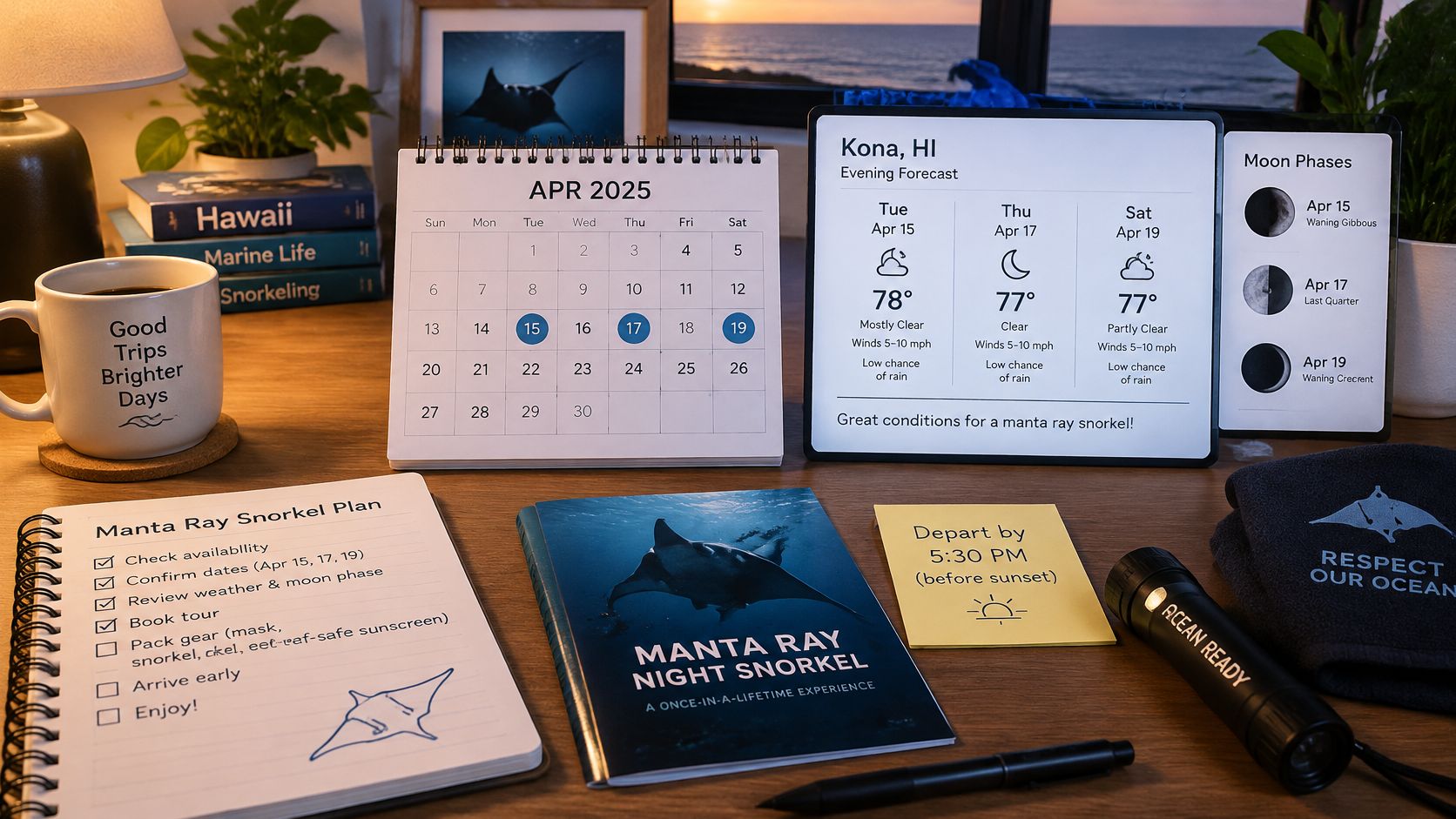
Shortlist possible evenings. Compare the marine forecast and moon phase, but preserve flexibility rather than filling every evening with prepaid activities.
Check departure and meeting times separately. Choose an evening departure and verify when check-in occurs. Meeting time may be before sunset, and arriving at departure time can mean arriving too late.
Compare supervision and capacity. Confirm the participant-to-guide arrangement meets the applicable limit. Ask about total boat capacity and how guests are distributed around the flotation setup. Fewer passengers can mean more room, but boat size alone doesn't guarantee an uncrowded light field.
Check live availability and select your date. Use the manta snorkeling reservation calendar below. Read the trip description before paying, including the meeting location and participation requirements.
Read the weather and cancellation policy. Find out whether an operator-canceled trip leads to a refund, a free reschedule, or another arrangement. For example, a family facing a swell warning should confirm those terms before moving its booking rather than assume payment automatically transfers.
Disclose relevant needs before paying. Explain your swimming ability, health concerns, and seasickness history. Ask whether the planned entry, flotation arrangement, and boat ladder suit your needs.
Reconfirm before departure. Check conditions the day before, review any operator messages, and verify the meeting point. Don't assume the viewing site and departure harbor are the same place.
A small group is useful only if the operator also manages it well. Ask how people are positioned, not just how many tickets are sold.
Before you pay, get clear answers on group size, guide coverage, refund terms, and included gear. Also distinguish a weather cancellation from a trip that operates but has no manta sighting. Those situations may have different policies.
What to Bring for the Water, the Boat and Your Camera
Pack for floating and returning to the harbor wet, not for a daytime beach stop. Keep valuables together so you aren't searching around the deck while the crew prepares entry.
A practical boat bag
- Swimwear and a rash guard. Arrive ready to get wet. A rash guard helps with comfort, but ask about a wetsuit if you get cold while remaining still.
- Sunscreen for the daylight portion. Apply before boarding if you'll be exposed to sun, and let it set. Choose a product compliant with local requirements rather than relying only on a reef-safe marketing label.
- A warm outer layer. A wind-resistant jacket or dry sweatshirt makes the return ride more comfortable.
- A towel and dry bag. Put your phone, keys, cards, and dry clothing somewhere protected from spray.
- Confirmed snorkel equipment. Check whether a mask, snorkel, fins, and flotation are included. Test your mask seal before entry, and tell the crew if it leaks.
- A seasickness plan. Options to review include the Ship-EEZ Seasickness Patch, Dramamine pills, Bonine pills, Sea Band wristbands, and ginger chews. These aren't interchangeable treatments or guaranteed fixes. Follow the specific product directions, check medication suitability with a pharmacist, and start any chosen preventive before boarding as directed, not after nausea begins.
Set the camera before entry
Use a waterproof camera housing or properly sealed waterproof phone case, and attach a secure wrist tether. Switch off flash and use the existing viewing lights. Try a low-light setting or higher ISO, but remember that long-exposure night modes can blur a moving manta.
If you'd rather concentrate on watching, review the manta night photo package information before bringing additional equipment.
A camera should never delay entry, occupy a hand you need for support, or cause you to block another swimmer. If getting the shot requires leaving your position, skip the shot.
How to Behave in the Water and Stay Safe at Night
A manta encounter isn't harmless because the animal stays near you. A ray can remain in the feeding area while still changing course to avoid people. Your goal is to avoid making it choose between food and a clear swimming route.
An analysis of tourist interactions at Maldives manta aggregation sites.pdf) found that frontal approaches, obstructing an animal's path, and close approaches increased avoidance, while passive observation caused less disturbance. That finding supports a simple approach in Kona: control your position rather than trying to control the encounter.
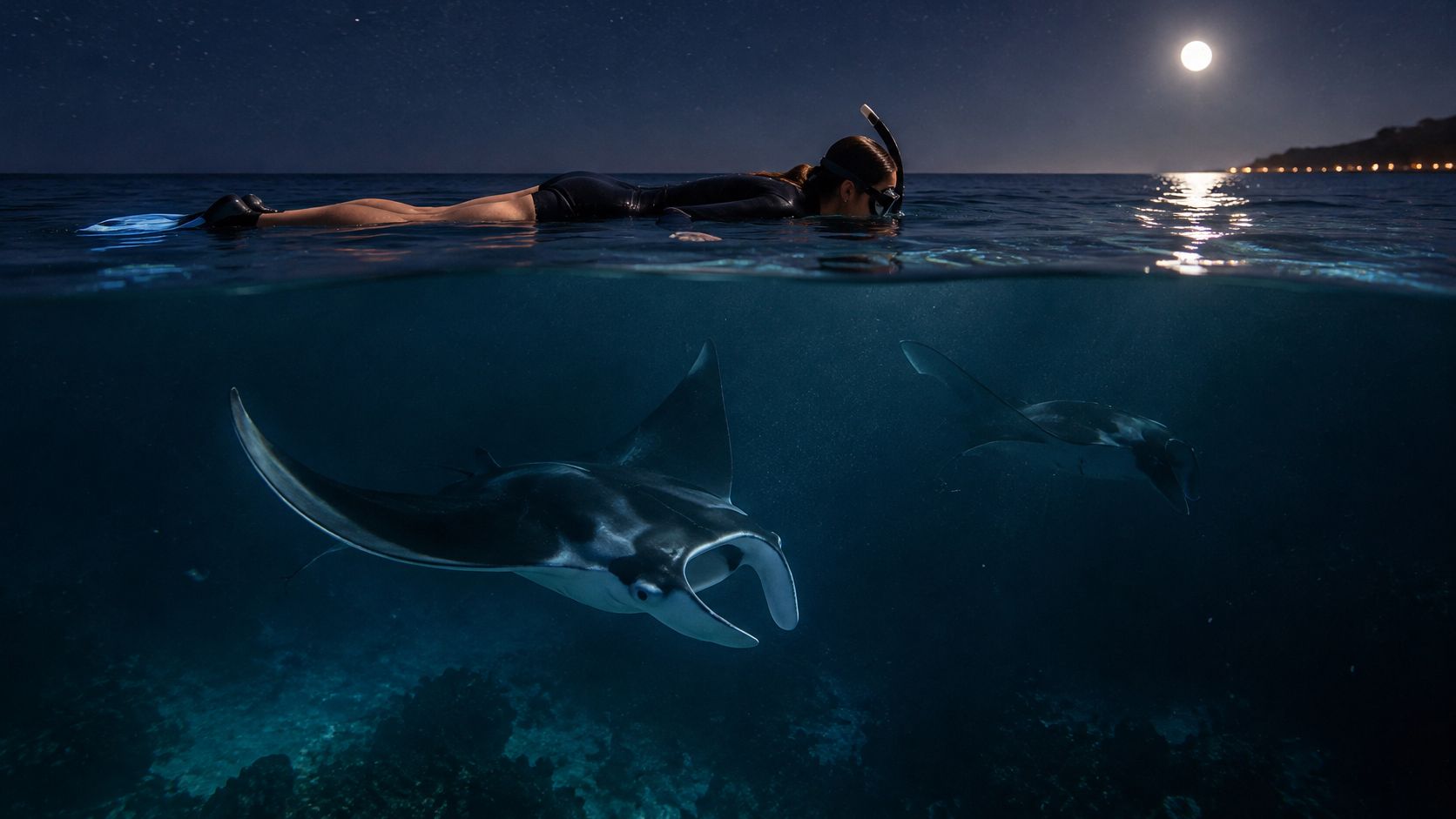
Hold a position that leaves room to feed
Our crew's detailed briefing explains the science behind the encounter and the golden rules of passive observation. Listen for the entry procedure, your position at the flotation setup, and the signal to use if you need help.
- Float positively buoyant and still. Use the provided support instead of continuously kicking to hold yourself up.
- Keep the central water column open. Don't hang vertically into the feeding corridor. Keep your fins submerged rather than splashing at the surface.
- Aim snorkel lights downward. Follow the crew's lighting arrangement instead of sweeping a beam after an animal.
- Move from the side only when necessary. Let your guide reposition you rather than swimming across a manta's approach.
- Never chase, touch, block, or dive toward a manta. Experience with breath-hold swimming doesn't make freediving through a managed feeding area appropriate.
The NOAA-hosted manta interaction guidance supports stationary surface viewing and a snorkel ring or equivalent control device for groups of four or more; the accompanying interaction figures below describe a 2020 analysis of 401 filmed snorkeler–reef-manta interactions.
Avoidance in filmed snorkeler encounters by distance
| Distance from manta | Avoidance rate | What to do |
|---|---|---|
| Within 3 m | 31% of encounters at this distance | Don't close the gap; create space without crossing its path |
| 4 to 5 m | 3.4% of encounters at this distance | Preferred spacing when conditions allow |
Those percentages describe encounters within each distance category, not the proportion of every filmed encounter combined. Use separation as a positioning goal, not a reason to kick abruptly when an animal approaches voluntarily.
When a manta comes very close
Stay still, don't reach, and preserve its escape path. Keep hands and feet out of its route and let it pass. Don't chase after it to recreate the moment.
Give your eyes time to adjust, maintain contact with your assigned support, and signal the guide early if you're cold, anxious, or struggling with your mask. Nighttime safety depends on communicating before a manageable discomfort becomes a rushed exit.
Decide Whether a Night Snorkel Suits You
Surface manta snorkeling needs no scuba certification and can suit beginners, families, and non-divers who meet the operator's participation requirements. Kona Honu Divers runs the Manta Ray Night Snorkel for guests watching from the surface, with snorkeling options that let non-divers see the action. If you're weighing the different viewing positions, compare snorkeling and diving with manta rays before choosing.
Questions that determine your fit
Will I definitely see a manta? No. Sightings are common, but the animals decide whether to visit. Book because you want a responsibly managed wildlife outing, not a guaranteed performance.
Can I go if I'm a weak swimmer? Possibly, but disclose that before booking. Flotation helps you remain at the surface; it doesn't replace the ability to follow instructions, breathe comfortably through a snorkel, or manage the entry and exit.
Is seasickness a deal breaker? Not necessarily. Pick calm conditions and use a suitable preventive as directed, but don't assume a remedy will make an uncomfortable forecast manageable.
Choose the calmest evening available, confirm group size and refund terms, and reserve through the availability calendar once you're satisfied with the arrangements.
Kona Honu Divers offers guided manta ray night snorkeling so you can watch the feeding encounter from the surface without scuba certification. Visit Kona Honu Divers to review the outing, discuss your swimming comfort, and choose an evening that fits your Big Island plans.