
Table of Contents
- A typical evening in order
- Why Garden Eel Cove is the preferred dive site
- What the nightly pattern actually changes
- What each format asks of you
- The legal line
- What the water actually demands
- First-timers and families
- Do I need scuba certification?
- Will I definitely see manta rays?
- Can I touch or ride a manta?
- Can I bring my own flotation board?
- What if I'm not a strong swimmer or I have limited mobility?
- How do I stay with my group in the dark?
- What if I feel anxious in dark water?
- Can children join?
You're comparing Kona evenings and the phrase manta ray night snorkel Big Island keeps landing in the short list. Nobody in your group is scuba certified, one person gets uneasy after dark, and the listing's "no certification required" line is doing more reassuring than it should. A night snorkel is time at the surface over a lit patch of sea, not a low-effort boat ride, and a busy site can feel packed even when the rays show up.
The choice is still a good one if the group can float, breathe through a snorkel, and follow a hands-off briefing. What follows is the evening in order, the two Kona sites, how a snorkel differs from the night dive, the rules that protect the animals, and the physical bar to clear before you pay.
What a Manta Ray Night Snorkel Involves
After dark the boat settles over a patch of water lit from below. Reef manta rays glide in to feed on plankton drawn into that beam. You stay on the surface with a mask and snorkel. The animals work the lit water underneath you.
That pattern is older than the tour brochures. Artificial lights near Keauhou began pulling plankton toward shore in the late 1970s, and reef mantas started gathering to feed in the illuminated water, according to the Hawaii Division of Aquatic Resources. Organized nighttime excursions were running along the Kona Coast by the early 1990s. Photo-identification work from 1992 through 2007 covered 3,208 surveys at primary night-viewing locations, including Keauhou and Ho'ona Bay, and identified 106 individual manta rays. A later compilation reported 318 unique manta rays documented around Hawai'i Island since 1979.
The lights don't charm the animals. They concentrate zooplankton, the mantas' food. NOAA's manta ray work product lists euphausiids, copepods, mysids, decapod larvae, and shrimp among typical prey, and notes a significant positive relationship between Kona manta abundance and zooplankton availability. Mantas are primarily nocturnal feeders, lining up with the nighttime rise of that prey. Plankton density, current, clarity, and weather change how hard they feed. A good light field raises the odds of close passes. It doesn't set a head count.
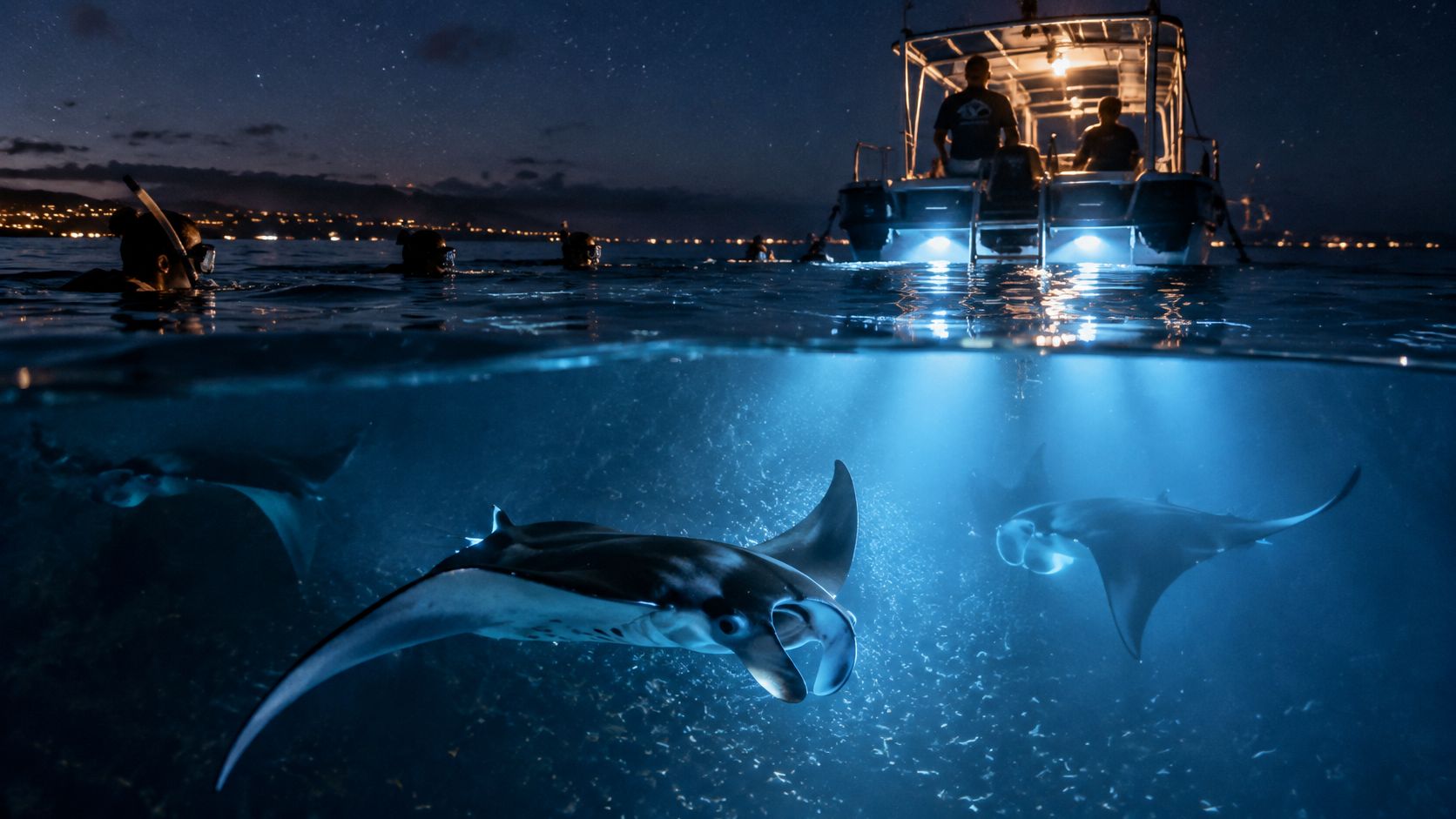
A typical evening in order
- Confirm the night before. Check the site, the departure time, and the forecast. Session length and departure shift by operator and season, so lock those in at booking.
- Arrive about 30 minutes early. Check in, collect gear, and use the restroom before the dock gets busy.
- Board before dusk. The crew stows the lights and checks the group list while there's still light on the ramp.
- Take the briefing on the way out. Ours covers the science of the light field and the golden rules of passive observation: watch, don't chase.
- Enter once the lights are on. Stay at the surface with your group while the mantas feed below.
- Exit when the session ends. Rinse the gear and warm up with a drink.
- Head in, shower, and eat before you try to sleep on the high of the night.
No scuba certification is required, because all of the viewing happens at the surface. A successful night is a few close passes from wild animals. It is never a promised number of rays.
Best Kona Viewing Sites and When to Go
| Site | Also known as | Setting | Research or state note |
|---|---|---|---|
| Garden Eel Cove | Makako Bay | Protected cove with a defined viewing area | Preferred site for the manta ray dive |
| Sheraton Keauhou Bay | Kaukalaelae Point/Keauhou Bay zone | Coastline fronting Sheraton Keauhou Bay | Named by the state as a principal viewing area |
The Hawaii Department of Land and Natural Resources names those two principal manta-ray viewing areas on the Kona coast. Mantas gather at both after dark to feed on plankton, so Garden Eel Cove is a documented feeding site, not a generic snorkel stop. The state does not rank one above the other and does not publish a reef-quality comparison. Judge each night by the conditions in front of you.
Why Garden Eel Cove is the preferred dive site
I would still book the manta ray dive at Garden Eel Cove. Makako Bay sits more protected than an exposed stretch of coast, and the viewing area is defined rather than spread along a shoreline. Our go-to for the Manta Ray Night Dive is that cove: a protected location, a good viewing area, a healthier reef, and generally calmer conditions than open-ocean swell. Divers are positioned in a specific viewing area, not left to drift the site. More on how these animals use the coast is on our manta rays in Hawaii page.
Keauhou, along the coastline fronting Sheraton Keauhou Bay, is the other principal area and a legitimate night stop. It is not a lesser ocean. It is a more open piece of coast, so swell and boat traffic change the feel of the session faster.
What the nightly pattern actually changes
Mantas come after dark while the lights are on. Feeding still tracks plankton density, current, clarity, and weather, so two nights at the same GPS point can look nothing alike. In 2022, Hawaii DOBOR estimated that approximately 60 to 70 viewing vessels brought guests close to feeding mantas in the two designated Ocean Recreation Management Areas, Makako Bay/Garden Eel Cove and Kaukalaelae Point/Keauhou Bay, per the DLNR notice on manta viewing. That notice also said no laws or rules specifically regulated manta viewing or diving at the time. The same notice described a proposed cap of 24 commercial permits in each zone, a limit of 60 passengers for hire on a vessel in a 24-hour period, and two-hour shifts. Operators already space boats because that volume doesn't fit one patch of water at once.
Match the departure to sunset when you book. Times move with the season. Expect dark water, and don't treat a sighting as booked. On our Manta Ray Night Dive trips, divers have seen manta rays on 92% of them. That is a strong pattern, not a promise for your night.
Night Snorkel Compared With the Night Dive
The split is where your body sits. Snorkelers float at the surface above the lights. Divers kneel on the sandy bottom inside the light circle, at the level where the feeding happens. On the night dive, the crew sets a powerful set of lights on the seafloor to draw plankton and mantas, while divers hold that bottom position and snorkelers stay up top. Powerful dive lights make a bright circle on the sand, so divers are not sitting in pitch black.
| Factor | Night snorkel | Night dive | Choose it if |
|---|---|---|---|
| Where you are | Surface, above the lights | Sandy bottom inside the light circle | Snorkel if you prefer staying near the surface |
| Certification | None needed | Certified divers only | Snorkel if you are not certified |
| Equipment | Mask, snorkel and flotation | Full scuba gear | Snorkel for simpler kit |
| Group handling | Snorkel ring for groups of four or more | Divemasters and instructors in the water | Dive if you want in-water guides |
| Swimming demands | Steady surface swimming in the dark | Dive training and gear handling | Snorkel if steady swimming in the dark suits you |
The night snorkel needs no certification because you never leave the surface. The Manta Ray Night Dive and the 2-Tank Morning Dive are open to certified divers. Certification is the gate, not a suggestion. A longer look at that choice is in snorkel or dive with manta rays.
What each format asks of you
The snorkel asks for steady kicking, a calm breath on the snorkel, and the patience to hold a float while shapes pass under your face. Groups of four or more stay together on a snorkel ring or similar flotation instead of scattering across the lights.
The dive asks for current certification, comfort with your own gear, and the ability to kneel still while a wing passes inches from your head. Giant mantas on this dive can have wingspans well over 12 feet, so "inches away" is a real distance, not a slogan. Experienced divemasters and instructors are in the water to manage the group. The dive is stationary and closely supervised.
Practical rule: Choose the snorkel if you are not certified or you want to stay at the surface. Choose the dive if you hold a certification and you want to be on the bottom with the lights.
Manta Etiquette and Safety Rules on the Water
Stay at the surface and let the animals come to you. That one rule keeps the feeding lane open and keeps hands off an animal that didn't invite you.
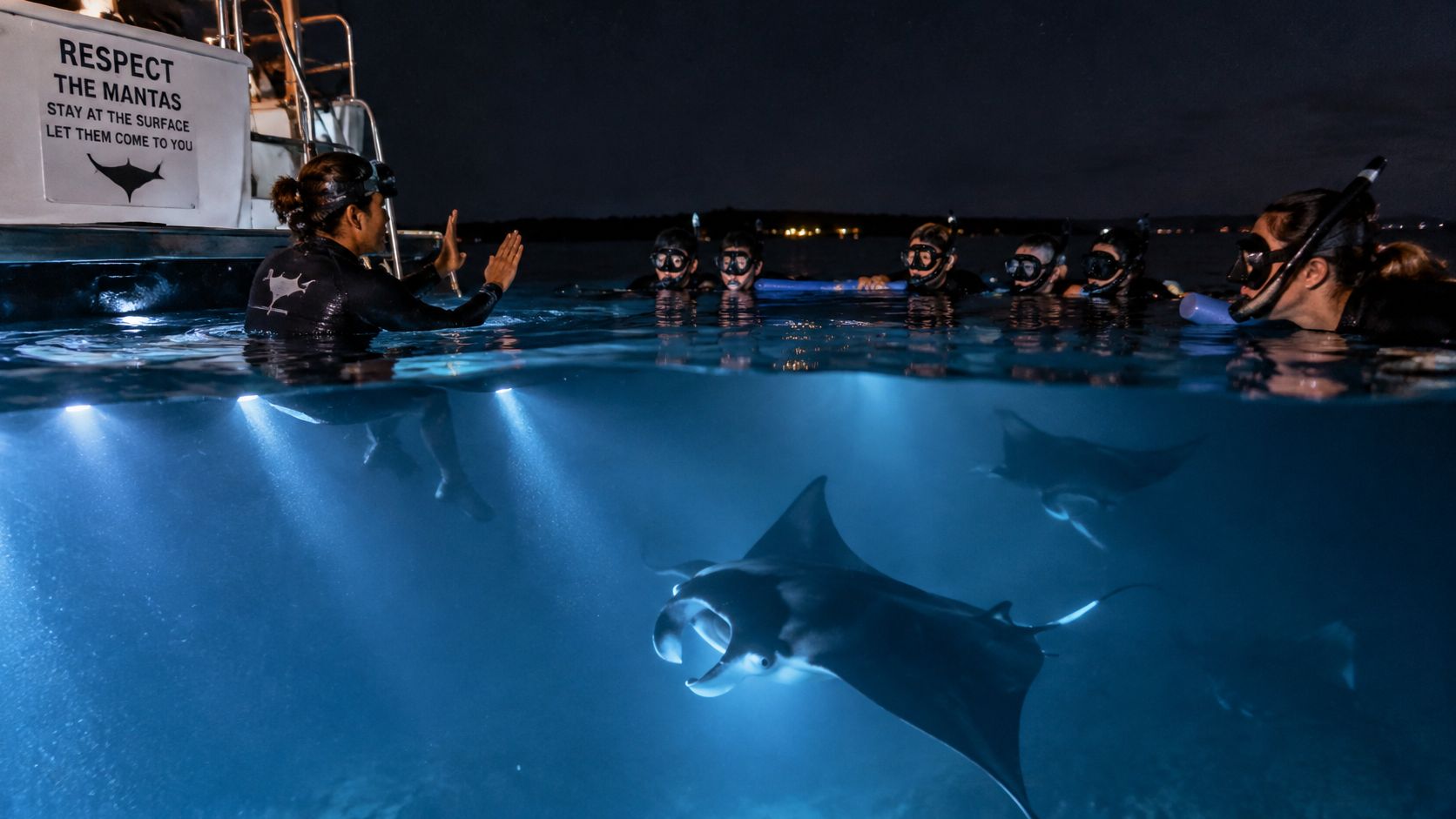
NOAA-supported Kona interaction standards separate the human plane from the manta plane. Snorkelers remain on the surface and avoid dropping into the water column where mantas feed. That open maneuvering space cuts the chance of a collision or of startling an animal into a sharp turn.
- Point lights downward. Upward or sideways beams scatter the food patch and pull animals toward faces and boat hulls.
- Don't touch, chase, grab, or ride. Contact can strip the protective mucus coating and leave the animal more open to pathogens.
- Don't descend into the feeding column. Your fins in that lane are a moving obstacle with a poor view of what's behind them.
- Avoid coral, sea urchins, and other bottom hazards. A curious duck-dive is how guests meet spines and living reef.
- Hold a neutral body position. Vertical kicking and splashing read as chaos in a dark, crowded light field.
- Stay with the group above the lights. A snorkel ring for groups of four or more keeps people together instead of spread across the site.
Same habits, written for divers as well as snorkelers, sit in our responsible diver etiquette notes.
The legal line
Watching is legal. Capture is not. Hawaii law prohibits knowingly capturing or killing a manta ray in state marine waters. Under HRS Chapter 188, criminal penalties rise from $500 for a first offense to $2,000 for a second and $10,000 for a third or later offense. An administrative fine of up to $10,000 can apply for each manta ray captured or killed, with possible seizure of the animal, the commercial marine license, the vessel, and the fishing gear.
If you drift toward the feeding animals, the crew will tell you to stop kicking, hold the float, and let the ray pass. Do it the first time. One guest lunging turns a calm pass into a collision risk for the whole group.
Crowds, Physical Demands and Who Should Join
| Crowd source | Felt crowded | Accepted maximum at one time | Met more than preferred |
|---|---|---|---|
| Snorkelers | 82% | 52 | 77% |
| Boats | 78% | 11 | 68% |
| Scuba divers | 69% | 32 | 67% |
A study of 444 manta-tour participants, filed with Hawaii County testimony, found that 82% felt crowded by snorkelers, 78% by boats, and 69% by scuba divers. They would accept an average maximum of 52 snorkelers, 11 boats, and 32 divers at one time. Yet 77% met more snorkelers than they wanted, 68% more boats, and 67% more divers. The same work found that 79% of snorkelers experienced conflict within their own group. Etiquette inside your party matters as much as the rays.
A high manta count does not buy you a better night. Extra people, extra lights, and extra hulls shrink the water you can see through. A direct-observation assessment on the Kona Coast from August 10 to 13, 2015, recorded about 16 to 19 vessels a night and about 160 to 190 snorkelers and divers in the water at once, and it flagged congestion as an accident risk, in a Hawaii County boating safety assessment. Vessel spacing and which departure you pick are wildlife management, not a booking footnote.
What the water actually demands
No certification required does not mean low physical demand. You float at the surface, manage a mask and snorkel in the dark, stay calm beside boats and large animals, and board or leave a vessel on a ladder. County testimony on manta tourism values is blunt about that gap: public guides talk certification and skip water confidence. Some charters expect confident open-ocean swimming, prior snorkel experience, and an unassisted ladder climb. Full-face masks and life jackets may be restricted. A flotation board is not a personal life jacket.
Before you book, ask what help exists for boarding, whether a flotation aid is issued, and whether a non-swimming observer can stay aboard. If the honest answer doesn't fit the person coming, don't put them in the water.
Rough crossings are a separate problem from swimming. If you get queasy, read how to avoid seasickness before the pier, and pack a Ship-EEZ seasickness patch, Dramamine, Bonine, Sea-Band wristbands (a cheaper generic that tends to rate better), or ginger chews. Take them on the schedule the label gives, not after you're already green.
What to Wear and Bring for the Night Water
Warm water still feels cold after an hour of not moving. Pack for the float, not for the beach photo.
- Swimsuit plus a light rash guard. The guard cuts chill and sun on the ride out. A thin layer beats a thick wetsuit you can't get on in the dark.
- A mask and snorkel that seal. Test the skirt on your face on land. A leaking mask at night ruins the whole session, and adjusting it while you drift is how people lose the group.
- Reef-safe sunscreen, on before you board. You won't reapply it well once your hands are wet.
- A towel and dry clothes for the ride back. The wind on a night return is the part guests underestimate.
- A waterproof bag for phone and keys. The boat is wet. Pockets are not a plan.
- A small flashlight for the dock. Turn it off once you're in the water. A loose beam wrecks night vision and the light field.
First-timers and families
Arrive early enough to try the mask in the shallows, and tell the crew the moment you feel uneasy. Use the flotation they hand you. A pool noodle from home is the wrong tool, and some charters restrict full-face masks and life jackets, so don't pack those as your backup without asking.
Children should be confident swimmers and stay with an adult inside the group. "Old enough to want to go" is not the same as "able to hold a float in dark water."
Leave jewelry that can snag, cameras without a strap, and anything you'd hate to drop. Dark water doesn't return souvenirs.
Frequently Asked Questions
Do I need scuba certification?
No for the night snorkel, which stays at the surface. The night dive is for certified divers only.
Will I definitely see manta rays?
No. Feeding tracks plankton, current, clarity, and weather. Sightings are never guaranteed, even on a site with a strong track record.
Can I touch or ride a manta?
No. You observe without touching, chasing, grabbing, or riding. Contact harms the mucus coating that protects the animal.
Can I bring my own flotation board?
Use what the crew provides. Full-face masks and life jackets may be restricted, so a homemade setup can get you turned away at the dock.
What if I'm not a strong swimmer or I have limited mobility?
Ask about flotation, boarding help, and staying aboard as a non-swimming observer before you pay. If that option isn't offered, this isn't the night for that person.
How do I stay with my group in the dark?
Groups of four or more use a snorkel ring and stay together above the lights. Don't swim off to "get a better angle."
What if I feel anxious in dark water?
Tell the crew immediately, and try the gear in the shallows before boarding. Anxiety you hide until you're offshore becomes the crew's emergency.
Can children join?
Only if they are confident swimmers who will stay with an adult in the group. Check the operator's age minimum when you book, because it isn't the same on every boat.
Book Your Manta Ray Night Snorkel With a Trusted Operator
Pick the boat on operations, not on the photo. A defined viewing area, a briefing that covers manta behavior, surface lights kept pointing down, a clear group-size policy, an honest account of crowding and physical demand, and experienced guides in the water are the checks that matter. Our notes on choosing a Kona dive operator walk through that list in more detail.
Kona Honu Divers runs the Manta Ray Night Dive from Garden Eel Cove, the protected site with the defined viewing area. The trip is listed for divers and snorkelers from beginner through advanced levels, and it is Kona's most popular dive because guests watch mantas pass inches away. Guests who want a more experienced day on the water can add the premium advanced 2-tank trip. Two ways to see the rays:
The 2-Tank Manta Dive and Snorkel is the plan for certified divers who want the bottom and for snorkelers sharing that boat. Wider Kona diving tours cover the daytime reef trips if the night isn't your only dive. The manta night snorkel is the surface-only option when nobody in the group holds a card.
Book the snorkel here.
Certified divers can book the dive here.
Book early in the trip so a weather cancel still leaves you a second night. Confirm the site, and ask about boarding help and a non-swimming observer seat before you assume everyone in the group is getting in.
Kona Honu Divers runs the Manta Ray Night Dive and the surface manta night snorkel from Garden Eel Cove, with a crew briefing, lights on the viewing area, and guides who keep certified divers and snorkelers in the right part of the water. If your group can handle the dark-water float, or you want the sandy bottom inside the light circle, check dates before the popular departures fill. Visit Kona Honu Divers to see the night trips and book the one that matches your certification and your swimming confidence.