
You're comparing manta tours, checking your vacation dates, and wondering what it feels like to enter the ocean after dark. The useful picture isn't a diver swimming after a giant ray. It's a dark cove, a bright circle on the sand, and a group holding still while a manta glides into the beam on its own terms.
A manta ray night dive in Hawaii works best when you treat it as managed wildlife viewing, not a scheduled performance. Your site, comfort in the water, and willingness to follow the light and positioning rules matter more than getting as close as possible.
Manta Ray Night Dive Hawaii at a Glance
Say you've descended with your guide and reached the assigned viewing area. You settle onto the sand, point your light upward, and watch suspended specks move through the beam. If a manta arrives, your job isn't to follow it. You stay put and leave room for it to feed.
Manta ray night dive at a glance
| Element | What to Expect | Why It Matters |
|---|---|---|
| Viewing site | Garden Eel Cove, a protected cove west of Kailua-Kona International Airport | Defined viewing area and generally calmer water |
| Feeding method | Underwater lights draw plankton into the water column above the group | No hand feeding and no contact with the mantas |
| Divers' position | Kneel on or near the sandy bottom in a semicircle, lights aimed upward | Stable position with low impact |
| Snorkelers' position | Float at the surface with lights aimed downward | Good view without diving depth |
| Species | Reef manta rays (Mobula alfredi) | Filter-feeding plankton eaters, not fish hunters |
| Experience level | Snorkelers and divers from beginner to advanced | Certification and night-dive requirements differ, so confirm eligibility before booking |
The experience differs from a daytime reef dive because the group usually stays in one designated place rather than touring the reef. You're observing feeding behavior, not feeding the animals yourself. Mantas choose their approach, turns, and departure.
Choose the viewpoint you can manage comfortably
Scuba puts you beneath the feeding lane, looking upward. Snorkeling keeps you at the surface, looking down, without managing a scuba system. Neither option removes the need to feel comfortable in open water at night.
A beginner can be a good participant when their skills match the activity and they follow the briefing. An experienced diver who swims into the feeding lane can be a poor participant despite a lengthy logbook.
Set the right expectation: Book for the opportunity to observe wild mantas, not for a promised number of passes.
The seasonal question is primarily about ocean conditions rather than a narrow wildlife window. Choose a suitable viewing site, prepare for a stationary nighttime encounter, and leave room in your itinerary for weather. Those decisions do more for the quality of your evening than chasing the boldest sighting claim.
How Lights and Plankton Bring Mantas Close
The setup works a little like a porch lamp gathering moths on a summer evening. Here, the small organisms are zooplankton, and the animals arriving to eat them are reef manta rays.
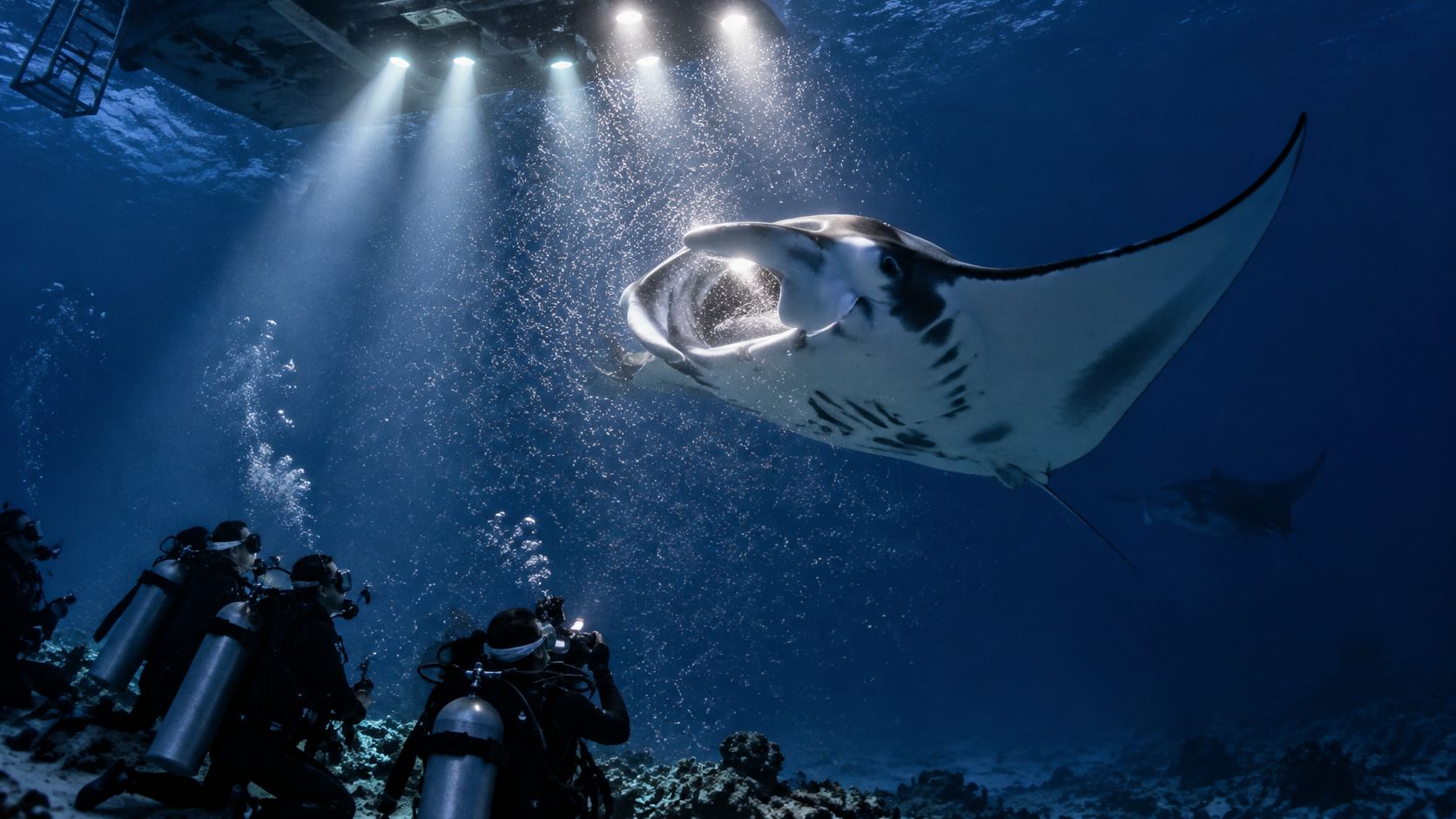
Underwater lights gather a concentrated prey field that mantas can filter-feed through. The rays glide, pivot, and sometimes barrel-roll through it, as described in NOAA's manta interaction guidance. The lights support an existing feeding behavior, rather than replacing natural prey with food handed out by people.
Positioning keeps the feeding lane open
Divers settle low in a semicircle with their lights directed upward. This leaves open water above the group for a manta to approach, turn, and return without weaving around swimming people. Snorkelers remain at the surface with lights directed down, a complementary arrangement explained by Love Big Island's manta viewing guide.
Keep your beam steady rather than sweeping it after an animal. You're helping maintain a predictable illuminated area, not using a spotlight to pursue a moving subject.
Our night dive starts with a detailed crew briefing covering the science behind the encounter and the rules of passive observation. Underwater, the experience is stationary and closely supervised, with experienced guides helping participants stay safe and comfortable. Powerful dive lights create a bright circle on the seafloor, so divers in the viewing area aren't sitting in complete darkness.
Let the manta complete its route
A productive encounter can look repetitive: a manta enters the light, feeds, turns out of the beam, and comes back. That repetition is useful. It means you can watch the animal's movement without repositioning yourself after every pass.
- Keep the center open. An empty feeding lane gives the manta room to maneuver.
- Hold your assigned position. Don't move toward a ray because it appears to be passing farther from you.
- Let departures happen. A manta leaving the illuminated area isn't an invitation to follow.
There's no hand feeding and no chasing. The closer the manta comes, the less you should change what you're doing.
Who the Kona Manta Rays Are and Why Sightings Vary
Frequent sightings don't necessarily mean a large population. At a reliable feeding site, visitors may repeatedly encounter the same resident animals, recognized individually by their markings.
In a study published in BMC Ecology and Evolution, researchers estimated the contemporary effective population size of reef manta rays around Hawaii Island at 104 individuals in 2023, with a 95% confidence interval of 99 to 110, according to the Manta Trust study summary. Effective population size is a genetic measure, not a head count of every living manta around the island.
For a different measure, NOAA reports that 318 unique reef manta rays were identified around Hawaii Island from 1979 through 2023. That cumulative identification record also isn't a count of animals present on any particular night.
Resident animals still make their own feeding decisions
Those distinctions matter when you read a tour's sighting claims. A dependable aggregation site can host repeated visits from a relatively small, identifiable community. It doesn't follow that the surrounding ocean contains an unlimited supply of mantas.
Learning about manta rays in Hawaii helps shift the focus from collecting close encounters to understanding the animals' behavior. Watch how a ray turns toward prey, leaves a thin patch, or chooses a different approach rather than judging the evening only by how many animals appear.
A 13-year analysis of community observations from 2010 to 2022 found persistent nighttime aggregations at Garden Eel Cove and Keauhou, approximately 20 km apart, with aggregation size positively correlated with zooplankton density.
A familiar feeding location isn't a reservation system for wildlife.
What a quiet night means
Prey availability helps explain why comparable tour procedures can produce different encounters. Some evenings bring animals into the viewing area quickly; others involve a longer wait or fewer feeding passes.
That doesn't make a brighter light or a closer diver the solution. Neither guarantees more prey or overrides an animal's choice to feed elsewhere.
The practical response is restraint: keep the feeding area clear, follow the guide, and assess the experience as wildlife observation. A quiet night is natural variability, not permission to push closer.
Why Garden Eel Cove Is the Best Place for the Dive
Garden Eel Cove is my preferred choice for this stationary scuba encounter because its protected location, defined viewing area, and surrounding reef habitat suit the job. You want a place where divers can settle predictably while the animals retain an open route overhead.
Kona Honu Divers often takes its manta charter to Garden Eel Cove.
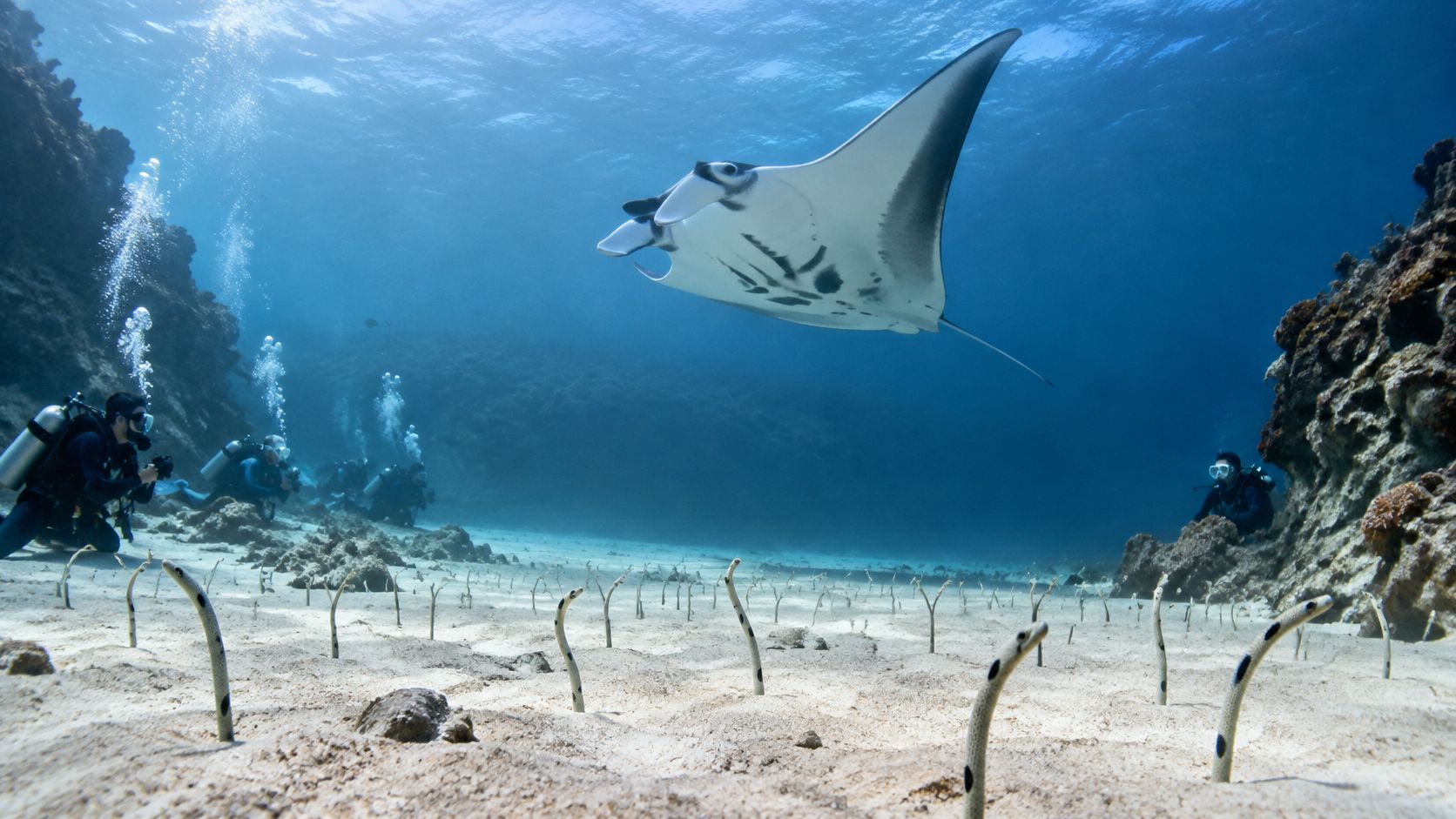
The site lies west of Kailua-Kona International Airport, within the West Hawaii Ocean Recreation Management Area, and its protected nearshore layout supports bottom-based viewing, as described in this Garden Eel Cove site guide. That's a more suitable arrangement for this activity than drifting through exposed water or trying to watch feeding mantas while touring a reef wall.
Better viewing without using the reef as a seat
The sandy viewing area lets guides position divers away from living coral. The illuminated lane is separated from nearby reef structure, reducing the temptation to brace a hand or knee against coral when a manta approaches.
For a diver, that separation is the important reef advantage. You can enjoy the surrounding habitat without making it part of your support system. The stationary layout also makes photography more manageable because you can compose from an assigned position instead of swimming to keep up.
Historical legislative testimony reproduced in a NOAA biological opinion reported manta appearances on approximately 80% of dives at Garden Eel Cove. Treat that as a historical benchmark, not a current forecast or booking guarantee.
Shelter is an advantage, not immunity from conditions
Garden Eel Cove's established nighttime aggregation and protected setting make a strong combination. They don't make every evening calm, eliminate boat traffic, or guarantee an uncrowded encounter.
Our divers use a specific viewing area at this well-established site. The manta ray dive tour and broader Kona diving tours provide the relevant trip details when you're planning your itinerary.
When comparing another site, evaluate the physical arrangement rather than accepting a promise of closer animals:
- Ocean shelter: How exposed is the entry and viewing area to the evening's swell?
- Suitable bottom: Can divers settle on sand or designated nonliving substrate?
- Reef separation: Can everyone watch without contacting coral?
- Group positioning: Is there a clear plan for divers, snorkelers, and the feeding lane?
A better viewing area is one that helps everyone hold position responsibly, not one that encourages people to surround the animals.
Best Season and Conditions for Your Trip
Kona's mantas are year-round residents, unlike migratory humpback whales. Winter can still deliver a worthwhile encounter, but swells and rough currents can make the trip harder or lead to cancellation, as The Hawaii Vacation Guide explains; the seasonal guidance also reports operator sighting success of roughly 80 to 90 percent during calm summer periods.
Season, sea conditions and sighting outlook
| Period | Sea Conditions | Sighting Outlook | Best For |
|---|---|---|---|
| Summer calm period | Generally calmer seas and clearer water | Operators report roughly 80 to 90 percent sighting success | First-time ocean participants and families |
| Winter | Swells and rough currents can make trips difficult | Mantas remain resident, so sightings still happen | Flexible travelers with a backup plan |
| Any season, rough day | Boat transit and in-water stability are reduced | Presence and sea state are separate variables | Trips where rescheduling is possible |
The summer range is operator-reported, not a guarantee. Nor does the winter row mean mantas disappear when conditions become uncomfortable.
Separate wildlife from operating conditions
Think about your booking in distinct parts. Manta presence concerns the animals. Sea-state suitability concerns whether you can travel, enter, hold position, and exit comfortably. Cancellation risk concerns whether the crew can responsibly run the trip.
Calmer water can improve the boat ride, visibility, and your ability to remain stable. That matters especially for families, first-time ocean participants, and photographers who need enough spare attention to manage equipment without neglecting the briefing.
Booking judgment: A flexible date is more useful than a confident-looking sighting percentage.
For an international traveler planning a single nonrefundable activity, the sensible priority is schedule flexibility. Choose a calm-season window if your wider itinerary allows, but don't dismiss a winter visit solely because it's winter.
Use this guide to the best time to see manta rays in Kona when choosing your dates. Keep a backup evening, and establish the weather, cancellation, and rescheduling terms before paying. A no-sighting policy and a weather-cancellation policy answer different questions, so check both.
Gear and Packing Checklist for the Night Dive
Pack for stillness, light management, and an orderly return to the boat, rather than for a long swim. Use the checklist to confirm what's provided and what you need to bring.
Night dive gear checklist
| Item | Purpose | Practical Note |
|---|---|---|
| Primary dive light | Keeps you inside the illuminated circle and shows the sand | Bring a bright, fully charged light |
| Backup light | Replaces the primary light if it fails | Carry it on your body, not in a bag |
| Mask and snorkel | Clear view of the mantas and the surface | Secure or remove a dangling snorkel |
| Exposure protection | Keeps you warm during a stationary kneel | Choose thickness for the water temperature |
| Camera | Captures mantas without blocking their path | Use a compact or wide-angle setup and keep large gear out of the water column |
| Buoyancy and weights | Lets you kneel on the sand without touching coral | Test weighting at the shallow entry first |
| Surface marker | Makes you visible to boat traffic at the surface | Confirm the operator's marker policy |
Configure equipment before the descent
Switch on each light and check that you can operate its controls with your equipment on. A backup clipped somewhere you can't reach isn't a useful backup. Secure lights and accessories so nothing drags across the bottom.
Check the mask strap and decide whether your snorkel needs to stay attached during the dive. A dangling snorkel is unnecessary clutter during close passes, and a displaced mask is harder to manage when you're surprised.
For weighting, use the shallow entry check when conditions and the guide's plan permit. The goal isn't to become heavily negative so you can't move. You still need controlled buoyancy for the descent, ascent, and any change of plan.
Dress for waiting rather than swimming
A stationary diver produces less warmth through movement than someone swimming along a reef. Choose exposure protection for the water temperature and your own cold tolerance, not because you're visiting Hawaii.
This guide to choosing a wetsuit for diving in Hawaii can help you prepare. Bring dry clothing for the return ride as well.
Keep the camera setup manageable. A compact camera or wide-angle lens lets you frame a nearby animal without extending a large rig into its route. Finally, check the current packing guidance before departure, including lights, exposure protection, and surface-marker procedures. Carrying a marker doesn't replace the planned ascent route.
Safety Rules and Photo Tips Underwater
A calm-looking viewing area still requires disciplined nighttime procedures. Our experienced divemasters and instructors are in the water with divers, but every participant needs to follow the same plan.
- Listen to the full briefing. Know the entry, assigned position, signals, exit procedure, and passive-observation rules before entering.
- Carry a primary and backup light, and stay inside your assigned light circle. Don't leave the group to investigate another beam.
- Maintain buddy contact throughout. Check where your buddy is rather than assuming the illuminated area makes separation impossible.
- Kneel in your assigned place and remain still. Swimming upward can put you directly into a manta's feeding route.
- Avoid directing exhaled bubbles into a manta's face. Keep breathing normally and continuously. Never hold your breath to avoid making bubbles.
- Never touch, chase, or attempt to ride a manta. Contact can damage its protective mucus coating and increase the risk of injury or infection.
- Ascend only on the operator's line. Don't independently surface away from your vessel into nighttime boat traffic.
Crowding changes the safety calculation
A Hawaiʻi County assessment documented at least 42 commercial operators using Makako and Keauhou Bays as of August 2015, with 16 to 19 vessels and approximately 160 to 190 snorkelers and divers simultaneously in the water during observed nights, as summarized in NOAA's giant manta ray status review. These are historical observations, not a prediction of your evening.
At Garden Eel Cove, an Underwater Atlas site profile reports that as many as 10 boats and approximately 80 divers and snorkelers may share the area. That scale explains why clear group positions matter even in a protected cove.
Keep divers low, snorkelers at the surface, and the feeding corridor open. The practices in responsible and considerate diver etiquette become particularly important when several groups share limited space.
Photograph from your place
Shoot upward toward the manta against the illuminated water column. Use a wide view, hold the frame steady, and let the animal enter the composition instead of reaching toward it.
When a manta makes a tight turn, stop shooting if you need to lower or retract your equipment to clear its route. The photograph is optional; preserving space isn't.
Local conditions, access arrangements, and authority rules can change. Current crew and authority instructions control the final plan, including how to respond to separation or an interrupted dive.
Manta Ray Night Dive FAQs
Do I need certification?
For scuba, confirm the required certification, night-diving experience, and any logbook requirement before booking. Don't assume that beginner-friendly means uncertified scuba. Snorkelers can watch from the surface; this snorkeling versus diving comparison helps match the viewpoint to your comfort level.
Is winter a bad time to go?
Not automatically. The animals remain resident, but winter swell can make the boat ride and water entry more demanding. Choose dates with room to move the trip rather than placing it on your final available evening.
Are sightings guaranteed?
No. A booking reserves participation in a tour, not an animal's arrival. Plankton availability and wildlife behavior affect the encounter, and changing your position or chasing a departing ray won't create a better feeding opportunity.
What happens if the ocean is rough?
The crew determines whether the trip can operate under the conditions. Establish the cancellation and rescheduling terms before payment, and don't assume a refund, replacement date, or no-sighting return trip is included unless the policy says so.
Do I need to touch or feed the mantas?
Neither is part of the encounter. Keep your hands to yourself even if an animal comes very close. A close pass doesn't change the passive-observation rule.
Can I bring a camera?
Yes, provided you can manage it without losing position, buddy awareness, or control of your equipment. A compact or wide-angle setup is practical, but leaving the camera behind is the better choice if you're still building confidence at night. Keep large equipment outside the feeding lane.
Book Your Manta Ray Night Dive in Kona
Choose scuba if you're qualified, comfortable underwater after dark, and want the bottom-up view. Choose the night snorkel if you prefer watching from the surface. Neither choice requires you to pursue a manta, and neither should push you beyond your current water confidence.
For the scuba encounter, I would prioritize Garden Eel Cove's protected setting and defined viewing area over a promise of exceptionally close animals. Good positioning and calm participation make the evening more manageable for the group and less intrusive for the rays.
Put flexibility into the booking
Choose your preferred date early enough in the vacation to retain a backup evening. Our most popular trips, including the manta ray night dive, often sell out weeks in advance, so reserving early helps secure a date within that flexible window.
Before completing the reservation, confirm your certification, night-diving readiness, and whether a logbook is needed. Check weather and no-sighting terms separately, and leave enough room in your schedule to accept a change without disrupting your departure plans.
- Match the activity to your skills. Select scuba or surface viewing based on comfort, not pressure from traveling companions.
- Confirm equipment arrangements. Know what you'll bring and what's supplied before arriving at the boat.
- Protect the backup date. Avoid filling every remaining evening with another nonrefundable reservation.
Build a wider dive itinerary deliberately
We offer both day and night dives, so guests can fit multiple dive trips into a day when the schedule and their readiness allow. Plan the combination around rest, equipment preparation, and your ability to stay attentive during the nighttime briefing.
For qualified, experienced divers, the Premium Advanced 2-Tank Trip and Blackwater Dive are additional options with different objectives. They aren't substitutes for the stationary manta encounter.
Reserve the activity that suits your skills, keep weather flexibility, and arrive ready to watch without interfering.
Kona Honu Divers offers guided manta ray night dives and surface-viewing snorkel trips, with a detailed briefing and supervised viewing. Visit Kona Honu Divers to choose your trip, confirm participation requirements, and reserve a date with a backup evening in your itinerary.