
You've probably seen the photos: black water, a diver's light pointing upward, and a giant manta ray sweeping over the camera. Then you check the forecast, notice you've only got one evening available on the Big Island, and wonder whether the famous Kona encounter is genuinely worth rearranging your plans for.
My advice is yes, but book it as a wildlife experience, not a guaranteed performance. Kona has a remarkable resident manta population and a long history of research, yet animals still decide where and when they feed. The site you visit, the operator's procedures, sea conditions, and your own comfort in the water will shape the night more than any marketing promise.
How the Manta Ray Night Dive Works
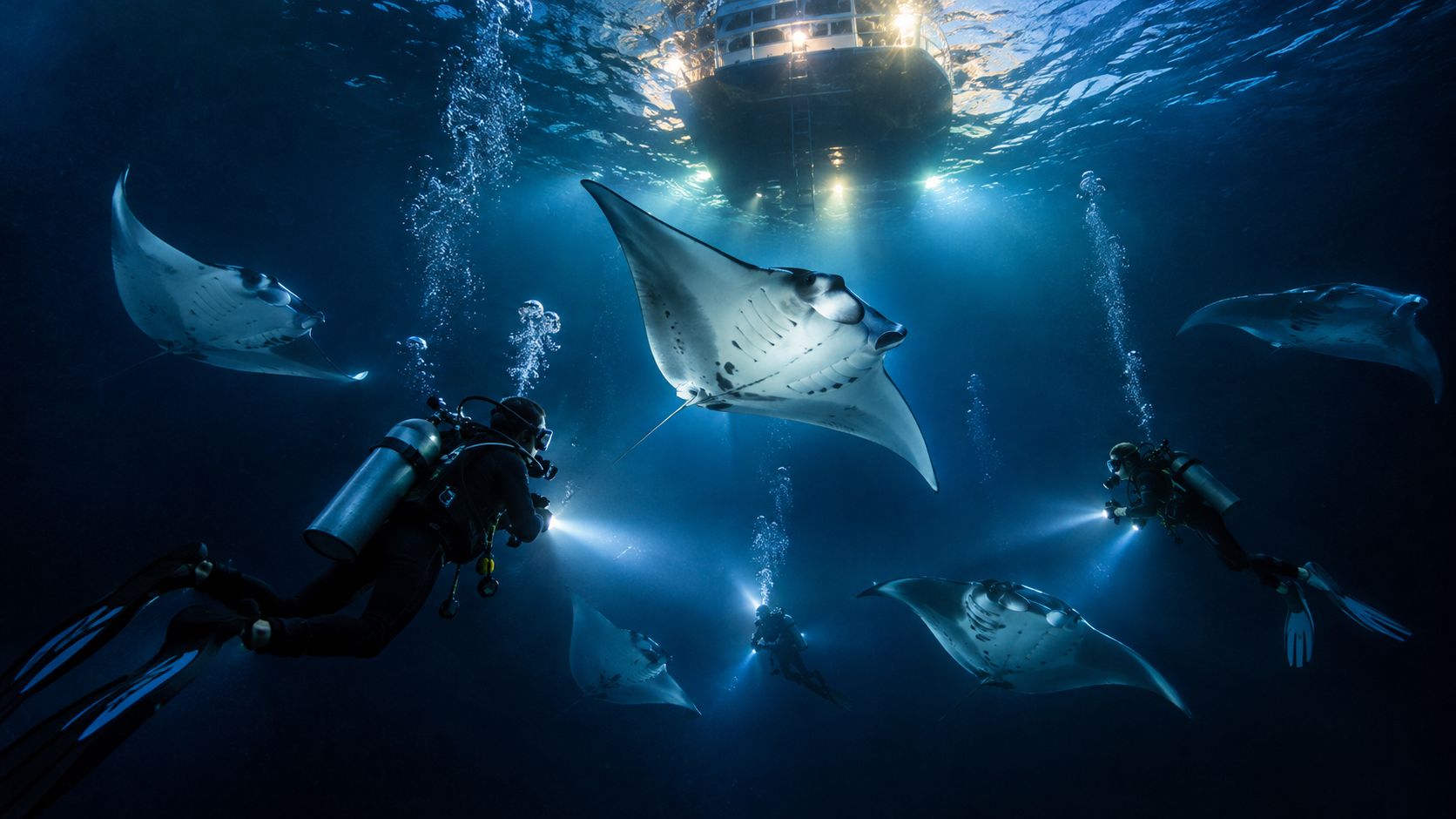
You leave the harbor at dusk, reach a known viewing site, get a short briefing, and then the group splits by activity. Certified divers drop to a sandy bottom area. Snorkelers stay on the surface. Lights point up through the water to draw in plankton, which gives the mantas a feeding lane and gives you something worth watching besides darkness.
That setup matters because this is not a staged animal show. Reef manta rays, Mobula alfredi, are there to feed in the lit water, not to interact with you. No one should be feeding them, herding them, or trying to get a reaction. The good operators make that clear before anyone hits the water.
The geometry matters
Your job underwater is simple. Hold your position and stay out of the flight path.
Divers usually kneel or settle on sand and look up into the beams. Snorkelers hold at the surface, often around a float with lights. Either way, the encounter works best when the manta controls the pass. If guests keep swimming, reaching, or shining lights wherever they want, the whole thing gets worse fast.
A manta can reach 22 feet or more in wingspan, according to Hawaiʻi's Department of Land and Natural Resources manta ray guide. That size changes the feel of the dive. You are not hunting for small nocturnal reef life with a torch. You are waiting for a broad filter feeder to bank through the light, sometimes close enough to fill your mask.
Practical rule: Pick your spot, aim your light where the guide tells you, and let the manta decide how close the pass will be.
Site layout matters as much as animal behavior. A wide, open viewing area gives mantas room to loop cleanly and keeps divers off coral and out of the feeding lane. That is one reason what makes diving in Kona unique also shapes the quality of this experience.
How the Kona Manta Tradition Began
A lot of visitors book this as if Kona has a nightly manta show. That is not how it started, and it is not how wildlife works.
The tradition began with a fluke. In the 1970s, a hotel on the Kona coast aimed floodlights at the ocean. The light concentrated plankton, and reef manta rays started feeding in that illuminated water, as described in Oceanographic Magazine's history of the Kona manta dive.
By the early 1990s, that accidental feeding setup had turned into organized night snorkel and dive trips. The bigger shift was repetition. Operators kept bringing people back to the same sites, and researchers kept watching those same areas long enough to recognize individual mantas and see patterns in how they used the coastline.
The identification work started in 1991, when researchers began naming and cataloging individual animals. A larger tracking effort followed in 2002. Research expanded again in 2008 with laser-based measurements used to study growth. Those steps changed the encounter from a lucky local oddity into a long-running field site for studying movement, feeding, habitat use, and individual life histories.
Why repeated observation matters
The strongest reason Kona became famous is consistency of effort, not any promise from the animals. In the peer-reviewed study available through NOAA's repository, researchers reported 25,444 sightings involving 118 different reef manta rays from 2009 through 2014. Observers surveyed Manta Heaven on 2,017 nights, or 92% of the study period, and Manta Village on 1,702 nights, or 78%.
That record matters because it shows sustained site use over decades. It also sets the right expectation before you book. These are well-watched feeding areas with unusually rich history, not a controlled attraction. The long record shows that repeated use creates opportunity, never certainty.
Choosing Between Kona's Manta Sites
Book the boat, drop in, and you still might not get the same night someone else got the day before. That is the right frame for choosing a site. You are picking the setting for a wildlife encounter, not reserving a show.
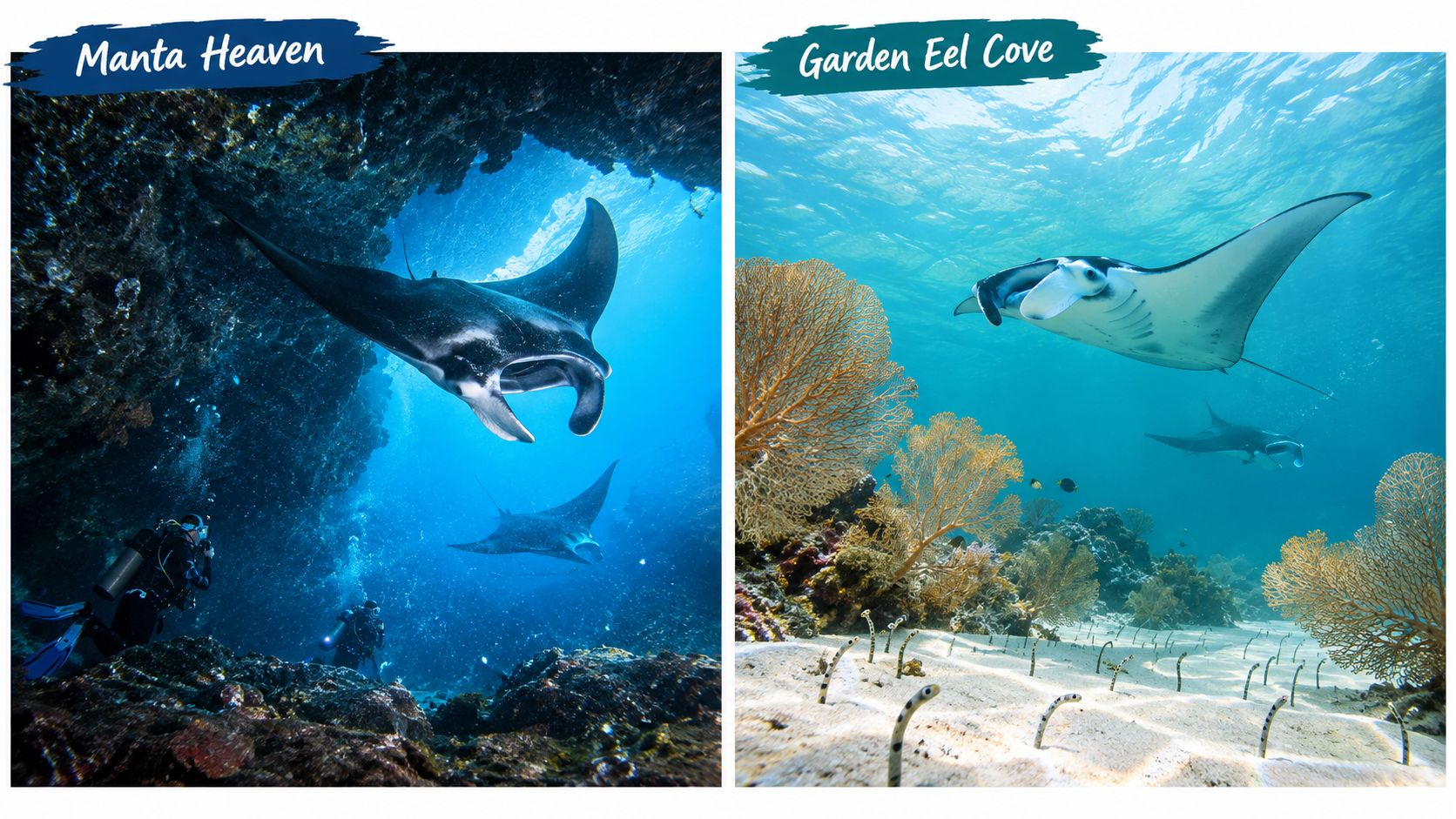
Site choice is the biggest decision you control. The two names you will hear most are Manta Heaven and Manta Village, and local operators also use Garden Eel Cove as a name for the Manta Heaven area. Ask for the exact mooring or site name before you pay. In Kona, loose naming causes confusion, and confusion turns into the wrong expectations.
The long observation record is one reason both areas matter. In the peer-reviewed study available through NOAA's repository, researchers recorded 19,841 observations at Manta Heaven and 5,603 at Manta Village during the 2009–2014 study period. Those figures show repeated use of both locations. They do not promise what will happen on your night, with your boat, in your conditions.
Kona Manta Sites at a Glance
| Factor | Manta Heaven | Garden Eel Cove |
|---|---|---|
| Shelter | More exposed to changing coastal conditions | More protected location |
| Viewing geometry | Can feel concentrated around the light setup | Broader viewing area for a cleaner diver experience |
| Reef character | Primarily a dedicated manta viewing setting | Healthier reef structure adds interest before and around the encounter |
| Crowd feel | May feel busier when boats converge | More comfortable when the site layout and spacing are managed well |
| My preference | A worthwhile alternative when conditions favor it | The stronger choice for a dive-focused trip |
For divers, I would choose Garden Eel Cove when the operator can confirm that is where you are going. The broader sand patch usually gives groups more room to spread out, which makes the dive calmer and cuts down on finning over someone else's light. The reef also holds your attention even if manta activity is only average. That matters. A wildlife trip should still feel worth doing when the animals are less cooperative than the brochure suggests.
Ask three direct questions before paying: Which site are you visiting? Is Garden Eel Cove available for this departure? What happens if weather or site conditions force a change? This comparison of Kona manta dive sites and tours is useful for background, but do not stop there. Get a current answer from the operator running your trip.
Certification, Gear, and In-Water Protocol
A manta night dive is suitable for Open Water certified divers who can descend, equalize, control buoyancy, and remain calm in low light. It isn't a difficult dive because of distance or navigation, but stationary diving exposes weak buoyancy control quickly. If you constantly kick to hold position, you'll stir sediment, drift toward coral, and make the viewing area harder for everyone.
Snorkelers don't need scuba certification, but they should be confident in the water and comfortable remaining at the surface after dark. The dive and snorkel formats share the same central rule: the animals come to the light, so visitors shouldn't pursue them.
Pack for the actual conditions
A 5mm wetsuit is a sensible choice for the Kona thermocline and a long period of relatively still observation. Bring or confirm access to the following:
- Mask and fins: A well-fitting mask matters more than expensive branding.
- Computer: Use your normal dive computer and follow the briefing.
- Primary and backup torch: Your primary light should be reliable, and a backup is basic night-diving discipline.
- Weight check: Get neutral before descending. Too much weight makes stationary control tiring.
- Dry layer: The boat ride home can feel cold after you exit the water.
Before booking, review this practical guide to scuba gear for beginners, especially if you're assembling a personal kit rather than renting.
Let the animals keep the corridor
Hold your light above your head so it illuminates the water column. Divers should keep their bodies low over the sand, stay off the reef, and avoid blocking a manta's approach. Time your exhalation so bubbles rise to the side rather than directly into the path of an approaching animal.
Don't touch, chase, grab, ride, or swim after a manta. Touching can remove its protective mucus coating and increase vulnerability to irritation and infection, as explained in the NOAA-hosted Kona manta guidance. Snorkelers should remain at the surface, and anyone carrying a snorkel should follow the operator's advice about removing it if it could snag an animal.
Best Seasons, Times, and Conditions for a Good Night
There isn't a magic calendar date that guarantees mantas. The strongest planning approach is to choose a night with manageable sea conditions, a competent operator, and enough schedule flexibility to accept a reschedule if conditions deteriorate.
A darker sky can make the lighted feeding area easier to observe, so many divers prefer a period around the new moon. That doesn't create plankton or summon mantas by itself. It reduces competing ambient light and can improve the visual contrast between the illuminated column and the surrounding water.
Read the conditions, not the brochure
Your operator should be able to discuss:
- Sea state: Wind and swell affect comfort, entry, exit, and the stability of the viewing area.
- Current: Stronger flow can make a stationary dive tiring and may change how mantas approach.
- Visibility: Suspended sediment can reduce the quality of the encounter even when animals are present.
- Water temperature: The surface may feel comfortable while deeper water feels noticeably cooler.
- Moon and natural prey: Mantas may feed offshore or elsewhere along the coast, regardless of the boat's lights.
The research summarized in Hawaiʻi manta snorkel guidance found no significant difference in plankton assemblage or abundance between samples associated with manta presence and absence. That matters because a quiet night isn't automatically evidence of poor lighting or poor crew performance. The animals may be exploiting offshore mesopelagic prey communities rather than feeding only on plankton gathered immediately around the lights.
A good operator won't promise a show. They'll explain the conditions, the uncertainty, and your options if the night isn't suitable.
Keep adequate gas reserves for a stationary dive, reduce unnecessary finning, and control your breathing. If the crew offers a reschedule because of weather or site conditions, take the offer seriously. A flexible second attempt is usually better than forcing a marginal night because your itinerary feels fixed.
Conservation, Etiquette, and the Governance Gap
“Don't touch the manta” is essential advice, but it isn't a complete conservation policy. A visitor can avoid contact and still contribute to pressure through crowded boats, poorly placed lights, repeated obstruction of feeding paths, noise, and careless vessel movement.
Demand is concentrated around a small local population. Approximately 80,000 people visit the Big Island manta attraction annually, according to reporting from Big Island Now. Genetic research reported by the NOAA Pacific Islands Fisheries Science Center, the Hawaiʻi Association for Marine Education and Research, and the University of Miami found that Hawaiian reef mantas tend to remain near home and rarely cross deep channels between islands. Local decisions therefore matter.
Ask what the operator controls
A safety guide reports that Hawaiʻi's adopted ocean-recreation rules, through amendments dated April 2025, did not include specific manta-viewing rules, even though state law protects rays against knowingly capturing, abusing, entangling, or killing them. That gap makes operator standards and visitor judgment more important.
Before booking, ask:
- Group size: How many guests will share the viewing area?
- Guide coverage: How many guides will be in the water and on the boat?
- Light placement: Where will the lights point, and how will the crew prevent them from shining directly into manta eyes?
- Crowd management: What happens when multiple boats or groups converge?
- Incident response: How does the crew document contact, injury, entanglement, or vessel incidents?
- Animal welfare: What does the guide do if a manta shows avoidance behavior or becomes entangled?
Read this guide to responsible and considerate diver etiquette before you go. Choose a provider that publishes its protocols and treats conservation as an operating standard, not a short speech delivered after everyone has entered the water.
Pricing, Booking, and Seasickness Prep
I won't invent a 2026 price range for a two-tank manta charter because operators change rates, inclusions, and departure formats. Get the live total before you pay, then compare what that total covers.
A typical booking conversation should clarify whether the package includes tanks, weights, dive light, wetsuit, guide, safety briefing, and refreshments. Confirm whether nitrox, photo packages, hotel transfers, gratuity, or a second dive cost extra. Kona Honu Divers offers a manta ray dive tour from Kona that includes a guided Garden Eel Cove manta dive for certified open-water divers, with tanks, weights, a dive light, and an approximately 45-minute manta dive, based on the tour information supplied by the operator.
Book around your actual risk
Peak dates can fill early, especially if your itinerary allows only one evening. If the manta encounter is a priority, book before arrival and leave another evening open when possible. Ask whether a poor-sighting policy means a refund, a rebooking option, or nothing at all. Those are different promises.
For seasickness, prevention works better than waiting until you feel ill. Discuss medication with a pharmacist or clinician, especially if you have medical conditions, take other drugs, or need to stay alert.
- Patch option: Ship-EEZ Seasickness Patch
- Tablet option: Dramamine pills
- Alternative tablets: Bonine pills
- Drug-free wristbands: Sea Band wristbands, a cheaper generic option with better ratings
- Ginger support: Ginger chews
Wear your swimsuit under your clothes, bring a towel and dry layer, and keep personal gear compact. If you're considering a photo package, review the practical details of a Kona manta night dive with photo package before assuming the camera arrangement will suit your diving style.
Putting It All Together Before You Book
You show up for a manta night dive, the ocean is sloppy, the briefing is rushed, and the crew keeps saying “the manta site” without naming it. That is how people end up disappointed. Book this like a wildlife trip, not like a guaranteed show.
Start with the site, the operator, and the conditions. If you're diving and want the strongest overall setup, ask for Garden Eel Cove. It gives you a more protected setting, a wider viewing area, and better reef quality than the looser, price-first comparisons many visitors make. If an operator won't clearly confirm the exact site, keep shopping. You also want to hear the backup plan before you pay.
Then judge the operator by how they run the dive, not by highlight reels. Pick the crew that explains light placement, keeps divers controlled and stationary, enforces non-contact rules, and gives a straight answer about what happens if weather turns or sightings are weak. A written poor-sighting or weather policy matters. So does honest language about the fact that wild animals do not perform on command.
Conditions come last because they can still override everything else. Dark nights can help contrast, but moon phase is not the main decision point. Current, swell, visibility, and where the plankton is concentrated matter more. Kona has a well-known local manta population, as noted earlier, but nightly attendance still changes.
Ask direct questions. Prepare for seasickness. Choose the provider that can explain how it protects the viewing corridor when the water gets crowded.
Kona Honu Divers offers a guided Garden Eel Cove manta night dive for certified open-water divers, with the equipment and briefing needed for a controlled stationary wildlife encounter. Visit Kona Honu Divers to check the current departure details, ask about site availability, and book the Kona manta experience that fits your schedule.