
You're comparing Kona manta trips, and the photos all look spectacular. One boat promises close passes, another offers a longer charter, and you're still deciding whether you'd rather watch from the surface or settle below the lights on scuba. The useful question isn't which trip gets you closest. It's which trip lets you stay comfortable while the mantas feed without interference.
For manta ray diving in Hawaii, choose Garden Eel Cove, then choose a crew that keeps people organized and lets the animals control the encounter. Kona's mantas return to familiar feeding areas. That makes careful positioning, sensible lighting, and patient guests more important than a dramatic booking-page photo.
Manta Ray Dive Options and Who Each One Suits
Manta dive options by certification and experience
| Option | Suits | Certification Needed | Viewing Method |
|---|---|---|---|
| Manta Ray Night Dive | Beginner to advanced divers and snorkelers | Scuba certification for divers; PADI Manta Ray Diver specialty recommended | Divers kneel on the sandy seafloor inside the light circle |
| Manta Ray Night Snorkel | Snorkelers who want no tank | None | Float on the surface above the lights |
| 2 Tank Manta Charter | Certified divers wanting a daytime dive too | Open Water Certification or higher and a dive within the past 2 years | Two-tank trip that includes the manta dive |
| Black Water Night Dive | Experienced divers | Scuba certification and operator approval of experience | Open-water night observation, not a stationary manta encounter |
| Premium Advanced 2 Tank Trip | Advanced divers | Scuba certification and experience appropriate to the itinerary | Two dives at remote lava formations |
Kona Honu Divers offers these options for different comfort levels, not as a ladder where the most demanding trip is automatically the best.
Choose by comfort, not ambition
The Manta Ray Night Dive suits certified divers who can manage their equipment calmly and enjoy a stationary encounter. Beginner suitability doesn't mean uncertified guests can use scuba without training.
The Manta Ray Night Snorkel removes the tank, regulator, and descent, but you still need to be comfortable floating in open ocean after dark. Our snorkeling versus diving comparison helps separate the viewing-angle decision from the comfort decision.
Choose the 2 Tank Manta Charter if you want a daytime reef dive as well. Open Water Certification or higher and a dive within the past two years are required.
The Black Water Night Dive is a different experience for experienced divers, not a more intense version of manta viewing. The Premium Advanced 2 Tank Trip suits divers seeking remote lava formations and a more demanding itinerary.
Consider the PADI Manta Ray Diver specialty before your encounter. It covers manta biology, behavior, and conservation, which helps you understand what you're watching rather than waiting for a close pass.
Decision rule: First-time manta visitors and anyone unsure should start with the flagship encounter or snorkel. Certified divers wanting the fuller afternoon-and-night outing should choose the two-tank charter.
How a Night Manta Dive Unfolds, Step by Step
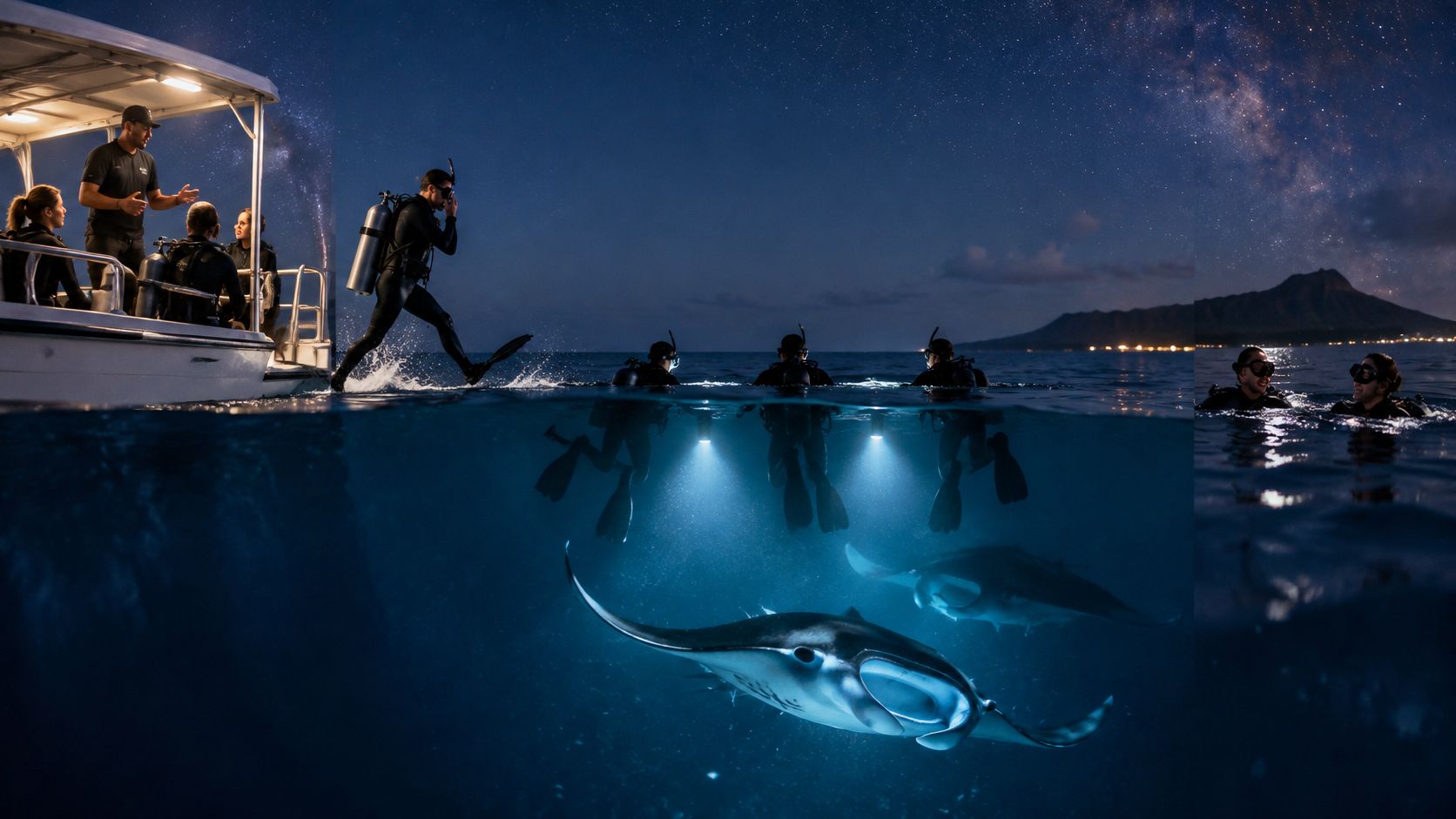
A well-run manta night isn't a search through dark water. It's an organized arrival at a feeding area, followed by quiet observation from an assigned position. Our dive is stationary and closely supervised, with experienced guides helping divers stay comfortable.
Before the first manta arrives
Listen to the full briefing.
Our crew explains the science of the encounter and the rules of passive observation before entry. Pay particular attention to descent procedures, hand signals, light placement, and how to request an early exit. Understanding the plan keeps a small equipment problem from becoming a distracting underwater scramble.Enter with the group, not on your own schedule.
The Hawaii Department of Land and Natural Resources proposed framework specifies a viewing window of 4:00 p.m. to 4:00 a.m. the following day and a proposed 8:1 customer-to-guide ratio. These are proposal provisions, not a substitute for confirming the current operating requirements before departure. The document also calls for designated moorings, limited live boating, and no vessel departure while participants or crew remain in the water.Settle into the assigned sandy viewing area.
Divers kneel where directed, away from living reef, while snorkelers remain at the surface. Powerful dive lights form a bright circle on the seafloor, so the viewing area isn't in complete darkness. Keep fins tucked and equipment secured rather than adjusting everything once the animals arrive.
The transition from boat to viewing area deserves your attention. If you're unfamiliar with managing signals, instruments, and equipment after sunset, review our night scuba diving guidance before departure.
Let the feeding pattern develop
Watch the food, then watch the rays.
Lights concentrate plankton, and mantas follow that food concentration. They filter-feed as they move through the water, sometimes banking and looping through the illuminated lane. Nobody needs to hand-feed, bait, or direct them through a routine.Stay predictable while the guides watch the whole scene.
Experienced divemasters and instructors are in the water with our divers. Their job includes monitoring people, equipment, spacing, and animal movement, not just pointing at each approaching ray. Let them adjust the formation rather than moving into a better-looking gap yourself.Leave together when the guide ends the encounter.
Wildlife behavior, air supply, comfort, and conditions all matter more than squeezing in another pass. Follow the planned ascent and exit, then use the debrief to ask about behavior or distinctive markings you noticed. An orderly departure protects the feeding lane just as much as an orderly arrival.
A good night has a simple rhythm: mantas make steady feeding passes while divers remain settled. Nobody needs to chase them to make the encounter work.
Why Garden Eel Cove Beats Keauhou for Viewing
Garden Eel Cove is the superior choice for a manta dive. Its naturally sheltered location gives divers calmer, clearer water, a better viewing area, and better surrounding reefs. That combination matters most when you're trying to remain still, watch overhead, and avoid disturbing the bottom.
Garden Eel Cove is also called Makako Bay. Don't mistake those names for separate booking destinations.
Garden Eel Cove and Keauhou compared
| Factor | Garden Eel Cove | Keauhou |
|---|---|---|
| Typical aggregation size | Consistently larger in the long-term study | Smaller in the same study |
| Manta visitors by sex | Part of a combined study population with an overall ratio close to 1:1 | Disproportionately female visitors |
| Shelter from open ocean | Naturally sheltered, with calmer and clearer water | Assess conditions locally; don't assume equivalent shelter |
| Reef quality and viewing area | Better reefs and a better viewing area for the scuba itinerary | Less compelling choice for this scuba-focused itinerary |
| Best for | Most divers, especially first-time manta divers | Visitors evaluating a suitable surface-viewing departure |
More mantas isn't the whole argument
A 2025 University of Hawaii study of community-sourced records from 2010 through 2022 analyzed more than 23,000 sightings of 167 individually identified reef mantas, finding consistently larger aggregations at Garden Eel Cove, disproportionately female visitors at Keauhou, and an overall sex ratio across both sites of approximately 1:1. The distinction matters: the combined sex ratio isn't a separate estimate for Garden Eel Cove alone.
The study also linked changes in aggregation size to zooplankton density and found strong female site fidelity. In plain language, mantas return to familiar areas, but they still follow the food. A productive site is not a promise that every evening will look alike.
Crowding deserves equal attention. A 2022 DLNR community-input notice estimated approximately 60–70 viewing vessels bringing guests to the Makako Bay and Kaukalaelae Point areas while proposing a more structured access system.
That estimate covers the viewing areas together, not boats simultaneously surrounding a single group. Nor does the notice establish that every proposed limit is now in force.
Choose a site for the space and structure it gives the encounter, not just the largest manta count in a trip report.
For a first-time scuba visitor, Garden Eel Cove is the clear recommendation. Better reef surroundings improve the broader outing, while the viewing layout supports the quiet, stable formation that a manta encounter needs. Protection helps, but the captain still has to assess the ocean on the day.
When to Go for the Best Manta Night
Book around ocean conditions and recent feeding activity, not a supposedly perfect month. Aggregations change as plankton availability changes. A resident population makes Kona a dependable place to plan an encounter, but a familiar feeding site doesn't guarantee a busy night.
Kona's water remains warm year-round, so don't choose travel dates around wetsuit considerations alone. Your personal cold tolerance and the time spent stationary still matter. A comfortable diver pays more attention to the animals and less attention to getting back aboard.
Make these checks before choosing dates
- Request recent Garden Eel Cove reports. Ask whether recent encounters involved steady feeding, brief visits, or quiet evenings. A report about behavior tells you more than a dramatic photo without context.
- Keep a backup evening. Schedule the encounter early enough in your stay that a weather cancellation doesn't automatically end your chance to go. Leave breathing room around other activities rather than filling every evening.
- Confirm the actual departure arrangements. Ask about check-in, expected return, site access, and how the crew handles a busy viewing area. An organized schedule matters more than arriving at the same time as everyone else.
Our guide to the best time to see manta rays in Kona can help you plan your travel window. Use recent reports to refine expectations, not to demand that wildlife repeat yesterday's performance.
Booking insight: A flexible evening with suitable conditions is worth more than a rigid reservation built around a calendar claim.
Be cautious about treating the proposed state viewing window as a tour departure schedule. The operating framework and your booked check-in time serve different purposes. Confirm the schedule before paying, and follow any updates the crew sends before departure.
Rules and Responsible Viewing for Manta Encounters
A crowded encounter is an ecological issue, not merely a disappointing customer experience. These aren't interchangeable animals arriving from an unlimited offshore population. Repeated interference happens to mantas that use familiar local feeding areas.
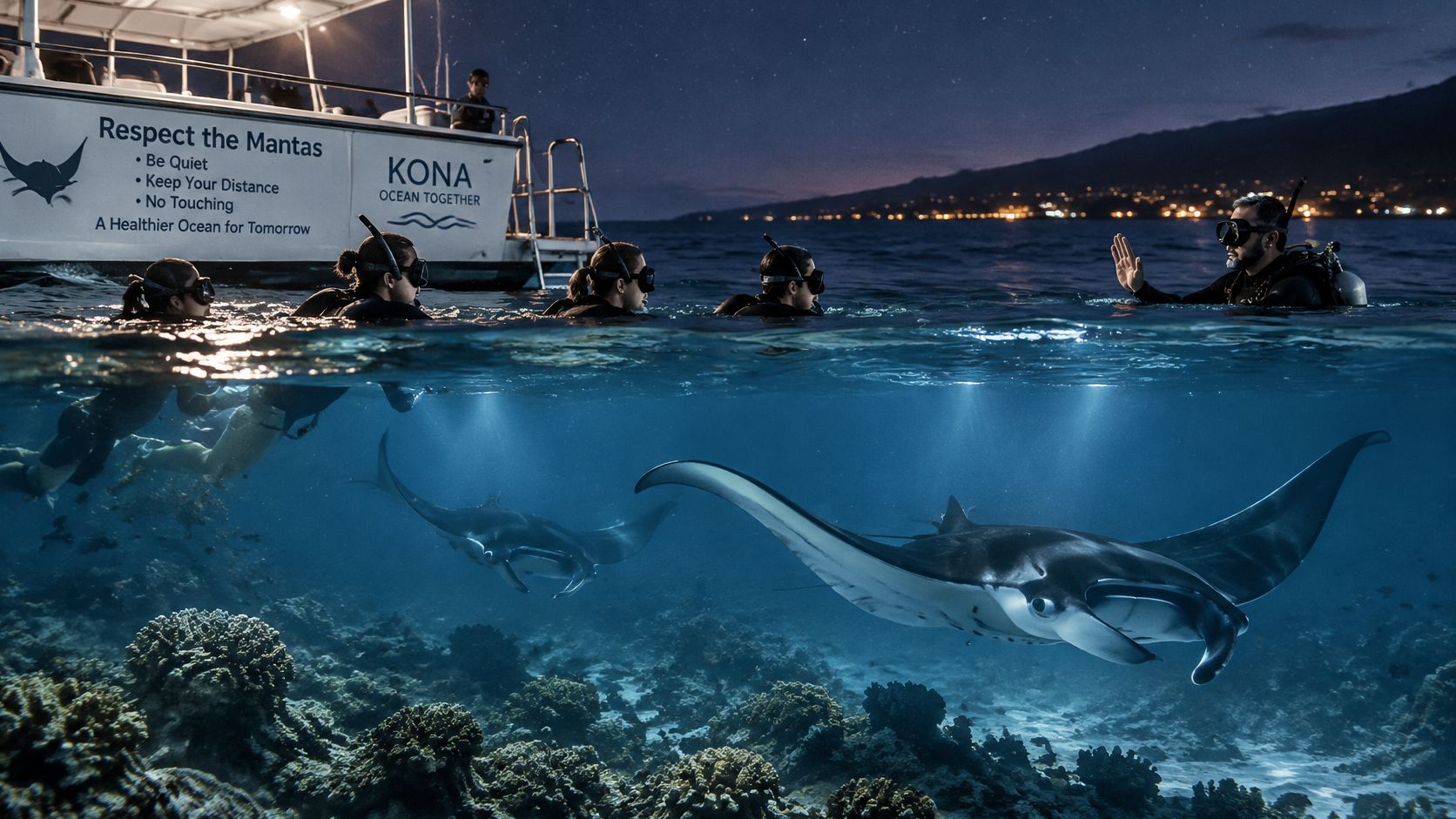
NOAA's manta ecology materials describe island-associated reef manta populations with strong site fidelity and limited interchange. That makes local disturbance consequential: another island's animals won't replace injured or displaced residents.
Understand the viewing-zone provisions
The DLNR manta-viewing rule document specifies commercial scuba only in the Makako Bay manta-ray viewing zone, commercial viewing inside a designated zone or at least seven nautical miles from its boundary, and restrictions on attraction lights more than 100 feet from an available viewing-zone campfire. Because this document belongs to the rulemaking materials, confirm the currently effective requirements rather than assuming every provision in the document has been enacted.
For the diver, the practical principle is straightforward: use the designated viewing arrangement. Don't establish a separate light station or swim away to create your own encounter.
Turn restraint into specific actions
- Control buoyancy. Stay neutrally buoyant during movement and use only the sandy position assigned by the guide. Don't plant yourself on coral or rise into an approaching ray's path.
- Keep your profile compact. Clip gauges, secure lights, and hold cameras close. Hands and equipment belong outside the feeding lane.
- Leave an exit. Never pursue, surround, or block a manta. An approaching animal still needs room to turn away.
- Follow light directions. Keep beams where the crew requests, rather than sweeping them across faces or tracking every turn.
A manta turning away doesn't prove distress. Still, repeated abrupt course changes near people, abandoned approaches after lights move, or difficulty maintaining a feeding path should prompt the guide to assess the setup. Guests shouldn't diagnose behavior and reposition themselves.
The appropriate response may be to adjust lights, tighten the formation, or end the encounter if interference continues. There's no universal guest count that makes every viewing zone safe, regardless of conditions and layout.
Use our responsible diver etiquette guidance as a preparation checklist. Judge an operator by stable diver positions, open feeding lanes, controlled lighting, an explained guide ratio, and willingness to shorten a dive for the animals. Guaranteed proximity belongs nowhere on that list.
What to Bring and How to Photograph Mantas at Night
Bring equipment you can manage without looking at it. A manta night isn't the place to discover that your mask leaks, your camera tray floats awkwardly, or your new accessory needs constant adjustment.
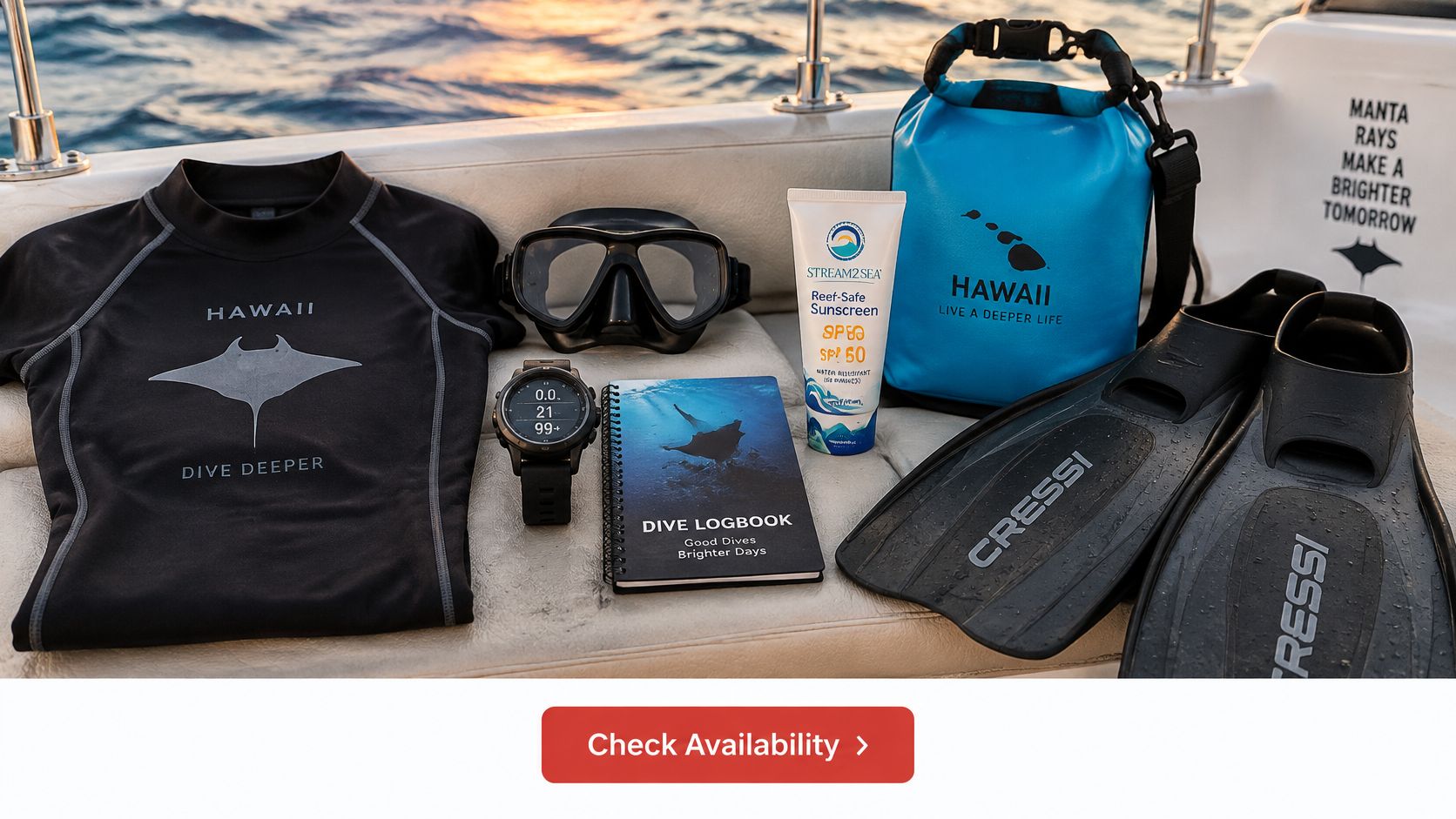
Pack for a stationary dive
- Exposure protection. Choose a properly fitted wetsuit suitable for your cold tolerance. Remaining still can feel cooler than actively swimming.
- Mask and fins. Favor familiar, well-fitting equipment over something new bought for the trip. Check straps and buckles before boarding.
- Dive computer and logbook. Bring your computer if you have one, plus whatever certification and experience records are requested.
- Sun protection. Apply reef-safe sunscreen well before the daytime portion rather than handling slippery equipment immediately afterward.
- Dry comfort. Pack a towel and warm layer for the return ride. Keep them in a dry bag.
The viewing lights supply the main illumination. Confirm what equipment is included in your reservation and whether you need a personal backup light. Don't arrive with additional high-output lighting and assume you'll be allowed to use it.
Build the photograph around your position
Start with a wide-angle lens. It lets you include a nearby manta without backing into another diver or stretching the camera into the feeding lane. Compose from your assigned position and accept that some passes won't produce a usable frame.
Prefocus on the expected path through the light circle, then use manual focus if autofocus keeps hunting in the dark. Choose a shutter speed that preserves movement detail and raise ISO as needed to support it. Higher ISO alone doesn't freeze motion, but it can help you maintain a faster shutter speed in limited light.
Use short bursts selectively, then lower the camera and watch. Continuous shooting can absorb your attention until you stop noticing your fins, buoyancy, or neighbors.
The animal's path matters more than the frame. Let an imperfect angle go.
Avoid flash and sudden strobe bursts unless the operator explicitly permits them. Don't add intrusive illumination because the image looks dark on your screen. Keep both hands on the camera when shooting, secure it when not shooting, and never reach toward an animal.
Browse our Kona manta photography guidance before choosing your setup. The most useful preparation is learning your controls in advance, so you can change settings without drifting. Patience and steady positioning produce better opportunities than pursuit.
Costs, Cancellations and How to Book
Book the Garden Eel Cove manta night with Kona Honu Divers, choosing the format that matches your certification and comfort. The protected location, stronger viewing area, and better reefs make it the right scuba recommendation. Use the diving tour schedule to check current departures and requirements.
Compare the complete booking cost
Don't compare a surface-viewing ticket with a charter that includes a daytime scuba dive as though they're the same purchase. Trip length, rental equipment, certification requirements, and included diving all affect the total. Check current rates and inclusions at checkout rather than relying on an old price in a travel post.
Our manta night has encounter rates of up to 92%. That's an encounter record, not a wildlife guarantee or a promise about how long an animal will remain.
Weather and ocean conditions can change the plan. Read how weather cancellations, guest cancellations, rescheduling, and missed check-ins are handled before paying. Keep your confirmation and the terms attached to your reservation.
Reserve in the right order
- Choose the appropriate format. Match the activity to your certification, recent diving, and comfort after dark.
- Prepare your credentials. Have your certification card available and decide whether to take the manta specialty beforehand.
- Select an early date. Our most popular trips, including the manta night, often sell out weeks in advance. Keep another evening available when your itinerary allows.
- Review the terms. Understand the cancellation deadline and what happens if the operator cancels for conditions.
- Arrive ready for check-in. Leave enough time for paperwork, equipment fitting, and the full briefing.
Before paying, get clear answers to these questions: What's included? What happens in rough weather? What's the cancellation deadline? What's the in-water guide ratio? Must I bring a certification card or medical form? Raise medical or comfort concerns before arrival, not while the boat is preparing to depart.
The best encounter comes from a calm, stationary group at a protected site. Book for that setup, then let the mantas decide how the night unfolds.
Kona Honu Divers offers guided manta encounters with underwater viewing for certified divers and surface viewing for snorkelers. Visit Kona Honu Divers to choose your Garden Eel Cove outing, confirm the requirements, and reserve a date that leaves room for changing ocean conditions.