
You have two tabs open, a flight into Kona already booked, and a night that has to work for a certified diver and a partner who has never used a tank. The listings all promise manta rays. They do not tell you whether the water will be calm, whether twenty other lights will be in your face, or whether you will spend the dive kneeling in a clean lane or bumping strangers in the dark.
Manta ray dives of Hawaii come down to that gap. Seeing a ray and having a calm, high-quality encounter are different outcomes. Score the night on site shelter, group size, and crowding, not only on whether an animal shows up.
Where to See Manta Rays in Kona and How They Compare
| Site | Setting | Typical manta group | Best for |
|---|---|---|---|
| Garden Eel Cove (Makako Bay) | Sheltered from open ocean, calmer and clearer water | Larger, more variable groups | Most visitors, first-timers and divers wanting a defined viewing area |
| Keauhou Bay | Recorded nighttime aggregation site | Smaller, steadier groups; 91% of sightings female-biased | Photographers seeking repeat views of the same animals |
Garden Eel Cove, also called Makako Bay, is the site I would book for a first night. It sits sheltered from the open ocean, so the water stays calmer and clearer than on an exposed point. The viewing area is a defined patch of sand, which means you kneel in one place instead of hunting along a reef edge. Reefs around that sand give the rest of the dive something to look at if the rays take their time.
A 13-year Kona dataset published in Environmental Biology of Fishes covered more than 23,000 sightings of 167 individually identified reef mantas. Garden Eel Cove supported larger and more variable groups with relatively balanced nightly sex ratios. Keauhou produced smaller groups, and 91% of recorded sightings there were female-biased. Group size tracked zooplankton through the year, and the nighttime aggregations stayed predictable even with tourism and artificial lights in the mix.
Keauhou Bay is the second named aggregation site. Smaller, steadier groups suit a photographer who wants repeated passes from the same animals, especially females that keep using one spot. It is a poor default if you want room to spread a group and a sheltered bottom you can hold.
Reef manta rays (Mobula alfredi) are the coastal species on these nights, not the ocean-roaming giant manta. They filter feed, looping through a patch of plankton with cephalic fins unfurled. They are not hunting you, and they are not performing on a schedule.
Crews place underwater lights so plankton collects in the beam. The rays learn those lit patches and return to feed. You are watching a feeding station, not a random fly-by, which is why a sloppy light or a diver in the lane changes the whole night.
Kona Honu Divers runs its manta ray night dive with Garden Eel Cove as the go-to site. Shelter, a real viewing area, and better surrounding reef make it the superior choice for most visitors.
Treat Garden Eel Cove as the default. Pick Keauhou only if you have a specific reason, such as a repeat visit aimed at the same animals, and you accept a smaller group in a less sheltered setup.
When to Go and What Changes Your Odds
The calendar month matters less than plankton and water conditions. A quiet Tuesday in a "good" season can be thin, and a midweek night after a plankton pulse can be excellent.
| Factor | What it changes | What to do |
|---|---|---|
| Zooplankton density | Strongest driver of group size | Ask about recent nights before booking |
| Season | Aggregation size varies through the year | Use recent site records, not the calendar alone |
| Site fidelity | Repeat visits by the same animals | Expect familiar animals, but no fixed count |
| Tides and currents | Concentrate plankton in predictable spots | Choose a flexible date if the first night is weak |
| Water shelter | Visibility and calm water | Choose a sheltered site such as Garden Eel Cove |
| Peak booking periods | Popular departures fill early | Book early for holiday weeks |
Zooplankton is the lever. When the prey is thick, more rays stack into the light. When it is thin, you may still see animals, just fewer loops and longer gaps. Ask what the last few nights looked like at the site you will use. A month name on a blog will not tell you that.
Season shifts the size of the aggregation, so a July booking is not automatically better than a January one. Females in particular reuse the same locations, and males move more. You may recognize belly spots from a photo set, and you still should not expect a head count.
Tides and the shape of the island pile plankton into known spots, then move that pile. If night one is weak, a second date is worth more than switching sites at the last minute. Shelter is the other half of the bet. Garden Eel Cove's protection from open-ocean swell is what keeps the viewing area usable when a more exposed bay is churned.
Holiday weeks fill first. Our most popular trips, including the manta ray night dive, often sell out weeks ahead. A reliable crew will share recent sightings and say plainly when the night looks poor, which is the standard behind any honest best time to see manta rays in Kona.
Practical rule: Book the sheltered site, then keep one backup night if your schedule allows. Conditions move faster than the brochure season.
Choosing the Right Manta Experience for Your Level
| Option | Who it suits | Requirements |
|---|---|---|
| Manta ray night dive | Certified divers who want to kneel on the bottom and watch closely | Scuba certification; the 2-tank manta charter needs Open Water or higher and diving within the past 2 years |
| Manta ray night snorkel | Non-divers, families and first-time snorkelers | No certification; comfortable floating at night |
| Blackwater night dive | Experienced divers wanting a deeper night encounter | Experienced divers; confirm current rules |
| Premium advanced two-tank trip | Experienced divers seeking remote reefs | Confirm current experience rules before booking |
Match the option to the person who will be in the water, not to the person who wants the most impressive story.
The night dive is for certified divers who can kneel, hold buoyancy, and watch. You are on the sand, looking up, with task loading that includes a light, a buddy, and dark water. The night snorkel fits non-divers, families, and anyone who can float in open water after sunset. Same animals, less gear, and a view from above the light field.
Snorkelers stay at the surface over the lit area. Divers kneel on the sand below them. Non-divers see the rays from a shallower, safer position, and they still need to keep fins off the bottom and off other people. If your group is mixed, splitting dive and snorkel on one night is usually cleaner than forcing a hesitant swimmer onto scuba. A direct comparison of whether to snorkel or dive with manta rays is the decision most groups should make before they pick a boat.
A survey of 444 manta-viewing participants found that 82% felt crowded by snorkelers, 78% by boats, and 69% by scuba divers. 67% met more scuba divers than they found acceptable, and 68% met too many boats. In related findings, 79% of snorkelers reported conflict with other snorkelers, and 53% of scuba divers reported conflict with other divers. People described bumping, poor spatial awareness, and lights in the eyes. Higher crowding lined up with lower satisfaction and a greater chance visitors would not come back.
How crowding should change the booking
- Separate zones: Ask whether divers and snorkelers have distinct areas. Mixed piles are where fins, cameras, and lights collide.
- Your own skill: If you cannot hold a kneel, you will drift into someone else's shot and into the feeding path. Pick the snorkel.
- Departure timing: A later or smaller boat will not create more rays. It can create fewer elbows.
- Deeper follow-ups: The blackwater night dive and the premium advanced two-tank trip are for divers who already handle night or long-range work. Confirm the current rules before you add either one.
Seeing rays on a packed night is still possible. A calm encounter is the one where you chose a format you can hold without correcting every minute.
Night Dive Steps and In-Water Rules
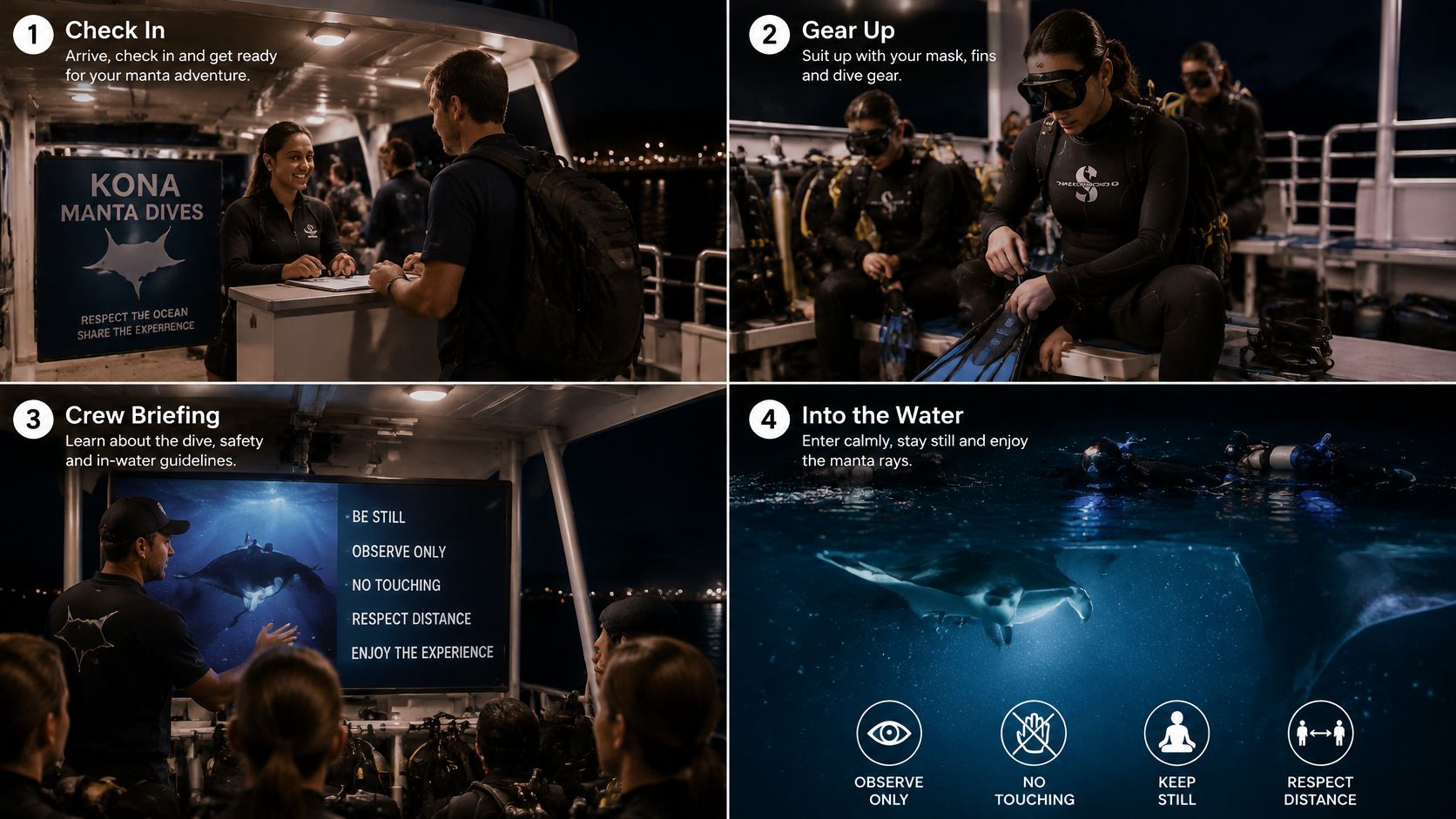
One night at Garden Eel Cove has a fixed shape. The NOAA wildlife-interaction guidance is the backbone: stay on sand, rubble, or boulder, leave an open water column, form a semicircle, and hold lights up so plankton gathers in the feeding area. That protected cove is why the rules are doable. You can kneel on a stable bottom without sitting on live coral.
From the dock to the kneel
- Check in, gear up, and take the briefing. Crews cover passive observation and a strict no-touch rule before anyone is wet, including why the rays are there and where you will sit. The common slip is treating the briefing as a formality and then inventing your own position on the bottom.
- Descend to the sand and kneel. Stay off coral, sea urchins, and other marine life while snorkelers float above the same viewing area. A buoyancy error here, a late dump or a panicked inflate, kicks silt into the lane and forces a second correction that shoves you forward. Do a buoyancy check on the boat, with the light and camera you will carry, so the first minute on the sand is a settle, not a rescue.
Powerful dive lights build a bright circle on the seafloor, so you are not kneeling in a blackout. Plankton drifts into those beams. If your light points at a ray's eyes, or at another diver's mask, you have turned a feeding tool into a distraction.
While the rays are looping
- Leave the lights on and your body still. Plankton collects where the beams meet above the group. Your job is to be furniture.
- Hold the light above your head, keep the semicircle, and leave the water column open. Rays loop through that open space. Sit in front of them, or stack yourself above a neighbor, and you block the path the guidance says to keep clear. Drifting out of the viewing area is the other slip. You think you are "getting closer." You are leaving the station and stirring a new patch of sand.
- Watch without chasing or touching. Keep fin kicks low so you do not sandblast the person beside you. Stay with your buddy and the group, and signal the crew if you feel unsafe. Guides are in the water on these dives, and the night is stationary and closely supervised, which only works if you stay where you were placed.
- Surface with the group. The crew's count of animals happens after everyone is back, not while people peel off early for a private pass. An early exit breaks the buddy system in the dark.
What a crowded night asks of you
On a busy evening, move to a quieter part of the same viewing area or ask the crew to reset positions. Do not solve crowding by swimming into the lane. Responsible diver etiquette is the difference between a loop you can watch and a cloud of silt with lights in it.
Stay low, light up, and let the ray choose the distance. Chasing never produces a better look than the next natural pass.
What to Bring and How to Photograph Mantas at Night
Night photography here is patience with a looping animal, not a lucky grab. You will get a handful of frames worth keeping on many nights, and you will miss more than you keep.
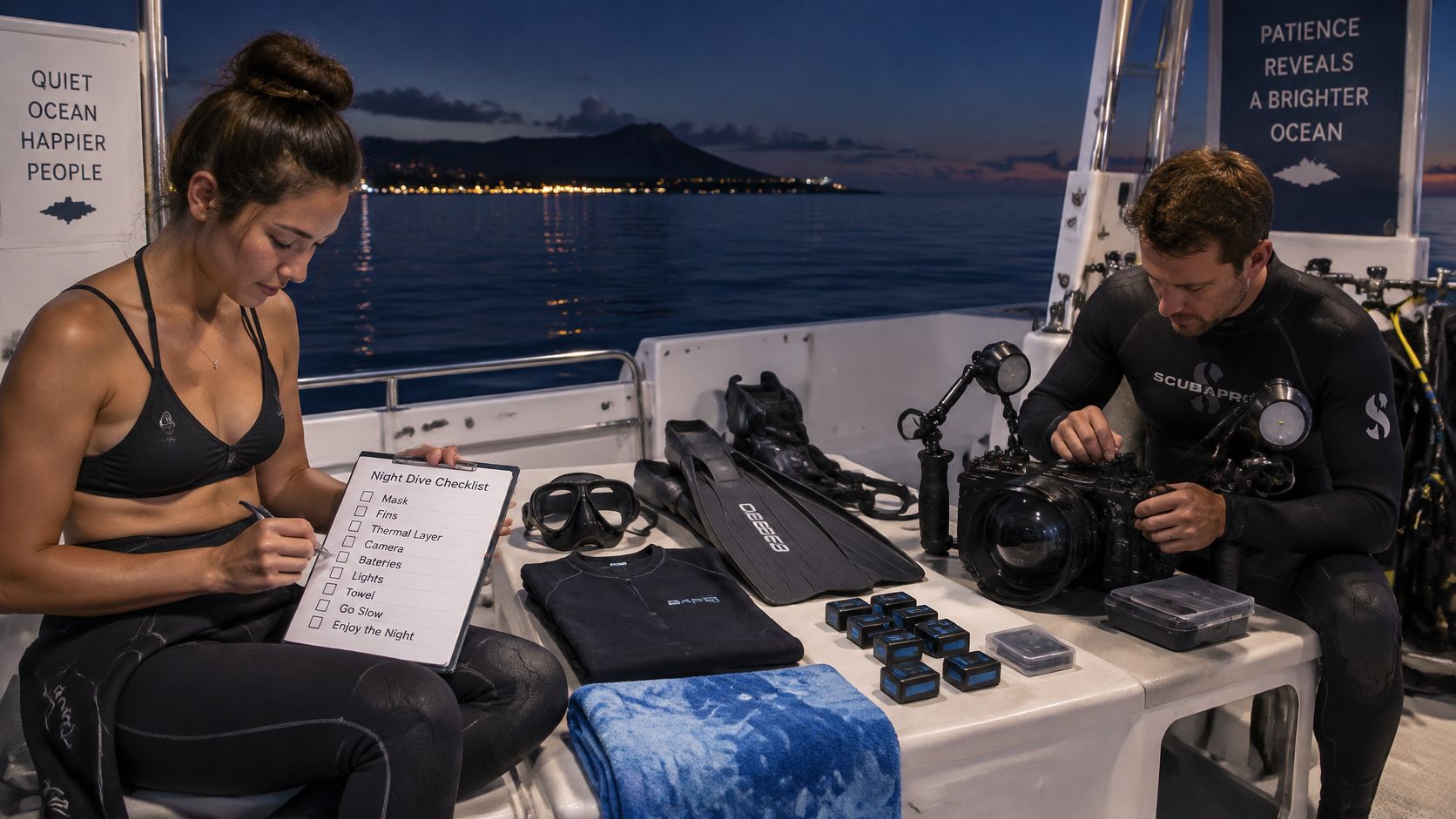
Packing list you can tick off
- Swimwear plus a thermal layer: The boat ride back is cooler than the water feels.
- Reef-safe sunscreen: Put it on before you board, not on the deck at sunset.
- Towel and a dry bag: The bag is for the phone, not for a pile of loose gear.
- Backup dive light: Divers should not rely on a single lamp once the site goes dark.
- Camera or housing, with a spare battery: Cold boats and long briefings eat charge.
Settings and habits that actually work
Use a wide-angle lens so the ray and the light field sit in one frame. A fast lens and a high ISO fit dark water better than a daylight setup you forgot to change. Turn strobes off, or fire them rarely. A sudden flash in a feeding lane startles animals and blinds the diver next to you.
Shoot from low on the sand. Swimming up for a belly shot puts you in the lane everyone else is trying to keep open. Burst mode matches the loop: the animal is in the beam for a second, then gone. Focus on the cephalic fins. They are the sharp edge that makes the frame look intentional instead of like a grey blur.
If the camera pulls your buoyancy around, clip it and watch. A calm group is what makes the next pass photographable. For a sense of what careful nights produce, look through these manta ray dive pictures from Kona and notice how many strong frames are shot from a fixed, low position.
Why Kona’s Manta Rays Need Protecting
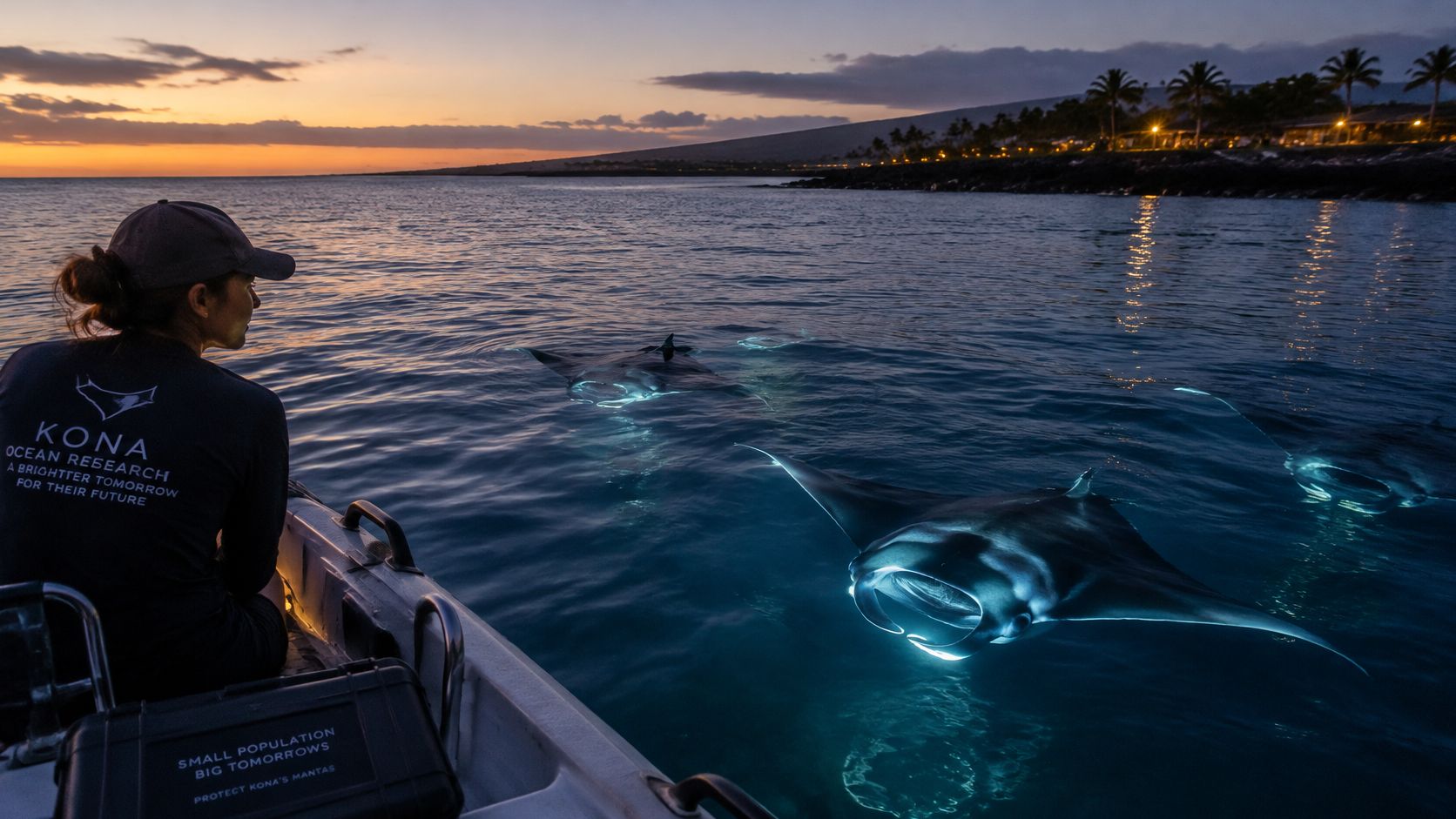
Kona's night encounters rest on a small local population. A 2023 peer-reviewed genomic study, summarized in this account of Hawaiʻi Island reef mantas, estimated a contemporary effective population size of approximately 104 reef manta rays for Hawaiʻi Island, with a 95% confidence interval of 99 to 110. At that scale, one injured animal is not a rounding error.
How the feeding station became an industry
Artificial lights collect plankton. Rays feed on those patches. Boats learned the pattern and built trips around it. The behavior is real, and it is also easy to overload. More hulls, more lights, and more people in the lane do not create more mantas. They crowd the same few animals.
Hawaiʻi's proposed commercial manta-viewing rules would limit operations to department-designated manta-viewing zones, or require vessels to remain at least seven nautical miles from any designated-zone boundary. Garden Eel Cove, also known as Makako Bay, is one of the Kona locations discussed in that management context. The point of a zone is simple. Tours belong in defined areas, not "anywhere along the coast" because a light can be dropped there.
Be wary of a pitch that treats every bay as interchangeable. A protected viewing area is part of how you keep both the animals and the encounter intact. Our approach to that standard is spelled out on our eco-friendly diving page.
What you can do on the night
- Follow the briefing: Position, lights, and the no-touch rule are the management plan you can carry out.
- Stay inside the viewing area: Wandering "for a better angle" is how lanes collapse.
- Do not touch: Skin contact is not a souvenir.
- Pick crews that stay in the zones and say so: Support is a booking choice, not a speech after the dive.
Book Your Garden Eel Cove Manta Dive
Book the Garden Eel Cove manta night dive unless you have a specific reason to be somewhere else. The shelter, the sand viewing area, and the larger recorded groups are why it wins for a first-timer.
Reserve in this order
- Match the trip to your certification. The night dive is the close, kneeling view. The night snorkel is the surface view for non-divers. Do not upgrade someone into scuba to keep the group together.
- Confirm departure time and group size. A listed "manta night" can still be a crowded boat. Ask how divers and snorkelers are separated.
- Ask for recent sightings at Garden Eel Cove. You want the last few nights, not a seasonal average.
- Only then look at advanced add-ons. Blackwater and the premium long-range two-tank are different dives for people who already meet the experience bar. Confirm those rules before you stack them onto a manta night.
- Reserve early. Popular nights, including this one, often sell out weeks ahead. Waiting for a perfect forecast usually means the boat is gone.
The broader set of Kona diving tours covers morning reefs and training if the manta night is only one piece of the trip. For this night, lock the sheltered site, the format you can hold, and a crew that will tell you when the plankton is thin.
Kona Honu Divers runs guided manta nights at Garden Eel Cove, with a supervised viewing area for certified divers and a surface snorkel for everyone else, plus reef, blackwater, and advanced charters when you want more than one kind of night. If you are planning manta ray dives of Hawaii and want the sheltered site, a clear briefing, and a crew that treats crowding as part of the plan, visit Kona Honu Divers and reserve the night that matches your level.