
You're looking at a manta night dive booking page, wondering what it feels like to enter the ocean after sunset. Will you be swimming around searching for animals, or waiting in one place? And why do all the photographs show such bright underwater lights?
The simplest way to understand the manta ray dives of Hawaii is to start with dinner, not diving equipment. The lights help gather tiny drifting animals called zooplankton, and manta rays come to eat them. Your role is to watch that feeding system without getting in its way.
Why Kona Became the Center of Manta Ray Night Diving
Stand on a Kona dock after dark and the lights offshore can look like an elaborate wildlife attraction built for visitors. The history is less deliberate. People noticed animals feeding near shoreline lights, then gradually learned how to observe that behavior.
Floodlights at the Kona Surf Hotel began attracting plankton in the early 1970s, followed by feeding mantas; Lefty, the first Kona manta in long-term records, was documented in 1979, and organized scuba excursions emerged around 1991, initially as a once-weekly activity, according to this history of Kona's manta night dives.
When the shoreline lights went dark
The same historical account describes a revealing change: after the hotel closed and its lights went off around 1999–2000, feeding activity reportedly shifted approximately 16 miles north toward the airport, then returned south when the property reopened as the Sheraton Keauhou Bay Resort in 2004–2005.
That sequence helps explain why Kona has established viewing areas rather than a single place where every manta encounter happens. The northern location became associated with Garden Eel Cove, also called Manta Heaven, while the southern location remained part of Keauhou's manta-viewing tradition.
The important distinction is between attracting food already present in the water and physically managing an animal encounter. Operators aren't holding rays in place or handing them bait. The animals approach a feeding opportunity and decide whether to remain.
Keep this distinction in mind: The lights create an opportunity to observe feeding. They don't turn the ocean into an aquarium.
What that history means for visitors
Think of the viewing site as a familiar dining area rather than a stage. Familiarity can help people organize an observation trip, but it doesn't give anyone control over the diners.
For a visitor, that changes the right question to ask before booking. Instead of asking only whether mantas visit a location, ask how the crew arranges the viewing area and keeps people clear of feeding animals.
The history also explains why darkness is central to the experience. Those illuminated patches aren't decorative lighting for photographs. They're part of the relationship between plankton, hungry rays, and the people watching nearby.
How Night Manta Dives Work Beneath the Surface
Think about a porch light attracting moths. An underwater light works as a useful analogy, except the small animals gathering in the beam are zooplankton, and the larger visitors arriving to eat them are manta rays.
Reef mantas are plankton feeders. They need concentrated patches of prey even though tropical waters are generally nutrient-poor; at Kona's nighttime sites, lights gather plankton into feeding areas through which the rays can make repeated passes, as described in research on Hawaiian reef manta ecology.
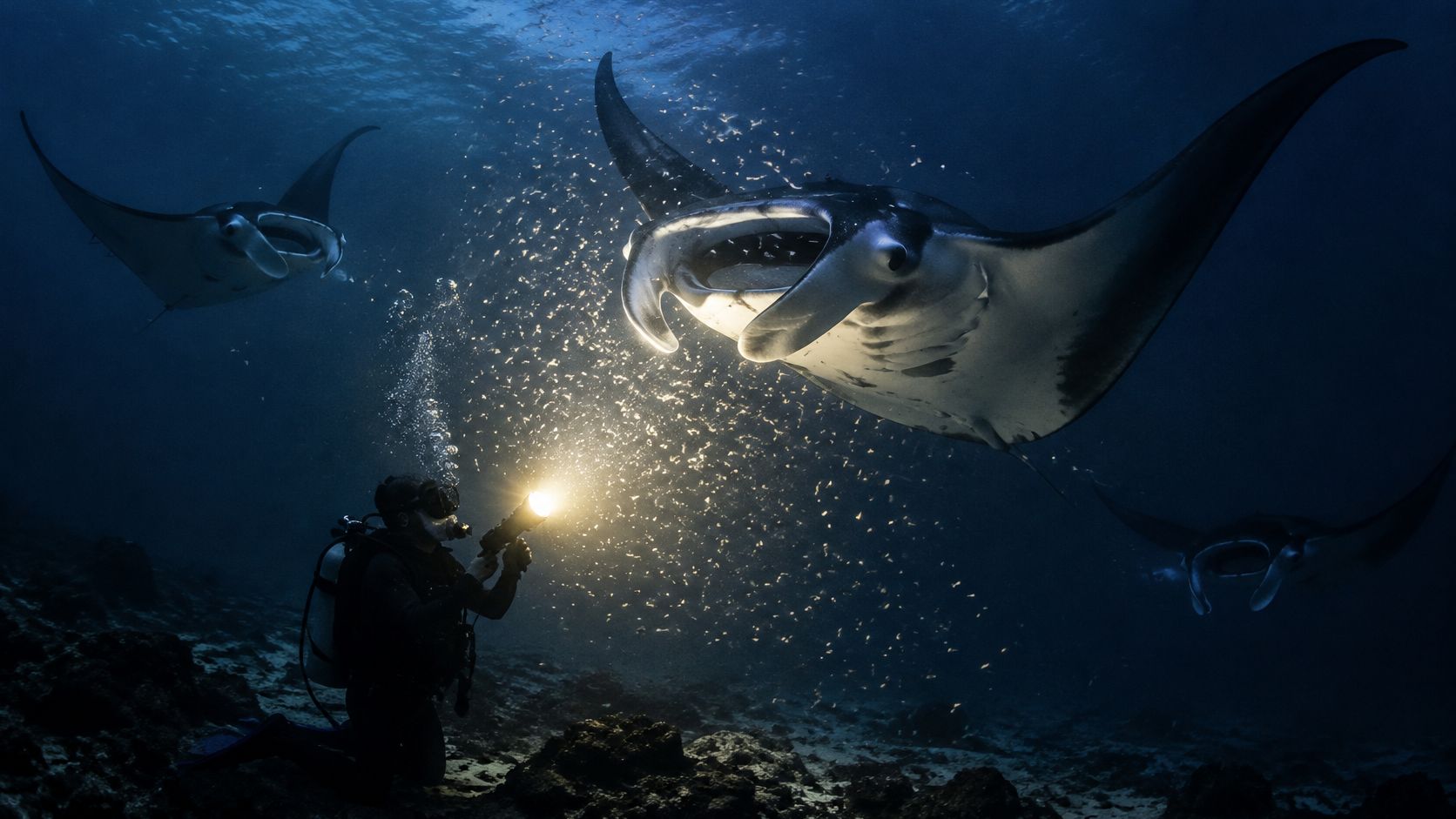
Leave the feeding corridor open
The beam isn't just a spotlight pointing at a manta. It helps define a feeding corridor, the space the animal uses to approach and pass through concentrated prey.
The practical guidance associated with that feeding setup is straightforward:
- Stay in your assigned position. Remain stationary in the designated bottom viewing area rather than rising toward an approaching ray.
- Keep equipment close. Cameras, strobes, hoses, and other accessories shouldn't project into the animal's approach path.
- Move lights deliberately. Avoid abruptly sweeping beams around the viewing area.
- Let the animal choose its route. Don't follow a ray or try to steer it toward your position.
These aren't arbitrary rules intended to make the group look tidy. They help keep the approach clear and the light-and-prey arrangement consistent.
Understand the depth without confusing it with your dive plan
The same ecological research indicates that Hawaiʻi Island mantas typically spend most of their time shallower than 50 meters when feeding or visiting cleaning stations. That describes their broader habitat use, not the depth you should expect or attempt on a particular tour.
Your operator's briefing establishes your actual viewing depth, entry procedure, signals, and exit plan. If darkness itself is your main concern, reviewing what to expect when scuba diving at night can help you identify questions to ask beforehand.
The right mental model is an active feeding system, not a scheduled animal performance. A well-organized dive gives you a place to observe it. It can't require a manta to arrive.
Garden Eel Cove Versus Keauhou for Your Dive
Garden Eel Cove is my stronger recommendation for a manta scuba tour. The reason isn't just the possibility of seeing more animals. Its protected location, defined viewing space, and surrounding reef habitat make it particularly well suited to watching from below.
Also called Manta Heaven or Makako Bay, it lies near Keahole Point and Kona International Airport, is accessible only by boat, and has an operator-managed illuminated viewing area beside a sandy slope and reef margins, according to this Garden Eel Cove site description.
Kona Manta Viewing Sites Compared
The published comparison describes sites approximately 20 kilometers apart, with larger, more variable aggregations at Garden Eel Cove and generally smaller aggregations at Keauhou, where 91% of sightings were female, in this long-term analysis of Kona's manta aggregations.
| Site | Setting and Access | Aggregation Pattern | Best Fit |
|---|---|---|---|
| Garden Eel Cove | Northern, boat-access site with a defined lighted viewing area, sandy slope, and adjacent reef | Larger and more variable aggregations | Divers prioritizing overhead viewing space and a reef-conscious layout |
| Keauhou | Southern established nighttime feeding location; confirm departure and access arrangements with the operator | Generally smaller aggregations with strongly female-biased sightings | Visitors particularly interested in the female-dominated site-use pattern |
The table describes patterns, not promises. A larger typical aggregation doesn't mean Garden Eel Cove will have more rays on every visit.
Why the sandy viewing area matters
A published dive description places Garden Eel Cove's principal viewing area at approximately 30–40 feet, with daytime garden eels around 60 feet, and describes the sandy amphitheater that supports upward viewing without settling on living coral in this overview of Kona dive sites.
That layout is the practical advantage. Divers can occupy an appropriate sandy area while leaving the adjacent reef alone and maintaining an open view above them.
For this particular activity, I consider that a better reef-and-viewing combination than choosing a site solely because mantas have been seen there. It isn't a claim that every patch of reef at one location is healthier than every patch at the other.
- Choose for the experience underwater. Ask where divers settle and how the crew keeps the viewing lane clear.
- Keep conditions in the decision. A protected setting doesn't remove the need for the crew's assessment.
- Use population differences as context. Keauhou's female-biased sightings are biologically interesting, not a quality ranking.
For a closer look at the naming and location differences, consult this comparison of Manta Heaven and Manta Village. For most visitors seeking a scuba-focused manta tour, Garden Eel Cove's viewing arrangement remains the stronger choice.
Best Seasons and Nightly Timing for Manta Dives
The most useful planning question isn't which month is best. It's what makes a feeding location attractive on the night you're there.
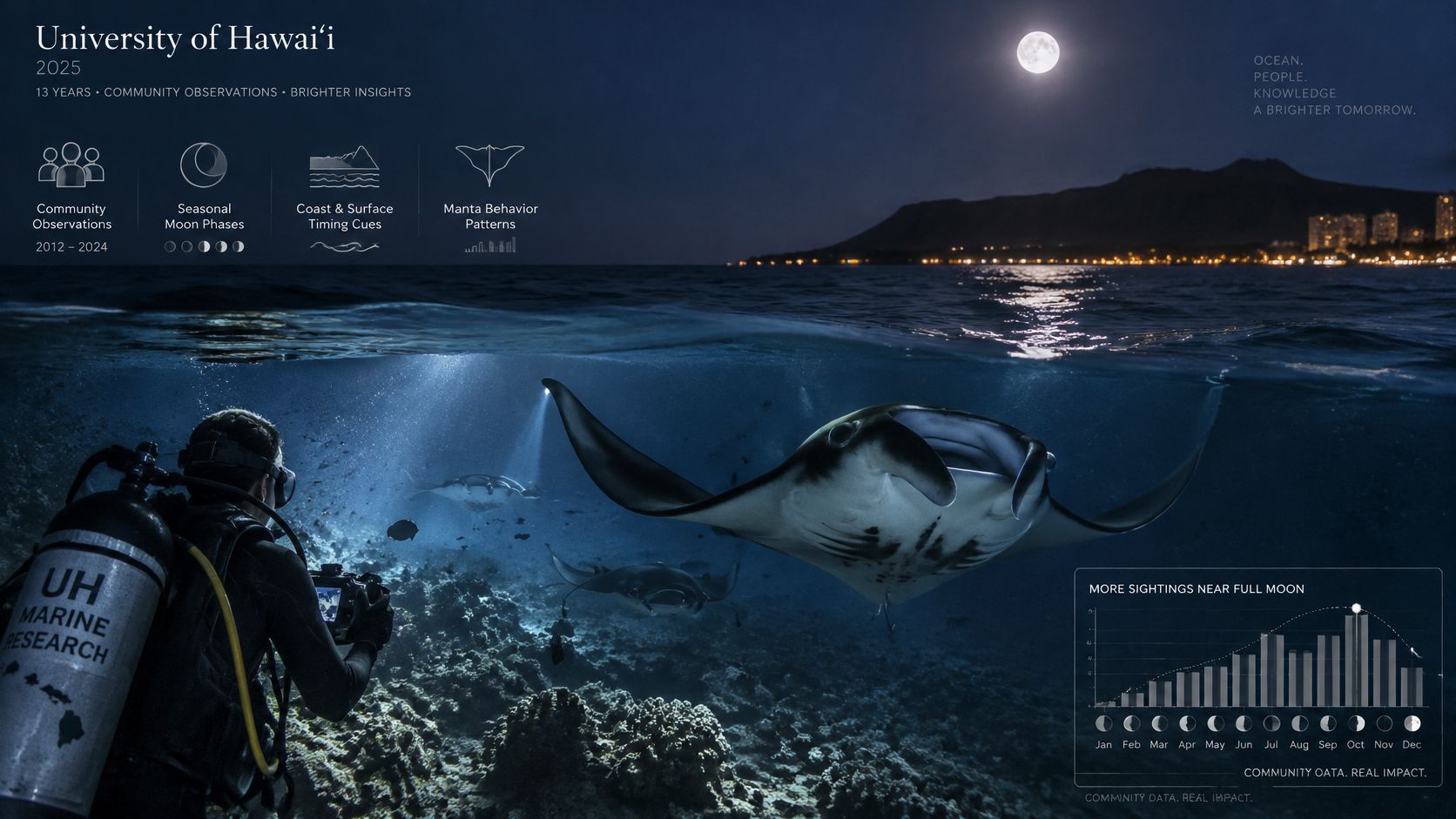
A 2025 University of Hawaiʻi study analyzed 13 years of community-sourced observations, covering 2010–2022, with more than 23,000 sightings of 167 individually recognized reef manta rays at Garden Eel Cove and Keauhou, as detailed in the university's research record.
What the observations tell us
The researchers linked changes in aggregation size to zooplankton density. They also reported relatively stable aggregations despite increased tourism during the study period, with no indication that the activity levels studied had reduced local population viability.
That finding is reassuring, but it needs careful interpretation. It doesn't mean unlimited tourism would be harmless, and it doesn't turn a long-term pattern into a prediction for your reservation.
For choosing travel dates, the useful lesson is narrower: prey availability matters more than choosing a calendar date alone. The findings don't justify promising the same number of animals every evening or naming an unbeatable month without additional evidence.
Plan flexibility rather than a guaranteed sighting
I'd leave room in the itinerary rather than make the manta trip the final possible activity before departure. If observing the feeding behavior is a central reason for your visit, you might consider booking a few evenings, provided the cost and your energy level make sense.
- Ask about the evening's schedule. Confirm check-in, departure, and the expected return rather than assuming every trip follows the same timetable.
- Ask about missed sightings. Understand the operator's actual policy before paying.
- Avoid chasing a supposedly perfect minute. The evidence supports attention to prey conditions, not a universal best clock time.
A reservation secures your place on a trip. It doesn't reserve a particular number of wild animals.
The viewing happens after dark, but the light-and-plankton conditions matter more than selecting an exact minute within the evening. Use this guide to timing manta encounters in Kona to prepare practical questions, then let the crew explain the plan for your departure.
Safety Considerations and What to Bring
Choose the version of the trip you can participate in comfortably. Don't book scuba because it sounds more impressive, and don't assume a surface activity requires no preparation.
Certification, swimming ability, and experience requirements should be confirmed for the specific tour. Explain your current skills accurately, including whether you've entered open water at night before.
Know what your position involves
Surface snorkelers typically hold a lighted board or remain above a downward-facing dive light, while divers stay near the designated underwater viewing area, as outlined in this guide to responsible Kona manta encounters.
That difference matters when you're assessing comfort. Ask yourself whether you'd rather manage scuba equipment below the surface or remain at the surface in darkness. Neither answer makes you a better wildlife observer.
Before committing, ask the operator to explain the entry, how the group stays together, what assistance is available, and how to signal that you want to stop. A clear answer is more useful than a general assurance that the trip is easy.
Pack for comfort and an uncomplicated return
Keep your belongings manageable, especially if you won't use them during the activity.
- Exposure protection suited to the conditions. Ask what the operator supplies and discuss whether you tend to get cold.
- A well-fitting mask. If you're bringing your own, check the strap and fit before departure rather than making adjustments in the water.
- A towel and dry clothes. Have them ready for after the activity.
- Protection for personal items. Ask what dry storage is available, and leave unnecessary valuables ashore.
- Required documentation and personal equipment. Confirm the operator's requirements rather than relying on another tour's packing list.
Rental equipment can simplify travel, but check what is included, what needs advance sizing, and what you're expected to bring. Divers considering nitrox should ask about availability and the applicable training requirements; it isn't a substitute for appropriate skills or a careful dive plan.
Before boarding: Tell the crew what makes you uneasy while there's still time to discuss it calmly.
“I'm comfortable in daylight, but this will be my first night entry” gives a guide something useful to work with. So does explaining a mask problem or uncertainty about holding position. Share those concerns before the briefing ends, not after you've reached the viewing area.
Photography Tips and Respecting Manta Rays
The photograph isn't worth leaving your position. Approach manta photography as a framing exercise: decide where the image will work, prepare your camera, and wait for an animal to enter the composition.
A ray moving through the light cone already gives you a subject and a visual setting. You don't need to manufacture a closer encounter by following it.
Compose from the place you've been assigned
Keep the camera within the space you're permitted to occupy. Frame the approach before the animal reaches you, and accept that some passes won't produce the angle you wanted.
- Choose a simple frame. Look for separation between the animal, the illuminated water, and distracting equipment.
- Keep lighting controlled. Use deliberate adjustments rather than swinging a light after every moving shape.
- Keep accessories contained. Check camera arms and strobes against the clearance guidance given during the briefing.
- Put observation first. If camera handling makes it difficult to maintain position, stop shooting.
My practical recommendation is to learn the rhythm before concentrating on images. Watch an approach, notice where the animal leaves the illuminated area, and decide whether that route offers a composition from your existing position.
Non-contact viewing is the standard
Don't touch, chase, or harass manta rays. The encounter guidance cited earlier explains that Hawaiʻi Department of Land and Natural Resources rules prohibit harassing or harming mantas in state waters, and that their protective skin mucus helps defend them against disease.
Avoiding contact therefore isn't just politeness. It protects a part of the animal that serves a biological purpose.
You can prepare by reviewing responsible and considerate diver etiquette, then applying the operator's site-specific instructions. If a closer photograph would require abandoning those instructions, let that photograph go.
A successful wildlife image records what an animal chose to do, not what a photographer made it do.
Patient photography and responsible viewing ask for the same restraint. Leave the route open, accept the angle available to you, and avoid turning another animal's meal into your pursuit. Protecting that freedom to feed is more important than bringing home a particular frame.
Choosing an Operator and Booking Your Night Dive
Book around site choice, participant readiness, and clear operating procedures, not a promise of extraordinary sightings. Ask which location the trip intends to use, why it suits the planned activity, and how the crew responds when conditions require a change.
For a scuba-focused evening, explain that you prefer Garden Eel Cove because of its protected setting and designated sandy viewing area. Treat that preference as a conversation with the crew, not an instruction to ignore their judgment.
Ask questions that reveal the actual trip
An operator should be able to explain what you're buying without relying on photographs alone. This guide to choosing a Kona dive company can help you organize the comparison.
- Confirm the format. Establish whether you're reserving scuba or snorkeling and what qualifications apply.
- Clarify equipment arrangements. Ask about rental fit, maintenance practices, exposure protection, and nitrox where relevant.
- Understand the viewing plan. Ask how people are positioned and how non-contact rules are communicated.
- Read the booking terms. Check cancellation, weather, and missed-sighting policies before reserving.
One option to evaluate is the publisher's manta ray dive and snorkel tour, alongside its full diving tour selection. Use the trip details to confirm the experience that matches your group rather than assuming every listing includes the same equipment or schedule.
Sample plans without an overpacked day
A diver's day: Consider a morning reef outing, followed by time ashore to eat, rest, and prepare for the evening manta activity. Before combining bookings, ask the operator to check the complete dive schedule and whether the evening package already includes a reef component.
A snorkeler's evening: Leave time to rest beforehand, organize dry clothes, and arrive ready to listen. Make the manta trip the evening's main activity rather than trying to fit it between tightly timed reservations.
Review recent guest feedback for comments about briefings, equipment help, and how crews handled uncertainty. Those details are more useful to your decision than excitement alone.
Once the format and requirements fit, check availability for your dates and reserve your night. Keep the confirmation handy so you can review arrival instructions without rushing.
For guided manta dive and snorkel options on the Kona coast, visit Kona Honu Divers. Ask about the planned viewing site, confirm the right format for your experience, and check availability to reserve your night observing the feeding rays.