
You've probably seen the photos: a manta's pale underside filling the frame as it glides above divers on the seafloor. The practical questions come next. Which site should you choose, what does the night feel like, and how can you tell whether a tour is organized around both guest safety and the animals' needs?
For manta ray dives of Hawaii, my recommendation is straightforward: prioritize Garden Eel Cove when conditions allow, choose the in-water format that fits your experience, and book with an operator that can explain its safety and wildlife protocols clearly. The rays are wild, and no crew can promise what they'll do on a particular night. A good crew can give you a stable place to watch without chasing them.
What a Manta Ray Night Dive in Kona Actually Feels Like
At Garden Eel Cove, the boat lights bring plankton into the water after dark. You descend to the sandy viewing area, settle into the place your guide assigns, and wait. When a manta enters the light, it may bank, turn, and loop overhead as it feeds. The most memorable part isn't speed or spectacle. It's staying still while a large wild animal chooses its own path through the illuminated water.
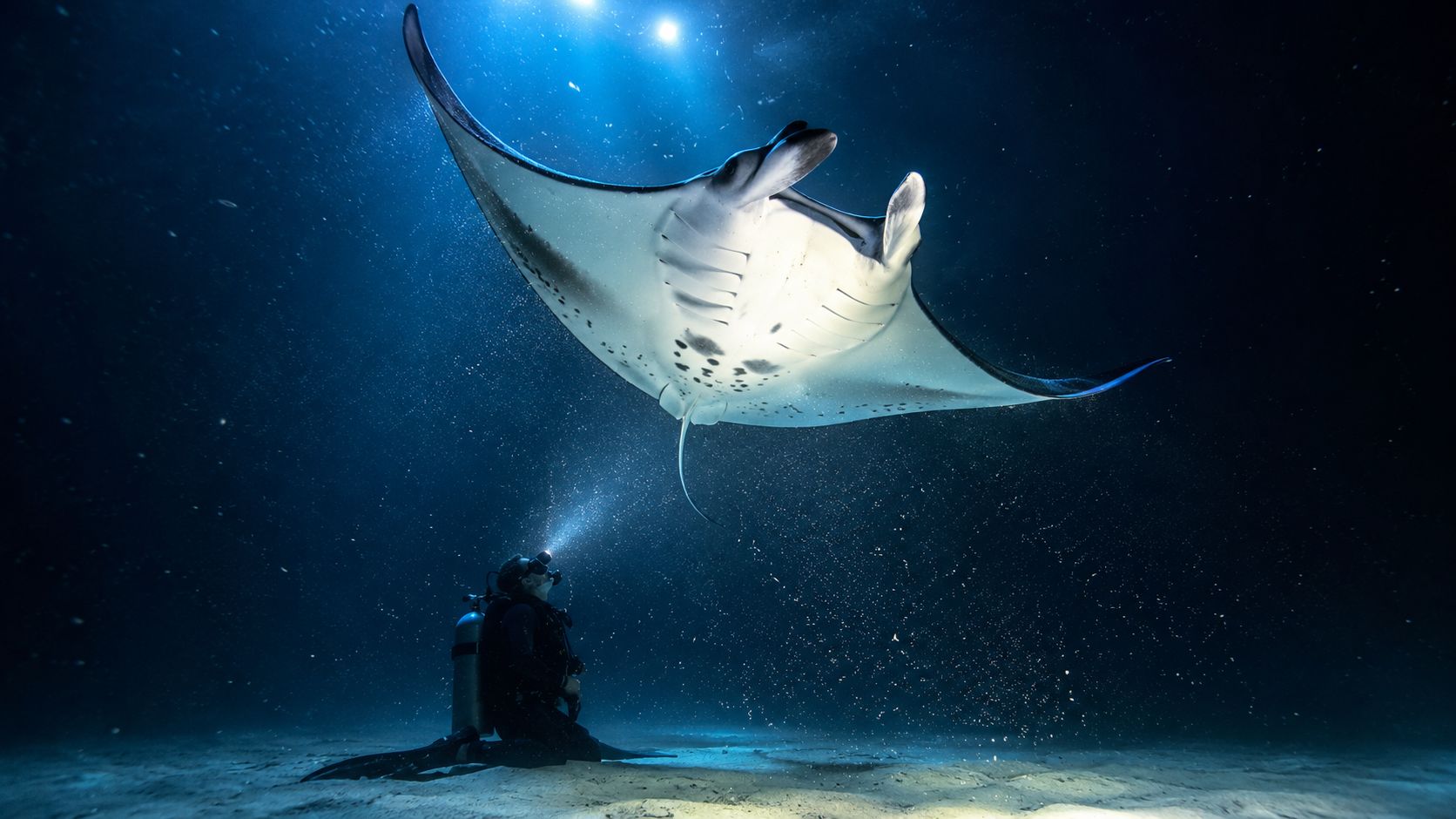
This isn't a typical reef dive, where you swim along a route and look for animals. For the manta encounter, scuba divers hold position near the bottom and watch upward. Snorkelers stay at the surface and look down. In either case, the animals do the moving. That's the point, and it's why comfort, buoyancy, and listening to the briefing matter more than trying to get closer.
The best seat is the one where you can stay calm and still. If you're working hard to manage your gear or position, you'll enjoy the encounter less and may disturb the feeding area.
Kona's manta dives are known for recurring encounters, but this is wildlife viewing, not a scheduled performance. In a six-year monitoring study, researchers recorded 25,444 sightings of 118 identified reef manta rays at Manta Heaven and Manta Village, showing how regularly a recognizable local population uses these aggregation sites (NOAA's monitoring study). The practical choices are where to go, when to book, and how to choose a crew that treats the encounter responsibly.
The Animals and Why Kona Is Special
At Garden Eel Cove, protected geography and a sandy viewing bowl give divers a clear place to settle while reef mantas feed above. Kona's night dives center on reef manta rays, Mobula alfredi. These filter feeders eat zooplankton, so the encounter depends on where prey gathers. Lights concentrate plankton in the water, creating feeding conditions that can draw mantas to a familiar area. They do not bring rays on command.
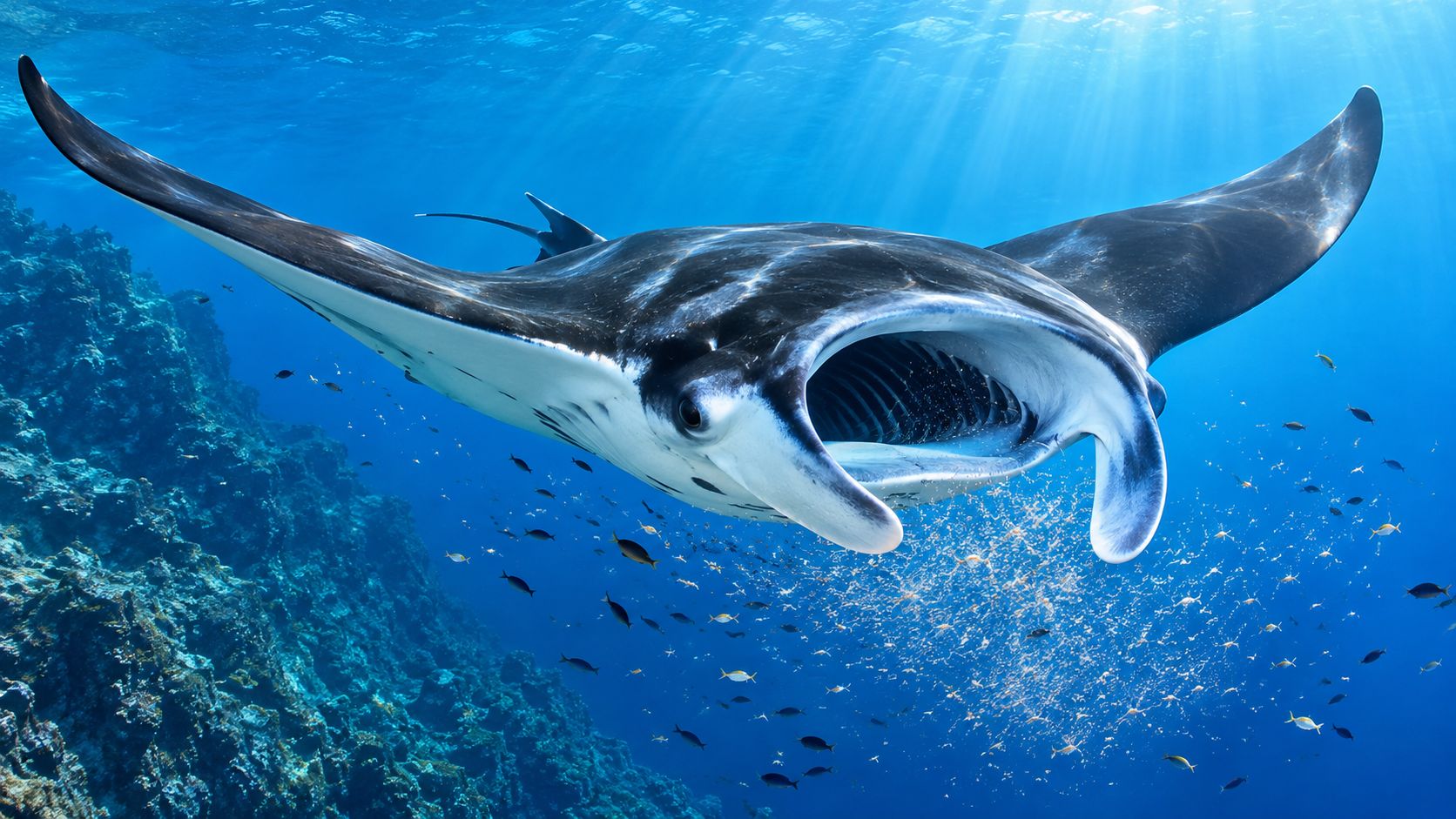
The setup may look choreographed, but the rays set the pace. Plankton density, water movement, and manta behavior all affect whether they show up and how they feed. Researchers comparing Garden Eel Cove and Keauhou found that aggregation size tracked zooplankton density, with larger aggregations generally at Garden Eel Cove (the Kona aggregation study). Choose an operator that keeps guests in place, manages lighting responsibly, and gives the animals room to feed.
Kona's reef mantas are tied to local island groups rather than spread evenly across Hawaiʻi. NOAA and collaborating researchers identified 318 unique reef mantas around Hawaiʻi Island, including approximately 104 adult breeders, and found that reef mantas generally stay close to their home island group (NOAA's genetic study). That local connection makes careful viewing matter. Ask whether the operator supports photo identification, which helps researchers recognize individual rays over time.
The oceanic manta, Mobula birostris, is a separate species. Kona's familiar night aggregation features reef mantas feeding near shore, not oceanic mantas sought in open water. Watch the rays' turns and feeding loops from your assigned position. Never reach toward one.
Garden Eel Cove vs Manta Village
When conditions allow a choice, I'd book Garden Eel Cove. Its protected geography and sandy viewing bowl give divers a clear place to settle while mantas feed overhead. The sloping reef meets a sandy flat, with coral heads and lava rock nearby, so the site offers reef structure as well as a defined viewing area. Garden Eel Cove is also known as Manta Heaven and lies north of Kailua-Kona near the airport.
Manta Village, near Keauhou, is the other principal nighttime aggregation site. Long-term records show more observations at Manta Heaven than at Manta Village during the study period, but those counts describe past records, not the sighting you'll get on one trip. The comparative analysis also notes female visitation and site fidelity at Manta Village.
| Consideration | Garden Eel Cove | Manta Village |
|---|---|---|
| Viewing layout | Sandy flat gives divers a clear area to hold position | Established viewing site, with encounters shaped by local conditions |
| Surrounding habitat | Sandy bottom with nearby coral and lava-rock formations | Reef and viewing conditions vary by site |
| Exposure | Protected geography can reduce exposure to common southerly swells | Conditions vary, so confirm the planned site with the operator |
| Aggregation pattern | Larger aggregations were recorded in the comparative analysis | Female visitation and site fidelity were noted in the analysis |
Choose Garden Eel Cove when conditions are suitable. Its sandy bowl makes it easier for the crew to organize a stationary viewing area, and its shelter from common southerly swells can help keep the experience comfortable. The site comparison also found larger aggregations at Garden Eel Cove, though manta activity changes with conditions.
Ask the operator how it decides between sites, how it positions guests, and what it does to protect the viewing area. A responsible crew makes the site call based on sea conditions and guest safety, not a promise of sightings.
Seasons, Conditions, and When to Book
Kona's manta encounters take place year-round, but the night you get depends on the ocean. Mantas feed where plankton is available, so a well-run tour can have a quiet night even when the calendar and forecast look inviting. Don't book on the assumption that a particular month guarantees a large aggregation. Choose dates that leave room to adapt if weather or sea conditions change.
For broad seasonal planning, use this guide to the best months to scuba dive in Hawaii, then check a current marine forecast closer to departure. Look at wind, swell direction, and whether conditions are expected to make the planned entry and viewing area uncomfortable or unsafe. Garden Eel Cove's geography can offer shelter from common southerly swells, but no site is immune to changing conditions.
Make a weather plan, not a sighting bet
A practical approach is to choose a stable stretch of vacation dates and ask the operator how it handles poor conditions, site changes, and rescheduling. Avoid treating a single night as your only opportunity if your itinerary can accommodate flexibility. A responsible crew may cancel or change plans rather than take guests into a congested or rough nighttime setting.
The trip itself usually starts with check-in, gear fitting, and a briefing. The crew should explain the entry, descent, hand signals, depth expectations, light placement, where to hold position, and how to avoid contact with the mantas. A short boat ride gives you time to finish setup and ask questions before the group enters the water.
Know what happens in the water
Once you're in, follow your guide and settle into the designated viewing area. Divers should stay low and control their buoyancy and fins; snorkelers should hold their assigned surface position. Don't swim after a manta or block its approach and exit path. If a ray passes close enough to brush you, stay still and let it continue. Don't reach toward it or twist around suddenly to follow it.
The viewing portion is typically less than an hour, with the rest of the evening taken up by check-in, gearing up, briefing, the boat ride, and getting back aboard. If you want the bottom-up view and have the training, choose scuba. If you'd rather stay on the surface, snorkel. Freediving is for people who are already comfortable managing breath-holds and positioning in dark water.
Gear, Training, and Who Can Join
Choose your format by asking a simple question: where will you be most relaxed? Scuba is for certified divers who can manage their equipment and stay controlled at night. An Open Water certification is the baseline described for joining a scuba dive; confirm the operator's requirements when you book. The snorkel-versus-dive comparison can help you choose based on the viewing angle and your comfort in the water.
Snorkeling doesn't require scuba certification. It suits non-divers and people who'd rather watch from the surface, but you still need to be comfortable in open water at night and able to follow instructions. Freediving also avoids scuba equipment, but it isn't automatically the easy option. You should already be comfortable with breath-holds and remaining composed in low light.
For scuba, ask what rental equipment is included and whether the crew can fit it before departure. A quality setup may include a 3 mm wetsuit, mask, fins, BCD, regulator, and dive light, with a 5 mm wetsuit available for guests who want more warmth. Certified divers can also ask whether nitrox is available and included. Don't assume every operator provides the same equipment or extras.
Equalization, comfort in the dark, and the ability to hold still all matter. If you're uncertain about any of them, say so during booking instead of trying to push through underwater. The right format is the one that lets you listen, stay composed, and watch the animals without fighting your gear.
Safety, Crowding, and How to Judge an Operator
At night, boats, snorkelers, and divers share a limited viewing area. Hawaii County's safety assessment raised concerns about increased manta-viewing activity and congested nighttime boating, snorkeling, and scuba diving at Makako Bay and Keauhou Bay (Hawaii County's manta-viewing safety assessment). That's why I judge an operator by its procedures, not only by whether it says mantas are likely.
Ask direct questions before paying. A good crew should be able to describe its group limits, how it positions the boat, what it does in poor visibility, and how it supports guests at the surface. Ask whether the boat ties to a buoy rather than drifting with engines running, how snorkelers are kept clear of scuba divers, and what happens if someone needs help.
| Question to Ask | What a Good Operator Does | Why It Matters |
|---|---|---|
| How do you manage the group? | Sets clear positions and keeps the group organized | Reduces crowding and confusion in the water |
| How do you handle the boat? | Explains its mooring and propulsion procedures | Limits hazards around swimmers and rays |
| What happens in poor conditions? | Can cancel, change sites, or reschedule | Avoids treating a wildlife encounter as worth any risk |
| What surface support is provided? | Describes who monitors guests and how help is summoned | Gives guests a clear response plan |
| How do you separate snorkelers and divers? | Explains where each group stays and how they avoid crossing paths | Keeps viewing lanes clearer and safer |
Ask about lighting, too. The lights help create the viewing setup, but they don't make the encounter purely natural or excuse careless positioning. Read the operator's responsible diver etiquette guidance and expect the crew to reinforce it in the briefing. If answers about group control or emergencies are vague, choose another operator.
Underwater Photography Tips for the Manta Dive
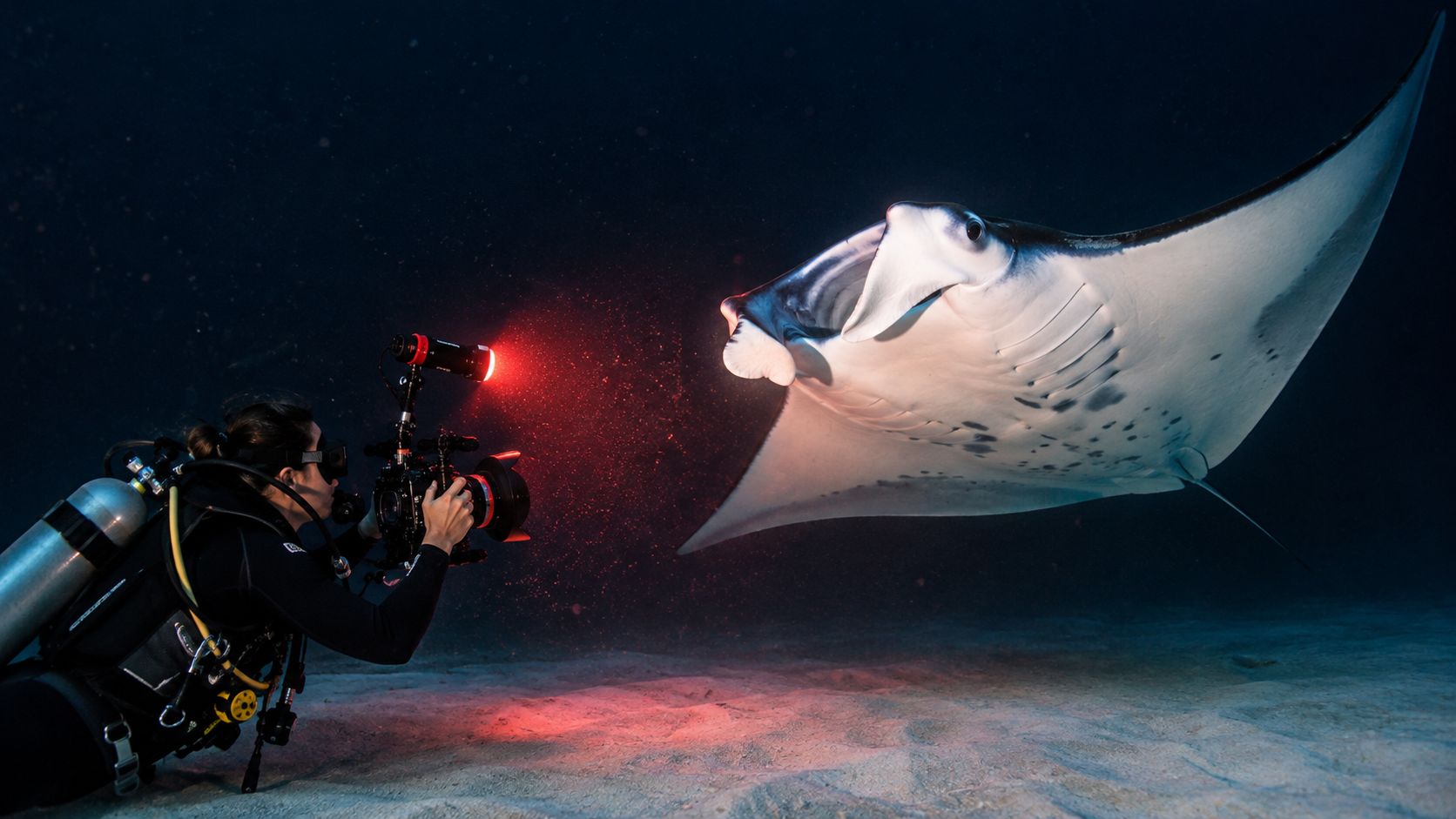
The best manta photographs come from a steady position, not a chase. At Garden Eel Cove, settle on the sandy viewing bowl where your guide directs you, compose around the illuminated water, and wait for a ray to pass. Pursuing one disrupts your framing, stirs sediment, and can change its route.
Build a simple night-shooting setup
Set your camera to manual exposure so you can adjust deliberately as a manta crosses the light field. A wide lens captures the animal and its surroundings. A high ISO and fast shutter can help in low light, though you'll need to balance noise against motion blur on your camera. Choose a wide-angle prime lens only if you're already comfortable handling it underwater.
Use a red focus light while repositioning. Aim your strobes carefully to preserve detail in the manta's pale underside, and never direct a bright beam into its eye. For video, a diffuser softens the light and helps reduce harsh highlights. Keep your rig close to your body and steady.
Let the manta set the distance
Give the ray a clear path to approach and leave. Follow the crew's directions about where to sit and where to point your lights. If your setup makes you kick, drift, or turn repeatedly, simplify it. Staying still matters more than taking another frame.
Kona's resident reef mantas remain closely associated with island waters, so local encounters deserve care. Entanglement from fishing lines and moorings is another documented concern. Hawaii law prohibits capturing, possessing, abusing, or entangling rays in state marine waters. Review the visitor guidance on Kona manta dives before your trip, and follow your guide's directions around the animals.
NOAA's recovery assessment describes how poorly managed diver activity can affect seafloor habitat, zooplankton availability, and manta feeding or cleaning behavior (NOAA's recovery assessment). Keep your fins clear of the bottom, never touch or pursue a ray, and leave its route open. Ask whether the operator records photo-identifications or shares sightings with researchers. Browse these Kona manta dive photographs for examples of the views, but take your position from your guide, not another photographer's image.
Booking the Right Manta Ray Experience
Choose the view that suits your comfort, then check whether the operator can explain how the trip will run. Scuba gives certified divers the bottom-up view; snorkeling keeps guests at the surface. Freediving is a fit for people who are already comfortable with breath-holds and dark-water positioning. If you're traveling with a mixed group, ask whether everyone can join the same trip and how the operator manages separate in-water groups.
For a professional setup, look for clear briefings, well-maintained rental gear, experienced guides, a boat-positioning plan, and a willingness to change plans when conditions aren't safe. Ask about group size, surface support, lighting, rescheduling, and whether photo-identification data are recorded or shared. A responsible crew won't guarantee a particular number of mantas or promise that every night will be identical.
Kona Honu Divers offers a two-tank manta dive and snorkel option at Garden Eel Cove, giving guests a way to pair a reef dive with the nighttime manta experience. Compare the trip details with your certification, comfort level, and preferred viewing position before booking. For itinerary planning, use this guide to places to stay on the Big Island for divers.
Common questions before you book
When should I go? Manta trips run year-round, but conditions and plankton affect what you see. Choose a stable weather window and keep your plans flexible.
Can non-divers join? Yes, snorkeling is the surface option and doesn't require scuba certification. Confirm the operator's swimming and age requirements directly, since those details can vary.
Is it safe for children or older adults? Age alone doesn't determine suitability. Ask the operator about its rules, water comfort requirements, and support, and be candid about mobility, medical, or swimming concerns.
What's the success rate? There's no honest way to guarantee a sighting on your night. Research documents repeated use of Kona's aggregation sites, but the mantas are wild and feeding conditions change.
What if only a few mantas show up? Stay in position and watch their behavior rather than expecting a crowd. A smaller aggregation can still offer close observation without giving you permission to approach.
Do I need to bring gear? Ask what rentals are included. Bring any personal mask or camera gear you prefer, plus a towel and warm, dry clothes for after the boat ride.
How is this different from daytime snorkeling? The night trip centers on feeding activity around lights, while daytime snorkeling lets you explore a reef in daylight. Choose based on whether you want a focused wildlife encounter or a broader surface-level reef outing.
A centered booking button is a direct way to check dates and trip details:
For a manta night built around a clear briefing, organized viewing, and respect for the animals, compare the trip format with your certification and comfort in the water. Visit Kona Honu Divers to review the manta dive and snorkel options, confirm the planned site, and ask about safety and rescheduling before you book.