
More than 23,000 manta sightings, recorded across 13 years at two coves on the Kona Coast, and every one of them traced to just 167 individually identified reef manta rays. That's the dataset behind a long-term photo-identification survey of Kona's night manta sites at Garden Eel Cove and Keauhou, two locations roughly 20 kilometers apart.
Those numbers change what kind of experience you're signing up for. A manta ray dive Hawaii visitors plan months ahead isn't a lottery draw against an empty ocean. It's a feeding aggregation that assembles on a schedule set by plankton, light, current, and the animals' own choices, at a site where researchers have counted mantas night after night for more than a decade.
This guide treats the night that way. You'll learn how the light circle works as a plankton concentrator, which site to book and why, what the crew expects of you on the sand, how to shoot a pass without wrecking it for the diver beside you, and what to do when the rays stay home. No promises of a close pass. A plan for judging the evening with clear eyes.
How the Light Circle Draws Mantas In
Say the lights go onto the sand a few minutes before the divers do. By the time the group is kneeling, a lit column of water stands above them, and the first manta arrives out of the unlit edge of the circle rather than from directly overhead. Nothing has been thrown in. No fish has been offered as bait. The animal has come for the plankton the beam has gathered.
Here's that column from the sand, with two rays working it in sequence.
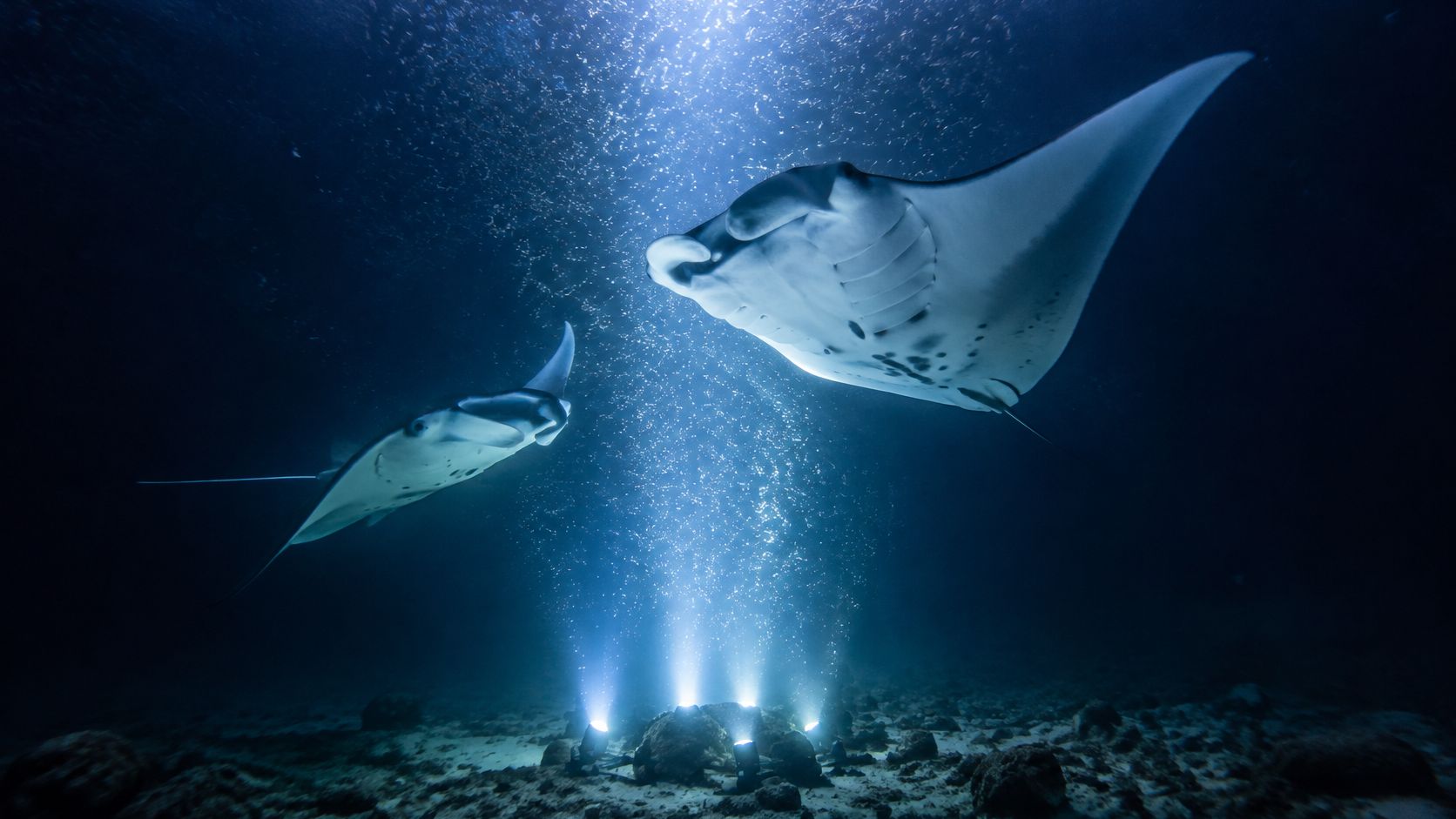
That's the entire design, and it pays to name it plainly. The Hawaiʻi County testimony describing how the dive is conducted treats the activity as a zooplankton-concentration system rather than a feeding operation: underwater lights attract and aggregate zooplankton, after which reef manta rays (Manta alfredi) repeatedly pass through the illuminated water column to filter-feed. Nobody trains the mantas. The crew builds a dense patch of food in a known place.
What the lights actually do
Plankton responds to light, and that one behavior is the engine under the whole evening. Lights placed on the seafloor pull the tiny animals into a beam, and the concentration builds into something a large filter feeder can work efficiently. A manta doesn't hunt individual copepods across a reef. It opens its cephalic fins, funnels water toward its mouth, and takes the dense patch in pass after pass.
The light isn't there for your camera. Its job is to gather prey into a volume small enough that a filter feeder can harvest it in repeated passes instead of cruising the reef at random.
Two things follow from that. First, the aggregation is repeatable, which is why crews return to the same cove night after night instead of hunting a manta on the move. Second, the system depends on geometry. Diver positioning and light placement shape both the quality of the encounter and how much disturbance the animals absorb.
Why the circle has lanes
Divers kneel inside a set viewing area on sand. Snorkelers hold a separate zone at the surface. Mantas move between the two, feeding on light-concentrated plankton as they go. Those zones aren't crowd control for its own sake. They keep the water above the lights open for a turn that a big animal can't abandon halfway through.
Mantas don't live in the beam. They commute to it. The same individuals work the deep scattering layer far below diver depth, feeding on prey that never sees sunlight, then rise into warmer water to rewarm between those dives. That's why a light circle can fill on a night when the surface water looks empty of plankton: the animals may have fed hours earlier in water no diver ever visits.
Think about the last campfire you sat around. The people who see the most are the ones sitting still, letting whoever circles the flames pick their own path. The ones who lean into the ring see less, and they rarely notice they're the reason.
A manta finishes its loop only if the lane stays open, and the lane stays open when a group breathes slowly and kneels still.
When someone breaks that pattern, the cost is immediate. Sudden movement interrupts a feeding pass, and a distracted animal at close range is a collision risk for everybody in the water. The fix is never complicated. Stay low, stay put, and let the loop complete on the manta's timing rather than yours.
Garden Eel Cove Versus Keauhou at Night
Two sites carry almost every night manta trip out of Kona, and the difference between them isn't scenery. It's the shape of the seafloor, the size of the crowd of animals, and what each location seems to be used for.
The 2025 University of Hawaiʻi study behind those long-running records measured survey effort directly. Garden Eel Cove was covered on 2,327 evenings, equal to 49.1% of all nights in the study period from 2010 through 2022, while the combined Garden Eel Cove and Keauhou dataset reached 56% of evenings (University of Hawaiʻi scholarspace). That is an unusually dense record for a wildlife site anywhere.
The finding that matters for a visitor is simple. Garden Eel Cove generally hosted larger nighttime feeding aggregations than Keauhou. Both sites ran close to a 1:1 male-to-female ratio overall, but Keauhou was visited disproportionately by females, which suggests the site may serve functions beyond feeding. Aggregation size at both tracked zooplankton density, so prey availability, not habit or luck, drives the numbers.
Garden Eel Cove and Keauhou for a night manta dive
| Site | Night aggregation | Study coverage | Best used for |
|---|---|---|---|
| Garden Eel Cove | Larger nighttime feeding groups | 2,327 evenings, 49.1% of nights | Dedicated manta dive in a protected sandy viewing area beside reef |
| Keauhou | Smaller groups and a higher share of females | Part of 56% combined evening coverage across both sites | A separate ecological site, not the default viewing arena |
Read that table as a booking decision rather than a ranking. If you have one night on the Big Island and you want the manta evening, the cove is where the layout and the aggregation both favor you.
The layout is the practical argument. Kona Honu Divers' site notes on the two locations describe Garden Eel Cove as a protected location with a defined sandy viewing area where divers and snorkelers can gather centrally rather than spreading across the reef, with reef structure beside the lights rather than underneath the group. Steadier conditions, a clearer separation between the illuminated zone and living coral, and better visibility all come out of that shape.
If you want the two-site history in detail, there's a site-by-site comparison of Manta Heaven and Manta Village that goes name by name.
What the long record says about pressure
One more result matters for anyone worried about loving the place to death. Despite increased tourism, the study reported relatively stable aggregations and no evidence that current activity levels had reduced the viability of the local population. That's a finding about the population, not a license to crowd a single animal, but it does tell you the tour format isn't hollowing out the resource.
For the dedicated evening, the two tank manta dive and snorkel charter runs the cove as its stop. For the rest of the week, the Big Island diving tours cover the morning reefs and longer charters.
Garden Eel Cove is the default for a dedicated manta dive: protected water, a sandy arena, reef at the edge of the light. Keauhou is a different ecological stop, worth understanding because the female-heavy pattern there hints at something the cove doesn't do.
Safety Rules Gear and Who Can Join
Eligibility comes before the packing list. This dive asks for an Open Water certification or equivalent and nothing more exotic. A night specialty isn't what makes it work, because you won't be navigating. You'll descend, settle into a fixed viewing area, and stay there while guides keep the group comfortable.
Who can join and what the night asks of them
| Item | What applies |
|---|---|
| Scuba certification | Open Water or equivalent; night specialty not required |
| Non-certified guests | Surface snorkel with the sister operation, not the kneel |
| Supervision | Stationary and closely guided in a set viewing area |
| Where to kneel | Sand, rubble, or boulder; no coral contact |
| Open-water clearance | Leave the column clear for wingspans near 18 feet |
| Personal kit | Swimsuit, towel, warm layer, trusted mask if owned; rental gear supplied |
Guests without a certification don't sit out. Surface snorkeling runs through a sister company owned by the same person as Kona Honu Divers, so a mixed group can split between the surface and the sand and compare notes on the ride back.
The four rules that cover almost everything
The responsible, considerate diver etiquette that Kona crews work from maps onto four habits on a night like this. The NOAA voluntary interaction standard for manta viewing fits on an index card, and if you follow it you will never be the reason a pass breaks apart.
- Stay on or near sand, rubble, or boulder bottom. That's where the viewing area sits, and it's where your fin tips stop doing damage.
- Touch nothing. No coral contact, no reaching for a passing wing. The standard asks divers to avoid contact with coral and other marine life, and the reason is practical as well as ethical: contact costs the animal energy it needs for feeding.
- Leave the water column open. The same standard directs divers to keep an open column for the mantas, and the number behind it is easy to remember. Manta rays can reach wingspans of approximately 18 feet, which is a lot of animal to fit through a gap you left with your head and shoulders.
- Hold your position through the whole pass. No chasing, no drifting across a turning lane, no high-intensity beam into an animal's eyes. Sudden movement interrupts a feeding circuit and turns a clean pass into a near miss.
Practical rule: your only job for forty-five minutes is to occupy the same square meter of sand and breathe slowly.
Packing, warmth, and the small stuff
Wear your swimsuit under your clothes, bring a towel, and add a warm layer for the ride home. If you own a mask you trust, bring it, because a leaking mask steals attention you'll want for the water. Apply any sunscreen you use before boarding. Rental gear is supplied and maintained on a service schedule, so you don't need to buy anything for one night.
If you're prone to seasickness, eat lightly and tell the crew early rather than at the mooring. A stable kneel matters more than fin speed, and a diver who's fighting nausea stops being a stationary object, which is the one thing the dive needs from you.
New ocean divers can join this guided format, and many do. Certified guests who want remote lava terrain or shark-nursery sites are looking at a different, more advanced charter instead. Enriched air isn't required for the night dive, but nitrox needs its own certification, so sort that out at booking if you plan to dive it.
One Evening Aboard the Two Tank Charter
Check-in takes place at Honokohau Harbor on the Kona Coast, and the boat departs while there is still afternoon light on the water. This is what boarding looks like before the sun sets.
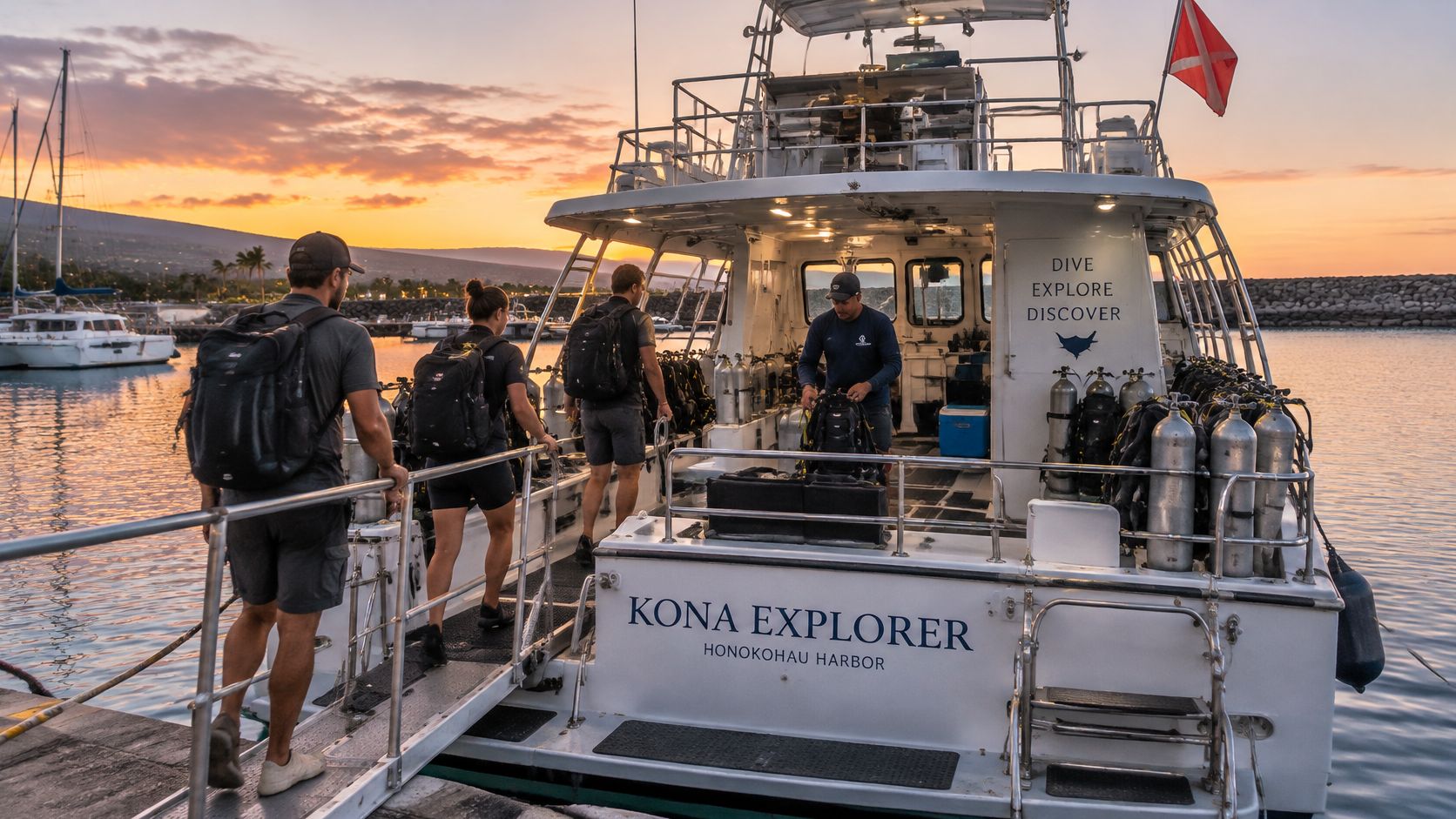
The first item on deck isn't gearing up. It's a briefing from the crew on the science of what you're about to see and the rules of passive observation. That briefing sets the tone for everything after it. You are not going to chase anything tonight.
From harbor to sunset
- Briefing on deck. Lights, plankton, mantas, where the viewing area sits, and how to hold still in it.
- A guided reef dive in daylight. The dive staff lead this one, so you get your weighting and your nerves sorted before dark.
- Surface interval as the sun drops. Kona does the dramatic part, and there's a light meal on board while the sky does its work.
- The manta dive. About 45 minutes kneeling on sand at Garden Eel Cove, the site our manta charter goes to most often, with the lights already on the bottom.
The boat is a spacious custom dive boat, and the group stays small enough that guests can be placed in the best part of the viewing area instead of stacked three deep. That's more space to gear up, a stable ride for the short coastal run, and a crew that will fit your rental gear rather than point at a bin.
Complimentary nitrox is part of the charter, and on a two-dive evening it matters. A higher oxygen mix can stretch the no-decompression window within the limits the crew sets, which is the difference between a conservative second dive and a short one. You still dive the profile the guides brief, not the one your computer might tempt you toward.
Here's the night in motion, from harbor to the cove.
If you'd rather see the boat and the rest of the schedule first, the Big Island boat tours page lays out the day and night options on the same hull.
Photographing Mantas From a Kneeling Spot
The manta moves. You don't. Every frame worth keeping from a Kona night dive comes out of that division of labor, and the photographers who struggle are usually the ones negotiating with it.
Here's the position that produces the shot.
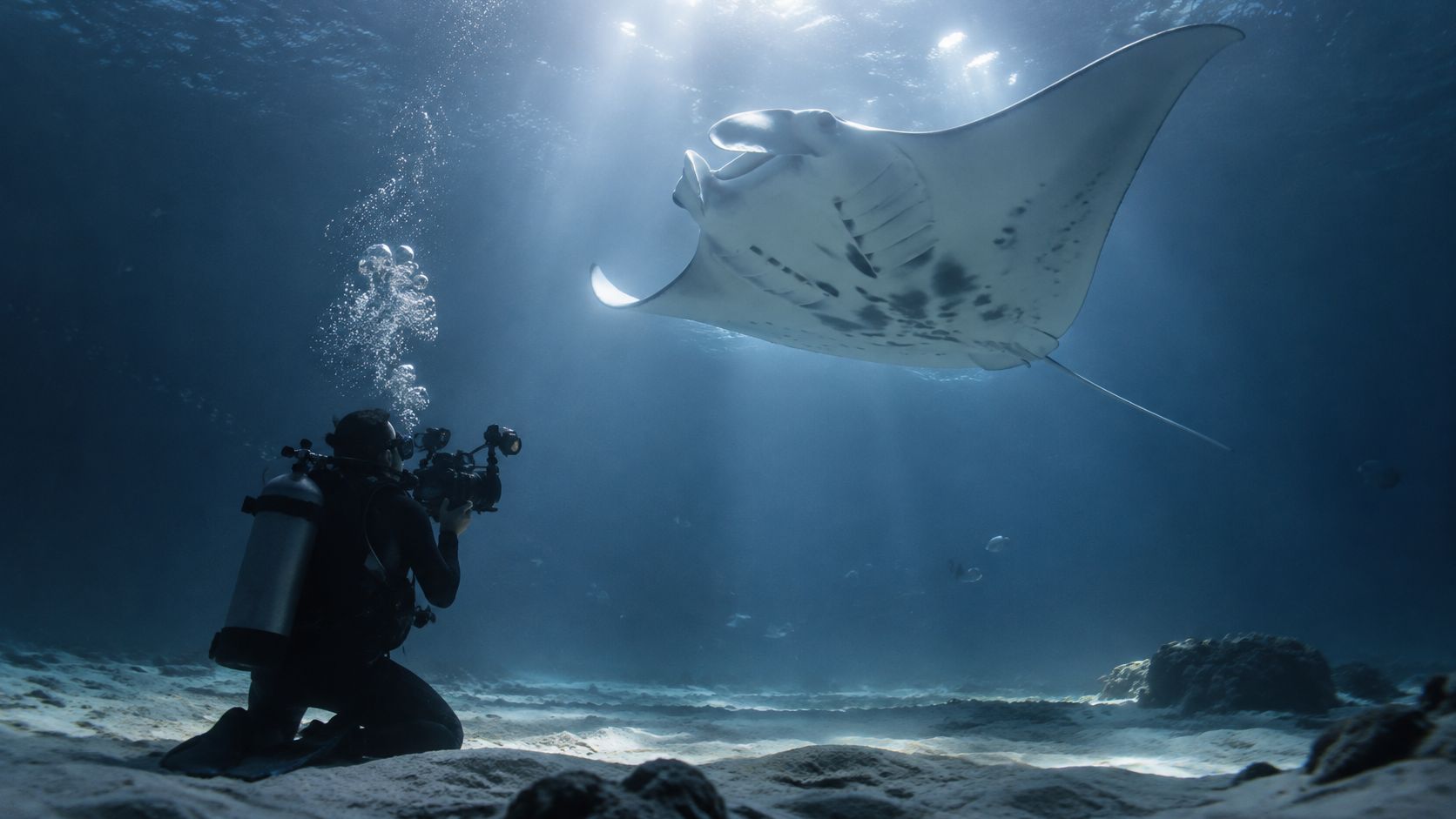
There's a physiological reason a manta near the lights looks unhurried. Recent marine-science research on reef manta diving behavior reports that reef mantas can dive as deep as 672 meters, apparently to feed on mesopelagic zooplankton associated with the deep scattering layer, then return repeatedly to the surface to warm. A calm animal at the surface is a warm animal between foraging dives, and the research points to the same consequence for divers: stable buoyancy, controlled breathing, and a motionless kneel near the bottom let the mantas complete their feeding circuits.
The setup
Bring a wide-angle lens or a decent action camera. Both forgive the distance you can't control, and neither tempts you to zoom into the dark where nothing is sharp.
- Focus light, used sparingly. A dim modeling light helps autofocus without turning the water into a snow globe of backscatter.
- A moderate ISO. Push it higher than you would on a daytime reef. A slightly grainy sharp frame beats a clean blur.
- A shutter fast enough to freeze a wingbeat. Wing tips move faster than the body, and the tips are the part people crop for.
- An aperture that holds the near animal. The dark background will fall away on its own, so spend your depth of field on the manta.
Video usually beats a burst of stills, because a pass is a loop rather than a portrait sitting. Roll on the approach, keep rolling through the turn, and pull the frames you want later.
Three frames worth kneeling for
The overhead pass gives you the belly, the gill slits, and the cephalic lobes unfurled into the beam. It's the signature shot of the dive and it only happens if you're low.
The side profile against the light column shows scale. Shoot into the bright water with the manta crossing it and you get the shape that explains why people book this dive twice.
The wide frame places the sandy circle and the reef edge in one image, which is the frame that tells someone at home what the night looked like.
Firing strobes straight up into plankton is how you get red-eye, backscatter, and blown highlights in the same picture. Bounce or diffuse, angle away from the densest water, and never sweep a beam across another diver's frame to get your shot.
The edit standard is simple. A sharp animal and an unblocked lane beat a closer, chaotic frame every time. For more frames from these nights, there's a gallery of Kona manta ray dive pictures worth scrolling before you pack a camera.
Nights When the Rays Do Not Arrive
Sometimes the circle stays empty. Kona Honu Divers reports seeing manta rays on about 80% of manta night dives, and no crew can promise them, because these are wild animals working their own schedule. A blank night isn't a broken tour. It's the honest tail end of a wild encounter.
If no mantas appear, the evening doesn't get cancelled. Divers are offered an epic night reef dive instead, on the same reef structure that sits beside the lights.
Sightings swing with zooplankton, weather, current, moonlight, and plain animal choice. A light circle concentrates animals and visitors in the same small patch of water, so crowding and stirred-up sand can flatten visibility even when mantas are around. A group that kicks hard and drifts wide makes its own bad conditions.
What to do with a slow night
- Stay with the group. Drifting off to search solo splits the crew's attention and rarely finds anything.
- Keep your buoyancy steady. A silt-out from a careless fin stroke ruins the water for the divers downcurrent of you.
- Let the guides call it. An alternate site or a quiet reef dive can be the right decision, and it isn't a downgrade.
- Judge the night differently. Safe, low-impact viewing is the success condition. A close pass is a bonus.
Guest plan: if the water goes quiet, resist the urge to fix it. Patience is part of the activity, not a delay to it.
Why a miss says nothing about the population
Kona's mantas show unusually strong site fidelity, which is exactly why a single quiet night doesn't mean the animals have moved on. Photo-identification surveys along the Kona Coast from 1992 through 2007 found that approximately 75% of identified reef manta individuals were seen repeatedly within the study area across the 15-year period, and federal conservation material summarizing that work reports 76% of 105 individuals re-sighted along the coast (NOAA's manta ray work product). The same analysis estimated only about 4.27 new pups entering the population each year and characterized immigration as consistently low.
Slow replacement is the number to sit with. A population that adds a handful of pups a year and depends on little outside recruitment has no spare animals to lose to careless interaction, which is the whole argument for a stationary, supervised dive format.
Some mantas were documented at a cleaning station roughly 28 kilometers north of the main study area, which tells you these animals move around the island while staying attached to the region. One cove isn't a switch the crew can flip. For more on how conditions shape the encounter, this explanation of Kona manta ray dive nights is worth ten minutes before you book.
Sample Itineraries and Common Questions
Three shapes cover most guests, and the choice usually comes down to certification rather than ambition.
- Manta night only. Meet at the harbor, sit through the crew briefing, take the surface interval while the sun drops, then kneel on sand at Garden Eel Cove. Best for certified divers with a single free evening.
- Reef day plus manta night. The full two-tank charter, with a guided daytime reef dive first. Best for certified divers who want a whole day on the water.
- Non-certified evening. Watch from the surface with the sister snorkel operation while divers kneel below. Same light circle, different vantage point.
Can I see mantas every night? No. Sightings move with plankton, weather, current, moonlight, and animal behavior, and a miss still includes the guided reef dive.
Can I go year round? Yes. The Kona night dive runs throughout the year.
Do I need a night specialty? No. Open Water or equivalent is enough, since the dive is shallow and stationary.
Is nitrox required? It's optional, and it needs its own certification if you want it.
What if I get seasick? Eat lightly and tell the crew early, before the boat leaves the harbor.
Reserve a Garden Eel Cove Night Dive
Kona Honu Divers has run this Hawaii manta night dive since 2002 and is a Manta Ray Greenlist Activity Provider. The two-tank manta charter is listed at up to $299 plus tax and fees, and prices move with demand, so the live calendar is worth more than any rate you saw quoted last season. Garden Eel Cove is the site we go to most often for it.
If you want a second night in the water, the blackwater night dive is a separate experience entirely, built around open-ocean plankton life and the animals that follow it. Guests who want remote lava formations and shark nursery terrain should look at the premium advanced two tank trip instead, since that's a different charter with different demands.
Kona Honu Divers runs the two-tank manta charter out of Honokohau Harbor, with a guided reef dive, a sunset surface interval, and a stationary kneel at protected Garden Eel Cove where the light circle does the work. If this guide changed how you're planning the evening, the next step is simple: pick a date, check the live calendar, and give the crew a call about certification, nitrox, or a snorkeler in your group. Visit Kona Honu Divers to see the manta nights, morning reefs, blackwater dives, and advanced charters side by side.