
You're looking at Kona tour dates, wondering whether your certification is recent enough, and trying to decide how you'll feel about getting into the ocean after sunset. The manta photographs look extraordinary. What they don't show is the preparation that makes the encounter feel manageable, or why the viewing site matters as much as the animals themselves.
For a manta ray dive in Hawaii, I'd prioritize Garden Eel Cove, a suitable experience level, and a crew that keeps the viewing area orderly. Its sheltered location, better reefs, and defined observation area make it a strong choice for a first night with mantas. The right expectation isn't a promised crowd of rays. It's a controlled dive where you can watch wild animals feed without getting in their way.
Who Can Join a Kona Manta Ray Night Dive
Can you do this, and should you dive or snorkel? The scuba version is for certified divers. The night snorkel lets non-divers watch the same animals from the surface without managing a tank, regulator, or underwater buoyancy.
Choose according to your current comfort, not the most adventurous option on the booking screen. A certification card establishes training, but recent diving helps establish readiness.
Match the experience to your situation
Manta experiences by certification and experience
| Your situation | Best option | What you need |
|---|---|---|
| Certified diver who dived within the past 2 years | Manta Ray Night Dive, 2 Tank Manta Charter | Open Water Certification or higher and a dive within the past 2 years |
| Not certified, age 5 or older, comfortable at the surface | Manta Ray Night Snorkel | Comfort floating on the surface; no certification |
| Certified diver out of the water too long | Refresher dive before the manta charter | A recent dive or refresher course |
| Diver wanting a deeper, unusual night dive | Black Water Night Dive | Certification and confirmation that you meet the charter's experience requirements |
| Experienced diver seeking remote reefs | Premium Advanced 2 Tank Trip | Relevant diving experience and confirmation of suitability for the planned sites |
Our 2 Tank Manta Charter requires Open Water Certification or higher and a dive within the past 2 years. If you qualify, the remaining question is whether you're comfortable checking your equipment, clearing your mask, and following a guide in reduced ambient light.
For non-divers, the surface option removes the scuba-training requirement. Snorkelers age 5 and older can join, but age alone doesn't establish readiness. A guest should be comfortable wearing a mask, breathing through a snorkel, and floating in ocean water after dark.
A refresher is preparation, not a setback
If your card has been sitting unused, arrange a refresher before committing to the night dive. Practicing buoyancy and equipment skills in daylight gives you less to manage when you're trying to watch the animals.
The distinction between introductory scuba and a certified night charter matters. This explanation of scuba diving in Hawaii without certification helps separate those options.
Tell the crew about mobility limitations, medical concerns, or anxiety when booking, rather than at the boarding ladder. Explain the actual task you're concerned about, such as climbing aboard or carrying equipment.
The simple test: certified and recently active means the manta dive is your option. Otherwise, choose the snorkel or schedule a refresher first.
What Happens on a Night Manta Dive, Step by Step
The night is structured rather than exploratory. You're not swimming through darkness searching for rays; you're joining a supervised viewing setup where the animals decide whether to approach.
The briefing is where that structure becomes clear, including your position, the light arrangement, and the exit procedure.
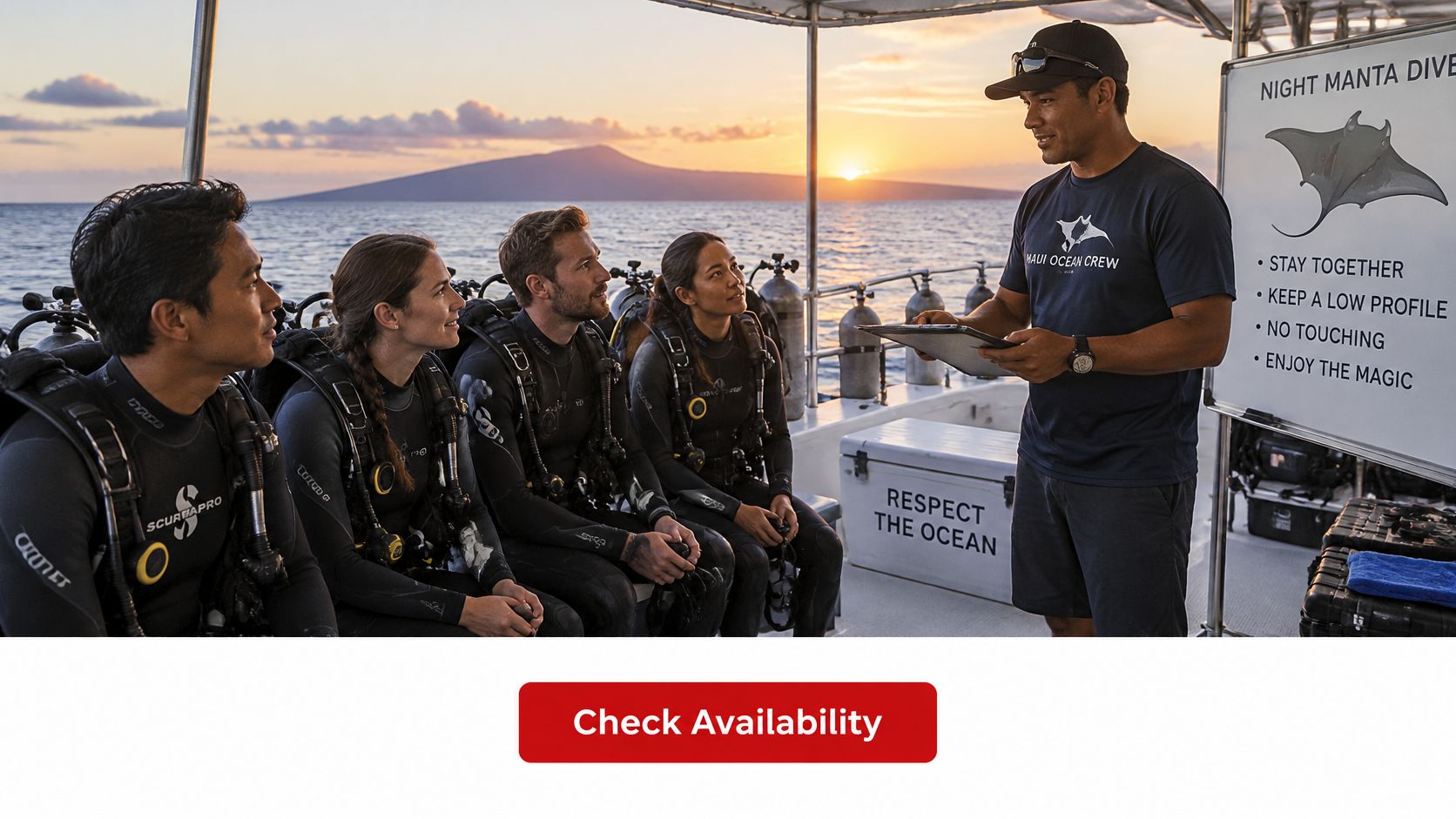
From dockside preparation to the viewing area
Arrive before dark and set up without rushing. Have your certification information ready, assemble your equipment, and let the crew address fit or function problems. Leaving a mask adjustment until the briefing starts divides your attention when you need to be listening.
The crew gives a detailed briefing covering manta feeding science and passive observation. Listen for where to settle, how to signal, and what to do if you're uncomfortable. Don't tune out because you've already watched a tour video; the instructions apply to that boat, group, and night.
The seafloor lights establish the feeding area. Powerful dive lights create a bright circle on the sand, so divers aren't in complete darkness, and plankton gathers in the illuminated water. Mantas come to feed on that plankton, not to perform for divers.
Settle where your guide directs you, with divers kneeling on the sandy bottom and snorkelers floating above. Move your fins gently and keep them clear of the substrate. Stirring up sand reduces everyone's view, while drifting toward the brightest light can put you in the feeding corridor.
Watch, communicate, and finish deliberately
Let the mantas choose their approach. They may pass through the light, turn into feeding loops, or disappear beyond the illuminated area. Keep your hands tucked, breathe steadily, and resist following a ray that leaves the viewing zone.
Stay with the group and monitor your own dive. Our night dive is stationary and closely supervised, with experienced divemasters and instructors in the water, but you still need to watch your pressure gauge and communicate discomfort. Don't wait until you're cold, anxious, or low on gas to get a guide's attention.
Follow the guide's departure and ascent signals. As the viewing setup is shut down, stay close and use the agreed exit procedure rather than starting an independent ascent. Once aboard, dry off and log the dive while the details are fresh.
A stationary dive can still absorb your attention completely. Looking upward at a feeding manta makes it easy to forget the ordinary checks that keep any scuba dive comfortable.
A good night can be a steady group, a few unhurried passes, and an exit before you become cold or tired. More action isn't worth losing control of your own dive.
Why Garden Eel Cove Gives the Best Manta Viewing
Garden Eel Cove is my first choice for this dive because the setting supports controlled observation. Its naturally sheltered position gives calmer, clearer water for viewing, while its better reefs and observation area let divers settle without using live coral as a seat. Shelter is an advantage, not a promise that every night will be flat.
Also called Makako Bay or Manta Heaven, the cove is identified by the Hawaii Department of Land and Natural Resources as one of two Kona locations where mantas gather at night to feed on plankton. The agency proposed management measures including restrictions on anchoring and rafting and limits on commercial operators. Those were proposed measures, not a basis for assuming every proposal is now an enforceable rule.
Compare the viewing setup, not just the site name
Garden Eel Cove compared with Keauhou for manta viewing
| Factor | Garden Eel Cove | Keauhou, Manta Village |
|---|---|---|
| Water protection | Naturally sheltered from the open ocean, with calmer and clearer water | Assess swell, wind, and access on the day |
| Aggregation size | Larger and more variable aggregations | Generally smaller aggregations |
| Sex ratio of sightings | Greater male mobility and a less strongly female-resident pattern | Strongly female-biased, with females making up 91% of sightings |
| Reef and viewing area | Better reef and viewing area for controlled observation | Confirm suitable positioning away from live coral |
| Sightings recorded | More sightings than Manta Village in the cited monitoring | Fewer sightings than Garden Eel Cove |
The Kona aggregation study describes different site-use patterns, including greater male mobility and stronger female residency at Keauhou. Those differences help explain why the sites don't deliver identical encounters.
Sighting volume also favors Garden Eel Cove: NOAA-related monitoring summarized in this Kona manta guide recorded 25,444 sightings of 118 individual reef mantas between 2009 and 2014, with more sightings at Manta Heaven than Manta Village. These are repeated sightings, not that many separate animals.
Site-selection rule: Prefer the location that gives the crew a suitable viewing area and room to protect the reef, not the location advertised with the biggest animal count.
Our go-to manta site is Garden Eel Cove. When comparing operators, ask which location they intend to use and why, but accept a conditions-based change rather than insisting on a site that isn't suitable that evening.
Gear and Pre-Dive Checklist for Night Mantas
Pack for fit, warmth, and simple equipment handling. A camera accessory won't compensate for a leaking mask, and wet clothing can make the return boat ride uncomfortable even after an excellent dive.
Confirm what equipment is included before packing your own kit. The practical principles in this guide to scuba diving at night are useful preparation, especially if you haven't used a dive light recently.
In your bag
- Mask, snorkel, and fins: Bring familiar, well-fitting equipment if you own it. Check the mask skirt and strap, and pack a spare strap rather than discovering damage at the dock.
- Dry storage: Use a dry bag for your phone, keys, and wallet. Pack a towel and dry clothing where you can reach them without emptying everything onto a wet deck.
- Camera essentials: Charge the battery, clear the memory card, and bring a spare card. Inspect the housing seal and complete the manufacturer's leak-check procedure before leaving the dock.
On your body
- Thermal protection: Choose a rash guard or wetsuit suited to the water and your cold tolerance. Because you'll be largely stationary, don't base that choice solely on how warm you feel while swimming.
- Sun protection: Apply reef-conscious sunscreen before arrival and allow it to set. Protective clothing reduces how much exposed skin needs sunscreen.
- A warm return layer: Pack a dry shirt or light jacket for the ride back. Keep it separate from your wet towel.
For the boat and your health
- Motion-sickness preparation: If you use a remedy, follow its timing instructions before boarding. Check with a pharmacist or clinician about suitability for diving and possible drowsiness.
- Water, food, and medication: Bring drinking water, a light snack, and personal medication in its original container. Eat a light meal several hours beforehand and avoid alcohol before diving.
- An honest health update: Tell the crew about medical conditions, recent illness, congestion, or unusual fatigue. Check the day's ocean conditions and raise concerns before departure.
Before entering, complete your buddy check and confirm your light, gauges, releases, and alternate air source are accessible. Familiar equipment still needs a deliberate check.
Photograph Mantas Without Disturbing Them
Chasing a manta for a photograph is the mistake to avoid first. You leave the stable viewing position, add movement to the feeding area, and often lose the composition you were trying to improve. Staying still gives you a better chance to anticipate an approach and frame it cleanly.
Build your camera setup around the viewing arrangement, not the other way around. The animal's route must remain open even when its closest pass would make an exceptional photograph.
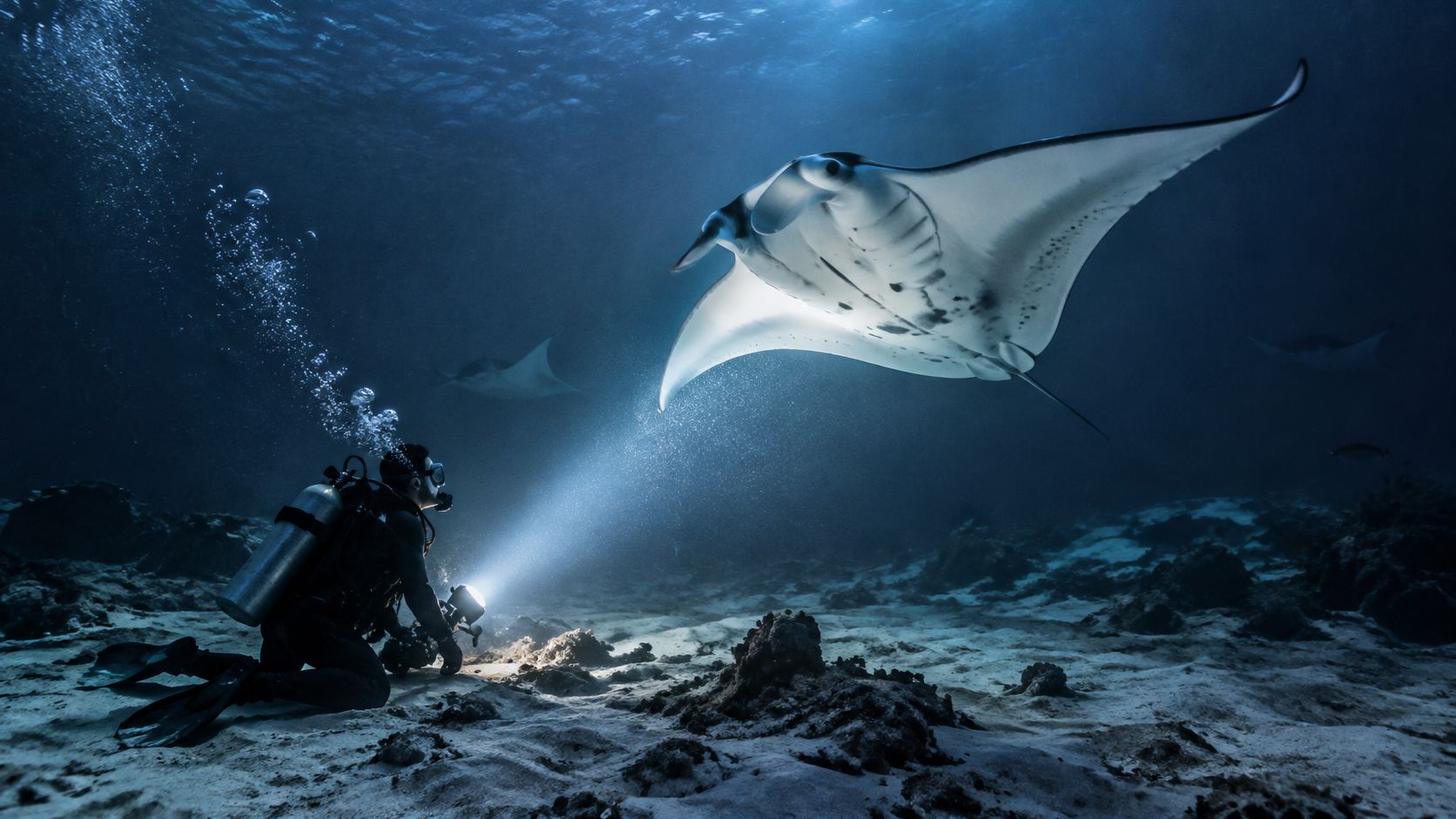
Use the light without moving the feeding area
Kona manta-viewing guidance calls for lights over sand or rubble, an open central water column, and handheld lights held above the head and aimed upward. It also advises against using lights to draw rays away from the viewing area or over coral.
That arrangement matters more than light output. A brighter beam aimed in the wrong direction isn't an upgrade, and swinging your torch after a departing ray can undermine the shared setup.
Before entering, check the crew's strobe rules. Don't assume flash is permitted because your camera has a strobe attached; excess lighting can interfere with other guests and the intended observation arrangement.
Simplify the camera work
- Choose a wide-angle view: Frame the manta with some surrounding water rather than trying to isolate a tiny detail. A wider composition also reduces the temptation to move closer.
- Prepare controls on deck: Know how to adjust exposure and start recording without hunting through menus. Don't make the night dive your camera's first underwater test.
- Shoot short bursts: Make a brief sequence during a suitable pass, then lower the camera. Constantly reviewing images can make you miss the animal's next approach.
- Check exposure early: Inspect the bright underside for lost detail and adjust as needed. A brilliant white belly and dark background can challenge automatic exposure.
Keep your camera, hands, and accessories away from the manta. Use the same spatial awareness described in responsible diver etiquette to avoid crowding neighboring divers or extending equipment into their view.
If the photograph requires the manta to change course, skip it. Watching the animal directly is a better result than forcing an image.
Planning Season, Timing and Booking Odds
There isn't a defensible single best month to promise every visitor. The useful planning question is whether you can reserve a suitable charter, remain flexible about ocean conditions, and leave room for natural changes in animal activity.
A 13-year dataset covering 2010–2022, described in the Kona manta tourism and aggregation assessment, recorded more than 23,000 sightings of 167 individually identified reef mantas and found seasonal aggregation changes positively associated with zooplankton density. That assessment also reports that females represented 91% of sightings at Keauhou.
Turn uncertainty into a workable itinerary
Prey availability helps explain why the same dive procedure can produce different numbers of animals and different lengths of encounter. A quieter night doesn't automatically mean the crew chose badly or the lighting failed.
Planning factors for a manta night dive
| Planning factor | What to know | How to use it |
|---|---|---|
| Booking lead time | Popular nights sell out weeks in advance | Reserve early for fixed dates |
| Animal presence | Aggregation size follows zooplankton density and varies by season | Expect variable numbers and plan two or three possible nights |
| Day-of conditions | Ocean and sea state can change access | Check conditions that morning and talk to the crew |
| Cancellation policy | Weather cancellation, guest cancellation, and no-sighting provisions are separate questions | Confirm the policy when you book |
Our most popular trips, including the manta night dive, often sell out weeks in advance. If your travel dates are fixed, book early instead of waiting until you arrive and assuming every evening will have space.
When possible, schedule the encounter before your final available evening. Leave two or three possible nights in your itinerary as a planning buffer, not as a claim that you'll need multiple attempts.
Read policies as carefully as the calendar
Ask what happens if the operator cancels for weather, if you need to cancel, and if the boat goes out without a manta sighting. Don't assume those situations receive the same treatment, and don't assume a return offer guarantees space before your flight home.
This guide to the best time to see manta rays in Kona can help you think through timing without reducing wildlife viewing to a calendar promise.
Judge the night by clear observation, room for the animals to maneuver, and competent group management. A low-count encounter can still be an excellent wildlife dive.
Book Your Manta Ray Night Dive Now
Kona Honu Divers' manta ray night dive has encounter rates of up to 92%, and manta sightings in Kona often exceed a 90% success rate. Those figures describe encounter frequency, not a guarantee of a particular animal count, repeated close passes, or identical conditions.
The practical decision is whether the format suits you. If you're ready for the scuba version, choose a date that leaves you unhurried and allows some itinerary flexibility. If you're not certified, choose surface viewing rather than trying to turn a wildlife encounter into rushed scuba preparation.
Add understanding before you add camera equipment
Our PADI Manta Ray Diver specialty course covers manta biology, behavior, and conservation and is taken before the Manta Ray Night Dive. It's an option for certified divers who want more context for the feeding behavior they'll observe.
If you're organizing other days underwater, compare the full diving tour lineup with the Kona diving excursions available for your trip. Keep your schedule realistic enough that you arrive rested rather than squeezing the night charter between exhausting activities.
Make the booking practical
- Pick a date and check availability. Keep another evening open when your itinerary allows.
- Confirm your certification and recent diving. Choose the night snorkel if you're not certified, or arrange appropriate refresher preparation.
- Pack from the checklist. Prioritize mask fit, thermal comfort, dry clothing, and familiar equipment.
- Arrive early to gear up before dark. Give yourself time to ask questions before the briefing begins.
Use the booking calendar to find your date, then communicate any health, mobility, or equipment concerns before departure. Clear preparation gives the crew useful information and gives you fewer decisions to make on the boat.
The best manta night is the one where you're prepared, you respect the animals, and you judge it by what you saw rather than by a promise.
Kona Honu Divers offers guided manta ray night diving and surface snorkeling, with Garden Eel Cove as its go-to manta site. Visit to choose your experience, check your dates, and arrange the preparation you need for a comfortable night watching mantas feed.