
You can be standing on the boat deck in Kona with a light wind on your face, wondering whether the water will feel too dark, too cold, or too busy. Then you slip in, the surface closes behind you, and the only thing that matters is the cone of light below and the space just beyond it.
A good manta ray dive changes fast from nerves to stillness. The first silhouette often arrives without warning, a broad wing shape sliding through the beam, turning, and then rising so close that the whole group goes quiet. That moment is why people keep coming back to Kona, but the actual experience is more interesting than the postcard version. It's a wild feeding encounter shaped by light, plankton, and the discipline of everyone in the water.
The Magic of Diving with Manta Rays at Night
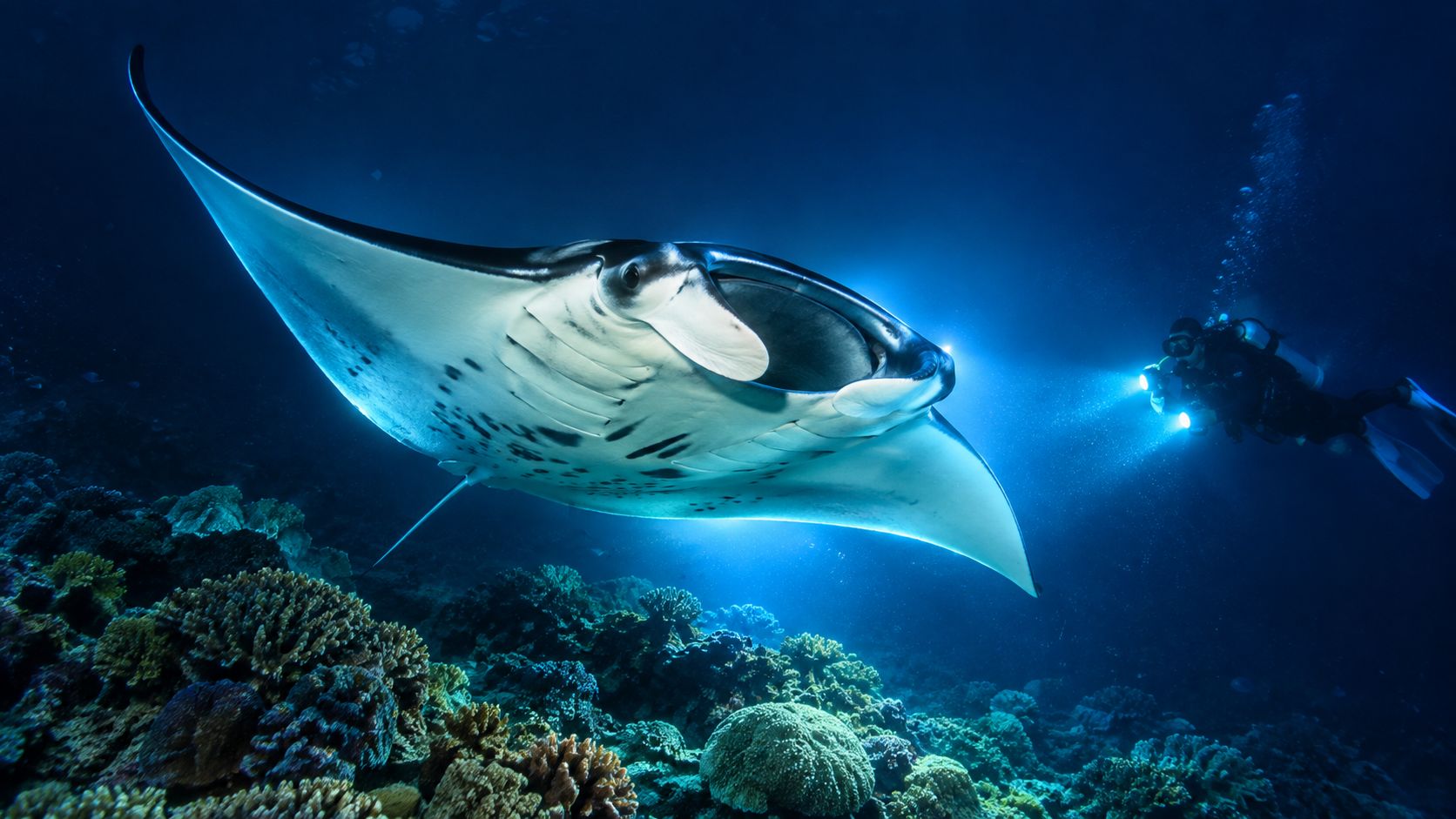
What the first minutes feel like
The best nights start with a simple job, hold position and let the darkness do its work. The water feels calmer than the shore-side nervous system expects, but your senses sharpen because every small movement matters. The beam of the dive light becomes a stage, and the empty space above it starts to feel charged.
Then the mantas arrive on their own terms. They do not swim in to perform, they come to feed where the plankton has been gathered, and that distinction changes how the whole dive feels. You stop waiting for entertainment and start watching a feeding behavior unfold at arm's length.
Practical rule: the less you try to control the encounter, the better it usually gets for both the rays and the people in the water.
That's the part newcomers often miss. The magic is not just seeing a manta, it's seeing how calmly the group can settle into the experience when the operator, the divers, and the animals all have room to do their jobs.
Why Kona feels different
Kona's night dive has a rhythm that's hard to duplicate elsewhere because the viewing happens in a known, repeatable setting offshore from Kailua-Kona. The principal locations are Keauhou Bay, or Manta Village, and Ho'ona Bay with adjacent Makako Bay, often called Manta Heaven or Garden Eel Cove. Both sit on the Big Island's western coast, but the feel of the water, the crowding, and the quality of the observation can be very different.
That difference matters. A manta ray night dive isn't only about the animal, it's also about the conditions around the animal. If the water is crowded, if buoyancy is sloppy, or if lights are poorly managed, the encounter loses its quiet elegance quickly.
For a straightforward Kona overview and site-specific dive context, see the Kona manta ray dive guide.
How the Kona Plankton Lights Work
The Kona experience began with a human-made change to the seascape, not a natural feeding spectacle alone. In the late 1970s, bright lights installed near the Kona Surf Hotel illuminated the water after dark. The lights attracted plankton, the plankton concentrated into a feeding source, and manta rays began returning to feed there.
That cause-and-effect chain matters because it explains the whole encounter. Divers are not calling mantas like pets, and the animals are not reacting to the boat as if it were the point of the show. They're following food, and the light makes the food easier to find.
Daytime and nighttime behavior are not the same
Manta rays use the water column differently across the day. During daylight, giant manta rays commonly stay in shallow surface waters, generally less than 5 m, where they clean and socialize. After dark, they move offshore and repeatedly oscillate through the water column to exploit vertically migrating zooplankton, with tagging studies reporting feeding descents of roughly 200–450 m and the ability to exceed 1,000 m. Those numbers come from NOAA Fisheries' framework for the species, and they explain why the night dive is such a specialized window into natural behavior.
That biology also sets expectations. The rays you see under the lights are not “shallow-water residents” for the evening, they are visiting the illuminated area because prey has been concentrated there. Seasonal thermocline shifts can change where prey sits in the water, which means encounter density can change with ocean conditions.
The ray is not there for the diver. The ray is there for the plankton, and the diver's job is to stay still enough to let that happen.
For more background on the Kona setup and site use, the Big Island manta night dive page adds useful local context.
What to Expect During Your Two-Tank Adventure
A good manta trip has a steady rhythm. You board, listen to the briefing, get your gear sorted, and ease into the evening before anyone enters the water. That structure gives divers time to understand the route, the light setup, the entry, and where to hold position once the mantas start using the beam.
The sequence on a typical Kona night
The briefing comes first. The captain or divemaster covers the site, hand signals, spacing, and how to stay clear of the animal's path. Then the boat heads out, equipment gets checked again, and the first dive or snorkel session gets everyone comfortable with the water before the manta portion begins.
The night encounter follows after that. Divers settle in, watch the light field, and wait for the animals to arrive on their own terms. The pace is deliberate because it has to be. A good encounter depends on patience, not pursuit.
For a more detailed breakdown of the two-tank format and timing, see our Big Island manta night dive overview.
Why the two-tank format helps
The reef dive before the manta session gives people time to adjust to the water, the gear, and the boat rhythm. It also makes the evening feel like a full dive outing, not just a transfer to the main event. For first-timers, that matters. The anticipation is often harder than the dive itself.
The second tank also gives the crew more room to manage the group well. On busy Kona nights, that matters for both safety and the quality of the encounter. When operators space people correctly, keep the lights where they belong, and avoid crowding the mantas, the experience is calmer for divers and less stressful for the animals. Good operators also understand how local conditions can shift. Plankton density, water movement, and thermocline changes can all affect where the rays show up and how long they stay.
Post-dive snacks and a little decompression time are part of the evening too. You are not just dropping in, seeing a ray, and leaving. You are spending a night on the water, and the better trips use that time to keep the group relaxed, prepared, and hydrated.
Why Garden Eel Cove Is the Superior Dive Site
The two main Kona viewing areas are not interchangeable, and that's where a lot of travel pages oversimplify things. Keauhou Bay, or Manta Village, is the classic name people know, but the site has documented crowding pressure. In the 2018 survey of 444 participants, with an 89% response rate and a stated margin of error of ±4.6 percentage points at the 95% confidence level, 82% of respondents felt crowded by snorkelers, 78% by boats, and 69% by scuba divers. That same study also found that site attendance could range from 100 to more than 300 people at one time, which tells you how managed the experience can become. Source study
Keauhou Bay and Garden Eel Cove compared
| Feature | Keauhou Bay, Manta Village | Ho'ona Bay, Garden Eel Cove |
|---|---|---|
| General feel | More heavily used and more prone to crowding | More protected and typically easier to manage |
| Crowding pressure | 82% felt crowded by snorkelers, 78% by boats, 69% by scuba divers | Less pressure in practice, which helps the encounter feel calmer |
| Ecological pattern | Important historical site with strong visitor demand | Often supports larger aggregations and better viewing conditions |
| Reef and spacing | Can feel compressed when attendance is high | Better space for a cleaner, more open viewing corridor |
The ecological case for Garden Eel Cove is strong too. The long-term Kona research found that Garden Eel Cove generally supported larger aggregations than Keauhou, while Keauhou was visited predominantly by females and showed high female site fidelity. The same research linked changes in aggregation size to zooplankton density, which means food availability is a primary driver of manta presence. That's a practical reason to prefer the site that better supports the dive, not just the site with the louder reputation.
Why the protected setting matters
A protected location isn't a marketing line, it's a usability issue. When the site gives the animals room, the divers usually get a calmer, longer, and less stressful view. Better reefs also matter because they create a more coherent underwater environment, not just a light field suspended in open water.
Bottom line: if you care about both the animal encounter and the feel of the dive, Garden Eel Cove gives you the cleaner trade-off.
For site comparison and booking context, the Manta dive Kona page is the natural next stop.
Safety, Etiquette, and Photography Tips
Manta ray diving is beautiful, but the species isn't resilient in the way casual tourism often assumes. NOAA Fisheries reports that the global population of the giant manta ray is unknown, while most regional populations with available estimates are only about 600–2,000 individuals. In areas exposed to fishing pressure, those populations have declined significantly, and NOAA states that depleted populations have a low likelihood of recovery. NOAA conservation and management
That reality changes how you should behave in the water. This is not the dive to test your buoyancy limits, drift into the light field, or swing your fins wide because you're excited. The encounter works when everyone keeps their profile controlled and predictable.
What respectful position control looks like
- Hold neutral buoyancy: Stay off the bottom and off the animal's flight path so the manta can pass cleanly.
- Keep fins quiet: Small fin movements are enough. Wild kicks muddy the water and narrow the corridor.
- Don't chase turns: Let the ray choose the angle of approach. Intercepting behavior breaks the feeding pattern.
- Watch your gear: Cameras, hoses, and dangling equipment can get in the way faster than people expect.
- Leave space overhead: Avoid putting bubbles or bodies directly above an approaching manta.
The reason this matters goes beyond etiquette. Mantas feed by filtering tiny planktonic organisms and need unobstructed water space to move through repeated passes and barrel rolls. Contact can disturb the protective mucus layer on the skin, and crowding can interrupt natural behavior. Those aren't theoretical concerns, they're part of why the most graceful dives look almost boring from the diver's perspective until the ray arrives.
Lighting and camera discipline
Photographers should aim for consistency, not drama. Let the manta enter the light field, keep strobes subdued, and avoid sudden blasts that alter the animal's line. A fixed, predictable group shape usually improves image quality anyway, because the manta has room to circle through the frame.
For divers choosing an operator, look for crews that keep the light field organized, brief clearly, and enforce spacing. If you want a reminder of standard underwater behavior, the responsible diver etiquette guide is worth reading before the boat leaves.
Booking with Kona Honu Divers and Final Thoughts
Kona Honu Divers offers a dedicated manta ray dive and snorkel trip that fits the rhythm of this experience well, especially if you want a structured evening with clear briefing, gear support, and an experienced local crew. The company also runs other specialized trips, but for this dive the main question is simple, do you want a well-managed outing that respects the animals and keeps the group organized.
If you're wondering whether the rays will show, the honest answer is that no operator can promise that. What a good crew can do is put you in the right place, at the right time, with the right expectations. That's the true value here, especially when the site, the plankton, and the weather all play a part.
Kona Honu Divers is also known for strong guest feedback, and that kind of reputation matters when you're choosing a night dive operator. The right boat, the right briefing, and a calm crew make the difference between a memorable encounter and a crowded one.
If you're planning a first Kona night dive, this is the moment to decide whether you want the easy version of the experience or the thoughtful one. Book the trip that gives you time, space, and a crew that understands the biology behind the spectacle.
Kona Honu Divers offers the kind of manta ray dive that's built around safety, clear briefing, and a respectful pace in the water. If you're ready to see Kona's night encounter the right way, visit Kona Honu Divers and check availability for your dates.