
Table of Contents
- Manta night dive options compared
- What Kona's sighting record actually means
- Pack for the boat and the water
- Set up your camera before descending
- Food attracts the animals, not a performance schedule
- The illuminated area is only a small part of manta habitat
- From briefing to viewing position
- During the encounter and ascent
- Give mantas control of the encounter
- Seeing mantas doesn't mean the group was well managed
- Match the itinerary to your priorities
- Will I definitely see mantas?
- What if no mantas appear?
- Is the night dive different from a daytime dive?
- How long does it last?
- Can a non-diver come along?
- Complete your booking checklist
You're comparing Kona evening tours, and the photos all look extraordinary: manta rays overhead, bright beams in dark water, and divers watching from the sand. What the photos don't tell you is whether you'll feel comfortable underwater, how crowded the viewing area will be, or what happens when the ocean doesn't cooperate.
The best manta night dive isn't the trip that produces a sighting. It's the experience that fits your certification, gives you a well-managed viewing position, and lets the animals feed without people getting in their way.
Manta Night Dive Options at a Glance
A manta night dive is a guided, stationary scuba experience after sunset: divers settle in a designated sandy viewing area while underwater lights concentrate plankton and attract feeding reef manta rays. Snorkelers watch from the surface instead, so certification determines your starting point, not whether you can participate.
Manta night dive options compared
| Experience | Who it suits | Viewing position | Certification needed |
|---|---|---|---|
| Manta Ray Night Dive | All certified divers, beginner to advanced | Kneel on the sandy bottom in the designated viewing area | Certified scuba diver |
| Manta Ray Night Snorkel | Snorkelers who want to see mantas from above | Float on the surface | None needed |
| Black Water Night Dive | Divers wanting a different night experience | Confirm the in-water arrangement on the tour page | Confirm certification and experience prerequisites before booking |
| Premium Advanced 2 Tank Trip | Experienced divers seeking advanced long-range diving | Follow the guide's site-specific dive profile | Confirm certification and experience prerequisites before booking |
Blackwater and advanced reef trips aren't interchangeable with a manta encounter. Choose them for their different diving objectives, not as alternative ways to watch the same feeding aggregation.
Kona's nighttime manta viewing has a long history. The local historical account published by Kona Honu Divers places organized viewing around 1991, near the former Kona Surf Hotel, where lights attracted plankton and mantas.
The important distinction is that these encounters involve resident animals returning to feeding locations, rather than visitors trying to intercept a seasonal migration.
Decision rule: Choose scuba for the underwater perspective if you're certified and comfortable. Choose snorkeling if you aren't certified, and choose a different night experience only if that's what you actually want to explore.
For mixed groups, compare snorkeling versus diving with manta rays before committing. The full scuba tour list helps separate wildlife viewing from other diving interests.
Garden Eel Cove and the Best Kona Viewing Spot
Garden Eel Cove is the superior choice for the manta dive because its protected location offers a better viewing area, healthier reef surroundings, and generally calmer conditions than a more exposed setting. It's our go-to location because those features help divers concentrate on watching rather than constantly correcting their position.
Protection matters underwater as well as on the surface. Reduced surge makes it easier to keep lights steady, avoid stirring sand, and maintain space between neighboring divers. A good viewing area also gives guides a practical place to organize the group without placing people on living reef.
What Kona's sighting record actually means
A six-year reef manta monitoring study archived by NOAA recorded 25,444 observations involving 118 individual reef mantas at Manta Heaven in Makako Bay and Manta Village at Kaukalaelae Point, with manta presence on 92% and 78% of monitored nights, respectively.
Garden Eel Cove is also commonly called Manta Heaven, so it shouldn't be treated as a separate, unstudied third location. Those historical monitoring results describe the study's sites and observation period, not a promise about your particular booking.
Our own trip record is a separate measure: divers have seen mantas on 92% of our Manta Ray Night Dive trips. Don't confuse that business encounter rate with the study's monitored-night figures.
Individual animals also use feeding sites differently. Some return frequently; others move between locations, and the study identified differences in male and female site use.
A protected site improves the setting. It doesn't give the crew control over wildlife or weather.
Swell, wind, and sea conditions can still change the evening's plan. A responsible site choice always includes permission to change course when conditions aren't suitable.
Certification, Packing and Camera Gear
| Participant | Requirement | Preparation priority |
|---|---|---|
| Scuba diver | Scuba certification | Comfortable buoyancy, equipment familiarity, and clear communication |
| Surface snorkeler | No scuba certification needed | Confirm swimming requirements and comfort in nighttime ocean conditions |
| Diver seeking additional learning | Ask about the PADI Manta Ray Diver specialty | Manta biology, behavior, conservation, and respectful interaction |
Certified divers can join the manta dive; non-certified guests can watch from the surface. Certification doesn't automatically mean you're ready for every condition, though. Tell the crew if you haven't dived recently, haven't used your equipment at night, or feel uncertain about holding position.
The PADI Manta Ray Diver specialty provides focused learning about manta biology, behavior, conservation, and respectful interaction before the encounter. Experienced divers considering an advanced long-range trip should evaluate that trip's prerequisites separately rather than assuming a manta dive prepares them for it.
Pack for the boat and the water
- Certification card and logbook. Have your credentials accessible, along with information about your recent diving.
- A warm, dry layer. Pack something you can put on after leaving the water, especially for the ride back.
- Sun protection. Apply sunscreen before any daylight portion of the outing. Don't assume a reef-safe label means a product has no environmental impact.
- A backup dive light. Confirm the crew's equipment arrangements and bring a familiar backup if you have one.
- A camera with a charged battery. Check the housing seal, controls, and attachment before boarding.
Set up your camera before descending
- White balance: Start with a manual setting matched to the available lights, then adjust after a test image.
- Exposure: A wider aperture and higher ISO can help capture movement without relying on flash.
- Lighting: Avoid flash and follow the crew's camera rules. Don't add unnecessary bursts of light around feeding animals.
- Handling: Secure the housing so it can't swing into a neighbor or become a distraction.
Use these Kona manta photography tips to plan your setup, but prioritize control over photographs. Arrive before the briefing and finish your equipment checks before entering, so you aren't troubleshooting while the group settles.
Why Mantas Come to the Lights After Dark
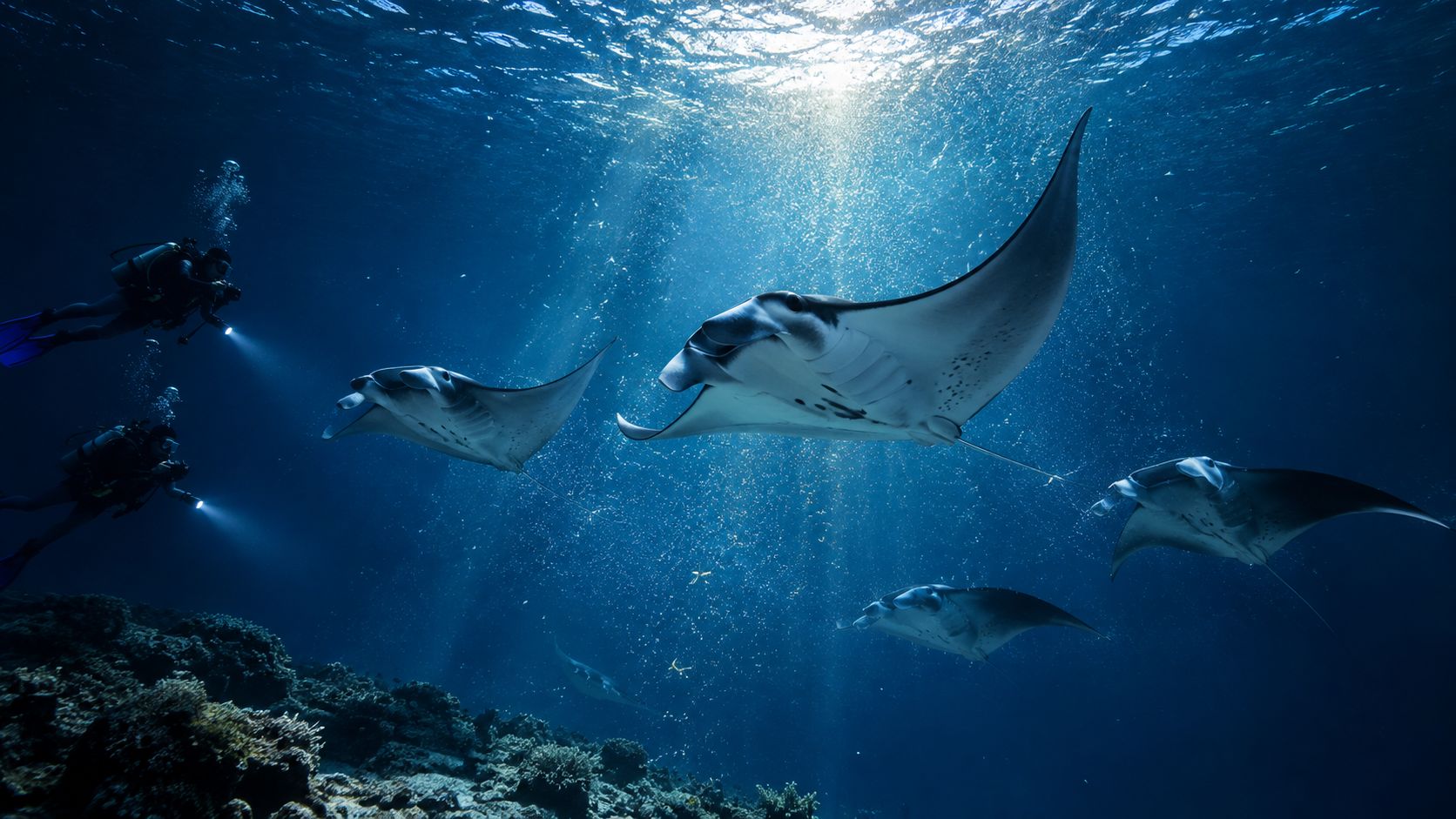
At night, zooplankton can become available higher in the water column. Underwater lights concentrate these tiny drifting animals into a food patch, rather like gathering a buffet beneath a lamp.
Reef manta rays, Mobula alfredi, move through that patch with their mouths open and filter food from the water. The SFGATE explanation of Kona's manta tours describes this light, plankton, and manta relationship, while emphasizing that currents, weather, plankton density, and animal movements still affect encounters.
Food attracts the animals, not a performance schedule
The lights don't summon a manta on command. They also don't guarantee that enough plankton will accumulate to make repeated feeding passes worthwhile.
A manta may cross the illuminated area, turn, and return through the same food-rich water. Another may pass once and continue elsewhere. Neither behavior means the crew should reposition divers to intercept it.
Stillness supports the encounter. Repeated fin kicks can suspend sediment, reduce visibility, and make neighboring divers work harder to maintain their space. A steady light aimed into the water column helps preserve an orderly viewing area without tracking an animal's face.
The illuminated area is only a small part of manta habitat
Mantas don't stop moving or feeding when they leave the lights. In a peer-reviewed tagging study published in PLOS ONE, every tagged reef manta in New Caledonia made dives exceeding 300 meters, and those deeper dives occurred more often at night.
That finding describes animals in New Caledonia, not the depth of a Kona recreational dive. Its practical lesson is straightforward: a manta disappearing below you may be changing its feeding depth, not inviting you to follow.
Watch the animal's choices: A feeding pass is an opportunity to observe, not permission to move closer.
Judge the encounter by whether the animals can move freely and whether you can watch without disrupting them. When a manta leaves the illuminated water, your job is to remain with the group, not extend the dive into darkness after it.
How the Manta Night Dive Unfolds, Step by Step
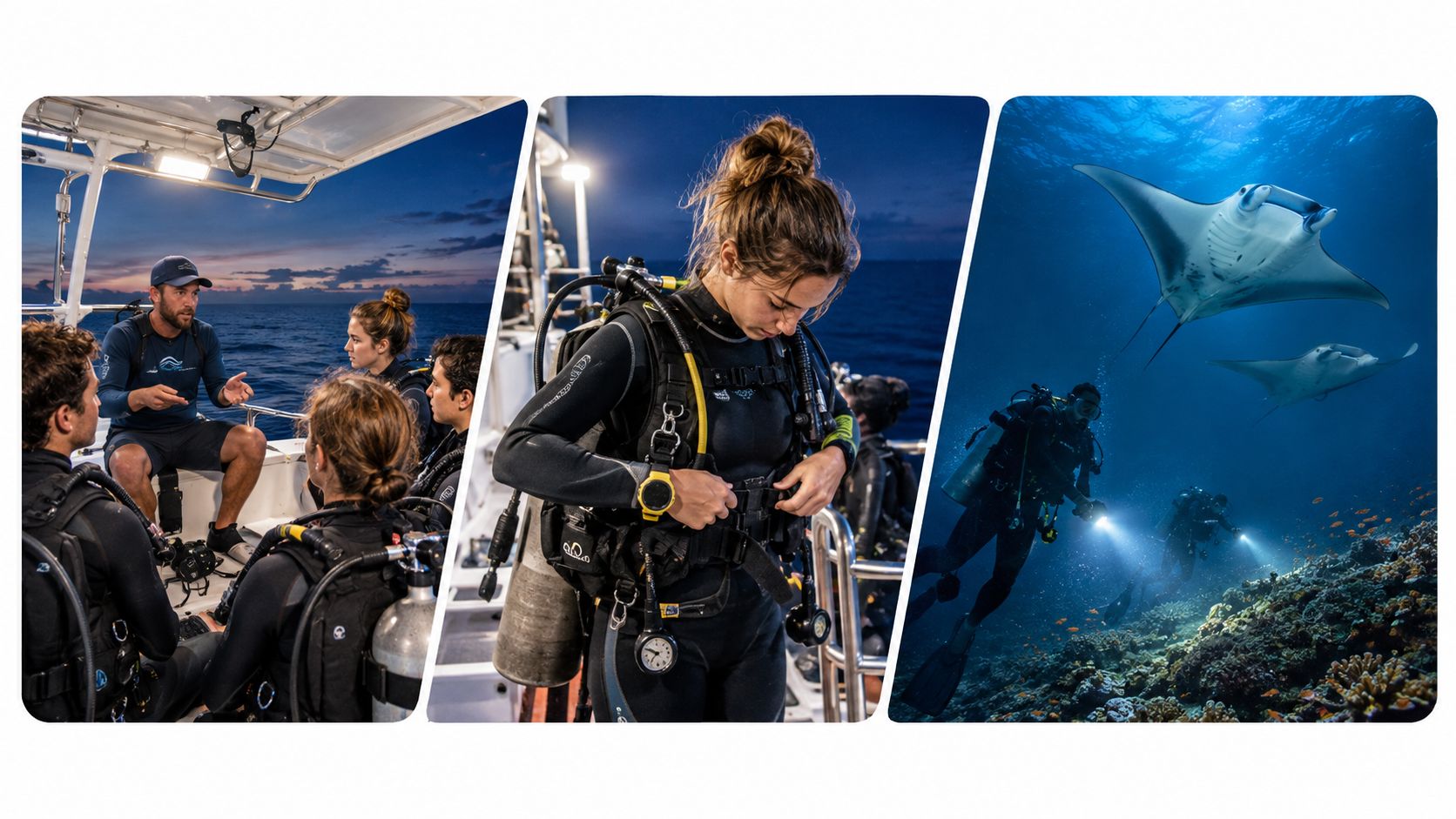
The dive feels less mysterious when you know what happens between boarding and returning to the boat. It's a supervised observation dive, not a nighttime swim in pursuit of wildlife.
From briefing to viewing position
Attend the complete briefing. Our crew explains the science behind the encounter and the golden rules of passive observation, including signals, group positioning, and the exit procedure. Mention concerns before entering, when the guide can answer without underwater communication limits.
Check your equipment and gas. Complete your buddy check, confirm your regulator and inflator work, and make sure you can read your computer and pressure gauge. Secure loose accessories because a stationary dive still requires access to your equipment without disturbing anyone beside you.
Descend with the group. Follow the guide to the designated viewing area instead of choosing a position independently. Our divemasters place divers where they can supervise the group and leave an open route for feeding mantas.
Let the crew establish the lights. Powerful lights on the seafloor create a broad illuminated circle around the viewing area. You won't be sitting in complete darkness, but you still need to recognize your guide and understand the boundaries of the group.
During the encounter and ascent
Settle only where instructed. Kneel on the designated sand, keep hands and fins quiet, and aim your personal light into the water column rather than at an animal's face. If you need to adjust your position, do it slowly and avoid pushing against reef or another diver.
Watch while continuing to manage your dive. Mantas may loop through the light when feeding conditions suit them, while experienced divemasters and instructors supervise underwater. Keep checking gas, depth, and your buddy instead of becoming so absorbed in filming that you stop monitoring yourself.
Leave when the crew signals. Follow the briefed ascent route and safety-stop procedure rather than staying behind for another photograph. Keep the exit orderly, and give the diver ahead enough room to reach the ladder or boarding point safely.
A common beginner concern is whether kneeling means abandoning buoyancy control. It doesn't. You still manage your buoyancy throughout the descent, positioning, and ascent, and you should never use excessive weight to pin yourself to the bottom.
Another concern is missing a manta while checking a gauge. That brief equipment check is part of competent diving, not a distraction from it. Your guide can manage the group, but you remain responsible for your own instruments and communication.
For preparation beyond the encounter itself, review the practical differences involved in scuba diving at night.
A successful session can include only a few clear feeding passes. Calm guests, controlled equipment, an orderly ascent, and no pursuit of departing animals matter more than keeping everyone underwater for a final glimpse.
Etiquette, Conservation and Crowd Management
A light-based wildlife tour isn't a neutral viewing tool. Operators deliberately concentrate plankton and influence where feeding happens. A dive can produce plenty of manta sightings and still involve poor spacing, excessive disturbance, or stressed participants.
Give mantas control of the encounter
The Marine Megafauna Foundation's manta tourism guidance recommends keeping at least 3 meters (10 feet) away, approaching from the side, remaining calm, and never touching, chasing, or blocking a feeding path.
- Maintain your distance: Don't move toward an approaching manta to improve your photograph. If an animal comes closer on its own, remain composed and follow the guide's directions.
- Avoid head-on approaches: Don't place yourself across the route an animal is already using.
- Keep your hands to yourself: Observation doesn't require contact, even when an animal passes within reach.
- Leave an exit: Never surround a manta or follow it out of the viewing area.
At a stationary viewing site, approaching from the side isn't an instruction to leave your place and swim toward a ray. The better choice is usually not to approach at all.
Locally concentrated animals can experience repeated pressure at the same sites. Strong site fidelity makes local boat activity, injuries, and participant conduct important even when broader population averages appear reassuring.
Conservation priorities include better information about abundance, population trends, injuries, movement, habitat use, and reproduction. Tourism can support education and local economic activity, but that doesn't establish that every encounter helps conservation or causes no harm.
Seeing mantas doesn't mean the group was well managed
A peer-reviewed study of evening manta trips involving 444 participants found that 79% of snorkelers and 53% of scuba divers experienced conflict with other participants.
Problems included bumping, poor awareness, and lights shining into people's eyes. Participants supported limits on boats and guests, along with stronger behavioral education.
Stable sightings don't prove crowding has no effect. Mantas may continue feeding while people struggle with overlapping lights, cramped positions, or confused entry procedures.
Before booking, ask specific operational questions:
- Group capacity: How many guests will be in the water, and how will guides divide them?
- Boat positioning: How will the crew manage the approach and separation from other vessels?
- Viewing space: How will divers be assigned positions without blocking one another?
- Entry and exit: What happens if another group is entering while yours is leaving?
- Changing conditions: Who makes the decision to stop or relocate?
Arrive early enough to understand your assigned position, not to claim a spot ahead of other guests. Underwater, leave room for your neighbors and keep your beam out of their eyes.
Use responsible diver etiquette throughout the outing. Report entanglement to the crew rather than attempting an improvised rescue, and don't let loose equipment or debris become another hazard.
If a manta descends, hold your planned depth and remain within gas and no-decompression limits. If conditions become unsafe, signal the divemaster and follow the crew's exit instructions promptly.
Best Times, Itineraries and Pricing
Plan around sunset, not a fixed clock time. The nighttime viewing takes place after daylight fades, so departure and check-in times shift through the year. Your booking confirmation should determine when you arrive.
The viewing portion isn't the full charter. Travel, briefing, equipment preparation, and any additional dive all require time, so don't schedule dinner or another activity immediately after the expected underwater finish.
Match the itinerary to your priorities
| Your priority | Itinerary to consider |
|---|---|
| Evening manta viewing | Manta Ray Night Dive |
| A daytime reef outing | 2 Tank Local Morning Dive |
| An introduction to scuba | Morning Introductory Scuba Dive |
| A different nighttime objective | Black Water Night Dive |
| Experienced long-range diving | Premium Advanced 2 Tank Trip |
Resident mantas make this a feeding-site experience rather than a migration-season booking. Your own schedule, ocean conditions, and comfort matter more than choosing a supposedly guaranteed date. The guide to the best time to see manta rays in Kona can help with planning.
Compare inclusions, not just headline prices. Check the number of dives, equipment arrangements, required experience, and cancellation terms on the current booking page.
Don't assume certification creates a particular surcharge or that every charter includes the same equipment. Confirm current prices, dates, and inclusions before paying, especially when comparing a surface experience with a scuba itinerary.
Frequently Asked Questions
Will I definitely see mantas?
No. These are free-ranging animals, and a strong encounter record isn't a guarantee for your evening. Book because you're comfortable with a wildlife experience whose outcome can change, not because you expect the crew to deliver a scheduled performance.
What if no mantas appear?
Stay with the group and complete the dive. Ask about the operator's current no-sighting policy before booking, including whether any return opportunity requires available space. Don't assume a refund or complimentary repeat trip is included.
Is the night dive different from a daytime dive?
Yes. You'll rely on lights and close attention to your guide, and you'll spend more time observing from a designated position than exploring reef. Familiar equipment, clear signals, and calm breathing help make that change manageable.
How long does it last?
Confirm both the planned underwater duration and the full charter length when booking. Your actual dive ends according to the briefed plan, your gas supply, and conditions, rather than a promise to remain underwater until mantas appear.
Can a non-diver come along?
A surface manta experience doesn't require scuba certification. Confirm swimming expectations and nighttime ocean suitability before reserving, because no certification requirement doesn't mean no physical demands.
Book Your Manta Night Dive
Popular manta trips often sell out weeks in advance, so reserve early enough to choose an evening that fits comfortably into your visit. Leaving flexibility elsewhere in your schedule makes a weather-related change easier to handle.
Complete your booking checklist
- Choose your date. Check availability and make sure you can meet the stated check-in time.
- Confirm your credentials. Select scuba only if you're certified, and have your card ready.
- Choose your viewing perspective. Pick the dive for underwater observation or the snorkel option for surface viewing.
- Prepare your equipment. Read the briefing material and decide whether bringing a camera will help or complicate your experience.
- Arrive ready to listen. Allow time for questions before the crew begins the safety briefing.
Use the manta dive tour page linked in the comparison table to review the current scuba itinerary. For surface viewing, use the manta snorkel booking option and review its participation requirements before reserving.
Choose the experience that matches your certification and comfort, and select the Garden Eel Cove dive for its protected setting and well-suited viewing area, subject to the crew's assessment of conditions.
Kona Honu Divers offers guided manta encounters, daytime reef dives, and other specialized Kona diving experiences. Visit Kona Honu Divers to choose an outing that fits your certification and plan a manta night dive focused on clear briefings, supervised viewing, and respectful observation.